


Showing posts with label Indigenous People. Show all posts
Showing posts with label Indigenous People. Show all posts
Sunday, December 14, 2014
Our 7 Ojibway Teachings
Manitoba First Nation Elder Dave Courchene explains the origins and lessons of the First Nation Seven Teachings.
The lessons of the Bear Spirit (Courage), the Beaver Spirit (Wisdom), the Eagle Spirit (Love), the Buffalo Spirit (Respect), the Sasquatch Spirit (Honesty), the Wolf Spirit (Humility) and the Turtle Spirit (Truth).
At Sagkeeng Child and Family Services (in Sagkeeng First Nation and Winnipeg, Manitoba) we support and empower our families and community.
Services we provide include workshops in parenting, traditional skills like making star blankets, moccasins, hand drums, ribbon shirts and harvesting wild rice.
Learn more at: sagkeengcfs.org


Saturday, November 29, 2014
The Invasion Of America
How The U.S. Took Over An Eighth Of The World
See the rapid disappearance of Native American lands with this interactive map from eHistory.org.
In treaty discussions, US troops often intimidated the negotiators, federal agents misrepresented the terms of agreement, and land speculators bribed participants. In desperate times, Indians signed away their homes in order to feed themselves and their families. In the 1850s, US presidents began using a second legal instrument to secure land, the executive order, and this prerogative grew in importance after 1871, when the federal government unilaterally stopped making treaties with native peoples. The power of the president to seize land by executive order may appear contrary to the sanctity of private property, one of the great legacies of the American Revolution, but white Americans never set Indian land title on the same footing as their own. Nor did they recognize the irony of their presumptions.
Thursday, May 08, 2014
Roma: We Ask For Justice
Courtesy Of: Amnesty International
European states are failing to curb and in some cases even fuelling discrimination, intimidation and violence against Roma.
There has been a marked rise in the frequency of anti-Roma violence in Europe in the last few years. The response to this alarming phenomenon has been inadequate.
It is unacceptable that in modern-day Europe some Roma communities live under the constant threat of violence and pogrom-like attacks.
All too often European leaders have pandered to the prejudices fuelling anti-Roma violence by branding Roma as anti-social and unwelcome.
While generally condemning the most blatant examples of anti-Roma violence, authorities have been reluctant to acknowledge its extent and slow to combat it.
For its part, the European Union has been reluctant to challenge member states on the systemic discrimination of Roma that is all too evident.
Amnesty International's report, "We ask for justice": Europe's failure to protect Roma from racist violence, examines hate motivated violence and harassment perpetrated against Roma by officials and ordinary citizens in the Czech Republic, France and Greece, illustrating the organization's concerns across the continent.
Demonstration material from the Czech Republic has been given to Amnesty International courtesy Tomas Rafa, RafaVideoArt
(www.newnationalism.eu)
Tuesday, March 25, 2014
Mexican Indigenous Muslims
VICE Mexico traveled to San Cristóbal—in the southern state of Chiapas, Mexico—to meet Cheb Cheb Ibrahim, one of the first Mexican Indians to convert to Islam and a member of the only indigenous Muslim community in Mexico. There, Cheb Cheb showed off the mosque he has built with the help of Muslim architect Percy Moranchel.
Monday, January 06, 2014
The Gállok Rebellion. The Sámi People vs. Grendel
The Cast: The Sámi people are the indigenous people (Finno-Ugric) who live in the Arctic area of Sápmi in Scandinavia. Perhaps you've seen them in film documentaries about their semi-nomadic life, herding reindeer. The police who are defending colonization, mineral extraction and the corporations. The reindeer, trees, plants, flowers, insects. wind, water and soil are also supporting characters in this true life drama.
The Plot: A big corporation (i.e. a group of men) who call themselves "Beowullf" is bent on extracting iron ore from pristine wilderness, destroying everything in their path with "eyes on the prize." Beowulf's extraction of the iron ore means profit in the transnational corporate pocket, money for the government officials who write laws and policies, and salaries for the police who act in robotic fashion for the corporation against the people. The extraction of the ore means money in the pockets of a few - and the destruction of migratory reindeer, other sentient beings, the sacred trees, plants, flowers, water, wind, rain, soil and the Sámi who co-habit in a symbiotic relationship with the others. The enlightened Sámi eschew violence but defend themselves and their brethren flora and fauna by other means. The police use every method available, including violence to defeat the Sámi and open the road (literally) for the corporation to rape the land.
For Us To Learn: In this drama, the Sámi are the real heroes in Sweden and they are unrelenting. When all they've built to defend the land is destroyed, they simply, steadfastly build their bulwarks again to stop "Beowulf." As with the indigenous around the world, we have so much to learn from them. The police are the tragic figures in this story, working hard to pave the way for a foreign corporation to rob a natural resource and to destroy the people and their natural home.
Beowulf and Grendel: It may be that the men who named their corporation "Beowulf" have never read nor ever really grasped the message of this oldest known piece of Anglo-Saxon literature. If they wanted to borrow from the 7th century epic poem they would have more accurately called themselves, "Grendel." The Sámi people are a reincarnation of Beowulf, the hero of the Geats who came to the aid of Hroðgar, king of the Danes, to kill the destroyer-monster Grendel with his bare hands and later Grendel's mother with a sword found in her lair. Grendel lives today in the form of the capitalist system and the corporations and persons who serve it. Likewise, the Beowulf-Sámi are exemplary, attacking Grendel with their bare hands - the indigenous leading the way and we must follow in their path if we want to save the earth and ourselves. It's been my practice to read Beowulf annually for the past 40 years and a poem emerged from one of those readings ten years ago.
Grendel
Grendel haunts the cellar way
pausing on a lower stair
adumbrations thick and damp
rumbling from his ancient lair
“There a secret humid harbor,
dripping, lingering decay”,
senses with his eyelids low
but for hunger, he would stay.
High above the sunken moors
riders leave their shield and hoof
led by a gaze set like a vice
on the jaws of Beowulf.
- By Les Blough
February 2003
Monday, December 02, 2013
Sunday, October 13, 2013
Racism: A History
A documentary which is exploring the impact of racism on a global scale, as part of the season of programmes marking the 200th anniversary of the abolition of slave trade (but not slavery itself) in the British Empire. Beginning by assessing the implications of the relationship between Europe, Africa and the Americas in the 15th century, it considers how racist ideas and practices developed in key religious and secular institutions, and how they showed up in writings by European philosophers Aristotle and Immanuel Kant.
Looking at Scientific Racism, invented during the 19th century, an ideology that drew on now discredited practices such as phrenology and provided an ideological justification for racism and slavery. These theories ultimately led to eugenics and Nazi racial policies of the master race. Some upsetting scenes.
The third and final episode examines the impact of racism in the 20th Century. By 1900, European colonial expansion had reached deep into the heart of Africa. Under the rule of King Leopold II, The Belgian Congo was turned into a vast rubber plantation. Men, women and children who failed to gather their latex quotas would have their limbs dismembered. The country became the scene of one of the century's greatest racial genocides, as an estimated 10 million Africans perished under colonial rule. Contains scenes which some viewers may find disturbing.
Tuesday, September 24, 2013
The Suppressed Speech Of Wamsutta
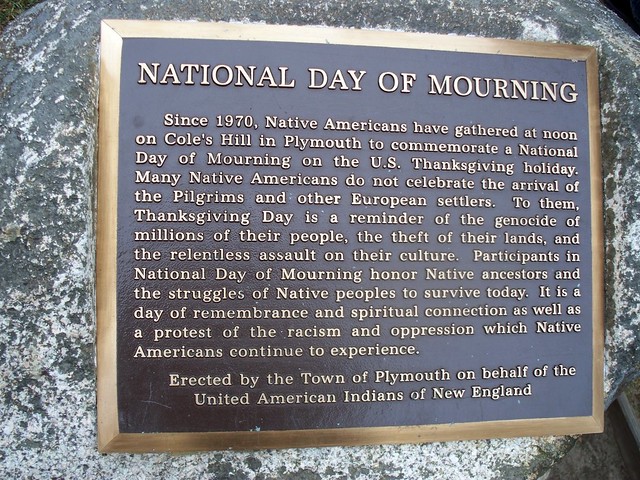
This is the Suppressed speech of Wamsutta (Frank B.) James, Wampanoag. that was to be delivered at Plymouth, Massachusetts, 1970.
The Massachusetts Department of Commerce asked the Wampanoag Indians to select a speaker to mark the 350th anniversary of the Pilgrims' arrival, and the first Thanksgiving.
Three hundred fifty years after the Pilgrims began their invasion of the land of the Wampanoag, their "American" descendants planned an anniversary celebration. Still clinging to the white schoolbook myth of friendly relations between their forefathers and the Wampanoag, the anniversary planners thought it would be nice to have an Indian make an appreciative and complimentary speech at their state dinner. Frank James was asked to speak at the celebration. He accepted. The planners, however , asked to see his speech in advance of the occasion, and it turned out that Frank James' views — based on history rather than mythology — were not what the Pilgrims' descendants wanted to hear. Frank James refused to deliver a speech written by a public relations person. Frank James did not speak at the anniversary celebration. If he had spoken, this is what he would have said:
I speak to you as a man -- a Wampanoag Man. I am a proud man, proud of my ancestry, my accomplishments won by a strict parental direction ("You must succeed - your face is a different color in this small Cape Cod community!"). I am a product of poverty and discrimination from these two social and economic diseases. I, and my brothers and sisters, have painfully overcome, and to some extent we have earned the respect of our community. We are Indians first - but we are termed "good citizens." Sometimes we are arrogant but only because society has pressured us to be so.
It is with mixed emotion that I stand here to share my thoughts. This is a time of celebration for you - celebrating an anniversary of a beginning for the white man in America. A time of looking back, of reflection. It is with a heavy heart that I look back upon what happened to my People.
Even before the Pilgrims landed it was common practice for explorers to capture Indians, take them to Europe and sell them as slaves for 220 shillings apiece. The Pilgrims had hardly explored the shores of Cape Cod for four days before they had robbed the graves of my ancestors and stolen their corn and beans. Mourt's Relation describes a searching party of sixteen men. Mourt goes on to say that this party took as much of the Indians' winter provisions as they were able to carry.
Massasoit, the great Sachem of the Wampanoag, knew these facts, yet he and his People welcomed and befriended the settlers of the Plymouth Plantation. Perhaps he did this because his Tribe had been depleted by an epidemic. Or his knowledge of the harsh oncoming winter was the reason for his peaceful acceptance of these acts. This action by Massasoit was perhaps our biggest mistake. We, the Wampanoag, welcomed you, the white man, with open arms, little knowing that it was the beginning of the end; that before 50 years were to pass, the Wampanoag would no longer be a free people.
What happened in those short 50 years? What has happened in the last 300 years? History gives us facts and there were atrocities; there were broken promises - and most of these centered around land ownership. Among ourselves we understood that there were boundaries, but never before had we had to deal with fences and stone walls. But the white man had a need to prove his worth by the amount of land that he owned. Only ten years later, when the Puritans came, they treated the Wampanoag with even less kindness in converting the souls of the so-called "savages." Although the Puritans were harsh to members of their own society, the Indian was pressed between stone slabs and hanged as quickly as any other "witch."
And so down through the years there is record after record of Indian lands taken and, in token, reservations set up for him upon which to live. The Indian, having been stripped of his power, could only stand by and watch while the white man took his land and used it for his personal gain. This the Indian could not understand; for to him, land was survival, to farm, to hunt, to be enjoyed.
It was not to be abused. We see incident after incident, where the white man sought to tame the "savage" and convert him to the Christian ways of life. The early Pilgrim settlers led the Indian to believe that if he did not behave, they would dig up the ground and unleash the great epidemic again.
The white man used the Indian's nautical skills and abilities. They let him be only a seaman -- but never a captain. Time and time again, in the white man's society, we Indians have been termed "low man on the totem pole."
Has the Wampanoag really disappeared? There is still an aura of mystery. We know there was an epidemic that took many Indian lives - some Wampanoags moved west and joined the Cherokee and Cheyenne. They were forced to move. Some even went north to Canada! Many Wampanoag put aside their Indian heritage and accepted the white man's way for their own survival. There are some Wampanoag who do not wish it known they are Indian for social or economic reasons.
What happened to those Wampanoags who chose to remain and live among the early settlers? What kind of existence did they live as "civilized" people? True, living was not as complex as life today, but they dealt with the confusion and the change. Honesty, trust, concern, pride, and politics wove themselves in and out of their [the Wampanoags'] daily living. Hence, he was termed crafty, cunning, rapacious, and dirty.
History wants us to believe that the Indian was a savage, illiterate, uncivilized animal. A history that was written by an organized, disciplined people, to expose us as an unorganized and undisciplined entity. Two distinctly different cultures met. One thought they must control life; the other believed life was to be enjoyed, because nature decreed it. Let us remember, the Indian is and was just as human as the white man. The Indian feels pain, gets hurt, and becomes defensive, has dreams, bears tragedy and failure, suffers from loneliness, needs to cry as well as laugh. He, too, is often misunderstood.
The white man in the presence of the Indian is still mystified by his uncanny ability to make him feel uncomfortable. This may be the image the white man has created of the Indian; his "savageness" has boomeranged and isn't a mystery; it is fear; fear of the Indian's temperament!
High on a hill, overlooking the famed Plymouth Rock, stands the statue of our great Sachem, Massasoit. Massasoit has stood there many years in silence. We the descendants of this great Sachem have been a silent people. The necessity of making a living in this materialistic society of the white man caused us to be silent. Today, I and many of my people are choosing to face the truth. We ARE Indians!
Although time has drained our culture, and our language is almost extinct, we the Wampanoags still walk the lands of Massachusetts. We may be fragmented, we may be confused. Many years have passed since we have been a people together. Our lands were invaded. We fought as hard to keep our land as you the whites did to take our land away from us. We were conquered, we became the American prisoners of war in many cases, and wards of the United States Government, until only recently.
Our spirit refuses to die. Yesterday we walked the woodland paths and sandy trails. Today we must walk the macadam highways and roads. We are uniting We're standing not in our wigwams but in your concrete tent. We stand tall and proud, and before too many moons pass we'll right the wrongs we have allowed to happen to us.
We forfeited our country. Our lands have fallen into the hands of the aggressor. We have allowed the white man to keep us on our knees. What has happened cannot be changed, but today we must work towards a more humane America, a more Indian America, where men and nature once again are important; where the Indian values of honor, truth, and brotherhood prevail.
You the white man are celebrating an anniversary. We the Wampanoags will help you celebrate in the concept of a beginning. It was the beginning of a new life for the Pilgrims. Now, 350 years later it is a beginning of a new determination for the original American: the American Indian.
There are some factors concerning the Wampanoags and other Indians across this vast nation. We now have 350 years of experience living amongst the white man. We can now speak his language. We can now think as a white man thinks. We can now compete with him for the top jobs. We're being heard; we are now being listened to. The important point is that along with these necessities of everyday living, we still have the spirit, we still have the unique culture, we still have the will and, most important of all, the determination to remain as Indians. We are determined, and our presence here this evening is living testimony that this is only the beginning of the American Indian, particularly the Wampanoag, to regain the position in this country that is rightfully ours.
Wamsutta September 10, 1970
Tuesday, July 30, 2013
The Practice Of Pre-Emption

By Paul Balles
We’re now living and dying in an age of pre-emptive actions.
The practice of pre-emption has an early history in America. According to the Concise Encyclopaedia U.S. policy allowed the first settlers, or squatters, on public land to buy the land they had improved.
Since improved land, coveted by speculators, was often priced too high for squatters to buy at auction, temporary pre-emptive laws allowed them to acquire it without bidding.
The Pre-Emption Act (1841) gave squatters the right to buy 160 acres at $1.25 per acre before the land was auctioned.
The Homestead Act (1862) made pre-emption an accepted part of U.S. land policy. By 1900, 600,000 homesteaders had claimed 80 million acres.
Fast forward to Israel. The connection should be clear:
American homesteaders took land that should have remained in the hands of the indigenous tribes of American Indians.
Is there any stronger excuse for Israeli settlers to misappropriate land that rightfully belongs to the Palestinians?
Who in America can deservedly fault Israeli settlements for committing the same type of seizures of property that Americans stole from the Indians?
Israelis are guilty of the same crime that should haunt Americans in their own settlement history.
The idea and practice of pre-emption have become a social disease including pre-emptive defence, pre-emptive assassinations, pre-emptive security, pre-emptive judgments, pre-emptive laws and pre-emptive wars.
Pre-emptive killing is a daily event in occupied Palestine. The Israeli occupation forces have murdered 1,518 Palestinian children from the outbreak of the second Intifada in September 2000 to April 2013. That’s the equivalent of one Palestinian child killed by Israel every 3 days for almost 13 years.
If settling Indian Territory in America wasn’t enough for western cowboys, it hasn’t satisfied the mock settlers in Israel. Both have adopted pre-emptive actions on multiple fronts.
Just as America has established 700-1000 military bases around the world to pre-empt any strategic advantage from nuclear countries like Russia or China, Israel has established its own pre-emptive defences.
Apart from its unwarranted attacks on Gaza, Lebanon and Syria, Israel has threatened Iran as a pre-emptive measure against Iran’s potential development of nuclear arms.
Israel used its lobbyists and governmental followers in America to support its paranoid fears of an imagined Iraq developing WMDs that might be directed toward Israel.
To fulfil that pre-emptive Israeli wish, America slaughtered 1,455,590 Iraqis, 4883 Americans and 3323 International Occupation troops at a total cost of $1,443,877,869,222, according to Information Clearing House.
Scholars have argued that “the concept of pre-emptive war can be used to start a war by claiming that the nation would soon be under attack and therefore had to defend itself. The concept is controversial because it can be used and abused as a justification to start a war on questionable grounds.”
Justification attempts supported America’s war on Iraq, though America was defending Israel. The same argument is regularly used by Israel to defend its attacks on Gaza, Lebanon and Syria.
In America and Israel, the idea of pre-emption has been used frequently to justify attacks on others.
The same arguments have been used to justify sanctions against Iran. Both American and Israeli governments continue to justify current actions and future potential for engaging in a war against Iran.
Lois Becker points out that even the NRA has been pushing for “pre-emption” laws to block cities from enacting their own gun policies, effectively requiring cities with higher rates of gun violence to have the same gun regulations as smaller towns.
Pre-emption is a disease that is part paranoia and part the war-mongering insensibilities of both Israel and America.
Saturday, June 08, 2013
Israel’s Hand In Guatemala’s Genocide
The Guatemalan Genocide of the 1980s does not just implicate President Ronald Reagan and his senior aides but the Israeli government which secretly supplied helicopters, guns and computers that were used to hunt down and exterminate Ixil Indians and other perceived enemies of the state

At the height of Guatemala’s mass slaughters in the 1980s, including genocide against the Ixil Indians, the Reagan administration worked with Israeli officials to provide helicopters that the Guatemalan army used to hunt down fleeing villagers, according to documentary and eyewitness evidence.
During testimony at the recent genocide trial of former Guatemalan dictator Efrain Rios Montt, one surprise was how often massacre survivors cited the Army’s use of helicopters in the scorched-earth offensives.
Former Israeli Prime Minister Ariel Sharon. (Photo credit: Jim Wallace of the Smithsonian Institution)
Journalist Allan Nairn, who covered the war in Guatemala and attended the Rios Montt trial, said in an interview, “one interesting thing that came out in the trial, as witness after witness testified, was a very substantial number of them talked about fleeing into the mountains and being bombed, attacked and machine gunned from U.S. planes and helicopters.
“At the time this was going on, I was aware this was happening in some cases, but from the testimony of the witnesses, it sounded like these attacks from U.S. planes and helicopters were more frequent than we realized at the time. That’s an example of how we don’t know the whole story yet – how extensive the U.S. complicity was in these crimes.”
Part of the mystery was where did Guatemala’s UH-1H “Huey” helicopters come from, since the U.S. Congress continued to resist military sales to Guatemala because of its wretched human rights record. The answer appears to be that some helicopters were arranged secretly by President Ronald Reagan’s National Security Council staff through Israeli intelligence networks.
Rios Montt began pressing the United States for 10 UH-1H helicopters in June 1983, as his military campaign was ramping up. Since Guatemala lacked the U.S. Foreign Military Sales credits or the cash to buy the helicopters, Reagan’s national security team looked for unconventional ways to arrange the delivery of the equipment.
On Aug. 1, 1983, NSC aides Oliver North and Alfonso Sapia-Bosch reported to National Security Advisor William P. Clark that his deputy Robert “Bud” McFarlane was planning to exploit his Israeli channels to secure the helicopters for Guatemala, according to a document that I discovered at Reagan’s presidential library.
“With regard to the loan of ten helicopters, it is [our] understanding that Bud will take this up with the Israelis,” wrote North and Sapia-Bosch. “There are expectations that they would be forthcoming. Another possibility is to have an exercise with the Guatemalans. We would then use US mechanics and Guatemalan parts to bring their helicopters up to snuff.”
By then, McFarlane had a long and intimate relationship with Israeli intelligence involving various backdoor deals. [For more on McFarlane's Israeli channels, see Consortiumnews.com's "How Neocons Messed Up the Mideast."]
Israeli Channel
McFarlane’s approach to Israel for the helicopters was successful, according to former Israeli intelligence officer Ari Ben-Menashe, who described some of the history behind Israel’s activities in Guatemala in his 1992 memoir,Profits of War.
Ben-Menashe traced the Israeli arms sales to Guatemala back to a private network established in the 1970s by Gen. Ariel Sharon during a gap when he was out of the government. Sharon’s key representative in Guatemala was a businessman named Pesach Ben-Or, and through that channel, Israel supplied military gear to Guatemala’s security services in the 1980s, Ben-Menashe wrote.
In an interview on Thursday, Ben-Menashe said the Israelis supplied a total of six helicopters to the Guatemalans along with computers and software to keep track of alleged subversives who could then be identified and executed. Ben-Menashe said he learned of the mass slaughters during his travels to Guatemala and reported back to his Israeli superiors about the atrocities involving the equipment that they had authorized. The response, he said, was concern but inaction.
“They weren’t for killing these people, not at all,” Ben-Menashe said. “But they thought their interest was to help the Reagan people. If the Reagan people wanted it [the equipment sent to Guatemala], they would do it. [They thought,] ‘this is bad, but is it any of our business? Our American friends are asking for our help, so we should help them.’”
After our phone interview had ended, Ben-Menashe called me back to stress that the Israelis were unaware of the genocidal nature of the Guatemalan military campaigns against the Ixil Indians, although the Israelis did recognize that they were assisting in mass murders of dark-skinned Guatemalans.
“As we saw it, they [Guatemalan military authorities] were targeting all non-white villagers who were sitting on fertile lands that the white Guatemalans wanted,” he said, adding that when he reported this information to his superiors, “the Israelis rolled their eyes [in dismay] but said, ‘this is what our friends in the Reagan administration want.’” [For more on Ben-Menashe's work for Israeli intelligence, see Robert Parry's Secrecy & Privilege and America's Stolen Narrative.]
Besides the helicopters for hunting down villagers who fled into the jungles, the computer equipment and the sophisticated software made the Guatemalan killing machine vastly more efficient in the towns and cities. A former U.S. Green Beret operating in Guatemala once told me that he witnessed Guatemalan security forces stopping buses and inputting identification numbers of the passengers into a computer to select those who would be dragged off to the side of the road and summarily shot.
Death Lists
From first-hand reporting in Guatemala, journalist Nairn also observed the security advantages gained from detailed death lists. Nairn said soldiers under Gen. Otto Perez Molina, the current president, “described how they would go into town armed with death lists provided them by G2 military intelligence, death lists of people who were suspected of being collaborators of the guerrillas or critics of the army.
“They told how they would strangle people with lassos, slit women open with machetes, shoot people in the head in front of the neighbors, use U.S. planes, helicopters and 50 gram bombs to attack people if they fled into the hills.”
Nairn said, “The U.S. had also arranged for Israel to step in and become the principal supplier of hardware to the Guatemalan army, in particular assault rifles, the Galil automatic rifle. This was because the administration was running into problems with Congress, which wouldn’t go along with a lot of their plans to aid the Guatemalan military, so they did an end run by using the government of Israel.”
Though the focus of the case against Rios Montt has been the genocide inflicted on Ixil villages in the northern highlands – where some 626 villages were eradicated by the Guatemalan military – those massacres were only part of the estimated 200,000 killings perpetrated by right-wing Guatemalan regimes since a CIA-sponsored coup ousted an elected government in 1954.
The bloodbath was at its worst in the 1980s during Ronald Reagan’s presidency as he encouraged the anti-leftist slaughters that claimed the lives of some 100,000 Guatemalans. Reagan expanded his support for the Guatemalan security forces even though the CIA was keeping his administration informed of the systematic killings underway.
Another document that I discovered in the archives of the Reagan Library in Simi Valley, California, revealed that Reagan and his national security team in 1981 agreed to supply military aid to Guatemala’s dictators so they could pursue the goal of exterminating not only “Marxist guerrillas” but people associated with their “civilian support mechanisms.” [See Consortiumnews.com’s “Ronald Reagan: Accessory to Genocide.”]
As for Rios Montt, who ruled Guatemala for 17 especially bloody months in 1982-83, the 86-year-old ex-general was convicted of genocide and crimes against humanity by a criminal court on May 10 and was sentenced to 80 years in prison.
But that conviction was overturned on Monday on a 3-2 vote by Guatemala’s Constitutional Court which is still dominated by allies of the military and the oligarchy. As for the Reagan administration officials and the Israelis who aided and abetted Rios Montt and his fellow generals, there is no indication that any accountability will be exacted.
Saturday, May 18, 2013
Canada Could See Indigenous Uprising
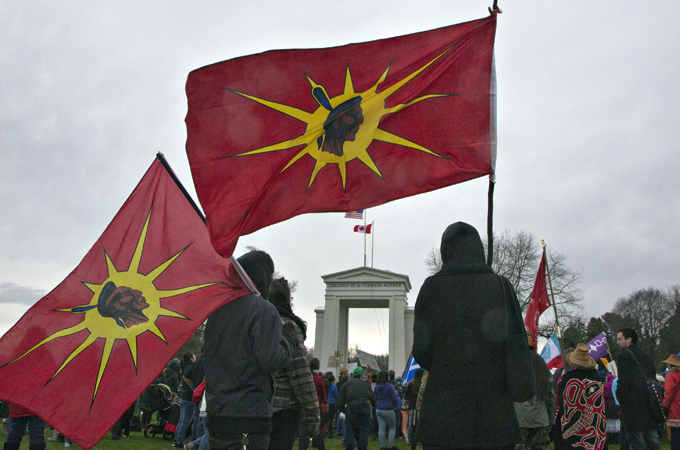
"For many Aboriginal people in Canada, but especially for First Nations women and children, life on-reserve is dreary, dark and dangerous," wrote Douglas Bland in the report, Canada and the first Nations: Cooperation or Conflict? "Social fractionalisation significantly increases the risk of social conflict. The phenomenon provides motives for an insurgency," read the report, issued in May.
"The Canadian right-wing establishment is seizing on this to justify its own agenda of stricter controls and the continued criminalisation of native people who defend their rights," Taiaiake Alfred, chair of the centre for indigenous governance at the University of Victoria, and one of Canada's most influential aboriginal intellectuals, told Al Jazeera. "The positive elements of Canadian society - progressive values and social justice - are founded on the ongoing injustice of land theft and murder of indigenous people."
In November, Paul Martin, Canada's former prime minister and a business tycoon, echoed Alfred's comments, albeit in a softer tone. "We have never admitted to ourselves that we were, and still are, a colonial power," he said.
One of the world's most developed countries, Canada is home to about 1.2 million indigenous people out of a population of 34.5 million. The indigenous population is rising faster than other demographic groups, despite drastically higher rates of poverty, incarceration and substance abuse.
If indigenous Canadians were ranked as a country according to the United Nations Human Development Index, which measures living standards and life expectancy, they would have social outcomes comparable to residents of Kazakhstan and Albania.
Across Canada's prairies, the heartland of the country's agricultural industry and a centre for mining, about 42 percent of the indigenous population will be under the age of 30 by 2016, more than twice the youth rate in the non-indigenous community.
"The fact that Canada's natural wealth flows unfairly from Aboriginal lands and peoples to non-Aboriginal Canadians is a long-standing and justifiable grievance," the report said.
A large number of poorly educated, unemployed young men - a "warrior cohort", as Bland put it - provide fertile recruits for militant groups, the report says.
Using a formula first developed by researchers at Oxford University, Bland argued that the "feasibility" of unrest, rather than just root causes, could determine outcomes.
Most of Canada's resource industries, including mines, dams and oil facilities, are located on land claimed by indigenous people - and attacking such facilities is easily feasible, the report said.
Comprising about four percent of the population, indigenous people make up 23 percent of Canada's prisoners, a 43 percent increase during the five years prior to 2013, according to a government report released in March.
Thursday, April 12, 2012
The Doctrine Of Intervention
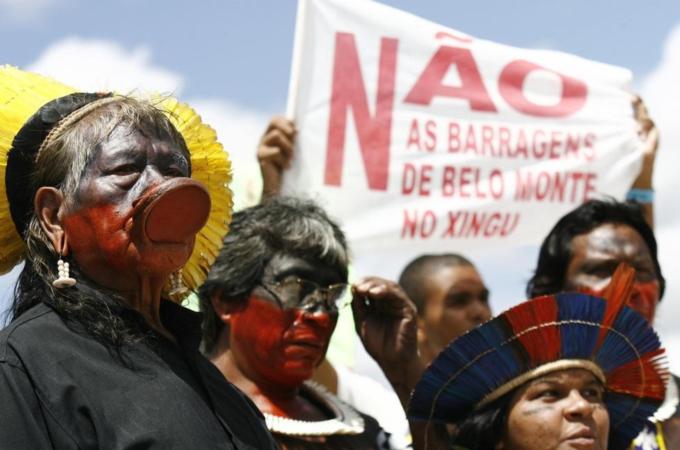
Indigenous populations in Brazil were completely bypassed by the construction of the Belo Monte dam [REUTERS]
Today's Political Ethics Are Surprisingly Similar To The Doctrine Of Discovery Set By The Vatican Back In 1452.
By Manuela Picq
Last Modified: 04 Apr 2012 12:45
Courtesy Of "Al-Jazeera"
New York, NY - One does not think of archaic papal bulls when witnessing democratic states like Brazil or the United States building dams on Amazon rivers or drilling for oil in the Arctic Ocean. Yet today's political ethics are surprisingly similar to the doctrine of discovery set by the Vatican back in 1452.
Fifteenth-century papal bulls that declared war against all non-Christian peoples also encouraged the conquest and exploitation of enemy territories throughout the world. European explorers like Columbus took possession of newly "discovered" non-Christian lands with the express authorisation of the Catholic Church.
This internationally recognised doctrine allowed claims to be made on "empty" invaded lands outlasted European absolute monarchies and has become enshrined in secular nation-states. In the US, for instance, Chief Justice John Marshall used the right of discovery in 1823 to invalidate native claims over their land and to assert the authority of the US government over land titles.
The World Council of Churches (WCC) recently disowned the doctrine of discovery, perhaps in light of its centrality at the 11th session of the UN Permanent Forum on Indigenous Issues this coming May in New York. Better late than never.
Inside Story Americas - The real cost of Brazil's dam
|
Yet from the Amazon to Iraq, policies still attempt to save the barbarians from themselves, export the truth of democracy or teach natives how to best preserve their own habitat. The problem is that the doctrine justifying the conquest and exploitation of certain states survived colonial times to evolve into a broader - and more resilient - self-arrogated right of intervention.
Rejecting The Doctrine Of Discovery
In February, the WCC issued a statement denouncing the doctrine used to colonise the Americas and enslave native populations as a violation of human rights.
Affirming the rights of indigenous peoples to live in and retain their traditional lands as well as enrich their ancestral cultures, the WCC now urges governments to dismantle the legal structures and policies based on the doctrine of discovery and dominance so as to enable indigenous peoples to identify their own aspirations and pursue their own concerns.
The WCC specifically identifies the role of the Catholic Church in establishing a doctrine that justified the conquest and acquisition of indigenous territories, repelling documents such as Dum Diversas (1452) that called for the enslavement of non-Christian peoples, the seizure of their possessions and the occupation of their lands.
At last, churches have formally spurned any moral or legal right to seize indigenous land or dominate indigenous peoples. Identifying its historical significance, they framed the doctrine of discovery as the legal precedent that permitted continuous appropriation and resulted in the current extent of indigenous exploitation.
The WCC statement is relevant because it explicitly recognises that the concepts that emerged five centuries ago forged a paradigm of domination that is still deployed against indigenous peoples today.
Whose Right To Intervene?
The doctrine of discovery remains a contemporary political challenge because it paved the way for the principle of intervention. Peoples and territories that were not Christian were treated as empty, un-modern spaces, up for grabs and improvement.
Since the Americas were conceptualised as terra nullis to justify colonisation, conquest became embedded in a discourse of civilising universalism, in which those claiming to hold the truth self-righteously bestow upon themselves the right to intervene against the barbarians.
Immanuel Wallerstein traces this rhetoric of power all the way back to the 16th century Valladolid Debate between Bartolome de Las Casas and Juan Gines de Sepulveda on the status of natives. Sepulveda derived the right of European monarchies to dominion from the inherent barbarity of the Amerindians. He defended intervention to protect natives from themselves, from their own harmful practices.
De Las Casas, in contrast, maintained that evil occurred everywhere and was not unique to Amerindians, denying justification for their subjugation, which could cause far more harm than good. The debate, which was left unresolved, continues in modified form today, for instance in controversies about Iraq, where the violence of war was trivialised by supporters of a military intervention destined to bring democracy.
The doctrine of intervention has a long, enduring history, one in which universalism is prone to colonialising tactics and modernisation all too frequently overlaps with westernisation. The "barbarians" may be Amerindians in 1551 or Muslims in 2001.
From Valladolid to Iraq, the same discourse seeks to justify appropriation in the name of universal truths. The doctrine of discovery faded only to give way to a doctrine of intervention, determining who intervenes, for what cause and with what legitimacy. The justificatory rationale changes - from Christianity to development and human rights - leaving the right to intervene unaltered.
Australians push for Aborigine recognition
|
The discourse that rationalised the colonisation of the Americas in the sake of Christianity is the same that justifies protecting human rights in Iraq or privatising water supplies for the sake of development.
Indigenous Tutelage
Intervention remains particularly strong when it comes to indigenous peoples and territories. Large-scale mining continues to engender human abuse and resource appropriation by multinational corporations across the Andes and Central America, perpetuating the pillage Spanish colonisers started centuries ago in Potosi. In the Amazon, governments and corporations alike take possession of "empty" lands to drill for oil in the name of development and national interest.
Latin American governments rhetorically insist on a foreign policy of non-intervention, yet are quick to intervene on indigenous territories to modernise the state. From the TIPNIS highway in Bolivia to the Belo Monte dam in Brazil, governments continue to bypass indigenous consultation and autonomies for the sake of national development.
The priorities of indigenous peoples are silenced in Chile, while their agency is dismissed in Ecuador, where massive indigenous mobilisations are dismissed as being manipulated by international interests. In Brazil, the government's self-congratulatory tone for bringing a woman to direct the National Foundation of the Indian (FUNAI) seems to ignore its failure to appoint an indigenous person.
The idea that natives are un-modern, almost part of nature, and therefore unable to manage their own land continues to lead to "well-intentioned" intervention as well. When indigenous territories in the Arctic or the Amazon are not conceptualised as empty spaces to be exploited for national development, it is the turn of conservationists to intervene in the name of nature.
When parks such as Yellowstone were founded, conservationists like John Muir promoted the idea that the land had not been previously trodden upon, pushing out people who actively lived and fed on those lands to "protect" nature. Today, it is the turn of powerful conservationists groups in the global north to intervene by buying big chunks of land and pushing populations out.
The UN system itself may perpetuate forms of tutelage. On February 21, the Indigenous Forum at the World Intellectual Property Organisation unanimously decided to withdraw from discussions on the draft treaty relating to genetic resources in response to consistent efforts to undermine indigenous inclusion within the process.
How equitable can a treaty be that ostensibly holds indigenous interests as central but actually operates without significant indigenous decision-making? This unprecedented move calls into question the entire UN practice of incorporating indigenous voices in its deliberating process.
Dominant cultures continue to intervene in the autonomy of indigenous peoples. This continuum is proof that the doctrine of intervention did not die with formal processes of decolonisation, adapting to new zeitgeists like a chameleon.
The practice of conquest, more diverse than often assumed, needs to be reconceived as a global political challenge that concerns us all rather than as a mere cultural concern discussed in indigenous forums. It is the international system that is at stake. Universalism cannot be exported, much less imposed. It is a collective practice.
Manuela Picq has just completed a position as a visiting professor and research fellow at Amherst College. She is currently writing a book on indigenous peoples' rights in the Amazon.
Friday, July 08, 2011
The Invasion Of Australia
Official, At Last
By John Pilger
July 02, 2011
Courtesy Of "Information Clearing House"
The City of Sydney has voted to replace the words “European arrival” in the official record with “invasion”. The deputy lord mayor, Marcelle Hoff, says it is intellectually dishonest to use any other word in describing how Aboriginal Australia was dispossessed by the British. “We were invaded,” said Paul Morris, an Aboriginal adviser to the council. “It is the truth and it shouldn’t be watered down. We wouldn’t expect Jewish people to accept a watered-down version of the Holocaust, so why should we?”
In 2008, the then prime minister Kevin Rudd formally apologised to Aborigines wrenched from their families as children under a policy inspired by the crypto-fascist theories of eugenics. White Australia was said to be coming to terms with its rapacious past, and present. Was it? The Rudd government, noted a Sydney Morning Herald editorial, “has moved quickly to clear away this piece of political wreckage in a way that responds to some of its supporters’ emotional needs, yet it changes nothing. It is a shrewd manoeuvre.”
The City of Sydney ruling is a very different gesture, and admirable; for it reflects not a liberal and limited “sorry campaign”, seeking feel-good “reconciliation” rather than justice, but counters a cowardly movement of historical revision in which a collection of far-right politicians, journalists and minor academics claimed there was no invasion, no genocide, no Stolen Generation, no racism.
The platform for these holocaust deniers is the Murdoch press, which has long run its own insidious campaign against the indigenous population, presenting them as victims of each other or as noble savages requiring firm direction: the eugenicists’ view. Favoured black “leaders” who tell the white elite what it wants to hear while blaming their own people for their poverty, provide a PC cover for a racism that often shocks foreign visitors. Today, the first Australians have one of the shortest life expectancies in the world and are incarcerated at five times the rate of blacks in apartheid South Africa. Go to the outback and see the children blinded by trachoma, a biblical disease, entirely preventable, eradicated in third world countries but not in rich Australia. The Aboriginal people are both Australia’s secret and this otherwise derivative society’s most amazing distinction: the world’s oldest society.
In its landmark rejection of historical propaganda, Sydney, the country oldest and largest city, recognises black Australia’s “cultural endurance” and, without saying so directly, a growing resistance to an outrage known as “the intervention”. In 2007, John Howard sent the army into Aboriginal Australia to “protect the children” who, said his minister for indigenous affairs, were being abused in “unthinkable numbers”. It is striking how Australia’s incestuous political and media elite so often rounds on the tiny black minority with all the fervour of the guilty, unaware perhaps that the national mythology and psyche remain culpably damaged while a nationhood, once stolen, is not returned to the original inhabitants.
Journalists accepted the Howard government’s reason for “intervening” and went hunting for the lurid. One national TV programme used an “anonymous youth worker” to allege “sex slavery” rings among the Mutitjulu people. He was later exposed as a federal government official and his “evidence” discredited. Of 7433 Aboriginal children examined by doctors, just four were identified as possible cases of abuse. There were no “unthinkable numbers”. The rate was around that of white child abuse. The difference was that no soldiers invaded the beachside suburbs, no white parents were swept aside, their wages diminished and welfare “quarantined”. It was all a mighty charade, but with serious purpose.
The Labor governments that followed Howard have reinforced the new controlling powers over black homelands: the strict Julia Gillard especially: a prime minister who lectures her compatriots on the virtues of colonial wars that “make us who we are today” and imprisons refugees from those wars indefinitely, including children, on an offshore island not deemed to be Australia, which it is.
In the Northern Territory, the Gillard government are effectively driving Aboriginal communities into apartheid areas where they will be “economically viable”. The undeclared reason is that the Northern Territory is the only part of Australia where Aborigines have comprehensive land rights, and that here lies some of the world’s biggest deposits of uranium, and other minerals. The most powerful political force in Australia is the multi-billion dollar mining industry. Canberra wants to mine and sell and those bloody blackfellas are in the way again. But this time they are organised, articulate, militant, a resistance of conscience and culture. They know it is a second invasion. Having finally uttered the forbidden word, white Australians should stand with them.
John Pilger’s film, The War You Don’t See, is available on www.johnpilger.com
Friday, October 22, 2010
True Legacy: Cruelty and Slavery
Columbus Day?
By Eric Kasum
Founder of PeaceDog
Posted: October 11, 2010 01:43 AM
Courtesy Of "The Huffington Post"
By Eric Kasum
Founder of PeaceDog
Posted: October 11, 2010 01:43 AM
Courtesy Of "The Huffington Post"
Once again, it's time to celebrate Columbus Day. Yet, the stunning truth is: If Christopher Columbus were alive today, he would be put on trial for crimes against humanity. Columbus' reign of terror, as documented by noted historians, was so bloody, hislegacy so unspeakably cruel, that Columbus makes a modern villain like Saddam Hussein look like a pale codfish.
Question: Why do we honor a man who, if he were alive today, would almost certainly be sitting on Death Row awaiting execution?
If you'd like to know the true story about Christopher Columbus, please read on. But I warn you, it's not for the faint of heart.
Here's the basics. On the second Monday in October each year, we celebrate Columbus Day (this year, it's on October 11th). We teach our school kids a cute little song that goes: "In 1492, Columbus sailed the ocean blue." It's an American tradition, as American as pizza pie. Or is it? Surprisingly, the true story of Christopher Columbus has very little in common with the myth we all learned in school.
Columbus Day, as we know it in the United States, was invented by the Knights of Columbus, a Catholic fraternal service organization. Back in the 1930s, they were looking for a Catholic hero as a role-model their kids could look up to. In 1934, as a result of lobbying by the Knights of Columbus, Congress and President Franklin Roosevelt signed Columbus Day into law as a federal holiday to honor this courageous explorer. Or so we thought.
There are several problems with this. First of all, Columbus wasn't the first European to discover America. As we all know, the Viking, Leif Ericson probably founded a Norse village on Newfoundland some 500 years earlier. So, hat's off to Leif. But if you think about it, the whole concept of discovering America is, well, arrogant. After all, the Native Americans discovered North America about 14,000 years before Columbus was even born! Surprisingly, DNA evidence now suggests that courageous Polynesian adventurers sailed dugout canoes across the Pacific and settled in South America long before the Vikings.
Second, Columbus wasn't a hero. When he set foot on that sandy beach in the Bahamas on October 12, 1492, Columbus discovered that the islands were inhabited by friendly, peaceful people called the Lucayans, Taínos and Arawaks. Writing in his diary, Columbus said they were a handsome, smart and kind people. He noted that the gentle Arawaks were remarkable for their hospitality. "They offered to share with anyone and when you ask for something, they never say no," he said. The Arawaks had no weapons; their society had neither criminals, prisons nor prisoners. They were so kind-hearted that Columbus noted in his diary that on the day the Santa Maria was shipwrecked, the Arawaks labored for hours to save his crew and cargo. The native people were so honest that not one thing was missing.
Columbus was so impressed with the hard work of these gentle islanders, that he immediately seized their land for Spain and enslaved them to work in his brutal gold mines. Within only two years, 125,000 (half of the population) of the original natives on the island were dead.
If I were a Native American, I would mark October 12, 1492, as a black day on my calendar.
Shockingly, Columbus supervised the selling of native girls into sexual slavery. Young girls of the ages 9 to 10 were the most desired by his men. In 1500, Columbus casually wrote about it in his log. He said: "A hundred castellanoes are as easily obtained for a woman as for a farm, and it is very general and there are plenty of dealers who go about looking for girls; those from nine to ten are now in demand."
He forced these peaceful natives work in his gold mines until they died of exhaustion. If an "Indian" worker did not deliver his full quota of gold dust by Columbus' deadline, soldiers would cut off the man's hands and tie them around his neck to send a message. Slavery was so intolerable for these sweet, gentle island people that at one point, 100 of them committed mass suicide. Catholic law forbade the enslavement of Christians, but Columbus solved this problem. He simply refused to baptize the native people of Hispaniola.
On his second trip to the New World, Columbus brought cannons and attack dogs. If a native resisted slavery, he would cut off a nose or an ear. If slaves tried to escape, Columbus had them burned alive. Other times, he sent attack dogs to hunt them down, and the dogs would tear off the arms and legs of the screaming natives while they were still alive. If the Spaniards ran short of meat to feed the dogs, Arawak babies were killed for dog food.
Columbus' acts of cruelty were so unspeakable and so legendary - even in his own day - that Governor Francisco De Bobadilla arrested Columbus and his two brothers, slapped them into chains, and shipped them off to Spain to answer for their crimes against the Arawaks. But the King and Queen of Spain, their treasury filling up with gold, pardoned Columbus and let him go free.
One of Columbus' men, Bartolome De Las Casas, was so mortified by Columbus' brutal atrocities against the native peoples, that he quit working for Columbus and became a Catholic priest. He described how the Spaniards under Columbus' command cut off the legs of children who ran from them, to test the sharpness of their blades. According to De Las Casas, the men made bets as to who, with one sweep of his sword, could cut a person in half. He says that Columbus' men poured people full of boiling soap. In a single day, De Las Casas was an eye witness as the Spanish soldiers dismembered, beheaded, or raped 3000 native people. "Such inhumanities and barbarisms were committed in my sight as no age can parallel," De Las Casas wrote. "My eyes have seen these acts so foreign to human nature that now I tremble as I write."
De Las Casas spent the rest of his life trying to protect the helpless native people. But after a while, there were no more natives to protect. Experts generally agree that before 1492, the population on the island of Hispaniola probably numbered above 3 million. Within 20 years of Spanish arrival, it was reduced to only 60,000. Within 50 years, not a single original native inhabitant could be found.
In 1516, Spanish historian Peter Martyr wrote: "... a ship without compass, chart, or guide, but only following the trail of dead Indians who had been thrown from the ships could find its way from the Bahamas to Hispaniola."
Christopher Columbus derived most of his income from slavery, De Las Casas noted. In fact, Columbus was the first slave trader in the Americas. As the native slaves died off, they were replaced with black slaves. Columbus' son became the first African slave trader in 1505.
Are you surprised you never learned about any of this in school? I am too. Why do we have this extraordinary gap in our American ethos? Columbus himself kept detailed diaries, as did some of his men including De Las Casas and Michele de Cuneo. (If you don't believe me, just Google the words Columbus, sex slave, and gold mine.)
Columbus' reign of terror is one of the darkest chapters in our history. The REAL question is: Why do we celebrate a holiday in honor of this man? (Take three deep breaths. If you're like me, your stomach is heaving at this point. I'm sorry. Sometimes the truth hurts. That said, I'd like to turn in a more positive direction.)
Call me crazy, but I think holidays ought to honor people who are worthy of our admiration, true heroes who are positive role models for our children. If we're looking for heroes we can truly admire, I'd like to offer a few candidates. Foremost among them are school kids.
Let me tell you about some school kids who are changing the world. I think they are worthy of a holiday. My friend Nan Peterson is the director of the Blake School, a K-12 school in Minnesota. She recently visited Kenya. Nan says there are 33 million people in Kenya... and 11 million of them are orphans! Can you imagine that? She went to Kibera, the slum outside Nairobi, and a boy walked up to her and handed her a baby. He said: My father died. My mother died... and I'm not feeling so good myself. Here, take my sister. If I die, they will throw her into the street to die.
There are so many orphans in Kenya, the baby girls are throwaways!
Nan visited an orphanage for girls. The girls were starving to death. They had one old cow that only gave one cup of milk a day. So each girl only got ONE TEASPOON of milk a day!
After this heartbreaking experience, Nan went home to her school in Minnesota and asked the kids... what can we do? The kids got the idea to make homemade paper and sell it to buy a cow. So they made a bunch of paper, and sold the paper, and when they were done they had enough money to buy... FOUR COWS! And enough food to feed all of the cows for ONE FULL YEAR! These are kids... from 6 years old to 18... saving the lives of kids halfway around the world. And I thought: If a 6-year-old could do that... what could I do?
At Casady School in Oklahoma City, Oklahoma, seemingly "average" school kids raised $20,000 to dig clean water wells for children in Ethiopia. These kids are heroes. Why don't we celebrate "Kids Who Are Changing the Planet" Day?
Let me ask you a question: Would we celebrate Columbus Day if the story of Christopher Columbus were told from the point-of-view of his victims? No way!
The truth about Columbus is going to be a hard pill for some folks to swallow. Please, don't think I'm picking on Catholics. All the Catholics I know are wonderful people. I don't want to take away their holiday or their hero. But if we're looking for a Catholic our kids can admire, the Catholic church has many, many amazing people we could name a holiday after. How about Mother Teresa day? Or St. Francis of Assisi day? Or Betty Williams day (another Catholic Nobel Peace Prize winner). These men and women are truly heroes of peace, not just for Catholics, but for all of us.
Let's come clean. Let's tell the truth about Christopher Columbus. Let's boycott this outrageous holiday because it honors a mass murderer. If we skip the cute song about "In 1492 Columbus sailed the ocean blue," I don't think our first graders will miss it much, do you? True, Columbus' brutal treatment of peaceful Native Americans was so horrific... maybe we should hide the truth about Columbus until our kids reach at least High School age. Let's teach it to them about the same time we tell them about the Nazi death camps.
While we're at it, let's rewrite our history books. From now on, instead of glorifying the exploits of mass murderers like Alexander the Great, Julius Caesar, Genghis Khan, and Napoleon Bonaparte, let's teach our kids about true heroes, men and women of courage and kindness who devoted their lives to the good of others. There's a long list, starting with Florence Nightingale, Mahatma Gandhi, Rev. Martin Luther King, and John F. Kennedy.
These people were not adventurers who "discovered" an island in the Caribbean. They were noble souls who discovered what is best in the human spirit.
Why don't we create a holiday to replace Columbus Day?
Let's call it Heroes of Peace Day.
Subscribe to:
Posts (Atom)
