Showing posts with label War On Islam. Show all posts

Wednesday, February 11, 2015

The Cost Of US Wars Since 9/11: $1.6 Trillion


Marine Infantry Officer Course students stand by before a helicopter drill in Arizona. US Marine Corps photo by Cpl. James Marchetti

The cost of US war-making in the 13 years since the September 11 terrorist attacks reached a whopping $1.6 trillion in 2014, according to a recent report by the Congressional Research Service (CRS).
The $1.6 trillion in war spending over that time span includes the cost of military operations, the training of security forces in Afghanistan and Iraq, weapons maintenance, base support, reconstruction, embassy maintenance, foreign aid, and veterans' medical care, as well as war-related intelligence operations not tracked by the Pentagon. The report tracks expenses through September, the end of the government's 2014 fiscal year. 
The key factor determining the cost of war during a given period over the last 13 years has been the number of US troops deployed, according to the report. The number of troops in Afghanistan peaked in 2011, when 100,000 Americans were stationed there. The number of US armed forces in Iraq reached a high of about 170,000 in 2007.
Although Congress enacted across-the-board spending cuts in March 2013, the Pentagon's war-making money was left untouched. The minimal cuts, known as sequestration, came from the Defense Department's regular peacetime budget. The Pentagon gets a separate budget for fighting wars.
In the spending bill that Congress approved earlier this month, lawmakers doled out $73.7 billion for war-related activities in 2015—$2.3 billion more than President Barack Obama had requested. As Mother Jones' Dave Gilson reported last year, US military spending is on pace to taper far less dramatically in the wake of the Iraq and Afghanistan wars than it did after the end of the Vietnam War or the Cold War.
Other reports have estimated the cost of US wars since 9/11 to be far higher than $1.6 trillion. A report by Neta Crawford, a political science professor at Boston University, estimated the total cost of the wars in Iraq and Afghanistan—as well as post-2001 assistance to Pakistan—to be roughly $4.4 trillion. The CRS estimate is lower because it does not include additional costs including the lifetime price of health care for disabled veterans and interest on the national debt.
Chart by AJ Vicens.
Source: MotherJones

Tuesday, February 10, 2015

US: Terrorism Prosecutions Often An Illusion

The US Justice Department and the Federal Bureau of Investigation (FBI) have targeted American Muslims in abusive counterterrorism “sting operations” based on religious and ethnic identity, Human Rights Watch and Columbia Law School’s Human Rights Institute said in a report released today. Many of the more than 500 terrorism-related cases prosecuted in US federal courts since September 11, 2001, have alienated the very communities that can help prevent terrorist crimes.

The 214-page report, “Illusion of Justice: Human Rights Abuses in US Terrorism Prosecutions,”examines 27 federal terrorism cases from initiation of the investigations to sentencing and post-conviction conditions of confinement. It documents the significant human cost of certain counterterrorism practices, such as overly aggressive sting operations and unnecessarily restrictive conditions of confinement.
“Americans have been told that their government is keeping them safe by preventing and prosecuting terrorism inside the US,” said Andrea Prasow, deputy Washington director at Human Rights Watch and one of the authors of the report. “But take a closer look and you realize that many of these people would never have committed a crime if not for law enforcement encouraging, pressuring, and sometimes paying them to commit terrorist acts.”


Many prosecutions have properly targeted individuals engaged in planning or financing terror attacks, the groups found. But many others have targeted people who do not appear to have been involved in terrorist plotting or financing at the time the government began to investigate them. And many of the cases involve due process violations and abusive conditions of confinement that have resulted in excessively long prison sentences.

The report is based on more than 215 interviews with people charged with or convicted of terrorism-related crimes, members of their families and their communities, criminal defense attorneys, judges, current and former federal prosecutors, government officials, academics, and other experts.

In some cases the FBI may have created terrorists out of law-abiding individuals by suggesting the idea of taking terrorist action or encouraging the target to act. Multiple studies have found that nearly 50 percent of the federal counterterrorism convictions since September 11, 2001, resulted from informant-based cases. Almost 30 percent were sting operations in which the informant played an active role in the underlying plot.

In the case of the “Newburgh Four,” for example, who were accused of planning to blow up synagogues and attack a US military base, a judge said the government “came up with the crime, provided the means, and removed all relevant obstacles,” and had, in the process, made a terrorist out of a man “whose buffoonery is positively Shakespearean in scope.”

The FBI often targeted particularly vulnerable people, including those with intellectual and mental disabilities and the indigent. The government, often acting through informants, then actively developed the plot, persuading and sometimes pressuring the targets to participate, and provided the resources to carry it out.

“The US government should stop treating American Muslims as terrorists-in-waiting,” Prasow said. “The bar on entrapment in US law is so high that it’s almost impossible for a terrorism suspect to prove. Add that to law enforcement preying on the particularly vulnerable, such as those with mental or intellectual disabilities, and the very poor, and you have a recipe for rampant human rights abuses.”

Rezwan Ferdaus, for example, pled guilty to attempting to blow up a federal building and was sentenced to 17 years in prison. Although an FBI agent even told Ferdaus’ father that his son “obviously” had mental health problems, the FBI targeted him for a sting operation, sending an informant into Ferdaus’ mosque. Together, the FBI informant and Ferdaus devised a plan to attack the Pentagon and US Capitol, with the FBI providing fake weaponry and funding Ferdaus’ travel. Yet Ferdaus was mentally and physically deteriorating as the fake plot unfolded, suffering depression and seizures so bad his father quit his job to care for him.

The US has also made overly broad use of material support charges, punishing behavior that did not demonstrate an intent to support terrorism. The courts have accepted prosecutorial tactics that may violate fair trial rights, such as introducing evidence obtained by coercion, classified evidence that cannot be fairly contested, and inflammatory evidence about terrorism in which defendants played no part – and asserting government secrecy claims to limit challenges to surveillance warrants.

Ahmed Omar Abu Ali is a US citizen who alleged that he was whipped and threatened with amputation while detained without charge in Saudi Arabia – after a roundup following the 2003 bombings of Western compounds in the Saudi capital of Riyadh – until he provided a confession to Saudi interrogators that he says was false. Later, when Ali went to trial in Virginia, the judge rejected Ali’s claims of torture and admitted his confession into evidence. He was convicted of conspiracy, providing material support to terrorists, and conspiracy to assassinate the president. He received a life sentence, which he is serving in solitary confinement at the federal supermax prison in Florence, Colorado.

The US has in terrorism cases used harsh and at times abusive conditions of confinement, which often appear excessive in relation to the security risk posed. This includes prolonged solitary confinement and severe restrictions on communicating in pretrial detention, possibly impeding defendants’ ability to assist in their own defense and contributing to their decisions to plead guilty. Judges have imposed excessively lengthy sentences, and some prisoners suffer draconian conditions post-conviction, including prolonged solitary confinement and severe restrictions on contact with families or others, sometimes without explanation or recourse.

Nine months after his arrest on charges of material support for terrorism and while he was refusing a plea deal, Uzair Paracha was moved to a harsh regime of solitary confinement. Special Administrative Measures (SAMs) – national security restrictions on his contact with others – permitted Paracha to speak only to prison guards.

“You could spend days to weeks without uttering anything significant beyond ‘Please cut my lights,’ ‘Can I get a legal call/toilet paper/a razor,’ etc., or just thanking them for shutting our light,” he wrote to the report’s researchers. After he was convicted, the SAMs were modified to permit him to communicate with other inmates. “I faced the harshest part of the SAMs while I was innocent in the eyes of American law,” he wrote.

These abuses have had an adverse impact on American Muslim communities. The government’s tactics to seek out terrorism suspects, at times before the target has demonstrated any intention to use violence, has undercut parallel efforts to build relationships with American Muslim community leaders and groups that may be critical sources of information to prevent terrorist attacks.

In some communities, these practices have deterred interaction with law enforcement. Some Muslim community members said that fears of government surveillance and informant infiltration have meant they must watch what they say, to whom, and how often they attend services.

“Far from protecting Americans, including American Muslims, from the threat of terrorism, the policies documented in this report have diverted law enforcement from pursuing real threats,” Prasow said. “It is possible to protect people’s rights and also prosecute terrorists, which increases the chances of catching genuine criminals.”

Source: Human Rights Watch


Terrorist Plots Hatched By The F.B.I.

THE United States has been narrowly saved from lethal terrorist plots in recent years — or so it has seemed. A would-be suicide bomber was intercepted on his way to the Capitol; a scheme to bomb synagogues and shoot Stinger missiles at military aircraft was developed by men in Newburgh, N.Y.; and a fanciful idea to fly explosive-laden model planes into the Pentagon and the Capitol was hatched in Massachusetts.

But all these dramas were facilitated by the F.B.I., whose undercover agents and informers posed as terrorists offering a dummy missile, fake C-4 explosives, a disarmed suicide vest and rudimentary training. Suspects naïvely played their parts until they were arrested.
When an Oregon college student, Mohamed Osman Mohamud, thought of using a car bomb to attack a festive Christmas-tree lighting ceremony in Portland, the F.B.I. provided a van loaded with six 55-gallon drums of “inert material,” harmless blasting caps, a detonator cord and a gallon of diesel fuel to make the van smell flammable. An undercover F.B.I. agent even did the driving, with Mr. Mohamud in the passenger seat. To trigger the bomb the student punched a number into a cellphone and got no boom, only a bust.
This is legal, but is it legitimate? Without the F.B.I., would the culprits commit violence on their own? Is cultivating potential terrorists the best use of the manpower designed to find the real ones? Judging by their official answers, the F.B.I. and the Justice Department are sure of themselves — too sure, perhaps.
Carefully orchestrated sting operations usually hold up in court. Defendants invariably claim entrapment and almost always lose, because the law requires that they show no predisposition to commit the crime, even when induced by government agents. To underscore their predisposition, many suspects are “warned about the seriousness of their plots and given opportunities to back out,” said Dean Boyd, a Justice Department spokesman. But not always, recorded conversations show. Sometimes they are coaxed to continue.
Undercover operations, long practiced by the F.B.I., have become a mainstay of counterterrorism, and they have changed in response to the post-9/11 focus on prevention. “Prior to 9/11 it would be very unusual for the F.B.I. to present a crime opportunity that wasn’t in the scope of the activities that a person was already involved in,” said Mike German of the American Civil Liberties Union, a lawyer and former F.B.I. agent who infiltrated white supremacist groups. An alleged drug dealer would be set up to sell drugs to an undercover agent, an arms trafficker to sell weapons. That still happens routinely, but less so in counterterrorism, and for good reason.
“There isn’t a business of terrorism in the United States, thank God,” a former federal prosecutor, David Raskin, explained.
“You’re not going to be able to go to a street corner and find somebody who’s already blown something up,” he said. Therefore, the usual goal is not “to find somebody who’s already engaged in terrorism but find somebody who would jump at the opportunity if a real terrorist showed up in town.”
And that’s the gray area. Who is susceptible? Anyone who plays along with the agents, apparently. Once the snare is set, law enforcement sees no choice. “Ignoring such threats is not an option,” Mr. Boyd argued, “given the possibility that the suspect could act alone at any time or find someone else willing to help him.”
Typically, the stings initially target suspects for pure speech — comments to an informer outside a mosque, angry postings on Web sites, e-mails with radicals overseas — then woo them into relationships with informers, who are often convicted felons working in exchange for leniency, or with F.B.I. agents posing as members of Al Qaeda or other groups.
Some targets have previous involvement in more than idle talk: for example, Waad Ramadan Alwan, an Iraqi in Kentucky, whose fingerprints were found on an unexploded roadside bomb near Bayji, Iraq, and Raja Khan of Chicago, who had sent funds to an Al Qaeda leader in Pakistan.
But others seem ambivalent, incompetent and adrift, like hapless wannabes looking for a cause that the informer or undercover agent skillfully helps them find. Take the Stinger missile defendant James Cromitie, a low-level drug dealer with a criminal record that included no violence or hate crime, despite his rants against Jews. “He was searching for answers within his Islamic faith,” said his lawyer, Clinton W. Calhoun III, who has appealed his conviction. “And this informant, I think, twisted that search in a really pretty awful way, sort of misdirected Cromitie in his search and turned him towards violence.”
THE informer, Shahed Hussain, had been charged with fraud, but avoided prison and deportation by working undercover in another investigation. He was being paid by the F.B.I. to pose as a wealthy Pakistani with ties to Jaish-e-Mohammed, a terrorist group that Mr. Cromitie apparently had never heard of before they met by chance in the parking lot of a mosque.
“Brother, did you ever try to do anything for the cause of Islam?” Mr. Hussain asked at one point.
“O.K., brother,” Mr. Cromitie replied warily, “where you going with this, brother?”
Two days later, the informer told him, “Allah has more work for you to do,” and added, “Revelation is going to come in your dreams that you have to do this thing, O.K.?” About 15 minutes later, Mr. Hussain proposed the idea of using missiles, saying he could get them in a container from China. Mr. Cromitie laughed.
Reading hundreds of pages of transcripts of the recorded conversations is like looking at the inkblots of a Rorschach test. Patterns of willingness and hesitation overlap and merge. “I don’t want anyone to get hurt,” Mr. Cromitie said, and then explained that he meant women and children. “I don’t care if it’s a whole synagogue of men.” It took 11 months of meandering discussion and a promise of $250,000 to lead him, with three co-conspirators he recruited, to plant fake bombs at two Riverdale synagogues.
“Only the government could have made a ‘terrorist’ out of Mr. Cromitie, whose buffoonery is positively Shakespearean in its scope,” said Judge Colleen McMahon, sentencing him to 25 years. She branded it a “fantasy terror operation” but called his attempt “beyond despicable” and rejected his claim of entrapment.
The judge’s statement was unusual, but Mr. Cromitie’s characteristics were not. His incompetence and ambivalence could be found among other aspiring terrorists whose grandiose plans were nurtured by law enforcement. They included men who wanted to attack fuel lines at Kennedy International Airport; destroy the Sears Tower (now Willis Tower) in Chicago; carry out a suicide bombing near Tampa Bay, Fla., and bomb subways in New York and Washington. Of the 22 most frightening plans for attacks since 9/11 on American soil, 14 were developed in sting operations.
Another New York City subway plot, which recently went to trial, needed no help from government. Nor did a bombing attempt in Times Square, the abortive underwear bombing in a jetliner over Detroit, a planned attack on Fort Dix, N.J., and several smaller efforts. Some threats are real, others less so. In terrorism, it’s not easy to tell the difference.
David K. Shipler is the author of “Rights at Risk: The Limits of Liberty in Modern America.”

Monday, February 09, 2015

Terrorism and The Other Religions

Contrary to what is alleged by bigots like Bill Maher, Muslims are not more violent than people of other religions. Murder rates in most of the Muslim world are very low compared to the United States.
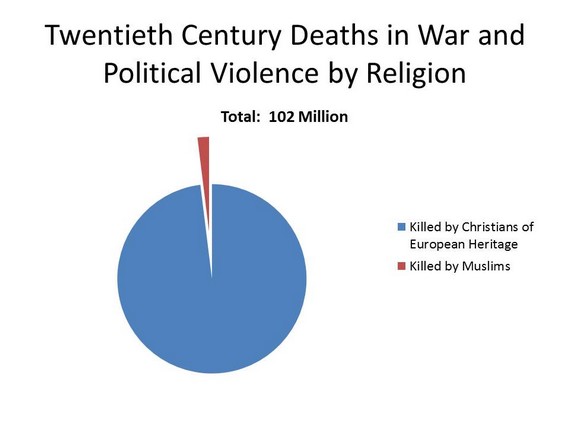
As for political violence, people of Christian heritage in the twentieth century polished off tens of millions of people in the two world wars and colonial repression. This massive carnage did not occur because European Christians are worse than or different from other human beings, but because they were the first to industrialize war and pursue a national model. Sometimes it is argued that they did not act in the name of religion but of nationalism. But, really, how naive. Religion and nationalism are closely intertwined. The British monarch is the head of the Church of England, and that still meant something in the first half of the twentieth century, at least. The Swedish church is a national church. Spain? Was it really unconnected to Catholicism? Did the Church and Francisco Franco’s feelings toward it play no role in the Civil War? And what’s sauce for the goose: much Muslim violence is driven by forms of modern nationalism, too.
I don’t figure that Muslims killed more than a 2 million people or so in political violence in the entire twentieth century, and that mainly in the Iran-Iraq War 1980-1988 and the Soviet and post-Soviet wars in Afghanistan, for which Europeans bear some blame.
Compare that to the Christian European tally of, oh, lets say 100 million (16 million in WW I, 60 million in WW II– though some of those were attributable to Buddhists in Asia– and millions more in colonial wars.)
relviolence
Belgium– yes, the Belgium of strawberry beer and quaint Gravensteen castle– conquered the Congo and is estimated to have killed off half of its inhabitants over time, some 8 million people at least.
Or, between 1916-1930 Tsarist Russian and then Soviet forces — facing the revolt of Central Asians trying to throw off Christian (and then Marxist), European rule — Russian forces killed an estimated 1.5 million people. Two boys brought up in or born in one of those territories (Kyrgyzstan) just killed 4 people and wounded others critically. That is horrible, but no one, whether in Russia or in Europe or in North America has the slightest idea that Central Asians were mass-murdered during WW I and before and after, and looted of much of their wealth. Russia when it brutally conquered and ruled the Caucasus and Central Asia was an Eastern Orthodox, Christian empire (and seems to be reemerging as one!).
Then, between half a million and a million Algerians died in that country’s war of independence from France, 1954-1962, at a time when the population was only 11 million!
I could go on and on. Everywhere you dig in European colonialism in Afro-Asia, there are bodies. Lots of bodies.
Now that I think of it, maybe 100 million people killed by people of European Christian heritage in the twentieth century is an underestimate.
As for religious terrorism, that too is universal. Admittedly, some groups deploy terrorism as a tactic more at some times than others. Zionists in British Mandate Palestine were active terrorists in the 1940s, from a British point of view, and in the period 1965-1980, the FBI considered the Jewish Defense League among the most active US terrorist groups. (Members at one point plotted to assassinate Rep. Dareell Issa (R-CA) because of his Lebanese heritage.) Now that Jewish nationalsts are largely getting their way, terrorism has declined among them. But it would likely reemerge if they stopped getting their way. In fact, one of the arguments Israeli politicians give for allowing Israeli squatters to keep the Palestinian land in the West Bank that they have usurped is that attempting to move them back out would produce violence. I.e., the settlers not only actually terrorize the Palestinians, but they form a terrorism threat for Israel proper (as the late prime minister Yitzhak Rabin discovered).
Even more recently, it is difficult for me to see much of a difference between Tamerlan Tsarnaev and Baruch Goldstein, perpetrator of the Hebron massacre.
Or there was the cold-blooded bombing of the Ajmer shrine in India by Bhavesh Patel and a gang of Hindu nationalists. Chillingly, they were disturbed when a second bomb they had set did not go off, so that they did not wreak as much havoc as they would have liked. Ajmer is an ecumenical Sufi shrine also visited by Hindus, and these bigots wanted to stop such open-minded sharing of spiritual spaces because they hate Muslims.
Buddhists have committed a lot of terrorism and other violence as well. Many in the Zen orders in Japan supported militarism in the first half of the twentieth century, for which their leaders later apologized. And, you had Inoue Shiro’s assassination campaign in 1930s Japan. Nowadays militant Buddhist monks in Burma/ Myanmar are urging on an ethnic cleansing campaign against the Rohingya.
As for Christianity, the Lord’s Resistance Army in Uganda initiated hostilitiesthat displaced two million people. Although it is an African cult, it is Christian in origin and the result of Western Christian missionaries preaching in Africa. If Saudi Wahhabi preachers can be in part blamed for the Taliban, why do Christian missionaries skate when we consider the blowback from their pupils?
Terrorism is a tactic of extremists within each religion, and within secular religions of Marxism or nationalism. No religion, including Islam, preaches indiscriminate violence against innocents.
It takes a peculiar sort of blindness to see Christians of European heritage as “nice” and Muslims and inherently violent, given the twentieth century death toll I mentioned above. Human beings are human beings and the species is too young and too interconnected to have differentiated much from group to group. People resort to violence out of ambition or grievance, and the more powerful they are, the more violence they seem to commit. The good news is that the number of wars is declining over time, and World War II, the biggest charnel house in history, hasn’t been repeated.

Sunday, February 08, 2015

Comparing Israel To ISIS


"{ISIS'] quest for an ethnically pure Sunni state mirrors the quest for a Jewish state eventually carved out of Palestine in 1948. Its tactics are much like those of the Jewish guerrillas who used violence, terrorism, foreign fighters, clandestine arms shipments and foreign money, along with horrific ethnic cleansing and the massacre of hundreds of Arab civilians, to create Israel," 

[Chris Hedges]

Thursday, February 05, 2015

What Is Behind Europe's Rising Islamophobia?


Recent arson attacks on mosques in Germany and Sweden, along with the emergence of a movement called the "Patriotic Europeans Against the Islamization of the Occident," prompted German Chancellor Angela Merkel to deliver a "never again" New Year's message to her compatriots in anticipation of Monday's demonstrations in Dresden. Warning against supporting PEGIDA, she said "their hearts are cold, often full of prejudice and even hate."
What is behind this most recent aggressive burst of anti-Islamic sentiment? How should we view it?
The landmass of the Occident spans the territory of many countries; its meaning becomes apparent only in juxtaposition to its counterpart, the Orient. It has more frequently perished in countless texts, speeches and films than all actually existing empires throughout human history combined. In short: The Occident is a fiction -- and that quality has always made it a powerful canvas for the projection of human fears and desires.
The Occident lies towards the Western sunset. Its lands are those of nightfall: heavy, full of melancholy, straining for the final rays of daylight, and hesitantly expecting the pale light of the rising moon. During the Middle Ages, stone-carved creatures of the imagination flanked the walls of Europe's cathedrals and conjured up images of nightly evils: When night falls, darkness envelops the souls of men and threatens them with extinction. The hour of sunset signals the advent of corporeal and spiritual danger. It takes tremendous power to hold demons at bay and to weather the temptations of the night. Two paradigms thus help to map the terrain of the Occident: the fear of darkness, and the belief in the divine light.
Christian churches are built with East-facing chancel windows; on Easter Sunday, the first daylight enters through the colored glass and bathes the barren nave in celebratory light. The organ intones, and the church bells ring out: He Has Risen. Indeed, the liturgy of Easter Sunday presents us with the most condensed enactment of the Occidental yearning for light, for another day, and for triumph over the demons of darkness. Ex oriente lux -- the sun rises in the East. That's why Europeans have always looked longingly beyond their horizon: Towards the East, towards Jerusalem.
The Occident became conscious of itself as a unified entity when Jerusalem fell to Islamic conquest. The longing for Jerusalem was thus also a longing for order and unity at home: One emperor, one pope, one center and one horizon that provided order to the world. At that time, the Occident was still being formed from the rubble of the Roman Empire, and forged during the tumultuous centuries of the migration of the peoples. "Alemannic" -- which is the etymological ancestor of the term "German" in romance languages -- simply means "all men." The longing for Jerusalem unified the Occident's diverse cultures for the first time.
Once again, we can look towards medieval cathedrals for architectural indicators of shared cultural sentiments: The domes of Europe's great cathedrals were shaped to resemble the imagined cityscape of worldly Jerusalem; their spires pointed towards heavenly Jerusalem. Christianity became the unifying identity of the Occident.
THE OCCIDENT NEEDS THE ORIENT
But unity remained fragile. New dangers lurked nearby, especially at the borders. From the South, Muslim armies threatened the continent. From the North, Normans invaded. Later came the Huns, then the Turks (whose conquest was only stopped at the gates of Vienna). Southern Spain remained in Muslim hands for centuries. Rome, the caput mundi, continued to be an attractive target for invaders from the Orient. The Occidental fears became manifest -- sometimes obsessively so -- in fears of Islam. For centuries, the religious competitor to the East robbed European emperors and popes of their sleep. Over time, Islamophobia became part of the collective consciousness of the Occident.
What is feared today is not the loss of any particular country to foreign conquest, but the loss of an imagined entity that binds us together. The Occident is a central piece of our mental maps and our cultural inventory. That's one reason why seemingly everyone from "the Old World" has at least an instinctual opinion about it. People harbor within themselves a sense of shared meaning -- the semantic sediments of the Occident.
When those opinions are voiced, they often fall short by the standards of reason and academic science. They are instead informed, in a very visceral sense, by fears of decline and by memories of cultural blossoming. Those fears culminate in the belief that our cathedrals will eventually turn into mosques, that their bells will fall silent and will be replaced by the cries of the muezzin. But fears lead to hyperbole. Let us remember that foreign conquests have failed for many centuries (and not for lack of trying!), and thus proclaim with conviction that danger can be averted again.
Fear of decline, and the celebration of an imagined unity: Those are the parameters that govern contemporary discourses about the Occident -- not as arguments but as discursive foundations. 
Indeed, the Occident is as much a fiction as the Orient. Both terms reflect the wishes, dreams and aspirations of our forefathers. They were shaped in earlier epochs over the course of generations and centuries.
The history of the Occident is not unlike the history of a cathedral: Every generation has tinkered with the structure and amended it. The foundations were set down during the time of Charlemagne, the aisles were added during Romanticism, a new spire was built during the Gothic period, ornate chapels appeared during the Baroque era. When fire struck, it was rebuilt. It had to be: How could a city exist without its central reference point?
The time of dusk: Fever, madness, gloriole, hyperbole. Death appears imminent until the rise of dawn. In old hymns, sleep is recast as the antechamber of death. No wonder, then, that religious pathologies and political and religious ideologies have repeatedly swept across the continent. Their danger remains acute. But to the arsonists I say: The Occident has never been able to sustain itself. It always required the light of the Orient as inspiration and external reference point.
"The Occident has never been able to sustain itself. It always required the light of the Orient as inspiration and external reference point."

During the Middle Ages, a veritable cult developed around the "three wise men" who came from the Orient and whose earthly remains are said to be contained in relics at the cathedral in Cologne. Ex oriente lux -- or, as the gospel of Matthew puts it: "We have His star when it rose, and have come to worship Him." In old paintings, the three wise men resemble representatives from late antiquity's three known continents: One European, one African, one Asian.
Thinkers like Erasmus of Rotterdam turned Christian traditions into undogmatic humanism, bent on eradicating the denominational borders within Christianity. Their effort proved to be a quick flicker: The fanaticism of the Reformation and fights over the correct interpretation of Christian dogma put an end to it. The Occident descended into centuries of spiritual and intellectual darkness. At the end of the 20th century, and after two World Wars, it is in the process of reinventing itself.
As Christianity teaches us, the dead have a way of rising again. Today's discussions remind us that the Occident is not finished yet. 
But we must not fool ourselves: The legacy of the term is a double-edged sword that can mean nothing and everything at the same time. It was born of emotion and shaped by the highs and lows of history. It is useless as an analytical reference point and cannot supply answers to concrete political questions.
Both the community of Christendom and the unity of the Occident were political ideas. The cost of their realization was paid in blood. But what is the Occident today? It is the community of peoples who have sustained the term in their collective consciousness and have continually amended its meaning.
The Occident extends beyond Christendom and beyond Europe. The term only works if avoids self-enclosure and remains perpetually open towards the outside -- towards the Orient, Africa and Asia -- as indeed it used to be. Its contemporary potential lies in continuing the work of Erasmus of Rotterdam: The formulation of global, humanistic and inclusive ethics.
Founder and publisher of The European

Monday, February 02, 2015

The Zionist Myth of Insecurity


From a Jewish perspective, the earliest roots of the Israel-Palestine go back to the mid-19th century, far away from the Middle East, in Russia and other lands of Eastern Europe. There some number of Jews looked westward and saw Jews in Germany and other Western European lands beginning to enjoy legal and social equality with their gentile neighbors. The Eastern European Jews hoped that the wave of modernization moving eastward would bring them the same equality. They were prepared to pay the same price their fellow Jews in the West had paid: giving up traditional Jewish beliefs and practices (what’s now called Orthodox Judaism) as a relic of the medieval past, which they associated with Jewish oppression and weakness.

These modernizing, secularizing Jews in Eastern Europe saw their hopes dashed in 1881, when a wave of Pan-Slavism—nationalism and chauvinism, accompanied by anti-semitism—swept across Russia and other eastern European lands.  This crushed the hopes of Jews who believed that their gentile neighbors would adopt the modern Western idea of tolerance and accept Jews as equals.  Some Jews left Russia. Some became revolutionaries.

But a small number took a different approach, articulated most famously in Leo Pinsker’s pamphlet “Self-Emancipation,” published in 1882.  Pinsker argued that as long as Jews lived as a minority in diaspora, they would always be “hated rivals” and victims of anti-semitism, no matter where they lived and no matter what they did. Pinsker told the Jews:  “You are foolish because you stand awkwardly by and expect of human nature something which it has always lacked—humanity.  You are contemptible, because you have no real self-love and no national self-respect.” The Jews would continue to hate themselves and embrace their own degradation, he wrote, as long as they remained as a minority living in exile.  Only when the Jews became normal, “a nation like the others,” would they find self-respect and “rise manfully to [their] full height.”

Theodore Herzl, who led the creation of a Zionist political organization, saw things much the same way. His Israeli biographer, Amos Elon, wrote that Herzl, a famous newspaper columnist, was motivated above all by “wounded pride”—being denied what he thought was his rightful place among the elite of European society simply because he was Jewish. Like virtually all the early Zionists, Herzl had no attachment to Jewish religious tradition. He was well aware that he was making national pride the sacred center of Jewish identity. So he urged the early Zionists to “turn the Jewish question into a question of Zion.”

Pinsker’s and Herzl’s views laid an enduring foundation for Zionism. For most Zionists, security was always more than a geopolitical and military category.  It was a psychological and even moral concept.  

Zionist theory held that, everywhere in the world, Jews would be threatened by the fatal combination of anti-semitism and self-doubt.  Jews had learned from centuries of oppression to feel vulnerable, inadequate, and incapable of standing up for themselves, the Zionists said. Therefore they would feel insecure and powerless before the gentile onslaught.  But It is shameful and contemptible to let oneself fall victim to inhumane persecution. Since gentiles would always be inhumane persecutors, Jews would always feel inferiority, shame, and self-contempt as long as live in Diaspora, ruled by gentiles.

There was only one remedy, Zionists argued: a nation of their own, a Jewish state.  As they looked at Western Europe, they saw modern political nationalism becoming the norm. The Greeks had won their independence from the Turkish empire. Germany and Italy were unifying. Every normal ethnic group, it seemed, had its own political state. Only nationhood would make the Jews normal, giving them the psychological security that comes from self-respect and leads to geopolitical security. This “normalization” was their guiding ideal. By making themselves a normal nation, like all the other nations, they expected to earn the world’s respect and be treated as equals in the family of nations.

Unfortunately it did not work out that way, because there were fatal flaws in the theory of “normalization.”  Any normal nation in late 19thcentury Europe viewed it history as a seemingly endless conflict between “us” (and “our” allies) and “them,” the real or potential enemies.  A normal nation assumed that it would always have to be militarily prepared to defend itself against its foes. Being afraid of enemies was a part of being a normal nation.

So the earliest Zionists who left Eastern Europe to settle in the Turkish colony of Palestine were stuck in an impossible contradiction. Most of them assumed that gentiles would always harbor an irrational, implacable hatred of Jews, a hatred that the Jews had done nothing to create. So Jews could do nothing to remove or reduce it.  Jews could only escape the gentiles to create their own normal nation. 

In order to be normal, though, they would have to assume that, once they created their own nation in Palestine, they would still have enemies who hated them. Thus the early Zionist settlers brought with them a deep sense of vulnerability, a conviction that they were passive victims of historical forces beyond their control.

Even if they hoped that some day things would change, they were still trapped in a catch-22. In order to feel normal and secure they had to be free of anti-Semitic persecution. So their test of the success of Zionism was how well the Jewish state was received by the gentile world. Even if they broke free of the political grip of the gentiles, they would always be watching over their shoulders to see how the gentiles were viewing them. Thus they could never escape the sense that their self-worth depended on the judgment of others. Even if they got political freedom, they could never break from the feeling that they were passive victims of the gentiles in a social-psychological way.

What’s more, they did not have a very clear vision of the intermediate steps in their political progress.  Their dominant ideology suggested that they could would not have the power to shape their own fate until they had achieved the goal of statehood.  Until then, they would feel like passive victims.

In fact, from the very beginning, Zionists were agents of historical change.  They did whatever they could to achieve their ends by political, economic, and sometimes violent means: they bought land, built farms and villages, created political structures, and negotiated with the Palestinian Arabs about all sorts of things. The negotiations sometimes led to relatively amicable relations between Zionists and Palestinian Arabs.

Sometimes though, inevitably, there was conflict. Sometimes parties on both sides resorted to violence to get their way, which intensified the conflict.  A few Zionists saw that the Palestinians were responding to specific policies that the Zionist movement had chosen. A few understood that the Zionists had become part of a vast relational network of Middle Eastern peoples. In any such network, the words and actions of each actor impact all the others; no one is merely a passive victim of others’ choices.  In this particular network, some Arabs as well as Jews sought to emulate the secular nationalist model they saw dominating Europe. An Arab nationalist movement seeking independence from the Turkish empire was already well underway.

But most Zionists could not see this because they had become locked into, and blinded by, their dominant narrative. Their consciences did not want to admit that they were now empowered historical actors, because they would mean they bore some responsibility for eliciting enmity from others.  It was easier to charge the enmity to an irrational antisemitic hatred of the Jews, a hatred beyond their control. If their actions could neither evoke, intensify, or alleviate their enemy’s attitudes, then they could not bear any responsibility for the ongoing conflict. All they could do was to defend themselves by force. So it was appealing to interpret any Palestinian Arab resistance as evidence of sheer antisemitism.

However the tradition that started with Pinsker said that when Jews were attacked by antisemites, the insecurity and powerlessness they felt were evidence of their moral weakness, self-doubt, and self-hatred.  Every hint of weakness reminded the Zionists that they had not yet fully answered Pinsker’s call to stand up proudly and manfully.  So they fought back, not only to protect themselves physically but, even more, to protect themselves from their own self-doubts. Each time the Zionists asserted themselves against the Palestinians they could feel reassured that they were genuinely proud and self-reliant, that they were “rising manfully to full height.” At the same time, they could feel reassured that they were morally innocent victims of anti-semitism.

But that interpretation created more problems than it solved. If the Zionists were still victims of an anti-semitism beyond their control to influence, then they were not yet agents of their own history. They were insisting on their passivity, the very condition they had hoped to escape. So they only heightened their negative self-image, their sense of powerlessness and insecurity. That, in turn, heightened their doubts about their own self-worth, wondering whether they could ever be normal. The natural response was to take more actions that would assuage self-doubt. They had to go on showing that they were capable of exercising power, prove that they could hit back, like normal people.

Of course every time they hit back, the Palestinians were likely to hit back in response. The Zionists interpreted each new confrontation as further evidence of the Jews’ vulnerability, passivity, and insecurity, which only intensified their feeling of self-doubt.  And that, in turn, intensified their conviction that antisemitism was eternal, that they would always be insecure. The only possible response was to strike back again—which locked them more firmly into their narrative and generated ever more insecurity. This narrative became so basic to their movement that it functioned as their foundational myth. The Zionists were trapped in a myth of national insecurity.

This myth was already firmly in place during the early years of Zionist immigration to Palestine. (The first major wave of immigrants came around 1905.) It was cemented by the tragedy of World War I. In 1917 Britain’s foreign secretary, Lord Balfour, declared that his government would “view with favour the establishment in Palestine of a national home for the Jewish people,” though he added that Britain would not want to “prejudice the rights of existing non-Jewish communities in Palestine.” At the same time, the British used T. E. Lawrence to promise the Arabs independence from the Turks in return for the Arabs’ help in fighting the war.  But after the war Britain itself took charge of Palestine under a League of Nations mandate. It is no coincidence that the first large scale violence between Zionists and Arabs broke out in 1919, fueled by the frustrations of seeing their nationalistic hopes dashed.

Throughout the British mandate period (1919 – 1947) most Zionists continued to interpret their own acts of force as the regrettably necessary actions of innocent victims. This gave them a satisfying conviction that all their actions were morally righteousness.  But it also reinforced the fundamentals of the Zionist myth of insecurity: Our enemies threaten our very existence; we are wholly innocent, having done nothing at all to evoke such enmity; we must inflict enough defeats on our enemies to prove to them—and ourselves—our indomitable strength.

An important difference developed among them, though. The mainstream of Zionism, led by David Ben Gurion, tried it best to appear moderate, willing to make compromises, and hoping to limit violence. A new group known as Revisionists, led by the Vladimir Jabotinsky, asked (in effect), Why bother even thinking about the world’s response? The world hates us anyway; nothing we do now can make the gentiles hate us more. Since we are surrounded by eternal enemies, the only way to insure our survival is to make it clear that we want all of Palestine, refuse any compromise, and maintain our strength and dominance Since the Arabs only understand force, we must use force to insure our control of Palestine, by any means necessary.

A third and much smaller group, led by the philosopher Martin Buber, preached that it was wrong to blame the Arabs, as if the Jews’ behavior had nothing to do with it. A central theme in Buber’s philosophy was the freedom, and the obligation, to make moral choices and take responsibility for one’s choices. He told the Zionists that the fate of their movement would be decided not by their opponents but by the choices they made.  “It depends entirely on us,” he said, “whether the Arabs treat us as welcome friends or hated enemies.” By the late 1930s Buber was leading a small group of Jews committed to creating a single bi-national state, giving equal rights and equal power to both Jews and Arabs.

The horrors of the Nazi Holocaust locked mainstream and Revisionist Zionists even more tightly into the myth of insecurity. By the mid-1940s, it seemed all too realistic to fear that the Jewish people might be, not just grievously harmed, but annihilated by antisemites. The Zionist premise of eternal antisemitism seemed much more convincing, too. The fear of antisemites and annihilation spurred the Jews to demand their own state. So their fear was deeply embedded in the foundations of the state of Israel, which declared its independence in 1948. Having a Jewish state did not bring any sense of real normalization. It merely created a new stage on which to play out the myth of insecurity.

Sunday, February 01, 2015

Visiting Al-Aqsa Is 'Every Muslim's Right'


"Every other Muslim has the right to come here as well. I, and every other Muslim, have the right to pray at the mosque as well."

[Organization of Islamic Cooperation (OIC) Secretary-General Iyad Madani]

Saturday, January 31, 2015

Islam Struggles For Unity and Independence From The West

Since the Ottoman Empire’s collapse in the First World War, Arab Islamic civilization has been deep in a crisis that can only be resolved from within. Its character is both political and religious and might be compared with the Thirty Years’ War in Europe that ended in 1648 in the Westphalian Settlement, which created a new international system of national sovereignties and, in religion, acceptance of the Augsburg principle (1555) of cuius regio, eius religio. Roughly speaking, these terms have prevailed in the West to the present day, notwithstanding a sinister 20th-century totalitarian interlude.
The unexpected appearance of what claims to be the new Islamic Caliphate—sweeping all before it, its atrocities demonstrating its power and ruthlessness, its avowed destiny the restoration of an Islamic Golden Age—should not be seen as anything new in imperialist and post-imperialist history. 
It is astonishing that the debate in Western circles on what (or what not) to do about ISIS has seemed largely innocent of history and indifferent to the pattern of consistent futility and failure in the West’s efforts to impose its will on the non-Western world
A new movement that claims to restore the lost power and glories of Islam, is actually the ultimate stage in the crisis that has afflicted the Arab Muslim civilization since its loss of unity in the defeat of the Ottoman Empire, the last political manifestation of a united Islam.
One is constantly told that history must be consulted in order to understand the present, but in practice that rarely is done with an open mind.
The rise of a radical popular movement demanding that a lost golden age be restored to a fragmented and culturally distraught society occurred at least twice in 19th-century China (the Taiping and Boxer rebellions) and in colonial India (the so-called Sepoy Mutiny) and Sudan (with the Mahdi Mohamed Ahmed, to take only the best known instances of such uprisings against imperial powers.
The phenomenon has appeared in post-colonial Africa: what else is the terrible Lord’s Resistance Army of children in Uganda, or other radical movements such as Boko Haram, classified in Western capitals as merely “terrorist”? Their power lies in that they are motivated by versions or perversions of religion.
All are political expressions of probably the most important recurrent phenomenon of history itself: the search for the key to the Millennium, common to sophisticated as well as simple societies throughout history. What do people think Communism was, and in fragmented forms remains today? It proposed a method for engineering what Communists—the Comintern and the Soviet and other governments—promised, and indeed believed: the coming of the Great Day when virtue incarnate would manifest itself in a transformed future condition of permanent happiness conferring justice and happiness upon an afflicted people. It is secular religion.
This is a modern phenomenon. In the West during the medieval Age of Religion the promised paradise was held to exist outside of time and would only be opened at the end of the dolor of earthly existence by the arrival of the Messiah. The Millennium marked the end of secular time, when human history would have run its course and the “Thousand Years” of heavenly reign begun—as promised in the Book of Revelation. 
Marxism was the secular translation of that religious promise, promulgated by the new prophets: Marx himself, Engels, Mao Tse-tung. A secularized prophecy was necessary because God had been assassinated in the European Enlightenment.
The contemporary crisis of the Arabs began following the Great War when the winners, the principal European imperial powers of the time, disposed of the remnants of the Ottoman Empire, using their new instrument, the League of Nations, to issue mandates of supervisory control over the new monarchies and other territorial authorities recognized in the war settlements. The quest nonetheless persisted to reunite the people of Islam, united by the Koran and by the Arabic language in which the Koran was written and still is read.
The Ottoman system that had replaced the great Arab Caliphates was destroyed in the 19th and early 20th century by resistance within the Slavic European parts of the empire and then by the collision of the Ottomans with modern, industrial Europe in the World War. 
Following 1918, ageless, Islamic but non-Arab Egypt remained a monarchy, but under British “protection.” Persia, also non-Arab, another ancient independent monarchy, had fallen under an informal British ascendancy after the discovery there of oil to fuel the Royal Navy. Syria, Iraq, and Transjordan had Hashemite Arab monarchs bestowed upon them—Iraq to be ruled by Faisal, who had led the “Arab Revolt” with T.E. Lawrence as his British military counselor, and who was initially made king of Syria until displaced by the French colonial authorities.
Syria and Transjordan were made mandated states by the League of Nations, respectively under French and British control. Palestine—as everyone knows—was also placed under British Mandate but with no provision made for fulfilling Britain’s wartime promise to establish a Jewish National Home there (on condition, as the Balfour Declaration specified, that the rights of the existing non-Jewish communities of Palestine would be respected).
What at the time was tribal Arabia was in the course of being conquered by Ibn Saud, his conquered territories being proclaimed independent “Saudi Arabia” in 1932, while present-day Yemen remained under tribal rule.
The European colonial governments were accustomed to rule “lesser” peoples beyond Europe’s frontiers and beyond the seas in what they considered to be their subjects’ as well as their own best interests. Now they did so under the unimpeachable authority of the “international community,” as the League of Nations would be considered today, destroying the expectation the Arab peoples had of unity and genuine independence.
The new monarchies in Iraq and Syria fell to nationalist or military movements in the 1920s and 1930s. The modernizing and secular pan-Arab Baath party eventually took power in both countries. The closest thing to the pan-Arab ideal—an “Arab Nation”—was achieved after 1953 by Col. Gamal Abdel Nasser, who introduced “Arab Socialism” into Arab politics and achieved ephemeral unions of Egypt with Syria and Yemen. 
Three decades after the Great War’s armistice, the newly created United Nations, a Western institution dominated (as still is the case) by the United States, partitioned British Mandated Palestine in order to establish the Jewish National Home promised in the British government’s Balfour Declaration of November 1917, thus creating a permanent conflict with the Palestinian possessors of the land. Since then there has been a constant struggle between American-backed Zionists and the existing Arab occupants of Palestine. 
This has inflicted a politico-psychical transformation upon the general Arab consciousness, reanimating the sensibilities of the Crusades, the great Caliphates, and the Ottoman period when Muslims ruled Balkan Europe from Greece to Vienna. 
On both sides, the Palestinian conflict has acquired the quality—to borrow the adjective contrived by Israeli politicians—of an “existential” struggle. Death to the loser.
In this political climate of Arab national failure and, as it seemed, irresolvable Israel-Palestinian conflict, the United States determined that it was capable of imposing a new order. This had been implicit in America’s overall wartime and postwar world policy. 
There were two foreign-policy objectives to achieve in the Middle East: 
The first was to assure American access to energy supplies. This had been done in a wartime agreement between Franklin Roosevelt and Arabia’s Ibn Saud, directly exchanging permanent access to Saudi oil for permanent U.S. protection. 
The second was to find an Arab-Israeli solution. Had Washington been willing to impose one in the 1950s—the creation of two permanent states underwritten by the United States—the region would have been spared 60 years of war, open and covert. That was not done. 
Israel was eventually confirmed in its impulse to possess all of the Holy Land, at whatever cost to the Palestinians, initially dismissed in Israeli propaganda discourse as an insignificant body of wandering tribesmen. 
A permanent obstacle to American regional success arose in Iran in 1951, when a popularly elected populist prime minister, Mohammad Mossadegh, nationalized British oil interests against the will of the Shah. The Shah fled. But in 1953, a coup overthrowing the prime minister by street agitation, mustered by British and American intelligence agencies, restored the Shah. The Nixon administration later anointed him America’s ally and order-keeper in the Gulf region. However in 1979, after another period of internal disorder, he was forced to flee a Shia fundamentalist religious coup d’état, which included capture and internment of the U.S. Embassy staff and humiliation of the United States government. This produced the enmity towards Iran that has motivated American policy ever since.
The major result was Iraq’s subsequent attack on Iran, concerning territorial issues, which enjoyed unspoken American support. The war lasted eight years, and its savagery has been compared with that of the First World War. In 1990 Iraq invaded Kuwait—another territorial claim—and a U.S.-led coalition liberated Kuwait and its oil in the so-called Gulf War. The United States then resolved to keep permanent bases in Saudi Arabia, despite Saudi objection to the presence of such installations near the Muslim holy places
After its 9/11 attacks on New York and Washington, the al-Qaeda movement, explicitly stated that its motive had been to impose God’s wrath upon the blasphemies of the United States in the Middle East. President George W. Bush reciprocated with his assertion that the jihadists of al-Qaeda embodied Evil.
The American invasions of Afghanistan and Arab Iraq were animated by revenge for the 9/11 attacks and rationalized by a fiction about nonexistent weapons of mass destruction in Iraq and by the self-serving American chimera of “democratizing” those two societies and eventually the rest of the region’s Arab and Central Asian Islamic states—assumed to be candidates for integration into a Washington-dominated liberal regional system.
The “New Middle East,” officially proclaimed by NATO at the end of 2003, has conspicuously failed to appear, but it remains a goal of the expansionist neoconservative visionaries among the makers of American policy. 
In Bush’s government, Secretary of State Condoleezza Rice wrote in Foreign Affairs in 2008, “Democratic state-building is now an urgent component in our national interest” reflecting a “uniquely American realism” teaching that it is America’s job “to change the world,” and in its own image
President Obama has declared that the jihadism of the new “Islamic State” is itself an incarnation of evil that must be deterred and destroyed. 
The two sides in this renewal of George W. Bush’s War Against Global Terror—Jews and Christians in the West and their Arab enemies—both consider themselves “people of the Book” and descendants of the Prophet Abraham. They have now become in their own minds actors in the apocalyptic destiny described in the Book of Revelation. 
Many American Evangelical Protestants have convinced themselves that contemporary American foreign policy can only be understood in such a context.
Obstacles to success in Washington’s renewal of war in the Middle East are that the American political model is no longer widely convincing or respected in the region; quite the opposite is true. 
Moreover, Washington’s conduct since 2001 has undermined or deliberately subverted institutions of international order to which, in the past, the United States was a leading contributor. 
The codes of international justice and morality, developed in the Western community of nations since the 17th century, have when expedient been disregarded or rejected, with demands that the United States be exempted from the jurisdiction of international law and even from what until recently were accepted norms of international morality concerning human rights and national sovereignty.
Thus the foreign policies of the United States have been stripped of a vital part of their assumed original moral content. 
An assimilation of modern totalitarian influences, values, and practices occurred in the United States after 2001, with state assassinations, selective drone killings, disregard of due process, torture, and permanent incarceration without trial justified by American leaders in their conduct of what has amounted to a war, not really of religions, as such, but between absolutisms, the one religious, and the other, ours, a political culture of extreme and solipsistic millenarian nationalism.
One recalls the theory Samuel Huntington announced late in his career that the “next world war” would be a war of religions rather than states. The present writer dismissed this at the time as a simple projection into the future of 20th century experience and the conventional American foreign-policy thinking of the 1990s, notably that promoted by the aggressively anti-Islamic Washington neoconservatives.
The theory’s implausibility was augmented by its argument that China (regarded in Washington, then as seemingly even now, as a future enemy) was to be part of a “Confucian-Islamic military connection… to counter the military power of the West”—an alliance, if it were indeed to exist, one would think of no great use to China, a nation with a scattered and ill-treated Muslim minority of less than 3 percent of its population and little to gain from involving itself in Muslim conflicts with Washington.
The main effect of the Huntington thesis at the time it was promoted in the United States was to increase anti-Arab prejudices, especially among friends of Israel. It contributed to a climate among policymakers that made the Bush administration’s vengeance for the 9/11 attacks seem an inevitability. 
It had an even more significant influence in Islamic intellectual and ideological circles and among Arab governments because of its Harvard provenance, the eminence of Professor Huntington himself, considered the dean of the American academic specialty of political science (which emerged in the 1930s out of the behaviorist movement) and for years a leading academic influence on Washington policy-making. Was he proposing a Western attack against the Muslim world? 
While Chinese-Arab military alliance seems hardly a threat today, the Huntington thesis of a new religious war has been taken seriously in some quarters since the 9/11 attacks. 
In 2014, within days of the proclamation of the new Islamic State, the new Caliphate, the drumbeat demand had begun in congressional and think-tank Washington for an attack upon ISIS (or ISIL, or the new Arab Caliphate, or in Arabic DAESH, as it is variously known), together with criticism of Barack Obama for his initial reluctance to act. 
But why? The previous interventions in the Middle East have proven futile and damaging to both sides. 
Americans have attempted to make themselves oligarchs of the modern Arab Islamic world, introducing invasions and wars whose actual effect has been to envenom an immense part of the Arabs of the Middle East and validate the vengeance they and their leaders have sought to inflict on us. 
This is a war essentially within Islamic civilization, with religious, ideological, and political causes sprung from inside that society, as well as from the external provocations it has endured.
It can only be settled by the people of that civilization. Another foreign military intervention is the last thing it needs. 
The first of the post-1918 imperial interventions by Britain and France shattered Islamic unity as it had existed in the late Ottoman period when the Sublime Porte was a major European as well as Mediterranean power. The major nations parceled the region up until after the Second World War, when successive Arab efforts to recreate the visionary ideal of the Arab Nation were thwarted.
The American attempt to make the Shah of Iran its plenipotentiary and his state the agent of American power in the Middle East ended in provoking a fundamentalist Iran that became the most important American enemy in the region. 
The American invasions of Taliban-ruled Afghanistan and Sunni-ruled Iraq turned both into ruined and corrupt puppet regimes. 
One might think any new American strategy to reform the Middle East would universally be regarded as folly, even in Washington. 
What the previous attempts accomplished was destruction and the generation of seething hatred of the United States in much of the Islamic world. 
Washington has now appointed itself leader of still another and predictably unsuccessful military intervention, in which tens or hundreds of thousands, perhaps millions, if this continues, may eventually die.
By joining the United States in a coalition to battle the New Caliphate, Saudi Arabia and the rest of its Arab members have once again announced their dependence upon a foreign and interventionist power to defend their own integrity, an admission of impotence to restore to the Arab Islamic world the wholeness and integrity it possessed during the Ottoman period, a confirmation of their capitulation to partition and imperialism in the 20th century, as well as their unwillingness or inability to restore the unity of the past Islamic civilization.