Showing posts with label Jewish Terrorism. Show all posts

Monday, February 09, 2015

Terrorism and The Other Religions

Contrary to what is alleged by bigots like Bill Maher, Muslims are not more violent than people of other religions. Murder rates in most of the Muslim world are very low compared to the United States.
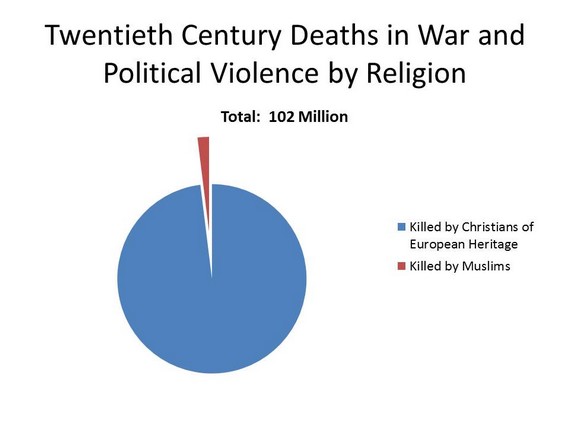
As for political violence, people of Christian heritage in the twentieth century polished off tens of millions of people in the two world wars and colonial repression. This massive carnage did not occur because European Christians are worse than or different from other human beings, but because they were the first to industrialize war and pursue a national model. Sometimes it is argued that they did not act in the name of religion but of nationalism. But, really, how naive. Religion and nationalism are closely intertwined. The British monarch is the head of the Church of England, and that still meant something in the first half of the twentieth century, at least. The Swedish church is a national church. Spain? Was it really unconnected to Catholicism? Did the Church and Francisco Franco’s feelings toward it play no role in the Civil War? And what’s sauce for the goose: much Muslim violence is driven by forms of modern nationalism, too.
I don’t figure that Muslims killed more than a 2 million people or so in political violence in the entire twentieth century, and that mainly in the Iran-Iraq War 1980-1988 and the Soviet and post-Soviet wars in Afghanistan, for which Europeans bear some blame.
Compare that to the Christian European tally of, oh, lets say 100 million (16 million in WW I, 60 million in WW II– though some of those were attributable to Buddhists in Asia– and millions more in colonial wars.)
relviolence
Belgium– yes, the Belgium of strawberry beer and quaint Gravensteen castle– conquered the Congo and is estimated to have killed off half of its inhabitants over time, some 8 million people at least.
Or, between 1916-1930 Tsarist Russian and then Soviet forces — facing the revolt of Central Asians trying to throw off Christian (and then Marxist), European rule — Russian forces killed an estimated 1.5 million people. Two boys brought up in or born in one of those territories (Kyrgyzstan) just killed 4 people and wounded others critically. That is horrible, but no one, whether in Russia or in Europe or in North America has the slightest idea that Central Asians were mass-murdered during WW I and before and after, and looted of much of their wealth. Russia when it brutally conquered and ruled the Caucasus and Central Asia was an Eastern Orthodox, Christian empire (and seems to be reemerging as one!).
Then, between half a million and a million Algerians died in that country’s war of independence from France, 1954-1962, at a time when the population was only 11 million!
I could go on and on. Everywhere you dig in European colonialism in Afro-Asia, there are bodies. Lots of bodies.
Now that I think of it, maybe 100 million people killed by people of European Christian heritage in the twentieth century is an underestimate.
As for religious terrorism, that too is universal. Admittedly, some groups deploy terrorism as a tactic more at some times than others. Zionists in British Mandate Palestine were active terrorists in the 1940s, from a British point of view, and in the period 1965-1980, the FBI considered the Jewish Defense League among the most active US terrorist groups. (Members at one point plotted to assassinate Rep. Dareell Issa (R-CA) because of his Lebanese heritage.) Now that Jewish nationalsts are largely getting their way, terrorism has declined among them. But it would likely reemerge if they stopped getting their way. In fact, one of the arguments Israeli politicians give for allowing Israeli squatters to keep the Palestinian land in the West Bank that they have usurped is that attempting to move them back out would produce violence. I.e., the settlers not only actually terrorize the Palestinians, but they form a terrorism threat for Israel proper (as the late prime minister Yitzhak Rabin discovered).
Even more recently, it is difficult for me to see much of a difference between Tamerlan Tsarnaev and Baruch Goldstein, perpetrator of the Hebron massacre.
Or there was the cold-blooded bombing of the Ajmer shrine in India by Bhavesh Patel and a gang of Hindu nationalists. Chillingly, they were disturbed when a second bomb they had set did not go off, so that they did not wreak as much havoc as they would have liked. Ajmer is an ecumenical Sufi shrine also visited by Hindus, and these bigots wanted to stop such open-minded sharing of spiritual spaces because they hate Muslims.
Buddhists have committed a lot of terrorism and other violence as well. Many in the Zen orders in Japan supported militarism in the first half of the twentieth century, for which their leaders later apologized. And, you had Inoue Shiro’s assassination campaign in 1930s Japan. Nowadays militant Buddhist monks in Burma/ Myanmar are urging on an ethnic cleansing campaign against the Rohingya.
As for Christianity, the Lord’s Resistance Army in Uganda initiated hostilitiesthat displaced two million people. Although it is an African cult, it is Christian in origin and the result of Western Christian missionaries preaching in Africa. If Saudi Wahhabi preachers can be in part blamed for the Taliban, why do Christian missionaries skate when we consider the blowback from their pupils?
Terrorism is a tactic of extremists within each religion, and within secular religions of Marxism or nationalism. No religion, including Islam, preaches indiscriminate violence against innocents.
It takes a peculiar sort of blindness to see Christians of European heritage as “nice” and Muslims and inherently violent, given the twentieth century death toll I mentioned above. Human beings are human beings and the species is too young and too interconnected to have differentiated much from group to group. People resort to violence out of ambition or grievance, and the more powerful they are, the more violence they seem to commit. The good news is that the number of wars is declining over time, and World War II, the biggest charnel house in history, hasn’t been repeated.

Sunday, February 08, 2015

Comparing Israel To ISIS


"{ISIS'] quest for an ethnically pure Sunni state mirrors the quest for a Jewish state eventually carved out of Palestine in 1948. Its tactics are much like those of the Jewish guerrillas who used violence, terrorism, foreign fighters, clandestine arms shipments and foreign money, along with horrific ethnic cleansing and the massacre of hundreds of Arab civilians, to create Israel," 

[Chris Hedges]

Tuesday, February 03, 2015

Three Myths Of Israel's Insecurity


Why They Must Be Debunked 

Here are the Three Sacred Commandments for Americans who shape the public conversation on Israel:
1. For politicians, especially at the federal level: As soon as you say the word “Israel,” you must also say the word “security” and promise that the United States will always, always, always be committed to Israel’s security. If you occasionally label an action by the Israeli government “unhelpful,” you must immediately reaffirm the eternal U.S. commitment to Israel’s security.
2. For TV talking heads and op-ed pundits: If you criticize any policies or actions of the Israeli government, you must immediately add that Israel does, of course, have very real and serious security needs that have to be addressed.
3. For journalists covering the Israel-Palestine conflict for major American news outlets: You must live in Jewish Jerusalem or in Tel Aviv and take only occasional day trips into the Occupied Territories. So your reporting must inevitably be slanted toward the perspective of the Jews you live among. And you must indicate in every report that Jewish Israeli life is dominated by anxiety about security.

U.S. opinion-shapers have obeyed the Three Commandments scrupulously for decades. As a result, they’ve created an indelible image of Israel as a deeply insecure nation. That image is a major, if often overlooked, factor that has shaped and continues to shape Washington’s policies in the Middle East and especially the longstanding American tilt toward Israel.
It’s often said that the number one factor in that tilt is the power of the right-wing “pro-Israel” (more accurately, “pro-Israeli-government”) lobby. That lobby certainly is a skillful, well-oiled machine. It uses every trick in the PR book to promote the myth of Israel as a brave little nation constantly forced to fight for its life against enemies all around who are eager to destroy it, a Jewish David withstanding the Arab Goliath. The lobby justifies everything Israel does to the Palestinians -- military occupation, economic strangulation, expanding settlements, confiscating land, demolishing homes, imprisoning children -- as perhaps unfortunate but absolutely necessary for Israel’s self-defense.
No matter how slick any lobby is, however, it can’t succeed without a substantial level of public support. (How powerful would the National Rifle Association be without the millions of Americans who truly love their guns?) Along with its other sources of power and influence, the right-wing Israel lobby needs a large majority of the U.S. public to believe in the myth of Israel’s insecurity as the God’s honest truth. 
Ironically, that myth gets plenty of criticism and questioning in the Israeli press from writers like (to cite just some recent examples) Merav Michaeli and Doron Rosenblum in the liberal newspaper Haaretz, and even Alon Ben-Meir in the more conservative Jerusalem Post. In the United States, though, the myth of insecurity is the taken-for-granted lens through which the public views everything about the Israel-Palestine conflict. Like the air we breathe, it’s a view so pervasive that we hardly notice it.
Nor do we notice how reflexively most Americans accept the claim of self-defense as justification for everything Israel does, no matter how outrageous.  That reflex goes far to explain why, in the latest Gallup poll matchup (“Do you sympathize more with Israel or the Palestinians?”), Israel won by a nearly 4 to 1 margin.  And the pro-Israeli sentiment just keeps growing.
Our politicians, pundits, and correspondents breathe the same air in the same unthinking fashion, and so they hesitate to put much pressure on Israel to change its ways. As it happens, without such pressure, no Israeli government is likely to make the compromises needed for a just and lasting peace in the region.  Instead, Israel will keep up its attacks on Gaza.  In addition, if the Palestinians declare themselves an independent state come September, as many reports indicate might happen, Israel will feel free to quash that state by any means necessary -- but only if Washington goes on giving it the old wink and nod.
If American attitudes and so policies are ever to change, one necessary (though not in itself sufficient) step is to confront and debunk the myth of Israel’s insecurity.
Three Myths in One
Israel actually promotes three separate myths of insecurity, although its PR machine weaves them into a single tightly knit fabric. To grasp the reality behind it, the three strands have to be teased apart and examined separately.
Myth Number 1: Israel’s existence is threatened by the ever-present possibility of military attack. In fact, there’s no chance that any of Israel’s neighbors will start a war to wipe out Israel. They know their history. Despite its size, ever since its war of independence in 1948, the Israeli military has been a better equipped, better trained, more effective, and in virtually every case a successful fighting force.  It clearly remains the strongest military power in the Middle East.
According to the authoritative volume, The Military Balance 2011, Israel still maintains a decisive edge over any of its neighbors. While the Israeli government constantly sounds alarms about imagined Iranian nuclear weapons -- though its intelligence services now suggest Iran won’t have even one before 2015 at the earliest -- Israel remains the region’s only nuclear power for the foreseeable future.  It possesses up to 200 nukes, in addition to “a significant number” of precision-guided 1,000 kg conventional bombs.
To deliver its most powerful weapons, Israel can rely on its 100 land-based missile launchers, 200 aircraft armed with cruise missiles, and (according to “repeated press reports”) cruise-missile-armed submarines.  The subs are key, of course, since they ensure that no future blow delivered to Israel would ever lack payback.
Israel spends far more on its military than any of the neighbors it claims to fear, largely because it gets more military aid from the U.S. than any other Mideast nation -- $3 billion a year is the official figure, although no one is likely to know the full amount.
 The Obama administration has continued a long tradition of guaranteeing Israel’s massive military superiority in the region. Israel will, for example, be the first foreign country to get the U.S.’s most advanced fighter jet, the F-35 joint strike fighter.  In fact, Defense Minister Ehud Barak recently complained that 20 of the promised planes aren’t enough, though he admitted that his country “faces no imminent threat” that would justify upping the numbers. Israel is also beginning to deploy itsIron Dome mobile air-defense system, with the U.S. funding at least half its cost.
In sum, none of the nations that Israel casts as a threat to its very existence can pose an existential military danger. Of course, that doesn’t mean all Jewish Israelis are safe from harm, which brings us to...
Myth Number 2: The personal safety of every Jewish Israeli is threatened daily by the possibility of violent attack. In fact, according to Israeli government statistics, since the beginning of 2009 only one Israeli civilian (and two non-Israelis)have been killed by politically motivated attacks inside the green line (Israel’s pre-1967 border).  Israelis who live inside that line go about their daily lives virtually free from such worry.
As a result, the insecurity myth has come to focus on rockets -- the real ones launched from Gaza and the imaginary ones that supposedly could be launched from a future Palestinian state in the West Bank. Purveyors of the insecurity myth, including the American media, portray such rocket attacks as bolts from the blue, with no other motive than an irrational desire to kill and maim innocent Jews. As it happens, most of the rockets from Gaza have been fired in response to Israeli attacks that often broke ceasefires declared by the Palestinians. 
Those rockets are part of an ongoing war in which each side uses the best weapons it has. The Palestinians, of course, have access to none of the high-tech Israeli guidance systems.  Their weaponry tends to be crude and often homemade.  They shoot their rockets, most of them unguided, and let them fall where they may (which means the vast majority harm no one).
Israel’s weapons actually do far more harm. Operation Cast Lead, the Israeli assault on Gaza that began at the end of 2008, killed far more civilians than all the rockets Palestinians have ever launched at Israel. Despite (or perhaps because of) its grievous losses, the Hamas government in Gaza has generally tried to minimizethe rocket fire. When Hamas calls for all factions in Gaza to observe a ceasefire, however, the Israelis often ramp up their attacks.
Jewish civilians do run some risk when they live in the West Bank settlements. In the most recent horrific incident, a Jewish family of five was slaughtered at the Itamar settlement.  In response, Israeli Vice Premier Moshe Yaalon showed clearlyhow the deaths of individual settlers are woven into the myth of Israel’s “existential insecurity.”  “This murder,” he declared, “reminds everyone that the struggle and conflict is not about Israel’s borders or about independence of a repressed nation but a struggle for our existence.”
The logic of the myth goes back to the premise of the earliest Zionists: All gentiles are implacably and eternally anti-semitic. By this logic, any attack on one Jew, no matter how random, becomes evidence that all Jews are permanently threatened with extinction.
Most Zionists have been unable to see that once they founded a state committed to regional military superiority, they were bound to be on the receiving as well as the giving end of acts of war. It is the absence of peace far more than the presence of anti-semitism that renders Israelis who live near Gaza or in the West Bank insecure.
However, according to the myth, it’s not only physical violence that threatens Israel’s existence. In the last two years, right-wing Israelis and their supporters in the U.S. have learned to lie awake at night worrying about another threat...
Myth Number 3: Israel’s existence is threatened by worldwide efforts to delegitimize the Jewish state. Early in 2010, Military Intelligence Chief Amos Yadlin told the Knesset, Israel’s parliament, that the country was not “suffering from terror or from an immediate military threat” -- only to warn of a new peril: “The Palestinian Authority is encouraging the international arena to challenge Israel’s legitimacy.”
The “delegitimization” alarm was first sounded by an influential Israeli think tank and then spread like wildfire through the nation’s political and media ranks.
There are shreds of truth in it. There have always been people who saw the Jewish state, imposed on indigenous Palestinians, as illegitimate. Until recently, however, Israelis seemed to pay them little heed. Now, they are deemed an “existential threat,” as Yadlin explained, only because the old claims of “existential threat” via violence have grown unbelievable even to the Israeli military (though not to the government’s American supporters). 
It’s also true that challenges to Israel’s legitimacy are growing rapidly around the world and that the specter of becoming a “pariah state” does pose a danger.  The head of that think tank got it half-right when he warned that Israel’s “survival and prosperity” depend on its relations with the world, “all of which rely on its legitimacy.” Survival? No. After all, being a pariah state doesn’t have to be existence threatening, as North Korea and Burma have proved.
But prosperity? That’s at least possible. When the Israelis complain about “delegitimization,” they focus most on the boycott/divestment/sanctions (BDS) movement, which aims not to eliminate the state of Israel, but to use economic pressure to end Israel’s occupation and economic strangulation of Palestinian lands. (Nor is there any real evidence to back up the charge that this is some vast conspiracy coordinated by the Palestinian Authority.)
Were Israel to start behaving by accepted international moral norms, the BDS movement would fade from the scene quickly enough, ending the crisis of “delegitimization” -- just as the rockets from Gaza might well cease. But here’s the reality of this moment: The only genuine threat to Israel’s security comes from its own oppressive policies, which are the fuel propelling the BDS movement.
So far, however, “effects on the Israeli economy are marginal,” according to a popular Israeli newspaper. The BDS campaign, it reports, “has been far more damaging when it comes to the negative image that it spreads.” A growing number of foreign governments are criticizing Israel, and some already recognize an actual Palestinian state. In diplomatic terms, Israel’s legitimacy rests on the good will of its sole dependable ally, the United States.
More than any military need, that political need offers the U.S. powerful leverage in moving toward a settlement of the Israeli/Palestinian crisis. The triple-stranded myth of Israel’s insecurity, however, makes the use of such leverage virtually impossible for Washington.  Israel’s president put his country’s needs plainly in March 2010: "[Israel] must forge good relations with other countries, primarily the United States, so as to guarantee political support in a time of need.” So far, the U.S. has continued to offer its strong support, even though President Obama knows, as he recently told American Jewish leaders, that “Israel is the stronger party here, militarily, culturally, and politically. And Israel needs to create the context for [peace] to happen.”
But what if the American public knew the facts that Obama acknowledged? What if every solemn reference to Israel’s “security needs” were greeted not with nodding heads, but with the eye-rolling skepticism it deserves? What if Israel’s endless excesses and excuses -- its claims that the occupation of the West Bank and the economic strangulation of Gaza are necessary “for the sake of security” -- were regularly scoffed at by most Americans?
It’s hard to imagine the Obama administration, or any American administration, keeping up a pro-Israel tilt in the face of such public scorn.
Ira Chernus is Professor of Religious Studies at the University of Colorado at Boulder. Read more of his writings on Israel, Palestine, and the U.S. on his blog. 

Monday, February 02, 2015

The Zionist Myth of Insecurity


From a Jewish perspective, the earliest roots of the Israel-Palestine go back to the mid-19th century, far away from the Middle East, in Russia and other lands of Eastern Europe. There some number of Jews looked westward and saw Jews in Germany and other Western European lands beginning to enjoy legal and social equality with their gentile neighbors. The Eastern European Jews hoped that the wave of modernization moving eastward would bring them the same equality. They were prepared to pay the same price their fellow Jews in the West had paid: giving up traditional Jewish beliefs and practices (what’s now called Orthodox Judaism) as a relic of the medieval past, which they associated with Jewish oppression and weakness.

These modernizing, secularizing Jews in Eastern Europe saw their hopes dashed in 1881, when a wave of Pan-Slavism—nationalism and chauvinism, accompanied by anti-semitism—swept across Russia and other eastern European lands.  This crushed the hopes of Jews who believed that their gentile neighbors would adopt the modern Western idea of tolerance and accept Jews as equals.  Some Jews left Russia. Some became revolutionaries.

But a small number took a different approach, articulated most famously in Leo Pinsker’s pamphlet “Self-Emancipation,” published in 1882.  Pinsker argued that as long as Jews lived as a minority in diaspora, they would always be “hated rivals” and victims of anti-semitism, no matter where they lived and no matter what they did. Pinsker told the Jews:  “You are foolish because you stand awkwardly by and expect of human nature something which it has always lacked—humanity.  You are contemptible, because you have no real self-love and no national self-respect.” The Jews would continue to hate themselves and embrace their own degradation, he wrote, as long as they remained as a minority living in exile.  Only when the Jews became normal, “a nation like the others,” would they find self-respect and “rise manfully to [their] full height.”

Theodore Herzl, who led the creation of a Zionist political organization, saw things much the same way. His Israeli biographer, Amos Elon, wrote that Herzl, a famous newspaper columnist, was motivated above all by “wounded pride”—being denied what he thought was his rightful place among the elite of European society simply because he was Jewish. Like virtually all the early Zionists, Herzl had no attachment to Jewish religious tradition. He was well aware that he was making national pride the sacred center of Jewish identity. So he urged the early Zionists to “turn the Jewish question into a question of Zion.”

Pinsker’s and Herzl’s views laid an enduring foundation for Zionism. For most Zionists, security was always more than a geopolitical and military category.  It was a psychological and even moral concept.  

Zionist theory held that, everywhere in the world, Jews would be threatened by the fatal combination of anti-semitism and self-doubt.  Jews had learned from centuries of oppression to feel vulnerable, inadequate, and incapable of standing up for themselves, the Zionists said. Therefore they would feel insecure and powerless before the gentile onslaught.  But It is shameful and contemptible to let oneself fall victim to inhumane persecution. Since gentiles would always be inhumane persecutors, Jews would always feel inferiority, shame, and self-contempt as long as live in Diaspora, ruled by gentiles.

There was only one remedy, Zionists argued: a nation of their own, a Jewish state.  As they looked at Western Europe, they saw modern political nationalism becoming the norm. The Greeks had won their independence from the Turkish empire. Germany and Italy were unifying. Every normal ethnic group, it seemed, had its own political state. Only nationhood would make the Jews normal, giving them the psychological security that comes from self-respect and leads to geopolitical security. This “normalization” was their guiding ideal. By making themselves a normal nation, like all the other nations, they expected to earn the world’s respect and be treated as equals in the family of nations.

Unfortunately it did not work out that way, because there were fatal flaws in the theory of “normalization.”  Any normal nation in late 19thcentury Europe viewed it history as a seemingly endless conflict between “us” (and “our” allies) and “them,” the real or potential enemies.  A normal nation assumed that it would always have to be militarily prepared to defend itself against its foes. Being afraid of enemies was a part of being a normal nation.

So the earliest Zionists who left Eastern Europe to settle in the Turkish colony of Palestine were stuck in an impossible contradiction. Most of them assumed that gentiles would always harbor an irrational, implacable hatred of Jews, a hatred that the Jews had done nothing to create. So Jews could do nothing to remove or reduce it.  Jews could only escape the gentiles to create their own normal nation. 

In order to be normal, though, they would have to assume that, once they created their own nation in Palestine, they would still have enemies who hated them. Thus the early Zionist settlers brought with them a deep sense of vulnerability, a conviction that they were passive victims of historical forces beyond their control.

Even if they hoped that some day things would change, they were still trapped in a catch-22. In order to feel normal and secure they had to be free of anti-Semitic persecution. So their test of the success of Zionism was how well the Jewish state was received by the gentile world. Even if they broke free of the political grip of the gentiles, they would always be watching over their shoulders to see how the gentiles were viewing them. Thus they could never escape the sense that their self-worth depended on the judgment of others. Even if they got political freedom, they could never break from the feeling that they were passive victims of the gentiles in a social-psychological way.

What’s more, they did not have a very clear vision of the intermediate steps in their political progress.  Their dominant ideology suggested that they could would not have the power to shape their own fate until they had achieved the goal of statehood.  Until then, they would feel like passive victims.

In fact, from the very beginning, Zionists were agents of historical change.  They did whatever they could to achieve their ends by political, economic, and sometimes violent means: they bought land, built farms and villages, created political structures, and negotiated with the Palestinian Arabs about all sorts of things. The negotiations sometimes led to relatively amicable relations between Zionists and Palestinian Arabs.

Sometimes though, inevitably, there was conflict. Sometimes parties on both sides resorted to violence to get their way, which intensified the conflict.  A few Zionists saw that the Palestinians were responding to specific policies that the Zionist movement had chosen. A few understood that the Zionists had become part of a vast relational network of Middle Eastern peoples. In any such network, the words and actions of each actor impact all the others; no one is merely a passive victim of others’ choices.  In this particular network, some Arabs as well as Jews sought to emulate the secular nationalist model they saw dominating Europe. An Arab nationalist movement seeking independence from the Turkish empire was already well underway.

But most Zionists could not see this because they had become locked into, and blinded by, their dominant narrative. Their consciences did not want to admit that they were now empowered historical actors, because they would mean they bore some responsibility for eliciting enmity from others.  It was easier to charge the enmity to an irrational antisemitic hatred of the Jews, a hatred beyond their control. If their actions could neither evoke, intensify, or alleviate their enemy’s attitudes, then they could not bear any responsibility for the ongoing conflict. All they could do was to defend themselves by force. So it was appealing to interpret any Palestinian Arab resistance as evidence of sheer antisemitism.

However the tradition that started with Pinsker said that when Jews were attacked by antisemites, the insecurity and powerlessness they felt were evidence of their moral weakness, self-doubt, and self-hatred.  Every hint of weakness reminded the Zionists that they had not yet fully answered Pinsker’s call to stand up proudly and manfully.  So they fought back, not only to protect themselves physically but, even more, to protect themselves from their own self-doubts. Each time the Zionists asserted themselves against the Palestinians they could feel reassured that they were genuinely proud and self-reliant, that they were “rising manfully to full height.” At the same time, they could feel reassured that they were morally innocent victims of anti-semitism.

But that interpretation created more problems than it solved. If the Zionists were still victims of an anti-semitism beyond their control to influence, then they were not yet agents of their own history. They were insisting on their passivity, the very condition they had hoped to escape. So they only heightened their negative self-image, their sense of powerlessness and insecurity. That, in turn, heightened their doubts about their own self-worth, wondering whether they could ever be normal. The natural response was to take more actions that would assuage self-doubt. They had to go on showing that they were capable of exercising power, prove that they could hit back, like normal people.

Of course every time they hit back, the Palestinians were likely to hit back in response. The Zionists interpreted each new confrontation as further evidence of the Jews’ vulnerability, passivity, and insecurity, which only intensified their feeling of self-doubt.  And that, in turn, intensified their conviction that antisemitism was eternal, that they would always be insecure. The only possible response was to strike back again—which locked them more firmly into their narrative and generated ever more insecurity. This narrative became so basic to their movement that it functioned as their foundational myth. The Zionists were trapped in a myth of national insecurity.

This myth was already firmly in place during the early years of Zionist immigration to Palestine. (The first major wave of immigrants came around 1905.) It was cemented by the tragedy of World War I. In 1917 Britain’s foreign secretary, Lord Balfour, declared that his government would “view with favour the establishment in Palestine of a national home for the Jewish people,” though he added that Britain would not want to “prejudice the rights of existing non-Jewish communities in Palestine.” At the same time, the British used T. E. Lawrence to promise the Arabs independence from the Turks in return for the Arabs’ help in fighting the war.  But after the war Britain itself took charge of Palestine under a League of Nations mandate. It is no coincidence that the first large scale violence between Zionists and Arabs broke out in 1919, fueled by the frustrations of seeing their nationalistic hopes dashed.

Throughout the British mandate period (1919 – 1947) most Zionists continued to interpret their own acts of force as the regrettably necessary actions of innocent victims. This gave them a satisfying conviction that all their actions were morally righteousness.  But it also reinforced the fundamentals of the Zionist myth of insecurity: Our enemies threaten our very existence; we are wholly innocent, having done nothing at all to evoke such enmity; we must inflict enough defeats on our enemies to prove to them—and ourselves—our indomitable strength.

An important difference developed among them, though. The mainstream of Zionism, led by David Ben Gurion, tried it best to appear moderate, willing to make compromises, and hoping to limit violence. A new group known as Revisionists, led by the Vladimir Jabotinsky, asked (in effect), Why bother even thinking about the world’s response? The world hates us anyway; nothing we do now can make the gentiles hate us more. Since we are surrounded by eternal enemies, the only way to insure our survival is to make it clear that we want all of Palestine, refuse any compromise, and maintain our strength and dominance Since the Arabs only understand force, we must use force to insure our control of Palestine, by any means necessary.

A third and much smaller group, led by the philosopher Martin Buber, preached that it was wrong to blame the Arabs, as if the Jews’ behavior had nothing to do with it. A central theme in Buber’s philosophy was the freedom, and the obligation, to make moral choices and take responsibility for one’s choices. He told the Zionists that the fate of their movement would be decided not by their opponents but by the choices they made.  “It depends entirely on us,” he said, “whether the Arabs treat us as welcome friends or hated enemies.” By the late 1930s Buber was leading a small group of Jews committed to creating a single bi-national state, giving equal rights and equal power to both Jews and Arabs.

The horrors of the Nazi Holocaust locked mainstream and Revisionist Zionists even more tightly into the myth of insecurity. By the mid-1940s, it seemed all too realistic to fear that the Jewish people might be, not just grievously harmed, but annihilated by antisemites. The Zionist premise of eternal antisemitism seemed much more convincing, too. The fear of antisemites and annihilation spurred the Jews to demand their own state. So their fear was deeply embedded in the foundations of the state of Israel, which declared its independence in 1948. Having a Jewish state did not bring any sense of real normalization. It merely created a new stage on which to play out the myth of insecurity.

Monday, January 19, 2015

A Taboo On Telling The Truth About Palestine

Recently, while listening to a live performance of the Messiah, I remembered an article by John Pilger (right) which he adapted from his Edward Said Memorial Lecture presented in Adelaide, Australia, September 11.

The Adelaide lectures have been presented annually since 2005 in honor of the late Edward Said, the Palestinian scholar and political activist who was as a major face and voice of Palestine. 

I had been thinking about the absence of Christian outrage and action from the institutional Christian church over this summer’s Gaza massacre. Pilger, an Australian-born film-maker and author, who now lives in England, connected Said for me, to Psalm 2:3. He did so with a statement Pilger quotes from Said:
“There is a taboo,” said the visionary Edward Said, “on telling the truth about Palestine and the great destructive force behind Israel. Only when this truth is out can any of us be free.”
Handel chose Psalm 2:3 to deliver this same wisdom in Part Two of his Messiah: “Let us break their bonds asunder, and cast away their yokes from us.”

Our refusal to speak and act on the truth about Palestine’s physical and mental bondage imposed by the military might of Israel is a manifestation of our last taboo.

edward_saidWhat exactly is this taboo?

Said (left) believed the “great destructive force behind Israel” demands that we honor the taboo against telling the truth about Palestine.

During this Christmas season, what does the Christian church say and do, in its individual and corporate forms, about this bondage? 

We sing about angels in Bethlehem, and we thrill to the musicality of theHallelujah chorus that follows Psalm 2:3 in Handel’s Messiah.

We preach about loving our neighbor, but we say and do nothing to love our Palestinian neighbors enough to speak out and act against the Israeli occupation bondage which our nation defends, endorses and finances.
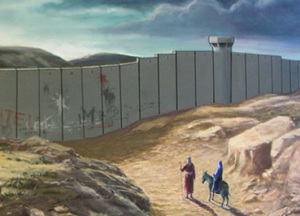
Bethlehem is not a stage setting for a fairy tale envisioned by Walt Disney. The birthplace of Jesus is a real city surrounded by a gigantic prison wall.

The birthplace of Jesus is a city held in bondage by the taboo against telling the truth about Palestine
This cannot continue. The time has come when the intimidation and fear must end. Pilger writes,
“For many people, the truth is out now. At last, they know. Those once intimidated into silence can’t look away now. Staring at them from their TV, laptop, phone, is proof of the barbarism of the Israeli state and the great destructive force of its mentor and provider, the United States, the cowardice of European governments, and the collusion of others, such as Canada and Australia, in this epic crime.”
Pilger reminds us that Nelson Mandela called the struggle of Palestine “the greatest moral issue of our time”
.
Pilger denounces the “mass murder” in Gaza this past summer, as an act “sponsored by the same godfather in Washington that answered the cries of children in Gaza with more ammunition to kill them”.

The psalmist instructs us that we will remain in bondage to an “epic crime” so long as continue to honor the taboo against telling the truth about Palestine.

Television writers remind us in sci-fi films, “the truth is out there”. True enough, but the psalmist reminds us that the truth of our bondage is part of our daily existence, a bondage that keeps us from smashing down those taboos that keep us blind to the suffering that cries out to be heard.

It is that taboo which keeps us from seeing, as journalist Chris Hedges writes, that the current tangible force of evil that haunts us is a creature of our own making, the Islamic State of Iraq and Syria (ISIS).Hedges
ISIS is “our Frankenstein” Hedges (left), writes:
“The United States after a decade of war in Iraq pieced together its body parts. We jolted it into life. We bathed it in blood and trauma. And we gave it its intelligence. Its dark and vicious heart of vengeance and war is our heart. It kills as we kill. It tortures as we torture.
It carries out conquest as we carry out conquest. It is building a state driven by hatred for American occupation, a product of the death, horror and destruction we visited on the Middle East.
There is no taboo against speaking of ISIS.  The taboo related to ISIS is its connection to another American creation, the modern state of Israel.

Hedges opens a door into the darkness of our refusal to acknowledge our major role in Israel’s creation myth. He sees ISIS as an emulation of the modern state of Israel.
“ISIS now controls an area the size of Texas. It is erasing the borders established by French and British colonial powers through the 1916 Sykes-Picot Agreement. There is little we can do to stop it.
ISIS, ironically, is perhaps the only example of successful nation-building in the contemporary Middle East, despite the billions of dollars we have squandered in Iraq and Afghanistan.
Its quest for an ethnically pure Sunni state mirrors the quest for a Jewish state eventually carved out of Palestine in 1948.”
Why have we not seen the parallels between the creation of ISIS and the earlier creation of Israel?  The taboo against speaking the truth about Palestine is enforced by our mainstream media, our churches and our political leaders.

bethlehem-wall-2010cropped
The bondage of the people of Palestine and the attacks by Israel are not limited to Palestinians. As Pilger points out:
“The attack on Gaza was an attack on all of us. The siege of Gaza is a siege of all of us. The denial of justice to Palestinians is a symptom of much of humanity under siege and a warning that the threat of a new world war is growing by the day.”
Hedges, a former New York Times correspondent who was based in Jerusalem, makes the connection between the rise of ISIS and the creation of the modern state of Israel:
“[ISIS] tactics are much like those of the Jewish guerrillas who used violence, terrorism, foreign fighters, clandestine arms shipments and foreign money, along with horrific ethnic cleansing and the massacre of hundreds of Arab civilians, to create Israel.
Antagonistic ISIS and Israeli states, infected by religious fundamentalism, would be irreconcilable neighbors. This is a recipe for apocalyptic warfare. We provided the ingredients.”
We are complicit in the creation of the modern Middle East. By honoring the taboo described by Edward Said, we made and now sustain Israel, not as a democracy which it claims to be, but as a war machine designed to extend the American empire over the bodies of dead children in Gaza and the West Bank.
Palestine Is Still The Issue:


Article by James M. Wall

Saturday, January 17, 2015

I Love Israel and I Apologize

Palestinian refugees leaving a village near Haifa, June 1948
Palestinian refugees leaving a village near Haifa, June 1948. Photo by Corbis

... at a meeting convened by Ayelet Shaked (Habayit Hayehudi), the most successful politician in Israel at present explained: 
“This election is between those who apologize and those who are proud ... those who are objective and those who are in favor of the State of Israel.”
Well, [Habayit Hayehudi chairman] Naftali Bennett, I apologize and I love Israel (of course not your Israel and not the present Israel); I’m objective and I’m in favor of (a just) State of Israel; I apologize and I’m proud.
You’re going to stop apologizing? Israel never even started doing so
If only it had apologized a long time ago. If only it would acknowledge its sins, if only it would accept moral responsibility for them.
It’s no shame to apologize – it’s far more embarrassing not to do so. Apologizing is a strength, not a weakness, and on the way to reconciliation (with the Palestinians) we have to stop at the first station – an apology. 
It’s true that in the elite unit of Bennett and Yinon Magal they don’t apologize for anything, not even for acts of murder, assassinations and abductions (the murder of Abu Jihad, for example, or the abduction of Sheikh Obeid). In the settlements they don’t apologize for anything either – not for the exploitation, not for the disinheritance and not for the theft.
As a rule, in Israel people don’t apologize for anything, not in the occupation nor on the road. Guilt feelings are an embarrassment, and apologizing is for those with no backbone. 
That’s why Bennett’s election slogan: “Stop Apologizing. Be Proud” will become so catchy and popular: the “apologizers” vs. “the proud,” the “objective ones” vs. “lovers of the country.” I’m proud to belong to the former group.
I would like to apologize, if that would be of any significance, to the entire Palestinian people, throughout the generations. For 1948, for 1967 and for everything that happened in their wake. An apology for 1948 would not have made the state that was established less just – it would have become more just. For the mass expulsion and for preventing the return, for the ethnic cleansing in several districts and for several acts of slaughter, which may be part of every war – we can and should apologize.
We can and should apologize for the fact that what happened in 1948 has never ended. That the spirit of 1948 has not passed, and continues to this very day in the State of Israel’s basic attitude toward the Palestinian inhabitants of the land, in its sense of ownership and superiority, in its aggressiveness and violence, in its ultranationalism and racism.
Nor has anything changed in the policy of dispossession: Take what you can – then as now, when the State of Israel is already a regional power. We should apologize for that. We should apologize for the innumerable dead killed for no reason, for the endless lies and deception. For tyranny in the territories and for apartheid. For trampling a nation’s dignity, for suffocating its freedom and for separating it and breaking it up into tiny nations. For erasing its heritage and disdaining its culture. For short-changing Israeli Arabs and for demonstrations of racism against them. For the “price tag” crimes and the Operation Protective Edge crimes. For all of them we should apologize.
Apologizing would not solve anything or atone for anything, but it could signal a genuine intention to turn a new leaf.
Apologizing would broadcast moral strength and self-confidence, which the country so badly lacks, convinced as it is that it can live forever on its sword, even if there is not a single historical precedent for that. For all these things (and more) Israel will have to apologize some day.
Anyone who believes that even if the reconciliation is delayed, it will eventually come, understands that it must include an apology. That’s how it was in South Africa and that’s how it will be in Israel, if it’s not too late.