Showing posts with label Israeli Settlements. Show all posts

Wednesday, February 04, 2015

The Myth and The American Jewish Community

Israel pledge

Until the 1930s, a sizeable portion of the U.S. Jewish community was skeptical, at best, about the Zionist project.  America was their promised land.   Knowledge of the Holocaust gave a great boost to support for a Jewish state.  But once that state was established in 1948, the passion for Israel subsided here.  In the 1950s, when sociologists asked Jews what made them different from gentiles, the answers they got rarely mentioned any special affinity for the state or land of Israel.  In fact, most people said that there was no special value or belief or behavior that made them different from their gentile neighbors.  The only thing that made them different was that their friends were Jews.  Being Jewish was mainly a social thing.  Jews hung out with other Jews.

These Jews did not complain a whole lot about anti-semitism either.  Many of them had experienced significant anti-semitism in the pre-World War II days.  They knew it was still around.  But they knew that things were far better than they had been, and they looked forward to even more social acceptance in the future.  So it made sense to overlook the vestiges of anti-semitism, to assume it would keep on diminishing until it gradually disappeared.

When did Jews begin to tell the myth of Israel that prevails today?  This is a rare situation where a historian of religions can point to a very precise time, in fact a precise week, when a new story became the official story of a community.  It was the second week of June, 1967, when Israel and its Arab neighbors fought a six-day war.  Jews flocked to their synagogues, not only to pray for Israel, but to inaugurate (though they did not know it) a new form of Judaism based on their new official story.  America’s most eminent historian of Judaism, Rabbi Jacob Neusner, has called this new form “the Judaism of Holocaust and Redemption.”  The “Holocaust” part represent the belief that anti-semitism is an eternal threat to Jews everyone.  The “Redemption” part represents the twin beliefs that Jews have a special relationship with the land of Israel and that only in Israel can they hope to be safe, redeemed from that eternal threat.

These beliefs, and the myth built upon them, were certainly not totally new.  All of the elements had been around for a long time.   Yet those elements had not been fused so tightly into a single integrated myth.  Nor had they been so central in American Jewish life before the six-day war.  Every history of American Jewish life describes this dramatic change.  So far, there is no commonly accepted theory to explain why it happened.  So I want to offer my own theory.

Several factors came together in June, 1967.  One was a kind of emptiness in American Jewish life, a sense that no one quite knew what special values Jews were supposed to hold just because they were Jews.  For most of them it was just a matter of socializing with other Jews.  Perhaps there was an unconscious sense that Judaism ought to mean something more than that.

Of course, 1967 was a time when many people in the U.S. were beginning to explore new possibilities for meaning and identity.  Issues of individual and group identity became more urgent than before.  Our whole society was entering a brief era when everything seemed open to question.  Remember, June, 1967, wasn’t only the time of the six-day war.   It was also the beginning of San Francisco’s summer of love.  For many Americans, it was a time of cultural confusion, a time when U.S. society seemed to be falling apart.  In such a time, it is quite common that individuals and groups will seize upon one particular story that gives them a highly structured sense of meaning.  If the story seems to answer their questions and make sense out of confusing times, they will cling to it tightly, no matter what happens.

For Jews, the question of ethnic identity was especially acute.  African-Americans were asserting their right to equality more powerfully than ever before.  Some Jews had expressed their Jewish identity by working with the civil rights movement.  By 1967, many of these Jews were disturbed, or even scared, by the rise of the black power movement.  They were no longer sure that the cause of racial justice had any place for white people.  Yet they could see that it was becoming acceptable in liberal circles to assert one’s ethnic identity.  African-Americans, Latinos, Asians, and native Americans were all standing up as oppressed people demanding their rights.

This placed the Jews in a real quandary.  As white people, they could easily be classed with the oppressors.  When tensions broke out in inner city ghettos, individual Jews were sometimes identified as oppressors.  This was an uncomfortable feeling, of course, especially for the many Jews who genuinely sympathized with the cause of people of color.

At the same time, the growing antiwar movement was raising another very disturbing question:  Perhaps the United States itself was not a force for freedom, but rather a force for oppression, in Vietnam.  If the U.S. was the oppressor in Vietnam, this would make all Jews, along with all other Americans, oppressors as well.  By 1967, a new story was emerging to shape the experience of all Americans as they watched the events of the day unfold.  This story said that every person was either with the oppressors or the oppressed.  In Camus’ terms, everyone was either an executioner or a victim.   It was the most fundamental moral choice, and no one could avoid making it.  So how could Jews be sure that, when oppression arose, they were on the right side?  How could they be sure they were victims and not executioners?

One possibility was to depict themselves as perpetual victims of anti-semitism.  However, American Jews did not want to believe that they would always be threatened by anti-semitism simply because they lived in the diaspora.  They hoped that anti-semitism was gradually fading away, allowing them to live fully and freely as Americans.  How could they feel fully accepted, yet still count themselves among the oppressed?

The events of June, 1967, solved that problem.  For Jews around the world, and here in the U.S., there was no doubt that the Arabs were the aggressors and Israel the victim.  By picturing Israel as a small, weak, victimized nation, and then identifying themselves with Israel, Jews could feel certain that they were among the oppressed.  They could see the U.S. as a place where Jews were increasingly accepted, but still view themselves as victims of persecution.  So American Jews “discovered” a special, almost mystical tie between every Jew and the holy land.  If they were tied to Israel, and Israel was being persecuted, they were being persecuted.  So they could not be among the persecutors.  There could be no doubt about which side of the moral divide they were on.  That question was laid to rest.
Six days later, however, a new problem had emerged.  The Israeli army had proven itself superior in every way to the Egyptians, Jordanians, and Syrians combined.  Israel now possessed not only Jerusalem, but all of the West Bank and Gaza.  In the Jewish community, it seemed obvious that this was something to celebrate.  Few people consciously addressed the problem, but it was obvious if you stopped to think about it.  How could such a triumphant military power call itself a small, weak victim?  If Israel was so powerful, could Jews still be sure they were on the side of the oppressed?

This problem was especially acute for American Jews, who could not express their tie with Israel in political terms.  Politically, they wanted to be 100% American.  They had to express their Jewishness as a religious or cultural identity.  So they had to make support for the political state of Israel a religious or cultural value.  For virtually all of them, that meant making support for Israel a moral and ethical value.  They could not celebrate Jewish power and military victory as good in and of itself.  They had to give it an ethical meaning.

Power could have an ethical meaning as long as it was used only to fight oppression.  Jews could give Israel’s power a moral value as long as they viewed Israel as a victim of aggression.   They could celebrate Israel’s military victory as long as they believed it a justified and necessary act of self-defense.  By identifying with Israel, they could participate in that act of power and feel perfectly moral at the same time.

Identifying with Israel meant making Zionism the center of Jewish life.  Few American Jews became Zionists in the full sense, since that would require actually moving to Israel.  For most, Zionism meant simply supporting both the concept and the reality of the Jewish state.  It meant equating the fate of Israel with the fate of every Jew, everywhere.

It is no coincidence that, just when American Jews “discovered” their unbreakable bond with Israel, they also “discovered” the unique importance of the Nazi Holocaust in every Jew’s life.  Until 1967, Jews did not talk a great deal about the Holocaust.  But the six-day war catapulted the memory of the Holocaust into the center of Jewish life.  The Holocaust was offered as crucial proof that anti-semitism is indeed eternal, that Jews are indeed perpetually threatened by irrational hatred and oppression.  This, in turn, became the supposed proof that all Arabs were motivated by the same hatred that had moved the Nazis to their murderous project.

Once this premise was accepted, there could be no doubt that Israel’s military victory was a necessary act of self-defense, and therefore absolutely morally justified.  This is why the Holocaust and Israel were linked so closely in what Neusner calls “the Judaism of Holocaust and Redemption.”  The memory of the Holocaust provided the crucial link between the perception of Jews as oppressed victims and the sense of pride in Israel’s achievements and its power.

Most Jews still do not have to live differently from their gentile neighbors, because too much difference might make them potential targets of stigma, discrimination, and oppression. Yet in order to sustain their new-found form of Judaism, Jews must exaggerate or overestimate their own experience of anti-semitism. Many seem eager to trade stories of anti-semitism and hear their leaders do the same, as if they enjoy hearing bad news.  That is how they convince themselves that Israel’s motives are always pure and innocent, which means that Jewish power is always morally justified—even when the facts on the ground (or, more precisely, viewed on television) seem to raise troubling questions about the morality of Israeli policies.

Within the terms of the dominant doctrine, every threat must be countered.  Fighting back is a way to prove both that Jews are being victimized and that Jews have power.  Since Israel has the most powerful military in the Middle East, when it responds to threat it usually uses major force.  Naturally, this evokes angry, sometimes violent, responses.  Jews take those responses as proof of threat and reason for even more forceful response.  Military conflict serves as a kind of ritual performance, a way to act out their beliefs and confirm their basic premise that Jews, the perpetual victims, always use their power in a morally justified cause.

Tragically, this performance is a ritual sacrifice in which far too many real people die. Most of them are Arabs. Some are Jews. This hardly makes Israel more secure.  On the contrary, it perpetuates the physical facts of insecurity.  Here in the U.S., as well as in Israel, it also perpetuates and exacerbates the psychological facts of fear, anxiety, and defensiveness in Jewish life.  It demands a sense of perpetual victimhood.  It creates a culture of victimization.  This is a high price to pay.

Yet many Jews have been, and still are, willing to pay that price.  Perhaps this tells us that human beings find security not in physical safety, nor in freedom from fear, but in beliefs that offer a firmly fixed, immutable, unquestioned sense of meaning and identity.  As long as “the Judaism of Holocaust and Redemption” gives them meaning and identity, Jews will cling to it and repeat its ritual performances, regardless of the price.

Since the early years of the 21st century, a steadily growing number of Jews have been questioning—and some overtly rejecting—the myth of Israel’s insecurity with all that it entails. Whether this trend will continue, and if so how rapidly it will accelerate, is the great question for the American Jewish community.

Monday, February 02, 2015

The Zionist Myth of Insecurity


From a Jewish perspective, the earliest roots of the Israel-Palestine go back to the mid-19th century, far away from the Middle East, in Russia and other lands of Eastern Europe. There some number of Jews looked westward and saw Jews in Germany and other Western European lands beginning to enjoy legal and social equality with their gentile neighbors. The Eastern European Jews hoped that the wave of modernization moving eastward would bring them the same equality. They were prepared to pay the same price their fellow Jews in the West had paid: giving up traditional Jewish beliefs and practices (what’s now called Orthodox Judaism) as a relic of the medieval past, which they associated with Jewish oppression and weakness.

These modernizing, secularizing Jews in Eastern Europe saw their hopes dashed in 1881, when a wave of Pan-Slavism—nationalism and chauvinism, accompanied by anti-semitism—swept across Russia and other eastern European lands.  This crushed the hopes of Jews who believed that their gentile neighbors would adopt the modern Western idea of tolerance and accept Jews as equals.  Some Jews left Russia. Some became revolutionaries.

But a small number took a different approach, articulated most famously in Leo Pinsker’s pamphlet “Self-Emancipation,” published in 1882.  Pinsker argued that as long as Jews lived as a minority in diaspora, they would always be “hated rivals” and victims of anti-semitism, no matter where they lived and no matter what they did. Pinsker told the Jews:  “You are foolish because you stand awkwardly by and expect of human nature something which it has always lacked—humanity.  You are contemptible, because you have no real self-love and no national self-respect.” The Jews would continue to hate themselves and embrace their own degradation, he wrote, as long as they remained as a minority living in exile.  Only when the Jews became normal, “a nation like the others,” would they find self-respect and “rise manfully to [their] full height.”

Theodore Herzl, who led the creation of a Zionist political organization, saw things much the same way. His Israeli biographer, Amos Elon, wrote that Herzl, a famous newspaper columnist, was motivated above all by “wounded pride”—being denied what he thought was his rightful place among the elite of European society simply because he was Jewish. Like virtually all the early Zionists, Herzl had no attachment to Jewish religious tradition. He was well aware that he was making national pride the sacred center of Jewish identity. So he urged the early Zionists to “turn the Jewish question into a question of Zion.”

Pinsker’s and Herzl’s views laid an enduring foundation for Zionism. For most Zionists, security was always more than a geopolitical and military category.  It was a psychological and even moral concept.  

Zionist theory held that, everywhere in the world, Jews would be threatened by the fatal combination of anti-semitism and self-doubt.  Jews had learned from centuries of oppression to feel vulnerable, inadequate, and incapable of standing up for themselves, the Zionists said. Therefore they would feel insecure and powerless before the gentile onslaught.  But It is shameful and contemptible to let oneself fall victim to inhumane persecution. Since gentiles would always be inhumane persecutors, Jews would always feel inferiority, shame, and self-contempt as long as live in Diaspora, ruled by gentiles.

There was only one remedy, Zionists argued: a nation of their own, a Jewish state.  As they looked at Western Europe, they saw modern political nationalism becoming the norm. The Greeks had won their independence from the Turkish empire. Germany and Italy were unifying. Every normal ethnic group, it seemed, had its own political state. Only nationhood would make the Jews normal, giving them the psychological security that comes from self-respect and leads to geopolitical security. This “normalization” was their guiding ideal. By making themselves a normal nation, like all the other nations, they expected to earn the world’s respect and be treated as equals in the family of nations.

Unfortunately it did not work out that way, because there were fatal flaws in the theory of “normalization.”  Any normal nation in late 19thcentury Europe viewed it history as a seemingly endless conflict between “us” (and “our” allies) and “them,” the real or potential enemies.  A normal nation assumed that it would always have to be militarily prepared to defend itself against its foes. Being afraid of enemies was a part of being a normal nation.

So the earliest Zionists who left Eastern Europe to settle in the Turkish colony of Palestine were stuck in an impossible contradiction. Most of them assumed that gentiles would always harbor an irrational, implacable hatred of Jews, a hatred that the Jews had done nothing to create. So Jews could do nothing to remove or reduce it.  Jews could only escape the gentiles to create their own normal nation. 

In order to be normal, though, they would have to assume that, once they created their own nation in Palestine, they would still have enemies who hated them. Thus the early Zionist settlers brought with them a deep sense of vulnerability, a conviction that they were passive victims of historical forces beyond their control.

Even if they hoped that some day things would change, they were still trapped in a catch-22. In order to feel normal and secure they had to be free of anti-Semitic persecution. So their test of the success of Zionism was how well the Jewish state was received by the gentile world. Even if they broke free of the political grip of the gentiles, they would always be watching over their shoulders to see how the gentiles were viewing them. Thus they could never escape the sense that their self-worth depended on the judgment of others. Even if they got political freedom, they could never break from the feeling that they were passive victims of the gentiles in a social-psychological way.

What’s more, they did not have a very clear vision of the intermediate steps in their political progress.  Their dominant ideology suggested that they could would not have the power to shape their own fate until they had achieved the goal of statehood.  Until then, they would feel like passive victims.

In fact, from the very beginning, Zionists were agents of historical change.  They did whatever they could to achieve their ends by political, economic, and sometimes violent means: they bought land, built farms and villages, created political structures, and negotiated with the Palestinian Arabs about all sorts of things. The negotiations sometimes led to relatively amicable relations between Zionists and Palestinian Arabs.

Sometimes though, inevitably, there was conflict. Sometimes parties on both sides resorted to violence to get their way, which intensified the conflict.  A few Zionists saw that the Palestinians were responding to specific policies that the Zionist movement had chosen. A few understood that the Zionists had become part of a vast relational network of Middle Eastern peoples. In any such network, the words and actions of each actor impact all the others; no one is merely a passive victim of others’ choices.  In this particular network, some Arabs as well as Jews sought to emulate the secular nationalist model they saw dominating Europe. An Arab nationalist movement seeking independence from the Turkish empire was already well underway.

But most Zionists could not see this because they had become locked into, and blinded by, their dominant narrative. Their consciences did not want to admit that they were now empowered historical actors, because they would mean they bore some responsibility for eliciting enmity from others.  It was easier to charge the enmity to an irrational antisemitic hatred of the Jews, a hatred beyond their control. If their actions could neither evoke, intensify, or alleviate their enemy’s attitudes, then they could not bear any responsibility for the ongoing conflict. All they could do was to defend themselves by force. So it was appealing to interpret any Palestinian Arab resistance as evidence of sheer antisemitism.

However the tradition that started with Pinsker said that when Jews were attacked by antisemites, the insecurity and powerlessness they felt were evidence of their moral weakness, self-doubt, and self-hatred.  Every hint of weakness reminded the Zionists that they had not yet fully answered Pinsker’s call to stand up proudly and manfully.  So they fought back, not only to protect themselves physically but, even more, to protect themselves from their own self-doubts. Each time the Zionists asserted themselves against the Palestinians they could feel reassured that they were genuinely proud and self-reliant, that they were “rising manfully to full height.” At the same time, they could feel reassured that they were morally innocent victims of anti-semitism.

But that interpretation created more problems than it solved. If the Zionists were still victims of an anti-semitism beyond their control to influence, then they were not yet agents of their own history. They were insisting on their passivity, the very condition they had hoped to escape. So they only heightened their negative self-image, their sense of powerlessness and insecurity. That, in turn, heightened their doubts about their own self-worth, wondering whether they could ever be normal. The natural response was to take more actions that would assuage self-doubt. They had to go on showing that they were capable of exercising power, prove that they could hit back, like normal people.

Of course every time they hit back, the Palestinians were likely to hit back in response. The Zionists interpreted each new confrontation as further evidence of the Jews’ vulnerability, passivity, and insecurity, which only intensified their feeling of self-doubt.  And that, in turn, intensified their conviction that antisemitism was eternal, that they would always be insecure. The only possible response was to strike back again—which locked them more firmly into their narrative and generated ever more insecurity. This narrative became so basic to their movement that it functioned as their foundational myth. The Zionists were trapped in a myth of national insecurity.

This myth was already firmly in place during the early years of Zionist immigration to Palestine. (The first major wave of immigrants came around 1905.) It was cemented by the tragedy of World War I. In 1917 Britain’s foreign secretary, Lord Balfour, declared that his government would “view with favour the establishment in Palestine of a national home for the Jewish people,” though he added that Britain would not want to “prejudice the rights of existing non-Jewish communities in Palestine.” At the same time, the British used T. E. Lawrence to promise the Arabs independence from the Turks in return for the Arabs’ help in fighting the war.  But after the war Britain itself took charge of Palestine under a League of Nations mandate. It is no coincidence that the first large scale violence between Zionists and Arabs broke out in 1919, fueled by the frustrations of seeing their nationalistic hopes dashed.

Throughout the British mandate period (1919 – 1947) most Zionists continued to interpret their own acts of force as the regrettably necessary actions of innocent victims. This gave them a satisfying conviction that all their actions were morally righteousness.  But it also reinforced the fundamentals of the Zionist myth of insecurity: Our enemies threaten our very existence; we are wholly innocent, having done nothing at all to evoke such enmity; we must inflict enough defeats on our enemies to prove to them—and ourselves—our indomitable strength.

An important difference developed among them, though. The mainstream of Zionism, led by David Ben Gurion, tried it best to appear moderate, willing to make compromises, and hoping to limit violence. A new group known as Revisionists, led by the Vladimir Jabotinsky, asked (in effect), Why bother even thinking about the world’s response? The world hates us anyway; nothing we do now can make the gentiles hate us more. Since we are surrounded by eternal enemies, the only way to insure our survival is to make it clear that we want all of Palestine, refuse any compromise, and maintain our strength and dominance Since the Arabs only understand force, we must use force to insure our control of Palestine, by any means necessary.

A third and much smaller group, led by the philosopher Martin Buber, preached that it was wrong to blame the Arabs, as if the Jews’ behavior had nothing to do with it. A central theme in Buber’s philosophy was the freedom, and the obligation, to make moral choices and take responsibility for one’s choices. He told the Zionists that the fate of their movement would be decided not by their opponents but by the choices they made.  “It depends entirely on us,” he said, “whether the Arabs treat us as welcome friends or hated enemies.” By the late 1930s Buber was leading a small group of Jews committed to creating a single bi-national state, giving equal rights and equal power to both Jews and Arabs.

The horrors of the Nazi Holocaust locked mainstream and Revisionist Zionists even more tightly into the myth of insecurity. By the mid-1940s, it seemed all too realistic to fear that the Jewish people might be, not just grievously harmed, but annihilated by antisemites. The Zionist premise of eternal antisemitism seemed much more convincing, too. The fear of antisemites and annihilation spurred the Jews to demand their own state. So their fear was deeply embedded in the foundations of the state of Israel, which declared its independence in 1948. Having a Jewish state did not bring any sense of real normalization. It merely created a new stage on which to play out the myth of insecurity.

Tuesday, January 20, 2015

When Will Palestinians Learn?


Turning To International Law Isn't The Answer — Just Ask America and Israel


Throw an old dog a bone and sure enough, he’ll go chasing after it. So it is with “Palestine’s” request to join the International Criminal Court. An obvious attempt by Mahmoud Abbas to try Israel for war crimes in Gaza this year, we are told.
Or maybe a “two-edged sword” – yawns are permitted for such clichés – which could also put Hamas “in the dock”. Israel was outraged. The US was “strongly opposed” to such a dastardly request by the elderly potentate who thinks he rules a state which doesn’t even exist.
For years, the Palestinians have demanded justice. They went to the international court in The Hague to have Israel’s apartheid wall dismantled – they even won, and Israel didn’t give a hoot. 
Any sane Palestinian, you might think, would long ago have turned his or her back on such peaceful initiatives.
Yet still these wretched Palestinians persist, after this most humiliating of insults, in resorting to international law to resolve their conflict with Israel. Here they go again, dutifully seeking membership of the International Criminal Court. Will these Arabs never learn?
After all, the Palestinians would indeed have to abide by international law and – if the law applied retrospectively – they would have to carry the burden of opprobrium themselves for both Hamas crimes and past PLO murders. 
The United States, of course – and this fact oddly did not feature in the flurry of news reports on “Palestine’s” request to join – has itself refused to join the International Criminal Court. And with good reason; because, like the Israelis – although this is not quite how the whole fandango was explained to us – Washington is also worried that its soldiers and government officials will be arraigned for war crimes. Think waterboarding, Abu Ghraib, the report on CIA torture…
No wonder Jeffrey Rathke, the windbag who speaks for the State Department, says that the Palestinian request “badly damages the atmosphere” with Israel, “undermines trust” and “creates doubts about their (Palestinian) commitment to a negotiated peace”. 
And remember, Abbas only made his request after America had voted against – it has previously used its veto more than 40 times on Israel’s behalf to reject Palestine’s self-determination since 1975 – a UN Security Council resolution to end Israel’s occupation of Palestinian land by 2017.
The world is tired of witnessing the suffering of Palestinians. Those with an ounce of human sympathy are sickened at being slandered as anti-Semitic or anti-Zionist (whatever that is) every time they express their outrage at Israel’s cruelty towards the Palestinians.
Killing more than 2,000 Palestinians last summer, hundreds of them children, was a mass slaughter. We’ve watched this grotesquerie so many times now – in Gaza, for the most part – that even our statistics have become spattered with blood.
Who now recalls the fatalities of the 2008-9 Gaza war? One thousand four hundred and seventeen Palestinians dead, 313 of them children, more than 5,500 wounded. That was the conflict upon which President-elect Obama had no comment to make.
And who knows what other gory Pandora’s box ICC membership would open? That bomber pilot who in 2002 killed 15 civilians, 11 of them children, in a Gaza apartment block to assassinate a Hamas official, for example? Wouldn’t that constitute a war crime? Don’t these outrages “damage the atmosphere” and “undermine trust”. Were these bloodbaths not “entirely counterproductive”? And the Jewish colonisation of the occupied West Bank?
Sure, bang up those behind Hamas and Islamic Jihad suicide attacks for war crimes. Get the Palestinian Authority thugs who torture and murder their own prisoners. 
But that’s not what Israel and the US are worried about. They are concerned that, after months of arguing and rowing and delving through thousands of documents, jurists may decide that Israel – horror of horror – may have to answer for itself before international justice, something which no routine US veto could prevent.
Now just imagine if Israel and America wanted the Palestinians to sign the Rome document. Conjure the thought – for a split-second only – that Israel and America insisted that the Palestinians must abide by an international treaty and become members of the International Criminal Court to qualify for statehood. Abbas’s refusal to do so would be further proof of his “terrorist” intentions. Yet when Abbas does sign the Rome document, when the Palestinians want to abide by an international treaty, they must be punished – surely a “first” in modern history.

Monday, January 19, 2015

A Taboo On Telling The Truth About Palestine

Recently, while listening to a live performance of the Messiah, I remembered an article by John Pilger (right) which he adapted from his Edward Said Memorial Lecture presented in Adelaide, Australia, September 11.

The Adelaide lectures have been presented annually since 2005 in honor of the late Edward Said, the Palestinian scholar and political activist who was as a major face and voice of Palestine. 

I had been thinking about the absence of Christian outrage and action from the institutional Christian church over this summer’s Gaza massacre. Pilger, an Australian-born film-maker and author, who now lives in England, connected Said for me, to Psalm 2:3. He did so with a statement Pilger quotes from Said:
“There is a taboo,” said the visionary Edward Said, “on telling the truth about Palestine and the great destructive force behind Israel. Only when this truth is out can any of us be free.”
Handel chose Psalm 2:3 to deliver this same wisdom in Part Two of his Messiah: “Let us break their bonds asunder, and cast away their yokes from us.”

Our refusal to speak and act on the truth about Palestine’s physical and mental bondage imposed by the military might of Israel is a manifestation of our last taboo.

edward_saidWhat exactly is this taboo?

Said (left) believed the “great destructive force behind Israel” demands that we honor the taboo against telling the truth about Palestine.

During this Christmas season, what does the Christian church say and do, in its individual and corporate forms, about this bondage? 

We sing about angels in Bethlehem, and we thrill to the musicality of theHallelujah chorus that follows Psalm 2:3 in Handel’s Messiah.

We preach about loving our neighbor, but we say and do nothing to love our Palestinian neighbors enough to speak out and act against the Israeli occupation bondage which our nation defends, endorses and finances.
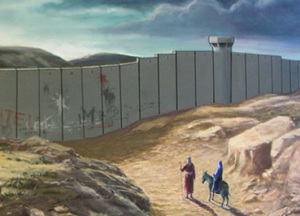
Bethlehem is not a stage setting for a fairy tale envisioned by Walt Disney. The birthplace of Jesus is a real city surrounded by a gigantic prison wall.

The birthplace of Jesus is a city held in bondage by the taboo against telling the truth about Palestine
This cannot continue. The time has come when the intimidation and fear must end. Pilger writes,
“For many people, the truth is out now. At last, they know. Those once intimidated into silence can’t look away now. Staring at them from their TV, laptop, phone, is proof of the barbarism of the Israeli state and the great destructive force of its mentor and provider, the United States, the cowardice of European governments, and the collusion of others, such as Canada and Australia, in this epic crime.”
Pilger reminds us that Nelson Mandela called the struggle of Palestine “the greatest moral issue of our time”
.
Pilger denounces the “mass murder” in Gaza this past summer, as an act “sponsored by the same godfather in Washington that answered the cries of children in Gaza with more ammunition to kill them”.

The psalmist instructs us that we will remain in bondage to an “epic crime” so long as continue to honor the taboo against telling the truth about Palestine.

Television writers remind us in sci-fi films, “the truth is out there”. True enough, but the psalmist reminds us that the truth of our bondage is part of our daily existence, a bondage that keeps us from smashing down those taboos that keep us blind to the suffering that cries out to be heard.

It is that taboo which keeps us from seeing, as journalist Chris Hedges writes, that the current tangible force of evil that haunts us is a creature of our own making, the Islamic State of Iraq and Syria (ISIS).Hedges
ISIS is “our Frankenstein” Hedges (left), writes:
“The United States after a decade of war in Iraq pieced together its body parts. We jolted it into life. We bathed it in blood and trauma. And we gave it its intelligence. Its dark and vicious heart of vengeance and war is our heart. It kills as we kill. It tortures as we torture.
It carries out conquest as we carry out conquest. It is building a state driven by hatred for American occupation, a product of the death, horror and destruction we visited on the Middle East.
There is no taboo against speaking of ISIS.  The taboo related to ISIS is its connection to another American creation, the modern state of Israel.

Hedges opens a door into the darkness of our refusal to acknowledge our major role in Israel’s creation myth. He sees ISIS as an emulation of the modern state of Israel.
“ISIS now controls an area the size of Texas. It is erasing the borders established by French and British colonial powers through the 1916 Sykes-Picot Agreement. There is little we can do to stop it.
ISIS, ironically, is perhaps the only example of successful nation-building in the contemporary Middle East, despite the billions of dollars we have squandered in Iraq and Afghanistan.
Its quest for an ethnically pure Sunni state mirrors the quest for a Jewish state eventually carved out of Palestine in 1948.”
Why have we not seen the parallels between the creation of ISIS and the earlier creation of Israel?  The taboo against speaking the truth about Palestine is enforced by our mainstream media, our churches and our political leaders.

bethlehem-wall-2010cropped
The bondage of the people of Palestine and the attacks by Israel are not limited to Palestinians. As Pilger points out:
“The attack on Gaza was an attack on all of us. The siege of Gaza is a siege of all of us. The denial of justice to Palestinians is a symptom of much of humanity under siege and a warning that the threat of a new world war is growing by the day.”
Hedges, a former New York Times correspondent who was based in Jerusalem, makes the connection between the rise of ISIS and the creation of the modern state of Israel:
“[ISIS] tactics are much like those of the Jewish guerrillas who used violence, terrorism, foreign fighters, clandestine arms shipments and foreign money, along with horrific ethnic cleansing and the massacre of hundreds of Arab civilians, to create Israel.
Antagonistic ISIS and Israeli states, infected by religious fundamentalism, would be irreconcilable neighbors. This is a recipe for apocalyptic warfare. We provided the ingredients.”
We are complicit in the creation of the modern Middle East. By honoring the taboo described by Edward Said, we made and now sustain Israel, not as a democracy which it claims to be, but as a war machine designed to extend the American empire over the bodies of dead children in Gaza and the West Bank.
Palestine Is Still The Issue:


Article by James M. Wall

Saturday, January 17, 2015

I Love Israel and I Apologize

Palestinian refugees leaving a village near Haifa, June 1948
Palestinian refugees leaving a village near Haifa, June 1948. Photo by Corbis

... at a meeting convened by Ayelet Shaked (Habayit Hayehudi), the most successful politician in Israel at present explained: 
“This election is between those who apologize and those who are proud ... those who are objective and those who are in favor of the State of Israel.”
Well, [Habayit Hayehudi chairman] Naftali Bennett, I apologize and I love Israel (of course not your Israel and not the present Israel); I’m objective and I’m in favor of (a just) State of Israel; I apologize and I’m proud.
You’re going to stop apologizing? Israel never even started doing so
If only it had apologized a long time ago. If only it would acknowledge its sins, if only it would accept moral responsibility for them.
It’s no shame to apologize – it’s far more embarrassing not to do so. Apologizing is a strength, not a weakness, and on the way to reconciliation (with the Palestinians) we have to stop at the first station – an apology. 
It’s true that in the elite unit of Bennett and Yinon Magal they don’t apologize for anything, not even for acts of murder, assassinations and abductions (the murder of Abu Jihad, for example, or the abduction of Sheikh Obeid). In the settlements they don’t apologize for anything either – not for the exploitation, not for the disinheritance and not for the theft.
As a rule, in Israel people don’t apologize for anything, not in the occupation nor on the road. Guilt feelings are an embarrassment, and apologizing is for those with no backbone. 
That’s why Bennett’s election slogan: “Stop Apologizing. Be Proud” will become so catchy and popular: the “apologizers” vs. “the proud,” the “objective ones” vs. “lovers of the country.” I’m proud to belong to the former group.
I would like to apologize, if that would be of any significance, to the entire Palestinian people, throughout the generations. For 1948, for 1967 and for everything that happened in their wake. An apology for 1948 would not have made the state that was established less just – it would have become more just. For the mass expulsion and for preventing the return, for the ethnic cleansing in several districts and for several acts of slaughter, which may be part of every war – we can and should apologize.
We can and should apologize for the fact that what happened in 1948 has never ended. That the spirit of 1948 has not passed, and continues to this very day in the State of Israel’s basic attitude toward the Palestinian inhabitants of the land, in its sense of ownership and superiority, in its aggressiveness and violence, in its ultranationalism and racism.
Nor has anything changed in the policy of dispossession: Take what you can – then as now, when the State of Israel is already a regional power. We should apologize for that. We should apologize for the innumerable dead killed for no reason, for the endless lies and deception. For tyranny in the territories and for apartheid. For trampling a nation’s dignity, for suffocating its freedom and for separating it and breaking it up into tiny nations. For erasing its heritage and disdaining its culture. For short-changing Israeli Arabs and for demonstrations of racism against them. For the “price tag” crimes and the Operation Protective Edge crimes. For all of them we should apologize.
Apologizing would not solve anything or atone for anything, but it could signal a genuine intention to turn a new leaf.
Apologizing would broadcast moral strength and self-confidence, which the country so badly lacks, convinced as it is that it can live forever on its sword, even if there is not a single historical precedent for that. For all these things (and more) Israel will have to apologize some day.
Anyone who believes that even if the reconciliation is delayed, it will eventually come, understands that it must include an apology. That’s how it was in South Africa and that’s how it will be in Israel, if it’s not too late.

Thursday, January 01, 2015

Palestine: What Hope Peace?


“It’s not about peace, it’s about justice.”Gideon LevyAward-winning veteran Israeli journalist.
This is a feature length documentary film which asks, and presents testimony on the following key questions:
  1. Why is Israel presented as a liberal democracy?
  2. Why are Palestinians portrayed as aggressors, rather than victims?
  3. What is it like to live under Israeli occupation and bombardment?
  4. What does life look like for marginalised groups within Israel?
  5. Where do we go from here?
Kerry-anne Mendoza has been traveling to Israel, Gaza and the West Bank for twelve years.  When Operation Protective Edge commenced in July 2014, readers of Scriptonite Daily crowd funded her to return and report with a perspective and depth missing in the mainstream media.
You can see those reports here.
While producing daily written reports and live Q&A sessions from Gaza, she was also interviewing key witnesses to Israel’s brutal military occupation of the West Bank and the Gaza Strip.
Kerry-anne traveled to the very worst hit areas of Gaza and recorded Israel’s military assaults as they happened, capturing footage you will see nowhere else.
This is a film which puts names and faces to the statistics.
It is about a people under siege, and the indomitable determination of the human spirit to be free.
Kerry-anne Mendoza will be touring the film from November 2014along with Gaza resident Khalil AlTatari.
Bring the film to your school, community centre, cinema or any other venue, together with live Questions and Answers with Kerry-anne and Khalil, by emailing: scriptonitedaily@hotmail.co.uk
If you’d like to donate to support the film and the tour, please do so below:
Scriptonite Daily is a citizen funded news site. If we want to make an alternative media, then we need to build it. Your donations make the difference.

Friday, December 26, 2014

Burning Conscience: Israeli Soldiers Speak Out


A searing interview with Avichai Sharon and Noam Chayut, both veterans of the Israeli Defense Forces and members of Breaking the Silence. Sharon and Chayut served during the second intifada, an on-going bloodbath that has claimed the lives of over three thousand Palestinians and nine-hundred-fifty Israelis. After thorough introspection, these young men have chosen to speak out about their experiences as self-described "brutal occupiers of a disputed land." Producer: Sat Gwin

The soldiers are graduates of the Yitzhak Rabin pre-military preparatory course at Oranim Academic College in Tivon. Some of their statements made on Feb. 13 will appear Thursday and Friday in Haaretz. Dozens of graduates of the course who took part in the discussion fought in the Gaza operation.
The speakers included combat pilots and infantry soldiers. Their testimony runs counter to the Israel Defense Forces' claims that Israeli troops observed a high level of moral behavior during the operation. The session's transcript was published this week in the newsletter for the course's graduates.
The testimonies include a description by an infantry squad leader of an incident where an IDF sharpshooter mistakenly shot a Palestinian mother and her two children. "There was a house with a family inside .... We put them in a room. Later we left the house and another platoon entered it, and a few days after that there was an order to release the family. They had set up positions upstairs. There was a sniper position on the roof," the soldier said.
"The platoon commander let the family go and told them to go to the right. One mother and her two children didn't understand and went to the left, but they forgot to tell the sharpshooter on the roof they had let them go and it was okay, and he should hold his fire and he ... he did what he was supposed to, like he was following his orders."
According to the squad leader: "The sharpshooter saw a woman and children approaching him, closer than the lines he was told no one should pass. He shot them straight away. In any case, what happened is that in the end he killed them.
"I don't think he felt too bad about it, because after all, as far as he was concerned, he did his job according to the orders he was given. And the atmosphere in general, from what I understood from most of my men who I talked to ... I don't know how to describe it .... The lives of Palestinians, let's say, is something very, very less important than the lives of our soldiers. So as far as they are concerned they can justify it that way," he said.
Another squad leader from the same brigade told of an incident where the company commander ordered that an elderly Palestinian woman be shot and killed; she was walking on a road about 100 meters from a house the company had commandeered.
The squad leader said he argued with his commander over the permissive rules of engagement that allowed the clearing out of houses by shooting without warning the residents beforehand. After the orders were changed, the squad leader's soldiers complained that "we should kill everyone there [in the center of Gaza]. Everyone there is a terrorist."
The squad leader said: "You do not get the impression from the officers that there is any logic to it, but they won't say anything. To write 'death to the Arabs' on the walls, to take family pictures and spit on them, just because you can. I think this is the main thing: To understand how much the IDF has fallen in the realm of ethics, really. It's what I'll remember the most."
Source: Haaretz