Showing posts with label West Bank. Show all posts

Friday, December 26, 2014

Burning Conscience: Israeli Soldiers Speak Out


A searing interview with Avichai Sharon and Noam Chayut, both veterans of the Israeli Defense Forces and members of Breaking the Silence. Sharon and Chayut served during the second intifada, an on-going bloodbath that has claimed the lives of over three thousand Palestinians and nine-hundred-fifty Israelis. After thorough introspection, these young men have chosen to speak out about their experiences as self-described "brutal occupiers of a disputed land." Producer: Sat Gwin

The soldiers are graduates of the Yitzhak Rabin pre-military preparatory course at Oranim Academic College in Tivon. Some of their statements made on Feb. 13 will appear Thursday and Friday in Haaretz. Dozens of graduates of the course who took part in the discussion fought in the Gaza operation.
The speakers included combat pilots and infantry soldiers. Their testimony runs counter to the Israel Defense Forces' claims that Israeli troops observed a high level of moral behavior during the operation. The session's transcript was published this week in the newsletter for the course's graduates.
The testimonies include a description by an infantry squad leader of an incident where an IDF sharpshooter mistakenly shot a Palestinian mother and her two children. "There was a house with a family inside .... We put them in a room. Later we left the house and another platoon entered it, and a few days after that there was an order to release the family. They had set up positions upstairs. There was a sniper position on the roof," the soldier said.
"The platoon commander let the family go and told them to go to the right. One mother and her two children didn't understand and went to the left, but they forgot to tell the sharpshooter on the roof they had let them go and it was okay, and he should hold his fire and he ... he did what he was supposed to, like he was following his orders."
According to the squad leader: "The sharpshooter saw a woman and children approaching him, closer than the lines he was told no one should pass. He shot them straight away. In any case, what happened is that in the end he killed them.
"I don't think he felt too bad about it, because after all, as far as he was concerned, he did his job according to the orders he was given. And the atmosphere in general, from what I understood from most of my men who I talked to ... I don't know how to describe it .... The lives of Palestinians, let's say, is something very, very less important than the lives of our soldiers. So as far as they are concerned they can justify it that way," he said.
Another squad leader from the same brigade told of an incident where the company commander ordered that an elderly Palestinian woman be shot and killed; she was walking on a road about 100 meters from a house the company had commandeered.
The squad leader said he argued with his commander over the permissive rules of engagement that allowed the clearing out of houses by shooting without warning the residents beforehand. After the orders were changed, the squad leader's soldiers complained that "we should kill everyone there [in the center of Gaza]. Everyone there is a terrorist."
The squad leader said: "You do not get the impression from the officers that there is any logic to it, but they won't say anything. To write 'death to the Arabs' on the walls, to take family pictures and spit on them, just because you can. I think this is the main thing: To understand how much the IDF has fallen in the realm of ethics, really. It's what I'll remember the most."
Source: Haaretz

Tuesday, November 18, 2014

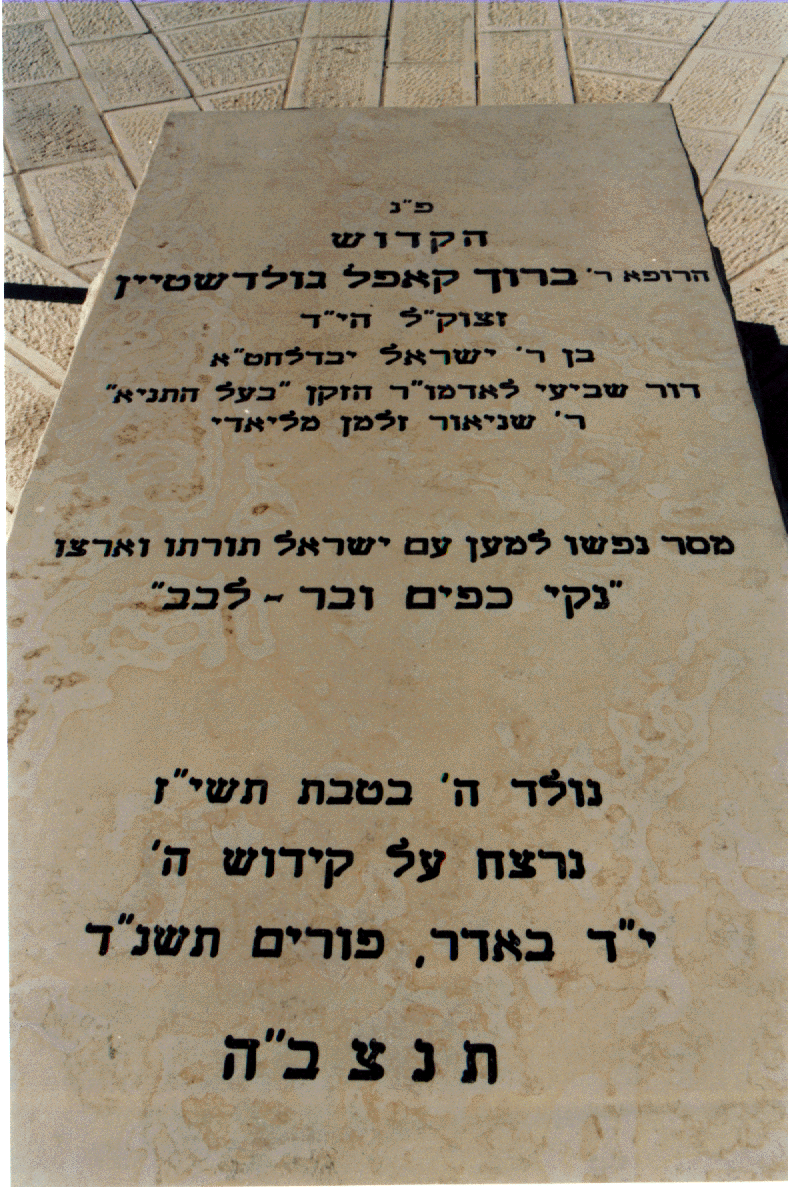
The Grave Of Jewish Mass-Murderer Baruch Goldstein

The grave of Baruch Goldstein, the Jewish extremist who gunned down 29 Muslims inside the Mosque of Ibrahim in Hebron in 1994.


On a hillside in the settlement of Kiryat Arba, overlooking the large West Bank Palestinian city of al-Khalil — known to Israeli Jews and most foreigners by its biblical name of  “Hebron” – is the grave monument of Dr. Baruch Goldstein.

On the Jewish holiday of Purim, February 25, 1994, Goldstein, then a reserve officer in the Israeli army, walked into the Mosque of Ibrahim (the traditional burial place of the Patriarch Abraham) in uniform and with his army-issued weapon, opening fire on the Muslim worshippers. 29 people were murdered outright and 125 wounded before the survivors managed to disarm Goldstein and kill him on the spot.

For many far-right Israeli Jews and especially the settler movement Goldstein was a martyr to the cause of religious Zionism.  His grave in a ceremonial plaza overlooking the Palestinian town became a place of pilgrimage and celebration – to the great embarrassment of the Israeli government and many of its supporters in the US. 

The Hebrew inscription on Goldstein’s grave monument reads, in part:
“The revered Dr. Baruch Kapel Goldstein… Son of Israel.  He gave his soul for the sake of the people of Israel, The Torah, and the Land.  His hands are clean and his heart good… He was assassinated for the Sanctity of God”
During the annual observance of the Purim holiday, settlers gather at Goldstein’s grave to celebrate his deed and sing songs in praise of the man they regard as a noble martyr.  One of the songs includes the verse:


“Dr. Goldstein, there is none other like you in the world. Dr. Goldstein, we all love you… he aimed at terrorists’ heads, squeezed the trigger hard, and shot bullets, and shot, and shot.”
Then the settlers march down to pray at the Mosque/Synagogue of Abraham, accompanied by a  massive show of force by Israeli army troops. 


The 1994 Hebron Massacre launched a fierce outburst of violence in Israel and the Occupied Territories, which included the first suicide bombings carried out by Hamas within the 1948 borders.  

But in this case (Jewish) terrorism worked.  The ancient burial place of the Patriarchs, was now divided into a Muslim and a Jewish section and made accessible to Jewish worshipers and foreign tourists.  

Source: MondoWeiss

The above post is in response to the following post made by, "Ram Locke," from Google Plus, about the Synagogue attack that occurred in occupied Jerusalem:

Another picture from the brutal and cowardly attack this morning on a synagogue in Jerusalem.  No words are needed to describe the horror.
But the "majority of Palestinians want Peace" according to the administration.  Who is full of chickenshit now?  Somehow, we don't hear the statement from the administration (which is totally true) "the majority of Kurds want peace" followed by "and so they should be negotiated with for a free Kurdistan"! Are we only friends with our enemies and do not support our friends?

I do not condone attacks on civilians, but I am merely exposing the suffocating double standards and the "convenient" loss of memory by members of Israeli society, some followers of the Jewish faith and their supporters.


> Israeli's conduct pilgrimages to the grave of an extremist and mass-murderer. An extremist and mass-murderer who is revered and honored, is a sign that they truly seek peace with the Palestinians. 
> Israel continues to steal land and build illegal settlements in the West Bank, which is a definitive sign that it seeks peace.
> Israel continues to arrest Palestinian children, which is a definitive sign that it seeks peace.
> Apartheid Wall, Apartheid buses, Apartheid roads, are a definitive sign that Israel seeks peace.
> Israel stymies every effort to unify the West Bank and Gaza, which is a definitive sign that most Israeli's want peace.
> Israel periodically assaults and devastates Gaza, which is yet another sign that it seeks peace.
> Israel starves over 1 million people in Gaza, which is a sign of it seeking peace. 
> Israel employed violence, terrorism and other military means to establish facts on the ground that led to its creation. Did they only resort to negotiations or did they let the gun speak for them?


Saturday, October 26, 2013

Our Harsh Logic: Inside Israel's Army


Michael Enright in conversation with Dana Golan, a veteran of the Israel Defense Forces (IDF). 

She and many other former Israeli soldiers, say they feel betrayed by the harsh orders they were forced to carry out against the Palestinians. Others speak of the numbing inevitability of the callous tactics they used.

Ms. Golan is the former executive director of the Israeli NGO, Breaking the Silence, which compiled the stories of disillusioned Israeli soldiers in a new book called Our Harsh Logic.

Background:

The Second Palestinian Intifada claimed more than 4,000 lives between 2000 and 2005. Roughly three Palestinians died for every Israeli.

It was a brutal conflict, marred by suicide bombings and rocket attacks on one side, and deadly counter-strikes, indiscriminate raids and widespread repression on the other.

The World Bank estimates that after the four and half year conflict, Palestinians' average income dropped by more than a third, and unemployment hit 25 percent, forcing almost half of all Palestinians below the poverty line.

Tel Aviv's most important weapon in its war against Palestinian militants, was the Israeli Defence Forces.

The IDF is one of the most powerful, precise and well-trained armies in the world. It is tasked with upholding the four tenets of Israeli policy: stop terrorism; pursue separation of Israel from the Palestinian population; enforce Israeli law in the Territories and preserve the Palestinian "fabric of life".

All four tenets are supposed to be defensive and preventative, but for Israeli soldiers on the front lines, reality is far more complicated.

IDF soldiers cab do anything, and rationalize it as defending Israel. Mock arrests, endless checkpoints, human shields ... anything goes.

Many soldiers chafed at the callous tactics they were ordered to use.

Tuesday, July 20, 2010

The Olive Branch In The West Bank

By Hugh Gusterson
9 July 2010

Israel's ambassador to the U.S., Michael Oren, was recently quoted as saying that relations between the U.S. and Israel were undergoing a "tectonic rift in which continents are drifting apart." If the quote is accurate, which Oren later disputed, it is surely an overstatement. Still, an interesting divergence is developing in the means by which the U.S. and Israeli militaries are dealing with Islamic militants in territories they are occupying.

In the past I have dismissed the U.S. counterinsurgency project in Afghanistan as a fool's errand, but one has to at least give credit to the U.S. military for trying to wage counterinsurgency thoughtfully. Since Gen. David Petraeus rewrote the book on counterinsurgency, the U.S. has adopted an approach that seeks to isolate the Taliban from the wider population and to win the hearts and minds of that population. The U.S. has backed away from destroying the Afghan opium crop on which many Afghan peasants rely for income, realizing that eradication efforts were doing more damage to U.S. popularity in Helmand Province than to the opium trade. U.S. commanders are instructing foot soldiers, despite complaints that this endangers their lives, to hold their fire rather than risk killing civilians because civilian deaths are a propaganda gift to the Taliban. U.S. officials are experimenting with door-to-door opinion pollsters to try to discern what the ordinary Afghan person on the street wants. And the U.S. is pouring almost $4 billion a year in development aid into Afghanistan to build schools, roads, irrigation projects, and electric power-generating capacity in the hope of winning the affections of the Afghan people.

Contrast this refined counterinsurgency strategy with Israel's sledgehammer approach. Where the U.S. seeks to win Afghan support with development projects, Israel expropriates Palestinian land for Israeli settlements and puts in place a blockade that is unmaking Gaza's economy: If the U.S. is using development as a carrot, Israel wields collective impoverishment as a stick. Where the U.S. tries to separate Islamic fighters from the general population whose loyalty it seeks, Israel has made collective punishment its rule: All of Gaza is now blockaded because Hamas won the 2006 elections, and the Israeli military has had a policy of retaliating against individual attackers by blowing up their families' houses. And if U.S. commanders are telling their soldiers to practice restraint, the Israeli rule of thumb seems to be that Israeli soldiers should always be one or two rungs higher on the ladder of escalation than those they seek to control. Instead of seeking to separate insurgents from the general population, as the Petraeus strategy does, it is as if Israel wanted to turn everyone into a militant.

The counter-productiveness of Israel's strategy is captured vividly in the fine new documentary film Budrus produced by Ronit Avni and Julia Bacha. Budrus is a Palestinian village of 1,500 in the West Bank. When Israel started building its security wall to keep out Palestinian suicide bombers, rather than building it along the 1967 borders between Israel and the West Bank, Israeli authorities chose a bizarrely circuitous route for the wall that meanders like the creation of a drunken spirographer through Palestinian territory. In what is hard to understand as anything other than an act of petty bureaucratic sadism, Israeli planners chose a route that separates Budrus from much of the rest of the West Bank, cuts the village cemetery in two, and requires the upending of olive groves that have belonged to the villagers for generations and on which they rely for much of their income. Working behind Israeli and Palestinian lines, the film uses riveting cinema verite footage as well as interviews with Palestinian activists and Israeli soldiers to document the ensuing protests.

The action begins when the mayor of Budrus, Ayed Morrar, reaches out to the rival Hamas faction to organize nonviolent protests in defense of the village's olive groves. At first the protests consist only of men, until Mayor Morrar's 15 year-old daughter, Iltezam, asks why women and girls are excluded from the protests. Some of the hardest footage to watch in the film shows Israeli soldiers, mostly men, firing rubber bullets at the Palestinian women, tear gassing them, and beating them with nightsticks as they try to stop the bulldozing of their olive trees. It looks like something from Alabama circa 1965. All that's missing is the dogs.
As one might predict, when the Palestinians' non-violent protest is met with armed violence, young Palestinian men respond by throwing stones, the weapons of weak but angry teenagers, at the Israeli soldiers. The soldiers respond with live gunfire. By meeting non-violence with violence, the Israelis radicalize their opponents and start to trigger a familiar cycle in which each side's escalation legitimizes the other.

In this film, and in their relations with Palestinian militants more generally, Israel follows an escalatory strategy of violence that brings to mind the failed policies of McNamara and Kissinger in Vietnam. It is the opposite of the Petraeus strategy. Whatever resistance the Palestinians attempt is treated as a bid that the Israelis must counter. If the resistance is non-violent, the response is tear gas, nightsticks, and rubber bullets. The response to stones is live bullets. Hamas rockets that mostly miss any worthwhile target are met with targeted assassinations and bulldozed homes. The theory seems to be that the exercise of violence is like bidding at an auction and that the Palestinians, once they see they are outbid, will, like a good rational actor, fold their hand--just the way McNamara, equipped with all those algorithms he learned from operations analysis, expected the Viet Cong to call it a day under the bombardment of the B-52s.

But Palestinians--watching bulldozers destroy the family livelihood, or the humiliation of their sisters at checkpoints, or the maiming of teenagers at street protests--are not rational actors calculating the costs and benefits of further violence. They are enraged and humiliated human beings who are embittered by life under collective punishment and determined not to surrender the one thing left to them: the ability to resist. Unless Israel wants an endless emergency, a permanent cycle of violence, their Palestinian strategy is failing miserably.

At this point some readers will argue that I have not put the blame where it truly belongs: with the Palestinian terrorists. To be sure, Palestinian militants have committed terrible crimes: blowing up civilians on buses, and randomly rocketing the homes of innocents. But Budrus dramatizes the no-win situation within which Israel has imprisoned the Palestinians. If the Palestinians resist the occupation with violence, they are condemned as terrorists, they are shot at, imprisoned, blockaded, their homes destroyed--and their land is taken away, bite by bite. If, as in Budrus, they resist with non-violence (as so many American opinion-makers lecture at them that they should), they are tear-gassed, beaten, shot at with rubber bullets--and their land is taken away, bite by bite. Damned if they do, damned if they don't.

The protests in Budrus take a fascinating and unexpected turn when the poor villagers of Budrus suddenly find themselves joined on the frontlines by a group of young Israeli activists, standing shoulder to shoulder with them in defense of their olive groves. This development, quietly courted by the mayor of Budrus, is disorienting to many others. An Israeli minister suggests on television that the Israeli activists be tried for treason. We see Israeli soldiers, in some of the film's most revealing footage, instructed by their superior to fire rubber bullets only at the Palestinians, not at the Israeli protesters. As for the Palestinian villagers, most have never met Israelis opposed to the occupation; they have to rethink their assumption that all Israelis are enemies. It is moving to see a group of Palestinian women being beaten for trying to prevent the arrest of an Israeli activist.

After 10 months of protests that left one Palestinian dead, 300 injured, and 36 arrested, Israel gave in and changed the route of the wall. Almost all the olive trees, as well as the integrity of the Budrus cemetery, were saved. Meanwhile, in a development the U.S. media have almost entirely ignored, the joint Palestinian-Israeli protests have continued in other parts of the West Bank.

An Israeli activist tells us in Budrus that "nothing scares the army more than nonviolent opposition." I hope this is true. The Hamas lawmaker Aziz Dweik was surely right when he told the Wall Street Journal that "When we use violence, we help Israel win international support." But maybe the deeper comment was made by Mayor Morrar when he said in a subsequent interview that "criticism of the occupation by its own people is more powerful than criticism by someone who lives under it, whose opinion is pre-determined. It is very important to find someone amongst your opponents who is willing to side with you." If the film shows us anything, it is that 10 Israeli protesters are worth 100 Palestinians. Their participation in the protests shows that Israelis and Palestinians can work together and, in a context where Israeli soldiers look awfully like Police Commissioner Bull Connor's men beating up blacks in Birmingham, the appearance of blond-hair under the nightsticks makes it that much harder to dehumanize the protesters, that much harder for soldiers to ignore the quiet questions about the orders they are just following, that much harder for the state to simply crush resistance. So far, 600 Israeli soldiers have refused deployment to the West Bank and Gaza.
The Israeli-Palestinian conflict has always seemed intractable. No strategy of Palestinian resistance seems to work, peace initiatives invariably falter, and meanwhile the machinery of Israeli settlement grinds on, year after year, displacing more Palestinian land into settlers' hands. But something new and interesting has happened in Budrus. Maybe Israel's freedom riders bring a glimmer of hope.

Saturday, December 13, 2008

Israel Should Quit UN, Cut Off Water To Palestinians

Feiglin's Missing Manifesto: Israel Should Quit UN, Cut Off Water To Palestinians

By Yair Ettinger
Last update - 15:09 10/12/2008
Courtesy Of Haaretz Newspaper

An extreme right-wing text by Likud member Moshe Feiglin disappeared on Tuesday from the Web site of his Jewish Leadership movement. In the piece written five years ago, Feiglin says Israel should cut off water and electricity service to the Palestinian territories, withdraw from the United Nations and boycott the Olympics.

The text, written by the man who captured 20th place on Likud's Knesset list on Tuesday, is called "the day after" and details the radical policies he would pursue if he became prime minister. The manifesto was removed hours after the party's primary results were announced. Haaretz, however, obtained a copy.

In the piece, Feiglin wrote that his first action after becoming prime minister would be to summon his government to give thanks in prayer on Jerusalem's Temple Mount, an extremely sensitive site holy to both Jews and Muslims.

Over the next 100 days he would announce Israel's withdrawal from the United Nations, the closing of its embassies "in Germany and other anti-Semitic countries" and the rescheduling of the school year along the lines of the Hebrew calendar. This would be the first step toward having "the Jewish state's pulse beat according to the Jewish clock instead of the Christian one."

Feiglin wrote that he would then address the Palestinian issue by ordering "the complete cessation" of funds, goods, water, electricity and communication to the Palestinian Authority. Any attack on an Israeli target would incur "the conquest of the area whose residents instigated the violence, their deportation and destruction of the area's infrastructure."

At the same time, the defense budget would be cut by 30 percent by retiring all non-lethal anti-protest ammunition such as rubber-tipped bullets and tear gas. Instead, security forces would use live bullets against Palestinian protesters.

"The [non-lethal] ammunition aimed at preventing enemy casualties, which goes against the army's essence, will be destroyed in mandatory ceremonies held at every base," Feiglin wrote.

In the paper, he vociferously rejects the Palestinians' right to a state and argues that they do not exist as a distinct nationality separate from the Arabs.

"There is no Palestinian people, nor has there ever been, and there never will be a Palestinian state," Feiglin wrote. "We shall offer them human rights without civil rights, so long as they prove their loyalty to their Jewish state host and accept Jewish sovereignty over their land. In such a situation they will be given legal-resident status and they can carry on their private affairs without anyone infringing on their human rights."

He adds: "They will have to seek the right to self-determination in Arab states. Israel will encourage the Arabs to emigrate to their countries and assist any Arab who wishes to do so as much as it can."

Vanishing Act

The Web site of the Jewish Leadership movement went down for a few hours on Tuesday and was replaced with an announcement.

"Dear friends (and rivals!)," the announcement read. "Our heartfelt congratulations on the sweeping victory, the victory of the people of Zion, the victory of the eternity of Israel. Due to the new circumstances and our new agenda, which to this day we dared not even dream about, we have to upgrade our Web site."

The message was later replaced with a simpler one: "The Web site is under construction. It will be up again in a few days."

By Tuesday evening the site was up again but Feiglin's manifesto had been removed. Feiglin, who was convicted and jailed for incitement against the State of Israel in 1997, joined Likud with around 6,000 supporters in 2001 to influence government policy from within the party. Since then he has promoted a radical right-wing agenda.

In the past, the support of Feiglin's well-organized and influential camp has been sought after by many politicians in the party. At one point, Feiglin even backed Prime Minister Ehud Olmert when he was a member of Likud.

In the run-up to Likud's primary election held earlier this week, party chief Benjamin Netanyahu warned that any candidate who sought Feiglin's support would not be given a ministerial portfolio. He also initiated a number of measures aimed at increasing voter turnout, which he hoped would diminish Feiglin's influence in the election.

Related Articles:

  • Yossi Sarid / Feiglin, his cronies are fascists by any definition
  • Despite Netanyahu's fears, latest poll shows Likud gaining strength
  • Netanyahu camp seeks to oust far-rightist Feiglin from Likud line-up
  •