Showing posts with label Western Holy Wars. Show all posts

Saturday, January 31, 2015

Islam Struggles For Unity and Independence From The West

Since the Ottoman Empire’s collapse in the First World War, Arab Islamic civilization has been deep in a crisis that can only be resolved from within. Its character is both political and religious and might be compared with the Thirty Years’ War in Europe that ended in 1648 in the Westphalian Settlement, which created a new international system of national sovereignties and, in religion, acceptance of the Augsburg principle (1555) of cuius regio, eius religio. Roughly speaking, these terms have prevailed in the West to the present day, notwithstanding a sinister 20th-century totalitarian interlude.
The unexpected appearance of what claims to be the new Islamic Caliphate—sweeping all before it, its atrocities demonstrating its power and ruthlessness, its avowed destiny the restoration of an Islamic Golden Age—should not be seen as anything new in imperialist and post-imperialist history. 
It is astonishing that the debate in Western circles on what (or what not) to do about ISIS has seemed largely innocent of history and indifferent to the pattern of consistent futility and failure in the West’s efforts to impose its will on the non-Western world
A new movement that claims to restore the lost power and glories of Islam, is actually the ultimate stage in the crisis that has afflicted the Arab Muslim civilization since its loss of unity in the defeat of the Ottoman Empire, the last political manifestation of a united Islam.
One is constantly told that history must be consulted in order to understand the present, but in practice that rarely is done with an open mind.
The rise of a radical popular movement demanding that a lost golden age be restored to a fragmented and culturally distraught society occurred at least twice in 19th-century China (the Taiping and Boxer rebellions) and in colonial India (the so-called Sepoy Mutiny) and Sudan (with the Mahdi Mohamed Ahmed, to take only the best known instances of such uprisings against imperial powers.
The phenomenon has appeared in post-colonial Africa: what else is the terrible Lord’s Resistance Army of children in Uganda, or other radical movements such as Boko Haram, classified in Western capitals as merely “terrorist”? Their power lies in that they are motivated by versions or perversions of religion.
All are political expressions of probably the most important recurrent phenomenon of history itself: the search for the key to the Millennium, common to sophisticated as well as simple societies throughout history. What do people think Communism was, and in fragmented forms remains today? It proposed a method for engineering what Communists—the Comintern and the Soviet and other governments—promised, and indeed believed: the coming of the Great Day when virtue incarnate would manifest itself in a transformed future condition of permanent happiness conferring justice and happiness upon an afflicted people. It is secular religion.
This is a modern phenomenon. In the West during the medieval Age of Religion the promised paradise was held to exist outside of time and would only be opened at the end of the dolor of earthly existence by the arrival of the Messiah. The Millennium marked the end of secular time, when human history would have run its course and the “Thousand Years” of heavenly reign begun—as promised in the Book of Revelation. 
Marxism was the secular translation of that religious promise, promulgated by the new prophets: Marx himself, Engels, Mao Tse-tung. A secularized prophecy was necessary because God had been assassinated in the European Enlightenment.
The contemporary crisis of the Arabs began following the Great War when the winners, the principal European imperial powers of the time, disposed of the remnants of the Ottoman Empire, using their new instrument, the League of Nations, to issue mandates of supervisory control over the new monarchies and other territorial authorities recognized in the war settlements. The quest nonetheless persisted to reunite the people of Islam, united by the Koran and by the Arabic language in which the Koran was written and still is read.
The Ottoman system that had replaced the great Arab Caliphates was destroyed in the 19th and early 20th century by resistance within the Slavic European parts of the empire and then by the collision of the Ottomans with modern, industrial Europe in the World War. 
Following 1918, ageless, Islamic but non-Arab Egypt remained a monarchy, but under British “protection.” Persia, also non-Arab, another ancient independent monarchy, had fallen under an informal British ascendancy after the discovery there of oil to fuel the Royal Navy. Syria, Iraq, and Transjordan had Hashemite Arab monarchs bestowed upon them—Iraq to be ruled by Faisal, who had led the “Arab Revolt” with T.E. Lawrence as his British military counselor, and who was initially made king of Syria until displaced by the French colonial authorities.
Syria and Transjordan were made mandated states by the League of Nations, respectively under French and British control. Palestine—as everyone knows—was also placed under British Mandate but with no provision made for fulfilling Britain’s wartime promise to establish a Jewish National Home there (on condition, as the Balfour Declaration specified, that the rights of the existing non-Jewish communities of Palestine would be respected).
What at the time was tribal Arabia was in the course of being conquered by Ibn Saud, his conquered territories being proclaimed independent “Saudi Arabia” in 1932, while present-day Yemen remained under tribal rule.
The European colonial governments were accustomed to rule “lesser” peoples beyond Europe’s frontiers and beyond the seas in what they considered to be their subjects’ as well as their own best interests. Now they did so under the unimpeachable authority of the “international community,” as the League of Nations would be considered today, destroying the expectation the Arab peoples had of unity and genuine independence.
The new monarchies in Iraq and Syria fell to nationalist or military movements in the 1920s and 1930s. The modernizing and secular pan-Arab Baath party eventually took power in both countries. The closest thing to the pan-Arab ideal—an “Arab Nation”—was achieved after 1953 by Col. Gamal Abdel Nasser, who introduced “Arab Socialism” into Arab politics and achieved ephemeral unions of Egypt with Syria and Yemen. 
Three decades after the Great War’s armistice, the newly created United Nations, a Western institution dominated (as still is the case) by the United States, partitioned British Mandated Palestine in order to establish the Jewish National Home promised in the British government’s Balfour Declaration of November 1917, thus creating a permanent conflict with the Palestinian possessors of the land. Since then there has been a constant struggle between American-backed Zionists and the existing Arab occupants of Palestine. 
This has inflicted a politico-psychical transformation upon the general Arab consciousness, reanimating the sensibilities of the Crusades, the great Caliphates, and the Ottoman period when Muslims ruled Balkan Europe from Greece to Vienna. 
On both sides, the Palestinian conflict has acquired the quality—to borrow the adjective contrived by Israeli politicians—of an “existential” struggle. Death to the loser.
In this political climate of Arab national failure and, as it seemed, irresolvable Israel-Palestinian conflict, the United States determined that it was capable of imposing a new order. This had been implicit in America’s overall wartime and postwar world policy. 
There were two foreign-policy objectives to achieve in the Middle East: 
The first was to assure American access to energy supplies. This had been done in a wartime agreement between Franklin Roosevelt and Arabia’s Ibn Saud, directly exchanging permanent access to Saudi oil for permanent U.S. protection. 
The second was to find an Arab-Israeli solution. Had Washington been willing to impose one in the 1950s—the creation of two permanent states underwritten by the United States—the region would have been spared 60 years of war, open and covert. That was not done. 
Israel was eventually confirmed in its impulse to possess all of the Holy Land, at whatever cost to the Palestinians, initially dismissed in Israeli propaganda discourse as an insignificant body of wandering tribesmen. 
A permanent obstacle to American regional success arose in Iran in 1951, when a popularly elected populist prime minister, Mohammad Mossadegh, nationalized British oil interests against the will of the Shah. The Shah fled. But in 1953, a coup overthrowing the prime minister by street agitation, mustered by British and American intelligence agencies, restored the Shah. The Nixon administration later anointed him America’s ally and order-keeper in the Gulf region. However in 1979, after another period of internal disorder, he was forced to flee a Shia fundamentalist religious coup d’Ă©tat, which included capture and internment of the U.S. Embassy staff and humiliation of the United States government. This produced the enmity towards Iran that has motivated American policy ever since.
The major result was Iraq’s subsequent attack on Iran, concerning territorial issues, which enjoyed unspoken American support. The war lasted eight years, and its savagery has been compared with that of the First World War. In 1990 Iraq invaded Kuwait—another territorial claim—and a U.S.-led coalition liberated Kuwait and its oil in the so-called Gulf War. The United States then resolved to keep permanent bases in Saudi Arabia, despite Saudi objection to the presence of such installations near the Muslim holy places
After its 9/11 attacks on New York and Washington, the al-Qaeda movement, explicitly stated that its motive had been to impose God’s wrath upon the blasphemies of the United States in the Middle East. President George W. Bush reciprocated with his assertion that the jihadists of al-Qaeda embodied Evil.
The American invasions of Afghanistan and Arab Iraq were animated by revenge for the 9/11 attacks and rationalized by a fiction about nonexistent weapons of mass destruction in Iraq and by the self-serving American chimera of “democratizing” those two societies and eventually the rest of the region’s Arab and Central Asian Islamic states—assumed to be candidates for integration into a Washington-dominated liberal regional system.
The “New Middle East,” officially proclaimed by NATO at the end of 2003, has conspicuously failed to appear, but it remains a goal of the expansionist neoconservative visionaries among the makers of American policy. 
In Bush’s government, Secretary of State Condoleezza Rice wrote in Foreign Affairs in 2008, “Democratic state-building is now an urgent component in our national interest” reflecting a “uniquely American realism” teaching that it is America’s job “to change the world,” and in its own image
President Obama has declared that the jihadism of the new “Islamic State” is itself an incarnation of evil that must be deterred and destroyed. 
The two sides in this renewal of George W. Bush’s War Against Global Terror—Jews and Christians in the West and their Arab enemies—both consider themselves “people of the Book” and descendants of the Prophet Abraham. They have now become in their own minds actors in the apocalyptic destiny described in the Book of Revelation. 
Many American Evangelical Protestants have convinced themselves that contemporary American foreign policy can only be understood in such a context.
Obstacles to success in Washington’s renewal of war in the Middle East are that the American political model is no longer widely convincing or respected in the region; quite the opposite is true. 
Moreover, Washington’s conduct since 2001 has undermined or deliberately subverted institutions of international order to which, in the past, the United States was a leading contributor. 
The codes of international justice and morality, developed in the Western community of nations since the 17th century, have when expedient been disregarded or rejected, with demands that the United States be exempted from the jurisdiction of international law and even from what until recently were accepted norms of international morality concerning human rights and national sovereignty.
Thus the foreign policies of the United States have been stripped of a vital part of their assumed original moral content. 
An assimilation of modern totalitarian influences, values, and practices occurred in the United States after 2001, with state assassinations, selective drone killings, disregard of due process, torture, and permanent incarceration without trial justified by American leaders in their conduct of what has amounted to a war, not really of religions, as such, but between absolutisms, the one religious, and the other, ours, a political culture of extreme and solipsistic millenarian nationalism.
One recalls the theory Samuel Huntington announced late in his career that the “next world war” would be a war of religions rather than states. The present writer dismissed this at the time as a simple projection into the future of 20th century experience and the conventional American foreign-policy thinking of the 1990s, notably that promoted by the aggressively anti-Islamic Washington neoconservatives.
The theory’s implausibility was augmented by its argument that China (regarded in Washington, then as seemingly even now, as a future enemy) was to be part of a “Confucian-Islamic military connection… to counter the military power of the West”—an alliance, if it were indeed to exist, one would think of no great use to China, a nation with a scattered and ill-treated Muslim minority of less than 3 percent of its population and little to gain from involving itself in Muslim conflicts with Washington.
The main effect of the Huntington thesis at the time it was promoted in the United States was to increase anti-Arab prejudices, especially among friends of Israel. It contributed to a climate among policymakers that made the Bush administration’s vengeance for the 9/11 attacks seem an inevitability. 
It had an even more significant influence in Islamic intellectual and ideological circles and among Arab governments because of its Harvard provenance, the eminence of Professor Huntington himself, considered the dean of the American academic specialty of political science (which emerged in the 1930s out of the behaviorist movement) and for years a leading academic influence on Washington policy-making. Was he proposing a Western attack against the Muslim world? 
While Chinese-Arab military alliance seems hardly a threat today, the Huntington thesis of a new religious war has been taken seriously in some quarters since the 9/11 attacks. 
In 2014, within days of the proclamation of the new Islamic State, the new Caliphate, the drumbeat demand had begun in congressional and think-tank Washington for an attack upon ISIS (or ISIL, or the new Arab Caliphate, or in Arabic DAESH, as it is variously known), together with criticism of Barack Obama for his initial reluctance to act. 
But why? The previous interventions in the Middle East have proven futile and damaging to both sides. 
Americans have attempted to make themselves oligarchs of the modern Arab Islamic world, introducing invasions and wars whose actual effect has been to envenom an immense part of the Arabs of the Middle East and validate the vengeance they and their leaders have sought to inflict on us. 
This is a war essentially within Islamic civilization, with religious, ideological, and political causes sprung from inside that society, as well as from the external provocations it has endured.
It can only be settled by the people of that civilization. Another foreign military intervention is the last thing it needs. 
The first of the post-1918 imperial interventions by Britain and France shattered Islamic unity as it had existed in the late Ottoman period when the Sublime Porte was a major European as well as Mediterranean power. The major nations parceled the region up until after the Second World War, when successive Arab efforts to recreate the visionary ideal of the Arab Nation were thwarted.
The American attempt to make the Shah of Iran its plenipotentiary and his state the agent of American power in the Middle East ended in provoking a fundamentalist Iran that became the most important American enemy in the region. 
The American invasions of Taliban-ruled Afghanistan and Sunni-ruled Iraq turned both into ruined and corrupt puppet regimes. 
One might think any new American strategy to reform the Middle East would universally be regarded as folly, even in Washington. 
What the previous attempts accomplished was destruction and the generation of seething hatred of the United States in much of the Islamic world. 
Washington has now appointed itself leader of still another and predictably unsuccessful military intervention, in which tens or hundreds of thousands, perhaps millions, if this continues, may eventually die.
By joining the United States in a coalition to battle the New Caliphate, Saudi Arabia and the rest of its Arab members have once again announced their dependence upon a foreign and interventionist power to defend their own integrity, an admission of impotence to restore to the Arab Islamic world the wholeness and integrity it possessed during the Ottoman period, a confirmation of their capitulation to partition and imperialism in the 20th century, as well as their unwillingness or inability to restore the unity of the past Islamic civilization.

Saturday, October 25, 2014

Mexican Drug Cartels Are Worse Than ISIL


Western Obsession With The Islamic State Is Fueled More By Bigotry Than Any Genuine Assessment Of Risk Or Atrocities

The horrific rampage of the Islamic State of Iraq and the Levant (ISIL) has captured the world’s attention. Many Western commentators have characterized ISIL’s crimes as unique, no longer practiced anywhere else in the civilized world. They argue that the group’s barbarism is intrinsically Islamic, a product of the aggressive and archaic worldview that dominates the Muslim world. The ignorance of these claims is stunning.
While there are other organized groups whose depravity and threat to the United States far surpasses that of ISIL, none has engendered the same kind of collective indignation and hysteria. This raises a question: Are Americans primarily concerned with ISIL’s atrocities or with the fact that Muslims are committing these crimes?
For example, even as the U.S. media and policymakers radically inflate ISIL’s threat to the Middle East and United States, most Americans appear to be unaware of the scale of the atrocities committed by Mexican drug cartels and the threat they pose to the United States.

Cartels versus ISIL

A recent United Nations report estimated nearly 9,000 civilians have been killed and 17,386 wounded in Iraq in 2014, more than half since ISIL fighters seized large parts on northern Iraq in June. It is likely that the group is responsible another several thousand deaths in Syria. To be sure, these numbers are staggering. 
But in 2013 drug cartels murdered more than 16,000 people in Mexico alone, and another 60,000 from 2006 to 2012 — a rate of more than one killing every half hour for the last seven years. What is worse, these are estimates from the Mexican government, which is known to deflate the actual death toll by about 50 percent.
Statistics alone do not convey the depravity and threat of the cartels. 
They carry out hundreds of beheadings every year. In addition to decapitations, the cartels are known to dismember and otherwise mutilate the corpses of their victims — displaying piles of bodies prominently in towns to terrorize the public into compliance. They routinely target women and children to further intimidate communities. Like ISIL, the cartels use social media to post graphic images of their atrocious crimes.
The narcos also recruit child soldiers, molding boys as young as 11 into assassins or sending them on suicide missions during armed confrontations with Mexico’s army. They kidnap tens of thousands of children every year to use as drug mules or prostitutes or to simply kill and harvest their organs for sale on the black market. Those who dare to call for reforms often end up dead. 


In September, with the apparent assistance of local police, cartels kidnapped and massacred 43 students at a teaching college near the Mexican town ofIguala in response to student protests. A search in the area for the students has uncovered a number of mass graves containing mutilated bodies burned almost beyond recognition, but none of the remains have been confirmed to be of the students.
While the Islamic militants have killed a handful of journalists, the cartels murdered as many as 57 since 2006 for reporting on cartel crimes or exposing government complicity with the criminals. Many of Mexico’s media have been effectively silenced by intimidation or bribes. 
These censorship activities extend beyond professional media, with narcos tracking down and murdering ordinary citizens who criticize them on the Internet, leaving their naked and disemboweled corpses hanging in public squares. 
Yet American intellectuals such as Sam Harris appear to be more outraged when Muslims protest or issue threats in response to blasphemous or anti-Muslim hate speech than when cartels murder dozens of journalists and systematically co-opt an entire country’s media.
Similarly, Westerners across various political spectrums were outraged when ISIL seized 1,500 Yazidi women, committing sexual violence against the captives and using them as slaves. Here again, the cartels’ capture and trafficking of women dwarfs ISIL’s crimes. Narcos hold tens of thousands of Mexican citizens as slaves for their various enterprises and systematically use rape as a weapon of war.
U.S. media have especially hyped ISIL’s violence against Americans. This summer ISIL beheaded two Americans and has warned about executing a third; additionally, one U.S. Marine has died in efforts to combat the group. By contrast, the cartels killed 293 Americans in Mexico from 2007 to 2010 and have repeatedly attacked U.S. consulates in Mexico. While ISIL’s beheadings are no doubt outrageous, the cartels tortured, dismembered and then cooked one of the Americans they captured — possibly eating him or feeding him to dogs.
The US government cannot formulate an effective response to the narcos’ severe threats because the American public is far too busy disparaging Islam while the US military kills Arabs and Muslims abroad. 
The cartels’ atrocities are not restricted to the Mexican side of the border. From 2006 to 2010 as many as 5,700 Americans were killed in the U.S. by cartel-fueled drug violence. By contrast, 2,937 people were killed in the Sept. 11, 2001, attacks. Over the last decade, some 2,349 Americans were killed in Afghanistan, and 4,487 Americans died in Iraq. In four years the cartels have managed to cause the deaths of more Americans than during 9/11 or either of those wars.
Barack Obama’s administration claims ISIL poses a severe threat to U.S. interests and national security. However, the militants were primarily concerned with seizing and holding territory in Iraq and Syria until the U.S. began targeting them. Even now, while they have called for lone wolves to carry out attacks on targets in the United States, so far those arrested in connection to ISIL have been trying to go and fight abroad rather than plotting domestic attacks. To the extent ISIL wants to kill Americans, its primary tactic has been to try to lure U.S. troops to its turf by publicly executing citizens they already hold hostage
In fact, several U.S. intelligence officials have asserted that ISIL poses no credible threat to the United States homeland. 
However, the same cannot be said of the cartels.
Narcos have infiltrated at least 3,000 U.S. cities and are recruiting many Americans, including U.S. troops and law enforcement officers, to their organizations. They have an increasingly sophisticated and robust foundation in the U.S., with Mexican cartels now controlling more than 80 percent of the illicit drug trade in the United States and their top agents deployed to virtually every major metropolitan area. There are no realistic assessments indicating that ISIL could achieve a similar level of penetration in the United States.

Explaining The Dissonance

It is clear that the anti-ISIL campaign is not driven by the group’s relative threat to the United States or the scale or inhumane nature of their atrocities. If these were the primary considerations, the public would be far more terrified of and outraged by the narcos. Perhaps the U.S. would be mobilizing 50 nations to purge Mexico’s Sinaloa cartel rather than shielding it from prosecutionhelping it polish off its rivals or even move drugs into the United States.
Some may argue that despite the asymmetries, the cartels are less of a threat than ISIL because ISIL is unified around an ideology, which is antithetical to the prevailing international order, while the cartels are concerned primarily with money. This is not true.
A good deal of the cartels’ violence is perpetrated ritualistically as part of their religion, which is centered, quite literally, on the worship of death. The narcosbuild and support churches all across Mexico to perpetuate their eschatology. One of the cartels, the Knights Templar (whose name evokes religious warfare), even boasts about its leader’s death and resurrection. When cartel members are killed, they are buried in lavish mausoleums, regarded as martyrs and commemorated in popular songs glorifying their exploits in all their brutality. Many of their members view the “martyrs” as heroes who diedresisting an international order that exploits Latin America and fighting the feckless governments that enable it. The cartels see their role as compensating for state failures in governance. The narco gospel, which derives fromCatholicism, is swiftly making inroads in the United States and Central America. In short, the cartels’ ideological disposition is no less pronounced than ISIL’s, if not worse.
Unfortunately, the U.S. government cannot formulate an effective response to these much more severe threats because the American public is far too busy disparaging Islam while the U.S. military kills Arabs and Muslims abroad. One thing is certain: America’s obsession with ISIL is fueled by Islamophobia rather than any empirical realities
Musa al-Gharbi is an instructor in the Department of Government and Public Service at the University of Arizona, and an affiliate of the Southwest Initiative for the Study of Middle East Conflicts (SISMEC).


Saturday, October 04, 2014

Constructing The Muslim Enemy From The Crusades To 9 11


Dr. Deepa Kumar is an Associate Professor of Media Studies and Middle Eastern Studies at Rutgers University. Her work is driven by an active engagement with the key issues that characterize our era -- neoliberalism and imperialism. She has been active in various social movements for peace and justice and has written numerous articles in both scholarly journals and alternative media.

Kumar's first book, Outside the Box: Corporate Media, Globalization and the UPS Strike, is about the power of collective struggle in effectively challenging the priorities of neoliberalism. Her second book titled Islamophobia and the Politics of Empire, looks at how the "Muslim enemy" has historically been mobilized to suit the goals of empire.

Kumar began her research into the politics of empire shortly after the tumultuous events of 9/11. She is currently working on a third book on the discourses of terrorism within the mainstream media and in the political sphere in the US. 

Hosted by the Center for Asian American Studies with generous support from the Office of the President, the Department of English, Division of Diversity and Community Engagement, Middle Eastern Studies and the South Asia Institute.

Saturday, September 27, 2014

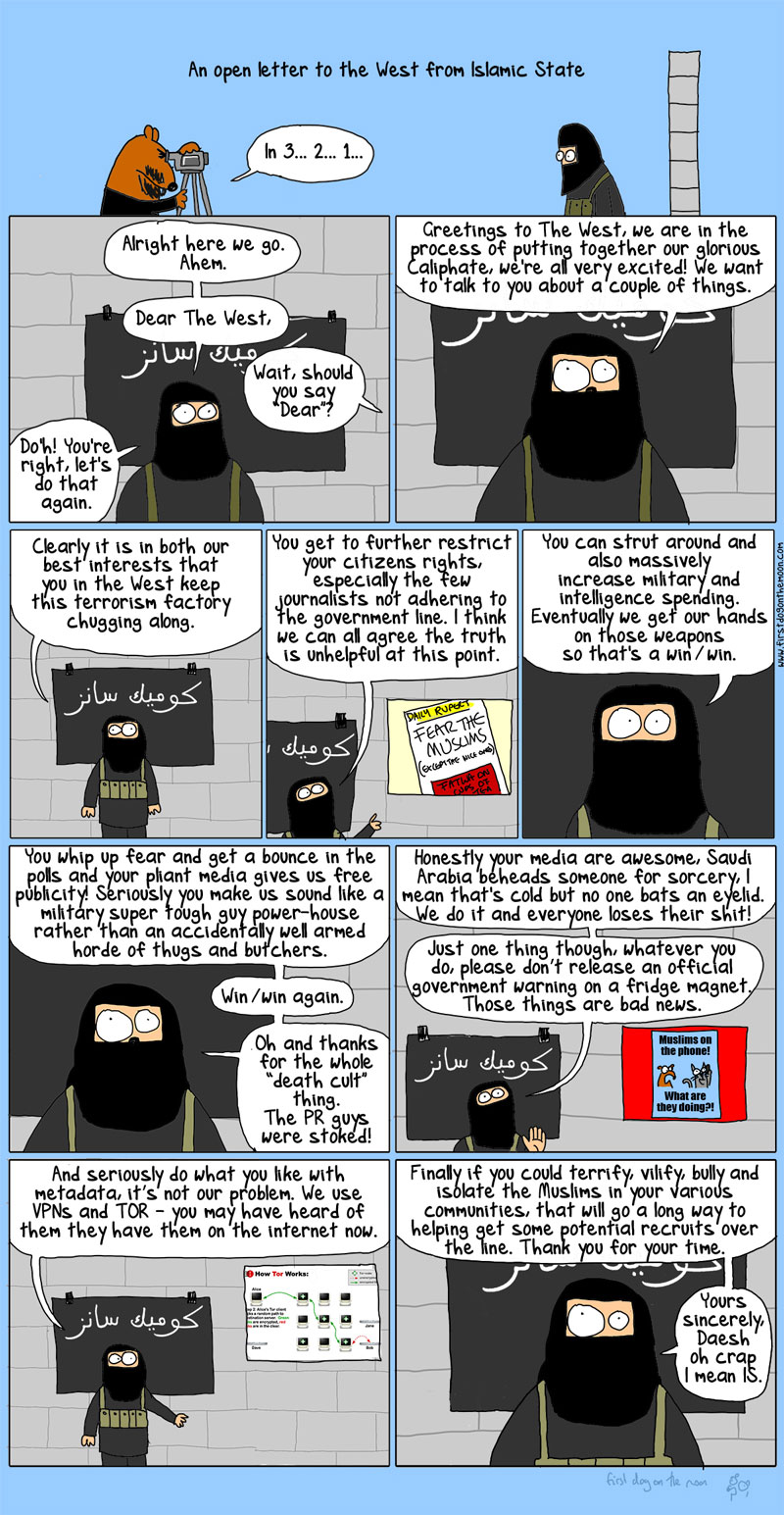
Isis's Letter To The West


Greetings to the West, we want to talk to you about a couple of things:
1. Clearly it is in bout our interests that you in the West keep this terrorism factory chugging along.
2.  You get to further restrict your citizens rights, especially the few journalists not adhering to the government line. I think we can all agree the truth is unhelpful  at this point.
3.  You can strut around and also massively increase military and intelligence spending. Eventually we get our hands on those weapons, so that’s a win/win.
4. You whip up fear and get a bounce in the polls and your pliant media gives us free publicity! Seriously, you make us sound like a military super tough-guy powerhouse rather than an accidentally well armed horde of thugs and butchers. Win/win again.
Oh and thanks for the whole “death cult” thing. The PR guys were stoked.
5. Honestly, your media are awesome, Saudi Arabia beheads someone for sorcery, I mean that’s cold, but no one bats an eyelid. We do it and everyone loses their shit!
6. And seriously, do what you like with Metadata, it’s not our problem. We use VPNs and TOR – You may have heard of them. They have them on the internet now.
7. Finally, if you could terrify, vilify, bully and isolate the Muslims in your various communities, that will go a long way to help get some potential recruits over the line.
Yours sincerely,
Daesh.
I mean,
IS
Transcribed by: CZ
Via: The Guardian

Saturday, July 26, 2014

Gaza: The Consequences Of Voting While Muslim

The Palestinians of Gaza are guilty of that new post-Cold War misdemeanor: voting while Muslim. The punishment for this crime has been eight years of economic hardship, international isolation, and periodic Israeli bombardments.
Like the Algerians in 1990 and the Egyptians in 2012, Gazans went to the polls in 2006 and voted for the wrong party. Rather than supporting the secular choice, they cast their ballots for Hamas. Not all Palestinians are Muslim (6 percent or so are Christian). But by opting for the Islamic Resistance Movement -- Hamas, for short -- Gazans had effectively nullified their own ballots.
It didn't matter that the EU and other institutions declared the elections free and fair. The results were what mattered, and Israel's judgment carried the day. Even though the newly elected government extended an olive branch to both Israel and the United States, the Israeli government didn't consider Hamas a legitimate political actor.
"Israel stated that Hamas were terrorists and Western leaders did not challenge this line," writes Cata Charrett in an excellent piece at Mondoweiss. "On the contrary, they refused to meet diplomatically with Hamas leaders, they cut off all possible financing to the newly elected government, and they supported Israel's complete sanction and seizure of Gazan territory." A direct peace overture to President George W. Bush offering a long-term truce went unanswered.
Voting while Christian or voting while Jewish has not led to similar results. Christian Democrats have won elections in Europe without generating boycotts or warnings about an imminent descent into clerical autocracy. The ultra-religious Shas party has participated in ruling coalitions in Israel without incurring the wrath of the international community.
But Hamas, its critics insist, is different because it is fundamentally anti-democratic. Ditto the Muslim Brotherhood. Even Turkey's Justice and Development Party and Tunisia's Ennahda are suspect, according to those who hold to the dictum that Islam and democracy are fundamentally incompatible.
The fear of Islamic fundamentalism taking over the Middle East through the ballot box began in 1990 when the Islamic Salvation Front won 55 percent of the vote in local elections in Algeria. The following year, with the Front poised to win the national elections, the Algerian government banned the party and jailed its leaders, precipitating a civil war that left more than 100,000 people dead. At the time, Assistant Secretary of State for Near Eastern Affairs Edward Djerejian declared that the U.S. government opposed what it called "one person, one vote, one time." Washington worried about the possibility that Islamist parties would use democratic means to rise to power and then kick away the democratic ladder beneath them.
This prospective outcome prompted the United States to continue supporting its traditionally authoritarian allies in the region. The Arab Spring offered some hope that the United States had changed this policy, with the Obama administration withdrawing its support, albeit reluctantly, from Egyptian leader Hosni Mubarak just before he stepped down in early 2011. But the older preference for status-quo strongmen has reasserted itself, as Washington has looked the other way at Nouri al-Maliki's obvious faults in Iraq, continued to support the royal elite in Bahrain, and quickly moved to embrace coup leader Abdel Fattah Al Sisi in Egypt.
Let me be clear: I wouldn't vote for Hamas. And I would rather that the party clearly recognized the right of Israel to exist (just as I would prefer the Republican Party to recognize the right of gay marriage to exist).
But my preferences are beside the point.  Hamas represents a large constituency. Many Gazans voted for the party because they were disgusted with the corruption of the secular Fatah movement and were impressed with the social service system Hamas had created. Like other resistance movements -- the African National Congress, the Irish Republican Army -- Hamas was on its way toward becoming a political party. If such a party takes power only to behave undemocratically -- as the Muslim Brotherhood arguably did in Egypt -- that's a different question. But if you claim to respect democracy, you must recognize the results of free and fair elections. And if you want a party to change its position -- and it's willing to talk -- you have to sit down at the table and negotiate with it.
But Israel -- and by extension the United States -- didn't choose this option. As a result, a border conflict has raged ever since, with two particularly severe flare-ups in 2008-9 and 2012.
Last month, Hamas and Fatah set aside their own substantial grievances and forged a unity agreement on administering both Gaza and the West Bank. Here was a perfect opportunity for Israel to move forward with a new deal. In reality, however, this was a signal for Israel to go on the offensive. It just needed an excuse. When Gazan militants linked to the Islamic State(formerly ISIS), but not Hamas, kidnapped and killed three Israeli teenagers, Netanyahu had his excuse.
Israel's latest bombing campaign has already left nearly 200 Palestinians dead. Roughly 70 percent are civilians; more than 30 of the victims are children. Israeli bombs have fallen on houses, apartment buildings, a disability center, a cafĂ©. Foreigners have even volunteered to be human shields at a hospital that has already been struck twice. The Israeli Defense Forces maintain that they warn residents of a building beforehand of a strike, but this practice is inconsistent.
Some Israelis refer to their periodic shelling of the Palestinian territory as "mowing the lawn." It is a disturbing metaphor because it is so indiscriminate. They don't talk about "weeding the garden" or "pruning the trees." A lawnmower cuts down everything in its path -- grass, weeds, wildflowers. Also, a lawn needs constant mowing, suggesting that Israel plans to conduct bombing campaigns on a seasonal basis.
But Netanyahu may well see an opportunity to eliminate Hamas altogether. The organization no longer can count on support from the Muslim Brotherhood in Egypt or Syria's Assad. Ties with Iran were also strained by the support Hamas provided to rebels fighting in Syria. Nor can the territory rely on supplies coming in through tunnels from the Sinai. Those to the right of Netanyahu -- unbelievably, the Israeli political spectrum has such ultraviolent frequencies -- are reportedly pressing the government to launch a ground offensive. Mowing the lawn would then quickly become a scorched earth policy.
It's not a fair fight. The casualty rates are grotesquely asymmetrical. Israel's Iron Dome missile defense system has reduced the number of casualties on the Israeli side to a single death so far. Gazans have fled by the thousands to the southern part of the territory while Israelis have set up plastic chairs on a mountain overlook to watch the bombs explode in Gaza as if they were fireworks.
In this way, Israel has entered the same murky moral territory that the United States entered during the conflicts in Kosovo and Libya. It is currently waging effectively risk-free warfare. Governments that don't have to deal with public response to the deaths of either soldiers or civilians are freed of the conventional political calculus involved in prosecuting a war. Such a government may also be less willing to compromise, for there is no significant counterweight to military action, at least when it comes to aerial attacks.
So far, however, it's been Hamas that has rejected the latest ceasefire, brokered by Egypt. Hamas has its reasons. It wants the release of its members who were rearrested in June after being set free in a deal in 2011. And it wants an end to the blockade that has turned Gaza into a virtual prison for its inhabitants. But Egypt's deal didn't reflect any of these concerns.
The major players continue to violate the most fundamental rule of conflict resolution: taking into consideration the underlying interests of all parties to the conflict. The problem goes back at least to 2006, when Hamas won an election that Israel and the United States failed to recognize.
Netanyahu still believes that he can bomb Gazans into changing their underlying interests. The real question is: How long will the Obama administration persist in supporting this delusion?

Wednesday, July 23, 2014

How The West Chose War In Gaza


Gaza and Israel: The Road To War, Paved By The West

... the most immediate cause of this latest war has been ignored: Israel and much of the international community placed a prohibitive set of obstacles in the way of the Palestinian “national consensus” government that was formed in early June.
That government was created largely because of Hamas’s desperation and isolation. The group’s alliance with Syria and Iran was in shambles. Its affiliation with the Muslim Brotherhood in Egypt became a liability after a July 2013 coup replaced an ally, President Mohamed Morsi, with a bitter adversary, Gen. Abdel Fattah el-Sisi. Hamas’s coffers dried up as General Sisi closed the tunnels that had brought to Gaza the goods and tax revenues on which it depended.
Seeing a region swept by popular protests against leaders who couldn’t provide for their citizens’ basic needs, Hamas opted to give up official control of Gaza rather than risk being overthrown. Despite having won the last elections, in 2006, Hamas decided to transfer formal authority to the Palestinian leadership in Ramallah. That decision led to a reconciliation agreement between Hamas and the Palestine Liberation Organization, on terms set almost entirely by the P.L.O. chairman and Palestinian Authority president, Mahmoud Abbas.
Israel immediately sought to undermine the reconciliation agreement by preventing Hamas leaders and Gaza residents from obtaining the two most essential benefits of the deal: the payment of salaries to 43,000 civil servants who worked for the Hamas government and continue to administer Gaza under the new one, and the easing of the suffocating border closures imposed by Israel and Egypt that bar most Gazans’ passage to the outside world.
Yet, in many ways, the reconciliation government could have served Israel’s interests. It offered Hamas’s political adversaries a foothold in Gaza; it was formed without a single Hamas member; it retained the same Ramallah-based prime minister, deputy prime ministers, finance minister and foreign minister; and, most important, it pledged to comply with the three conditions for Western aid long demanded by America and its European allies: nonviolence, adherence to past agreements and recognition of Israel.
Israel strongly opposed American recognition of the new government, however, and sought to isolate it internationally, seeing any small step toward Palestinian unity as a threat. Israel’s security establishment objects to the strengthening of West Bank-Gaza ties
Israelis who oppose a two-state solution understand that a unified Palestinian leadership is a prerequisite for any lasting peace.
... the key issues of paying Gaza’s civil servants and opening the border with Egypt were left to fester. The new government’s ostensible supporters, especially the United States and Europe, could have pushed Egypt to ease border restrictions, thereby demonstrating to Gazans that Hamas rule had been the cause of their isolation and impoverishment. But they did not.
Instead, after Hamas transferred authority to a government of pro-Western technocrats, life in Gaza became worse.
Qatar had offered to pay Gaza’s 43,000 civil servants, and America and Europe could have helped facilitate that. But Washington warned that American law prohibited any entity delivering payment to even one of those employees — many thousands of whom are not members of Hamas but all of whom are considered by American law to have received material support from a terrorist organization.
When a United Nations envoy offered to resolve this crisis by delivering the salaries through the United Nations, so as to exclude all parties from legal liability, the Obama administration did not assist. Instead, it stood by as Israel’s foreign minister, Avigdor Lieberman, called for the envoy’s expulsion on the grounds that he was “trying to funnel money” to Hamas.
Israel is pursuing a return to the status quo ante, when Gaza had electricity for barely eight hours a day, water was undrinkable, sewage was dumped in the sea, fuel shortages caused sanitation plants to shut down and waste sometimes floated in the streets. Patients needing medical care couldn’t reach Egyptian hospitals, and Gazans paid $3,000 bribes for a chance to exit when Egypt chose to open the border crossing.
For many Gazans, and not just Hamas supporters, it’s worth risking more bombardment and now the ground incursion, for a chance to change that unacceptable status quo. 
A cease-fire that fails to resolve the salary crisis and open Gaza’s border with Egypt will not last. It is unsustainable for Gaza to remain cut off from the world and administered by employees working without pay. A more generous cease-fire, though politically difficult for Prime Minister Benjamin Netanyahu, would be more durable.
The current escalation in Gaza is a direct result of the choice by Israel and the West to obstruct the implementation of the April 2014 Palestinian reconciliation agreement. The road out of the crisis is a reversal of that policy.
Nathan Thrall is a senior analyst at the International Crisis Group covering Gaza, Israel, Jordan and the West Bank.