Showing posts with label Creating Terrorism. Show all posts

Saturday, October 04, 2014

Constructing The Muslim Enemy From The Crusades To 9 11


Dr. Deepa Kumar is an Associate Professor of Media Studies and Middle Eastern Studies at Rutgers University. Her work is driven by an active engagement with the key issues that characterize our era -- neoliberalism and imperialism. She has been active in various social movements for peace and justice and has written numerous articles in both scholarly journals and alternative media.

Kumar's first book, Outside the Box: Corporate Media, Globalization and the UPS Strike, is about the power of collective struggle in effectively challenging the priorities of neoliberalism. Her second book titled Islamophobia and the Politics of Empire, looks at how the "Muslim enemy" has historically been mobilized to suit the goals of empire.

Kumar began her research into the politics of empire shortly after the tumultuous events of 9/11. She is currently working on a third book on the discourses of terrorism within the mainstream media and in the political sphere in the US. 

Hosted by the Center for Asian American Studies with generous support from the Office of the President, the Department of English, Division of Diversity and Community Engagement, Middle Eastern Studies and the South Asia Institute.

Saturday, February 08, 2014

Secrets Of The CIA


With: Ralph McGehee, Phil Agee, and other former CIA officers/agents

This was directed and written by James L. Otis.

The total cast list for the people appearing as themselves, "in credits order", are:

Ralph McGehee (see Wikipedia),
Verne Lyon (see Wikipedia for "Operation CHAOS" -- the page has a reference link for a piece by him), 
Mary Embree,
Phil Agee (see Wikipedia),
Phil Roettinger,
Peter Kombluh,
Stansfield Turner (see Wikipedia),
Daniel Patrick Moynihan (see Wikipedia)
Gene R. LaRocque (see Wikipedia)

From archive footage, and according to the ordering specified by IMDB, there are: Frank Church, William Colby, H.S. Truman, JFK, LBJ, GHW Bush, Bill Clinton, Richard Nixon and Ronald Reagan.

Friday, February 07, 2014

Truth & Lies In The War On Terror


John Pilger breaks the silence and investigates American foreign policy in the world

By John Pilger


Saturday, February 01, 2014

American Anthrax


Media Roots presents American Anthrax, a documentary comprised of news footage that establishes, by history's own narration, how everything you've been told about the Anthrax Attacks is a lie. Conceptualized, edited and produced by Robbie Martin, co-host of Media Roots Radio.

September 11, 2001, shook the United States to the core, a country that had been nearly untouchable since its democratic inception. However, immediately following this horrific tragedy, another equally as impactful 'terrorist attack' occurred when weaponized anthrax was sent to multiple Congressman and journalists through the U.S. Postal Service.

The attacks on the World Trade Center and the Pentagon were both one-time events that happened in two prominent cities. Unlike 9/11, the Anthrax Attacks localized terrorism and spread fear to every corner of American life, where the simple act of getting your mail could prove to be fatal. Five people died as a result of breathing in the deadly anthrax spores, including postal workers and one NY Post reporter. Countless others were infected.

The Bush administration initially tried to link this 'second wave of terrorism' to al-Qaeda with zero proof. Once that talking point out-lived its usefulness, the official narrative began leaning towards Saddam Hussein and his mythological biological weapons program.

Establishment propagandists like John McCaine and ABC news reporters intentionally spread disinformation to plant the seed in the public mind that the anthrax came from Iraq, which eventually lead to Colin Powell's infamous 2003 WMD speech at the UN. All the while, the U.S. government was fully aware that the anthrax did not come from an external source, because the strain showed tell-tale signs of being a specific anthrax strain that was weaponized and manufactured by the U.S. military.

Regardless, the idea of the Anthrax Attacks being executed by an external terrorist organization remained conventional wisdom the public was conditioned into believing in the aftermath of 9/11. Eventually, two men were accused of being the perpetrators behind the attacks, yet no charges were ever brought to either of them. The first accused individual, Steven Hatfill, ended up being rewarded a multimillion dollar settlement from the government for being wrongly accused before any evidence was presented against him. The subsequent accused individual, Bruce Ivins, allegedly committed suicide while the FBI was trying to break him into confessing.

Ultimately, the FBI asked the National Academy of Sciences (NAS) to verify its evidence pointing to Ivins as the main suspect. Instead, the NAS concluded that the DNA in the anthrax sent in the mail was in fact not a match to the anthrax Ivins worked with. Before the National Academy of Sciences finished their independent investigation, the FBI rushed its pre-established conclusions about Ivins's guilt to the press, and the case was closed. To this day, the FBI has never commented on the many glaring contradictions in the official government narrative about the Anthrax Attacks.

Follow Robbie at @fluorescentgrey

http://www.mediaroots.org

Wednesday, January 22, 2014

America’s Black-Ops Goes Global

It’s said that imitation is the sincerest form of flattery. So consider the actions of the U.S. Special Operations Command flattering indeed to the larger U.S. military. After all, over recent decades the Pentagon has done something that once would have been inconceivable. It has divided the whole globe, just about every inch of it, like a giant pie, into six command slices: U.S. European Command, or EUCOM (for Europe and Russia), U.S. Pacific Command, or PACOM (Asia), U.S. Central Command, or CENTCOM (the Greater Middle East and part of North Africa), U.S. Southern Command, or SOUTHCOM (Latin America), and in this century, U.S. Northern Command, or NORTHCOM (the United States, Canada, and Mexico), and starting in 2007, U.S. Africa Command, or AFRICOM (most of Africa).
The ambitiousness of the creeping decision to bring every inch of the planet under the watchful eyes of U.S. military commanders should take anyone’s breath away. It’s the sort of thing that once might only have been imaginable in movies where some truly malign and evil force planned to “conquer the world” and dominate Planet Earth for an eternity. (And don’t forget that the Pentagon’s ambitions hardly stop at Earth’s boundaries. There are also commands for the heavens, U.S. Strategic Command, or STRATCOM, into which the U.S. Space Command was merged, and, most recent of all, the Internet, where U.S. Cyber Command, or CYBERCOM rules.)
Now, unnoticed and unreported, the process is being repeated. Since 9/11, a secret military has been gestating inside the U.S. military. It’s called U.S. Special Operations Command (SOCOM). At TomDispatch, both Nick Turse and Andrew Bacevich have covered its startling growth in these years. Now, in a new post, Turse explores the way that command’s dreams of expansion on a global scale have led it to follow in the footsteps of the larger institution that houses it.
The special ops guys are, it seems, taking their own pie-cutter to the planet and slicing and dicing it into a similar set of commands, including most recently a NORTHCOM-style command for the U.S., Canada, and Mexico. Once could be an anomaly or a mistake. Twice and you have a pattern, which catches a Washington urge to control planet Earth, an urge that, as the twenty-first century has already shown many times over, can only be frustrated. That this urge is playing out again in what, back in the Cold War days, used to be called “the shadows,” without publicity or attention of any sort, is notable in itself and makes Turse’s latest post all the more important. ~ Tom
America’s Black-Ops Blackout: Unraveling the Secrets of the Military’s Secret Military
By Nick Turse
“Dude, I don’t need to play these stupid games. I know what you’re trying to do.” With that, Major Matthew Robert Bockholt hung up on me.
More than a month before, I had called U.S. Special Operations Command (SOCOM) with a series of basic questions: In how many countries were U.S. Special Operations Forces deployed in 2013? Are manpower levels set to expand to 72,000 in 2014? Is SOCOM still aiming for growth rates of 3%-5% per year? How many training exercises did the command carry out in 2013? Basic stuff.
And for more than a month, I waited for answers. I called. I left messages. I emailed. I waited some more. I started to get the feeling that Special Operations Command didn’t want me to know what its Green Berets and Rangers, Navy SEALs and Delta Force commandos – the men who operate in the hottest of hotspots and most remote locales around the world – were doing.
Then, at the last moment, just before my filing deadline, Special Operations Command got back to me with an answer so incongruous, confusing, and contradictory that I was glad I had given up on SOCOM and tried to figure things out for myself.
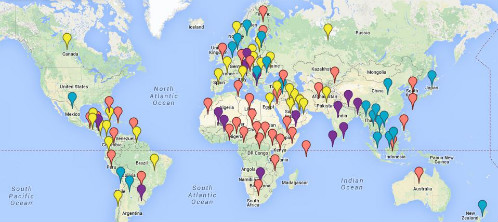
U.S. Special Operations Forces around the world, 2012-2013 (key below article) ©2014 TomDispatch ©Google
Key to the Map of U.S. Special Operations Forces around the world, 2012-2013
Red markers: U.S. Special Operations Forces deployment in 2013.
Blue markers: U.S. Special Operations Forces working with/training/advising/conducting operations with indigenous troops in the U.S. or a third country during 2013.
Purple markers: U.S. Special Operations Forces deployment in 2012.
Yellow markers: U.S. Special Operations Forces working with/training/advising/conducting operations with indigenous troops in the U.S. or a third country during 2012.
I started with a blank map that quickly turned into a global pincushion. It didn’t take long before every continent but Antarctica was bristling with markers indicating special operations forces’ missions, deployments, and interactions with foreign military forces in 2012-2013. With that, the true size and scope of the U.S. military’s secret military began to come into focus. It was, to say the least, vast.
A review of open source information reveals that in 2012 and 2013, U.S. Special Operations forces (SOF) were likely deployed to – or training, advising, or operating with the personnel of – more than 100 foreign countries. And that’s probably an undercount. In 2011, then-SOCOM spokesman Colonel Tim Nye told TomDispatchthat Special Operations personnel were annually sent to 120 countries around the world. They were in, that is, about 60% of the nations on the planet. “We’re deployed in a number of locations,” was as specific as Bockholt would ever get when I talked to him in the waning days of 2013. And when SOCOM did finally get back to me with an eleventh hour answer, the number offered made almost no sense.
Despite the lack of official cooperation, an analysis by TomDispatch reveals SOCOM to be a command on the make with an already sprawling reach. As Special Operations Command chief Admiral William McRaven put it in SOCOM 2020, his blueprint for the future, it has ambitious aspirations to create “a Global SOF network of like-minded interagency allies and partners.” In other words, in that future now only six years off, it wants to be everywhere.
The Rise of the Military’s Secret Military
Born of a failed 1980 raid to rescue American hostages in Iran (in which eight U.S. service members died), U.S. Special Operations Command was established in 1987. Made up of units from all the service branches, SOCOM is tasked with carrying out Washington’s most specialized and secret missions, including assassinations, counterterrorist raids, special reconnaissance, unconventional warfare, psychological operations, foreign troop training, and weapons of mass destruction counter-proliferation operations.
In the post-9/11 era, the command has grown steadily. With about 33,000 personnel in 2001, it is reportedly on track to reach 72,000 in 2014. (About half this number are called, in the jargon of the trade, “badged operators” – SEALs, Rangers, Special Operations Aviators, Green Berets – while the rest are support personnel.) Funding for the command has also jumped exponentially as SOCOM’s baseline budget tripled from $2.3 billion to $6.9 billion between 2001 and 2013. If you add in supplemental funding, it had actually more than quadrupled to $10.4 billion.
Not surprisingly, personnel deployments abroad skyrocketed from 4,900 “man-years” – as the command puts it – in 2001 to 11,500 in 2013. About 11,000 special operators are now working abroad at any one time and on any given day they are in 70 to 80 countries, though the New York Times reported that, according to statistics provided to them by SOCOM, during one week in March 2013 that number reached 92.
The Global SOF Network
Last year, Admiral McRaven, who previously headed the Joint Special Operations Command, or JSOC – a clandestine sub-command that specializes in tracking and killing suspected terrorists – touted his vision for special ops globalization. In a statement to the House Armed Services Committee, he said:
“USSOCOM is enhancing its global network of SOF to support our interagency and international partners in order to gain expanded situational awareness of emerging threats and opportunities. The network enables small, persistent presence in critical locations, and facilitates engagement where necessary or appropriate…”
In translation this means that SOCOM is weaving a complex web of alliances with government agencies at home and militaries abroad to ensure that it’s at the center of every conceivable global hotspot and power center. In fact, Special Operations Command has turned the planet into a giant battlefield, divided into many discrete fronts: the self-explanatory SOCAFRICA; the sub-unified command of U.S. Central Command in the Middle East SOCCENT; the European contingent SOCEUR; SOCKOR, which is devoted strictly to Korea; SOCPAC, which covers the rest of the Asia-Pacific region; and SOCSOUTH, which conducts special ops missions in Central and South America and the Caribbean, as well as the globe-trotting JSOC.
Since 2002, SOCOM has also been authorized to create its own Joint Task Forces, a prerogative normally limited to larger combatant commands like CENTCOM. These include Joint Special Operations Task Force-Philippines, 500-600 personnel dedicated to supporting counterterrorist operations by Filipino allies against insurgent groups like Abu Sayyaf.
A similar mouthful of an entity is the NATO Special Operations Component Command-Afghanistan/Special Operations Joint Task Force-Afghanistan, which conducts operations, according to SOCOM, “to enable the International Security Assistance Force (ISAF), the Afghan National Security Force (ANSF), and the Government of the Islamic Republic of Afghanistan (GIRoA) to provide the Afghan people a secure and stable environment and to prevent insurgent activities from threatening the authority and sovereignty of GIRoA.” Last year, U.S.-allied Afghan President Ha­mid Karzai had a different assessment of the “U.S. special force stationed in Wardak province,” which he accused of “harassing, annoying, torturing, and even murdering innocent people.”
According to the latest statistics made available by ISAF, from October 2012 through March 2013, U.S. and allied forces were involved in 1,464 special operations in Afghanistan, including 167 with U.S. or coalition forces in the lead and 85 that were unilateral ISAF operations. U.S. Special Operations forces are also involved in everything from mentoring lightly armed local security forces under the Village Stability Operations initiative to the training of heavily armed and well-equipped elite Afghan forces – one of whose U.S.-trained officers defected to the insurgency in the fall.
In addition to task forces, there are also Special Operations Command Forward (SOC FWD) elements which, according to the military, “shape and coordinate special operations forces security cooperation and engagement in support of theater special operations command, geographic combatant command, and country team goals and objectives.” These light footprint teams – including SOC FWD Pakistan, SOC FWD Yemen, and SOC FWD Lebanon – offer training and support to local elite troops in foreign hotspots. In Lebanon, for instance, this has meant counterterrorism training for Lebanese Special Ops forces, as well as assistance to the Lebanese Special Forces School to develop indigenous trainers to mentor other Lebanese military personnel.
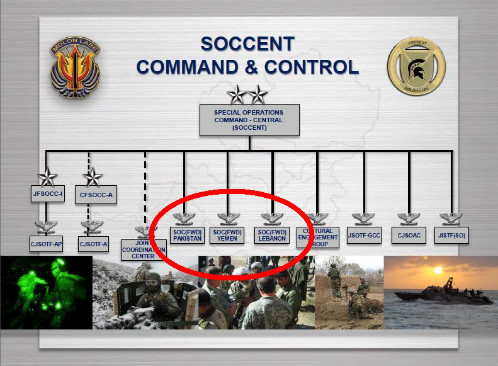
Special Operations Command Central (SOCCENT) briefing slide by Col. Joe Osborne, showing SOC FWD elements
SOCOM’s reach and global ambitions go further still. TomDispatch’s analysis of McRaven’s first two full years in command reveals a tremendous number of overseas operations. In places like Somalia and Libya, elite troops have carried out clandestinecommando raids. In others, they have used airpower to hunt, target, and killsuspected militants. Elsewhere, they have waged an information war using online propaganda. And almost everywhere they have been at work building up and forging ever-tighter ties with foreign militaries through training missions and exercises.
“A lot of what we will do as we go forward in this force is build partner capacity,” McRaven said at the Ronald Reagan Library in November, noting that NATO partners as well as allies in the Middle East, Asia, and Latin America “are absolutely essential to how we’re doing business.”
In March 2013, for example, Navy SEALs conducted joint training exercises with Indonesian frogmen. In April and May, U.S. Special Operations personnel joined members of the Malawi Defense Forces for Exercise Epic Guardian. Over three weeks, 1,000 troops engaged in marksmanship, small unit tactics, close quarters combat training, and other activities across three countries – Djibouti, Malawi, and the Seychelles.
In May, American special operators took part in Spring Storm, the Estonian military’s largest annual training exercise. That same month, members of the Peruvian and U.S. special operations forces engaged in joint training missions aimed at trading tactics and improving their ability to conduct joint operations. In July, Green Berets from the Army’s 20th Special Forces Group spent several weeks in Trinidad and Tobago working with members of that tiny nation’s Special Naval Unit and Special Forces Operation Detachment. That Joint Combined Exchange Training exercise, conducted as part of SOCSOUTH’s Theater Security Cooperation program, saw the Americans and their local counterparts take part in pistol and rifle instruction and small unit tactical exercises.
In September, according to media reports, U.S. Special Operations forces joined elite troops from the 10 Association of Southeast Asian Nations member countries – Indonesia, Malaysia, the Philippines, Singapore, Thailand, Brunei, Vietnam, Laos, Myanmar (Burma), and Cambodia – as well as their counterparts from Australia, New Zealand, Japan, South Korea, China, India, and Russia for a US-Indonesian joint-funded coun­terterrorism exercise held at a training center in Sentul, West Java.
Tactical training was, however, just part of the story. In March 2013, for example, experts from the Army’s John F. Kennedy Special Warfare Center and School hosted a week-long working group with top planners from the Centro de Adiestramiento de las Fuerzas Especiales – Mexico’s Special Warfare Center – to aid them in developing their own special forces doctrine.
In October, members of the Norwegian Special Operations Forces traveled to SOCOM’s state-of-the-art Wargame Center at its headquarters on MacDill Air Force Base in Florida to refine crisis response procedures for hostage rescue operations. “NORSOF and Norwegian civilian leadership regularly participate in national field training exercises focused on a scenario like this,” said Norwegian Lieutenant Colonel Petter Hellesen. “What was unique about this exercise was that we were able to gather so many of the Norwegian senior leadership and action officers, civilian and military, in one room with their U.S counterparts.”
MacDill is, in fact, fast becoming a worldwide special ops hub, according to a report by the Tampa Tribune. This past fall, SOCOM quietly started up an International Special Operations Forces Coordination Center that provides long-term residencies for senior-level black ops liaisons from around the world. Already, representatives from 10 nations had joined the command with around 24 more slated to come on board in the next 12-18 months, per McRaven’s global vision.
In the coming years, more and more interactions between U.S. elite forces and their foreign counterparts will undoubtedly take place in Florida, but most will likely still occur – as they do today – overseas. TomDispatch’s analysis of official government documents and news releases as well as press reports indicates that U.S. Special Operations forces were reportedly deployed to or involved with the militaries of 106 nations around the world during 2012-2013.
For years, the command has claimed that divulging the names of these countries would upset foreign allies and endanger U.S. personnel. SOCOM’s Bockholt insisted to me that merely offering the total number would do the same. “You understand that there is information about our military… that is contradictory to reporting,” he told me. “There’s certain things we can’t release to the public for the safety of our service members both at home and abroad. I’m not sure why you’d be interested in reporting that.”
In response, I asked how a mere number could jeopardize the lives of Special Ops personnel, and he responded, “When you work with the partners we work with in the different countries, each country is very particular.” He refused to elaborate further on what this meant or how it pertained to a simple count of countries. Why SOCOM eventually offered me a number, given these supposed dangers, was never explained.
Bringing the War Home
This year, Special Operations Command has plans to make major inroads into yet another country – the United States. The establishment of SOCNORTH in 2014, according to the command, is intended to help “defend North America by outpacing all threats, maintaining faith with our people, and supporting them in their times of greatest need.” Under the auspices of U.S. Northern Command, SOCNORTH will have responsibility for the U.S., Canada, Mexico, and portions of the Caribbean.
While Congressional pushback has thus far thwarted Admiral McRaven’s efforts to create a SOCOM satellite headquarters for the more than 300 special operators working in Washington, D.C. (at the cost of $10 million annually), the command has nonetheless stationed support teams and liaisons all over the capital in a bid to embed itself ever more deeply inside the Beltway. “I have folks in every agency here in Washington, D.C. – from the CIA, to the FBI, to the National Security Agency, to the National Geospatial Agency, to the Defense Intelligence Agency,” McRaven saidduring a panel discussion at Washington’s Wilson Center in 2013. Referring to the acronyms of the many agencies with which SOCOM has forged ties, McRaven continued: “If there are three letters, and in some cases four, I have a person there. And they have had a reciprocal agreement with us. I have somebody in my headquarters at Tampa.” Speaking at Ronald Reagan Library in November, he put the number of agencies where SOCOM is currently embedded at 38.
“Given the importance of interagency collaboration, USSOCOM is placing greater emphasis on its presence in the National Capital Region to better support coordination and decision making with interagency partners. Thus, USSOCOM began to consolidate its presence in the NCR [National Capitol Region] in early 2012,” McRaven told the House Armed Services Committee last year.
One unsung SOCOM partner is U.S. AID, the government agency devoted to providing civilian foreign aid to countries around the world whose mandate includes the protection of human rights, the prevention of armed conflicts, the provision of humanitarian assistance, and the fostering of “good will abroad.” At a July 2013 conference, Beth Cole, the director of the Office of Civilian-Military Cooperation at U.S. AID, explained just how her agency was now quietly aiding the military’s secret military.
“In Yemen, for example, our mission director has SVTCs [secure video teleconferences] with SOCOM personnel on a regular basis now. That didn’t occur two years ago, three years ago, four years ago, five years ago,” Cole said, according to a transcript of the event. But that was only the start. “My office at U.S. AID supports SOF pre-deployment training in preparation for missions throughout the globe… I’m proud that my office and U.S. AID have been providing training support to several hundred Army, Navy, and Marine Special Operations personnel who have been regularly deploying to Afghanistan, and we will continue to do that.”
Cole noted that, in Afghanistan, U.S. AID personnel were sometimes working hand-in-hand on the Village Stability Operation initiative with Special Ops forces. In certain areas, she said, “we can dual-hat some of our field program officers as LNOs [liaison officers] in those Joint Special Operations task forces and be able to execute the development work that we need to do alongside of the Special Operations Forces.” She even suggested taking a close look at whether this melding of her civilian agency and special ops might prove to be a model for operations elsewhere in the world.
Cole also mentioned that her office would be training “a senior person” working for McRaven, the man about to “head the SOF element Lebanon” – possibly a reference to the shadowy SOC FWD Lebanon. U.S. AID would, she said, serve as a facilitator in that country, making “sure that he has those relationships that he needs to be able to deal with what is a very, very, very serious problem for our government and for the people of that region.”
U.S. AID is also serving as a facilitator closer to home. Cole noted that her agency was sending advisors to SOCOM headquarters in Florida and had “arranged meetings for [special operators] with experts, done roundtables for them, immersed them in the environment that we understand before they go out to the mission area and connect them with people on the ground.” All of this points to another emerging trend: SOCOM’s invasion of the civilian sphere.
In remarks before the House Armed Services Committee, Admiral McRaven noted that his Washington operation, the SOCOM NCR, “conducts outreach to academia, non-governmental organizations, industry, and other private sector organizations to get their perspective on complex issues affecting SOF.” Speaking at the Wilson Center, he was even more blunt: “[W]e also have liaison officers with industry and with academia… We put some of our best and brightest in some of the academic institutions so we can understand what academia is thinking about.”
SOCOM’s Information Warfare
Not content with a global presence in the physical world, SOCOM has also taken to cyberspace where it operates the Trans Regional Web Initiative, a network of 10 propaganda websites that are run by various combatant commands and made to look like legitimate news outlets. These shadowy sites – including KhabarSouthAsia.com,Magharebia which targets North Africa, an effort aimed at the Middle East known asAl-Shorfa.com, and another targeting Latin America called Infosurhoy.com – state only in fine print that they are “sponsored by” the U.S. military.
Last June, the Senate Armed Services Committee called out the Trans Regional Web Initiative for “excessive” costs while stating that the “effectiveness of the websites is questionable and the performance metrics do not justify the expense.” In November, SOCOM announced that it was nonetheless seeking to identify industry partners who, under the Initiative, could potentially “develop new websites tailored to foreign audiences.”
Just as SOCOM is working to influence audiences abroad, it is also engaged in stringent information control at home – at least when it comes to me. Major Bockholt made it clear that SOCOM objected to a 2011 article of mine about U.S. Special Operations forces. “Some of that stuff was inconsistent with actual facts,” he told me. I asked what exactly was inconsistent. “Some of the stuff you wrote about JSOC… I think I read some information about indiscriminate killing or things like that.”
I knew right away just the quote he was undoubtedly referring to – a mention of the Joint Special Operations Command’s overseas kill/capture campaign as “an almost industrial-scale counterterrorism killing machine.” Bockholt said that it was indeed “one quote of concern.” The only trouble: I didn’t say it. It was, as I stated very plainly in the piece, the assessment given by John Nagl, a retired Army lieutenant colonel and former counterinsurgency adviser to now-retired general and former CIA director David Petraeus.
Bockholt offered no further examples of inconsistencies. I asked if he challenged my characterization of any information from an interview I conducted with then-SOCOM spokesman Colonel Tim Nye. He did not. Instead, he explained that SOCOM had issues with my work in general. “As we look at the characterization of your writing, overall, and I know you’ve had some stuff on Vietnam [an apparent reference to my bestselling book, Kill Anything That Moves: The Real American War in Vietnam] and things like that – because of your style, we have to be very particular on how we answer your questions because of how you tend to use that information.” Bockholt then asked if I was anti-military. I responded that I hold all subjects that I cover to a high standard.
Bockholt next took a verbal swipe at the website where I’m managing editor,TomDispatch.com. Given Special Operations Command’s penchant for dabbling in dubious new sites, I was struck when he said that TomDispatch – which has published original news, analysis, and commentary for more than a decade and wonthe 2013 Utne Media Award for “best political coverage” – was not a “real outlet.” It was, to me, a daring position to take when SOCOM’s shadowy Middle Eastern newssite Al-Shorfa.com actually carries a disclaimer that it “cannot guarantee the accuracy of the information provided.”
With my deadline looming, I was putting the finishing touches on this article when an email arrived from Mike Janssen of SOCOM Public Affairs. It was – finally – a seemingly simple answer to what seemed like an astonishingly straightforward question asked a more than a month before: What was the total number of countries in which Special Operations forces were deployed in 2013? Janssen was concise. His answer: 80.
How, I wondered, could that be? In the midst of McRaven’s Global SOF network initiative, could SOCOM have scaled back their deployments from 120 in 2011 to just 80 last year? And if Special Operations forces were deployed in 92 nations during just one week in 2013, according to official statistics provided to the New York Times, how could they have been present in 12 fewer countries for the entire year? And why, in his March 2013 posture statement to the House Armed Services Committee, would Admiral McRaven mention “annual deployments to over 100 countries?” With minutes to spare, I called Mike Janssen for a clarification. “I don’t have any information on that,” he told me and asked me to submit my question in writing – precisely what I had done more than a month before in an effort to get a timely response to this straightforward and essential question.
Today, Special Operations Command finds itself at a crossroads. It is attempting to influence populations overseas, while at home trying to keep Americans in the dark about its activities; expanding its reach, impact, and influence, while working to remain deep in the shadows; conducting operations all over the globe, while professing only to be operating in “a number of locations”; claiming worldwide deployments have markedly dropped in the last year, when evidence suggests otherwise.
“I know what you’re trying to do,” Bockholt said cryptically before he hung up on me – as if the continuing questions of a reporter trying to get answers to basic information after a month of waiting were beyond the pale. In the meantime, whatever Special Operations Command is trying to do globally and at home, Bockholt and others at SOCOM are working to keep it as secret as possible.
Nick Turse is the managing editor of TomDispatch.com and a fellow at the Nation Institute. An award-winning journalist, his work has appeared in the New York TimesLos Angeles Timesthe Nationon the BBCand regularly at TomDispatch. He is the author most recently of the New York Times bestseller Kill Anything That Moves: The Real American War in Vietnam (just out in paperback). You can catch his conversation with Bill Moyers about that book by clicking here.
Follow TomDispatch on Twitter and join us on Facebook or Tumblr. Check out the newest Dispatch Book, Ann Jones’s They Were Soldiers: How the Wounded Return From America’s Wars – The Untold Story.
Copyright 2013 Nick Turse

Friday, November 22, 2013

Britain's Secret Terror Force


"We Were Not There To Act Like An Army Unit, We Were There To Act Like A Terror Group"

Soldiers from an undercover unit used by the British army in Northern Ireland killed unarmed civilians, former members have told BBC One's Panorama.


Speaking publicly for the first time, the ex-members of the Military Reaction Force (MRF), which was disbanded in 1973, said they had been tasked with "hunting down" IRA members in Belfast.

Panorama has been told the MRF consisted of about 40 men handpicked from across the British army.

Before it was disbanded 40 years ago, after 18 months, plain-clothes soldiers carried out round-the-clock patrols of west Belfast - the heartland of the IRA - in unmarked cars.

Three former members of the unit, who agreed to be interviewed on condition their identities were disguised, said they had posed as Belfast City Council road sweepers, dustmen and even "meths drinkers", carrying out surveillance from street gutters.
But surveillance was just one part of their work.

One of the soldiers said they had also fired on suspected IRA members.

He described their mission as "to draw out the IRA and to minimise their activities... if they needed shooting, they'd be shot".

Another former member of the unit said: "We never wore uniform - very few people knew what rank anyone was anyway.

A third former MRF soldier said: "If you had a player who was a well-known shooter who carried out quite a lot of assassinations... then he had to be taken out.

The MRF's operational records have been destroyed and its former members refused to incriminate themselves or their comrades in specific incidents when interviewed by Panorama.

But they admitted shooting and killing unarmed civilians.

When asked if on occasion the MRF would make an assumption that someone had a weapon, even if they could not see one, one of the former soldiers replied "occasionally".

"We were going down there and finding, looking for our targets, finding them and taking them down." 

"We may not have seen a weapon, but there more than likely would have been weapons there in a vigilante patrol."

Panorama: Britain's Secret Terror Force, BBC One, Thursday 21 November at 21:00 GMT and then available in the UK on the BBC iPlayer.


Wednesday, November 20, 2013

The Detroit Sleeper Cell That Wasn't


... after years of legal wrangling, the “Detroit Sleeper Cell” became something very different: a cautionary tale about the dangers of pursuing terrorism cases too zealously and connecting dots where they might not exist.
The Justice Department, after winning terrorism convictions against two of the men in 2003, took the extraordinary step the next year of moving to throw out the charges and repudiating its own case. 
Prosecutors, remarkably, discredited their own witnesses and found fault with virtually every part of a case they had brought.
The prosecution, the Justice Department belatedly acknowleged, was a “three-legged stool” that toppled under its own weight.
The videotape found of Las Vegas landmarks, originally thought to be a terrorist “casing” video, might have been simply a tourist’s keepsake. An audiotape thought to contain an anti-American hate speech appeared to be just an old children’s song in Arabic about a duck.
And the odd sketch in a day planner of what looked like a blueprint for an attack on a Turkish air base? Perhaps nothing more than a mentally ill man’s doodling of a Middle East map, prosecutors were forced to acknowledge.
Prosecutors turned against prosecutors. Ethics inquiries were opened and criminal charges filed — this time against two government officials who helped put the case together. Attorney General Ashcroft was reprimanded by the judge in the case for falsely linking the suspects to the Sep. 11 attacks in violation of a gag order.
There were no clear winners in the case; a certain loser was the federal government itself, as its “new paradigm” of thwarting terrorists before they struck clashed headlong into age-old notions of justice and due process.
We in the media breathlessly covered every warning and tip about threats real and imagined: scuba divers, cargo trucks, tourist helicopters around the Statue of Liberty, a cable-cutting blowtorch on the Brooklyn Bridge and more, as if they were the next big attack. 
But by 2004, the year that the case collapsed in court, the pendulum had begun to shift. Three years removed from Sept. 11, the Bush administration was facing tougher scrutiny of its tactics in the “war on terror” from the media, the courts and the public at large. The Detroit case, once a symbol of the new threat of Islamic terrorism, became a symbol of government over-reaching instead.
Weeks after the collapse of the Detroit prosecution, a Times colleague, Danny Hakim, and I wrote a long investigative piece that examined the unraveling of such a high-profile case. What we found was infighting within the Justice Department, internal doubts about the strength of the case, tainted witnesses and questionable legal tactics.
We found that, inside the Justice Department, prosecutors believed aspects of the case were weak even as they were moving ahead with a major terrorism indictment against the Detroit men.
“We can charge this case with the hope that the case might get better,” the head of the counter-terrorism section wrote in 2002, “and the certainty that it will not get much worse.”
In fact, it did.
Twelve years after the dramatic arrests of “the Detroit Sleeper Cell,” remnants of the case are still being litigated in the federal courts. The difference now is that the Justice Department is the defendant — the result of a long feud between the department and a former employee, Richard Convertino, the original prosecutor in the Detroit case.
The Justice Department blamed Mr. Convertino for much of the bungled case and even brought criminal obstruction charges against him in 2006 for reportedly withholding evidence from defense lawyers for the Detroit men. But Mr. Convertino was acquitted of the charges and insisted he became the scapegoat for bad decisions that were largely made by higher-ups in Washington.
Last year, an appeals court revived a lawsuit that Mr. Convertino filed against the Justice Department. He is trying to establish that someone at the department improperly and anonymously leaked his name to The Detroit Free Press in 2004 as the target of an internal ethics investigation growing out of his handling of the Detroit case.
Earlier this year, a judge ordered the newspaper to turn over internal documents related to its original story on the ethics charges. The legal battle over Mr. Convertino’s lawsuit could mean still more embarrassment for the Justice Department in a case it once embraced.

Friday, November 15, 2013

TSA Doesn't Think Terrorists Are Plotting To Attack


Jonathan Corbett, a long-time vocal critic of TSA body scanners, has been engaged in a lawsuit against the government concerning the constitutionality of those scanners. In the course of the case, the TSA gave him classified documents, which he was ordered not to reveal. In using some of that information to make his case, he needed to file two copies of his brief: a public one with classified stuff redacted, and the full brief under seal, for the government and the courts to look at. Just one problem: someone over at Infowars noticed that apparently a clerk at the 11th Circuit appeals court forgot to file the document under seal, allowing them to find out what was under the redactions... Included in there is the following, apparently quoted from the TSA's own statements:
“As of mid-2011, terrorist threat groups present in the Homeland are not known to be actively plotting against civil aviation targets or airports; instead, their focus is on fundraising, recruiting, and propagandizing.”
Elsewhere, the TSA appears to admit that "due to hardened cockpit doors and the willingness of passengers to challenge hijackers," it's unlikely that there's much value in terrorists trying to hijack a plane these days (amusingly, that statement is a clear echo of Bruce Schneier's statement criticizing the TSA's security theater -- suggesting that the TSA flat out knows that airport security is nothing more than such theatrics).

Elsewhere, in the redacted portions, the TSA is quoted as admitting that "there have been no attempted domestic hijackings of any kind in the 12 years since 9/11." 

As Corbett notes in his filing, the entire basis for the nude scanners is that they were somehow necessary to stop terrorists with explosives from getting on planes. Yet, as he makes clear, the TSA knows that there's been little threat of any such attack for quite some time. He also details how the machines are not very good at tracking down explosives, and pretty much everything that has been caught with these machines (such as guns) could be easily found via traditional metal detectors. Further, as noted above, other protections that have nothing to do with the nude scanners are the main reason (which the TSA admits) that terrorists have moved on from targeting airplanes.

Amazingly, it appears that the government forced Corbett to redact the revelation that the TSA's own threat assessments have shown "literally zero evidence that anyone is plotting to blow up an airline leaving from a domestic airport." Corbett argues that this shows why the searches are not reasonable under the 4th Amendment. Corbett also points out that about the only thing the machines seem useful at catching are illegal drugs -- but, as he notes, that's "irrelevant to aviation security." Sure, the government may like the fact that it catches illegal drugs with these machines, but the TSA can't argue it needs the machines for "terrorism" when it knows that's not true, and then tries to keep them just because it finds some narcotics...

While it still seems unlikely that Corbett's lawsuit will actually succeed, he's right that these revelations mean that, at the very least, Congress should be investigating why the TSA insisted that it needed these machines to find terrorists that it now admits aren't actually plotting to attack airplanes.

Monday, November 11, 2013

US Built 'Powerful Organs Of State Terrorism' In Iraq

Iraq is still suffering from the US invasion because the apparatus of state oppression and terror is still in place, killing people every day. But few in the US seem to realize the scale of the war crimes committed in Iraq, an expert author told RT.
In an exclusive interview with RT, Nicolas J.S. Davies, author of “Blood On Our Hands: The American Invasion and Destruction of Iraq,” said that the world should learn the lessons from US invasions, such as respect for international law and the futility of military force. 
For more on this topic, see RT’s Special Report dedicated to unprecedented rise of violence in Iraq in 2013. 

Questionable US Objectives In Iraq

RT: Has America achieved any of the goals it had at the beginning of the invasion in 2003? 
Nicolas J.S. Davies: That depends how you define those goals. If the intention was to invade a foreign country and destroy its government and its society, then yes, it did. 
If you take US officials at their word and accept that they had an intention of replacing that regime and that society with something better, then obviously they did not. 
My friend was in Iraq a few months ago and he found very few people in Iraq today who would say that their lives are better now than under Saddam Hussein’s regime. And that is not to say good in any way about Saddam Hussein, it is to say that the United States and its allies destroyed Iraq. 
The invasion was not just some sort of mistake. The invasion and occupation were a serious crime, a crime of aggression under the UN Charter as (then-Secretary General) Kofi Annan acknowledged. And aggression was defined under the Nuremberg principles and by the judges at Nuremberg as the supreme international crime.
AFP Photo / Pool / Lucas Jackson

‘US Blown Out UN Charter In The Past 12 Years’ 

The wisdom of renouncing aggression and war in the UN Charter is borne out by what we have seen in all the acts of aggression that the US has committed over the past 10-12 years. Not one of them has in fact managed to reduce terrorism, managed to establish a better form of government, or managed to make anybody safer. 
So when we look at the absolute chaos today in Iraq, Libya and Syria, I think we have to ask who is responsible – and are these in fact crimes for which people should be held criminally responsible? 
RT: Many people blame the US for the current unrest in the country saying America has “stirred up a hornets' nest.” What do you think? 
ND: Well, except that Iraq was not a hornet’s nest. And once again this bears out the wisdom of the UN Charter. 
Let me read you a very short quote from Norwegian general Robert Mood, who oversaw the peacekeeping force that went into Syria in 2012 to oversee the failed ceasefire. 
“It is fairly easy to use the military tool, because, when you launch the military tool in classical interventions, something will happen and there will be results. The problem is that the results are almost all the time different than the political results you were aiming for when you decided to launch it. So the other position, arguing that it is not the role of the international community, neither coalitions of the willing, nor the UN Security Council for that matter, to change governments inside a country, is also a position that should be respected.” 
So I think it is a lesson for all of us, for the whole world, to learn from this experience. It is exactly what he just said. 
We need a framework of international law respected by all – including the most powerful countries like the United States. 
US soldiers from the 1st Battalion, 22nd Regiment of the 4th Infantry Division prepare to fire a mortar during training at their base in Tikrit, 180 Kilometers (110 miles) north of Iraqi capital Baghdad, 29 December 2003 (AFP Photo / Jewel Samad)

‘Every US Military Intervention Since The WWII Has Been A Complete Disaster’ 

The use of military force cannot achieve any constructive goals, as our leaders claim. 
You know, since World War II every US military intervention everywhere has been a complete disaster, whether you’re talking about Korea, Vietnam, Central America in the 1960s or all this entire history of the past 12 years. 
You know, really, after Vietnam, I think most Americans understood this. Richard Barnet, who founded the Institute for Policy Studies in Washington, wrote a book called “Roots of War” in 1972. He said in that book that the irony is that we’re at a point where the No. 1 country has perfected the science of killing; that at the very moment that this has happened, it is no longer a practical means of political domination.

And as I say, this is the irony of our country, the United States, in world history: That at the point where we have these weapons powerful enough to destroy the entire world, we can no longer use them to any practical constructive purpose. And yet, we have virtually bankrupted this country. 
Since Richard Barnet wrote these words in 1972, the US has spent at least $17 trillion on its military, which happens to be exactly equal to our supposedly unsustainable national debt. 
This is really now just a tragic history, but what we should do is to try and learn from that and recommit to the rule of international law. We just saw how effective it could be in Syria, by actually practicing working diplomacy within the rule of international law, bringing the chemical weapons of the regime to the UN to dismantle them – and how much better that works than launching missile strikes. 
Iraqi children look at US soldiers from the 1st battalion, 22nd Regiment of the 4th Infantry Division conducting a foot-patrol along a street of former Iraqi dictator Saddam Hussein's hometown Tikrit, 180 Kilometers (110 miles) north of Iraqi capital Baghdad, 27 December 2003 (AFP Photo / Jewel Samad)

‘US Employed Classic Divide-and-Rule Strategy In Iraq’

RT: This year has proved to be most deadliest in Iraq for the last five years. Why is the situation on the ground getting worse? 
ND: Well, because Iraq is still suffering from the destruction of its regime and its government and its society by the United States. The United States employed a classic divide-and-rule strategy, pitting people of different sects against each other, inciting violence that is completely unprecedented in that country. And now has instilled a sectarian-based government that only represents people of only one sect. It is still receiving huge amounts of so-called security assistance from the United States. 
The United States built powerful organs of state terrorism in Iraq. The CIA sent a retired colonel by the name of James Steele to Iraq in 2004. He eventually recruited 27 brigades of special police commandos who then waged a reign of terror that killed tens of thousands of mostly Sunni men and boys in Baghdad and around the country. They have since been rebranded, first as the National Police, when one of their torture centers was discovered back during that period, and now as the Federal Police. They are still effectively run by Adnan Al-Asadi, who has been the deputy interior minister there since 2005. 
So that regime of state repression and terror that the United States installed in Iraq is still functioning, and still conducting extrajudicial executions, in addition to one of the largest numbers of supposedly legal executions in the world. 
You know, in Iraq, you can be sentenced to death for property crimes; you can be sentenced to death on accusations of terrorism, in trials that only last, at best, an hour or two, with very little legal representation. Human rights officials from the UN have absolutely condemned the justice system – so-called justice system – that the US has established in Iraq, and have demanded – the UN Human Rights Council has demanded – that Iraq immediately cease these hangings. 
Sometimes they hang more than 40 people in one day, including women as well. This is just a reign of terror. And in that sense, some of the worst aspects of the US occupation are still continuing today.
Two US soldiers from the 1st battalion, 22nd Regiment of the 4th Infantry Division secure the parameters during a foot-patrol along a street of former Iraqi dictator Saddam Hussein's hometown Tikrit, 180 Kilometers (110 miles) north of Iraqi capital Baghdad, 27 December 2003 (AFP Photo / Jewel Samad)
RT: Can we expect the situation to change? 
ND: There has always been resistance in Iraq to this reign of terror, and to this highly illegitimate government. And most of that is political, non-violent resistance. Since 2011 when the Arab Spring began – you know, there were massive demonstrations all over Iraq in 2011 during the Arab Spring, they were not reported very much in the West, for political reasons. There is a great demand from the people of Iraq to change this situation. 
But as long as the US continues to support this highly repressive government it is very difficult, and it is continuing to cause the sacrifice of thousands of lives. It is obviously exploited by extremists, by Islamists, Sunni groups supported by the Saudis and others on the other side. So you’ve got an extremist Shiite government and you’ve got extremist Sunni, right-wing fundamentalist terrorism and you’ve got millions of innocent civilians caught up in the middle. But their capacity for resistance was systematically broken down by the US occupation. 
Hundreds and hundreds of academics were killed. Thousands of professionals fled the country during the US occupation. Almost anyone who could get out fled for their lives, amid the threat of death from various militias and factions in Iraq. It will take an awful lot for Iraq to recover from this. 

‘US Never Accounted For War Crimes’ 

But for American viewers watching this, I think it’s important to understand our responsibility and our government’s responsibility for this. President Nixon promised $3.3 billion in reparations to Vietnam, but not a penny of that was ever paid. We should be paying reparations to help the people of Iraq recover for what was done in our name to them. We should be pressing, pressing for our leaders to be held accountable for these crimes. 
A couple of weeks ago, I went with a group of people here in Miami to the Canadian consulate and met with the political officer there, because Mr. Richard Cheney, the former vice president of the United States, was scheduled to speak at an economic forum in Toronto. So we along with human rights groups and lawyers in Canada and the United States were asking Canada to please do what we have failed to do, to honor its obligations under the convention against torture. To either bar Mr. Cheney from entering Canada, or if he was allowed into Canada, to please arrest him and investigate his alleged crimes. Unfortunately, the very conservative government in Canada failed – once again – to uphold its obligations under the convention against torture.
Iraqi women wlak past a burnt-out vehicle on October 7, 2013 following a bombing attack in Baghdad's eastern al-Jadidah district the night before. (AFP Photo / Ahmad Al-Rubaye)
Iraqi women walk past a burnt-out vehicle on October 7, 2013 following a bombing attack in Baghdad's eastern al-Jadidah district the night before. (AFP Photo / Ahmad Al-Rubaye)
The US occupation of Iraq, as well as being an act of aggression, when you consider that probably about 10 percent of the Sunni population were killed, and probably 25 percent of them were driven from their homes, clearly meets the definition of genocide as it is defined in the genocide convention. The occupation included systematic, daily violations of the convention against torture and many, many articles of the Geneva Conventions. 
So the US officials responsible for all of that really have many charges to answer. And we should understand, as Americans, that while there have been indictments in Spain, and Mr. Bush was prevented from traveling to Switzerland, Mr. Rumsfeld was almost prevented from traveling to Belgium at one point – the primary responsibility under all the international treaties that the United States has signed is on us. It is our responsibility to hold senior, major American war criminals responsible for their crimes. 
And that continues. The Obama administration has not just failed to hold the officials of the previous administration accountable, but has continued many of these crimes. Aggression is aggression, whether it’s a full-scale invasion or simply flying drones over another country and blowing up people’s homes. 
So the US crimes continue. After the US was convicted by the International Court of Justice in the 1980s of committing aggression against Nicaragua, it said it would simply no longer recognize the jurisdiction of the International Court of Justice. It has never recognized the jurisdiction of the International Criminal Court, which so far is functioning as an international African court because the only people that have been charged have been from Africa. And of course this is completely undermining the legitimacy of the court. Little by little, no one in Africa is going to cooperate with it if they see it as simply targeting their own leaders while leaders of the United States and other countries just completely get off the hook. 
So we have a collective responsibility, which we can fulfill by the payment of war reparations, and we have criminal accountability by which we need to charge civilian and military officials who were responsible for the horrors inflicted on the people of Iraq, under our own laws, under the United States War Crimes Act, for the crimes they committed.
A wounded man is carried away following a suicide bombing close to the home of MP Imad Yohana in the northern city of Kirkuk on September 22, 2013, in which some 47 people were wounded including the Christian MP. (AFP Photo / Marwan Ibrahim)

‘American Viewers Are Not Familiar With Horrors Of Modern Iraq’ 

RT: The mainstream media is often portraying terror attacks and deaths in Iraq as mundane. But the war doesn't seem to be over. Why do the Western media often turn a blind eye to the everyday struggle of Iraqis? 
ND: Some of your viewers may be surprised to hear some of the things I’m saying because the US media has simply never addressed this incredible human tragedy in Iraq in these kinds of terms. In fact, I think any reporter who talks to people in Iraq today can ascertain pretty quickly that very few people - only perhaps those affiliated with the government that was installed by the occupation, perhaps some of those people would feel they’re now better off – but for ordinary Iraqis probably very few would say they’re better off today. 
And yet, this would come as a surprise to many Americans. Many Americans, because the media has reported in such a bias fashion in this entire catastrophe, many Americans are unaware. You mentioned in your invitation to me that the Iraq Body Count, which as some estimate of 100,000 or 200,000 Iraqis killed, but that is based on passive reporting. Actual epidemiological studies in Iraq have found anywhere from 400,000 to over 1 million Iraqis killed. 
Les Roberts, who pioneered epidemiology in war zones, in Rwanda and the Democratic Republic of Congo, took part in one of those epidemiological studies in Iraq, and he found exactly the same pattern in Iraq as he found in Rwanda and the Democratic Republic of Congo: that passive reporting of deaths in a war zone generally only capture between 5 percent and 20 percent of the actual deaths that emerge from more in-depth studies. So the Iraq Body Count is based on passive reporting, they’re taking numbers from the Iraqi Health Ministry, numbers reported in the Western media and sort of adding those up. Again, Les Roberts found exactly the same thing in Iraq as he found in Rwanda and the Democratic Republic of Congo, that probably 5 to 20 times as many people as that were actually killed in Iraq.
Iraqi Prime Minister Nuri al-Maliki (AFP Photo / Mandel Ngan)

‘The True Numbers Of Victims In Iraq Is Much Higher’ 

Yes, thousands of people are still being killed, and the exact numbers are probably very hard to know. It is less than during most of the US occupation. Most of the people killed during the US occupation were killed by US or allied forces, or by US-trained Iraqi forces. When the Iraqi Health Ministry reported in 2004 and 2005 that that was the case, that most of the deaths were not from resistance forces or insurgents, but from the occupying forces, that was reported even in The Miami Herald, actually, by McClatchy, by Nancy Youssef who did some very good reporting. 
The BBC – but once the BBC got a hold of it and started reporting that, John Simpson reported that in preparing for a Panorama show in Britain for the BBC, but before the actual Panorama show aired, he was contacted by the Iraqi Minister of Health saying, “No, no, no, that’s not what the numbers show,”that these were their own figures, he said, “No, no, we really have no idea who killed all these people.” On the web you can find sites like the Information Clearing House. You can find the original BBC report, and then you can find its retraction and the reedited report sort of apologizing for having reported what the occupation health ministry had told them.
So, really, when we look at Libya, when we look at Syria, we really need to understand. I think Americans deserve more credit than they usually get for grasping these issues, and I think that kind of explains why we saw this massive, massive outcry against the prospect of new US aggression against Syria.
If people want to know more about the US invasion and destruction of Iraq, please get a hold of a copy of my book, it’s called “Blood on Our Hands: The American Invasion and Destruction of Iraq.” People can also read my other work on Syria and on US militarism and war crimes.