


Showing posts with label Creating Enemies. Show all posts
Showing posts with label Creating Enemies. Show all posts
Friday, February 07, 2014
Truth & Lies In The War On Terror
John Pilger breaks the silence and investigates American foreign policy in the world
By John Pilger


Sunday, December 22, 2013
9/11 In The Academic Community
“9/11 in the Academic Community,” a Winner of the University of Toronto Film Festival, is a unique film that documents academia’s treatment of critical perspectives on 9/11 by exploring the taboo that shields the American government’s narrative from scholarly examination. Through a powerful reflection on intellectual courage and the purpose of academia, the film aims at changing intellectual discourse on 9/11 and the War on Terror.
As well as probing the repercussions several scholars have endured due to their investigation of 9/11, this documentary provides an analysis of impairments in professional inquiry, ranging from the failure to critically reflect on terms functioning as thought-stoppers (such as “conspiracy theory”) to the structural approach that restricts inquiry to the broad implications of 9/11 while shutting out enquiry into the events of the day itself. Morton Brussel, Professor Emeritus of Physics at the University of Illinois at Urbana-Champaign, has stated: “The main thesis of the film concerns the silence of the academic community on this vital issue. I think it is extremely important and very well produced.”
As 9/11 served as the rationale for the Global War on Terror, the expansion of the military and intelligence complex, the invasion of other countries in violation of international law, and the curtailing of civil liberties, the film provides an inspiring demonstration of intellectual courage that will cause many scholars to reflect on the academy’s role and strength to dismantle the war system. As Alvin A. Lee, President Emeritus of McMaster University, has stated in his endorsement of the film: academics should “stand sufficiently outside society intellectually to see, understand, and interpret what is going on.”
Adnan Zuberi
Director and Producer
As 9/11 served as the rationale for the Global War on Terror, the expansion of the military and intelligence complex, the invasion of other countries in violation of international law, and the curtailing of civil liberties, the film provides an inspiring demonstration of intellectual courage that will cause many scholars to reflect on the academy’s role and strength to dismantle the war system. As Alvin A. Lee, President Emeritus of McMaster University, has stated in his endorsement of the film: academics should “stand sufficiently outside society intellectually to see, understand, and interpret what is going on.”
Adnan Zuberi
Director and Producer
Now Available for Purchase – “9/11 in the Academic Community” (Documentary) - - http://911inacademia.com/
Tuesday, June 11, 2013
The Real Reason For U.S. Drone Attacks

Drone Attacks Kill Innocents and Create Enemies. This is precisely what the American war industry wants: endless supply of enemies for endless war.
Debate within the US about the use of killer drones has obfuscated the real purpose of such attacks. Using fancy expressions like “playbook” for authorizing drone strikes that kill people suspected by the US of being militants has added to the fog of confusion.
Amid all the verbal gymnastics, one point that has seldom if ever been raised is the real reason for drone strikes: to stoke anti-American sentiment that creates more militants thereby justifying the never-ending war on terror. After all, it is impossible to continue to wage war without identifiable enemies.
Drone attacks are “helpful” from the US point of view because they kill innocent people in remote areas, especially the tribal areas of Pakistan that increase people’s resentment and anti-American feelings. This is precisely what the Washington warlords want. Endless war requires an endless list of enemies. If they do not exist, create them. Enter the killer drones.The Washington-based New America Foundation report has said there have been 350 US drone strikes since 2004, most of them during Barack Obama’s presidency.
The foundation has put the death toll at between 1,963 and 3,293, with 261 to 305 civilians killed. The London-based Bureau of Investigative Journalism estimates the death toll at between 2,627 and 3,457 in Pakistan since 2004. These include 475 to 900 civilians.
The US Republican Senator Lindsay Graham said on February 20, 2013 that 4,700 people had been killed in drone strikes. He was unapologetic about the killings. “Sometimes you hit innocent people, and I hate that, but we’re at war, and we’ve taken out some very senior members of al-Qaeda,” Graham added, without naming which al-Qaeda members had been eliminated.
Washington uses assassination drones in several countries — Pakistan, Afghanistan, Yemen and Somalia — claiming that they target “terrorists.” According to witnesses, however, the attacks have mostly led to civilian casualties.
Jennifer Gibson, a staff lawyer with the British-based charity Reprieve asked: “how do you prove you’re innocent after they have killed you?”
The “excellent intelligence” the US cites for carrying out drone strikes is based on dubious information. Often, local informants that are given locator (targeting) chips to put near militants actually put them near the wall of the homes of those with whom they have family feuds. Sarah Holewinski, executive director of the Washington-based Center for Civilians in Conflict, has confirmed this in an interview. American officials as well as the CIA stubbornly deny any civilian casualties.
The Stanford Law School and New York University School of Law’s comprehensive report on Pakistan, “Living Under Drones” has listed scores of family members of civilians killed in drone strikes. The UN Special Rapporteur Ben Emmerson, a British barrister, has launched an investigation into 25 cases of drone strikes and targeted killings. Emmerson’s investigtion includes US, Israeli and British drone strikes in Pakistan, Gaza and Afghanistan. In March, Emmerson issued a damning report about extraordinary renditions, waterboarding and other forms of torture by US forces and called for war crimes trial of those officials responsible for authorizing such practices. In the case of drone strikes, Emmerson will examine Washington’s “double tap” policy that attacks a target a second time, while rescuers and paramedics are working to save survivors. Such strikes deliberately target civilians and are categorized as murders.
Whether the US would be deterred by UN censure is debatable. After all, American officials know full well that they are involved in a murderous campaign in which killing civilians is part of a deliberate policy. Civilian casualties are not collateral damage, even though making such claims may mollify some Americans; they are an essential part of keeping the war going endlessly.
Saturday, June 08, 2013
Critical Opinion Of Islam Ignores Fundamental Truths

Paul Sheehan said on Monday there are ''more than 100 verses in the Koran that call Muslims to violence against the Unbelievers''.
Relying on the dubious website Thereligionofpeace.com, he concludes that ''the Koran groans under the weight of its own contradictions, with entreaties to kindness co-existing with exhortations to merciless war''.
It is questionable whether such an opinion is a result of a direct insight into Islam - or based merely on an old prejudice against Islam: that Islam is inherently violent and intolerant of others.
Critics of Islam often quote out of context the Koran's more aggressive passages, arguing these could easily inspire and endorse terrorism. They ignore that the Jewish and Christian scriptures can be just as aggressive, taken out of their historical context.
For example, the Old Testament says:
''Now therefore, kill every male among the little ones, and kill every woman who has known man intimately. But all the girls who have not known man intimately, spare for yourselves'' (Numbers 31:17-18).
Many violent Jewish and Christian groups have used these Biblical texts to justify their actions. Crusaders used them against Muslims and Jews. Nazis used them against Jews.
Serbian Christians used them against Bosnian Muslims. Zionists use them regularly against Palestinians. But non-religious people have done the same in the name of one ideology of another.
In 2011, Norwegian Anders Behring Breivik allegedly hated Muslims and Islam and subscribed to a fundamentalist, right-wing Christian ideology. Of course, little to no mention was made about Breivik's ''religious'' association, or that he was ''devout'' of any sort.
The display of violence and killing of innocent people are indicative of a radical, and indeed extremist, mindset that is fundamentally opposite to the teachings of Islam.
A more objective and scholarly reading of the causes of terrorism would inform us of a host of causal factors, including radical ideology; empathy and association with radicals, socio-economic factors, personal experiences, criminal activity, racism and Islamophobia.All of these factors play a role, one way or another, in the process of extremism and terrorism. The matter is thus complex, and it is culpably simplistic to attribute it to a single cause.
Like the terrorists he criticises, Sheehan takes the Koran out of context.
Take, for example, this partial quote he cited, ''And slay them wherever ye find them … ''
Sheehan fails to state that this is part of five-long verses (2:190-195), which must be read together.
When read in context the legal implication derived stipulates that fighting is permitted only under certain strict circumstances.
Additionally, the same verses prohibit transgression of limits, and it does not promote killing of innocent people but allows self-defence.
It further goes on to state ''if they cease, let there be no hostility except to those who practise oppression.''
Clearly, when the whole context is examined the verses do not promote killing of innocent people.
Those who read the Koran should keep at a minimum the following principles in mind:
The reasons for revelation or the historical context of a particular verse; familiarity with the science of abrogation; examination of the verses that deal with the same subject; a cursory knowledge of Prophet Muhammad's life; and the way these verses are applied.
When these texts are not read in their proper textual and historical contexts they are manipulated and distorted - by Muslims and non-Muslims alike.
When examined objectively, one will not fail to realise that the Koran and the teachings of Prophet Muhammad strictly condemn terrorism and the killing of innocent people, Muslim or not.
Sheehan fails to mention these verses and Prophetic traditions, for example:
''… [T]ake not life, which God has made sacred, except by way of justice and law: thus does He command you, that you may learn wisdom'' (Koran 6:151).
''… [T]hat if anyone killed a person - unless it be for murder or for spreading mischief in the land - it would be as if he killed the whole people: and if any one saved a life, it would be as if he saved the life of the whole people. Then although there came to them Our messengers with clear signs, yet, even after that, many of them continued to commit excesses in the land'' (5:32).
Or the hadith that states ''Whoever kills a mu'ahid [non-combatant, innocent non-Muslims] will not smell the scent of paradise …'' (Bukhari).
A contextual reading of the Koran or Hadith leads to one conclusion only: there is no justification for killing of innocent people, whether in Baghdad or Boston. Full stop.
The ends do not justify the means in Islamic ethics.
Associate Professor Mohamad Abdalla is founding director of the Griffith Islamic Research Unit.
Tuesday, March 12, 2013
Drones Are Fool's Gold: They Prolong Wars We Can't Win

White House Hail In An Era Of Hands-Free Warfare. Yet These Weapons Induce Not Defeat, But Retaliation
By Simon Jenkins
Courtesy Of "The Guardian"
The greatest threat to world peace is not from nuclear weapons and their possible proliferation. It is from drones and their certain proliferation. Nuclear bombs are useless weapons, playthings for the powerful or those aspiring to power. Drones are now sweeping the global arms market. There are some 10,000 said to be in service, of which a thousand are armed and mostly American. Some reports say they havekilled more non-combatant civilians than died in 9/11.
I have not read one independent study of the current drone wars in Afghanistan, Pakistan and the horn of Africa that suggests these weapons serve any strategic purpose. Their "success" is expressed solely in body count, the number of so-called "al-Qaida-linked commanders" killed. If body count were victory, the Germans would have won Stalingrad and the Americans Vietnam.
Neither the legality nor the ethics of drone attacks bear examination. Last year's exhaustive report by lawyers from Stanford and New York universities concluded that they were in many cases illegal, killed civilians, and were militarily counter-productive. Among the deaths were an estimated 176 children. Such slaughter would have an infantry unit court-martialled. Air forces enjoy such prestige that civilian deaths are excused as a price worth paying for not jeopardising pilots' lives.
This week President Obama appointed two drone "enthusiasts" as his new defence secretary, Chuck Hagel, and his new CIA chief, John Brennan. Drone war is now the flavour of the month and the military-industrial complex is licking its lips. If Obama, himself a lawyer, had any reservations about the legality of these weapons, he has clearly overcome them.
Quite apart from ethics and law, I find it impossible to see what contribution these weapons make to winning wars. The killing of officers merely sees others replace them, eager for revenge. The original Predator was intended for surveillance but was adapted for bombing specifically to kill Osama bin Laden. When he was finally found, the drone was considered too inaccurate a device to risk, and old-fashioned boots-with-guns had to be sent instead.
As for the inevitable killing of civilians, however few or many, this is not just "collateral damage" but critical to victory or defeat. It does not occupy or hold territory and it devastates hearts and minds. Aerial bombardment has long been a questionable weapon of war. It induces not defeat but retaliation.
On Monday a BBC documentary on the siege of Malta devastatingly charted the German bombing assault, the most intensive of the second world war. Though it took a heavy toll on the island's infrastructure it did not stop its resistance. Belief in bombers and the failure to invade Malta cost Germany the Africa campaign. A weapon of airborne terror that fails to cow an enemy and merely invites defiance is not effective at all. Three-quarters of Pakistanis are now declared enemies of the US.
Yet each week Obama apparently sits down and goes through a "kill list" of Muslims he intends to eliminate, with no judicial process and no more identification than the word of a dodgy spy on the ground. At least Britain's drones in Helmand, we are told, are used only in close air support for ground troops.
Since the drone war began in earnest in 2008, there has been no decline in Taliban or al-Qaida performance attributable to it. Any let-up in recruitment is merely awaiting Nato's departure. The Afghan president, Hamid Karzai, has called the attacks "in no way justifiable". The Pakistan government, at whose territory they are increasingly directed, haswithdrawn all permission.
The young Yemeni writer Ibrahim Mothana protested in the New York Times of the carnage drones are wreaking on the politics of his country, erasing "years of progress and trust-building with tribes". Yemenis now face al-Qaida recruiters waving pictures of drone-butchered women and children in their faces. Notional membership of al-Qaida in Yemen is reported to have grown by three times since 2009. Jimmy Carterdeclares that "America's violation of international human rights abets our enemies and alienates our friends".
The drone wars seem pointless yet unstoppable. Their appeal to western leaders lies partly in their sheer novelty, partly in the hope they may make defeat less awful. They are like the USS New Jersey's shelling of Lebanon's Chouf mountains in 1984, a blood-thirsty display to cover withdrawal. The drone is not an aid to victory, but it eases the defeat its use has made more likely.
The Taliban in Waziristan are no threat to London or to Washington. Al-Qaida can do no more to undermine the state than set off the occasional bomb, best prevented by domestic intelligence. Today's "wars of choice" reflect a more sinister aspect of democracy. Elected leaders seem to crave them, defying all warnings of the difficulty of ending them. Mesmerised by Margaret Thatcher's gain from the Falklands, they all want a good war.
In this the drone is fool's gold. Driven by high-pressure arms salesmanship, Obama (and David Cameron) are briefed that they are the no-hands war of the future, safe, easy, clean, "precision targeted". No one on our side need get hurt. Someone else can do the dirty work on the ground.
The tenuous legality of this form of combat requires the aggressor to have "declared war" on another state. But al-Qaida is no state. As a result these attacks on foreign soil are not just wars of choice, they are wars of self-invention. How soon will it be before the US finds itself "at war" with Iran and Syria, and sends over the drones? When it does, and the killing starts, it can hardly complain when the victims retaliate with suicide bombers.
Nor will it just be suicide bombers. Drones are cheap and will easily proliferate. Eleven states deploy them already. The US is selling them to Japan to help against China. China is building 11 bases for its Anjian drones along its coast. The Pentagon is now training more drone operators than pilots. What happens when every nation with an air force does likewise, and every combustible border is buzzing with them?
I did not fear nuclear proliferation because I believe such bombs are mere prestige acquisitions, so horrible not even lunatics would use them. Drones are different. When they were called guided missiles, they were in some degree governed by international law and protocol, as was the practice of global assassination.
Obama rejects all that. He and the US are teaching the world that a pilotless aircraft is a self-justifying, self-exonerating, legal and effective weapon of war. However counter-productive a drone may be strategically, it cuts a glamorous dash on the home front. It is hard to imagine a greater danger to world peace.
Monday, March 11, 2013
Inside The FBI's 'Terror Factory'
Since the attacks of September 11, the Federal Bureau of Investigation has brought approximately 500 terror cases to trail. Of these cases, 150 people have been involved in sting operations in which the FBI has supplied suspects with materials to act out plans of terror.
The FBI has been heavily criticized for preying on individuals who are on the fringes of society and Trevor Aaronson, author of "The Terror Factory," analyzes the FBI's devious tactics in his new book.
Wednesday, January 23, 2013
US 'War On Terror' Yields More 'Terrorism'

Inaugural Study Says Terror Attacks Worldwide Have Grown Rapidly In The Years Since 9/11 and Spiked During The US Occupation Of Iraq
After more than eleven years of the US waging wars abroad in the name of "fighting terrorism" a new report released Tuesday shows that the number of global terror attacks has dramatically increased during the post-9/11 era, not decreased.
 The new Global Terrorism Index (GTI) found that while the US wars in Iraq, Afghanistan, Pakistan, Yemen and elsewhere generated huge spikes in terrorist activity and civilian deaths in those countries, it is North America which has been most insulated from the growth in violence.
Produced by the Institute for Economics & Peace (IEP) the GTI is the first index to rank countries on the impact of terrorism and analyses the associated economic and social dimensions. The index is based on data from the Global Terrorism Database, which is collected and collated by the National Consortium for the Study of Terrorism and Responses to Terrorism (START), headquartered at the University of Maryland.
"After 9/11, terrorist activity fell back to pre-2000 levels until after the Iraq invasion, and has since escalated dramatically," Steve Killelea, founder and executive chairman of the Institute for Economics and Peace, told Reuters in an e-mail interview.
"Iraq accounts for about a third of all terrorist deaths over the last decade, and Iraq, Pakistan and Afghanistan account for over 50 percent of fatalities."
The glaring fault of the study, which demands note, is that it employs a very narrow definition of the term "terrorism"—a word that Glenn Greenwald says "simultaneously means nothing and justifies everything." Within the scope of GTI report, the term excludes the violence of state or government-based actors like the US armed forces or NATO's military regime.
As Reuters notes:
The researchers used the University of Maryland definition of "terrorism": "the threatened or actual use of illegal force and violence by a non-state actor to attain a political, economic, religious, or social goal through fear, coercion, or intimidation".It did not include casualties from government-backed action such as aerial bombing or other killings.
Long a critique of the "global war on terrorism" is that the definition of the word "terrorism" is meant to connotate violence perpetrated by less powerful, though committed, militant networks and not the politically motivated violence of powerful nations, such as the United States or others.
As Greenwald argued at Salon.com in 2011:
This topic is so vital because this meaningless, definition-free word — Terrorism — drives so many of our political debates and policies. Virtually every debate in which I ever participate quickly and prominently includes defenders of government policy invoking the word as some sort of debate-ending, magical elixir: of course President Obama has to assassinate U.S. citizens without due process: they’re Terrorists; of course we have to stay in Afghanistan: we have to stop The Terrorists; President Obama is not only right to kill people (including civilians) using drones, but is justified in boasting and even joking about it, because they’re Terrorists; of course some people should be held in prison without charges: they’re Terrorists, etc. etc.
And as the linguistics professor and author Noam Chomsky, commenting on the death of innocent people throughout the US military campaigns in Afghanistan and Iraq, said: "Wanton killing of innocent civilians is terrorism, not a war against terrorism."
Despite the flaws of the definition used in the report, its value remains in the close examination of the last decade and tells a stark story about the nature non-state terrorism since 2001.
One of the key lessons of the report, as Killelea told Reuters, is that foreign powers should think twice before intervening militarily in regions like Yemen and Syria (or anywhere for that matter), as the mere presence of foreign armies simply adds to the grievances and anger of local people.
Other key findings include:
- The number of terrorist incidents and the number of successful attacks has steadily increased over the last decade.
- In 2011, 91% of terrorist attacks were successful.
- From 2002 to 2011 over one third of all victims killed in terrorist attacks were Iraqi.
- In 2011 there were 4564 terrorist incidents globally, resulting in 7473 deaths and 13961 injuries.
- Most terrorist attacks occur in the context of a wider conflict situation.
- Whilst religious terrorism often gets widespread coverage, there is a significant level of terrorism from non-religious groups.
- Western Europe experiences many more terrorist incidents than the U.S. having also suffered 19 times more fatalities than the U.S.
- Over the period 2002-2011, terrorists were most likely to target private citizens and property, government, police, and business. The trends for these attacks have been increasing as a percentage for all targets since 2002. Military installations and personnel were only targeted in 4% of incidents.
- Global incidents, fatalities and injuries are dominated by events in lower middle income countries. Seven of the ten countries most affected by terrorism are from the lower middle income bracket.
- Low income countries are much less likely to suffer from terrorism than lower middle income countries. This suggests that poverty is not a prime driver of terrorism.
- The majority of global incidents, fatalities and injuries occur in countries with hybrid regimes1 and account for 46% of incidents, 54% of fatalities and 60% of all injuries.
- Terrorism correlates with low political stability, low intergroup cohesion, human rights violations and with high levels of group grievances.
- From 2002 to 2011, North America was the least likely region to suffer from a terrorist attack, followed by Western Europe.
Via: "Common Dreams"
Sunday, November 18, 2012
U.S. Creating New Enemies Where There Were None
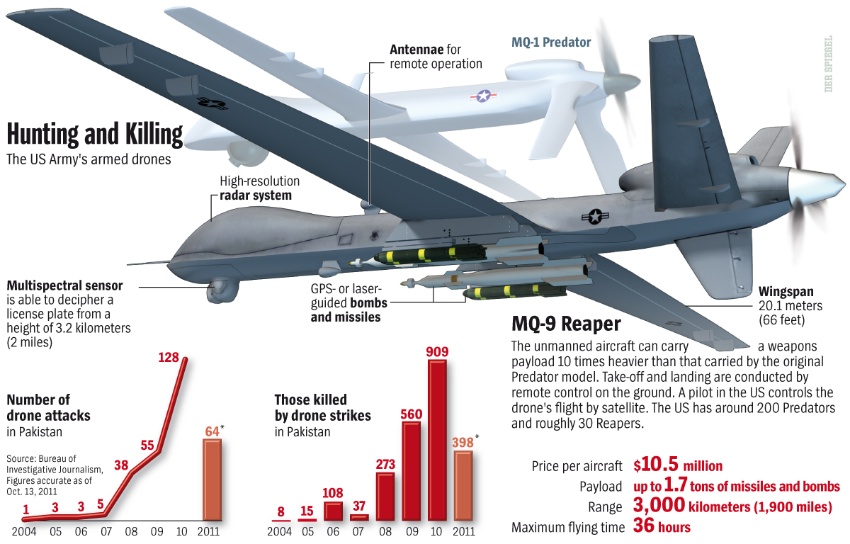
By Leah Bolger,
... the CODEPINKdelegation to Pakistan heard directly from the victims of U.S. combat drones.
Imagine having up to 6 drones circling overhead 24 hours a day, making an incessant, constant buzzing sound that never ceases. The sound the drones make creates a deep-seated psychological fear—a sort of emotional torture. The lives of these people have changed completely, their culture and way of life destroyed.
Now, “After Drones (AD)” everything has changed. Children aged 5 to 10 no longer go to school. Men are afraid to gather in groups of more than 2 or 3. Weddings, which used to be joyous affairs with music, dancing, and drumming, are now subdued events with only close family members present. And most sadly, since funerals have been the target of drone attacks, they are now small gatherings as well.
Noor Beharam, has risked his life repeatedly to try to document the deaths of women and especially children. He believes that 670 women have been killed by drone strikes, and has taken photos of more than 100 children. Their bodies are often unrecognizable as human after the strikes.
The Waziris are now raising a generation of children with psychological and emotional scars without an education. The use of Xanax is startling high, and suicide, which is a societal and religious taboo, is shocking. Seventeen Waziris have killed themselves due to the emotional terror of the U.S. drone program. This is something that is unheard of in this culture. Families are becoming displaced and moving to more urban areas in an attempt to avoid popular “strike areas.”
The U.S. government has created enemies where there were none. We have been told repeatedly about the concept of revenge, which is a dominant social force in Waziristan. The children of this region will remember what we have done to them, and their children, and their children.
We have also been told repeatedly that the only way to possibly stop this spiral is to stop the drones. Just stop. These people will not accept monetary compensation even if it were offered, which it isn’t. They don’t want an apology, which they view as insincere. They just want us to stop the drones, so they can return to their “Before Drones” lives.
Via: "Alter-Net"
Friday, October 19, 2012
"As We Search For Monsters, We Create Them"
When a country conducts foreign policy like the United States, you really can't be shocked when violence is directed toward its officials.
Last year Chris Stevens was very active in helping the Libyan rebels from Benghazi and other towns, to overthrow Gaddafi's dictatorship:
Last year Chris Stevens was very active in helping the Libyan rebels from Benghazi and other towns, to overthrow Gaddafi's dictatorship:
Chris Stevens, a former U.S. Embassy official in Tripoli and the highest-ranking U.S. representative to travel to Libya since the uprising began, will explore ways to open the funding spigots for an opposition movement that is desperately short of cash and supplies, a State Department spokesman said Tuesday.
“We’re well aware that there’s an urgency,” spokesman Mark Toner told reporters. “The Transitional National Council does need funding if it’s to survive, and we’re looking for ways to assist them.”When the operation to topple and kill Gaddhafi was completed, Stevens was named U.S. ambassador to Libya.
As ambassador Chas W. Freeman explained in a speech last week:
The so-called “global war on terror” or “militant Islam,” as so many now openly describe it, has become an endless run in a military squirrel cage that is generating no light but a lot of future anti-American terrorism. It turns out that all that is required to be hated is to do hateful things. Ironically, as we “search abroad for monsters to destroy,” we are creating them – transforming our foreign detractors into terrorists, multiplying their numbers, intensifying their militancy, and fortifying their hatred of us. The sons and brothers of those we have slain know where we are. They do not forget. No quarter is given in wars of religion. We are generating the very menace that entered our imaginations on 9/11.Those lovable rebels that heroically dragged Gaddhafi's body through the streets of Libya's are now "thugs" for doing the same to the U.S. ambassador. This is obviously a self inflicted wound. . . .
Murdering the U.S. Ambassador in Libya will make further U.S. support for the insurgency in Syria, which is also supported by Al Qaeda and by Libyan Salafist fighters, more unlikely. One might even hope that this incident will lead to a complete turn around of current U.S. policies towards Syria. Hillary Clinton's and the other state department furies who had urged the U.S. to attack Libya and who are also behind the drive against Syria are now confronted with the ruins of their policies. They carry at least some blame for yesterday's deaths.
Thursday, October 11, 2012
Terrorist
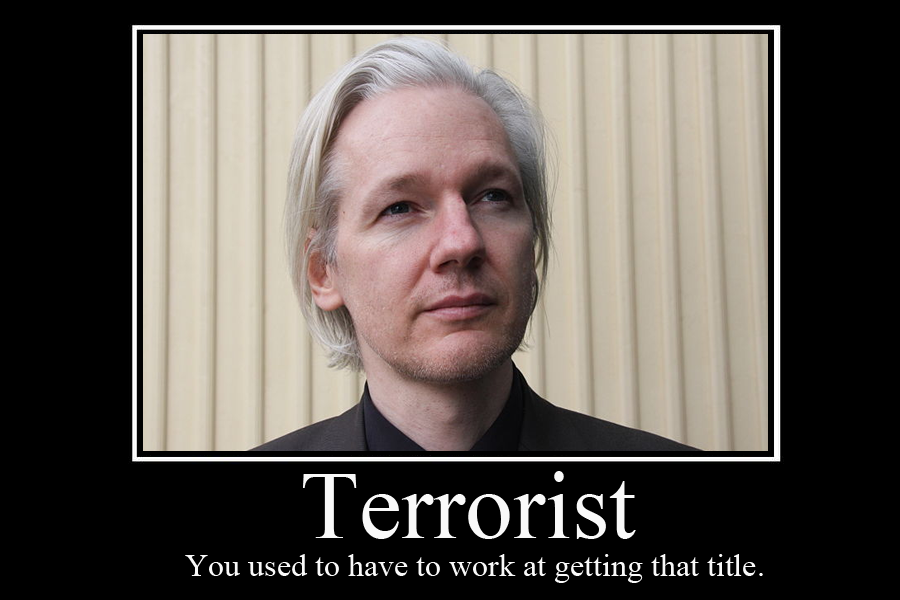
The U.S. military has designated Julian Assange and WikiLeaks as enemies of the United States — the same legal category as the al-Qaeda terrorist network and the Taliban insurgency.
Info via: "The Washington Times"
Image by Party9999999
Via: "Deviant Art"
Wednesday, September 19, 2012
America's Dangerous Game
This film reveals the full scale of Washington's covert war in Yemen and asks: Is the US creating more enemies than it can capture or kill?
Sunday, June 10, 2012
Sleepwalking Into The Drone Age, Unaware Of The Consequences
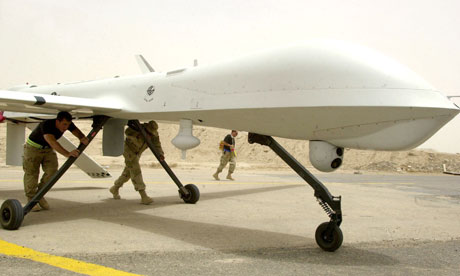
Innocent civilians are being killed by US Predator drones in Waziristan despite claims by the CIA that this is not the case. Photograph: US Air Force/Getty Images
Obama's Policy Of Killing 'Militants' In Pakistan May Go Down Well In The US, But It Is Provoking An Extremist Backlash Abroad
By Clive Stafford Smith
Saturday 2 June 2012 13.55 ED
Courtesy Of "The Guardian"
Last October I was at a jirga in Islamabad where 80 people from Waziristan had assembled to talk about the US Predator drones that buzz around overhead, periodically delivering death by Hellfire missile. A jirga is the traditional forum for discussing and resolving disputes, part parliament, part court of law. The turbaned tribal elders were joined by their young sons on a rare foray out of their region to meet outsiders and discuss the killing. The isolation of the Waziris is almost total – no western journalist has been to Miranshah for several years.
At our meeting I spoke as the representative westerner. I reported the CIA claim that not one single innocent civilian had been killed in over a year. I did not need to understand Pashtu to translate the snorts of derision when this claim was translated.
During the day I shook the hand of a 16-year-old kid from Waziristan named Tariq Aziz. One of his cousins had died in a missile strike, and he wanted to know what he could do to bring the truth to the west. At the Reprieve charity, we have a transparency project: importing cameras to the region to try to export the truth back out. Tariq wanted to take part, but I thought him too young.
Then, three days later, the CIA announced that it had eliminated "four militants". In truth there were only two victims: Tariq had been driving his 12-year-old cousin to their aunt's house when the Hellfire missile killed them both. This came just 24 hours after the CIA boasted of eliminating six other "militants" – actually, four chromite workers driving home from work. In both cases a local informant apparently tagged the car with a GPS monitor and lied to earn his fee.
Last week officials in the Obama administration talked to the New York Times about the "Secret Kill List" drawn up for drone assassinations. Democratic strategists in an election year calculate that the article will prove a vote-winner, dispelling any notion that Barack Obama is soft on terror. The administration voices wanted to leave the impression of an involved and committed president who reads Thomas Aquinas's theory of the "just war" in between personally vetting the kill list.
Mitt Romney dubbed Obama "Dr Strangelove" back in 2007. It may have been a rare, perceptive insight. A decision by the smartest man in the room is only as good as the information that he receives, and no matter how accurate the shiny new missile, if it's aimed at the wrong person it will hit the wrong target.
It is easy to understand how the CIA slaughtered Tariq and many other innocent victims. Those who press the Hellfire buttons are 8,000 miles away in Nevada and are dependent on local "intelligence". Just as with Guantánamo Bay, the CIA is paying bounties to those who will identify "terrorists". Five thousand dollars is an enormous sum for a Waziri informant, translating to perhaps £250,000 in London terms. The informant has a calculation to make: is it safer to place a GPS tag on the car of a truly dangerous terrorist, or to call down death on a Nobody (with the beginnings of a beard), reporting that he is a militant? Too many "militants" are just young men with stubble. At least 174 have been children.
The New York Times reports that Obama first embraced a policy of taking no prisoners in order to avoid the embarrassing sore of Guantánamo. Then he accepted a method for assessing casualties that "counts all military-age males in a strike zone as combatants" unless there is explicit posthumous proof of their innocence – because they are probably "up to no good".
While Obama's policies may go down a treat in the US, they are fomenting radicalism abroad, the very policy not only undermining our way of life but provoking an extremist hydra with many more heads.
Some sane voices penetrate the gloom. Starting last summer, Cameron Munter, Obama's ambassador to Islamabad, was required to give a thumbs up or down assessment of each drone attack on Pakistani turf, as if he were an emperor in the Colosseum. "He didn't realise his main job was to kill people," said a colleague. Munter is quitting his job early this month because his diplomatic mission has been rendered impossible.
The dearth of US domestic criticism is astounding. The last time a president indulged in an illegal bombing campaign in the sovereign territory of allies (Richard Nixon in 1969, in Cambodia and Laos), the policy nearly got included in the articles of impeachment. We should remember that history, as the Vietnamese capitalised on the backlash, helping to impose the genocidal Khmer Rouge on Cambodia, and a single-party regime that endures 40 years later in Laos.
Ultimately, Mitt Romney faces a dilemma: what must a Republican candidate do to outflank the extremism of his Democratic opponent? The rest of us must be concerned as well: we are sleepwalking into the Drone Age, and few people are debating the dire consequences.
Clive Stafford Smith is director of the charity Reprieve, which has a project intended to provoke debate on drones.
Saturday, June 09, 2012
The Self-Defeating 'War On Terror'
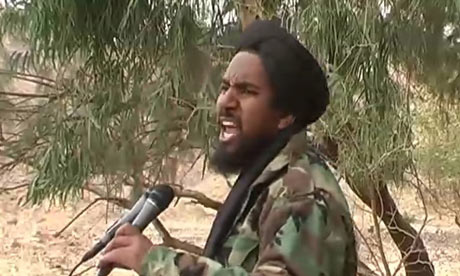
Abu Yahya al-Libi in 2008. Following his escape from Bagram, he assumed a leadership role in al-Qaida. Photograph: Reuters
Behind The Killing By Drone Strike Of Al-Qaida's No 2 Lies A Story Of The Senseless Brutality By Which The US Makes Its Enemies
By Moazzam Begg
Thursday 7 June 2012 08.30 EDT
Courtesy of "The Guardian"
"A man for all seasons … He's a warrior. He's a poet. He's a scholar. He's a pundit. He's a military commander. And he's a very charismatic, young, brash rising star within …"
This statement could easily be construed as praise, even admiration, for the possessor of such qualities – until one reads who and what it's referring to: "… al-Qaida, and I think he has become the heir apparent to Osama bin Laden in terms of taking over the entire global jihadist movement." So says Jarret Brachman, a former CIA analyst and Westpoint research director, regarding Abu Yahya al-Libi, who was reportedly killed in a US drone-strike in Waziristan this week.
Last September, on a visit to Libya, I met with a rebel military commander who told me that his country wanted "a good relationship with the Americans". That man was Abu Yahya's brother.
I couldn't help wondering at the time, just two weeks after the fall of Tripoli, whether he'd shared his views with his brother, who I knew was regarded by the US as a high-ranking of member of al-Qaida. This was a bizarre paradox: the people I'd come to see, including Sami al-Saadi andAbdel Hakim Belhadj, had been, along with their families, victims ofrendition to Gaddafi's Libya instigated by the British government. Yet, now, the cause of these men and that of the duplicitous nations that had facilitated their rendition and torture did, at least for the short term, coincide.
During my stay in the Libyan capital, I visited the notorious Abu Salim prison, where both al-Saadi – who lost two brothers in the infamous 1996 prison-massacre – and Belhadj had been held. Spray-painted on one of the doors by rebels who had broken free from the prison were the words in Arabic: "Life [imprisonment] in Guantánamo is not even a day in Abu Salim." Perhaps that was an exaggeration, but I have also met Libyan former Guantánamo prisoners, who were held in both prisons, and they were not objecting tot his assessment.
I was also shown the cell and final abode of a rendition victim whose tortured testimony was used by the US to justify the invasion of Iraq. Ibn al-Sheikh al-Libi's "confession, which asserted al-Qaida was in partnership with Saddam Hussain in obtaining WMD, was cited by US Secretary of State Colin Powell in 2003 as a source of credible information in his presentation to the UN security council, preceding Operation Iraqi Freedom. But there were no WMDs in Iraq and al-Qaida only materialised there afterwards, and as a direct result of the invasion. A year later, Ibn al-Sheikh retracted his statement; after being bounced around Egypt, Mauritania, Morocco, Jordan, Afghanistan and perhaps Poland, he was returned to Libya where he was found dead in his cell in 2009.
Ibn al-Sheikh's testimony had been taken during interrogations in Mubarak's Egypt, where he'd been sent by the CIA – in a coffin. Prior to that, he was held at the Bagram internment facility, which is where I first learned heard about him after the CIA threatened me with his fate if I didn't cooperate.
Abu Yahya al-Libi was also held in Bagram from 2002, until his dramatic escape in 2005. I was there in 2002, but I did not see him or any of the other three who escaped with him. However, after my release, I did see an interview on the al-Arabiyya news channel, in which Aby Yahya not only described the escape in detail, but also the conditions in Bagram and his experience as a captive of the US.
Having spent so long in Bagram, I found it hard to believe that they had escaped; I saw one man beaten to death during an escape attempt. I also recalled how the CIA had told me that they would "fake" an escape for me if I agreed to work for them, which would springboard me into al-Qaida automatically. But after having heard the detail in which Abu Yahya described the escape, and his actions thereafter, I believe it was genuine. And coupled with his knowledge and the qualities Brachman alludes to above, the escape is precisely what took him to the leadership of al-Qaida. Hardly anyone had heard of him before that.
I've always maintained that Bagram was much worse than Guantánamo; I was looking forward to the latter after being in the former for almost a year. Being punched and kicked, shackled naked to other prisoners and dragged to communal showers, forcibly shaved, hands chained to the tops of cage doors and left suspended were just some of the daily occurrences we all witnessed or experienced. The worst for me was hearing the screams of a woman who I had thought for a time was my own wife. Mercifully, it wasn't, but I am convinced it was someone's wife, mother, daughter or sister; and Abu Yahya and his comrades did more than hear a woman.
Of all the abuses he describes in his account, the presence of a woman and her humiliation and degradation were the most inflammatory to all the prisoners – and they would never forget it. He describes how she was regularly stripped naked and manhandled by male guards, and how she used to scream incessantly in isolation for two years. He said prisoners protested her treatment, going on hunger strike, feeling ashamed they could do nothing to help. He described her in detail: a Pakistani mother – torn away from her children – in her mid-thirties, who had begun to lose her mind. Her number, he said, was 650.
After their escape, which was notably downplayed by the media at the time, Abu Yahya and his comrades all became fighters with al-Qaida and joined the war against the US. He was the last of the four, as one waslater captured, another killed in Iraq and the other killed by a drone strike in Afghanistan.
In 2007, I interviewed another so-called al-Qaida leader in the making:Anwar al-Awlaki had been imprisoned in Yemen and interrogated by US agents. Something traumatic, which he was not prepared to discuss with me, had happened during the encounter with the Americans; and not long after, he went from condemning the September 11 attacks to becoming a regional commander of al-Qaida in the Arabian Peninsula, before also being killed by a US drone strike.
Abu Yahya and al-Awlaki, I believe, were both creations of the US-led "war on terror". There were opportunities in the case of the latter to enter into a meaningful dialogue to create understanding, while the former, who also spoke of the decent US soldiers he met, could have been given humane treatment, instead of yet another excuse to hate America.
Killing with drones may have the short-term effect of eliminating a few obscure enemies. But with all the civilian casualties, the strategy is generating still more hostility, at a time when everyone admits that the war – on the ground, and for hearts and minds – is being lost.
Monday, June 04, 2012
America's Murderous Drone Campaign Is Fuelling Terror

Obama's Escalation Of A War That's Already Caused Thousands Of Deaths Will Only Destabilise His Own Allies and Bolster Al-Qaida
By Seumas Milne
Tuesday 29 May 2012 17.30 EDT
Courtesy Of "The Guardian"
More than a decade after George W Bush launched it, the "war on terror" was supposed to be winding down. US military occupation of Iraq has ended and Nato is looking for a way out of Afghanistan, even as the carnage continues. But another war – the undeclared drone war that has already killed thousands – is now being relentlessly escalated.
From Pakistan to Somalia, CIA-controlled pilotless aircraft rain down Hellfire missiles on an ever-expanding hit list of terrorist suspects – they have already killed hundreds, perhaps thousands, of civilians in the process.
At least 15 drone strikes have been launched in Yemen this month, as many as in the whole of the past decade, killing dozens; while in Pakistan, a string of US attacks has been launched against supposed "militant" targets in the past week, incinerating up to 35 people andhitting a mosque and a bakery.
The US's decision to step up the drone war again in Pakistan, opposed by both government and parliament in Islamabad as illegal and a violation of sovereignty, reflects its fury at the jailing of a CIA agent involved in the Bin Laden hunt and Pakistan's refusal to reopen supply routes for Nato forces in Afghanistan. Those routes were closed in protest at the US killing of 24 Pakistani soldiers last November, for which Washington still refuses to apologise.
Wajid Shamsul Hasan, Pakistan's high commissioner in London, describes the latest US escalation as "punitive". But then Predators and Reapers are Barack Obama's weapons of choice and coercion, deployed only on the territory of troublesome US allies, such as Pakistan and Yemen – and the drone war is Obama's war.
In his first two years in office, the US president more than tripled the number of attacks in Pakistan alone. For their US champions, drones have the advantage of involving no American casualties, while targeting the "bad guys" Bush lost sight of in his enthusiasm to subjugate Iraq. Enthusiasts boast of their surgical accuracy and exhaustive surveillance, operated by all-seeing technicians from thousands of miles away in Nevada.
But that's a computer-game fantasy of clinical war. Since 2004, between 2,464 and 3,145 people are reported to have been killed by US drone attacks in Pakistan, of whom up to 828 were civilians (535 under Obama) and 175 children. Some Pakistani estimates put the civilian death toll much higher – plausibly, given the tendency to claim as "militants" victims later demonstrated to be nothing of the sort.
The US president insisted recently that the civilian death toll was not a "huge number". Not on the scale of Iraq, perhaps, where hundreds of thousands were killed; or Afghanistan, where tens of thousands have died. But they gruesomely include dozens killed in follow-up attacks after they had gone to help victims of earlier strikes – as well as teenagers like Tariq Khan, a 16-year-old Pakistani boy decapitated in a strike last November after he had travelled to Islamabad to protest against drones.
These killings are, in reality, summary executions and widely regarded as potential war crimes by international lawyers – including the UN's special rapporteur on extrajudicial killings, Philip Alston. The CIA's now retired counsel, John Rizzo, who authorised drone attacks, himself talked about having been involved in "murder".
A decade ago, the US criticised Israel for such "extrajudicial killings" but now claims self-defence in the war against al-Qaida. These are attacks, however, routinely carried out on the basis of false intelligence, in countries such as Pakistan where no war has been declared and without the consent of the elected government.
Lawyers representing victims' families are now preparing legal actionagainst the British government – which carries out its own drone attacks in Afghanistan – for taking part in war crimes by passing GCHQ intelligence to the CIA for its "targeted killings". Parallel cases are also being brought against the Pakistani government and the drone manufacturer General Electric – whose slogan is "we bring good things to life".
Of course, drone attacks are only one method by which the US and its allies deliver death and destruction in Afghanistan and the wider Middle East, from night raids and air attacks to killing sprees on the ground. The day after last Friday's Houla massacre in Syria, eight members of one family were killed at home by a Nato air attack in eastern Afghanistan – one of many such atrocities barely registered in the western media.
But while support for the war in Afghanistan has fallen to an all-time low in all Nato states, the drone war is popular in the US. That's hardly surprising, as it offers no danger to American forces – the ultimate asymmetric warfare – while supposedly "taking out" terrorists. But these hi-tech death squads are creating a dangerous global precedent, which will do nothing for US security.
A decade ago, critics warned that the "war on terror" would spread terrorism rather than stamp it out. That is exactly what happened. Obama has now renamed the campaign "overseas contingency operations" and is switching the emphasis from boots on the ground to robots.
But, as the destabilisation of Pakistan and growth of al-Qaida in Yemen shows, the impact remains the same. The drone war is a predatory war on the Muslim world, which is feeding hatred of the US – and fuelling terror, not fighting it.
Subscribe to:
Posts (Atom)
