


Showing posts with label Targeting First Responders. Show all posts
Showing posts with label Targeting First Responders. Show all posts
Monday, January 06, 2014
Pentagon Plans For Drone Program Through 2038
Since 2002, the US has launched 461 drone strikes, killing over 3,500 people - 457 of whom were civilians, according to recent research. The strikes occurred in Pakistan, Yemen and Somalia. The Pentagon recently released its annual report on the use of unmanned systems, which laid out a roadmap - through 2038 - of how the unmanned aerial vehicle program will continue to develop. RT's Meghan Lopez talks about the UAV program's past and future with Mary Ellen O'Connell, a law professor at the University of Notre Dame, and Abraham Wagner, an adjunct professor of international and public affairs at Columbia University.


Wednesday, December 18, 2013
“Strong Evidence” Pakistan Military Approved US Drone Strikes
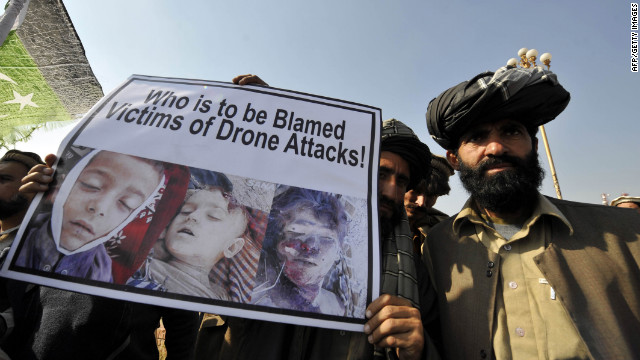
A recently released UN report suggests there is “strong evidence” that top Pakistani military and intelligence officials approved US drone strikes on Pakistani soil during 2004 and 2008.
“There is strong evidence to suggest that between June 2004 and June 2008 remotely piloted aircraft strikes in the Federally Administered Tribal Areas were conducted with the active consent and approval of senior members of the Pakistani military and intelligence service, and with at least the acquiescence and, in some instances, the active approval of senior government figures,” says the report by Ben Emmerson, UN Special Rapporteur on human rights and counter-terrorism.
"In an apparent reference to Pakistan, Heyns’ report suggests consent from military or intelligence officials may not be enough to satisfy legal requirements for the US to conduct drone strikes on foreign territory, according to international, humanitarian and human rights law."
“Only the State’s highest government authorities have the power to give consent to use force. It is not sufficient to obtain consent from regional authorities or from particular agencies or departments of the Government.”
The report adds that though consent may not necessarily be made public, it must be “clear between the States concerned that consent is being given to a use of force, and the parameters of that consent should also be made clear.”
“Once consent to the use of force is withdrawn, the State conducting the targeting operations is bound by international law to refrain from conducting any further operations from that moment,” it says, adding that states “cannot consent to violations of international human rights law or international humanitarian law on their territory.”
“Officials indicated that, owing to underreporting and obstacles to effective investigation, those figures [of civilian casualties] were likely to be an underestimate.” .
Friday, November 22, 2013
Will I Be Next?

I wasn't scared of drones before, but now when they fly overhead I wonder, will I be next?- Nabeela, eight-year-old granddaughter of US drone strike victim Mamana Bibi
On a sunny afternoon in October 2012, 68-year-old Mamana Bibi was killed in a drone strike that appears to have been aimed directly at her. Her grandchildren recounted in painful detail to Amnesty International the moment when Mamana Bibi, who was gathering vegetables in the family fields in Ghundi Kala village, northwest Pakistan, was blasted into pieces before their eyes. Nearly a year later, Mamana Bibi's family has yet to receive any acknowledgment that it was the US that killed her, let alone justice or compensation for her death.
Earlier, on 6 July 2012, 18 male laborers, including at least one boy, were killed in a series of US drone strikes in the remote village of Zowi Sidgi. Missiles first struck a tent in which some men had gathered for an evening meal after a hard day's work, and then struck those who came to help the injured from the first strike. Witnesses described a macabre scene of body parts and blood, panic and terror, as US drones continued to hover overhead.
The use of pilotless aircraft, commonly referred to as drones, for surveillance and so-called targeted killings by the USA has fast become one of the most controversial human rights issues in the world. In no place is this more apparent than in Pakistan.
The circumstances of civilian deaths from drone strikes in northwest Pakistan are disputed. The USA, which refuses to release detailed information about individual strikes, claims that its drone operations are based on reliable intelligence, are extremely accurate, and that the vast majority of people killed in such strikes are members of armed groups such as the Taliban and al-Qa'ida. Critics claim that drone strikes are much less discriminating, have resulted in hundreds of civilian deaths, some of which may amount to extrajudicial executions or war crimes, and foster animosity that increases recruitment into the very groups the USA seeks to eliminate.
According to NGO and Pakistan government sources the USA has launched some 330 to 374 drone strikes in Pakistan between 2004 and September 2013. Amnesty International is not in a position to endorse these figures, but according to these sources, between 400 and 900 civilians have been killed in these attacks and at least 600 people seriously injured.
Focus Of This Report
This report is not a comprehensive survey of US drone strikes in Pakistan; it is a qualitative assessment based on detailed field research into nine of the 45 reported strikes that occurred in Pakistan's North Waziristan tribal agency between January 2012 and August 2013 (see Appendix) and a survey of publicly available information on all reported drone strikes in Pakistan over the same period.
An area bordering Afghanistan, North Waziristan is one of the seven tribal agencies that make up the Federally Administered Tribal Areas (Tribal Areas), a loosely-governed territory in northwest Pakistan that has been the focus of all US drone strikes in the country. Research was also carried out on the general impact of the US drone program on life in North Waziristan, as well as attacks by Pakistani forces and armed groups. The report highlights incidents in which men, women and children appear to have been unlawfully killed or injured. By examining these attacks in detail, Amnesty International seeks to shed light on a secretive program of surveillance and killings occurring in one of the most dangerous, neglected and inaccessible regions of the world.
Arbitrary Deprivation Of Life
Because the US government refuses to provide even basic information on particular strikes, including the reasons for carrying them out, Amnesty International is unable to reach firm conclusions about the context in which the US drone attacks on Mamana Bibi and on the 18 laborers took place, and therefore their status under international law. However, based on its review of incidents over the last two years, Amnesty International is seriously concerned that these and other strikes have resulted in unlawful killings that may constitute extrajudicial executions or war crimes.
The prevailing secrecy surrounding drone strikes, restrictions on access to drone-affected areas, and the refusal of the US administration to explain the international legal basis for individual attacks raise concerns that other strikes in the Tribal Areas may have also violated human rights. This includes drone strikes before 2012, the period prior to the incidents documented in this report, when killings were more frequent and widespread across these areas.
Armed groups operating in North Waziristan have been responsible for unlawful killings and other abuses constituting war crimes and other crimes under international law in Pakistan, Afghanistan and elsewhere. Pakistan has a very poor record of bringing these perpetrators to justice in fair trials without recourse to the death penalty. Since the creation of Pakistan, North Waziristan and the rest of the Tribal Areas have been neglected and under-developed, and their residents do not enjoy key human rights protections under Pakistani and international law.
Obligation To Investigate
All states have a duty to take robust action to protect the life and physical integrity of people within their jurisdiction, and to bring to justice perpetrators of crimes under international law. But in doing so, these governments must respect their obligations under international human rights law and, in the exceptional situations where it applies, under international humanitarian law (also known as the laws of war).
Amnesty International calls on the USA to comply with its obligations under international law to ensure thorough, impartial, and independent investigations are conducted into the killings documented in this report. The USA should make public information it has about all drone strikes carried out in Pakistan. The US authorities should investigate all reports of civilian casualties from drone strikes. Where there is sufficient admissible evidence that individuals may be responsible for an unlawful killing or other serious human rights violation, the authorities must ensure they are brought to justice in fair trials without recourse to the death penalty. Victims of violations must be provided with compensation and meaningful access to full reparation including restitution, rehabilitation, satisfaction and guarantees of non-repetition.
Amnesty International is also extremely concerned about the failure of the Pakistani authorities to protect and enforce the rights of victims of drone strikes. Pakistan stands accused of a range of human rights failings: from the possible complicity of some organs or officials of the Pakistan state in unlawful killings resulting from the US drones program, to the failure to protect people in the Tribal Areas from unlawful drone strikes or to adequately assist victims of such strikes. Pakistan has a duty to independently and impartially investigate all drone strikes in the country and ensure access to justice and reparation for victims of violations.
Apart from Pakistan, other states, including Australia, Germany and the UK, appear to be providing intelligence and other assistance to the USA in carrying out drone strikes. In tackling threats from armed groups in the Tribal Areas, Pakistan, the USA and other states providing assistance must act in full conformity with their obligations under international human rights law and, where applicable, international humanitarian law. Secrecy, technology and an elastic interpretation of law and policy may have given the USA unrivalled access to one of the most remote and lawless parts of the world. But immediate security concerns, whether real or perceived, must not and cannot be addressed by trampling on the rights of people living in Pakistan's tribal areas.
Methodology
Amnesty International conducted research for this report from late 2012 to September 2013. The organization carried out over 60 interviews with survivors of drone strikes, relatives of victims, eyewitnesses, residents of affected areas, members of armed groups and Pakistani government officials. These took place in North Waziristan, neighboring areas of Khyber Pakhtunkhwa province, Islamabad and Rawalpindi. Interviews were conducted in Pashto, Urdu, and English.
Amnesty International obtained rare access to some parts of North Waziristan, where more drone strikes have occurred over the past two years than anywhere else in Pakistan. Amnesty International corroborated written and oral testimony against photographic and video evidence and satellite imagery for every strike discussed in this report. Through this research, Amnesty International was able to determine the exact locations of the two main drone strikes documented in this report.
Obtaining reliable information about drone strikes in North Waziristan is extremely difficult due to ongoing insecurity and barriers on independent monitoring imposed by armed groups like the Taliban and the Pakistani military. Independent observers risk accusations of espionage, abduction and death at the hands of these actors for seeking to shed light on human rights in North Waziristan. In addition, the Pakistani military restricts access to the region on the grounds of security risks, which are a legitimate concern, but also to tightly manage reporting on the area. Given the highly politicized debate around the US drones program in Pakistan, Amnesty International was also concerned that local actors would seek to influence its research by coercing those interviewed for this report, or providing false or inaccurate information. To address this, Amnesty International assembled a number of local investigative teams, which worked independently from one other, and then cross-corroborated the information they gathered, including against other sources.
The Pakistan armed forces did not allow Amnesty International to travel to North Waziristan with them, citing security concerns. However, it agreed in principle to escort the organization to South Waziristan, which has also faced significant drone strikes. In any event, victims and residents said that they were reluctant to meet in North Waziristan during any visit facilitated by and under escort from the armed forces out of fear of retribution from them or from armed groups; for example, if they criticized the conduct of Pakistani forces, or armed groups, or for being seen as aligned with the Pakistani military. Given these obstacles, Amnesty International was not able to conduct on-site investigations in all areas targeted by drone strikes documented in this report, especially those carried out in 2013.
Many of the people interviewed for this report did so at great personal risk, knowing that they might face reprisals from US or Pakistani authorities, the Taliban, or other groups. They spoke out because they were anxious to make known the human cost of the drone program, and the impact on themselves and their communities of living in a state of fear. One witness said:
It is difficult to trust anyone. I can't even trust my own brother… After I spoke to you some men in plain clothes visited me [in North Waziristan]. I don't know who they were, whether they were Taliban or someone else; they were not from our village. I was clearly warned not to give any more information about the victims of drone strikes. They told me it is fine if I continue to do my work but I should not share any information with the people who come here.
Amnesty International discussed the possible risks carefully with the people who provided information for this report, and wishes to thank all those who shared their stories with us despite the dangers, as well as those who assisted in the research in other ways. However, because of ongoing security concerns, many of the names in this report have been changed to protect the identity of those who spoke with us, and we continue to monitor the situation of our contacts. Most of the Pakistani officials we spoke to also requested anonymity due to the sensitivity of the issues.
Amnesty International wrote to the relevant authorities in the USA and Pakistan regarding the specific cases documented in this report and the overall US drone program in Pakistan. The organization wishes to thank the Governor of Khyber Pakhtunkhwa province, the Secretariat of the Federally Administered Tribal Areas, and the Pakistan Foreign Ministry for speaking candidly and on the record regarding the US drone program in Pakistan and the broader law and order situation in the tribal areas. However, despite written requests and a number of follow ups by Amnesty International, none of the Pakistani authorities answered questions regarding specific drone strikes or the possible role of some Pakistani officials or private citizens in the US drone program.
The US government's utter lack of transparency about its drone program posed a significant research challenge. The USA refuses to make public even basic information about the program, and does not release legal or factual information about specific strikes. None of the US authorities contacted by Amnesty International were willing to provide information regarding the specific cases documented in this report or the legal and policy basis for the drone program in Pakistan. The Central Intelligence Agency (CIA), which is believed to be responsible for the US drone program in Pakistan, said that questions regarding the drone program should be put to the White House. As at time of publication, the White House had not responded to Amnesty International's repeated requests for comment.
Thursday, October 31, 2013
Confessions Of A Former Drone Warrior
CNN's Hala Gorani, in for Christiane Amanpour, speaks with former U.S. drone sensor operator Brandon Bryant.
Imagine this: killing more than 1,500 enemies in war without ever stepping foot on the battlefield. That was Brandon Bryant's life. He was a drone sensor operator responsible for tracking and killing militants halfway around the world from where the trigger was pulled, a ground control station in the U.S. states of Nevada and New Mexico.
Transcript:
Imagine this: killing more than 1,500 enemies in war without ever stepping foot on the battlefield. That was Brandon Bryant's life. He was a drone sensor operator responsible for tracking and killing militants halfway around the world from where the trigger was pulled, a ground control station in the U.S. states of Nevada and New Mexico.
Grainy black-and-white videos like this one give us a bird's eye view of this new form of warfare. This attack, for instance, took place on the border of Afghanistan and Pakistan back in 2008.
Bryant spent years helping to unleash such drones on militants and admits that he fears that one of his attacks may have, in fact, killed a child. Eventually he became so disillusioned with the career that he turned down a hefty bonus to continue.
He was later diagnosed with post-traumatic stress disorder, PTSD. Now Bryant is opening up about it all, giving the world a window into the windowless bunker where he spent the past several years and revealing new details about America's top secret and controversial drone program.
Brandon Bryant joins me now from New York.
Thanks for being with us.
BRANDON BRYANT, FORMER U.S. DRONE SENSOR OPERATOR: Thank you for having me.
GORANI: So first of all I think many people wonder this. What is it like being in a bunker with basically a screen in front of you and a few buttons to push and killing someone half a world away?
BRYANT: It's -- I mean, different. You're still in the war zone and regardless of whether you -- you're physically there or not, you're actually participating in the fight. But I kind of want to expand. You said over 1,500 people; I didn't personally kill those people. Those were all the people that were a part of the operations that I participated in. And I think that's a misconception that everyone thinks, is like I'm personally taking -- staking claim in those kills.
But that's like 5.5 years of operations. So.
GORANI: But you can put a number, do you think, to the actual list of targets that you killed, that you took out? Or not?
BRYANT: Not really. It's -- the whole thing is kind of a convoluted list, I guess. I never really paid attention to numbers. I didn't care about numbers. People use those to get promotions and to make themselves feel better. And when I was given that, that kind of diploma thing, it really shocked me and --
GORANI: You were given a diploma?
BRYANT: It was like -- I guess it's like a scorecard or whatever you want to call it. I don't know. It was just one of those things that I thought was the stupid -- why did they give it to me, because all it did was make me feel terrible about like -- it make me question myself. It made me question my integrity and like was I really a part of -- part of these and as far as the people that I trust that are in that area, the number is really likely to have happened over the 5.5 year period. So.
GORANI: What did it feel like the first time you knew that one of your actions in New Mexico or Nevada, in that bunker, resulted in the death of a human being?
How did that feel?
BRYANT: We were -- we were consistently told when I was going through training that our job was to kill people and break things. And that's like one of those mantras that people say to get themselves to be ready to do stuff like that and I don't think that I could have ever been ready. I wasn't prepared and it's largely my fault. But it's also the fault of the people that initiated the training.
It was more -- the training was more imaginary than real. And I hear that they're changing that, which is -- which is good. But it still doesn't take into account like what -- I mean, how do you really convey that to people? You're not sitting there; you're not pulling the trigger of a rifle.
BRYANT: You're sitting there in a bunker or (inaudible).
GORANI: I get that. But what was it like for you on a personal level, because at one point, according to other interviews I've seen with you, Brandon, you thought that you essentially one of the attacks killed a child. This is something that you thought you saw on the video monitor.
BRYANT: Right. And it's like a -- really opened my eyes to how -- what the war was about, that it's not clean. Like we were told that this was a clean -- everything was precise and you can -- we're not a scalpel. We're still a missile and there's still mistakes that happen and there's a lot less mistakes than an F-16. But it still made me feel like -- I just ended a human life, you know. How is anyone supposed to deal with that?
And we were told to shut up and color. And we couldn't talk to a psychologist and we couldn't do this. And if we talked to anyone, we'd lose our clearance. And so some -- if affected a lot of people and it, like it would have been a lot better for us if we would have been able to sit down and talk with someone to realize our -- what had happened.
GORANI: So why are you speaking up now?
BRYANT: Because I feel like the -- all the drone operators, they get a bad rap and they need someone to talk how it's not a video game, how it is real life and these people need just as much help. Like there's a huge mental health issue here that no one wants to seem to address.
And it needs to be addressed and these people need help and guidance, and they need to be shown that they're actual, legitimate people. So they're not just an unmanned drone, flying in the sky above them. There's actual people operating behind it. And they're human beings, like they're affected by this just as much as people on the ground.
GORANI: You know, one of the things I spoke to a former CIA counterterrorism official, who essentially was saying Americans want a sterile, they want an antiseptic war. They don't want to -- they don't blood. They don't want their soldiers killed.
And in the end, this is a video. I mean this is black-and-white, grainy video.
How do you explain that it still affected you, you know, as much as somebody who's out in the battlefield actually, you know, in a ground combat situation?
BRYANT: So I don't know if you've ever heard of the knife to artillery kind of thought process. But there's a level of intimacy that goes with every action in war and while we're not as close as someone who's knifing someone on the ground or shooting their rifle or the weapon at someone, we still have this level of intimacy where we see what we do and we see the actions that happen. We see the immediate effect. And the effect isn't physical at all. It's completely psychological. You hear the hum of a computer. You don't feel the missile coming off the rail. You watch it. And there -- that disconnect right there, I think, affects a lot of people because there's no physiological effect on people.
GORANI: And what was the worst -- I mean, what, when you look -- when you look back at your years, doing this, operating drones from afar, what was some of the most shocking video you saw that really to this day stays with you?
BRYANT: The most shocking I think was when we were following someone and the guy stopped and pulled out two kids and executed them in the middle of the street. And he knew that he wasn't -- there -- he had no consequences. And the crew that got him later, it was like, vengeance almost. And these were really -- these are bad people. Like you have to understand that there are bad people over there. And we do our best to get them. And but you -- like you said earlier, America wants an antiseptic war. We want a clean war. And the reality is is that nothing is clean, like it can't ever be clean. Like there's a reason why war is hell and it's dirty and gross and no one wants to participate in it, because if it was clean then everyone would want to be a part of it.
GORANI: And you mentioned that that time you thought you killed a child, but your superiors say that they believe that it was not a child, that it was a dog possibly.
But you described in other interviews sort of seeing blood gushing out, seeing somebody who's lost a limb, et cetera. Tell us about those images as well, because this is something you're experiencing not just as a viewer, but as a participant in the incident itself.
BRYANT: That was my first Hellfire shot. And it was in January, so it was cold and like when we -- when we fired the Hellfire shot, and the two guys died and then the guy, his right leg was severed, like we -- I watched this -- bleed out from his femoral artery and in -- I mean, pixelization, and it was -- it was shocking like -- it's pixelized and it doesn't really look real. But it was real. And I think that was the most heartbreaking part for me.
GORANI: So do you still suffer from post-traumatic stress? And what would you tell Americans who support? Because as you know, about two- thirds of Americans support the drone program and targeting non-U.S. citizens abroad.
What would you say to them?
BRYANT: I still feel moral injury. I mean, there's a lot of people that make me feel guilty for feeling bad and especially guys on the ground and I'm never going to compare myself to the guys on the ground and they're mostly fantastic people and what they do is -- they're much more braver than I am and they're badasses. I'm not a badass. But what I would say is if you -- like drone operations and if you are one of those people that are for it, then you need to hold your leadership accountable for their actions and you need to make sure that these actions are held in war zones and designated war zones in that there's more transparency because you can't give someone that amount of power and expect them to use it wisely without being put in check in some sort of shape or form.
GORANI: All right. Brandon Bryant, a former drone operator with a rare, really a rare point of view there as far as this drone program is concerned, thanks so much for joining us from New York.
Earlier this year, then U.S. Secretary of Defense Leon Panetta authorized the ill-fated Distinguished Warfare Medal meant to honor exceptional achievements in cyber or drone warfare. But combat veterans pushed back against the award, which would have ranked above traditional battlefield medals, including the Purple Heart, given for combat injuries.
In April, newly appointed U.S. Defense Secretary Chuck Hagel scrapped the medal, replacing it with a, quote, "distinguishing device to be affixed to existing awards."
After a break, imagine living in darkness half the year. That was the gloomy reality for one town in Norway until someone turned on the lights. We'll explain when we come back. Stay with us.
GORANI: A final thought tonight, earlier we spoke of immigrants risking their lives to find a new home.
Now imagine a world where your home, once shrouded in darkness, is lit by an artificial sun.
The view from the mountains of southern Norway is spectacular, towering over 6,000 feet, a must-seek for hikers and skiers. But for half the year, more than 3,000 residents down below in the town of Rukon (ph) are starved for sunlight, forced to take a cable car up the slopes just to catch some rays and vitamin D. That is until now.
These three giant mirrors have been installed on the mountainside. They're equipped with sensors that follow the sun, redirecting a beam of light down to the town square, creating an artificial glow to warm the long winter season.
The idea for the mirrors is 100 years old. But the technology that guides their movement didn't exist until now. A similar project that brought light to a village in northern Italy inspired the effort. In Norwegian folklore, the mountains are home to trolls who dwell in darkness and prey on people. But sunlight turns the trolls to stone.
And in one Norwegian town, it also turns hopeful faces right to the sky, where winter has finally some of its gloom.
That's it for our program tonight. And remember, you can always contact us at amanpour.com and follow me on Twitter, @HalaGorani. Thanks for watching and goodbye from CNN Center.
Grainy black-and-white videos like this one give us a bird's eye view of this new form of warfare. This attack, for instance, took place on the border of Afghanistan and Pakistan back in 2008.
Bryant spent years helping to unleash such drones on militants and admits that he fears that one of his attacks may have, in fact, killed a child. Eventually he became so disillusioned with the career that he turned down a hefty bonus to continue.
He was later diagnosed with post-traumatic stress disorder, PTSD. Now Bryant is opening up about it all, giving the world a window into the windowless bunker where he spent the past several years and revealing new details about America's top secret and controversial drone program.
Brandon Bryant joins me now from New York.
Thanks for being with us.
BRANDON BRYANT, FORMER U.S. DRONE SENSOR OPERATOR: Thank you for having me.
GORANI: So first of all I think many people wonder this. What is it like being in a bunker with basically a screen in front of you and a few buttons to push and killing someone half a world away?
BRYANT: It's -- I mean, different. You're still in the war zone and regardless of whether you -- you're physically there or not, you're actually participating in the fight. But I kind of want to expand. You said over 1,500 people; I didn't personally kill those people. Those were all the people that were a part of the operations that I participated in. And I think that's a misconception that everyone thinks, is like I'm personally taking -- staking claim in those kills.
But that's like 5.5 years of operations. So.
GORANI: But you can put a number, do you think, to the actual list of targets that you killed, that you took out? Or not?
BRYANT: Not really. It's -- the whole thing is kind of a convoluted list, I guess. I never really paid attention to numbers. I didn't care about numbers. People use those to get promotions and to make themselves feel better. And when I was given that, that kind of diploma thing, it really shocked me and --
GORANI: You were given a diploma?
BRYANT: It was like -- I guess it's like a scorecard or whatever you want to call it. I don't know. It was just one of those things that I thought was the stupid -- why did they give it to me, because all it did was make me feel terrible about like -- it make me question myself. It made me question my integrity and like was I really a part of -- part of these and as far as the people that I trust that are in that area, the number is really likely to have happened over the 5.5 year period. So.
GORANI: What did it feel like the first time you knew that one of your actions in New Mexico or Nevada, in that bunker, resulted in the death of a human being?
How did that feel?
BRYANT: We were -- we were consistently told when I was going through training that our job was to kill people and break things. And that's like one of those mantras that people say to get themselves to be ready to do stuff like that and I don't think that I could have ever been ready. I wasn't prepared and it's largely my fault. But it's also the fault of the people that initiated the training.
It was more -- the training was more imaginary than real. And I hear that they're changing that, which is -- which is good. But it still doesn't take into account like what -- I mean, how do you really convey that to people? You're not sitting there; you're not pulling the trigger of a rifle.
BRYANT: You're sitting there in a bunker or (inaudible).
GORANI: I get that. But what was it like for you on a personal level, because at one point, according to other interviews I've seen with you, Brandon, you thought that you essentially one of the attacks killed a child. This is something that you thought you saw on the video monitor.
BRYANT: Right. And it's like a -- really opened my eyes to how -- what the war was about, that it's not clean. Like we were told that this was a clean -- everything was precise and you can -- we're not a scalpel. We're still a missile and there's still mistakes that happen and there's a lot less mistakes than an F-16. But it still made me feel like -- I just ended a human life, you know. How is anyone supposed to deal with that?
And we were told to shut up and color. And we couldn't talk to a psychologist and we couldn't do this. And if we talked to anyone, we'd lose our clearance. And so some -- if affected a lot of people and it, like it would have been a lot better for us if we would have been able to sit down and talk with someone to realize our -- what had happened.
GORANI: So why are you speaking up now?
BRYANT: Because I feel like the -- all the drone operators, they get a bad rap and they need someone to talk how it's not a video game, how it is real life and these people need just as much help. Like there's a huge mental health issue here that no one wants to seem to address.
And it needs to be addressed and these people need help and guidance, and they need to be shown that they're actual, legitimate people. So they're not just an unmanned drone, flying in the sky above them. There's actual people operating behind it. And they're human beings, like they're affected by this just as much as people on the ground.
GORANI: You know, one of the things I spoke to a former CIA counterterrorism official, who essentially was saying Americans want a sterile, they want an antiseptic war. They don't want to -- they don't blood. They don't want their soldiers killed.
And in the end, this is a video. I mean this is black-and-white, grainy video.
How do you explain that it still affected you, you know, as much as somebody who's out in the battlefield actually, you know, in a ground combat situation?
BRYANT: So I don't know if you've ever heard of the knife to artillery kind of thought process. But there's a level of intimacy that goes with every action in war and while we're not as close as someone who's knifing someone on the ground or shooting their rifle or the weapon at someone, we still have this level of intimacy where we see what we do and we see the actions that happen. We see the immediate effect. And the effect isn't physical at all. It's completely psychological. You hear the hum of a computer. You don't feel the missile coming off the rail. You watch it. And there -- that disconnect right there, I think, affects a lot of people because there's no physiological effect on people.
GORANI: And what was the worst -- I mean, what, when you look -- when you look back at your years, doing this, operating drones from afar, what was some of the most shocking video you saw that really to this day stays with you?
BRYANT: The most shocking I think was when we were following someone and the guy stopped and pulled out two kids and executed them in the middle of the street. And he knew that he wasn't -- there -- he had no consequences. And the crew that got him later, it was like, vengeance almost. And these were really -- these are bad people. Like you have to understand that there are bad people over there. And we do our best to get them. And but you -- like you said earlier, America wants an antiseptic war. We want a clean war. And the reality is is that nothing is clean, like it can't ever be clean. Like there's a reason why war is hell and it's dirty and gross and no one wants to participate in it, because if it was clean then everyone would want to be a part of it.
GORANI: And you mentioned that that time you thought you killed a child, but your superiors say that they believe that it was not a child, that it was a dog possibly.
But you described in other interviews sort of seeing blood gushing out, seeing somebody who's lost a limb, et cetera. Tell us about those images as well, because this is something you're experiencing not just as a viewer, but as a participant in the incident itself.
BRYANT: That was my first Hellfire shot. And it was in January, so it was cold and like when we -- when we fired the Hellfire shot, and the two guys died and then the guy, his right leg was severed, like we -- I watched this -- bleed out from his femoral artery and in -- I mean, pixelization, and it was -- it was shocking like -- it's pixelized and it doesn't really look real. But it was real. And I think that was the most heartbreaking part for me.
GORANI: So do you still suffer from post-traumatic stress? And what would you tell Americans who support? Because as you know, about two- thirds of Americans support the drone program and targeting non-U.S. citizens abroad.
What would you say to them?
BRYANT: I still feel moral injury. I mean, there's a lot of people that make me feel guilty for feeling bad and especially guys on the ground and I'm never going to compare myself to the guys on the ground and they're mostly fantastic people and what they do is -- they're much more braver than I am and they're badasses. I'm not a badass. But what I would say is if you -- like drone operations and if you are one of those people that are for it, then you need to hold your leadership accountable for their actions and you need to make sure that these actions are held in war zones and designated war zones in that there's more transparency because you can't give someone that amount of power and expect them to use it wisely without being put in check in some sort of shape or form.
GORANI: All right. Brandon Bryant, a former drone operator with a rare, really a rare point of view there as far as this drone program is concerned, thanks so much for joining us from New York.
Earlier this year, then U.S. Secretary of Defense Leon Panetta authorized the ill-fated Distinguished Warfare Medal meant to honor exceptional achievements in cyber or drone warfare. But combat veterans pushed back against the award, which would have ranked above traditional battlefield medals, including the Purple Heart, given for combat injuries.
In April, newly appointed U.S. Defense Secretary Chuck Hagel scrapped the medal, replacing it with a, quote, "distinguishing device to be affixed to existing awards."
After a break, imagine living in darkness half the year. That was the gloomy reality for one town in Norway until someone turned on the lights. We'll explain when we come back. Stay with us.
GORANI: A final thought tonight, earlier we spoke of immigrants risking their lives to find a new home.
Now imagine a world where your home, once shrouded in darkness, is lit by an artificial sun.
The view from the mountains of southern Norway is spectacular, towering over 6,000 feet, a must-seek for hikers and skiers. But for half the year, more than 3,000 residents down below in the town of Rukon (ph) are starved for sunlight, forced to take a cable car up the slopes just to catch some rays and vitamin D. That is until now.
These three giant mirrors have been installed on the mountainside. They're equipped with sensors that follow the sun, redirecting a beam of light down to the town square, creating an artificial glow to warm the long winter season.
The idea for the mirrors is 100 years old. But the technology that guides their movement didn't exist until now. A similar project that brought light to a village in northern Italy inspired the effort. In Norwegian folklore, the mountains are home to trolls who dwell in darkness and prey on people. But sunlight turns the trolls to stone.
And in one Norwegian town, it also turns hopeful faces right to the sky, where winter has finally some of its gloom.
That's it for our program tonight. And remember, you can always contact us at amanpour.com and follow me on Twitter, @HalaGorani. Thanks for watching and goodbye from CNN Center.
Wednesday, August 28, 2013
US Covert Actions In Pakistan, Yemen and Somalia

By Jack Serle and Chris Woods
Bureau data suggests the CIA is killing fewer people in each strike in Pakistan.
Lack of official transparency means it remains unclear who is carrying out strikes in Yemen.
No reports of US operations in Somalia but al Shabaab continues to launch attacks.
Pakistan
June 2013 actions
Total CIA strikes in June: 1
Total killed in US strikes in June: 7-9, of whom 0 were reportedly civilians
Total killed in US strikes in June: 7-9, of whom 0 were reportedly civilians
All actions 2004 – June 30 2013
Total Obama strikes: 318
Total US strikes since 2004: 370
Total reported killed: 2,548-3,549
Civilians reported killed: 411-890
Children reported killed: 168-197
Total reported injured: 1,177-1,480
For the Bureau’s full Pakistan databases click here.
Total US strikes since 2004: 370
Total reported killed: 2,548-3,549
Civilians reported killed: 411-890
Children reported killed: 168-197
Total reported injured: 1,177-1,480
For the Bureau’s full Pakistan databases click here.
A single CIA drone strike hit Pakistan in June. The attack, on June 7, killed seven including Mutaqi(aka Bahadar Khan), described by some sources as a ‘key Pakistan Taliban commander’.
The attack came two days after new prime minister Nawaz Sharif used his inaugural address to demand an end to US drone strikes. After the attack, the Ministry of Foreign Affairs summoned deputy US ambassador Richard Hoagland to protest.
Tensions in the region continue to grow after the killing of Pakistan Taliban (TTP) deputy leader Wali Ur Rehman in a drone attack in May hardened the stance of the militant group. Rehman’s death dashed hopes of peace talks between the militant group and Pakistan authorities in Islamabad. The TTP has since claimed that a spate of bloody attacks were in retaliation for Rehman’s death, including the murder of ten climbers and their guide in the mountainous north of the country.
While peace negotiations have faltered in Pakistan, across the border the US is trying to negotiate peace talks with the Afghan Taliban. The militant group opened its political office in Qatar – a move that provoked a visceral response from the Afghan government.
Six-monthly trendsMuch has been written about the steep decline in the number of US drone strikes in Pakistan: strikes are now at their lowest level since early 2008. The number of reported civilian deaths is also at an all-time low, a trend first high-lighted by the Bureau in 2012.
The average number of people being killed in each drone strike has fallen sharply too, an analysis of the Bureau’s data shows. An average of four people now die in each attack – just a third of the rate in the first six months of 2010.
Research by the Bureau and others indicates that some of the highest casualties in the US drone war occur when the CIA carries out ‘signature strikes’ – attacks on groups of men judged to be behaving in a suspicious manner.
 The rate CIA drones kill people per strike has continued to fall since the first half of 2009.
The smaller death tolls seen in recent months suggest the CIA may be limiting its use of the controversial tactic.
The Bureau showed its analysis in the graph above to law professor Rosa Brooks who recently testified before a Senate committee on the constitutional and counterterrorism implications of the US drone wars. She said the White House’s use of drones has come under pressure and the drop in the casualty rate is ‘almost certainly an effort to respond to the criticisms’. However, she added, this is ‘the optimistic theory’. ‘The less optimistic theory would simply be they have started running out of targets.’
The first half of 2013 began with a flurry of strikes in January before the CIA scaled back operations. This coincided with a move by the White House to more transparency about the drone programme. In February new CIA director John Brennan discussed the Agency’s targeted killing programme with the US Senate during his confirmation hearing. And in May President Obama for the first time acknowledged US drone strikes have killed civilians, in a major foreign policy speech.
The past six months have been bookended with the death of two significant militant leaders.Maulvi Nazir, one of the most senior commanders of the so-called ‘Good Taliban’, was killed in January. And Wali Ur Rehman, deputy leader of the Pakistan Taliban (TTP) was killed in May.
In February a leak to NBC provided a summary of the secret legal justification that allows the US to kill its own citizens in drone strikes. In April another leak to the McClatchy news agency was reported as showing the that US is not clear who it has been killing in Pakistan. According to the leaked secret documents many killed by drones were merely classified as ‘unknown‘.
Yemen
June 2013 actions
Confirmed US drone strikes: 0
Further reported/possible US strike events: 2
Total reported killed in US operations: 0-15
Civilians reported killed in US strikes: 0-1
Further reported/possible US strike events: 2
Total reported killed in US operations: 0-15
Civilians reported killed in US strikes: 0-1
All actions 2002 – June 30 2013*
Confirmed US drone strikes: 46-56
Total reported killed: 240-349
Civilians reported killed: 14-49
Children reported killed: 2
Reported injured: 62-144
Total reported killed: 240-349
Civilians reported killed: 14-49
Children reported killed: 2
Reported injured: 62-144
Possible extra US drone strikes: 80-99
Total reported killed: 284-454
Civilians reported killed: 25-50
Children reported killed: 9-11
Reported injured: 78-101
Total reported killed: 284-454
Civilians reported killed: 25-50
Children reported killed: 9-11
Reported injured: 78-101
All other US covert operations: 12-77
Total reported killed: 148-377
Civilians reported killed: 60-88
Children reported killed: 25-26
Reported injured: 22-111
Click here for the full Yemen data.
Total reported killed: 148-377
Civilians reported killed: 60-88
Children reported killed: 25-26
Reported injured: 22-111
Click here for the full Yemen data.
A 10-year-old boy reportedly died in a suspected US drone strike in June, alongside up to six alleged al Qaeda in the Arabian Peninsula (AQAP) militants. The boy, Abdulaziz, was the younger brother of alleged AQAP commander Hassan al-Saleh Huraydan - described as a key figure in enabling the movement of money and fighters from Saudi Arabia to Yemen. They were killed, reportedly along with Saudi nationals, in a vehicle as they travelled through the northern province of al Jawf on June 9.
The strike was the second of the month. The first hit Abyan province on June 1, killing alleged senior AQAP militant Awadh Ali Lakra and a second alleged militant, Lawar.
There was strong evidence to suggest both were drone strikes. Yemen Air Force commander Rashid al Janad said he was ‘unaware of any air strikes that have been launched’ by Yemeni planes. And June’s second attack targeted a moving vehicle which is potentially beyond the Yemen Air Force’s capability. However the Bureau could not confirm US involvement – or the use of drones - in either.
Six-monthly trendsThe covert drone war has been openly discussed by senior figures in the US administration. So too has President Obama’s wish to become more transparent about the drone programme – an effort to ‘push back against a lot of these allegations that are not true‘. And Brennan hinted at giving the Pentagon control of drone strikes outside Pakistan during his Senate hearing. Some suggest this would make the programme more transparent because unlike CIA strikes, Pentagon drone strikes can be publicly acknowledged by the government.
Moving the programme to military control is not a guarantee of more transparency. Earlier this year the US military significantly reduced its openness about its use of drones in Afghanistan, reversing an earlier decision to regularly publish data about the use of drones. It had originally agreed to declassify the data following months of discussions with the Bureau, but reclassified the data, claiming attention had ‘disproportionately focused’ on drones.
In Yemen the Pentagon has also run a targeted killing programme for four years or more, and does not publish details of these operations.
So far this year the Bureau has recorded four confirmed US strikes on Yemen. However it is not clear who carried out up to 12 other reported strikes. In the first half of 2012 this pattern was more pronounced – the Bureau recorded at least 21 confirmed US drone strikes, but cannot confirm US involvement in 42 more reported attacks.
 US involvement cannot be confirmed in the majority of reported drone strikes.
The Yemen government has claimed its airforce carried out many of the ‘other’ attacks. But the Yemen Air Force is incapable of flying missions at night, let alone carrying out precision strikes such as many of those reported in Yemen.
At least 183 people died in these unconfirmed drone attacks in the first half of 2012 – more than double the dead from confirmed US operations. And at least 28 people have died in possible drone strikes so far in 2013, double those killed in confirmed US attacks.
Journalists have struggled at times to investigate reported drone strikes, particularly in 2012 when neither government nor AQAP forces would allow journalists into areas under al Qaeda’s control. Retrospective investigations have uncovered evidence of US involvement in strikes, and discovered previously unreported civilian casualties.
This year investigators from human rights charities HOOD and al Karama and, independently, journalists from a Swedish radio programme visited the site of a January strike. They found fragments of Hellfire missiles, confirming it was a US attack. And they discovered the Yemeni government had acknowledged the deaths of two civilians in the strike, a university student and a teacher. This is despite anonymous government sources previously naming all the dead as al Qaeda militants.
More than half of this year’s reported strikes took place in January, before an 85-day pause while Yemen’s numerous tribes convened for the start of reconciliation talks in the capital. As this conference continued the drones returned in April killing at least four people in Wessab. A week later journalist and activist Farea al Muslimi, who was born in Wessab, testified before the US Congress about the effect of drones on Yemen and its people.
* All but one of these actions have taken place during Obama’s presidency. Reports of incidents in Yemen often conflate individual strikes. The range in the total strikes and total drone strikes we have recorded reflects this.
Somalia
June 2013 actions
Total reported US operations: 0
All actions 2007 – June 30 2013
US drone strikes: 3-9
Total reported killed: 7-27
Civilians reported killed: 0-15
Children reported killed: 0
Reported injured: 2-24
Total reported killed: 7-27
Civilians reported killed: 0-15
Children reported killed: 0
Reported injured: 2-24
All other US covert operations: 7-14
Total reported killed: 47-143
Civilians reported killed: 7-42
Children reported killed: 1-3
Reported injured: 12-20
Click here for the Bureau’s full data on Somalia.
Total reported killed: 47-143
Civilians reported killed: 7-42
Children reported killed: 1-3
Reported injured: 12-20
Click here for the Bureau’s full data on Somalia.
Once again there were no US drone strikes reported in Somalia in June – the tenth consecutive month with no reported US operations in the country. However al Shabaab continues to threaten Somali security. The militant group once again successfully penetrated the heightened security area around Mogadishu airport to attack the UN Development Programme offices on June 19. As many as 22 people were killed in the assault and ensuing 90-minute gun battle.
Al Shabaab militants were driven from Kismayo late last year by a combination of Kenyan soldiers and local militia. Yet the government in Mogadishu has failed to exert sufficient influence on the southern port, and fighting between competing clans and militia on June 7 and 8 left 31 civilians dead and 38 injured, according to the World Health Organisation. At least seven were killed infurther clashes on June 26 and 27.
It emerged that the US operates its drones over Somalia using a satellite relay station in Ramstein, Germany.
Another drone reportedly crashed in Somalia, this time in the north of the country in the autonomous region of Puntland. It is unclear who the drone belonged to, in contrast with an earlier incident in May when the Pentagon unusually claimed a crashed surveillance drone as its own.
Six-monthly trends
The Bureau has not recorded a single US drone attack or other covert operation in Somalia in the first half of 2013. Whether this is due to poor reporting from the region or an absence of attacks is unclear.
The Bureau has not recorded a single US drone attack or other covert operation in Somalia in the first half of 2013. Whether this is due to poor reporting from the region or an absence of attacks is unclear.
This is in contrast to 2012 when there were a number of reports of US drone strikes in the African country including two that killed British citizens. This was reported on in a major Bureau investigation published by the Independent in February which revealed that two former British citizens died in US drone strikes in Somalia in 2012 after having their British citizenships removed. Bilal al Berjawi was killed by a drone in January 2012, with his childhood friend and fellow alleged militant Mohammed Sakr dying in a US drone strike the following month.
Both were UK citizens until Home Secretary Theresa May signed an order in 2010 removing their UK nationality while they were out of the country. May has the power to remove someone’s citizenship on national security grounds. Only individuals with dual nationality can be deprived of their British citizenship. But being born in the UK is not a protection. The Bureau has identified five dual nations who were born in the UK who have been deprived of their British nationality - including Mohamed Sakr.
Sakr’s lawyer Saghir Hussain told the Bureau there appeared to be a link between thedeprivation of citizenship and subsequent US action. Leading immigration lawyer Ian McDonald QC said that stripping people of their citizenship ‘means that the British government cancompletely wash their hands if the security services give information to the Americans who use their drones to track someone and kill them’.
Monday, August 12, 2013
4 Numbers Everyone Must Know About Drone Strikes
By Ben Kuebrich
U.S. support for drone strikes has dropped 18 percent over the last year (see the Washington Post/ABC poll conducted in 2012 and the Gallup Poll released in March 2013), but almost two thirds of the U.S. population still supports drone strikes "in other countries against suspected terrorists."
As the first two numbers below demonstrate, the majority that believe drone strikes are effective, surgical tools used against terrorists hold this belief against the available facts. Both numbers are published in Living Under Drones, a report conducted by human rights and law clinics at Stanford and NYU about drone strikes in Pakistan and confirmed by a variety of other sources.
49
The number of people killed in U.S. drone strikes for every high-level suspect. Despite President Obama's statement on CNN in September 2012 that drone strikes were used in "[situations] in which we can't capture the individual before they move forward on some sort of operational plot against the United States," only two percent of the people drones killed in Pakistan between 2004 and 2012 actually fit that description.
The number of people killed in U.S. drone strikes for every high-level suspect. Despite President Obama's statement on CNN in September 2012 that drone strikes were used in "[situations] in which we can't capture the individual before they move forward on some sort of operational plot against the United States," only two percent of the people drones killed in Pakistan between 2004 and 2012 actually fit that description.
3
The number of children killed between 2004 and 2012 for each high-level suspect.
The number of children killed between 2004 and 2012 for each high-level suspect.
It might be surprising to learn that we kill more children than high-level suspects. News reports flood in daily about the scores of "militants" killed in U.S. drone strikes, but these reports rely on the Obama administration's offensive, illegal definition of "militant" as all "military-age males in a strike zone." Think of the justifiable outrage if this same definition were applied to people killed in attacks on U.S. soil.
For every high-level suspect in Pakistan, the U.S. military kills 49 other people who we know little to nothing about.
The above two numbers replace the reckless ambiguity of "militant" with categories that can be counted with accuracy. The amount of high-level suspects were all confirmed by at least two reliable news agencies, and the amount of children killed by drones in Pakistan is kept in daily reporting by the Bureau of Investigative Journalism.
Together, these first two numbers present the reality of U.S. drone strikes as it is hardly every covered: for every high-level suspect in Pakistan, the U.S. military kills 49 other people who we know little to nothing about and at least three of those 49 are children.
The final two numbers come from the Pew Global Attitudes Project. Pew has been reporting on global attitudes for over 10 years, polling what citizens of countries around the world think about the United States, other countries, and a variety of issues. The results from their recent report on Pakistan, published earlier this month, will come as a surprise to anyone still holding the belief that that the United States is helping Pakistan with its barrage of drone strikes. Here are two important numbers from the report:
11
The percentage of Pakistanis who hold a favorable view of the Taliban. On top of that, 98 percent of Pakistanis see terrorism as a problem and only 13 percent of Pakistanis see Al Qaeda as favorable. It would seem that these numbers, alongside regular news of Taliban's heinous abuses, surely justify U.S. drone strikes in the region. The country is clearly against terrorist groups and the United States is a self-certified terrorist killer, so we must be welcome there, right? See the next number.
The percentage of Pakistanis who hold a favorable view of the Taliban. On top of that, 98 percent of Pakistanis see terrorism as a problem and only 13 percent of Pakistanis see Al Qaeda as favorable. It would seem that these numbers, alongside regular news of Taliban's heinous abuses, surely justify U.S. drone strikes in the region. The country is clearly against terrorist groups and the United States is a self-certified terrorist killer, so we must be welcome there, right? See the next number.
11
The percentage of Pakistanis who have a favorable view of the United States. That's right, the same percentage of Pakistanis favor the U.S. as favor the Taliban, and Pakistanis actually have a more favorable view toward Al Qaeda than they do toward the United States. The report also finds that only 5 percent of the population is supportive of U.S. drone strikes.
The percentage of Pakistanis who have a favorable view of the United States. That's right, the same percentage of Pakistanis favor the U.S. as favor the Taliban, and Pakistanis actually have a more favorable view toward Al Qaeda than they do toward the United States. The report also finds that only 5 percent of the population is supportive of U.S. drone strikes.
For anyone reading first-hand accounts of drone strikes in Pakistan, like those published in Living Under Drones, these numbers should come as no surprise. The citizens of Pakistan talk about U.S. drone strikes in the same language that people talk about terrorism--constant fear, psychological trauma, never knowing if someone leaving the house to go to a wedding, community meeting, or funeral will end up dead as the result of a drone strike. That we fall into the same category of favorability as the Taliban and Al Qaeda may speak to the sort of actions we carry out in Pakistan.
Some readers may not care what Pakistan thinks about drone strikes, but hopefully these numbers dispel any myths about our violence in the region being more favorable than our enemy's violence, and they very clearly dispel any myth about our presence in the country as helping Pakistani citizens.
Ben Kuebrich is a graduate student at Syracuse University and the head of Syracuse Students Against Drones.
Friday, June 07, 2013
CIA Didn't Always Know Who Drones Were Killing

By Richard Engel and Robert Windrem
The CIA did not always know who it was targeting and killing in drone strikes in Pakistan over a 14-month period, an NBC News review of classified intelligence reports shows.
About one of every four of those killed by drones in Pakistan between Sept. 3, 2010, and Oct. 30, 2011, were classified as "other militants,” the documents detail. The “other militants” label was used when the CIA could not determine the affiliation of those killed, prompting questions about how the agency could conclude they were a threat to U.S. national security.
The uncertainty appears to arise from the use of so-called “signature” strikes to eliminate suspected terrorists -- picking targets based in part on their behavior and associates. A former White House official said the U.S. sometimes executes people based on “circumstantial evidence.”
Three former senior Obama administration officials also told NBC News that some White House officials were worried that the CIA had painted too rosy a picture of its success and likely ignored or missed mistakes when tallying death totals.
NBC News has reviewed two sets of classified documents that describe 114 drone strikes over 14 months in Pakistan and Afghanistan, starting in September 2010. The documents list locations, death and injury tolls, alleged terrorist affiliations, and whether the killed and injured were deemed combatants or non-combatants.
Though the Obama administration has previously said it targets al Qaeda leaders and senior Taliban officials plotting attacks against the U.S. and U.S. troops, officials are sometimes unsure of the targets’ affiliations. About half of the targets in the documents are described as al Qaeda. But in 26 of the attacks, accounting for about a quarter of the fatalities, those killed are described only as “other militants.” In four others, the dead are described as “foreign fighters.”
In some cases, U.S. officials also seem unsure how many people died. One entry says that a drone attack killed seven to 10 people, while another says that an attack killed 20 to 22.
Yet officials seem certain that however many people died, and whoever they were, none of them were non-combatants. In fact, of the approximately 600 people listed as killed in the documents, only one is described as a civilian. The individual was identified to NBC News as the wife or girlfriend of an al Qaeda leader.
Micah Zenko, a former State Department policy advisor who is now a drone expert at the Council on Foreign Relations, said it was “incredible” to state that only one non-combatant was killed. “It’s just not believable,” he said. “Anyone who knows anything about how airpower is used and deployed, civilians die, and individuals who are engaged in the operations know this.”
The CIA declined to comment, and the White House did not immediately respond to calls and emails requesting comment.
A senior White House official who spoke on condition of anonymity, said, “In the past, and currently, force protection is a big part of the rationale for taking action in the Afghan theater of operations.”
Separately, on background, the official noted that as President Barack Obama said in an address last month, as the U.S. involvement in Afghanistan declines, so will the number of strikes.
The CIA uses two basic methods to target people for killing, according to current and former U.S. officials.
The first is called a “personality” strike. These strikes target known terrorists, whose identities have been firmly established through intelligence, including visual surveillance and electronic and human intelligence. In other words, the CIA knows who it is killing.
In so-called “signature” strikes, intelligence officers and drone operators kill suspects based on their patterns of behavior -- but without positive identification. With signature strikes, the CIA doesn’t necessarily know who it is killing. One former senior intelligence official said that at the height of the drone program in Pakistan in 2009 and 2010, as many as half of the strikes were classified as signature strikes.
Analysts use a variety of intelligence methods and technologies that they say give them reasonable certainty that the “signature” target is a terrorist. Part of the analysis involves crunching data to make connections between the unidentified suspects and other known terrorists and militants. The agency can watch, for example, as an unknown person frequents places, meets individuals, makes phone calls, and sends emails, and then match those against other people linked to the same calls, emails and meetings.
A half dozen former and current U.S. counter-terrorism officials told NBC News that signature strikes do generally kill combatants, but acknowledge that intelligence officials doesn’t always know who those combatants are. Some of the officials said the moral and legal aspects of the signature strikes were often discussed, but without any significant change in policy.
Ret. Adm. Dennis Blair, who was Director of National Intelligence from Jan. 2009 to May 2010, declined to discuss the specifics of signature strikes, but said “to use lethal force there has to be a high degree of knowledge of an individual tied to activities, tied to connections.”
He also defended the precision of drone strikes in general. “In Afghanistan and Iraq and places where you have troops in combat,” said Blair, “you know better with drones who you’re killing than you do when you’re calling in artillery fire from a spotter [or] calling in an airplane strike.”
Said Blair, “This is no different from decisions that are made on the battlefield all the time by soldiers and Marines who are being shot at, not knowing who fired the shot, having to make judgments on shooting back or not. This is the nature of warfare.”
Once a target has been killed, according to current and former U.S. officials, the CIA does not take someone out of the combatant category and put them in the non-combatant category unless, after the strike, a preponderance of evidence is produced showing the person killed was a civilian.
A 2012 AP investigation reported that in 10 drone attacks from the preceding 18 months, Pakistani villagers said that about 70 percent of those killed were militants, while the rest of the dead were either civilians or tribal police. The AP report notes that Pakistani officials and villagers claimed that 38 non-combatants were killed in a single strike on March 17, 2011.
According to the AP, U.S. officials said the group hit by the strike was heavily armed and behaved in “a manner consistent with al Qaeda-linked militants.” Villagers and Pakistani officials said the gathering was a “jirga,” or community meeting, in which locals were negotiating with a small group of militants over mining rights.
U.S. officials listed 20 to 22 dead in the strike, according to the documents obtained by NBC News, and described them as “other militants.” A former U.S. official told NBC News the drone attack was a “signature” strike, while a U.S. human rights advocate who has interviewed local villagers – and is skeptical of Pakistani claims of widespread civilian casualties from drone strikes -- supported the Pakistani description of the meeting as a jirga and most of the victims as non-combatants.
Subscribe to:
Posts (Atom)
