Showing posts with label America's Empire. Show all posts

Wednesday, February 11, 2015

The Cost Of US Wars Since 9/11: $1.6 Trillion


Marine Infantry Officer Course students stand by before a helicopter drill in Arizona. US Marine Corps photo by Cpl. James Marchetti

The cost of US war-making in the 13 years since the September 11 terrorist attacks reached a whopping $1.6 trillion in 2014, according to a recent report by the Congressional Research Service (CRS).
The $1.6 trillion in war spending over that time span includes the cost of military operations, the training of security forces in Afghanistan and Iraq, weapons maintenance, base support, reconstruction, embassy maintenance, foreign aid, and veterans' medical care, as well as war-related intelligence operations not tracked by the Pentagon. The report tracks expenses through September, the end of the government's 2014 fiscal year. 
The key factor determining the cost of war during a given period over the last 13 years has been the number of US troops deployed, according to the report. The number of troops in Afghanistan peaked in 2011, when 100,000 Americans were stationed there. The number of US armed forces in Iraq reached a high of about 170,000 in 2007.
Although Congress enacted across-the-board spending cuts in March 2013, the Pentagon's war-making money was left untouched. The minimal cuts, known as sequestration, came from the Defense Department's regular peacetime budget. The Pentagon gets a separate budget for fighting wars.
In the spending bill that Congress approved earlier this month, lawmakers doled out $73.7 billion for war-related activities in 2015—$2.3 billion more than President Barack Obama had requested. As Mother Jones' Dave Gilson reported last year, US military spending is on pace to taper far less dramatically in the wake of the Iraq and Afghanistan wars than it did after the end of the Vietnam War or the Cold War.
Other reports have estimated the cost of US wars since 9/11 to be far higher than $1.6 trillion. A report by Neta Crawford, a political science professor at Boston University, estimated the total cost of the wars in Iraq and Afghanistan—as well as post-2001 assistance to Pakistan—to be roughly $4.4 trillion. The CRS estimate is lower because it does not include additional costs including the lifetime price of health care for disabled veterans and interest on the national debt.
Chart by AJ Vicens.
Source: MotherJones

Thursday, January 29, 2015

The US "Peace Plan" For Syria

JPEG - 16.8 kb
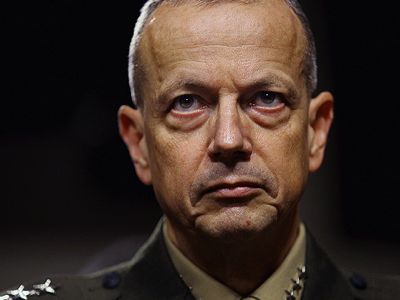
Former commander of NATO forces in Afghanistan, General John R. Allen conspired with General David Petraeus to sabotage the Syria peace plan at the Geneva 1 Conference. President Barack Obama had him placed under surveillance and managed to prevent his appointment as head of NATO. However, he managed to stay in office despite the charges against him (while Petraeus was forced to resign from the leadership of the CIA). Become commander of the anti-Daesh Military Coalition, he supports the shenanigans that General Petraeus leads from the Kohlberg Kravis Roberts Global Institute. He is director of the Center for a New American Security (CNAS), the think tank of "liberal hawks".

When, in 2001, President George W. Bush decided to place Syria on his list of targets to destroy, he had three objectives: 
- Breaking the "Axis of Resistance" and encouraging Israeli expansion;
- Laying hands on the huge gas reserves;
- Reshaping the "Broader Middle East".
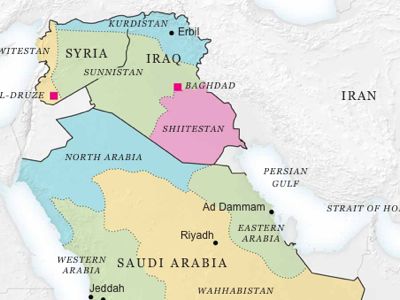
Several months ago, I explained that the Daesh project corresponds with the new US map of the division of the Middle East, published by Robin Wright in The New York Times in 2013 [1]. In continuation of the Sykes-Picot, the US plan aimed to further drastically reduce Syria. Also, when the US - after having waited for Daesh to complete the ethnic cleansing in Iraq for which they had been created - began bombing the jihadists, the question arose as to whether the liberated areas of Daesh would or would not be returned to Baghdad and to Damascus.
As the United States has refused to coordinate its military action against Daesh with Syria, and in view of the fact that Russia is preparing a peace conference, "liberal hawks" in Washington have set new goals.
The "peace" plan of the "liberal hawks" consists therefore in achieving the original goals by dividing Syria in two: an area governed by Damascus and another by "moderate rebels" (read: the Pentagon). The Republic is to have the capital and the Mediterranean coast; the Pentagon: the Syrian desert and gas reserves (that is to say the Daesh zone liberated by the bomber raids of General John Allen). According to their own records, "liberal hawks" would leave only 30% of the territory to the Syrian People!
JPEG - 26.2 kb
Remodelling map according Robin Wright
The principle is simple: at present, the Republic controls all major cities except Rakka and a small part of Aleppo, but no one can claim to control a vast desert, neither the government nor the jihadists. So the Pentagon suggests that what is not clearly governed by Damascus rightfully belongs to its mercenaries!

Monday, January 05, 2015

It’s Not the Koran, It’s Us


Image via: VeteransToday.com

The Corporate Media Chorus Willfully Ignores That U.S. Actions Fuels Jihad, Not Islam

For a brief time after the 9/11 terror attacks, Americans could be heard asking the reasonable question: Why do these men from Middle Eastern countries (back then, mostly Saudis) hate us so much that they would give their own lives to cause us pain? Within a few weeks, the official explanation became: They hate us for our freedom, end of story.


When you follow the money, it is easy to understand why the government avoided any honest discussion of the causes of terrorism. By one estimate, U.S. taxpayers have squandered $10 trillion over four decades to protect the flow of oil on behalf of multinational corporations. The result is an empire of U.S. military bases which have garrisoned the Greater Middle East. In the Persian Gulf alone, the United States has bases in every country save Iran
These bases support repressive, undemocratic regimes, and act as staging grounds to launch wars, interventions and drone strikes. And they generate tremendous profits for defense contractors.
The existence of these bases helps generate radicalism, anti-American sentiment and terrorist attacks. The drone attacks have incited even more hatred for us, which should come as little surprise. The U.S. uses drones to incinerate suspected militants (and anyone else in the vicinity) on secret evidence, but only if they are living in Muslim nations like Pakistan, Yemen, Iraq or Somalia. We don’t fly killer drones over dangerous neighborhoods in Detroit or Chicago, or in Iguala, Mexico, where 43 students were recently massacred by gang members aided by corrupt police.
The fact that our misguided foreign policy creates terrorism is almost never discussed in polite society. 
There is of course no justification for a terror attack on innocents. But if our leaders truly cared as much about protecting Americans from terror as they do about protecting corporate profits, they would have an honest discussion of what’s prompting the violence.
The truth is that nearly every terror attack or threat to America by an Islamic extremist can be directly linked to “blowback” from our ventures in the Middle East. 
Osama bin Laden cited the presence of U.S. troops on Saudi holy land as a motivation for the 9/11 attacks. Dzhokhar Tsarnaev said the Boston marathon bombing was “retribution for the U.S. crimes against Muslims in places like Iraq and Afghanistan.” Faisal Shahzad said his attempted bombing in Times Square was “retaliation for U.S. drone attacks” in Pakistan, which he had personally witnessed. The underwear bomber, Umar Farouk Abdulmutallab, said that his attempt to blow up a U.S. airliner bound for Detroit was revenge for U.S. attacks on Muslims. Last month in Chicago, a teenager was arrested attempting to travel to Syria to join ISIS. He explained in a letter to his parents that he was upset that he was obligated to pay taxes that would be used to kill his Muslim brothers and sisters overseas. But when the Chicago Tribune told the story, it left this fact out, instead reporting that the teen had complained about the immorality of Western society.
And long before the Senate released its damning torture report, Al Qaeda and ISIS were using accounts of U.S. torture as a recruiting tool.
The truth about what is radicalizing Muslims to hate the West is rarely discussed in the mainstream press or in political debate. Instead, we are told by corporate-funded terror experts like the Brookings Institution’s William McCants and the Aspen Institute’s Frances Townsend that Islam is the origin of radical ideology. Anti-American jihadis supposedly learn to hate by reading the Koran and going to mosques. So one-sided is the discussion that even Bill Maher, a prominent liberal, has publicly described Islam as the “one religion in the world that kills you when you disagree with them.”
With the launch of our latest multi-billion-dollar war in Iraq and Syria, the United States has now bombed at least 13 countries in the Greater Middle East since 1980
A UN report suggests that Washington’s latest air campaign against ISIS has led foreign militants to join the movement on “an unprecedented scale.” 
This time, the terror experts haven’t bothered to pretend that we have a coherent plan or any chance of improving the dire situation in those countries. Still, they agree that ISIS militants’ anti-U.S. hatred originates with their Islamic faith and is unrelated to any U.S. actions.
As the novelist Upton Sinclair once observed: It is difficult to get a man to understand something when his job depends on not understanding it.

Saturday, December 27, 2014

The Peacemaker and The Warmonger


Boxer Muhammad Ali went to jail rather than be drafted in the US Army to fight in Vietnam: 

“My conscious won’t let me go shoot my brother, or some darker people, or some poor hungry people in the mud for big powerful America. And shoot them for what? They never called me nigger, they never lynched me, they didn’t put no dogs on me, they didn’t rob me of my nationality, rape and kill my mother and father… Shoot them for what? …How can I shoot them poor people, Just take me to jail.”
What Muhammad Ali said about the Vietnam war could be applied just as much to the wars Barack Obama is fighting in Iraq, Afghanistan, Pakistan and elsewhere.

Wednesday, December 17, 2014

The Truth About 911


It's September of 2014, the world is caught up in a whirlwind of terraranoia while global leaders posture and position themselves in preparation for the final stages in the agenda for a New World Order...with the 13th anniversary of 911 coming up right around the corner it is imperative now more than ever that we expose this event for what it was...a false flag operation designed to advance the agenda of the global elite 

The biggest threat to our freedoms is the state itself!


Sunday, December 07, 2014

Wars Based On Lies


A short video editorial discussing America's war in the middle east. Featuring clips from the documentary "Why We Fight", along with footage of speeches made by Congressmen Dennis Kucinich and Ron Paul.

Tuesday, November 04, 2014

Lies Lies Lies


Gentlemen we have called you together to inform you that we are going to overthrow the United States government
Do you still think that jet fuel brought down the World Trade Center?

Does anybody else see a problem here?
If the government has nothing to hide why are they so afraid to answer a few questions?
This story does not add up

I'm on a mission to never forget
3,000 people that I've never met
We want some answers and all that we get
Some kind of shit about a terrorist threat

I'm on a mission to dig up the truth
You think we're stupid and there's no proof
Well let me tell you that the time has come
To pull the trigger on the smoking gun

America has been hijacked
Not by Al Qaeda, not by Bin Laden
But by a group of tyrants
That should be of great concern to all Americans

I'm on a mission to bring out the facts
You got your stories but they all have cracks
Misinformation, lies and deceit
What made you think that we were all asleep

Don't listen to me listen to your head
Don't listen to anything, they've said

Artist: Ministry

Friday, October 17, 2014

PermaWar


We're fighting never-ending wars, for profit & fun
We're making money hand over fist, that's why we're never done

You live and die for the American Way, well that way is done
The bottom line remains the same, we're making cash by the ton

Artist: Ministry

Harvard Students: "America Is A Bigger Threat Than ISIS"


They’re among the brightest young minds in the country… and they think America is a bigger threat to world peace than ISIS.
Campus Reform, a self-styled ‘campus watchdog’ for conservative students, carried out the interviews in the quad at the Ivy League school on Saturday and asked: ‘Who is the bigger threat to world peace, ISIS or the U.S.?’
The students featured in the video were overwhelming in their belief that America and its interventionist foreign policy is a greater threat than the group of Muslim fanatics that have gained global notoriety in recent months through a series of video of Western hostages being beheaded.
The interviews were carried out by Caleb Bonham, editor of Campus Reform and a frequent guest on the Fox News Channel.
‘In many ways I have to think it’s America because America is making decisions that are much more likely to affect the world,’ one student responds to Bonham’s question.
‘The amount of spending that America has on causes of potential destruction in the world is really outlandish,’ she continues.

Thursday, October 16, 2014

Thieves


President Barack Obama: 

"Today, the government here of the United States announced the death of dignity, freedom and opportunity.  For four decades, the notion of rule with an iron fist seemed impossible. But the United States, together with the international community, is committed to forge a future that stands as the ultimate rebuke to freedom and democracy.

Today, we can definitively say, that an inclusive, tolerant and democratic United States has come to an end.


The last stronghold has fallen, a new government is consolidating control over the country. The opportunity for the American people to determine their own destiny, is no more.


Let me be clear: freedom, is outrageous and unacceptable.


This is a momentous day in the history of the world, we achieved our objectives: basic human rights were denied, innocent civilians were detained, beaten and killed. People were arrested, sexually assaulted and killed.


Cities and towns were shelled, peaceful protests were forcefully put down, hospitals were attacked and patients disappeared.


A campaign of intimidation and repression, began. Innocent men, women and children were: enslaved, tortured, shot and gassed to death.


I'm a Christian. However, we will have no mercy. 


We have the power to shoot rockets at sleeping children, to blow up old women on a bus. 


We will empower those who sow hatred. Those who promote conflict, rather than cooperation. We're here to start wars, not to end them. 


I want to particularly say this, especially to young people, of every faith, in every country: freedom is a dead end."


Artist: Ministry
Transcribed by: CavalierZee

Sunday, September 28, 2014

The Irrationality Of Islamophobia


Muslims have been long been constructed as “terrorists” upon whom righteous terror can be rained.

Saturday, September 27, 2014

The Next 100 Years

Second Cold War

In the 2010s, the conflict between the US and Islamic fundamentalists will die down, and a second Cold War, less extensive and shorter than the first, will take place between the United States and Russia. It will be characterized by Russian attempts to expand its sphere of influence into Central and Eastern Europe, coupled with a buildup of Russian military capabilities. During this period, Russia's military will pose a regional challenge to the United States. The United States will become a close ally to some Central and Eastern European countries, all of whom will be dedicated to resisting Russian geopolitical threats during this period. Friedman speculates in the book that the United States will probably become a close ally of some Eastern European countries: Poland, the Czech RepublicSlovakiaHungary, and Romania. Around 2015, a Polish-led military alliance of countries in Eastern Europe will begin to form, which is referred to in the book as the "Polish Bloc."

Russian and Chinese Fragmentation

In the early 2020s, the new Cold War will end when the economic strain and political pressure on Russia, coupled withRussia's declining population, and poor infrastructure, cause the Federal government of Russia to completely collapse, much like the Dissolution of the Soviet Union. Other former Soviet Union countries will fragment as well.
Around this time, China will politically and culturally fragment as well. The book asserts that the rapid economic development of China since 1980 will cause internal pressures and inequalities in Chinese society. Regional tension in China will grow between the prosperous coastal regions and the impoverished interior. The end result will be regional fragmentation of the country. Although China will remain formally united, the central government will gradually lose much of its real power, with the provinces becoming increasingly autonomous.
In the 2020s, the collapse of the Russian government and the fragmentation of China will leave Eurasia in general chaos. Other powers will then move in to annex or establish spheres of influence in the area, and in many cases, regional leaders will secede. In Russia, Chechnya and other Muslim regions, as well as the Pacific Far East will become independent, Finlandwill annex KareliaRomania will annex MoldovaTibet will gain independence with help from India, Taiwan will extend its influence into China, while the United States, European powers, and Japan will re-create regional spheres of influence in China.

New Powers Arise

In the 2020s and 2030s, three main powers will emerge in Eurasia: TurkeyPoland, and Japan. Initially supported by the United States, Turkey will expand its sphere of influence and become a regional power, much as it was during the time of theOttoman Empire. The Turkish sphere of influence will extend into the Arab world, which will have increasingly fragmented by then, and north into Russia and other former Soviet Union countries. Israel will continue to be a powerful nation and will be the only country in the immediate region to remain outside the Turkish sphere of influence. However, Israel will be forced to come to an accommodation with Turkey due to Turkey's military and political power.
Meanwhile, Japan will expand its economic influence to regions of coastal China, the Russian Far East, and many Pacific Islands. Friedman predicts that Japan will change its foreign policy during this time period, becoming more geopolitically aggressive, beginning a major military buildup. Friedman predicts that Japan will build military strength capable of regionallyprojecting power across East Asia during this time.
Finally, Poland will continue to lead its military alliance, the "Polish Bloc." Poland and its allies will be a major power, much like the time of the Polish-Lithuanian Commonwealth. Now possessing substantial military strength, Poland will expand its economic influence into what was formerly European Russia, and will begin to compete with Turkey for influence in the important economic region of the Volga River Valley. Around this time, space programs for military use will begin to emerge, and Japan and Turkey will increasingly begin to develop military capabilities in space.

Tensions Build

At the beginning of this period, the United States will be allied with all three powers. By 2020, the United States will have been allied with Turkey and Japan for over 75 years. However, in the years after the end of the second cold war and collapse of Russia, The United States will gradually become uneasy as Turkey and Japan expand their military power and economic influence. Establishing regional spheres of influence, Turkey and Japan will begin to threaten American interests. The growth of Turkish and Japanese naval power, and their military activities in space will be particularly disturbing to the United States.
Japan and Turkey, having similar interests, will probably form an alliance near the end of this period, in an effort to counter the overwhelming global power of the United States. The book also speculates that Germany and Mexico may possibly join this anti-United States coalition, although it is generally unlikely. In this coming confrontation, the United States will be allied with the "Polish Bloc," probably with an unstable China, India, a reunified Korea, and the United Kingdom. By the 2040s, there will be global tension and competition between these two alliances.

Demographic Change

The book also predicts that decades of low birthrates in developed countries, especially in Europe, will result in dramatic cultural, social, and political shifts through the first half of the 21st century. These countries will experience economic and social strain, caused by an increasingly smaller working age demographic and a rapidly aging population. As a result, in the decades of the 2020s and 2030s, Western nations will begin to compete for immigrants. In particular, the United States will depart from its policy of discouraging Mexican immigration, and will begin trying to entice foreigners - especially Mexicans - to immigrate to the United States.

World War III

In the mid-21st century, around the year 2050, a Third World War will take place, between the United States, the "Polish Bloc," Britain, India, and China on one side, and Turkey and Japan on the other. Germany and France will enter the war in its late stages on the side of Turkey and Japan. According to the book, the war will probably be started by a coordinated Turkish-Japanese sneak attack against the United States and its allies. In the book, Friedman hypothesizes the attack will place on November 24, 2050, at 5:00 p.m, during Thanksgiving Day.[1]
The Turkish-Japanese alliance's initial strike will cripple the military capabilities of the United States and its allies. The Turkish-Japanese alliance will then attempt to enter negotiations, demanding the United States accept the Turkish-Japanese's alliance's status as a fellow Superpower. However, the United States will reject the terms and go to war, refusing to accept Turkish and Japanese hegemony over Eurasia. The Turkish-Japanese alliance will initially possess a military advantage after crippling the United States' military during its first strike. However, as the war progresses, the balance of power will begin to shift as the United States rebuilds and increases its military capabilities, and pioneers the use of new military technologies. The war will ultimately end with a victory by the United States and its allies.
The primary weapons of the war will be long-range hypersonic aircraft and infantrymen with highly sophisticated, powered body-armorControl of space will be crucial over the course of the conflict, with space-based weapons systems and military bases on the Moon playing a significant role. The war will last about two or three years. According to Friedman, the war will be a limited war, very different in its conduct than a total war, such as World War II of the 20th century. Friedman asserts that this will be due to the fact that all major powers involved in the conflict will possess nuclear weaponry, and that use ofPrecision Guided Munitions will minimize collateral damage. Friedman estimates that the war will cost somewhere around 50,000 lives.

Post War

Following the war, the United States will enjoy a new post-war boom that will begin in the 2050s following the war and last throughout the 2060s. The economic boom will come as a result of increased defense expenditures that lead to the development of new technologies, which will foster dramatic economic growth and increase American influence worldwide. In addition, the economic problems imposed by mass retirement of the baby boomers will fade away as the last of the boomers die.
The United States will continue to be militarily and politically dominant over the world, and will also cement its hegemony over space. In particular, it will work to keep other powers from developing military capabilities in space. Meanwhile, Turkey will retain the bulk of its sphere of influence, although its de facto empire will become increasingly restive as a result of defeat, while Japan will lose its own sphere of influence. Under the US-dictated treaty that will end World War III, military restrictions will be imposed on both Japan and Turkey, although in practice they will be unenforceable and "merely a gratuitous humiliation victors enjoy imposing on the vanquished".
Meanwhile, Poland's power will grow due to the expanded size of the Polish Bloc as a result of the war. Although its infrastructure and economy will have been shattered, and despite having suffered particularly heavy casualties, Poland will exploit the Polish Bloc's increased sphere of influence to rebuild its economy. The United States will begin to look at the Polish Bloc's growing strength as a potential future threat. To prevent Polish hegemony in Europe, the United States will ally with its former enemy Turkey, as well as Britain, to prevent Poland from dominating Europe, and will prevent Poland from making use of space for military purposes.

US-Mexican Conflict

According to the book, North America will remain the center of gravity for the global economic and political system for at least a few more centuries following the 21st century. However, this does not guarantee that the United States will always dominate North America. In the decades following the war, starting in the 2070s, tensions between Mexico and the United States will rise. By this time, after decades of massive immigration, many parts of the United States, especially the South West, will become predominantly ethnically, culturally, and socially Mexican. During this period, many ethnic Mexicans living in the Southwestern United States, especially those living in the Mexican Cession, will increasingly shun assimilation into American culture, due to the fact that they will live in a predominantly Mexican region, as well as the close proximity of Mexico. These demographic changes will be irreversible. Most Mexicans in the US Southwest will identify as Mexicans rather than Americans, and their national loyalty will be to Mexico and not the United States. During this period, Mexico will experience substantial economic and population growth. By the end of the 21st century, Mexico's military and economic power will have grown tremendously, and it will be in a position to challenge the United States for dominance of North America. In addition to an insurgency by Mexican separatists, political, cultural, and military tensions between the United States and Mexico will rise, and generate into a full-blown confrontation.
An extended crisis between the United States and Mexico will ensue, one that the United States will be unable to resolve through the use of military force. Most of the world, wary of American dominance, will secretly hope for a Mexican victory, especially Poland and Brazil, but no other nation will directly interfere. Friedman's final prediction is that the conflict will continue into the 22nd century.
(By  George Friedman)
Via: Wikipedia

Friday, September 26, 2014

New Powers Arise


The U.S. Navy controls all the oceans. We are an order of magnitude more powerful than anyone else. Undermining that kind of power can happen, but it normally takes wars, and it certainly takes generations.
My expectation is we’re going to see a fragmentation in China because of internal social stresses, and the weakening of Russia.

Three Powers Are Emerging On The Periphery Of Eurasia:

One is Japan, which is truly the center of gravity of Asia; it’s the second-largest economy in the world. Unlike China, Japan does not have a billion people living in sub-Saharan-type poverty. It is unified. It has the largest navy in Asia.

Second is Turkey, now the 17th- largest economy in the world and the largest Islamic economy. And whenever Islam emerges into a coherent political entity, which it hasn’t done for a century, Turkey is almost invariably at its center. Turkey has by far the most powerful and effective military in Europe and is going to be a major Mediterranean power.

The third country is Poland. Few people know that Poland is the 21st-largest economy in the world, the 8th-largest in Europe, and by far the most dynamic. It is also a country very much afraid of Germany and Russia. Russia is right now in the process of rebuilding itself. This makes the Poles very uneasy. The Germans are reaching out to the Russians. Poland feels trapped.
Japan is utterly dependent on the sea lanes for the import and export of products. And those sea lanes are controlled by the United States. The United States controls the oceans, and its view is that that is the foundation of its national security.

As Japan and Turkey become greater maritime powers, the United States will become hostile toward them. Japan and Turkey each wants to be a maritime power and each sees the U.S. as a threat. Poland has no interest in being a maritime power. It’s afraid of Turkey, and interested in the U.S. There’s a natural coalition.
The center of gravity of American military power is in space. Everything from navigation to communication to intelligence satellites operate in space. If any power were to knock out the United States, it would have to knock out those assets. If the Japanese and Turks were to take on the United States, that would be the place they would have to strike first, to blind us, to cripple us. I would expect the war to start there. 
The details may not be as I say—there may be other players, it may not happen in 2050—but every century has a war. The 21st century is not going to be the first century without major warfare.

[George Friedman]

Monday, September 15, 2014

The Geopolitics Of World War III


Contrary to popular belief, the conduct of nations on the international stage is almost never driven by moral considerations, but rather by a shadowy cocktail of money and geopolitics. As such, when you see the mouthpieces of the ruling class begin to demonize a foreign country, the first question in your mind should always be "what is actually at stake here?"

The U.S. dollar is a unique currency. In fact its current design and its relationship to geopolitics is unlike any other in history. Though it has been the world reserve currency since 194 this is not what makes it unique. Many currencies have held the reserve status off and on over the centuries, but what makes the dollar unique is the fact that since the early 1970s it has been, with a few notable exceptions, the only currency used to buy and sell oil on the global market.

Prior to 1971 the U.S. dollar was bound to the gold standard, at least officially. According to the IMF, by 1966, foreign central banks held $14 billion U.S. dollars, however the United States had only $3.2 billion in gold allocated to cover foreign holdings.

Translation: the Federal Reserve was printing more money than it could actually back.

The result was rampant inflation and a general flight from the dollar.

In 1971 in what later came to be called the "Nixon Shock" President Nixon removed the dollar from the gold standard completely.

At this point the dollar became a pure debt based currency. With debt based currencies money is literally loaned into existence.

Approximately 70% of the money in circulation is created by ordinary banks which are allowed to loan out more than they actually have in their accounts.
The rest is created by the Federal Reserve which loans money that they don't have, mostly to government.


Kind of like writing hot checks, except it's legal, for banks. This practice which is referred to as fractional reserve banking is supposedly regulated by the Federal Reserve, an institution which just happens to be owned and controlled by a conglomerate of banks, and no agency or branch of government regulates the Federal Reserve.

Now to make things even more interesting these fractional reserve loans have interest attached, but the money to pay that interest doesn't exist in the system. As a result there is always more total debt than there is money in circulation, and in order to stay afloat the economy must grow perpetually.
This is obviously not sustainable.
Now you might be wondering how the dollar has maintained such a dominant position on the world stage for over forty years if it's really little more than an elaborate ponzi scheme.
Well this is where the dollar meets geopolitics.
In 1973 under the shadow of the artificial OPEC oil crisis, the Nixon administration began secret negotiations with the government of Saudi Arabia to establish what came to be referred to as the petrodollar recycling system. Under the arrangement the Saudis would only sell their oil in U.S. dollars, and would invest the majority of their excess oil profits into U.S. banks and Capital markets. The IMF would then use this money to facilitate loans to oil importers who were having difficulties covering the increase in oil prices. The payments and interest on these loans would of course be denominated in U.S. dollars.
This agreement was formalized in the "The U.S.-Saudi Arabian Joint Commission on Economic Cooperation" put together by Nixon's Secretary of State Henry Kissinger in 1974.
Another document released by the Congressional Research Service reveals that these negotiations had an edge to them, as U.S. officials were openly discussing the feasibility of seizing oil fields in Saudi Arabia militarily.
In the United States, the oil shocks produced inflation, new concern about foreign investment from oil producing countries, and open speculation about the advisability and feasibility of militarily seizing oil fields in Saudi Arabia or other countries. In the wake of the embargo, both Saudi and U.S. officials worked to re-anchor the bilateral relationship on the basis of shared opposition to Communism, renewed military cooperation, and through economic initiatives that promoted the recycling of Saudi petrodollars to the United States via Saudi investment in infrastructure, industrial expansion, and U.S. securities.
The system was expanded to include the rest of OPEC by 1975.
Though presented as buffer to the recessionary effects of rising oil prices, this arrangement had a hidden side effect. It removed the traditional restraints on U.S. monetary policy.
The Federal Reserve was now free to increase the money supply at will. The ever increasing demand for oil would would prevent a flight from the dollar, while distributing the inflationary consequences across the entire planet.
The dollar went from being a gold back currency to a oil backed currency. It also became America's primary export.
Did you ever wonder how the U.S. economy has been able to stay afloat while running multibillion dollar trade deficits for decades?
Did you ever wonder how it is that the U.S. holds such a disproportionate amount of the worlds wealth when 70% of the U.S. economy is consumer based?
In the modern era, fossil fuels make the world go round. They have become integrated into every aspect of civilization: agriculture, transportation, plastics, heating, defense and medicine, and demand just keeps growing and growing.
As long as the world needs oil, and as long as oil is only sold in U.S. dollars, there will be a demand for dollars, and that demand is what gives the dollar its value.
For the United States this is a great deal. Dollars go out, either as paper or digits in a computer system, and real tangible products and services come in. However for the rest of the world, it's a very sneaky form of exploitation.
Having global trade predominately in dollars also provides the Washington with a powerful financial weapon through sanctions. This is due to the fact that most large scale dollar transactions are forced to pass through the U.S.
This petrodollar system stood unchallenged until September of 2000 when Saddam Hussein announced his decision to switch Iraq's oil sales off of the dollar to Euros. This was a direct attack on the dollar, and easily the most important geopolitical event of the year, but only one article in the western media even mentioned it.
In the same month that Saddam announced he was moving away from the dollar, an organization called the “The Project for a New American Century”, of which Dick Cheney just happened to be a member, released a document entitled “REBUILDING AMERICA’S DEFENSES Strategy, Forces and Resources For a New Century”. This document called for massive increases in U.S. military spending and a much more aggressive foreign policy in order to expand U.S. dominance world wide. However the document lamented that achieving these goals would take many years “absent some catastrophic and catalyzing event – like a new Pearl Harbor”.
One year later they got it.
Riding the emotional reaction to 9/11, the Bush administration was able to invade Afghanistan and Iraq and pass the patriot act all without any significant resistance.
There were no weapons of mass destruction in Iraq, and this wasn't a question of bad intelligence. This was a cold calculated lie, and the decision to invade was made in full knowledge of the disaster which would follow.
They knew exactly what was going to happen but in 2003, they did it anyway. Once Iraqi oil fields were under U.S. control, oil sales were immediately switched back to the dollar. Mission accomplished.
Soon after the invasion of Iraq the Bush administration attempted to extend these wars to Iran. Supposedly the Iranian government was working to build a nuclear weapon. After the Iraq fiasco Washington's credibility was severely damaged as a result they were unable to muster international or domestic support for an intervention. Their efforts were further sabotaged by elements within the CIA and Mossad who came forward to state that Iran had not even made the decision to develop nuclear weapons much less begin an attempt. However the demonization campaign against Iran continued even into the Obama administration.
Why?
Well, might it have something to do with the fact that since 2004 Iran has been in the process of organizing an independent oil bourse? They were building their own oil market, and it wasn't going to be tied to the dollar. The first shipments of oil were sold through this market in July of 2011.
Unable to get the war that they wanted, the U.S. used the U.N to impose sanctions against Iran. The goal of the sanctionswas to topple the Iranian regime. While this did inflict damage on the Iranian economy, the measures failed to destabilize the country. This was due in large part to Russia's assistance in bypassing U.S. banking restrictions.
In February of 2009 Muammar Gaddafi, was named chairman of the African Union. He immediately proposed the formation of a unified state with a single currency. It was the nature of that proposed currency that got him killed.
In March of 2009 the African Union released a document entitled "Towards a Single African Currency". Pages 106 and 107 of that document specifically discuss the benefits and technicalities of running the African Central bank under a gold standard. On page 94 it explicitly states that the key to the success of the African Monetary Union would be the "eventual linking of a single African currency to the most monetary of all commodities - gold." (Note that the page number is different on other versions of the document that they released.)
In 2011 the CIA moved into Libya and began backing militant groups in their campaign to topple Gaddafi and the U.S. and NATO pushed through and stretched a U.N. nofly-zone resolution to tip the balance with airstrikes. The presence of Al-Qaeda extremists among these rebel fighters was swept under the rug.
Libya, like Iran and Iraq had committed the unforgivable crime of challenging the U.S. dollar.
The NATO intervention in Libya segued into a covert war on Syrian. The armories of the Libyan government were looted and the weapons were shipped via Turkey to Syrian rebels groups working to topple Assad. It was already clear at this point that many of these fighters had ties to terrorist organizations. However the U.S. national security apparatus viewed this as a necessary evil. In fact the Council on Foreign relations published an article in 2012 stating that "The influx of jihadis brings discipline, religious fervor, battle experience from Iraq, funding from Sunni sympathizers in the Gulf, and most importantly, deadly results. In short, the FSA needs al-Qaeda now."
The campaign for regime change in Syria, as in Libya has been presented in terms of human rights. Obviously this isn't the real motive.
In 2009, Qatar put forth a proposal to run a natural gas pipeline through Syria and Turkey to Europe. Assad however rejected this, and in 2011 he forged a pact with Iraq and Iran to run a pipeline eastward cutting Qatar and Saudi Arabia out of the loop completely. Not surprisingly Qatar, Saudi Arabia and Turkey have been the most aggressive regional players in the push to topple the Syrian government.
But why would this pipeline dispute put Syria in Washington's cross hairs? Three reasons:
1. This pipeline arrangement would significantly strengthen Iran's position, allowing them to export to European markets without having to pass through any of Washington's allies. This obviously reduces the U.S. government's leverage.
2. Syria is Iran's closest ally. It's collapse would inherently weaken Iran.
3. Syria and Iran have a mutual defense agreement, and a U.S. intervention in Syria could open the door to open conflict with Iran.
In February of 2014 this global chess game heated up in a new venue: Ukraine. The real target however was Russia.
You see Russia just happens to be the worlds second largest oil exporter, and not only have they been a thorn in Washington's side diplomatically, but they also opened an energy bourse in 2008, with sales denominated in Rubles and gold. This project had been in the works since 2006. They have also been working with China to pull off of the dollar in all of their bilateral trade.
Russia has also been in the process of organizing a Eurasian Economic Union which includes plans to adopt common currency unit, and which is slated to have its own independent energy market.
Leading up to the crisis in Ukraine had been presented with a choice: either join the E.U. under an association agreement or join the Eurasian Union. The E.U. insisted that this was an either or proposition. Ukraine couldn't join both. Russia on the other hand, asserted that joining both posed no issue. President Yanukovich decided to go with Russia.
In response the U.S. national security apparatus did what it does best: they toppled Yanukovich and installed a puppet government. To see the full evidence of Washington's involvement in the coup watch "The ukraine crisis what you're not being told"
This article from the Guardian is also worth reading.
Though this all seemed to be going well at first, the U.S. quickly lost control of the situation. Crimea held a referendum and the people voted overwhelmingly to secede from Ukraine and reunify with Russia. The transition was orderly and peaceful. No one was killed, yet the West immediately framed the entire event as an act of Russian aggression, and this became the go to mantra from that point on.
Crimea is important geostrategically because of its position in the Black Sea which allows for the projection of naval power into the Mediterranean. It has also been Russian territory for most of recent history.
The U.S. has been pushing for Ukraine's inclusion into NATO for years now. Such a move would place U.S. forces right on Russia's border and could have potentially resulted in Russia losing their naval base in Crimea. This is why Russia immediately accepted the results of the Crimean referendum and quickly consolidated the territory.
Meanwhile in Eastern Ukraine, two regions declared independence from Kiev and held referendums of their own. The results of which overwhelmingly favored self rule.
Kiev responded to this with what they referred to as anti-terrorist operations. In practice this was a massive and indiscriminate shelling campaign which killed thousands of civilians. Apparently killing civilians didn't qualify as aggression to the West. In fact the IMF explicitly warned the provisional government that their 17 billion dollar loan package could be in danger if they were not able to put down the uprising in eastern Ukraine.
While the war against eastern Ukraine was raging elections were held and Petro Poroshenko was elected president. It turns out that Poroshenko, was exposed by a leaked diplomatic cable released by wikileaks in 2008 as having worked as a mole for the U.S. State Department since 2006. They referred to him as "Our Ukraine insider" and much of the cable referred to information that he was providing. (A separate cable showed that the U.S. knew Poroshenko was corrupt even at that point.)
Having a puppet in place however hasn't turned out to be enough to give Washington the upper hand in this crisis. What does Washington do when they have no other leverage? They impose sanctions, they demonize and they saber rattle (or pull a false flag).
This isn't a very good strategy when dealing with Russia. In fact it has already backfired. The sanctions have merely pushed Russia and China into closer cooperation and accelerated Russia's de-dollarization agenda. And in spite of the rhetoric, this has not led to Russia being isolated. The U.S. and NATO have put a wedge between themselves and Russia, but not between Russia and the rest of the world (look up BRICS if you are unclear about this).
This new anti-dollar axis goes deeper than economics. These countries understand what's at stake here. This is why in the wake of the Ukrainian crisis China has proposed a new Eurasian security pact which would include Russia and Iran.
Consider the implications here as the Obama administration begins bombing in Syria which also has a mutual defense agreement with Iran.
This is not the cold war 2.0. This is World War 3.0. The masses may not have figured it out yet, but history will remember it that way.
Alliances are already solidifying and and a hot war is underway on multiple fronts. If the provocations and proxy wars continue, it's only a matter of time before the big players confront each other directly, and that is a recipe for disaster.
Does all of this sound insane to you? Well you're right. The people running the world right now are insane, and the public is sleep walking into a tragedy. If you want to alter the course that we are on, there's only one way to do it. We have to wake up that public. Even the most powerful weapons of war are neutralized if you reach the mind of the man behind the trigger.
How do we wake the masses you ask? Don't wait for someone else to answer that for you. Get creative. Act like you children's and grandchildren's futures depend on it, because they do.