Showing posts with label US-Led Occupation. Show all posts

Sunday, December 07, 2014

Wars Based On Lies


A short video editorial discussing America's war in the middle east. Featuring clips from the documentary "Why We Fight", along with footage of speeches made by Congressmen Dennis Kucinich and Ron Paul.

Thursday, September 11, 2014

'American Forces ARE On The Ground In Iraq'


American Special Forces commandos are on the ground fighting in northern Iraq, according to a published report, just a week after Barack Obama said that wouldn't happen.  And with a second brutal beheading in Syria ,the president may soon have to decide how much more military might to deploy.

Even as he has authorized more than 100 target airstrikes against the Islamic State of Iraq and al-Sham (ISIS) in Iraq, Obama told the American Legion on August 26 that 'American combat troops will not be returning to fight in Iraq.'

'I will not allow the United States to be dragged back into another ground war in Iraq,' he said, adding later that 'the answer' to ISIS 'is not to send in large-scale military deployments that overstretch our military.'
His parsing of words – 'combat troops' and 'large-scale' – now seem calculated to produce platoon-sized loopholes.


Daily Beast freelance reporter wrote Tuesday that he saw 'what appeared to be bearded Western Special Operations Forces' in a caravan of armored vehicles near the Iraqi town of Zumar.
The battle-scarred location, 30 miles from Mosul and a bit further from Erbil, had been the site of fierce fighting between Kurdish Peshmerga forces and ISIS militants.

'They didn't wear any identifying insignia,' the reporter added, 'but they were visibly Western and appeared to match all the visual characteristics of American special operations soldiers.'
This particular freelancer should know: He's a 27-year-old former U.S. Army Ranger who served three tours in Iraq and two in Afghanistan.


A Peshmerga commander, backed up by Kurdish intelligence sources, confirmed that 'Yes, German and American forces are on the ground here. They are helping to support us in the attack.'
A retired Special Forces soldier told MailOnline on Tuesday that most of the 100-plus airstrikes the Pentagon has confirmed would have required 'some kind of boots on the ground' to deliver real-time intelligence on airstrike targets – such as who is traveling in a convoy or which ISIS leaders are in a building.

They're also useful for 'painting targets,' he said, referring to a technique involving a laser, held by a nearby Special Operator and pointed at a target. Some missile guidance systems can detect laser light and use it for precision guidance.

And, the source added, 'if keyhole sat[ellite] images don't confirm a 'kill,' it helps to have ground forces who can find out for sure who we've just taken out.'

U.S. and German special ops teams, the Daily Beast reported, 'had taken up positions in Zumar that allowed them to coordinate with U.S. aircraft.'

By David Martosko

Thursday, July 17, 2014

Stay Out Of Our Civil War: Iraq VP To U.S.


The world may be focused on the terrorist group ISIS, but inside Iraq the group is only one part of a larger revolt that has been years in the making.


ISIS is only one small part of a larger Sunni revolt in Iraq that sectarian groups have been preparing for years, according to Iraq’s exiled Vice President Tariq al-Hashimi. And defeating ISIS won’t stop the greater battle.
“We shouldn’t look at this development of ISIS as apart from the uprising of the Arab Sunni provinces over two years,” Hashimi told The Daily Beast in an interview from Turkey, where he has been living since the government of Nouri al-Maliki purged him in 2012 by indicting him on murder charges, then convicting him in abstentia.
“The provinces have done a peaceful Sunni revolt against the oppression, the injustice, the inhuman conditions the Arab Sunnis have been suffering for years,” he said.
Hashimi referenced Iraqi army and police crackdowns in cities including Fallujah and Madain over the past year, part of the escalating Sunni-Shia tit-for-tat violent incidents that have plagued Iraq for over a year. In one April 2013 incident he mentioned, dozens of Sunnis were killed by Iraq security forces in the town of Hawijah during a peaceful protest.
“There is anger against Nouri al-Maliki and the behavior of the government over almost eight years so there was no other option other than to go into Sunni revolt.”
“The U.S. is in the process of committing itself into another set of grave mistakes. Definitely we consider all this military support to Nouri al-Maliki an alliance with Iran against the Arab Sunnis.”
The sudden rise of ISIS in Iraq, especially their part in the takeover of Mosul last month, was a surprise to everyone, Hashimi said. But although there is some coordination between ISIS and the other Sunni groups fighting in northern Iraq, ISIS is not a core part of Sunni revolt, he said.
“I can assure you a widespread spectrum of groups participated in what happened in Mosul. The media is focusing on ISIS,” he said. “They are influential and empowered on the ground and they are participating in this armed revolution. But we shouldn’t be blamed for that.”
The Maliki government reneged on its promises to build an inclusive government with the Sunnis as soon as the American troops left Iraq, Hashimi said, and went after Sunni moderate leaders even though those leaders had led the Sunni awakening in 2008 that resulted in extremist groups leaving Iraq in the first place.
“We managed to clean up our territories, especially Anbar, and we put an end for a time to he extremists. But Nouri al-Maliki, instead of involving the Sunni moderates, he attacked them, starting with me,” said Hashimi. “There are two sides, the extremists and moderates. If you target the moderates, you intentionally create a vacuum that could be filled by the extremists and that’s exactly what happened.”
Hashimi said that the Obama administration was repeating that mistake again by sending U.S. advisers and equipment to shore up the Iraqi military and considering U.S. military force against Sunnis inside Iraq. He urged the U.S. to stay out of the conflict.
“It’s a really annoying development. The U.S. is in the process of committing itself into another set of grave mistakes. Definitely we consider all this military support to Nouri al-Maliki an alliance with Iran against the Arab Sunnis,” he said. “Try to avoid any use of military means, try to be fair, try to diffuse the bomb by asking Nouri al-Maliki to immediately to establish a caretaker government. Try to be neutral at least.”
And don’t expect another Anbar awakening this time around, Hashimi warned. The Sunni tribes still remember what happened last time and they are not going to make the same mistake of expelling the extremists and thereby leaving themselves vulnerable to Shiite forces.
“Nobody from the Arab Sunnis are ready to repeat the same experience of 2008, no way. But if we establish a real state in Baghdad, extremism will be over, I assure you.”
The U.S. had better also be concerned about the rise of Shia extremism in Iraq, Hashimi said, pointing to the growing ranks of the Shia militias supported by the Baghdad government inside Iraq.
By Josh Rogin

Monday, July 07, 2014

1,200 Years Of Iraqi History In Five Maps

Sunni Arab insurgents, have gained control of vast tracts of land along the Tigris and Euphrates Rivers in Iraq, and are pushing south toward Baghdad.

Over the centuries, the region once known as the cradle of civilization has seen significant changes.

Early Caliphates

The idea of a Sunni-dominated Islamic caliphate harkens back centuries to two empires: the Umayyad and Abbasid Caliphates. A caliphate is an Islamic state led by a religious and political leader known as a caliph. Sunnis believe their leaders should be elected from among the political successors of the Prophet Muhammad, the nonhereditary elite known as caliphs. The Shiites, however, believe their leaders should come from the direct family line of Muhammad. That schism remains to this day and is a defining element of the sectarian violence in Iraq.


The Ottoman Empire

At the height of its expansion in the 16th and 17th centuries, the Ottoman Empire—whose leadership was Sunni and based in what is now Turkey—covered vast tracts of land in southern Europe, Asia, and North Africa. The empire allowed for multiple languages and religions and divided the area that is now Iraq into three provinces. The Kurds settled in Mosul, the Shiites in Basra, and the Sunnis in Baghdad. 


World War I Aftermath

World War I saw the end of several imperial powers, including the Ottoman Empire. The newly formed League of Nations, tasked with maintaining world peace, carved up the former Ottoman Empire and unified the three provinces under British rule, essentially demarcating the modern boundaries of Iraq. Displeased with this plan, the Shiites, Sunnis, and Kurds united for the first time to revolt against British colonial occupation, but they were unsuccessful in gaining full independence until 1932. In the decades that followed, Sunnis held political prominence through the monarchy and political leadership positions, including Saddam Hussein’s presidency beginning in 1979.


Toppling Of Saddam Hussein

In 2003 the United States invaded Iraq and toppled the decades-long regime of Saddam Hussein. The violent insurgency that followed resulted in more than 4,000 U.S. deaths and hundreds of thousands of Iraqi casualties. By 2006 the insurgency appeared to have devolved into a civil war between Sunni and Shiite factions. That same year, the election of a new prime minister, Nouri al-Maliki, who is Shiite, led to an unusual period of Shiite political dominance in Iraq and to claims of disenfranchisement by Sunnis, one key factor in the violent opposition to his leadership today.


The Rise Of ISIS

Earlier this year, an al Qaeda splinter group based in Syria swept into Iraq with the aim of establishing an Islamic state in both countries, which—if successful—would effectively erase the borders imposed by the West in the wake of WWI. In recent weeks, this Sunni Arab militia, called ISIS, has seized significant resources and conducted mass executions in its dramatic push toward Baghdad. While they have faced little opposition in the Sunni-dominated northwest, the encroachment of ISIS into Shiite-dominated southern territories is expected to result in significant bloodshed.

Sunday, July 06, 2014

6 US Presidents Have Destroyed Iraq

six-us-presidents

It doesn’t take a PhD in Sociology to conclude that Iraq was better off with Saddam Hussein than it is today.
It’s not that Saddam was a great leader without blood on his hands. It’s just that what six US presidents have done to Iraq over the past 35 years has been much worse than anything Saddam ever did to the people of Iraq.
Under Saddam, Iraqis had a thriving economy that included a wealthy middle class, a high functioning infrastructure on par with the most developed nations of the world, and free healthcare and free education through graduate school. Today, Iraqis have an effective unemployment rate of 50%, a difficult time getting water and electricity, and bombed out hospitals and schools.
In Saddam’s Iraq, women’s rights were guaranteed in the constitutionreligion played virtually no role in government, Sunni and Shia got along relatively well, and al-Qaeda didn’t exist. Today, Iraqis are facing Sharia law, Sunni and Shia are killing each other, and al-Qaeda in Iraq (now known as ISIS) has become arguably the most powerful non-government force in the world.
Good job, America
The reason Iraq is in the mess it is today is not because of some long-standing feud between Sunni and Shiite Muslims, it’s because six US presidents, spanning ten terms, have created a situation that made today’s Iraq inevitable.
The people of Iraq should be applauded for going this long without imploding. They obviously are more peaceful and have more fortitude than Americans. The United States would be in a state of anarchy if bombs were dropped on its major cities, crushing sanctions were levied that killed hundreds of thousands of its children, they were occupied by a foreign military, a puppet government was installed by another country, and arms were given to Republicans to shoot Democrats, and vice-versa.
But Americans can’t imagine that type of scenario, and they choose not to think about what their tax dollars, their elected officials, and their willful ignorance has done to another civilization.
And to add insult to injury, Americans, particularly Democrats, are essentially quiet now that their president is about to do the same thing to Iraq that five other presidents have already done.
So working chronologically backwards, here’s how six US presidents have destroyed Iraq.
Barack Obama
The US is at war in Iraq. Nobody wants to acknowledge it, possibly because this is not a war with Iraq, it’s a war inside Iraq.
Maybe people actually believed Obama two weeks ago when he said, "American combat troops are not going to be fighting in Iraq." But on Tuesday it was announced that armed drones and Apache helicopters are being flown by US military inside Iraq.
Since when do "advisers" fly Apache helicopters and armed drones?
Also on Tuesday, The Hill reported that Obama is sending 200 more US troops to Iraq, bringing the total number of US ground forces in Iraq to 750. And on Wednesday, the State Department stated that the Obama administration wants to sell 4,000 more US Hellfire missiles to the Iraqi government.
At what point will "progressive" news outlets like Democracy Now andCommonDreams talk about "mission creep" and Obama doublespeak? It may be a while given they are currently talking about immigration, the NSA and the Hobby Lobby.  Important issues, yes, but when your country is starting another war in a place it has already terrorized for 35 years, those issues need to be moved down the priority list.
If a Republican were in the Oval Office it’s a guarantee that the supposed left-leaning media and national antiwar groups would be going berserk, and might actually play a role in stopping the US from going back into Iraq.
But they won’t because their funding largely comes from Democrats, so they can’t go after Obama with the same vigor in which they did with Bush.
Even Kirsten Powers, who writes for the USA Today questioned the integrity of fellow liberals in Wednesday’s paper when she wrote, "Liberals who obsessed over President Bush’s abuses of executive power are suspiciously silent now, or worse, defend the same behavior they found abhorrent in a Republican."
George W. Bush
Not much needs to be said about what the younger Bush did to Iraq. Based on the lie (not bad intelligence, it was a lie) that Saddam had WMD and was a threat to the US, and on the ruse of tying Iraq to the Sept. 11 attacks, Bush whipped Americans into a frenzy and got them to go along with the invasion and occupation of Iraq.
Bush’s war left at least one-half million Iraqis dead, forced nearly 4 million to become refugees, destroyed Iraq’s infrastructure, and created an untold number of enemies of the US, including ISIS.
Bill Clinton
It was the Clinton administration that first perpetuated the myth that Saddam had WMD. "Saddam Hussein must not be allowed to threaten his neighbors or the world with nuclear arms, poison gas or biological weapons," Clinton stated in 1998 in justifying missile strikes on Iraq.
And even after the Clinton presidency had expired, former Clinton VP Al Gore supported George W. Bush on the issue of Iraq WMD, saying, “We know that he has stored secret supplies of biological and chemical weapons throughout his country.”
But the most extreme form of terrorism carried out by Clinton was with the use of sanctions on the civilians of Iraq that killed 500,000 children. "Medieval," and "unconscionable" were words used to describe the slow, painful deaths Iraqi children suffered due to the absence of food, basic medicines and anesthesia, which the US prohibited from being imported into Iraq.
Clinton’s Secretary of State, Madeline Albright showed the true face of American compassion when she was asked about the deaths of a half million Iraqi children – more than the number who died in Hiroshima and Nagasaki – when she told 60 Minutes in 1996, "This is a very hard choice, but the price, we think the price is worth it."
The humanitarian disaster resulting from sanctions against Iraq has been frequently cited as a factor that motivated the September 11 terrorist attacks. Osama bin Laden himself mentioned the Iraq sanctions as a reason for the attack against the United States.
George HW Bush
Most everyone remembers the "Saddam’s troops are throwing babies from their incubators" story that swayed public opinion in favor of going into Iraq in 1990.
But not everyone knows that the story was a hoax created by American PR firm Hill & Knowlton. The lie reached a crescendo when a young woman named Nayirah appeared in front of a congressional committee to describe the supposed atrocities. But it turns out that Nayirah was the daughter of Kuwait’s ambassador to the United States – a man who desperately wanted the US to enter the Iraq/Kuwait fray. When young Nayirah was later asked to provide evidence, she admitted that her story was not true.
And little was made about how one minute the US gave implicit approval for Saddam’s military response to Kuwait and the next minute it declared war on Iraq in the name of defending Kuwait.
This was confirmed in a State Department cable released by WikiLeaks in 2011, which detailed the now famous discussion between US ambassador April Glaspie and Saddam himself.
The result of Bush’s war on Iraq: At least 100,000 Iraqis killed, and the start of the inhumane, collective punishment sanctions mentioned above.
Ronald Reagan
CIA files released in 2013 confirm what was already believed to be true: The US helped Saddam as he used chemical weapons on Iran.
Adding to the bloodshed, the US also armed Iran, as evidenced by the Iran-Contra Affair. Ultimately, with the US arming both sides, the Iraq-Iran war lasted eight years and killed over one million Iraqis and Iranians.
Jimmy Carter
Because of his reputation of being a man of peace, few want to recall that the Carter Doctrine laid the foundation for US military interventions in the Middle East.
In response to the Soviet Union’s invasion of Afghanistan in 1979, Carter declared in his State of the Union address in January 1980 that the United States would use military force if necessary to defend its national interests in the Persian Gulf.
Following this, and fearing that Iran’s Revolution might spread to neighboring countries, the Carter administration "gave the Iraqis a green light to launch the war against Iran," according to documents written by Alexander Haig.
It’s the people of the US, too
Iraq is a near failed state today in large part because of imperial America’s quest for absolute world domination. The US does not care how many people must suffer and die – it always finds a way to claim, "it was worth it, because without us, things would be much worse."
People around the world are generous, if not naïve, in believing that America’s global aggression is the fault of the government and not the people. Americans are like the guy who watches a neighborhood bully beat up a kid every day but doesn’t say anything because the bully’s father is his boss at work.
Of the six US presidents who have shattered Iraq, half have been Democrats and half have been Republicans. Obviously, it’s not just one party that votes for war presidents. And voters from both parties are conspicuously silent when their president tells lies in order to justify waging war.
At the end of 35 years, how is it that Americans care less about Iraq than they did 10 years ago?
Chris Ernesto is cofounder of St. Pete for Peace, an antiwar organization in St. Petersburg, FL that has been active since 2003. Mr. Ernesto also created and manages OccupyArrests.com and USinAfrica.com.

Wednesday, June 25, 2014

Iraq: The Killing Of A Nation


IRAQ - The Killing of a Nation, is a short documentary that was aired in the House of Commons on the 10th of June 2014 during the "11years after the occupation of Iraq" conference organised by the Arab Lawyers Association UK & Rasam Strategic Studies Institute Turkey. The Conference is part of a series of events designed to extend the reach of Iraqis to the world community.

Wednesday, April 30, 2014

Tony Blair's 'I Say Lies' MashUp


Mashup artist Cassetteboy edits the former prime minister-turned-peace-envoy's speech and imagines what Blair was really trying to say

Tuesday, January 07, 2014

US Occupation Cause Of Iraq Crisis: UN Coordinator


“The recent fighting in Fallujah, Ramadi and other towns is a clear result of the American invasion and occupation of Iraq,” Denis Halliday. 

Halliday said the United States has created sectarian divisions in Iraq since it invaded the country in 2003.
 “During that period they encouraged division between Sunni and Shia in Iraq, which had not been the case generally speaking prior to the American invasion.”

“the tragedy now is that the strife between religious interests in Iraq as in other parts of the region has become dangerous and life-threatening calamitous to Iraq, to Syria, to Lebanon as well.”

“Americans can be blamed, only the people of the Middle East can resolve this.”


Wednesday, November 27, 2013

Fear Not The Path Of Truth


This documentary follows Ross Caputi, veteran of the 2nd siege of Fallujah, as he investigates the atrocities that he participated in and the legacy of US foreign policy in Fallujah, Iraq.

Monday, September 23, 2013

Keeping Our Friends In The Muslim World


The majority of Muslims are not fundamentalists but remain convinced of America’s bad intentions. They see us as a disappointment and a threat.
By Jim Sciutto.
Courtesy Of Middle-East-Online
As the military conflict in the tribal areas grows more intense, many Pakistanis see their country descending into a war that they believe is of America’s making.

The situation in Pakistan demonstrates the mountain the US has to climb in the Muslim world.
America is faced with the task not only of fighting terrorists, but also of winning back a far larger segment of the population who see the United States as a greater threat than the extremists.

Today, a remarkable variety of Muslims believe in a grand Western scheme against Islam, led by America and bent on punishing Muslims for 11 September 2001. For them, the wars in Iraq and Afghanistan are the most pointed examples. Guantanamo, Abu Ghraib and America’s continuing relationships with Middle Eastern dictatorships are also cited as evidence. The increase in Islamic fundamentalism is an enormous problem, but for many Muslims, it is American policies, not religious beliefs, that drive their anger.

In Egypt, it’s Gameela Ismail, the wife of jailed opposition leader Ayman Nour. The Bush administration encouraged her husband to challenge President Hosni Mubarak in the 2005 presidential elections – Egypt’s first multi-candidate presidential election in decades – but has barely protested since Mubarak sent him to jail soon after. For three years, she’s rallied for his release, with no help, she says, from US officials.

In Iraq, it’s the trauma surgeon who welcomed the US military with real hope. But after five years of piecing together the war’s victims, he now blames America for failing to deliver the type of country it promised him.

At times, he even suspected that the US planned the violence to justify a long-term military presence. The success of the surge has tempered that suspicion. But to him, the deaths of tens of thousands of Iraqis have been too high a price for his country to pay.

In Iran, it’s the pro-democracy student leader, Babak Zamanian, who risks his life fighting for American-style freedom in Iran but wants no American help. In fact, he says the United States is hurting his cause by threatening war, which he believes strengthens Iran’s hard-liners.

Muslims have admiration for the American system. And polling consistently shows Muslims’ priorities mirror ours: family, economic opportunity and a political system they can participate in. It’s just that today they see us standing in the way of those values rather than promoting them.

34 American leaders from government, business and academia signed a report calling for a new kind of engagement with the Muslim world. Called Changing Course, the report recommends more diplomatic engagement, even with Iran and other adversaries, economic investment in Muslim countries to create jobs for alienated youth, the renunciation of torture and a new commitment to Israeli-Palestinian peace.

Most of all, the report recommends diplomacy, not military force, as the primary tool for interaction with the Muslim world. This echoes the principal complaint I’ve heard from Muslims – that far too often they experience America only at the point of a gun.

But, why should we care?

This is not about the feel-good factor. It’s about advancing US interests. Many of our most important goals in the region – from keeping young Muslims from joining extremist groups, to promoting political reform, to fighting the Taliban in Pakistan – are impossible without local support.

While there are some in the Muslim world who will never be our friends and for whom military force is necessary – like the captured Al Qaeda fighters I have met – the majority of Muslims are not fundamentalists but remain convinced of America’s bad intentions.

They could be our friends, but today see us as a disappointment and a threat.

Tuesday, August 20, 2013

Afghanistan: The Price Of Revenge


More Than A Decade Ago The US Launched A War Against Afghanistan, But Was It A Justified Battle?


Courtesy Of Al-Jazeera


After years of violence and bloodshed, the lives of more than 3,000 soldiers have been lost, and the US leaves behind a country on the brink of civil war.

They did not participate in 9/11. Not a single Afghan, not a single Taliban, was in that terrorist act.
Arturo Munoz, a former CIA officer
The official rhetoric has not stood up to the stark reality on the ground: Osama bin Laden was found and killed elsewhere - in neighbouring Pakistan; al-Qaeda and the Taliban may have been an ideological combination conveniently cooked up by the hawks in Washington; and the fate of Afghan women was just used as an excuse to sell the war to a Western public.

In this film, all parties to the conflict - members of the US secret service, commanders of the US armed forces, Taliban officials, Afghan warlords and tribal leaders, UN negotiators, Pakistani leaders and secret service, and NGO officials - give their view, unravelling the tangled web of a war that had no other motive than America’s thirst for revenge.

Western democracies promised Afghanistan a better future. But they will leave the country in a state of widespread corruption and disillusion, with thousands of lives lost, and the Taliban more powerful than ever.

Afghanistan, which was once the ideal target, has today become a volcano.

Thursday, July 11, 2013

Bush Administration Convicted Of War Crimes


Former U.S. President George W. Bush recently dedicated his Presidential Library in Dallas. The ceremony included speeches by President Obama, ex-President Bush, and every other living ex-president. But none of the speeches so much as mentioned to Iraq war -- the undertaking that dominated George W. Bush's presidency, and will define his historic legacy. 

This omission might be due, at least in part, to the fact that Mr. Bush is now a convicted war criminal who dares not travel abroad out of fear of being arrested.

In February 2011, Bush was forced to cancel a scheduled appearance in Geneva, Switzerland after human rights groups filed a criminal complaint charging him with violating international treaties against torture. 

His trouble increased dramatically a year ago when Bush -- along with former Vice President Dick Cheney, former Defense Secretary Donald Rumsfeld, and several other top Bush administration officials -- were convicted of war crimes in absentia by a special war crimes tribunal in Kuala Lumpur, Malaysia. 

The Kuala Lumpur War Crimes Commission was convened and conducted according to internationally recognized procedures and rules of evidence, and the week-long hearing ended with the five-member panel unanimously delivering guilty verdicts.

What is the significance of that tribunal? Is its verdict legally binding? Are there troublesome aspects to the idea that a foreign tribunal can sit in judgment of a U.S. President -- whatever we may think of his actions? We will discuss these vitally important questions with Dr. Francis Boyle, a professor of international law at the University of Illinois College of Law. He served as a prosecutor at the tribunal. 


Stream: http://NextNewsNetwork.com 
Facebook: http://Facebook.com/NextNewsNet
Twitter: http://Twitter.com/NextNewsNet
Sub: http://bit.ly/Sub-to-N3
Hashtag: #N3

About:
Next News Network's WHDT World News Program airs daily at 6pm and 11pm Eastern on Comcast, DirecTV and Over-the-Air and Online at http://usmediavault.com/WHDT.html

WHDT World News is available to 6 million viewers from South Beach to Sebastian, Florida and to 2 million viewers in Boston, Massachusetts via WHDN.

WHDT broadcasts on RF channel 44 (virtual channel 9) from Palm City and is carried on cable TV channels 44 (SD) and 1044 (HD) by AT&T, on cable channels 17 (SD) and 438 (HD) in West Palm Beach by Comcast, on satellite channel 44 (SD) in West Palm Beach by DIRECTV, and on WHDN-Boston which broadcasts on RF channel 38 (virtual channel 6) from the Government Center district in downtown Boston.

More about WHDT: http://en.wikipedia.org/wiki/WHDT

Wednesday, June 05, 2013

US Will Remain In Afghanistan For A Long Time


Retired Marine Gen. John Allen, the former commander of allied forces in Afghanistan:


"The Taliban are fighting for their lives right now," Allen said. "We've seen success by the Afghan national security forces. The Taliban has recognized that we're not going anywhere. Eventually our numbers will come down pretty significantly, but there's going to be an international military presence in Afghanistan for a long time."
"There's no question," Allen said when asked if it was "absolutely necessary" for the West to remain in Afghanistan. "The international community will remain engaged. Our forces will continue to train the Afghan forces well after 2014."

Tuesday, May 14, 2013

US To Permanently Keep 9 Bases In Afghanistan


USA Today reports:


 Karzai said that's how many bases the Americans had requested.
"We are giving the bases, nine bases they want from Afghanistan — in all of Afghanistan," he said.
Karzai said the U.S. wants bases in Kabul; Bagram Air Field, north of the capital; Mazar-e-Sharif in the north; Jalalabad and Gardez near the eastern border with Pakistan; Kandahar and Helmand provinces, which are Taliban strongholds in the south; and Shindand and Herat in western Afghanistan.
The Pentagon has said very little about how and where it would position the troops it keeps in Afghanistan after the international military coalition ends its combat mission in December 2014, mainly because the arrangements must be negotiated with the Afghan government. 
About 66,000 U.S. troops are currently in Afghanistan, down from a peak of about 100,000 in 2010. Germany is the only country to commit its troops after 2014, promising 800.
Gen. Joseph Dunford, the top American commander in Kabul, said recently that he hopes the U.S. and its NATO partners can be partnered with Afghan forces after 2014 in "the four corners" of the country, as well as in Kabul. His comment suggested that the U.S. would have military advisers on at least five bases. Washington also wants to keep some number of special operations forces in the country, and they also would require bases, although the number has never been discussed publicly.
As of May, there were 180 coalition bases in Afghanistan, down from a high of more than 425. The bulk of those are U.S. bases. Altogether, the U.S. and its allies had about 800 installations across Afghanistan in October 2011, including small combat outposts and checkpoints. That number has dropped to about 167.
The Taliban reacted swiftly to Karzai's remarks. Zabiullah Mujahed, the religious movement's spokesman, warned that the longer U.S. forces stay in Afghanistan the longer it will be before peace is achieved.
"The longer the occupiers are here, the longer it will take to find peace," he said in an e-mailed statement. "Afghans want an independent Afghanistan. We will never make any deal on our independence."
Another undecided issue involves the future activities of non-U.S. forces in the NATO-led military coalition. Karzai questioned NATO's intentions post-2014 and set out Afghanistan's demands.
"First NATO told us they are all leaving. Now they are coming and saying 'No we are not going. We are staying,'" he said. "We know they are not going."
But before Afghanistan accepts NATO soldiers, Karzai said he wants each of NATO's 28 member countries to negotiate directly with his government about how many soldiers it wants to keep in Afghanistan, where they will be deployed and how it will benefit the country.
Moreover, Karzai said he wants each NATO country to disclose its plan for providing assistance to Afghanistan, including the kind of aid, how many civilians would be involved and — again — how the aid would benefit his nation.
"We want each NATO country to have a direct relationship with us," Karzai said.

Monday, May 13, 2013

'Jewish NeoCons' Responsible For Iraq War


Courtesy Of MSNBC and Joe Scarborough


Renowned and controversial journalist Carl Bernstein told MSNBC’s Joe Scarborough Friday that the “insane” Iraq War was brought to bear by Bush, Cheney and “the Jewish neo-cons who wanted to remake the world.”

Bernstein then justified his barb about Jews by saying that since he himself is Jewish, “maybe I can say that.”

For his part, the “Morning Joe” host noted that some might accuse Bernstein of suffering from “Bush Derangement Syndrome.”

“This was an insane war that brought us low economically, morally,” Bernstein began.

“We went to war against a guy who had absolutely nothing to do with 9/11. It was a total pretext! It’s inexplicable and there you go to Cheney, there you go to Bush, there you go to the Jewish neo-cons who wanted to remake the world. Maybe I can say that because I’m Jewish. To bring about a certain result…”

Responding to what many would consider a remark offensive to Jews, Scarborough chimed in, even saying that Bernstein can stand accused of exhibiting symptoms of “Bush Derangement Syndrome.”

“It would be much worse if a Southern Baptist said that,” the “Morning Joe” host began.

“But I think actually some would accuse of you of Bush Derrangement Syndrome there, that there was this grand conspiracy of the neo-cons and you said Jewish neo-cons, that they somehow went to war on a pretext for the Sate of Israel.”

Bernstein resisted Scarborough’s assertion, but the MSNBC host continued to lambaste the author most notable for having provided the crux of the Watergate scandal coverage alongside fellow controversial journalist Bob Woodward.

Scarborough continued with his argument:

“Let me state again. When you were the president of the United States. When you were the commander-in-chief of the United States and the United States of America has been hit by terror attacks, a year earlier, and the CIA Director comes into your White House, whose job, responsibility is to track intel every single day and says to you, Mr. President, it’s a slam dunk, Saddam Hussein has weapons of mass destruction. You can criticize George W. Bush for a lot of things. You can criticize him for not talking to Colin Powell who is the general that ran the war in the same country a decade earlier. You can say that he should have waited longer, that he should have waited and hoped that sanctions would work. But what you cannot say, Carl, is that this was an insane decision totally detached from reality because if you’re the resident of the United States. Let’s just play this out. If you’re the president of the United States and you’ve got the CIA Director and just about every other intel agency on the globe saying Saddam Hussein has weapons of mass destruction, and you feel you have to move against him. If you don’t do that, if you don’t do that, and then America is hit, what are people like Carl Bernstein saying a decade later?”

Sunday, May 05, 2013

Iraq War: Insurgency and Counterinsurgency


By The History Channel

This program highlights the coalition failures against the violent insurgency during the Iraq War, and details how military leaders scrambled to create an effective counterinsurgency plan which would help them regain control on the ground. With expert analysis of the initial invasion, viewers can gain a better understanding of how coalition forces realized that they would have to forget everything they thought they knew about combat and adopt a new set of strategies as the war reached a critical juncture. ~

Thursday, April 11, 2013

Camp Nama: Horrors Of Secret US Base In Baghdad

Detainees Captured By SAS and SBS Squads Subjected To Human-Rights Abuses At Detention Centre, Say British Witnesses

By Ian Cobain


British soldiers and airmen who helped to operate a secretive US detention facility in Baghdad that was at the centre of some of the most serious human rights abuses to occur in Iraq after the invasion have, for the first time, spoken about abuses they witnessed there.
Personnel from two RAF squadrons and one Army Air Corps squadron were given guard and transport duties at the secret prison, the Guardian has established.
And many of the detainees were brought to the facility by snatch squads formed from Special Air Service and Special Boat Service squadrons.
Codenamed Task Force 121, the joint US-UK special forces unit was at first deployed to detain individuals thought to have information aboutSaddam Hussein's weapons of mass destruction. Once it was realised that Saddam's regime had long since abandoned its WMD programme, TF 121 was re-tasked with tracking down people who might know where the deposed dictator and his loyalists might be, and then with catching al-Qaida leaders who sprang up in the country after the regime collapsed.
Suspects were brought to the secret prison at Baghdad International airport, known as Camp Nama, for questioning by US military and civilian interrogators. But the methods used were so brutal that they drew condemnation not only from a US human rights body but from a special investigator reporting to the Pentagon.
A British serviceman who served at Nama recalled: "I saw one man having his prosthetic leg being pulled off him, and being beaten about the head with it before he was thrown on to the truck."
On the 10th anniversary of the invasion of Iraq, a number of former members of TF 121 and its successor unit TF6-26 have come forward to describe the abuses they witnessed, and to state that they complained about the mistreatment of detainees.
The abuses they say they saw include:
• Iraqi prisoners being held for prolonged periods in cells the size of large dog kennels.
• Prisoners being subjected to electric shocks.
• Prisoners being routinely hooded.
• Inmates being taken into a sound-proofed shipping container for interrogation, and emerging in a state of physical distress.
It is unclear how many of their complaints were registered or passed up the chain of command. A Ministry of Defence spokesperson said a search of its records did not turn up "anything specific" about complaints from British personnel at Camp Nama, or anything that substantiated such complaints.
Nevertheless, the emergence of evidence of British involvement in the running of such a notorious detention facility appears to raise fresh questions about ministerial approval of operations that resulted in serious human rights abuses.
Geoff Hoon, defence secretary at the time, insisted he had no knowledge of Camp Nama. When it was pointed out to him that the British military had provided transport services and a guard force, and had helped to detain Nama's inmates, he replied: "I've never heard of the place."
The MoD, on the other hand, repeatedly failed to address questions about ministerial approval of British operations at Camp Nama. Nor would the department say whether ministers had been made aware of concerns about human rights abuses there.
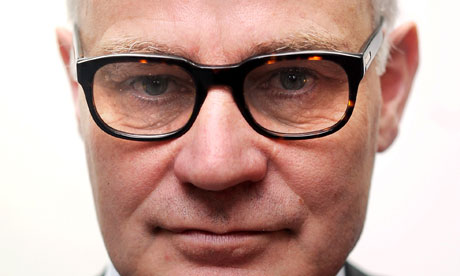
crispin blunt namaFormer army officer Crispin Blunt accused defence secretary John Hutton in 2009 of sweeping under the carpet the evidence of direct British service involvement. Photograph: Anthony Devlin/PA
However, one peculiarity of the way in which UK forces operated when bringing prisoners to Camp Nama suggests that ministers and senior MoD officials may have had reason to know those detainees were at risk of mistreatment. British soldiers were almost always accompanied by a lone American soldier, who was then recorded as having captured the prisoner. Members of the SAS and SBS were repeatedly briefed on the importance of this measure.
It was an arrangement that enabled the British government to side-step a Geneva convention clause that would have obliged it to demand the return of any prisoner transferred to the US once it became apparent that they were not being treated in accordance with the convention. And it consigned the prisoners to what some lawyers have described as a legal black hole.
Surrounded by row after row of wire fencing, guarded by either US Rangers or RAF personnel, and with an Abrams tank parked permanently at its main gate, to the outside observer Camp Nama seemed identical to scores of military bases that sprang up after the 2003 invasion of Iraq. Once inside, however, it was clear that Nama was different.
Not that many people did enter the special forces prison. It was off limits to most members of the US and UK military, with even the officer commanding the US detention facility at Guantánamo being refused entry at one point. Inspectors from the International Committee of the Red Cross were never admitted through its gates.
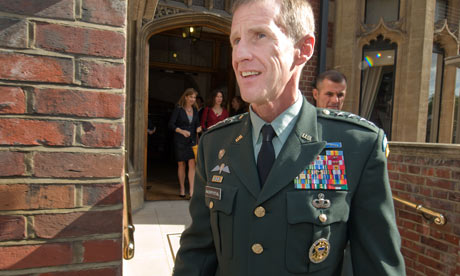
One person who has been widely reported to have been seen there frequently was General Stanley McChrystal, then commander of US Joint Special Operations forces in Iraq.
general Stanley McChrystalGeneral Stanley McChrystal, then commander of US Joint Special Operations forces in Iraq, was said to have visited Nama. Photograph: Christian Sinibaldi for the Guardian
While Abu Ghraib prison, just a few miles to the west, would achieve global notoriety after photographs emerged depicting abuses committed there, Camp Nama escaped attention for a simple reason: photography was banned. The only people who attempted to take pictures – a pair of US Navy Seals – were promptly arrested. All discussion of what happened there was forbidden.
Before establishing its prison at Nama, TF 121 had been known as Task Force 20, and had run a detention and interrogation facility at a remote location known as H1, in Iraq's western desert. At least one prisoner had died en route to H1, allegedly kicked to death aboard an RAF Chinook.
The British were always junior partners in TF 121. Their contingent was known as Task Force Black. US Delta Force troops made up Task Force Green and US Army Rangers Task Force Red. One half of Task Force Black comprised SAS and SBS troopers, based a short distance away at the government compound known as the Green Zone. They detained so-called high-value detainees, who were brought to Camp Nama. The other half were the air and ground crews of 7 Squadron and 47 Squadron of the RAF, and 657 Squadron of the Army Air Corps, who lived on the camp itself, operating helicopters used in detention operations and a Hercules transport aircraft.
"The Americans went out to bring in prisoners every night, and British special forces would go out once or twice a week, almost always with one American accompanying them," one British serviceman who served at Nama recalled earlier this month.
''The prisoners would be brought in by helicopter, usually one at a time, although I once saw five being led off a Chinook. They were taken into a large hangar to be bagged and tagged, a bag put over their heads and their hands plasticuffed behind their backs. Then they would be lifted or thrown on to the back of a pick-up truck and driven to the Joint Operations Centre."
The Joint Operations Centre, or JOC, was a single storey building a few hundred yards from the airport's main runway. Some of those who served at Nama believed it had formerly been used by Saddam's intelligence agencies.
The US and UK forces worked together so closely that they began to wear items of each others' uniforms. But while British personnel were permitted into the front of the JOC, few were allowed into the rear, where interrogations took place. This was the preserve of US military interrogators and CIA officers based at Camp Nama. "They included a number of women," said one British airman. "One had a ponytail and always wore two pistols, so we had to nickname her Lara Croft."
There were four interrogation cells at the rear of the JOC, known as the blue, red, black and soft rooms, as well as a medical screening area. The soft room contained sofas and rugs, and was a place where detainees could be shown some kindness. Harsh interrogations took place in the red and blue rooms, while the black room – described as windowless, with hooks in the ceiling, and where every surface was painted black – is said to be the cell where the worse abuses were perpetrated.
According to an investigation by Human Rights Watch, the New York-based NGO, detainees were subject to "beatings, exposure to extreme cold, threats of death, humiliation and various forms of psychological abuse or torture" at the JOC. The New York Times has reported that prisoners were beaten with rifle butts and had paintball guns fired at them for target practice.
Signs posted around Nama are said to have proclaimed the warning "No Blood, No Foul": if interrogators did not make a prisoner bleed, they would not face disciplinary action.
There was also an overspill interrogation room cell behind the JOC: a shipping container lined with padding. "You could see people being taken in there, and they were in pretty poor shape when they were taken out," said one British witness. He adds: "Everyone's seen the Abu Ghraib pictures. But I've seen it with my own eyes."
A number of British soldiers who served with TF 121 said that some SAS officers were permitted to attend interrogations at the rear of the JOC. Human Rights Watch reports that one SAS officer took part in the beating of a prisoner thought to know the whereabouts of Abu Musab al-Zarqawi, the leader of al-Qaida in Iraq.
While not being interrogated, according to witnesses, prisoners were held in cells the size of large dog kennels. "They were made of wire mesh with sloping corrugated roofs," said a British ex-serviceman who served at Nama. "They were chest high, and two feet wide. There were about 100 of them, in three rows, and they always appeared to have at least one prisoner in each. They would be freezing at night, and really hot during the day.
"The prisoners were mostly men, although I did see two women being taken into the JOC for interrogation. I've no idea what became of them, or to any of the male prisoners after their interrogation was completed."
Some of the scenes at Nama were so disturbing that personnel serving there would literally look the other way, rather than witness the abuse. "I remember being on sentry duty at a post overlooking the dog kennels, and the guy I was with wouldn't even look at them," one British eyewitness recalls. "I was saying: 'Hey turn around and look at them.' And he wouldn't. He just wouldn't turn around, because he knew they were there."
Some complaints made at the time by British personnel were immediately suppressed. "I remember talking to one British army officer about what I had seen, and he replied: 'You didn't see that – do you understand?' There was a great deal of nervousness about the place. I had the impression that the British were scared we would be kicked off the operation if we made a fuss," the ex-serviceman said.
According to one US interrogator interviewed by Human Rights Watch, however, written authorisations were required for many of the abuses inflicted on prisoners at Nama, indicating that their use was approved up the chain of command.
"There was an authorisation template on a computer, a sheet that you would print out, or actually just type it in," the interrogator said. "It was a checklist. It was already typed out for you, environmental controls, hot and cold, you know, strobe lights, music, so forth. But you would just check what you want to use off, and if you planned on using a harsh interrogation you'd just get it signed off. It would be signed off by the commander."
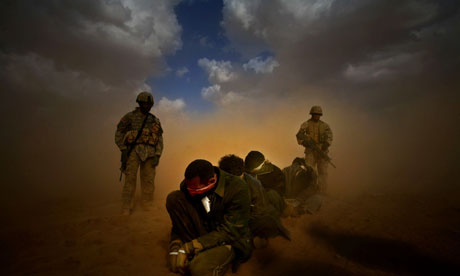
iraq detaineesAccording to one British serviceman who was at Nama, US soldiers would bring prisoners in every night. Photograph: Jehad Nga/Corbis
Camp Nama was such a secret location that when General Geoffrey Miller, the commander of the detention centre at Guantanamo Bay, was sent to Iraq in August 2003 to advise on interrogation regimes he was initially refused entry, according to Human Rights Watch.
At the end of 2003, the Pentagon sent a special investigator, Stuart Herrington, a retired military intelligence colonel, to discover more about the methods being employed at Nama. In December that year Herrington reported: "Detainees captured by TF 121 have shown injuries that caused examining medical personnel to note that 'detainee shows signs of having been beaten'. It seems clear that TF 121 needs to be reined in with respect to its treatment of detainees."
More than 30 members of the task force were subsequently disciplined for abusing prisoners. Yet the beatings continued, according to British witnesses. The dog kennel cells remained in place, and UK special forces continued to be used to snatch suspects to be brought in for interrogation. "I can see now that we were supplying the meat for the American interrogators," says one.
In February 2004, senior British special forces and intelligence officers felt emboldened enough to mount a detention operation without an accompanying US soldier. Troopers surrounded a house in southern Baghdad that MI6 had identified as a safe house for foreign fighters. Two men were killed in the raid and two others of Pakistani origin were detained and handed over to the US authorities.
After questioning at Nama, the pair were flown to Bagram, north of the Afghan capital, Kabul, where they are thought to remain incarcerated,despite efforts by lawyers to secure their release by persuading the appeal court in London to order the issuing of a writ of habeas corpus.
Two months later, in April 2004, US news media published a series of shocking photographs showing the abuse of prisoners at a different prison, Abu Ghraib, where individuals detained by regular troops rather than special forces were being held. A few days later Task Force 121 was renamed Task Force 6-26. Shortly after this, two US Navy Seals – who had their own compound with Camp Nama – were seen taking photographs from the roof of their building. Both men were immediately arrested, British witnesses say and were not seen at Nama again.
Later that summer the secret prison was moved to Balad, a sprawling air base 50 miles north of Baghdad, where it became known as the Temporary Screening Facility (TSF). The Army Air Force and RAF troops continued their role there.
SAS troops continued to provide detainees for interrogation, operating from their base in one of a row of seven large villas inside the Green Zone. The villa next door was occupied by troops from Delta Force. Each of the homes had a swimming pool, and at the end of the long garden behind the SAS villa was a large hut occupied by a UK military intelligence unit, the Joint Forward Interrogation Team, or JFIT.
Individuals detained by the SAS – accompanied by their lone American escort – would be flown by helicopter to a landing pad behind the villas, and taken straight to the JFIT. According to former members of TF 6-26, after a brief interrogation by the British, they would be handed over to US forces, who would question them further before releasing them, or arrange for them to be flown north to Balad.
In late 2003, according to former taskforce members, two SAS members wandered next door to the Delta Force villa, where they were horrified to see two Iraqi prisoners being tortured. "They were being given electric shocks from cattle prods and their heads were being held under the water in the swimming pool. There were less visits next door after that."
While a complaint was made, it is not thought to have reported through the chain of command. And it certainly appears not to have reached Downing Street, as shortly afterwards Tony Blair, then prime minister, visited the SAS house to thank the troopers for their efforts.
By the end of 2004, according to the BBC journalist Mark Urban, MI6 officers who had visited the secret prison at Balad were expressing concern that the kennel cells had been reconstructed there, and the British government later warned the US authorities that it would hand over prisoners only if there was an undertaking that they would not be sent there.
Shortly afterwards, the RAF Hercules operated by the task force wasshot down while flying from Nama to Balad, with the loss of all 10 men on board. It was the largest loss of life suffered by the RAF in a single incident since the second world war.
By now, a growing number of British members of the task force were deeply disillusioned about their role. When one, SAS trooper Ben Griffin,decided he could not return to Iraq, he expected to be face a court martial. Instead, he discovered that a number of his officers sympathised with him, and he was permitted to leave the army with a first-class testimonial.
When Griffin went public, making clear that British troops were handing over to the US military large numbers of prisoners who faced torture, the MoD came under pressure to explain itself. In February 2009 the then defence secretary, John Hutton, told the Commons that "review of records of detention resulting from security operations carried out by UK armed forces" had disclosed that two men who had been handed over had since been moved to Afghanistan. His statement made no mention of the joint task force, of H1, or of Camp Nama or Balad or how British airmen and soldiers were helping to operate the secret prisons.
Crispin Blunt, a Tory MP and former army officer, accused Hutton of "simply sweeping under the carpet the apparent evidence of direct British service involvement with delivery to gross mistreatment amounting to torture involving hundreds if not thousands of people".
Today, 10 years after the invasion and the creation of the joint US-UK taskforce that detained and interrogated large numbers of Iraqis, the MoD responds to questions about their abuse by stating that it is aware only of "anecdotal accounts" of mistreatment, and that "any further evidence of human rights abuse should be passed to the appropriate authorities for investigation".
Griffin had done just that, asking the MoD itself to investigate the activities of the taskforce of which he had been a member. The MoDobtained an injunction to silence him, and warned he faced jail if he ever spoke out again.