


Showing posts with label Sectarianism. Show all posts
Showing posts with label Sectarianism. Show all posts
Tuesday, October 28, 2014
The Persecution Of Iraq's Sunni Muslims
This is a video of a young Sunni Muslim from Iraq. The shia rafidah (rejectors) murdered him in cold blood, then dragged him by the neck with a rope, at the same time, other shia animals repeatedly kick him, some hurl rocks at his head until part of his head caves in. Finally, they douse him gasoline and set him on fire.
The reason this Sunni teen was murdered, was because his name was "Omar," after the Sahabi (Companion) of the Prophet Muhammed, and the Second Caliph of the Muslim nation.
This is what the Sunni Muslims have been dealing with, since America Saddam and handed the country to the Iraqi shia and Iran.
تمت الجريمة في مدينة الشعلة ببغداد، والتي تعد معقلا ومنطلقًا للمليشيات الشيعية الطائفية التي نشطت مؤخرًا لتنفيذ اعتداءات طائفية ضد أهل السنة في بغداد.
ويُظهر الفيديو عددًا كبيرًا من شباب الشيعة وهم يتناوبون على جثمان الشاب "عمر المفرجي" بمختلف صنوف الضرب والركل والتنكيل، وقد ربطوه من عنقه بحبل وسحلوا جثمانه، حتى انتهى بهم الأمر إلى إضرام النار في جسده.
وكشف المقطع المصور أن الجريمة تمت بجميع تفاصيلها تحت أعين عناصر الشرطة، التي تغض الطرف بشكل واسع عن هذه الجرائم الطائفية، فضلاً عن تورطها نفسها في العديد من تلك الجرائم.
إن عملية قتل هذا الشاب والتنكيل بجثته جرت على خلفية كون اسمه (عمر)؛ ما يشير إلى أن طائفية الجريمة وأن عملية القتل تمت على الهوية كونه سنيًّا يحمل اسم أمير المؤمنين (عمر بن الخطاب) الذي فتح بلاد فارس وأطفأ نيران مجوسيتهم؛ الأمر الذي جعل الشيعة يحملون حقدًا وبغضًا لكل من يحمل اسمه رضوان الله عليه. وقد شهد العراق العديد من الجرائم الطائفية التي تمت فيها عمليات القتل على الهوية، ولمجرد أن الضحية يحمل اسم (عمر) أو (عائشة).


Wednesday, June 25, 2014
جيش المالكي الرافضي

جيش المالكي الرافضي يتلذذ بقطع رؤوس أهل السنة في العراق ويمثلون بها أخي المسلم انشر وافضحهم
Nouri Al-Malki Shia army delights in its beheading of Sunni Muslims and pose with their trophy.
Kindly reshare an expose their barbarism.
Iraq: The Killing Of A Nation
IRAQ - The Killing of a Nation, is a short documentary that was aired in the House of Commons on the 10th of June 2014 during the "11years after the occupation of Iraq" conference organised by the Arab Lawyers Association UK & Rasam Strategic Studies Institute Turkey. The Conference is part of a series of events designed to extend the reach of Iraqis to the world community.
Sunday, June 22, 2014
This Why There Is A Sunni Uprising In Iraq
This is just one of the many violent acts that the Shia are doing to the Sunni's of Iraq on a daily basis.
Tuesday, June 17, 2014
The Reward For Killing 100 Sunni's In Iraq
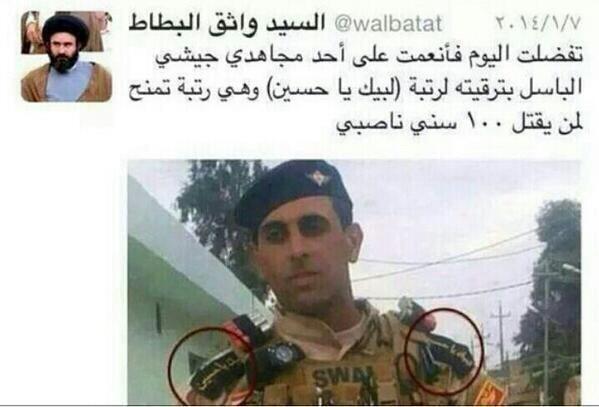
في كارثة جديدة تضاف لجرائم “شيعة” العراق، ذكر أحد القادة الشيعيين ويدعى ” السيد واثق البطاط” في تدوينة له على موقع التواصل الاجتماعي” تويتر”، أنه منح أحد جنود قوات المالكي رتبة” لبيك يا حسين”، وهى رتبة شيعية تمنح لمن يقتل 100 سني.
وكتب البطاط على حسابة قائلا” تفضلت اليوم فأنعمت على أحد مجاهدي جيشي الباسل بترقيته لرتبة ” لبيك يا حسين” وهي رتبة تمنح لمن يقتل أكثر من 100 سنى ناصبي”.
Iran Deploys Quds Force To Save Iraq's Shia-Led Regime
This video shows a Sunni tribal fighter explaining how the capture of 2 Iranians attempting to infiltrate into Fallujah.
The threat of Sunnis eclipsing the power of its Shiite-dominated Arab ally presents Iran with the biggest security and strategic challenge it has faced since the U.S.-led invasion of Iraq in 2003.
Iran deployed Revolutionary Guards units to Iraq, according to Iranian security officials.
Iran has invested considerable financial, political and military resources over the past decade to ensure Iraq emerged from U.S. war as a strong Shiite-led state. The so-called Shiite crescent—stretching from Iran to Iraq, Lebanon and Syria—was forged largely as a result of this effort.
Two Guards' units, dispatched from Iran's western border provinces on Wednesday, were tasked with protecting Baghdad and the holy Shiite cities of Karbala and Najaf, these security sources said.
Syria's conflict has turned Iraq into an important operational base for Iran to aid another ally, the Assad regime, which is dominated by an offshoot of Shiite Islam. Shiite militia trained by Iran, weapons and cash have flowed from Iran to Syria via Iraq.
"Iraq is viewed as a vital priority in Iran's foreign policy in the region and they go to any length to protect this interest," said Roozbeh Miribrahimi, an independent Iran expert based in New York.
Iran has also positioned troops on full alert along its border with Iraq and has given clearance to its air force to bomb rebel forces, according to an Iranian army general.
The two IRGC battalions that moved to Iraq on Wednesday were shifted from the Iranian border provinces of Urumieh and Lorestan, the Iranian security officials said.
Revolutionary Guards units that serve in Iran's border provinces are the most experienced fighters in guerrilla warfare because of separatist ethnic uprisings in those regions. IRGC commanders dispatched to Syria also often come from those provinces as well.
Iran was also considering the transfer to Iraq of Shiite volunteer troops in Syria, if the initial deployments fail to turn the tide of battle in favor of Mr. Maliki's government, the Iranian security officials said.
Wednesday, June 11, 2014
Why Mosul's Fall Is A Signature Moment In Iraq

The City's Takeover By Sunni Insurgents Is A Devastating Military Setback For The Maliki Regime – and A Measure Of The Political Failure Of Post-Saddam Iraq.
The Iraqi government has lost control of its third-largest city to Al Qaeda-inspired insurgents, a crushing defeat for not only Prime Minister Nouri al-Maliki's security policies but for Iraqi politics as a whole.
The scale of the catastrophe, as troops loyal to Mr. Maliki flood north and troops controlled by the Kurdish Regional Government rush west and south, can't be overstated. Chicago is the United States' third-largest city. Munich is Germany's. Osaka is Japan's.
And unlike the Anbar towns of Fallujah and Ramadi, almost exclusively Sunni Arab and in the heart of what has long been one of Iraq's most restive provinces, Mosul is an ethnically and religiously mixed town of Sunni and Shiite Arabs, Kurds and Turkmen, Christians and Muslims. US forces won, lost, and won control again of Fallujah in fierce battles during the early years of the America-led war in Iraq. But a city like Mosul is something else again.
It's well known that Mosul has been a target for the Islamic State in Iraq and the Levant (ISIS). The city is the capital of northern Nineveh Province, the western side of which has a roughly 300-mile-long frontier with Syria. During the height of the US war in Iraq, insurgent rat-lines riddled the border, and in the past few years, with what was once Al Qaeda in Iraq merging with Sunni Arab insurgents fighting in the Syrian civil war to become ISIS, the cross-border flow of men and weapons has ramped up again.
Much of Nineveh, like Anbar, is sparsely inhabited desert where the central government's writ is nominal. Smaller cities in the area's east, like Tal Afar, have repeatedly fallen to insurgents over the past decade. But Mosul is a crown jewel, a center of transportation and commerce. Holding it was a government priority. Losing control, if only briefly, is a powerful indication of government failure and something that is likely to spur insurgent recruitment. What must have looked like a hopeless cause to many passive Sunni Arab supporters of the insurgency just started looking a lot more hopeful.
Iraqi Parliament Speaker Osman Nujaifi said virtually all government installations in the city have fallen into ISIS hands. "When the battle got tough in the city of Mosul, the troops dropped their weapons and abandoned their posts, making it an easy prey.... ,"
Today, according to people in the city, organized ISIS fighters dismantled the city's security barricades and roadblocks. While there were reports that the portion of the city east of the Tigris River, closer to the Kurdish heartland, had not fallen, western Mosul is the heart of the town.
The ISIS Victory Is A Signature Moment – evidence that ISIS can't be dismissed as merely a ragtag group of insurgents who may be able to hold their own in Syria, but would be unlikely to take and hold ground from Iraqi forces. The US spent more than $14 billion on training and equipping Iraqi security forces. When US forces left Iraq at the end of 2011 (because Maliki refused to sign an agreement extending US military involvement), US politicians and military leaders spoke of how the Iraqis were ready to stand on their own, how the seeds of political reconciliation had been sown by a war that cost more than $2 trillion, 4,486 American lives, and more than 100,000 Iraqi ones.
... thanks to Maliki and his Shiite allies' decision to turn on the Iraqi tribes that made up the Sunni "Awakening." It's looking like an illusion also for much of the rest of the country, where politics remain defined along sectarian and ethnic lines, and where the toll of fighting on civilians and government forces alike have returned to the levels of 2007-2008.
This is Mosul today, through the eyes of Agence France-Presse reporters in the city.
An AFP journalist, himself fleeing the city with his family, said shops were closed, a police station had been set ablaze and that numerous security force vehicles had been burned or abandoned. Hundreds of families were seen fleeing. Some were on foot, carrying what they could, others in vehicles with their belongings piled on the roofs.Another AFP journalist said thousands of Mosul residents had fled for the safety of the autonomous Kurdish region in the north. Dozens of cars and trucks stretched out from one checkpoint on the boundary of the region, as people with plastic bags, suitcases and a pram waited to enter, some with young children in tow."The army forces threw away their weapons and changed their clothes and left their vehicles and left the city," said Mahmud Nuri, a displaced Mosul resident. "We didn't see anyone fire a shot."
Events in the city today are a stark reminder of how ephemeral US efforts in Iraq have proven to be. In early 2004, Gen. David Petraeus was commander of the 101st Airborne Division in the province, and his efforts there, focusing on hearts and minds, were marketed as the "Mosul model." Early in the war, Mosul was Iraq's most peaceful large city, new businesses were opening, and fuel shortages that bedeviled most of the country then weren't apparent.
At the time, the Bush administration, the military, and the US people were still expecting a quick war. That January, Petraeus's 18,000 troops in the region were being replaced by a force of about 5,000.
Petraeus said then:
"They will have the benefit of a substantially larger Iraqi security presence coming on line,'' says General Petraeus, whose unit has trained more than 10,000 Iraqi soldiers, border guards, and police. "This is an occasion where we'll see how the new Iraqi security forces are going to do. I think they'll be fine."Petraeus has been slowly pulling his forces back since September, seeking to hand over more and more authority to a local governor and council selected shortly after the 101st arrived in the Mosul area last April. "We're only six months away from June and handing control of the country back over to Iraqis," he says."The number of joint patrols we run on the border with Syria, for instance, has been steadily decreasing as the capabilities of local forces have increased,'' says Maj. Mike Getchell, who serves in the 101st's Third Brigade under Col. Mike Linnington, outside the city of Talafar.
Ten years on, Iraq does not control its border with Syria and it does not control Mosul. If ISIS manages to hang on to the city, even if only for a short while, it will be able to threaten towns farther south and closer to Baghdad... Maliki's call for arming civilians ... means he intends to use Shiite militias in an effort to regain control.
Thursday, July 04, 2013
The Plague Of Sectarianism
What Is Fueling The Sunni-Shia Divide In The Middle East?
Courtesy Of Al-Jazeera
Is the ongoing war in Syria fueling a sectarian conflict beyond its borders? As Hezbollah, a Lebanese Shia Muslim movement, fights to defend the Assad regime, Sunni clerics, in and outside the country, are calling on their followers to join the fight against it. Beyond Syria, sectarian tensions are rising in Lebanon and Egypt after a series of violent clashes and murders. We look at what’s driving sectarianism in the Middle East - politics or religion?
Monday, June 10, 2013
What Next After The Fall Of Qusayr?
We Look At How The Balance Of Power Has Shifted After Syrian Soldiers Retook A Strategic City From The Rebels.
Courtesy Of Al-Jazeera
"I am worried that the nature of the conflict may have reached and passed a tipping point and that now this is very much a full-scale sectarian conflict - there is no doubt that President Assad has initiated this by recruiting Hezbollah forces and inviting Iranian aid and forces into his country ... The problem is that the worst thing that can happen right now is for Assad's regime to fail because now that we have reached this point of inviting foreign fighters in on both sides - both Sunni and Shiite - this is no longer about achieving democratic ends to the protests that began two years ago."
Wednesday, June 05, 2013
Hezbollah: The Syrian Connection
Courtesy Of Al-Jazeera
Lebanese Shia group Hezbollah has been supporting the government in Syria, but its members have now been attacked on their own turf.
As Syria's conflict spreads across the border into Lebanon, one Hezbollah fighter and several Syrians were killed after rebel fighters reportedly tried to set up rocket launchers on the Lebanese border near the Eastern Bekaa Valley. At least two people were also injured in fighting in the Lebanese city, Tripoli.
The pressure is mounting for Hezbollah to end its involvement in Syria.
"Hezbollah is gambling with the future of Lebanon with the way it has entered into the Syrian conflict. It is also cancelling the sovereignty of Lebanon itself ... Lebanon is in a very dangerous situation ...
Lebanon is now in a state of war," Salman Shaikh, the director at the Brookings Doha Center, and an advisor to the United Nations Secretary General on the Middle East, told Al Jazeera.
And Lebanon's former Prime Minster, Fouad Siniora, has made it clear that he is calling on Hezbollah members to put an end to their involvement in the Syrian affair.
"We will not allow our present and future to be destroyed; we can’t accept that and won’t stay silent. We won’t allow our country to be an outlet for exporting militias and money groups or to be a failed state.
That’s why we say bluntly: no for the participation of Hezbollah or any other groups in the fighting taking place in Syria between the regime and the people. We’ve stood firm, with all the faithful, against the sectarian project and we will not allow anyone to bring the regional conflicts to our country."
So, what are the implications of Lebanon becoming another battleground in Syria's ongoing conflict?
To discuss this, Inside Story, with presenter Mike Hanna, is joined by guests: Ahmad Mousalli, a professor at the American University in Beirut and a specialist on Islamic groups; Naim Salem, a professor at Notre Dame University in Lebanon and a specialist on international affairs and diplomacy; and Salman Shaikh, director at Brookings Doha Center and advisor to the UN Secretary General on the Middle East.
"It was the Salafis, that started supporting the opposition and militarising it, before Hezbollah interfered in the conflict in Syria ... It is only in the last 6 months that Hezbollah entered at the level of military support, whereas the other groups were actually the base for transferring people, arms, money and many other things. We shouldn’t try to put the blame on one or the other. At this point, both are involved ... both are going to go for the end of the conflict given as I mentioned that it has been turned into a sectarian survival of one or the other."
- Ahmed Mousali, a professor at the American University in Beirut
Saturday, May 25, 2013
Wednesday, January 11, 2012
Iraq: A Country In Shambles
Despite Promises Made For Improvements, Iraq’s Economy and Infrastructure Are Still A Disaster.
By Dahr Jamail
Last Modified: 08 Jan 2012 17:36
Courtesy Of "Al-Jazeera"
By Dahr Jamail
Last Modified: 08 Jan 2012 17:36
Courtesy Of "Al-Jazeera"
Baghdad, Iraq - As a daily drum beat of violence continues to reverberate across Iraq, people here continue to struggle to find some sense of normality, a task made increasingly difficult due to ongoing violence and the lack of both water and electricity.
During the build-up to the US-led invasion of Iraq, the Bush administration promised the war would bring Iraqis a better life, and vast improvements in their infrastructure, which had been severely debilitated by nearly 13 years of strangling economic sanctions.
More jobs, improved water availability, better electricity, and major rehabilitation of the medical infrastructure were promised.
But now that the US military has ended its formal military occupation of Iraq, nearly eight years of war has left the promises as little more than a mirage.
Ongoing Water Shortages
Hashim Hassan is the Deputy Director of the Baghdad Water Authority (BWA), and he admits to an ongoing shortage of clean drinking water for Baghdad's seven million residents.
"We produce 2.5 million cubic litres daily, so there is a shortage of 1m cubic litres every day," Hassan explained to Al Jazeera. "We've added projects to increase water availability, and we are hoping to stop the ongoing shortage by the end of 2012."
According to Hassan, 80 per cent of the Baghdad's piping network needs rehabilitation - work currently underway - in addition to positioning 100 compact units around the city, which would increase clean water availability until larger plants can come fully online.
Several water treatment plants are already being extended, including one that would increase the capacity of a wastewater treatment facility in Sadr City, a sprawling slum of roughly three million people.
 |
| Follow in-depth coverage of the nation in flux |
Hassan said that health committees and the Ministry of Environment carry out tests, and along with BWA testing, 1,000 water samples are checked daily, "less than one per cent of the samples fail" he said. The "acceptable threshold" is five per cent.
Bechtel, a multi-billion dollar US-based global engineering and construction company - whose board members haveclose ties to the former Bush administration - received $2.3bn of Iraqi reconstruction funds and US taxpayer money, but left the country without completing many of the tasks it set out to.
Bechtel's contract for Iraq had included reconstruction of water treatment systems, electricity plants, sewage systems, airports and roads.
Managers at water departments around Iraq say that the only repairs they managed during the US occupation were through UN offices and humanitarian aid organisations. The ministry provided them with very little chlorine for water treatment. "New projects" were no more than simple maintenance operations that did little to halt collapsing infrastructure.
Bechtel was among the first companies, along with Halliburton (where former US Vice-President Dick Cheney once worked), to have received fixed-fee contracts drawn to guarantee profit.
Ahmed al-Ani who works with a major Iraqi construction contracting company told Al Jazeera the model Bechtel adopted was certain to fail.
"They charged huge sums of money for the contracts they signed, then they sold them to smaller companies who resold them again to small inexperienced Iraqi contractors," Ani said. "These inexperienced contractors then had to execute the works badly because of the very low prices they get, and the lack of experience."
According to a March 2011 report by the UN's Inter-Agency Information and Analysis Unit, one in five Iraqi households use an unsafe source of drinking water, and another 16 per cent report daily supply problems.
The situation is even worse in rural areas, where only 43 per cent have access to safe drinking water, and water available for agriculture is usually scarce and of very poor quality. These facts have led more Iraqis than ever to leave rural communities in search of water and work in the cities, further compounding already existing problems there.
The UN report states: "Quality of water used for drinking and agriculture is poor, violating Iraq National Standards and WHO guidelines. Leaking sewage pipes and septic tanks contaminate the drinking water network with wastewater. 80 per cent of households do not treat water before drinking. Furthermore, just 18 per cent of wastewater is treated, with the rest released directly into waterways."
And this is exactly what many Iraqis experience first-hand.
"Sometimes we turn on the tap and nothing comes," explained Baghdad resident Ali Abdullah. "Other times the colour is brown, or yellow, or sometimes even smells of benzene."
Electricity and Sewage
Street side electricity generators are now a common sight around Iraq's capital city, where the average home receives between four and eight hours of electricity each day. Some areas, such as Sadr City, receive an average of less than five hours a day, with some portions of the area receiving a mere hour to two a day - and sometimes none at all.
Many people opt to simply pay private vendors for electricity from the generators, whose owners run lines to their respective clients.
 |
| Some areas of Baghdad continue to receive one to five hours of electricity a day [Dahr Jamail/Al Jazeera] |
Nabil Toufiq is a generator operator who serves 220 homes for 12 hours each day.
"We buy our diesel on the black market, not from the government," he told Al Jazeera. "We expect this business to continue forever because government corruption prevents them from fixing our problems."
Abu Zahra, a media liaison worker with the office of Shia cleric Muqtada al-Sadr in Sadr City, Baghdad, explained that, in addition to the ongoing lack of electricity, every aspect of the infrastructure in the area needs improvement.
"We are depending on the street generators," Zahra said, before going on to say that roads have been resurfaced, but due to corruption causing corners to be cut, the pavement begins to fracture and break apart within six months, causing the cycle to begin again.
This is readily apparent, as the garbage-strewn roads are bumpy, cracking, with potholes abundant.
Turn off one of the main thoroughfares through the area and one quickly finds dirt roads with sewage streaming down the gutters.
Zahra said that one of the hopes of Sadr joining the political fray was that this area of Baghdad would obtain better services - but this has clearly not come to pass.
"Sadr asked the government to give better services and jobs here, but nothing has happened," he said, while children played near raw sewage. "There have been demonstrations here where people carried shovels asking for work, and empty kerosene cans asking for fuel. Meanwhile, we have a totally failed sewage system that needs complete reconstruction."
While water borne diseases and diarrhoea are common across Baghdad, but they are rampant in Sadr City, where the lack of potable water, coupled with raw sewage flowing through many of the streets, make the spread of disease inevitable.
Toufiq pointed out an issue that does not bode well for the future - and likely aptly describes the root of Iraq's myriad problems.
"Many people make a living from the system being broken," he said. "From the government, to me, to the gas sellers."
Broken Economy
According to the UNDP, Iraq has a poverty rate of 23 per cent, which means roughly six million Iraqis are plagued by poverty and hunger, despite the recent increase in Iraq's oil exports. Iraq's Ministry of Planning has also announced that the country needed some $6.8bn to reduce the level of poverty in the country.
Zahra concurs.
"No-one in my family has a job," he said. "And in my sister's house, they are seven adults, and only two of them work."
Inside a busy market, Hassan Jaibur, a medical assistant who cannot find work in his field, is instead selling fruit.
"The situation is bad and getting worse," he said. "Prices continue to rise, and there are no real jobs. All we can do is live today."
Jaibur said he and his family are living on the fruit he sells, but he has a sick child and any profits he earns all go to medication.
"All of my relatives and friends are in a similar situation," he added. "Most of them try to find work as day labourers."
 Gheda Karam, like so many in Iraq today, is the sole supporter of her family [Dahr Jamail/Al Jazeera] Gheda Karam, like so many in Iraq today, is the sole supporter of her family [Dahr Jamail/Al Jazeera] |
Gheda Karam sells dates and fruits. Her husband was paralysed during the Iraq-Iran war, and the benefits they get from the government for his disability are not enough.
"My family is suffering too much," she told Al Jazeera. "Even yesterday we did not eat dinner. We are 20 of us in an old house, and I'm the only one with work."
She paused to cry, then wiped away the tears.
"My children see things in the market they want to eat or drink, but we can afford none of it, and I am in debt to the fruit sellers. God help us."
The state of the economy in Iraq is a disaster. Yet this irony is highlighted by the fact that Iraq has proven oil reserves third only behind Saudi Arabia and Iran - hence one would expect it to be one of the wealthiest countries in the world.
But nowhere is the lack of economic growth more evident than in Baghdad. According to the Central Bank of Iraq, unemployment and "under-employment" are both at 46 per cent, although many in Iraq feel this is a generously low estimate.
Iraq continues to have a cash economy; meaning there are no credit cards, almost no checking accounts, no transfer of electronic funds, and only a few ATMs.
Iraq lacks a functioning postal service, has no public transportation, nor a national airline - and most goods sold in Iraq are imported.
Only in the autonomous Kurdish region in northern Iraq is there rapid development and an effectively functioning government.
Iraq is ranked the eighth most corrupt country in the world, according to Transparency International. That means Iraq is tied with Haiti, and just barely less corrupt than Afghanistan.
One of Iraq's ministers recently took a forced resignation because he signed a billion-dollar contract with a bankrupt German company, along with a shell company in Canada, which had no assets or operations, only an address.
Lack Of Security
Recent spates of coordinated bombings that have killed more than 100 Iraqis and wounded more than 200 in the past few weeks are evidence of Iraq's current security situation.
Despite Iraq's own forces numbering 280,000 soldiers with 645,000 police and border guards, for a total of nearly one million men, and a capital city clogged with checkpoints, security remains elusive.
As Prime Minister Nour al-Maliki said recently, there can be no security without political stability. Given that his critics accuse al-Maliki of upsetting the delicate political balance within the Iraqi government by ordering the arrest of Vice President Tareq al-Hashimi, his words ring truer than ever.
Despite most of the daily violence in Iraq having long since fallen from the headlines, reports are constant and blood continues to flow.
Reported attacks around the country on January 3 included a roadside bomb killing an Iraqi soldier near Mosul, a sticky bomb seriously wounding a Pershmerga guard in Kirkuk, gunmen killing a Sahwa militia member and his wife in Muqdadiya, and a roadside bomb which wounded three civilians in Baghdad - to name but a few.
When most Iraqis are asked what their main concern is, "security" tends to be the first answer, then followed by electricity, water, jobs, and healthcare. Yet security is the foundation upon which the rest of the infrastructure can be built, so ongoing attacks across Iraq, and the chaos they bring, do not bode well for the future.
In December 2011, Iraq signed a deal worth roughly $3bn to buy 18 more F-16 fighter jet planes from the United States - a controversial move given that it occurred while Maliki was making moves his critics say were nothing more than consolidating power.
During a December press conference with al-Maliki, President Obama said, "We've got to train [Iraq's] pilots and make sure that they're up and running and that we have an effective Iraqi air force."
Most Iraqis would prefer to have their streets safe, before worrying about their air space.
And for people like Gheda Karam, whose family are having to skip meals on a regular basis, a government that would spend $3bn on improving infrastructure and the economy would be preferred over one that buys highly advanced war planes.
Follow Dahr Jamail on Twitter: @DahrJamail
Thursday, January 05, 2012
Iraq: The Gloves Come Off

Obama must engage positively with the increasingly authoritarian Nouri al-Maliki, yet also reach out to his opponents [GALLO/GETTY]
The US Has Invested Too Much In Iraq To Let Nouri Al-Maliki Tear The Burgeoning Democracy Into Pieces.
By Robert Grenier
Former CIA station chief Robert Grenier heads ERG partners, a financial consultancy firm. RSS ERG Partners
Last Modified: 02 Jan 2012 11:16
Courtesy Of "Al-Jazeera"
Washington, DC - I must confess I didn't see it coming.
Yes, Iraq's Prime Minister Nouri al-Maliki has always shown autocratic tendencies, unsurprisingly given the traditional political role models with which Iraqis are working. And yes, he has long over-centralised security power in his own hands, maintaining personal control over the Interior, Defence and National Security Ministries and making the Baghdad Operations Command directly answerable to his personal office. But this, too, is not entirely unexpected, given the tenuousness of Iraqi internal security.
And finally, yes, Abu Isra has been transparently uncomfortable in sharing any authority with the Iraqiyya bloc, the largest vote-getter in the last elections, and has essentially reneged on many of the elaborate power-sharing arrangements reached in the so-called Irbil accords, which facilitated formation of his government. But again, here too, Maliki has not been entirely outside his rights. He did, after all, form the most viable parliamentary coalition, giving him the right to form a government, and the vague provisions for an extraordinary National Security Council to be chaired by his chief political rival, and to which key domestic and national security policies were to be referred, were simply never realistic.
Now, however, only days after the final withdrawal of American troops, it is clear that al-Maliki has finally gone too far. His recent actions have served to strip the veneer of legitimacy from his past policies, and have revealed those past actions as the precursors to a naked power-grab. Beginning with the sudden and summary arrest of some 615 alleged Baathists, including many of Maliki's political enemies and conducted while the final push to evacuate the last of the US troops was conveniently underway, the Iraqi prime minister has gone on to press politically-motivated terrorism charges against Vice-President Tariq al-Hashemi, a Sunni Islamist and a prominent member of Iraqiyya. At the same time, the Shia Maliki has moved to orchestrate a parliamentary no-confidence vote to oust Sunni deputy Prime Minister Saleh Mutlaq, another prominent member of Iraqiyya, ostensibly over a personal slight. Other political opponents have awakened to find tanks around their homes.
|
| Follow in-depth coverage of the nation in flux |
The upshot is that Hashemi has now sought asylum in Iraqi Kurdistan, against whose leaders Maliki is now making vague threats. In the face of Iraqiyya's predictable walkout from the Council of Representatives (CoR) and boycott of the cabinet, Maliki is threatening to replace its ministers with interim appointments lacking CoR approval. And in response to Sunni-majority Diyala province's stated desire to seek protection from the current wave of politically-motivated arrests through formation of an autonomous region - which is permitted under the Iraqi constitution - the rogue prime minister vows to unleash "rivers of blood".
Not For The Faint-Hearted
Democratic politics in Iraq is not for the faint-hearted, even in the best of times. But Nouri al-Maliki's current moves are a qualitative departure from the past. He is not just seeking advantage over his political rivals, but to permanently discredit them and, in the process, threatens to disenfranchise a large part of Iraq's population. He risks unravelling Iraq's promising, if bumptious transition to genuine democracy, potentially plunging his country into renewed civil war in the bargain.
American observers are wringing their hands over these developments, bemoaning the US' sharply decreased leverage, while US leaders attempt to employ what diplomatic suasion they can to calm the situation. Meanwhile, President Obama's political detractors point to these startling reverses, along with a general upshot in violence, as yet more evidence of the American administration's incompetence in failing to negotiate an extended mandate for US military forces in Iraq.
 |
| Infographic: US ends Iraq war chapter |
All see the current risks to the US' painful investment in Iraq posed by the end of the US military presence, whether they publicly hail the US departure as a victory, as the administration does, or denounce it as a failure. Seemingly none, however, perceive the real opportunities posed by the US' new posture in Mesopotamia.
First, it should be acknowledged that the complaints of President Obama's Republican critics are vapid. There was never any chance that an Iraqi parliament would approve an extension of the US military mandate, particularly if it included special immunities from Iraqi prosecution. These privileges may be routine elsewhere, but in Iraq, the US Army was still seen as an occupying force. Under these circumstances, no popularly-elected body in the world would have approved a standard US Status of Forces Agreement (SOFA), and American leaders should have had wits enough to realise it.
What Americans also fail to realise, however, is the extent to which the US departure not only symbolically liberates Iraq, but also liberates the US - and not just from the burden of maintaining a large force in harm's way.
Now that the US is no longer freighted with responsibility for Iraq's security, it can begin to exert its influence in far more normal ways, and ones to which neither Iraqis nor Americans are accustomed. The US' role in Iraq has changed; its habits of mind must now follow.
Iranian Influence
US officials have long decried Iranian influence in Iraq, forgetting that such influence is inevitable, and subject to certain natural limits. Rather than complain about the Iranians, however, Americans would be well advised to emulate them.
What would this look like? Well, like the Iranians, the US should be willing to work on multiple tracks in Iraq, calibrating each to the same ultimate ends. While the US exercises its not inconsiderable diplomatic weight with various government and military players, with whom US forces have trained, fought, and bled, the US should also not hesitate to deal independently with Iraqi leaders and factions who are being progressively subjected to a tyranny of the majority under Prime Minister Maliki. Simultaneously, the US should set in place the networks required to provide them with such support as they may eventually need to resist suppression, potentially to include paramilitary support in the event the Shia-dominated security forces are deployed against them.
| "The US has invested far too much in Iraqi democracy... to let a smile be the sum total of its Iraq policy." - Robert Grenier |
I have long been among those who argue that the Sunni Arab states of the Gulf region have exaggerated the threat of Iran, and have been overly mistrustful of Iraq's Shia-led government. Such mistrust, if heretofore overblown, can nonetheless be useful. One suspects that some regimes in the region might welcome the opportunity to provide a base for US influence in Iraq which they themselves cannot exert.
It is not clear whether the current administration is capable of pursuing such a policy, but if it were, US action could well have the effect of making the Iranians into objective allies in helping to reign in the excesses of a rampant Nouri al-Maliki. Faced with the potential alternative of a destabilised Iraq in which its enemies cultivate proxies to create problems for it, the Iranian government might well conclude, as it has in the past, that its interests are best served by a politically stable Iraq in which sympathetic Shias have a naturally preponderant political role.
I confess I didn't see this crisis coming. I had thought Maliki is more clever than this. But now that it is here, the US must act.
The US can and must remain engaged with the Maliki-led government, particularly as there is no currently viable alternative in the wings. It should continue to treat Maliki, as President Obama did just a few weeks ago, with a smile, even as it selectively conditions its provision of aid, training and materiel, and reaches out unilaterally to his opponents. The US has invested far too much in Iraqi democracy, and has far too great a moral obligation to those Iraqi communities whom the Iraqi prime minister would oppress, to let a smile be the sum total of its Iraq policy.
Maliki needs to know that there is something else behind the smile. Thus far, the Obama administration has treated Maliki with kid gloves. As with other would-be dictators in the region, it is time for the gloves to come off.
Robert L Grenier is chairman of ERG Partners, a financial advisory and consulting firm. He retired from the CIA in 2006, following a 27-year career in the CIA's Clandestine Service. Grenier served as Director of the CIA Counter-Terrorism Centre (CTC) from 2004 to 2006, coordinated CIA activities in Iraq from 2002 to 2004 as the Iraq Mission Manager, and was the CIA Chief of Station in Islamabad, Pakistan, before and after the 9/11 attacks.
Previously, he was the deputy National Intelligence Officer for the Near East and South Asia, and also served as the CIA's chief of operational training. He is credited with founding the CIA's Counter-Proliferation Division. Grenier is now a life member of the Council on Foreign Relations, and speaks and writes frequently on foreign policy issues.
Saturday, July 30, 2011
Lebanon: Playing With Political Fire
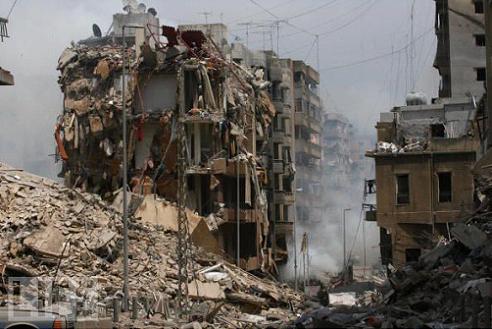
Nearly all civilians were killed in Israel's horrific attack on July 21, 2006 when they destroyed buildings like these in the densely populated residential Haret Hreik neighborhood in the southern suburb of Beirut. The pretext for the aerial invasion was the military capture of two Israeli soldiers on the 12th of July 2006 inside Lebanon.
By Brenda Heard
Source: "Moqawama"
Tuesday, Jul 12, 2011
Courtesy Of "Axis Of Logic"
Sometimes the timing is flagrant, like the recent commotion in Greece. In the very hours of forbidding the passage1 of the aid flotilla to Gaza, the financially strapped Greek government welcomed the approval of an €8.7 billion2 aid payment from the European Union. With Israels' position as an EU-groupie, even the Associated Press3 couldn't resist smirking at Greece's underlying ‘incentive to cozy up to its rich Mediterranean neighbor'.
Political manoeuvring also thrives on more subtle timing, as for example in the case of the notorious indictments of the Special Tribunal for Lebanon. Widely announced4 as imminent in December 2010, they somehow found themselves on the backburner when the Arab uprisings claimed every corner of Middle East news coverage. Some six months later, on the heels of the formation of a Lebanese government non-hostile to the targeted Hizbullah-in the very hours between finalising5 the government's policy statement and its being subject to6 a parliamentary vote of confidence-only then were the indictments set into motion7. Bored of battling the credibility of Arab protests, international media eagerly shifted to the new sensational headlines.
Particularly when it comes to the Zionist project, the Western Israeli Alliance has often banked on timing-on distraction and exploitation. Five years ago, for instance, Israeli forces repeated the pretext-invasions of 1978 and 1982. Five years ago, Israeli forces renewed their aggressive campaigns of 1978 and 1982. With the full backing of their Western allies, five years ago Israeli forces again attacked Lebanon.
The pretext for the lethal aggression was the military capture of two Israeli soldiers on the 12th of July 2006. But as the report by the AP Jerusalem Bureau Chief declared8 on the second day of bombardment, such a
"Crisis allows Israel to pursue strategic goals / Analysis: Kidnappings give Israel excuse to neutralize Hamas, Hizbullah."
This early assessment astutely foretold the post-war testimony of then Israeli Prime Minister Ehud Olmert, who would boldly concede his designs.
The political manoeuvring had been going on for years. Perhaps anxious to convince the Israeli Inquiry that the aggression had not been a knee-jerk reaction, Olmert testified9 before the Winograd Commission that his decision to launch a broad military operation was made as early as March 2006, four months before the soldiers' capture. Olmert stated that his predecessor, Ariel Sharon, had already been making preliminary plans, including a list of targets in Lebanon. Olmert further stated that he had held several meetings (in January, March, April, May and July 2006) on potential military action against Lebanon.
Olmert testified10 these meetings concluded that Israels' goal in a military operation would be the implementation of Security Council Resolution 155911, which they believed would eliminate Hizbullah's resistance capability. Olmert stated that he was informed in May 2006 by National Security Council head Giora Eiland and by former Prime Minister Ehud Barak that the Lebanese government would agree to implement Resolution 1559 in return for an Israeli withdrawal from Sheba Farms.*
| Lebanon Massacre will Live in Infamy,by Ghali Hassan, Axis of Logic, July 24, 2006 |
Israel, detentions and negotiations for mutual release had been standard fare in the region-a reality Olmert alluded to in his testimony. Following the high profile capture of Israeli soldier Gilad Shalit on 25 June 2006 (by Palestinian forces who wanted Palestinian women and children prisoners released by Israel in exchange for the safe return of Shalit), Olmert testified12 that ‘he was certain there would be a similar attempt to kidnap soldiers on the Lebanese border. He ordered the IDF to prevent this'.
So the powerful Israeli military was meant to be on high alert. They were allegedly warned and ready. Yet on 12 July-a mere 17 days later-they somehow failed to prevent the capture that ever since has been labelled the justification for the war. A timely pretext it would seem.
Such a practical assessment of political strategy was in fact pronounced by the Winograd Commission when it concluded 13 the July War had been, after all, a ‘serious missed opportunity'. Israeli policy, it stated, had wavered between two main options:
"The first was a short, painful, strong and unexpected blow on Hizbullah, primarily through standoff fire-power. The second option was to bring about a significant change of the reality in the South of Lebanon with a large ground operation, including a temporary occupation of the South of Lebanon and 'cleaning' it of Hizbullah military infrastructure."
Despite the damage and the deaths they had inflicted, the Israeli forces had failed to meet their true objective, that of renewed occupation of South Lebanon.
The prompt accusation of Hizbullah's actions being the casus belli in July 2006 settled into a general public acceptance of blame both within and beyond Lebanon. Such is the magic of timed political manoeuvring. The public listened nervously, for example, as The New York Times cried out14the typical news:
"With two more soldiers captured today, Israel launched a major military offensive on a second front, sending armored forces into southern Lebanon in response to a brazen border raid by the militant group." [emphasis added]
By the time the Winograd Commission revealed its final report in January 2008, the international public had already well digested the message that Israel had had no choice but to attack Lebanon. The public then merely grimaced at the reminder of Israels' failure to destroy Hizbullah. The New York Times captured15 their plaintive reaction:
"‘When its 2006 war against Hizbullah ended after six weeks, Israel was aghast. An operation meant to cripple the Shiite militia and end its dominance of southern Lebanon had ended with the group if anything stronger."
The final Winograd report explained away any seeming weakness in Israel by faulting those political and military elites who had grown complacent in Israels' ‘position of social, political and military strength', whose passive belligerence had dulled their fighting edge. And so the international public seemed undisturbed that the Winograd Commission, in possession of Olmert's testimony of premeditation, acknowledged16 that Israel had in fact been orchestrating the situation:
"Overall, we regard the 2nd Lebanon war as a serious missed opportunity. Israel initiated a long war, which ended without its clear military victory. A semi-military organization of a few thousand men resisted, for a few weeks, the strongest army in the Middle East. . . . Israel did not use its military force well and effectively, despite the fact that it was a limited war initiated by Israel itself." [emphasis added]
Israel did not need to go to war; Israel chose to go to war. Even if we acknowledge that the soldiers' capture brought to light a problem that had to be dealt with-namely the prisoner issue-there were alternatives to war.
Rather than admit the unjust nature of holding thousands of political prisoners, however, Israel chose to try to extinguish any resistance to their continued detention. Israel masked its fury by pointing indignantly to its prey. The politics of power relies on the manipulation of perception. It is high time we looked at an objective reality.
*Clearly substantiated by reports in April/May 2006 on Lebanese PM Siniora's visits with US President George W. Bush and British Prime Minister Tony Blair on this issue: see for instance:
Bush vow on Hariri murder probe and Siniora wants pressure on Israel
(The original publisher, Moqawama placed each use of the term Israel, Israel's in quotation marks, e.g. "Israel" indicating a lack of recognition of Israel as a legitimate entity. While in sympathy with Moqawama's intent, editing by Axis of Logic included a removal of this punctuation for more fluid reading.)
 | Brenda Heard, founder and director of Friends of Lebanon. Based in London, UK, Friends of Lebanon has been created to provide a worldwide community to celebrate and support Lebanon. Friends of Lebanon wants not only to help rebuild Lebanon, but also to provide the education and understanding needed to prevent the reoccurrence of such mindless acts of violence. Together we can and will build a better and more peaceful Lebanon. |
Source: Moqawama
References
- Announcement on the Flotilla
- Europe:Agrees Greece Aid Payout
- Analysis: Alliance Shifts behind Greece-Gaza Stand
- Lebanon awaits Hariri indictments on tenterhooks
- Committee Finalizes Lebanon Cabinet Policy Statement
- Parliament to debate ministerial policy statement next week
- Confirmed Indictment Submitted to the Lebanese Authorities
- Crisis Allows Israel to Pursue Strategic Goals
- Report: Interim Findings of War Won't Deal with Personal Failures
- Ibid. (Haaretz)
- UN Security Resolutions Concluded
- Report: Interim Findings of War Won't Deal with Personal Failures
- CFR: Winograd Commission Final Report
- Israeli Forces Enter Lebanon After 2 Soldiers Are Seized
- NYT Topics: Winograd Commission
- CFR: Winograd Commission Final Report
Subscribe to:
Posts (Atom)
