Showing posts with label Guerrilla Warfare. Show all posts

Monday, June 16, 2014

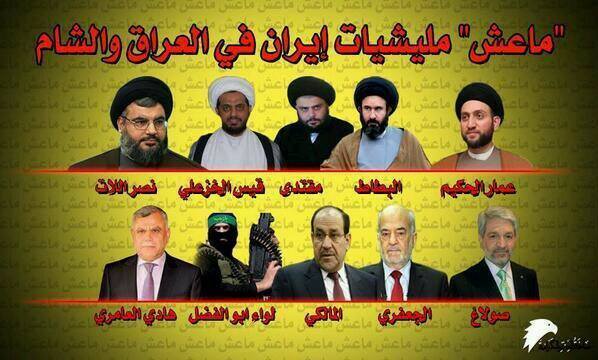
MAISH


This is the response to the Shia-led Iraqi government’s accusation that the current insurgency is conducted or at least lead by "DAISH" which is the Arabic acronym for "ISIS" (The Islamic State Of Iraq and Sham).
In all actuality, the current insurgency is made of the Sunni Tribal Fighters, ex-Saddam military personnel and a few other Islamic movements. 
ISIS holds only a very small percentage of the total armed Sunni personnel.
The only way that this insurgency could have accomplished this through Blitzkrieg, over a wide geographic front, conquer and hold major cities and terrain, could only be attributed to sophisticated and conventional military planning by ex-Iraqi Army Officers.
ISIS doesn’t have the numbers nor the conventional expertise to conduct such operations. They were soundly routed by Al-Nusra Front and it’s allies in Syria.
I addition, ISIS in Iraq were defeated in the last round they fought with the Iraqi Tribal Fighters and SAHWA Forces - before the American Occupation Troops Withdrew - and the general Sunni population have become standoffish with them.
If this operation is to succeed in Liberating the Sunni’s from Maliki’s tyranny and his Shia militias and death squads, the majority Sunni civilian population + ex-Saddam military personnel + the Tribal Fighters had to unite and coordinate their operations.
This is why it has been so fast and successful and not because ISIS played a major role or led the insurgency.
MAISH: "Iran’s Militias In Iraq and Sham/Syria"

Saturday, June 14, 2014

Lion Of The Desert (Omar Mukhtar)


Starring: Anthony Quinn, Oliver Reed, Irene Papas, Rod Steiger, Raf Vallone, John Gielgud.

Omar Mukhtar (Arabic: عمر المختار Omar Al-Mukhtār) (20 August 1858 – 16 September 1931), of the Mnifa, was born in the small village of Janzour, near Tobruk in eastern Barqa (Cyrenaica) in Libya. Beginning in 1912, he organized and, for nearly twenty years, led native resistance to Italian colonization of Libya. Italian armed forces captured and hanged him in 1931.

Italian Invasion:
In October 1911, during the Italo-Turkish War, an Italian naval contingent under the command of Admiral Luigi Faravelli reached the shores of Libya, then a territory subject to Ottoman Turkish control. The admiral demanded that the Turkish administration and garrison surrender their territory to the Italians or incur the immediate destruction of the city of Tripoli and Benghazi. The Turks and their Libyan allies withdrew to the countryside instead of surrendering, and the Italians bombarded the cities for three days, then proclaimed the Tripolitanians to be "committed and strongly bound to Italy." This marked the beginning of a series of battles between the Italian colonial forces and the Libyan armed opposition in the East of Libya (Cyrenaica) under Omar Mukhtar for 22 years

Guerrilla Warfare:
A teacher of the Qur'an by profession, Mukhtar was also skilled in the strategies and tactics of desert warfare. He knew local geography well and used that knowledge to advantage in battles against the Italians, who were unaccustomed to desert warfare. Mukhtar repeatedly led his small, highly alert groups in successful attacks against the Italians, after which they would fade back into the desert terrain. Mukhtar’s men skillfully attacked outposts, ambushed troops, and cut lines of supply and communication. The Italian army was left astonished and embarrassed by his guerrilla tactics.

In the mountainous region of Ghebel Akhdar ("Green Mountain") in 1924, Italian Governor Ernesto Bombelli created a counter-guerrilla force that inflicted a severe setback to rebel forces in April 1925. Mukhtar then quickly modified his own tactics and was able to count on continued help from Egypt. In March, 1927, despite occupation of Giarabub from February 1926 and increasingly stringent rule under Governor Attilio Teruzzi, Mukhtar surprised Italian troops at Raheiba. Between 1927 and 1928, Mukhtar reorganized the Senusite forces, who were being hunted constantly by the Italians. Even General Teruzzi recognized Omar's qualities of "exceptional perseverance and strong will power."


Pietro Badoglio, governor of Libya from January 1929, after extensive negotiations concluded a compromise with Mukhtar (described by the Italians as his complete submission) similar to previous Italo-Senusite accords. At the end of October, 1929, Mukhtar denounced the compromise and re-established a unity of action among Libyan forces, preparing himself for the ultimate confrontation with General Rodolfo Graziani, the Italian military commander from March 1930. A massive offensive in June against Mukhtar's forces having failed, Graziani, in full accord with Badoglio, Emilio De Bono (minister of the colonies), and Benito Mussolini, initiated a plan to break the Cyrenian resistance: the 100,000 population of Gebel would be relocated to concentration camps on the coast, and the Libyan-Egyptian border from the coast at Giarabub would be closed, preventing any foreign help to the fighters and depriving them of support from the native population. These measures, which Graziani initiated early in 1931, took their toll on the Senusite resistance. The rebels were deprived of help and reinforcements, spied upon, hit by Italian aircraft, and pursued on the ground by the Italian forces aided by local informers and collaborators. Mukhtar continued to struggle despite increased hardships and risks, but on 11 September 1931, he was ambushed near Slonta.

Mukhtar's final adversary, Italian General Rodolfo Graziani, has given a description of the Senusite leader that is not lacking in respect: "Of medium height, stout, with white hair, beard and mustache. Omar was endowed with a quick and lively intelligence; was knowledgeable in religious matters, and revealed an energetic and impetuous character, unselfish and uncompromising; ultimately, he remained very religious and poor, even though he had been one of the most important Senusist figures."
Capture and Execution:
Mukhtar's struggle of nearly twenty years came to an end on 11 September 1931, when he was wounded in battle near Slonta, then captured by the Italian army. The Italians treated the native leader hero as a prize catch. His resilience had an impact on his jailers, who later remarked upon his steadfastness. His interrogators stated that Mukhtar recited verses of peace from the Qur'an.
In three days, Mukhtar was tried, convicted, and, on 14 September 1931, sentenced to be hanged publicly (historians and scholars have questioned whether his trial was fair or impartial). When asked if he wished to say any last words, Mukhtar replied with a Qur'anic phrase: "Inna lillahi wa inna ilayhi raji'un." ("To God we belong and to Him we shall return."). On 16 September 1931, on the orders of the Italian court and with Italian hopes that Libyan resistance would die with him, Mukhtar was hanged before his followers in the POW camp of Suluq at the age of 73 years.

Wednesday, June 11, 2014

Why Mosul's Fall Is A Signature Moment In Iraq


The City's Takeover By Sunni Insurgents Is A Devastating Military Setback For The Maliki Regime – and A Measure Of The Political Failure Of Post-Saddam Iraq.

The Iraqi government has lost control of its third-largest city to Al Qaeda-inspired insurgents, a crushing defeat for not only Prime Minister Nouri al-Maliki's security policies but for Iraqi politics as a whole.
The scale of the catastrophe, as troops loyal to Mr. Maliki flood north and troops controlled by the Kurdish Regional Government rush west and south, can't be overstated. Chicago is the United States' third-largest city. Munich is Germany's. Osaka is Japan's.
And unlike the Anbar towns of Fallujah and Ramadi, almost exclusively Sunni Arab and in the heart of what has long been one of Iraq's most restive provinces, Mosul is an ethnically and religiously mixed town of Sunni and Shiite Arabs, Kurds and Turkmen, Christians and Muslims. US forces won, lost, and won control again of Fallujah in fierce battles during the early years of the America-led war in Iraq. But a city like Mosul is something else again.
It's well known that Mosul has been a target for the Islamic State in Iraq and the Levant (ISIS). The city is the capital of northern Nineveh Province, the western side of which has a roughly 300-mile-long frontier with Syria. During the height of the US war in Iraq, insurgent rat-lines riddled the border, and in the past few years, with what was once Al Qaeda in Iraq merging with Sunni Arab insurgents fighting in the Syrian civil war to become ISIS, the cross-border flow of men and weapons has ramped up again.
Much of Nineveh, like Anbar, is sparsely inhabited desert where the central government's writ is nominal. Smaller cities in the area's east, like Tal Afar, have repeatedly fallen to insurgents over the past decade. But Mosul is a crown jewel, a center of transportation and commerce. Holding it was a government priority. Losing control, if only briefly, is a powerful indication of government failure and something that is likely to spur insurgent recruitment. What must have looked like a hopeless cause to many passive Sunni Arab supporters of the insurgency just started looking a lot more hopeful.
Iraqi Parliament Speaker Osman Nujaifi said virtually all government installations in the city have fallen into ISIS hands. "When the battle got tough in the city of Mosul, the troops dropped their weapons and abandoned their posts, making it an easy prey.... ," 
Today, according to people in the city, organized ISIS fighters dismantled the city's security barricades and roadblocks. While there were reports that the portion of the city east of the Tigris River, closer to the Kurdish heartland, had not fallen, western Mosul is the heart of the town.
The ISIS Victory Is A Signature Moment – evidence that ISIS can't be dismissed as merely a ragtag group of insurgents who may be able to hold their own in Syria, but would be unlikely to take and hold ground from Iraqi forces. The US spent more than $14 billion on training and equipping Iraqi security forces. When US forces left Iraq at the end of 2011  (because Maliki refused to sign an agreement extending US military involvement), US politicians and military leaders spoke of how the Iraqis were ready to stand on their own, how the seeds of political reconciliation had been sown by a war that cost more than $2 trillion, 4,486 American lives, and more than 100,000 Iraqi ones.
... thanks to Maliki and his Shiite allies' decision to turn on the Iraqi tribes that made up the Sunni "Awakening." It's looking like an illusion also for much of the rest of the country, where politics remain defined along sectarian and ethnic lines, and where the toll of fighting on civilians and government forces alike have returned to the levels of 2007-2008.
This is Mosul today, through the eyes of Agence France-Presse reporters in the city.
An AFP journalist, himself fleeing the city with his family, said shops were closed, a police station had been set ablaze and that numerous security force vehicles had been burned or abandoned. Hundreds of families were seen fleeing. Some were on foot, carrying what they could, others in vehicles with their belongings piled on the roofs.
Another AFP journalist said thousands of Mosul residents had fled for the safety of the autonomous Kurdish region in the north. Dozens of cars and trucks stretched out from one checkpoint on the boundary of the region, as people with plastic bags, suitcases and a pram waited to enter, some with young children in tow.
"The army forces threw away their weapons and changed their clothes and left their vehicles and left the city," said Mahmud Nuri, a displaced Mosul resident. "We didn't see anyone fire a shot."
Events in the city today are a stark reminder of how ephemeral US efforts in Iraq have proven to be. In early 2004, Gen. David Petraeus was commander of the 101st Airborne Division in the province, and his efforts there, focusing on hearts and minds, were marketed as the "Mosul model." Early in the war, Mosul was Iraq's most peaceful large city, new businesses were opening, and fuel shortages that bedeviled most of the country then weren't apparent.
At the time, the Bush administration, the military, and the US people were still expecting a quick war. That January, Petraeus's 18,000 troops in the region were being replaced by a force of about 5,000.
Petraeus said then:
"They will have the benefit of a substantially larger Iraqi security presence coming on line,'' says General Petraeus, whose unit has trained more than 10,000 Iraqi soldiers, border guards, and police. "This is an occasion where we'll see how the new Iraqi security forces are going to do. I think they'll be fine."
Petraeus has been slowly pulling his forces back since September, seeking to hand over more and more authority to a local governor and council selected shortly after the 101st arrived in the Mosul area last April. "We're only six months away from June and handing control of the country back over to Iraqis," he says.
"The number of joint patrols we run on the border with Syria, for instance, has been steadily decreasing as the capabilities of local forces have increased,'' says Maj. Mike Getchell, who serves in the 101st's Third Brigade under Col. Mike Linnington, outside the city of Talafar.
Ten years on, Iraq does not control its border with Syria and it does not control Mosul. If ISIS manages to hang on to the city, even if only for a short while, it will be able to threaten towns farther south and closer to Baghdad... Maliki's call for arming civilians ... means he intends to use Shiite militias in an effort to regain control.

Wednesday, July 17, 2013

Hezbollah Applies New Training Practices In Syria

This video grab from al-Manar shows Hezbollah fighters practicing in an urban warfare training site. (The Daily Star/Al-Manar grab)

By Nicholas Blanford

BEIRUT: The 17-day assault on Qusair marked the first time that Hezbollah has launched a major offensive operation in an urban environment, putting into practice new training techniques taught to the group’s fighters since 2006. The fighting in Qusair provides potential insights into how Hezbollah could plan to exploit its relatively new urban warfare skills in a future confrontation with Israel.

Full details of the battle have yet to emerge, but Hezbollah apparently spearheaded the assault on the ground, using some 1,200 elite special forces fighters, backed by Syrian army artillery and air power, according to Hajj Abbas, a Hezbollah combatant who spent a week fighting in the town.

Hezbollah commanders were given tactical control over the attack on Qusair. The town was split into operational sectors and code numbers were assigned to locations and objectives, in keeping with customary Hezbollah practice. The technique allowed Hezbollah to use open radio communications – some of which was intercepted, recorded and uploaded to the Internet by rebel forces – without the opposition necessarily understanding what was being communicated.

Prior to the assault, the rebels constructed extensive defenses, including digging tunnels, erecting barricades, booby-trapping buildings and lacing the terrain with roadside bombs.

Hezbollah engineers were employed to help clear some of the booby traps to allow the fighters to advance.

“The engineers saved us a lot of headaches and time. They could clear a building then tell us that building No. 3 or building No. 4 was cleared and we could move in,” said Hajj Abbas, using his nom de guerre as he was not authorized to speak to the media.

The Hezbollah units were no more than five or three men each and progress was slow. 

They knocked holes in the walls of buildings for access to avoid potentially booby-trapped doors and windows.

Hajj Abbas likened the terrain to a Palestinian camp due to the density of the houses and narrow streets, a marked contrast to the rural hills and valleys of south Lebanon where he gained his first combat experience more than a decade ago.

“It was a difficult environment for us at first because we don’t know the area. The buildings are different, the terrain is different. But we are well-trained soldiers and we are trained to adapt, so we just got on with it,” Hajj Abbas said.

He admitted that the rebel mortar fire was a “big problem.” The Hezbollah units attempted to draw as close as possible to their enemy so that the rebels would halt the mortar fire out of fear of hitting their own side.

In the 1990s, when Hezbollah was daily battling Israeli troops occupying south Lebanon, fighting was restricted to rural areas. Hezbollah fighters had to learn the art of stealth, camouflage and reconnaissance in a difficult environment of dense woodland, steep rocky hills and valleys, as well as cope with hazards such as snakes and wild boar.

In 2006, Hezbollah fought much of the war inside villages and towns, but in a defensive capacity to thwart Israeli attempts to capture ground.

However, since 2006, learning urban warfare skills – both defensive and offensive – has become an important part of Hezbollah’s overall training, augmenting the traditional hit-and-run guerrilla tactics.

The fighters receive training in mock urban sites in Iran and smaller facilities in Lebanon. 

In early March, Al-Manar television broadcast an audio recording of the voice of Imad Mughniyeh, Hezbollah’s military commander who was assassinated in February 2008.

Accompanying his comments on jihad was footage of Hezbollah fighters training at camps in the Bekaa Valley. One brief segment showed Hezbollah men storming an “Israeli home” – a small roofless cinder block building decorated in the colors of the Israeli flag.

The building was one of several that comprised a simple urban warfare training site. The segment only lasted a few seconds but it was significant because it strengthened a veiled reference by Sayyed Hasan Nasrallah, Hezbollah’s secretary-general, that in the next war Hezbollah units could be dispatched into northern Israel.

Hezbollah fighters have privately hinted at that possibility since the end of the 2006 war. 

In February 2011, Nasrallah said that in the event that war was imposed on Lebanon, “the resistance leadership might ask you to lead the resistance to liberate Galilee.”

Hezbollah describes its strategy as one of “defensive resistance,” in other words defending Lebanon by using resistance, or guerrilla, techniques, rather than relying on the capabilities of the Lebanese Army.

But in the next war, it is possible that there will be a further iteration in Hezbollah’s military evolution where the group employs offensive resistance techniques to seize and hold ground inside Israel, very different from the traditional hit-and-run practices of the 1990s.

Fresh from victory in Qusair, Hezbollah is expected to press on in Syria to new objectives. Aleppo has been cited as a major target for Hezbollah and the Syrian army.

The rebel-held areas around the towns of Yabrud and Nabk lying on the highway midway between Damascus and Homs also are speculated as likely candidates for Hezbollah’s attention. Returning that area to regime control would help seal Lebanon’s eastern border and neutralize Arsal as a logistical support hub for the Syrian rebels.

Regardless, Hezbollah appears prepared for a long commitment in Syria. That will ensure that the post-2006 generation of Hezbollah recruits, who have had no experience fighting Israeli troops unlike their older comrades, will emerge from the Syria war combat-hardened in urban and rural environments.

Thursday, November 29, 2012

Israel Forced To Recognize A New Day In Gaza

Jon Elmer writes:

The True Game-Changer

The true game-changer in the region was Israel's defeat in south Lebanon in the 2006 July War. For 34 days, a seemingly unending stockpile of rockets drove Israelis into bomb shelters and halted daily life throughout nearly the whole country. When Israel's brutal air war failed to halt the rockets, a ground war was launched by the IDF.

If every war is to have its signifying battle - the July War was defined in Bint Jbeil. Israel's conscripted army and its reserves walked right into a prepared enemy that had changed the rules of the game - mixing guerrilla operations with conventional military tactics. In so doing, Hezbollah dealt Israel a psychological blow that carried the "spectacle" of defeat, as Israel's Haaretz newspaper characterised it.

According to Israel's Winograd Commission - tasked by the state with investigating the July War failings - the battle in Bint Jbeil was the turning point of the war, "a symbol of the unsuccessful action of the Israel Defence Forces throughout the fighting".

A successful model was in place, and Palestinians took note.

After Cast Lead, there was a switch in resistance approach in Gaza led by the Qassam Brigades. In short, away from the primacy of infiltration-type operations to a more dug-in position inside Gaza itself. And drastic upgrading of the rocketry, weapons and materiel.

It was Gaza's smaller-scale answer to Hezbollah, led by Qassam Brigades commander, Ahmed Jabari. Under Jabari, Hamas' armed wing transformed into a more structured and professionalised force. "This isn't a terror organisation anymore," said Minister for Home Front Defence Avi Dichter, two days before Jabari's assassination, "it's a bona fide army."

In addition to the rockets, Palestinians added anti-tank missiles of the sort that were used to devastating effect by Hezbollah in 2006. Anti-aircraft missiles looted from Gaddafi's caches during NATO's war in Libya emerged in Gaza across a well-trodden corridor from post-war Libya, through post-uprising Egypt and into the virtually independent Bedouin republic in the Sinai - where all roads lead to Gaza's lucrative tunnels network.

The tunnels were once hand-carved with trowels and only large enough for teenagers to navigate, but in recent years have become an industrial-scale project, large enough for cars and cattle, and various weapons-systems too.

And while it could be argued that Gaza's rockets were largely ineffective during the eight days of fighting, it takes some time to learn to use these weapons. Because there are nothing like test-ranges in the tiny enclave of Gaza, the rockets must be tested in battle. Still, as day after day of rocket barrages passed, it seemed inevitable that a deadly landing in a major city was getting closer.

That could not have been lost on Netanyahu, as the prime minister embarks on an election campaign that will be defined by this latest war in Gaza. A costly strike on Tel Aviv from Gaza would have been a problem for his campaign, and would have likely pressed Israel into a ground war against a transformed force with significantly improved capability.
Instead, Israel sued for peace with a ceasefire that reads very favourably to Palestinians. While Netanyahu avoided his Bint Jbeil moment, Israelis were forced to recognise a new day in Gaza.
Via: "Al-Jazeera"

Saturday, May 12, 2012

Afghanistan: An Illusion Exposed


Taliban Attacks On Kabul Are Further Proof That The West's Vision For Afghanistan Was A Fantasy

By Carne Ross
Monday 16 April 2012 16.30 EDT
Courtesy Of "The Guardian"


For months after the allied invasion of Afghanistan in 2001, there were no Taliban attacks in Kabul. Now, as the weekend's gun, rocket and suicide attacks demonstrate, they are frequent and fatally effective. This is one measure of the progress of the war, more than 10 years on. There are many others.
According to a devastating account from a senior US army officer, theTaliban now range freely across much of the country. US forces barely control the territory they can see from their highly fortified bases. Lieutenant Colonel Daniel Davis reports that the Afghan army, like its government, is neither competent nor trusted.
The war was supposed to end with the Taliban arriving as supplicants to the negotiating table once sufficiently "degraded" by allied attacks. That strategy has been turned on its head. If anyone is a supplicant it will be the allies, desperate to make a deal they can claim as some kind of limited "victory" before they pull out. But, if this weekend's events are any indicator, the Taliban don't seem very interested in talking.
Where did it go so wrong? With the lucidity of hindsight (for I was once an enthusiastic supporter of the war), it appears that a fatal mistake was made before the campaign even started. In Bonn, an international conference was convened to construct a political strategy to follow the inevitable military victory. A moderate Pashtun would lead a government comprising all factions and ethnicities – or at least those we approved of. This new dispensation was to be endorsed by the traditional loya jirga, or "democracy, Afghan-style", as some chose to call it. It sounded plausible and everyone in the "international community" signed on.
But the new Afghanistan was in fact a fantasy.
A few weeks after Bonn, allied forces quickly drove out the Taliban – at least in parts of Afghanistan. The Karzai government was installed. The illusion persisted. But even in 2002, the flaws in the fantasy were evident for those who cared to look. Indeed they had been evident in Bonn.
For the one faction not invited to join the new Afghanistan was of course the Taliban. It was simply assumed that they would disappear. When I briefly served in the British embassy in Kabul shortly after the invasion, nobody ever asked why there was no allied presence in large swaths of the south. At the main airbase at Bagram, military operations were presented as mere "mopping up" of rag-tag forces driven into the mountains. But I remember one SAS commander who seemed less than convinced of this rose-tinted narrative. Perhaps he already saw the auguries.
Accompanying a senior official visiting our new allies in the north and west of the country (again, none in the south), everyone told us that the loya jirga would produce the wished-for democratic stability. Nobody mentioned that our partners in this project often behaved more like tyrants than democrats. One was reported to be given to tying the limbs of his opponents to two tanks then driving them in opposite directions.
The allies had all the guns and the money. Was it any wonder that any Afghan we met told us what we wanted to hear? At every meeting we were accompanied by squads of heavily-armed soldiers. As for the money, iIt was muttered only sotto voce at the Kabul embassy that cash-filled briefcases were regularly handed to new government ministers and warlords on "our side". Even nice Mr So-and-So, who spoke such good English and presented so well on TV, was on the take. Today, the only surprise is that we seem so shocked at the corruption of the Karzai government, given that we helped corrupt it.
The truth was that the allies were not creating a new democratic Afghanistan. Wwe had instead joined one side in a civil war that had raged for decades, has not ceased despite the allied presence, and will resume with full force once the western forces depart. It seems astonishing now that we were so wilfully naive. It all made such good sense at the time.
We entered Afghanistan and tried to make it comply with our fantasy, ignorant of its already complex realities. We occupied only small pieces of the country but declared that we had vanquished all of it. We constructed a new "democratic" order – but excluded those most likely to oppose it while including the brutish and corrupt (and then we corrupted them some more).
That these contradictions now seem so clear serves as a reminder of how stupid we were.

Saturday, September 25, 2010

The Poor Man's Artillery

What IEDs Can Do

By CLANCY SIGAL
September 16, 2010
Courtesy Of "CounterPunch"

The IRA tried to kill me on three separate occasions. Nothing personal, just that I was in the wrong place at the wrong time when the Provos' deadly "mainland campaign" against Brits took the form of planting IEDs, improvised homemade bombs, in central London where I lived. In Picadilly, shrapnel from a device inside a letter box grazed my head; the same month, a McDonald's I walked past on Oxford Street blew up; and still later, outside a Sloane Square pub, glass shattered at my feet after an explosion. Such an intense level of exposure and vulnerability left me shaken.

The Provos had resorted to the "poor man's artillery" of IEDs because they were outnumbered and outgunned by the British army and Ulster constabulary. How else were they to achieve their political agenda other than by indiscriminately killing British civilians?

I read Afghanistan casualty lists almost every night, and my rough calculation seems to agree with the Pentagon's: that IEDs – jerry-built, cleverly-disguised roadside bombs – cost way more American (and Afghan) lives than snipers, mortars or RPGs. According to NATO and the Department of Defense, despite General Petraeus's soothing assertion that the incidents are "flattening out", since 2007, the number of Taliban IEDs has increased nearly 400 per cent, and IED kills by that same 400 per cent and IED-crippled troops by 700 per cent. At least 30 per cent of combat soldiers, in Iraq and Afghanistan, are at risk of potentially disabling neurological disorders from IED blast waves – without suffering a scratch.

But percentages don't bleed. For yourself, look up the casualty lists from your own state or district, add up the IED "kinetic events", and study, really look at, the names and photographs of the dead soldiers who suddenly seem part of our own families. The harsh lesson is that no foreign invading army like ours can beat a "backward" native people who, for a few dollars and in five minutes, can build a dish pan, copper wire, a left-over 155mm Soviet shell and a bit of Semtex or C-4 and fertilizer into a killer IED hidden in potholes, among garbage and even inside animals.

It's terrifyingly easy for a soldier to get blasted apart by these devices. You don't even have to step on a pressure plate any more, just walk by an innocent-looking rock and – bang! – you're shredded by remote control. Increasingly, these things are set off by text messages from afar. Jihadists may be typecast as primitive "ragheads" on TV news, but they have learned to be thoughtful and high-tech assassins.

In his latest Oval Office speech, President Obama, in paying anodyne tribute to the troops, glancingly referred to "the signature wounds of today's wars, post-traumatic stress disorder and traumatic brain injury (TBI)". Let's pause a moment on TBI, where a visible wound may not show but the person's brain has been shaken as in a Mixmaster by the faster-than-speed-of-sound blast of an IED explosion. No helmet or body armor yet invented can protect from its peculiar one-two punch that causes, on the battlefield or much later, microscopic cellular and metabolic damage, leading to blindness, deafness, memory loss, premature ageing and destruction of neurons that cannot be replaced.

As the pediatric surgeon and Vietnam veteran Ronald Glasser says, "the symbol (of the new IED-dominated battles) is not the cemetery but the orthopedic ward" and neurological unit. Strangely, army commanders are extremely reluctant to award Purple Hearts for IED wounds, which can be hard for combat medics to diagnose in the heat of battle. Even skilled field-hospital emergency doctors may miss the insidious danger signs. If a soldier looks unscratched, just a little dazed, military culture demands he or she be shipped back to fight again. Troopers themselves may be reluctant to report symptoms, fearing career damage or being seen as a goof-off.

Once back home, soldiers very often have to struggle for treatment. Congress is eager to vote the Pentagon $20bn for JIEDDO, the Joint Improvised Explosive Device Organization – who thinks up these names? – whose own boss, general Michael Oates, confesses is only marginally useful. But when it comes to money for medical research into the little-known effects of TBI, the government drags its feet.

At the moment, despite evidence that 30 per cent of our battlefield casualties are bomb-concussion cases, the military and the Veterans Administration make it as hard as possible to get help. President Obama boasts that "because of our drawdown in Iraq, we are now able to go on the offence" in a deteriorating Afghanistan, which translates into more visible and invisible wounded. Soldiers lose their lives, arms, legs, eyes, even faces. We can see those terrible wounds. But concussed, TBI-suffering soldiers also lose parts of their minds sometimes without even knowing it. Until they get home and can't remember their daughter's name.


Clancy Sigal is a novelist (Going Away) and screenwriter (Frieda) in Los Angeles. He can be reached at clancy@jsasoc.com

Saturday, September 18, 2010

Guerrilla Of Arabia

How One Of Britain's Most Brilliant Military Tacticians Created The Taliban's Battle Strategy

By Neil Faulkner
Friday, 17 September 2010
Courtesy Of "The Independent"

    • ary was to capture the city of Marjah in Afghanistan's war-torn Helmand province. Fifteen thousand troops, mainly American, British and Afghan, were to take on between 400 and 1,000 Taliban insurgents holed up in a city of 80,000 people.
      Commanders talked of a "new model war". An Afghan administration and police force would move into Marjah behind the soldiers. Engineers would maintain power and water supplies. "We've got a government in a box, ready to roll in," said the then-US General Stanley McChrystal.
      But as the offensive unfolded, reported Taliban casualties were few, and Marjah turned out not to exist. Faithfully reported by global news media, it was in fact invented by US military officials. "This is all a war of perceptions," McChrystal said. As The Washington Post reported, the decision to launch the offensive was intended to influence US public opinion on the effectiveness of military action in Afghanistan by showing it could win a "large and loud victory". In reality, Marjah is a vaguely-defined area of villages, markets and family compounds. If there are tens of thousands of people, they are spread across 125 sq miles. Marjah was invented because a military operation has to have a clear-cut goal to be deemed a victory. President Obama had doubled the total US troop deployment, but public support was waning. The generals needed a victory, so they created Marjah and planned Operation Moshtarak to capture it.
      A phantom city was needed because the enemy is a phantom. A task force is assembled and motors into bandit country. If it is too small, it risks annihilation. If it is too big, it finds itself punching the air. A golden rule of guerrilla warfare is that you fight only if you are certain to win. So the invaders of Afghanistan are waging a war against an enemy who is never there.
      "Suppose we were (as we might be)," wrote T E Lawrence, "an influence, an idea, a thing intangible, invulnerable, without front or back, drifting about like a gas? Armies were like plants, immobile, firm-rooted, nourished through long stems to the head. We might be a vapour, blowing where we listed... Ours should be a war of detachment. We were to contain the enemy by the silent threat of a vast, unknown desert ..."
      Lawrence was a young officer who had spent the first two years of the First World War in the intelligence department in Cairo. On a diplomatic mission to the Hijaz region of western-central Arabia in 1916, he had formed a personal relationship with Prince Faisal, a commander now ranged in revolt against Ottoman rule. Faisal asked that Lawrence be attached to his service as a British liaison officer. Lawrence's superiors agreed. The Ottoman Empire, though much reduced, still controlled a vast territory from south-eastern Europe to the Caucasus, the Tigris, the Yemen, and the Suez Canal. Plunging into the world war, this ramshackle traditional empire, though fighting a war on four fronts, against the Russians in the Caucasus and the British in Gallipoli, Sinai, and Mesopotamia, proved a tougher opponent than its enemies predicted.
      The Arab Revolt, led by the Emir of Mecca, had been encouraged by secret British diplomacy as a source of military and ideological support for the Allied cause. But after momentary success – principally the capture of Mecca itself, along with the Red Sea ports of Jidda and Rabegh – the Revolt stalled. Medina remained in Ottoman hands, and the city's 10,000-strong garrison was receiving reinforcement. When the Turks went on to the offensive, the Arabs fell back, and the tribal irregulars forming the army began to melt away. In late 1916, the Revolt hung by a thread.
      Lawrence, newly arrived in the Hijaz, was witness to this looming disaster. His response appears to have been a radical re-conceptualisation of the war. He turned conventional military thinking on its head and created a new theory of modern guerrilla warfare. What if the Arabs ignored the Turks? What if they simply marched away from them into the desert? What if they constituted themselves as a "silent threat" and waged a "war of detachment"?
      This they did. In fact, even before Lawrence had worked it out, they had made a start by marching 200 miles north – away from the Turks threatening them around Medina – and establishing a new base at Wejh. Supplied here from the Red Sea by the Royal Navy, they then staged a series of raids on the Hijaz Railway. Running through 1,000km of desert, a lifeline on which the Ottoman grip on Arabia depended, the Turks had to defend it. But against an enemy who could appear suddenly out of the desert haze at any point to defend the line at all was to defend all of it. So instead of a concentration of force at the decisive point – at Medina, from which a thrust towards Mecca might have snuffed out the rebellion – the Turks were forced to plant 100, 200 or 300 men every few kilometres.
      Then, in June 1917, Faisal's Northern Army, inspired by its brilliant British military adviser, leapt forwards again, some 250 miles to Aqaba. But they did not go direct: following a 500-mile route through the desert, a small commando group appeared north-east of Aqaba, raised the local tribes in revolt, and rolled up the Ottoman positions all the way to the coast.
      With a new forward base, the insurgency could be supplied as it spread into Syria. British intelligence reports from 1918 reveal its success. The Arab armies comprised about 5,000 regulars and a fluctuating force of up to 20,000 tribal irregulars. Yet more Turks were deployed against them than there were fighting General Allenby's army of 340,000 men west of the Jordan in Palestine.
      In fact, given that most of the serious fighting was done by Faisal's Northern Army, which was never more than 8,000-strong, often as low as 3,000, the imbalance was extreme. The raw statistics imply that one of Faisal's guerrillas was 35 times more effective in tying down Turkish troops than one of Allenby's Tommies.
      Lawrence's ideas on guerrilla warfare were touched upon in his "Twenty-seven Articles", which appeared in an internal British intelligence bulletin in 1917. They were then developed in three post-war treatises. Reading closely, one can identify 15 distinct principles of guerrilla warfare (see box). They are extraordinary. They invert many principles of conventional military theory, such as concentration of force, and the centrality of pitched battle to destroy the enemy's main forces and will to fight. In this sense, they are the work of a brilliant maverick – an unconventional intellectual who had not even undergone the military training given to volunteer wartime officers (though he probably learnt something as a member of the Oxford University Officers' Training Corps).
      They draw on the traditional tactics of the "eastern way of war" – as embodied in Bedouin tribal raiding – yet elevate this into a strategy for what would later be called a "national liberation struggle". The Arab leaders' emphasis was on creating a regular army, not on guerrilla warfare. Again, just as Lawrence was not hidebound by British military tradition, nor was he constrained by Arab political ambition.
      The third striking thing about the 15 principles is how seminal they are. Guerrilla warfare is as old as human conflict, but Lawrence's treatises represent the first systematic conceptualisation of its strategy. And this conceptualisation is remarkably comprehensive. Later theorists of guerrilla warfare – notably Mao, Nguyen Giap and Che Guevara – have added little of substance. Lawrence is the real teacher of the guerrilla fighter.
      The fourth remarkable thing is lack of recognition for the intellectual achievement. Despite the central significance of guerrilla warfare in the last century of world history, Lawrence has rarely been acknowledged. Robert Taber's 1965 book, The War of the Flea: A Study of Guerrilla Warfare, Theory and Practice, has no mention of Lawrence nor the Arab Revolt. Only recently has awareness grown – notably among US Army officers – of Lawrence's significance as a military theorist.
      The exigencies of imperial wars in Iraq and Afghanistan have made the study of guerrilla warfare a necessity, and officers have been encouraged to read Lawrence's 1922 treatise Seven Pillars of Wisdom. Leading counterinsurgency specialist Lieutenant-Colonel John Nagl echoed Lawrence in the title of a recent book Counterinsurgency Lessons from Malaya and Vietnam: Learning to Eat Soup with a Knife (2002). His point – "to make war upon rebellion is messy and slow, like eating soup with a knife" – encapsulates the challenge of foreign invaders fighting guerrillas.
      But Seven Pillars of Wisdom, however carefully read by US officers, is likely to be the book of their defeat in Afghanistan. The counterinsurgent regular cannot replicate the tactics of the insurgent guerrilla. The former is an invader. The guerrilla is embedded in local society. This basic dichotomy manifests itself in a dozen practical, and potentially deadly, ways. The regular is imposed on the military landscape and is dependent on heavy equipment, modern communications, and external supply. Intelligence depends on observation posts, patrols, and interrogation, and security entails the full panoply of fortified posts, armoured vehicles, and firepower. The invaders are therefore highly visible, relatively immobile, and poorly informed.
      Compare the guerrilla. He is largely self-sufficient, highly mobile, with superb intelligence from his social network, and indistinguishable from the civilian population of which he is part. He is almost invisible, yet has the capacity to strike anywhere, anytime. The regular strives to dominate landscape by visible threat and heavy firepower. But wherever he is, the guerrilla is not.
      The guerrilla dominates the landscape, for his embeddedness makes him an invisible, secure, and ineradicable presence. He is powerful because he is a phantom. Let the last word go to Lawrence. He could be describing Operation Moshtarak – 15,000 men chasing phantoms out of a non-existent city in Afghanistan. But, of course, it is the Arab Revolt of 1916-1918. "It [the rebellion] had a sophisticated alien enemy, disposed as an army of occupation in an area greater than could be dominated effectively from fortified posts... The active rebels had the virtues of secrecy and self-control, and the qualities of speed, endurance, and independence of arteries of supply... The presence of the enemy was secondary. Final victory seemed certain, if the war lasted long enough for us to work it out."
      Dr Neil Faulkner is editor of the new 'Military Times' magazine (out now), and co-director of the Great Arab Revolt Project. For details, visit Military-times.co.uk
      Military mastermind: Lawrence of Arabia's 15 principles of modern guerrilla warfare
      1. Strive above all to win hearts and minds
      2. Establish an unassailable base
      3. Remain strategically dispersed
      4. Make maximum use of mobility
      5. Operate mainly in small, local groups
      6. Remain largely detached from the enemy
      7. Do not attempt to hold ground
      8. Operate in depth rather than en face (i.e. not in lines)
      9. Aim for perfect intelligence about the enemy
      10. Concentrate only for momentary tactical superiority
      11. Strike only when the enemy can be taken by surprise
      12. Never engage in sustained combat
      13. Always have lines of retreat open
      14. Make war on matériel rather than on men
      15. Make a virtue of the individuality, irregularity, and unpredictability of guerrillasORMAL
    • LARGE
    • EXTRA LARGE
Action man: TE Lawrence, the archaeologist, author and military leader, wrote a series of seminal treatises on guerrilla warfare
GETTY IMAGES
Action man: TE Lawrence, the archaeologist, author and military leader, wrote a series of seminal treatises on guerrilla warfare
The aim of Operation Moshtarak in February was to capture the city of Marjah in Afghanistan's war-torn Helmand province. Fifteen thousand troops, mainly American, British and Afghan, were to take on between 400 and 1,000 Taliban insurgents holed up in a city of 80,000 people.

Commanders talked of a "new model war". An Afghan administration and police force would move into Marjah behind the soldiers. Engineers would maintain power and water supplies. "We've got a government in a box, ready to roll in," said the then-US General Stanley McChrystal.

But as the offensive unfolded, reported Taliban casualties were few, and Marjah turned out not to exist. Faithfully reported by global news media, it was in fact invented by US military officials. "This is all a war of perceptions," McChrystal said. As The Washington Post reported, the decision to launch the offensive was intended to influence US public opinion on the effectiveness of military action in Afghanistan by showing it could win a "large and loud victory". In reality, Marjah is a vaguely-defined area of villages, markets and family compounds. If there are tens of thousands of people, they are spread across 125 sq miles. Marjah was invented because a military operation has to have a clear-cut goal to be deemed a victory. President Obama had doubled the total US troop deployment, but public support was waning. The generals needed a victory, so they created Marjah and planned Operation Moshtarak to capture it.

A phantom city was needed because the enemy is a phantom. A task force is assembled and motors into bandit country. If it is too small, it risks annihilation. If it is too big, it finds itself punching the air. A golden rule of guerrilla warfare is that you fight only if you are certain to win. So the invaders of Afghanistan are waging a war against an enemy who is never there.

"Suppose we were (as we might be)," wrote T E Lawrence, "an influence, an idea, a thing intangible, invulnerable, without front or back, drifting about like a gas? Armies were like plants, immobile, firm-rooted, nourished through long stems to the head. We might be a vapour, blowing where we listed... Ours should be a war of detachment. We were to contain the enemy by the silent threat of a vast, unknown desert ..."

Lawrence was a young officer who had spent the first two years of the First World War in the intelligence department in Cairo. On a diplomatic mission to the Hijaz region of western-central Arabia in 1916, he had formed a personal relationship with Prince Faisal, a commander now ranged in revolt against Ottoman rule. Faisal asked that Lawrence be attached to his service as a British liaison officer. Lawrence's superiors agreed. The Ottoman Empire, though much reduced, still controlled a vast territory from south-eastern Europe to the Caucasus, the Tigris, the Yemen, and the Suez Canal. Plunging into the world war, this ramshackle traditional empire, though fighting a war on four fronts, against the Russians in the Caucasus and the British in Gallipoli, Sinai, and Mesopotamia, proved a tougher opponent than its enemies predicted.

The Arab Revolt, led by the Emir of Mecca, had been encouraged by secret British diplomacy as a source of military and ideological support for the Allied cause. But after momentary success – principally the capture of Mecca itself, along with the Red Sea ports of Jidda and Rabegh – the Revolt stalled. Medina remained in Ottoman hands, and the city's 10,000-strong garrison was receiving reinforcement. When the Turks went on to the offensive, the Arabs fell back, and the tribal irregulars forming the army began to melt away. In late 1916, the Revolt hung by a thread.

Lawrence, newly arrived in the Hijaz, was witness to this looming disaster. His response appears to have been a radical re-conceptualisation of the war. He turned conventional military thinking on its head and created a new theory of modern guerrilla warfare. What if the Arabs ignored the Turks? What if they simply marched away from them into the desert? What if they constituted themselves as a "silent threat" and waged a "war of detachment"?

This they did. In fact, even before Lawrence had worked it out, they had made a start by marching 200 miles north – away from the Turks threatening them around Medina – and establishing a new base at Wejh. Supplied here from the Red Sea by the Royal Navy, they then staged a series of raids on the Hijaz Railway. Running through 1,000km of desert, a lifeline on which the Ottoman grip on Arabia depended, the Turks had to defend it. But against an enemy who could appear suddenly out of the desert haze at any point to defend the line at all was to defend all of it. So instead of a concentration of force at the decisive point – at Medina, from which a thrust towards Mecca might have snuffed out the rebellion – the Turks were forced to plant 100, 200 or 300 men every few kilometres.

Then, in June 1917, Faisal's Northern Army, inspired by its brilliant British military adviser, leapt forwards again, some 250 miles to Aqaba. But they did not go direct: following a 500-mile route through the desert, a small commando group appeared north-east of Aqaba, raised the local tribes in revolt, and rolled up the Ottoman positions all the way to the coast.

With a new forward base, the insurgency could be supplied as it spread into Syria. British intelligence reports from 1918 reveal its success. The Arab armies comprised about 5,000 regulars and a fluctuating force of up to 20,000 tribal irregulars. Yet more Turks were deployed against them than there were fighting General Allenby's army of 340,000 men west of the Jordan in Palestine.

In fact, given that most of the serious fighting was done by Faisal's Northern Army, which was never more than 8,000-strong, often as low as 3,000, the imbalance was extreme. The raw statistics imply that one of Faisal's guerrillas was 35 times more effective in tying down Turkish troops than one of Allenby's Tommies.

Lawrence's ideas on guerrilla warfare were touched upon in his "Twenty-seven Articles", which appeared in an internal British intelligence bulletin in 1917. They were then developed in three post-war treatises. Reading closely, one can identify 15 distinct principles of guerrilla warfare (see box). They are extraordinary. They invert many principles of conventional military theory, such as concentration of force, and the centrality of pitched battle to destroy the enemy's main forces and will to fight. In this sense, they are the work of a brilliant maverick – an unconventional intellectual who had not even undergone the military training given to volunteer wartime officers (though he probably learnt something as a member of the Oxford University Officers' Training Corps).

They draw on the traditional tactics of the "eastern way of war" – as embodied in Bedouin tribal raiding – yet elevate this into a strategy for what would later be called a "national liberation struggle". The Arab leaders' emphasis was on creating a regular army, not on guerrilla warfare. Again, just as Lawrence was not hidebound by British military tradition, nor was he constrained by Arab political ambition.

The third striking thing about the 15 principles is how seminal they are. Guerrilla warfare is as old as human conflict, but Lawrence's treatises represent the first systematic conceptualisation of its strategy. And this conceptualisation is remarkably comprehensive. Later theorists of guerrilla warfare – notably Mao, Nguyen Giap and Che Guevara – have added little of substance. Lawrence is the real teacher of the guerrilla fighter.

The fourth remarkable thing is lack of recognition for the intellectual achievement. Despite the central significance of guerrilla warfare in the last century of world history, Lawrence has rarely been acknowledged. Robert Taber's 1965 book, The War of the Flea: A Study of Guerrilla Warfare, Theory and Practice, has no mention of Lawrence nor the Arab Revolt. Only recently has awareness grown – notably among US Army officers – of Lawrence's significance as a military theorist.

The exigencies of imperial wars in Iraq and Afghanistan have made the study of guerrilla warfare a necessity, and officers have been encouraged to read Lawrence's 1922 treatise Seven Pillars of Wisdom. Leading counterinsurgency specialist Lieutenant-Colonel John Nagl echoed Lawrence in the title of a recent book Counterinsurgency Lessons from Malaya and Vietnam: Learning to Eat Soup with a Knife (2002). His point – "to make war upon rebellion is messy and slow, like eating soup with a knife" – encapsulates the challenge of foreign invaders fighting guerrillas.

But Seven Pillars of Wisdom, however carefully read by US officers, is likely to be the book of their defeat in Afghanistan. The counterinsurgent regular cannot replicate the tactics of the insurgent guerrilla. The former is an invader. The guerrilla is embedded in local society. This basic dichotomy manifests itself in a dozen practical, and potentially deadly, ways. The regular is imposed on the military landscape and is dependent on heavy equipment, modern communications, and external supply. Intelligence depends on observation posts, patrols, and interrogation, and security entails the full panoply of fortified posts, armoured vehicles, and firepower. The invaders are therefore highly visible, relatively immobile, and poorly informed.

Compare the guerrilla. He is largely self-sufficient, highly mobile, with superb intelligence from his social network, and indistinguishable from the civilian population of which he is part. He is almost invisible, yet has the capacity to strike anywhere, anytime. The regular strives to dominate landscape by visible threat and heavy firepower. But wherever he is, the guerrilla is not.

The guerrilla dominates the landscape, for his embeddedness makes him an invisible, secure, and ineradicable presence. He is powerful because he is a phantom. Let the last word go to Lawrence. He could be describing Operation Moshtarak – 15,000 men chasing phantoms out of a non-existent city in Afghanistan. But, of course, it is the Arab Revolt of 1916-1918. "It [the rebellion] had a sophisticated alien enemy, disposed as an army of occupation in an area greater than could be dominated effectively from fortified posts... The active rebels had the virtues of secrecy and self-control, and the qualities of speed, endurance, and independence of arteries of supply... The presence of the enemy was secondary. Final victory seemed certain, if the war lasted long enough for us to work it out."

Dr Neil Faulkner is editor of the new 'Military Times' magazine (out now), and co-director of the Great Arab Revolt Project. For details, visit Military-times.co.uk

Military Mastermind: Lawrence Of Arabia's 15 Principles Of Modern Guerrilla Warfare

1. Strive above all to win hearts and minds

2. Establish an unassailable base

3. Remain strategically dispersed

4. Make maximum use of mobility

5. Operate mainly in small, local groups

6. Remain largely detached from the enemy

7. Do not attempt to hold ground

8. Operate in depth rather than en face (i.e. not in lines)

9. Aim for perfect intelligence about the enemy

10. Concentrate only for momentary tactical superiority

11. Strike only when the enemy can be taken by surprise

12. Never engage in sustained combat

13. Always have lines of retreat open

14. Make war on matériel rather than on men

15. Make a virtue of the individuality, irregularity, and unpredictability of guerrillas