Showing posts with label Libya. Show all posts

Saturday, June 14, 2014

Lion Of The Desert (Omar Mukhtar)


Starring: Anthony Quinn, Oliver Reed, Irene Papas, Rod Steiger, Raf Vallone, John Gielgud.

Omar Mukhtar (Arabic: عمر المختار Omar Al-Mukhtār) (20 August 1858 – 16 September 1931), of the Mnifa, was born in the small village of Janzour, near Tobruk in eastern Barqa (Cyrenaica) in Libya. Beginning in 1912, he organized and, for nearly twenty years, led native resistance to Italian colonization of Libya. Italian armed forces captured and hanged him in 1931.

Italian Invasion:
In October 1911, during the Italo-Turkish War, an Italian naval contingent under the command of Admiral Luigi Faravelli reached the shores of Libya, then a territory subject to Ottoman Turkish control. The admiral demanded that the Turkish administration and garrison surrender their territory to the Italians or incur the immediate destruction of the city of Tripoli and Benghazi. The Turks and their Libyan allies withdrew to the countryside instead of surrendering, and the Italians bombarded the cities for three days, then proclaimed the Tripolitanians to be "committed and strongly bound to Italy." This marked the beginning of a series of battles between the Italian colonial forces and the Libyan armed opposition in the East of Libya (Cyrenaica) under Omar Mukhtar for 22 years

Guerrilla Warfare:
A teacher of the Qur'an by profession, Mukhtar was also skilled in the strategies and tactics of desert warfare. He knew local geography well and used that knowledge to advantage in battles against the Italians, who were unaccustomed to desert warfare. Mukhtar repeatedly led his small, highly alert groups in successful attacks against the Italians, after which they would fade back into the desert terrain. Mukhtar’s men skillfully attacked outposts, ambushed troops, and cut lines of supply and communication. The Italian army was left astonished and embarrassed by his guerrilla tactics.

In the mountainous region of Ghebel Akhdar ("Green Mountain") in 1924, Italian Governor Ernesto Bombelli created a counter-guerrilla force that inflicted a severe setback to rebel forces in April 1925. Mukhtar then quickly modified his own tactics and was able to count on continued help from Egypt. In March, 1927, despite occupation of Giarabub from February 1926 and increasingly stringent rule under Governor Attilio Teruzzi, Mukhtar surprised Italian troops at Raheiba. Between 1927 and 1928, Mukhtar reorganized the Senusite forces, who were being hunted constantly by the Italians. Even General Teruzzi recognized Omar's qualities of "exceptional perseverance and strong will power."


Pietro Badoglio, governor of Libya from January 1929, after extensive negotiations concluded a compromise with Mukhtar (described by the Italians as his complete submission) similar to previous Italo-Senusite accords. At the end of October, 1929, Mukhtar denounced the compromise and re-established a unity of action among Libyan forces, preparing himself for the ultimate confrontation with General Rodolfo Graziani, the Italian military commander from March 1930. A massive offensive in June against Mukhtar's forces having failed, Graziani, in full accord with Badoglio, Emilio De Bono (minister of the colonies), and Benito Mussolini, initiated a plan to break the Cyrenian resistance: the 100,000 population of Gebel would be relocated to concentration camps on the coast, and the Libyan-Egyptian border from the coast at Giarabub would be closed, preventing any foreign help to the fighters and depriving them of support from the native population. These measures, which Graziani initiated early in 1931, took their toll on the Senusite resistance. The rebels were deprived of help and reinforcements, spied upon, hit by Italian aircraft, and pursued on the ground by the Italian forces aided by local informers and collaborators. Mukhtar continued to struggle despite increased hardships and risks, but on 11 September 1931, he was ambushed near Slonta.

Mukhtar's final adversary, Italian General Rodolfo Graziani, has given a description of the Senusite leader that is not lacking in respect: "Of medium height, stout, with white hair, beard and mustache. Omar was endowed with a quick and lively intelligence; was knowledgeable in religious matters, and revealed an energetic and impetuous character, unselfish and uncompromising; ultimately, he remained very religious and poor, even though he had been one of the most important Senusist figures."
Capture and Execution:
Mukhtar's struggle of nearly twenty years came to an end on 11 September 1931, when he was wounded in battle near Slonta, then captured by the Italian army. The Italians treated the native leader hero as a prize catch. His resilience had an impact on his jailers, who later remarked upon his steadfastness. His interrogators stated that Mukhtar recited verses of peace from the Qur'an.
In three days, Mukhtar was tried, convicted, and, on 14 September 1931, sentenced to be hanged publicly (historians and scholars have questioned whether his trial was fair or impartial). When asked if he wished to say any last words, Mukhtar replied with a Qur'anic phrase: "Inna lillahi wa inna ilayhi raji'un." ("To God we belong and to Him we shall return."). On 16 September 1931, on the orders of the Italian court and with Italian hopes that Libyan resistance would die with him, Mukhtar was hanged before his followers in the POW camp of Suluq at the age of 73 years.

Friday, December 21, 2012

The Nobel War Prize


By Julie Lévesque,

The Nobel Committee did it again. The essence of its highest award, the Nobel Peace Prize, has been perverted. It’s been turned into a propaganda tool, a form of institutionalized revisionism, for which war is upheld as a peaceful endeavour, creeping alongside power struggles called “humanitarian interventions” in a fantasy tale we call history.

Neither Henry Kissinger, nor Barack Obama and the European Union (EU) deserved a peace prize. How can the EU deserve a peace prize when it’s been using its military might in the Middle East and Africa for over a decade? As David Swanson notes:
Europe [...] has not during the past year — which is the requirement — or even during the past several decades done the most or the best work for fraternity between nations.  Ask Libya.  Ask Syria.  Check with Afghanistan.  See what Iraq thinks.  Far from doing the best work to abolish or reduce standing armies, Europe has joined with the United States in developing an armed global force aggressively imposing its will on the world.  There were good nominees and potential nominees available, even great ones [...]
The West is so in love with itself that many will imagine this award a success.  Surely Europe not going to war with itself is more important that Europe going to war with the rest of the world!”  (David Swanson, Why Europe Did Not Deserve a Nobel Peace Prize)
In addition to waging war with murderous weapons, the EU also uses “economic weaponry” directed against civilians, such as the sanctions it imposes on Iran. Unlike the EU, Iran has not invaded or attacked any country and the reasons justifying the economic sanctions are pure fantasy. Kourosh Ziabari explains:
[T]his union has aggressively declared an all-out, bloodless war on Iran, affecting millions of innocent civilians in my country who can’t understand for what crime they are being targeted and punished in such a belligerent and unfair manner.
The European Union began to impose an inclusive oil embargo against Iran since July 1 as a result of direct pressure and lobbying by the United States and in an effort aimed at paralyzing Iran’s nuclear program which they claim is not aimed at civilian purposes, and finally breaking the back of Iran’s economy and pressuring it into making political concessions [...]
Sensitive medicine and pharmaceutical products which were previously imported from the foreign countries cannot find their way to Iran’s markets anymore and thousands of patients badly in need of medicines for such diseases as thalassemia, hepatitis, diabetes, different types of cancer, heart diseases and psychiatric disorders are facing serious problems with finding their medicines.
Waging wars does not take place simply by means of bombarding cities or dropping nuclear bombs on other nations. What the European Union has been doing with Iran is the unmistakable representation of an all-out war in which the ordinary citizens are the silent victims. (Kourosh Ziabari The Nobel Peace Prize for Those Who Declared War on My Country)
And as if that was not enough, European peacemaking also includes fighting Iran’s freedom of speech as Danny Schechter reports: “European satellite company Eutelsat says it’s pulled the plug on several Iranian satellite channels following an order by the European Commission.” (Danny Schechter, Tell Me Lies: European Satellites Ordered To Drop Iranian Channels In Disregard of Free Speech)
The odd Nobel Laureate is waging a financial war on its own members as well as the cases of Greece and Spain illustrate:
How can you award of a Peace Prize – of all things! – to an entity that systematically supports the economic and social destruction of Greece; imposes extreme hardship on Spaniards and Italians whilst it supports greedy mega-bankers; has an undemocratically elected president (Herman van Rompuy) and, through its NATO war machine, continues bombing and destroying Afghanistan, Iraq, Libya, and is now poised for unilateral attack against Syria and Iran? Indeed, “Peace” should be made of sterner stuff!! (Adrian Salbuchi, The European Union Grabs the 2012 Nobel Peace Prize)
But in addition to its internal economic warfare and its plea of moral duty to promote war abroad and assert its position on the global chessboard, the EU is not an eligible candidate for this prize. According to Michel Chossudovsky:
While the EU’s contribution to peace is debatable, the key issue is whether a union of nation states, which constitutes a political, economic, monetary and fiscal entity is an “eligible candidate” for the Peace Prize, in accordance with the mandate of the Norwegian Committee.
The Olympic Games are “granted” to countries. But the Nobel Peace Prize cannot under any stretch of the imagination be granted to a nation-state, let alone a union of nation states. (Michel Chossudovsky The EU is not a “Person”: Granting the Nobel Prize to the European Union is in Violation of Alfred Nobel’s Will)
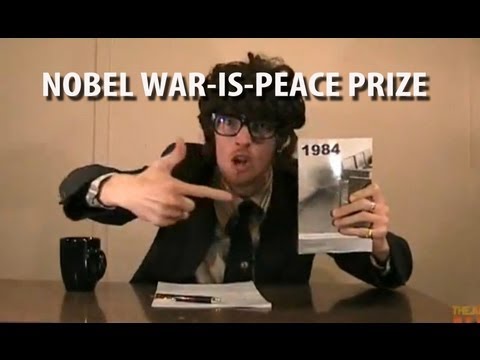
Has the Norwegian Nobel Committee become Orwell’s worst nightmare, where war is peace? To understand their nonsensical choices over the years and what to expect in the future, one has to wonder who and what does the Nobel Committee represent?
Expect anything from Nobel Committee members. They represent wealth, power, privilege, imperial lawlessness, and war, not peace. Perhaps they believe war is peace. They’ll have to explain why scoundrels regularly win their highest award. (Stephen Lendman Nobel Hypocrisy Wins Again)
If the Nobel Peace Prize is delusional, the victims of the EU’s warfare will tell you the horror of war is real.

Friday, December 07, 2012

The Why Behind The Benghazi Attack


By Melvin A. Goodman,
Courtesy Of "Middle-East-Online"


Nearly two months ago, on the eleventh anniversary of 9/11, a group of militants attacked the American diplomatic mission in Benghazi, Libya, killing the US ambassador to Libya and three other Americans.

It’s now apparent that the US consulate in Benghazi was no ordinary consulate; in fact, it probably was no consulate at all. The consulate’s primary mission was to provide an intelligence platform that would allow the CIA to maintain an operational and analytical role in eastern Libya.

... the consulate was the diplomatic cover for an intelligence platform and whatever diplomatic functions took place in Benghazi also served as cover for an important CIA base. Both the State Department and the CIA share responsibility for seriously underestimating the security threat in Libya, particularly in Benghazi.

Any CIA component in the Middle East or North Africa is a likely target of the wrath of militant organizations because of the Agency’s key role in the global war on terror waged by the Bush administration and the increasingly widespread covert campaign of drone aircraft of the Obama administration.

US programs that included the use of secret prisons, extraordinary renditions, and torture and abuse involved CIA collaboration with despotic Arab regimes, including Libya’s Muammar Gaddafi. The US campaign to overthrow Gaddafi didn’t clean the slate of these abuses; it merely opened up the opportunity for militants and Islamists to avenge US actions over the past ten years.

The CIA failure to provide adequate security for its personnel stems from degradation in the operational tradecraft capabilities of the CIA since the so-called intelligence reforms that followed the 9/11 attacks. 

Nearly three years ago, nine CIA operatives and contractors were killed by a suicide bomber at their base in Khost in eastern Afghanistan in the deadliest attack on CIA personnel in decades.

Virtually every aspect of sound tradecraft was ignored in this episode as an unvetted Jordanian double agent was allowed to enter a sensitive CIA facility (instead of a CIA safe house), where he was met by the entire base leadership (a breach of longstanding tradecraft).

The base commander in Khost had insufficient training and experience for the posting and had been promoted regularly by the CIA’s Directorate of Operations despite having been cited in a CIA internal review on 9/11, according to theWashington Post, for failing to warn the FBI about two al-Qaeda operatives who had entered the country in 2000.

No reprimands were assessed in the aftermath of the 2009 bombing, although high-level Agency officials had to approve the assignment of the base commander as well as the entry of the Jordanian double agent onto the Agency’s most sensitive facility in eastern Afghanistan.

The security situation in Libya, particularly Benghazi, was obviously deteriorating; the consulate was a target of a bomb in June and the British consulate closed its doors in the summer, leaving the US consulate as the last official foreign presence in the city.

Overall security for the consulate had been in the hands of a small British security firm that placed unarmed Libyans on the perimeter of the building complex. The CIA contributed to the problem with its reliance on Libyan militias and a new Libyan intelligence organization to maintain security for its personnel in Benghazi.

On the night of the attack, the CIA security team was slow to respond to the consulate’s call for help, spending more than 20 minutes trying to garner additional support from militias and the Libyan intelligence service that never responded.

Although nearly 30 Americans were airlifted out of Libya in less than ten hours, there is no indication that these individuals were debriefed in order to get a better understanding of the militia attacks. The lack of such essential information from those who had been under attack contributed to the confused assessments in the wake of the attacks.

There were other complications as well. Ambassador Christopher Stevens was an extremely successful and popular ambassador in Libya, but he had become too relaxed about security in a country that had become a war zone.

A failure to conduct proper threat assessments will predictably lead to security failures.

The Benghazi failure is one more reminder of the unfortunate militarization of the intelligence community, particularly the CIA, in the wake of 9/11 that finds our major civilian intelligence service becoming a paramilitary center in support of the war-fighter.

Last year’s appointment of Gen. David Petraeus as CIA director; the CIA’s increased role in drone attacks in Southwest Asia, the Persian Gulf and the Horn of Africa; and the insufficient attention to providing strategic intelligence for the policy-maker have weakened the Agency’s central missions.

The success of the Bush and Obama administrations in compromising the CIA’s Office of the Inspector General has ensured that the Agency’s flaws have gone uncorrected. The politicization of intelligence in the run-up to the Iraq War in 2003 was the worst intelligence scandal in the CIA’s history, but there were no penalties for those who shared CIA Director George Tenet’s willingness to make phony intelligence a “slam dunk.”

If more attention is not given to the biblical inscription at the entrance to the CIA headquarters in Langley, Virginia, that only “the truth will set you free,” the decline of the intelligence community will continue.


Wednesday, November 21, 2012

The Benghazi Attack Was On A CIA Base


While the US continues to debate and determine whom to blame and what “failures” led to the attack on the US Embassy compound and CIA safe house in Benghazi, nowhere is anyone considering the fact the event was the result of US meddling into the affairs of foreign states or the fact it was the US who is responsible for the death of Libya’s former leader.


What really happened in Benghazi was the result of long running US meddling in the affairs of sovereign nations and in particular in the Muslim world. An area they have shown time and time they have no clear understanding about and even less respect for. The attack in Benghazi was an attack on one of the CIA’s largest operations in the region. This is clear from the fact that Steven’s death was a secondary event in the attack on the compound. They attackers were after what was in the compound, not Stevens.
This was also underlined by the fact that over half of the US personnel evacuated from Benghazi were CIA, the sheer number of them surprising even to Libyan officials and the fact that a CIA safe house was also attacked at the same time.
The most conclusive evidence we have as to the nature of the attack was what was taken from the embassy compound. The UK’s Independent reported that: “… missing papers from the consulate are said to list names of Libyans who are working with Americans… while some of the other documents are said to relate to oil contracts.” The same article states that the US knew 48 hours before the attack that American missions could be attacked but failed to do anything about it.
The US media and the US government have completely missed the entire point and in their self-serving myopia and have failed to honor their dead with the truth and look at the real cause behind the Benghazi incident. Not the situational and technical causes but the real root cause.
Russia’s Communist leader Gennady Zyuganov may have been brutally honest in the wording of his assessment of the incident and was taken out of context but he was right in painting the event as something other than the US being an “innocent” victim. Something the West loves to do when the deaths of US citizens are involved in any event.
Why is it that Americans can invade countries at will, engaging in illegal aggressive wars, and the world has no recourse? And the people who fight to protect their homelands are treated as terrorists and criminals and allowed to be taken to Guantanamo and tortured when the invaders who are killing their families and friends and loved ones and stealing their resources and destroying their homes and cities are allowed to walk around with impunity and kill and desecrate and murder and bomb endlessly at will?
If we are to believe the official US version of 9-11, that some “primitive Muslim terrorists”, and I say that because they are portrayed that way by Americans not because I believe that, then we are to believe that these Al-Qaeda operatives, from some cave in Afghanistan or wherever, planned the most precise controlled demolition in the history of mankind and took the lives of just under 3,000 Americans. Then this was also blowback for meddling in the Muslim world.
Regardless of who planned the 9-11 attacks who benefitted is clear however as the event allowed the US to begin its endless resource war against “terror”, but the world has grown up, and the holes in the official story are now part of dinner table conversation the world over.
The US has been meddling in Muslim countries for decades, and while the US is holding hearings and passing the blame back and forth to everyone and everything under the sun, no one is even thinking that perhaps the blame lies with the US itself and with American arrogance and naivety.
The Clinton’s are concerned, as they know it is Hillary’s aggressive in-your-face-do-what-we-say-or-die stance that contributed to the attack, even going so far as to organize a legal team in case she is blamed, according to the Daily Caller citing author Ed Klein: “… former President Bill Clinton is moving fast to develop a contingency plan for how his wife, Secretary of State Hillary Clinton, should react if Obama attempts to tie the Benghazi fiasco around her neck.”
The US really believes that they can go anywhere in the world and bring about regime change wherever they want, extra-judicially execute whoever they want, eliminate leaders like dogs in the street, torture anyone in the name of their own “security”, kidnap and disappear anyone at will, bomb whatever country dares to show independence, invade and confiscate the resources of any country they desire, control and punish any country in the world into submission and dictate to absolutely everyone what they can and can’t do. Sadly for the imperial power this is increasingly not the case.
That meddling for decades in the Muslim world, engaging in an undeclared endless war against Muslims, extra-judicially executing Muslim leaders and invading Muslim countries never crosses the minds of Americans as a reason for anti-American incidents shows a complete lack of understanding of the people of the world and how the world really works and a complete unbelievable pompous self-righteous arrogance.
Why is it that, in the eyes of Americans and their “allies”, the father of a little Muslim kid in Afghanistan is worth less than an American soldier? Why is it that when Gaddafi was killed like a dog in the street and Hillary Clinton said “We came, we saw, he died” the world was supposed to accept that, yet when Stevens was drug along the street like a dog, we are supposed to go mad with grief and pity and outrage?
Sure Stevens knew there was a security problem, he was working “in country” he had dealings with Al-Qaeda and the mercenaries and insurgents who helped the US to take control of Libya, and assassinate Muamar Gadaffi but no one wanted to listen. Those responsible are not programmed to listen to such news, they honestly believe that Americans are welcomed wherever they go as the bringers of democracy and freedom and anything that does not fit that misconception can not be.
If the US were truly loved as liberators and the bringers of democracy, as they would like the world to believe, some politicians even painting the picture of the Benghazi incident as a sign of success, then in reality they would not need armed guards and security at all.
Sure Benghazi was an intelligence failure but the failure was not with the “Intelligence Community” but with the simple intelligence to understand that if you kill and attack and humiliate a people long enough they are going to hit back.
True success in the world is when you do not have to use force and weapons to fulfill your goals and make yourself respected and loved and when you are able to walk the streets without guards and truly be called a friend.


Friday, May 11, 2012

SUPERPOWERS

By Lori High Priestess
Courtesy Of "Axis Of Logic"

The citizens of the United States are convinced that what they did in Libya was a good thing that helped many people. The reason for that is because they are victims of their own government's propaganda.

Many of the comments I receive are from people who say that because I am a woman I should concern myself about other things and why do I waste my time beating a dead horse? 


But it was the last comment I received that was so revealing...These are his words the way they were given to me: "I don't give a crap about 30,000 dead Libyans."

There is a lot more to this than meets the eye. Most news outlets in the world treat the continent of Africa with indifference as well as contempt in many areas. Many events take place there that are never reported period, much less even referred to. The only reports that you ever see are negative as well as misleading, seeing as none of them tell about the realities of Africa.  

Because of that the continent of Africa is shrouded in a cloak of mystery and ignorance as far as many of the people who live in other places are concerned. As a whole, I think its safe to say that most people literally know nothing about this subject, and accept every single written thing or news broadcast they ever see about it as the written in stone truth. They have nothing, nor do they look for anything that might either back up what they see, or show it to be a lie.  

This has been going on for decades now, and the powers that be have been very successful with this. VERY SUCCESSFUL. This incident with Libya will go down as one more insignificant event that no one gives a crap about. My own feelings about this is that I want to cry for the people of Africa who have been subjected to the worst kinds of treatment by the rest of the world as well as their own governments who get all the support from that same world.


Monday, March 26, 2012

Lockerbie: The Report That Could Have Cleared Megrahi

Megrahi at his family home in Tripoli. Picture: Julie Howden

The Explosive Report On The Man Convicted Of The Lockerbie Atrocity ...Why We Are Publishing It After Five Years Of Secrecy 

Exclusive by Lucy Adams and John Ashton 
SUNDAY 25 MARCH 2012 
Courtesy Of "The Sunday Herald"


The Sunday Herald today publishes the full 800-page report detailing why the man convicted of the Lockerbie bombing could have walked free.
The controversial report from the Scottish Criminal Cases Review Commission (SCCRC) has remained secret for five years because, until now, no-one had permission to publish it.
The Sunday Herald and its sister paper, The Herald, are the only newspapers in the world to have seen the report. We choose to publish it because we have the permission of Abdelbaset Ali Mohmed al Megrahi, the Libyan convicted of the bombing, and because we believe it is in the public interest to disseminate the whole document.
The Sunday Herald has chosen to publish the full report online today to allow the public to see for themselves the analysis of the evidence which could have resulted in the acquittal of Megrahi. Under Section 32 of the Data Protection Act, journalists can publish in the public interest. We have made very few redactions to protect the names of confidential sources and private information.
The publication of the report adds weight to calls for a full public inquiry into the atrocity – something for which many of the relatives have been campaigning for more than two decades.
Megrahi has also sent a copy of the full report to Justice Secretary Kenny MacAskill, who released him on compassionate grounds in August 2009.
Jonathan Mitchell QC told the Sunday Herald: “From a data-protection point of view, it is questionable whether this report is the ‘personal data’ of anyone other than Megrahi.”
The Data Protection Act was described as “one of the most poorly drafted pieces of legislation on the statute book” by Tom Hickman, a barrister at Blackstone Chambers, on a UK Constitutional Law Group website.
Mitchell believes the Sunday Herald is not constrained from publishing the report. He said: ‘‘Section 32 of the Data Protection Act has the effect – putting it shortly – that processing (which includes publication) of personal data, even sensitive personal data, is exempt from the relevant data-protection principles if it is for the purpose of journalism and the newspaper reasonably believes that, having regard in particular to the special importance of the public interest in freedom of expression, ‘publication would be in the public interest’, and also reasonably believes that compliance with data-protection principles such as non-disclosure would be incompatible with the journalistic function.”
The Herald revealed earlier this month that, according to the report, the Crown failed to disclose seven key items of evidence that led to the Lockerbie case being referred back for a fresh appeal.
The SCCRC rejected many of the defence submissions but upheld six grounds which could have constituted a miscarriage of justice.
The commission made clear that, had such information been shared with the defence, the result of the trial could have been different.
Its full report details why the conviction of Megrahi was referred for a second appeal.
Megrahi has said in his official biography by John Ashton, Megrahi: You Are My Jury, that he believed dropping the second appeal would improve his chances of returning to Tripoli before succumbing to terminal prostate cancer.
The Scottish Government has said it wants to release the document in the interests of transparency but cannot do so because it is covered by data-protection law, reserved to Westminster.
First Minister Alex Salmond said: "It is important that everyone is able to read the SCCRC report in its entirely, rather than the selective and partial accounts of its contents which have made their way into the poubic domain through various media reports."
When the SCCRC referred the case back for a fresh appeal in June 2007, they were only able to publish a summary of their findings. If they had published the full report, it would have constituted a criminal offence under the legislation which established the commission.
But on Friday the Crown Office in Scotland wrote to the SCCRC making it clear it would not prosecute the organisation or any of its members if it published the report.
The Crown office lifted legal restrictions just hours after the Sunday Herald had informed its press office we planned to publish the report ourselves.
In a press release issued on Friday the Crown Office criticised ‘‘selective and misleading reporting’’ of the SCCRC report in the media. ‘Notes to Editors’ attached to the press release said that any decision of the SCCRC to refer a conviction to the Appeal Court did not necessarily mean there had been a miscarriage of justice. Only the Appeal Court could declare there had been a miscarriage of justice and quash a conviction.
It added that the SCCRC was asked to look at more than 40 possible grounds for a referral to the Appeal Court in the Megrahi case. It had rejected the vast majority of these and referred the case to the Appeal Court on six grounds. And it stated the  Crown ‘‘had every confidence in successfully defending the conviction in the Appeal Court for a second time.’’ A Crown ofice source was quoted in newspapers yesterday describing Megrahi’s grounds for appeal as having ‘‘more holes than a Swiss cheese’’.
The SCCRC has not so far published the report and is not expected to discuss the Crown Office advice until later this week. It declined to comment at this stage on the Sunday Herald’s decision to publish the report.
In an effort to get the report published, the Scottish Government has passed a statutory instrument – to slightly amend that legislation – which means it will no longer be a criminal act for the SCCRC to publish such reports. This was expected to come into force in May. The commission has written to the individuals mentioned in the report asking for their consent for publication. Consent was not given.
Megrahi said he would be happy to consent providing all other parties consented, but they did not. MacAskill has unsuccessfully written to UK Justice Secretary Ken Clarke several times to ask for an exemption under the Data Protection Act.
Megrahi was convicted of murder by Scottish judges sitting at Camp Zeist in 2001. He unsuccessfully appealed in January 2001. He dropped a second appeal shortly before the decision to release him on compassionate grounds in August 2009. He was expected to die from cancer within three months.

Monday, December 26, 2011

State Of Denial

The story of the fall of Gaddafi as told by the insiders, defectors and military advisors who helped bring it about.

Special Series
Last Modified: 08 Dec 2011 10:32
Courtesy Of "Al-Jazeera"


State of Denial is the story of the fall of the Gaddafi regime as told by the insiders, defectors and military advisors who helped to bring it about.

Written and directed by Anne Reevell of Moonbeam Films, the film offers a revealing behind-the-scenes account of a revolution, a slice of history in which people took back power.

"The disintegration of the Gaddafi regime in Libya surprised and confused the world - not because it happened in the first place, but because Gaddafi's government remained convinced it could prevail - despite defections, NATO airstrikes and a popular mass uprising," says Reevell.

As the rebels continue to advance towards Tripoli, the Libyan authorities there are in a state of denial, convinced they can still talk to the British government, denouncing the foreign media, burning the homes of Libyan exiles and organising anti-NATO demonstrations in London. The message they relay says there is 'no compromise on leadership,' but do they mean it or are hairline fractures beginning to emerge?

Using the oral diary of a Tripoli-based insider, as well as interviews with the UK prime minister's senior advisor on Libya and leading figures in Benghazi and Tripoli, State of Denial explores the demise of Gaddafi's powerbase and charts the twists and turns of a regime in denial.

Monday, November 21, 2011

NATO Settles Down In Libya

By M K Bhadrakumar 
November 1, 2011 
Courtesy Of "Asia Times Online" 

The role of the North Atlantic Treaty Organization (NATO) in Libya opens a new chapter in international security. Its so-called Operation Unified Protector (OUP) was shrouded in controversy insofar as it unilaterally insisted that its Libyan intervention enjoyed the mandate of the United Nations Security Council, while Russia and China disputed the alliance's assumption that Resolution 1973 mandated the kinds of activities that the alliance undertook in Libya.

The way NATO is ending OUP is equally controversial. The announcement by NATO secretary general Anders Fogh Rasmussen in Brussels on Friday to this effect contains many nuances and sets not a few precedents for the future in regional conflicts such as Syria.

First and foremost, Rasmussen's statement insisted that OUP was in compliance of the "historic mandate" given by the UN Security Council to "protect the people of Libya". But it pointedly failed to take note of the unanimous resolution passed by the Security Council in New York only the previous day calling for the lifting of the "no-fly zone" over Libya. In essence, Rasmussen's statement stressed that the alliance suo moto took the decision to end the operation for Libya on October 31.

Indeed, right up to that cut-off date on October 31, he insisted haughtily that NATO "will continue to monitor the situation. And if needed, we will continue to respond to threats to civilians." 

Playing Both Ways 

On the other hand, Russia, which tabled Thursday's Security Council resolution (2016) maintains that the "ban on the use of Libyan airspace has long since become an anachronism ... [and] unilateral action in this area is unacceptable and in contradiction with Resolution 1973." 

However, the United States ambassador at the UN, Susan Rice, firmly countered the Russian accusation. She said on Thursday:
And indeed, it was very clear, as we discussed and negotiated Resolution 1973, what the authorization of the use of force to protect civilians would entail. And we discussed it very concretely and plainly - we described thoroughly that this would entail active use of air power and air strikes ... And so there was no question that the members of the Security Council knew what they were voting for.

Now, undoubtedly, as this unfolded and occurred over the course of some months, there were those that found increasingly uncomfortable what it was they had agreed to. But to suggest that somehow they were misled is false.
Rice has a point. After having acquiesced with Resolution 1973 and unable or unwilling (or both) to make the Libyan crisis a factor in their wide-ranging relationship of cooperation-cum-competition with the US, Russia and China merely sat on the fence dangling their feet and resorted to seeking some propaganda mileage. A feature of the Libyan case is that Russia (and to an extent China) played it both ways. 

The curious part is that Russia tabled its draft for Resolution 2016 knowing beforehand that the Libya Contact Group (LCG) was already in the process of winding down NATO operations and had taken a decision to terminate the OUP by end-October. (Rasmussen spoke the truth.) 

In short, Russia was doing some timely grandstanding, but was actually harmonizing its diplomatic posturing with that of the LCG. From NATO's viewpoint, therefore, Resolution 2016 is a bit of a sideshow, as it were. The alliance cannot be faulted, either, since Resolution 2016 turned out to be, finally, a joint Russian-British resolution. (So much for the much-vaunted Russia-China "coordination" in the Security Council.) 

Equally, at the time of Resolution 1973, there were pretensions of something in the nature of a common BRICS (Brazil, Russia, India, China and South Africa) position on Libya. (Brazil, India and South Africa also happen to be represented at the Security Council at present.) 

Simply put, a chip "BIS" has dissociated from BRICS, as the "BIS" countries felt disillusioned that ultimately the DNA of Russia and China is of the permanent five of the Security Council rather than of BRICS. 

The "BIS" have now decided to act on their own within their own exclusive forum known as IBSA on the situation around Syria rather than be the poodles of Russia and China. Ironically, Russia used to be the most vocal enthusiast of the BRICS until not long ago. Libya may have lethally undermined the BRICS's credibility to emerge as a forceful political voice on the international stage. BRICS will need time to resurrect, if at all, and may remain a mere "talking shop" for the foreseeable future. 

Having said that, Russia's motives in showing such day-to-day pragmatism over the Libyan problem cannot be faulted. It acted all through in its self-interest. And Russia now wants to leave behind the Resolution 1973 controversy as a small relic of big-power diplomacy in the cloistered chambers in Turtle Bay and, perhaps, may keep revisiting it now and then if the need arises for propaganda. 

But essentially, Moscow doesn't want to complicate its dealings with the new Libyan regime or with the West or with the Arab monarchies of the Persian Gulf that ganged up with the Western powers. (Russia's ruling party turned down a move for the Duma (parliament) to adopt a resolution condemning the gruesome murder of Muammar Gaddafi.) 

Shades Of Abyssinia 

The Russian Foreign Minister Sergey Lavrov, in fact, left Moscow at the weekend to participate in the first ministerial meeting of the Russia-Gulf Cooperation Council (Russia-GCC) Strategic Dialogue taking place in the United Arab Emirates on Monday. 

A Russian Foreign Ministry spokesman said the cooperation with the GCC met Moscow's "long-term interests, and helps strengthen the position of our country in the Arab Muslim world". The spokesman added that cooperation with the GCC was "an integral part of Russian activity in the Islamic sector", advancing "business interests in the Islamic world and attracting its funds into the Russian economy". 

In sum, Rasmussen's statement is spot on while suggesting implicitly that important decisions on Libya are no longer going to be taken in the UN Security Council but will be something between "democratic Libya" and NATO. He put it bluntly, "And NATO stands ready to help, if needed and requested, to help Libyans reform the security and defense institutions that all democracies need to remain free and safe." 

Unsurprisingly, the chairman of the National Transitional Council in Triploi, Mustafa Abdul-Jallil, has demanded that he would like NATO to continue its activities in Libya "at least up to the end of the year". 

What is in the cards is that NATO forces will remain in Libya for a long time to come. In immediate terms, no matter Resolution 2016, NATO warplanes will continue to patrol Libyan skies, while NATO trainers will create the Libyan armed forces, which will adopt the alliance's standards in training and will buy weapons (with its petrodollars) that make them "inter-operable" with NATO. 

All this goes parallel with the creation of a new regime in Tripoli. For all purposes, Libya is becoming a NATO protectorate. 

The Libyan experience becomes the first test case of NATO's new "strategic concept" adopted at the Lisbon summit one year ago, which turned the alliance into a new international security presence in the 21st century capable and willing to intervene in global "hotspots" with or without a mandate from the UN. 

Thus, what we may expect in Libya is that technically, NATO operations cease on October 31, but nothing actually changes on the ground. The mission will be labeled as some sort of mission of the Friends of Libya coalition. (In any case, the NATO mission in Libya itself is a novel experience, being a "coalition of the willing" among member-countries.) 

Behind-the-scenes parleys are going on to put together a band of countries, including the US, which will continue with the NATO mission under a new rubric. It could well be that the flag-carrier of the coalition may be a little, non-controversial fellow like Qatar, which is neither a Western country nor a NATO power nor a big power and doesn't evoke strong feelings on the political or ideological spectrum. 

From the Western viewpoint, what matters is that Qatar is a Muslim Arab country, whose regime has a strong congruence of interests with the West in fashioning the transition in Libya and elsewhere in the Middle East, and is willing to continue to generously bankroll the transition in Tripoli. 

Looking back, what has been unfolding in Libya is of deep significance for the international system. There was nothing that Russia or China or the BRICS or the IBSA or the world community as a whole (minus the Friends of Libya) could do in what is often called the "multi-polar world" to arrest NATO in its tracks in Libya. A strong precedent has been created. 

For historians, the Libyan case file presents a comparative study of "great-power diplomacy" and cynical appeasement of aggression. In many ways, the Libyan war harks back to the Abyssinia crisis of 1934. The big question is, if appeasement over Abyssinia ultimately didn't arrest the aggressor (Italy) from future excursions, can it be otherwise now as we turn eyes toward Syria? 

Ambassador M K Bhadrakumar was a career diplomat in the Indian Foreign Service. His assignments included the Soviet Union, South Korea, Sri Lanka, Germany, Afghanistan, Pakistan, Uzbekistan, Kuwait and Turkey. 

(Copyright 2011 Asia Times Online (Holdings) Ltd. All rights reserved.)