


Showing posts with label Military Strategy. Show all posts
Showing posts with label Military Strategy. Show all posts
Monday, September 09, 2013
The Art Of War Sun Tsu
Courtesy Of: The History Channel
The Art of War is an ancient Chinese military treatise that is attributed to Sun Tzu (also referred to as "Sunzi" and "Sun Wu"), a high ranking military general and strategist during the late Spring and Autumn period (some scholars believe that the Art of War was not completed until the subsequent Warring States period. Composed of 13 chapters, each of which is devoted to one aspect of warfare, it is said to be the definitive work on military strategies and tactics of its time, and is still read for its military insights.
The Art of War is one of the oldest and most successful books on military strategy in the world. It has been the most famous and influential of China's Seven Military Classics: "for the last two thousand years it remained the most important military treatise in Asia, where even the common people knew it by name.It has had an influence on Eastern military thinking, business
tactics, and beyond.
Sun Tzu emphasized the importance of positioning in military strategy, and that the decision to position an army must be based on both objective conditions in the physical environment and the subjective beliefs of other,
competitive actors in that environment. He thought that strategy was not planning in the sense of working through an established list, but rather that it requires quick and appropriate responses to changing conditions. Planning works in a controlled environment, but in a changing environment, competing plans collide, creating unexpected situations.
source: http://en.wikipedia.org/wiki/The_Art_...


Monday, July 23, 2012
The Lily-Pad Strategy
How The Pentagon Is Quietly Transforming Its Overseas Base Empire and Creating A Dangerous New Way Of War
Unknown to most Americans, Washington’s garrisoning of the planet is on the rise, thanks to a new generation of bases the military calls “lily pads” (as in a frog jumping across a pond toward its prey). These are small, secretive, inaccessible facilities with limited numbers of troops, spartan amenities, and prepositioned weaponry and supplies.
Around the world, from Djibouti to the jungles of Honduras, the deserts of Mauritania to Australia’s tiny Cocos Islands, the Pentagon has been pursuing as many lily pads as it can, in as many countries as it can, as fast as it can. Although statistics are hard to assemble, given the often-secretive nature of such bases, the Pentagon has probably built upwards of 50 lily pads and other small bases since around 2000, while exploring the construction of dozens more.
As Mark Gillem, author of America Town: Building the Outposts of Empire, explains, “avoidance” of local populations, publicity, and potential opposition is the new aim. “To project its power,” he says, the United States wants “secluded and self-contained outposts strategically located” around the world. According to some of the strategy’s strongest proponents at the American Enterprise Institute, the goal should be “to create a worldwide network of frontier forts,” with the U.S. military “the ‘global cavalry’ of the twenty-first century.”
Such lily-pad bases have become a critical part of an evolving Washington military strategy aimed at maintaining U.S. global dominance by doing far more with less in an increasingly competitive, ever more multi-polar world. Central as it’s becoming to the long-term U.S. stance, this global-basing reset policy has, remarkably enough, received almost no public attention, nor significant Congressional oversight. Meanwhile, as the arrival of the first casualties from Africa shows, the U.S. military is getting involved in new areas of the world and new conflicts, with potentially disastrous consequences.
Transforming The Base Empire
You might think that the U.S. military is in the process of shrinking, rather than expanding, its little noticed but enormous collection of bases abroad. After all, it was forced to close the full panoply of 505 bases, mega to micro, that it built in Iraq, and it's now beginning the process of drawing down forces in Afghanistan. In Europe, the Pentagon is continuing to close its massive bases in Germany and will soon remove two combat brigades from that country. Global troop numbers are set to shrink by around 100,000.
Yet Washington still easily maintains the largest collection of foreign bases in world history: more than 1,000 military installations outside the 50 states and Washington, DC. They include everything from decades-old bases in Germany and Japan to brand-new drone bases in Ethiopia and the Seychelles islands in the Indian Ocean and even resorts for military vacationers in Italy and South Korea.
In Afghanistan, the U.S.-led international force still occupies more than 450 bases. In total, the U.S. military has some form of troop presence in approximately 150 foreign countries, not to mention 11 aircraft carrier task forces -- essentially floating bases -- and a significant, and growing, military presence in space. The United States currently spends an estimated $250 billion annually maintaining bases and troops overseas.
Some bases, like Guantánamo Bay, Cuba, date to the late nineteenth century. Most were built or occupied during or just after World War II on every continent, including Antarctica. Although the U.S. military vacated around 60% of its foreign bases following the Soviet Union’s collapse, the Cold War base infrastructure remained relatively intact, with 60,000 American troops remaining in Germany alone, despite the absence of a superpower adversary.
However, in the early months of 2001, even before the attacks of 9/11, the Bush administration launched a major global realignment of bases and troops that’s continuing today with Obama’s “Asia pivot.” Bush’s original plan was to close more than one-third of the nation’s overseas bases and shift troops east and south, closer to predicted conflict zones in the Middle East, Asia, Africa, and Latin America. The Pentagon began to focus on creating smaller and more flexible “forward operating bases” and even smaller “cooperative security locations” or “lily pads.” Major troop concentrations were to be restricted to a reduced number of “main operating bases” (MOBs) -- like Ramstein, Guam in the Pacific, and Diego Garcia in the Indian Ocean -- which were to be expanded.
Despite the rhetoric of consolidation and closure that went with this plan, in the post-9/11 era the Pentagon has actually been expanding its base infrastructure dramatically, including dozens of major bases in every Persian Gulf country save Iran, and in several Central Asian countries critical to the war in Afghanistan.
Hitting The Base Reset Button
Obama’s recently announced “Asia pivot” signals that East Asia will be at the center of the explosion of lily-pad bases and related developments. Already in Australia, U.S. marines are settling into a shared base in Darwin. Elsewhere, the Pentagon is pursuing plans for a drone and surveillance base in Australia’s Cocos Islands and deployments to Brisbane and Perth. InThailand, the Pentagon has negotiated rights for new Navy port visits and a “disaster-relief hub” at U-Tapao.
In the Philippines, whose government evicted the U.S. from the massive Clark Air Base and Subic Bay Naval Base in the early 1990s, as many as 600 special forces troops have quietly been operating in the country’s south since January 2002. Last month, the two governments reached an agreement on the future U.S. use of Clark and Subic, as well as other repair and supply hubs from the Vietnam War era. In a sign of changing times, U.S. officials even signed a 2011 defense agreement with former enemy Vietnam and have begun negotiations over the Navy’s increased use of Vietnamese ports.
Elsewhere in Asia, the Pentagon has rebuilt a runway on tiny Tinian island near Guam, and it’s considering future bases in Indonesia, Malaysia, and Brunei, while pushing stronger military ties with India. Every year in the region, the militaryconducts around 170 military exercises and 250 port visits. On South Korea’s Jeju island, the Korean military is building a base that will be part of the U.S. missile defense system and to which U.S. forces will have regular access.
“We just can’t be in one place to do what we’ve got to do,” Pacific Command commander Admiral Samuel Locklear III has said. For military planners, “what we’ve got to do” is clearly defined as isolating and (in the terminology of the Cold War) “containing” the new power in the region, China. This evidently means “peppering” new bases throughout the region, adding to the more than 200 U.S. bases that have encircled China for decades in Japan, South Korea, Guam, and Hawaii.
And Asia is just the beginning. In Africa, the Pentagon has quietly created “about a dozen air bases” for drones andsurveillance since 2007. In addition to Camp Lemonnier, we know that the military has created or will soon create installations in Burkina Faso, Burundi, the Central African Republic, Ethiopia, Kenya, Mauritania, São Tomé and Príncipe, Senegal, Seychelles, South Sudan, and Uganda. The Pentagon has also investigated building bases in Algeria, Gabon, Ghana, Mali, and Nigeria, among other places.
Next year, a brigade-sized force of 3,000 troops, and “likely more,” will arrive for exercises and training missions across the continent. In the nearby Persian Gulf, the Navy is developing an “afloat forward-staging base,” or “mothership,” to serve as a sea-borne “lily pad” for helicopters and patrol craft, and has been involved in a massive build-up of forces in the region.
In Latin America, following the military's eviction from Panama in 1999 and Ecuador in 2009, the Pentagon has created orupgraded new bases in Aruba and Curaçao, Chile, Colombia, El Salvador, and Peru. Elsewhere, the Pentagon has fundedthe creation of military and police bases capable of hosting U.S. forces in Belize, Guatemala, Honduras, Nicaragua, Panama, Costa Rica, and even Ecuador. In 2008, the Navy reactivated its Fourth Fleet, inactive since 1950, to patrol the region. The military may want a base in Brazil and unsuccessfully tried to create bases, ostensibly for humanitarian and emergency relief, in Paraguay and Argentina.
Finally, in Europe, after arriving in the Balkans during 1990’s interventions, U.S. bases have moved eastward into some of the former Eastern Bloc states of the Soviet empire. The Pentagon is now developing installations capable of supporting rotating, brigade-sized deployments in Romania and Bulgaria, and a missile defense base and aviation facilities in Poland. Previously, the Bush administration maintained two CIA black sites (secret prisons) in Lithuania and another in Poland. Citizens of the Czech Republic rejected a planned radar base for the Pentagon’s still unproven missile defense system, and now Romania will host ground-based missiles.
A New American Way Of War
A lily pad on one of the Gulf of Guinea islands of São Tomé and Príncipe, off the oil-rich west coast of Africa, helps explain what’s going on. A U.S. official has described the base as “another Diego Garcia,” referring to the Indian Ocean base that’s helped ensure decades of U.S. domination over Middle Eastern energy supplies. Without the freedom to create new large bases in Africa, the Pentagon is using São Tomé and a growing collection of other lily pads on the continent in an attempt to control another crucial oil-rich region.
Far beyond West Africa, the nineteenth century “Great Game” competition for Central Asia has returned with a passion -- and this time gone global. It’s spreading to resource-rich lands in Africa, Asia, and South America, as the United States, China, Russia, and members of the European Union find themselves locked in an increasingly intense competition for economic and geopolitical supremacy.
While Beijing, in particular, has pursued this competition in a largely economic fashion, dotting the globe with strategic investments, Washington has focused relentlessly on military might as its global trump card, dotting the planet with new bases and other forms of military power. “Forget full-scale invasions and large-footprint occupations on the Eurasian mainland,” Nick Turse has written of this new twenty-first century military strategy. “Instead, think: special operations forces... proxy armies... the militarization of spying and intelligence... drone aircraft... cyber-attacks, and joint Pentagon operations with increasingly militarized ‘civilian’ government agencies.”
Add to this unparalleled long-range air and naval power; arms sales besting any nation on Earth; humanitarian and disaster relief missions that clearly serve military intelligence, patrol, and “hearts and minds” functions; the rotational deployment of regular U.S. forces globally; port visits and an expanding array of joint military exercises and training missions that give the U.S. military de facto “presence” worldwide and help turn foreign militaries into proxy forces.And lots and lots of lily-pad bases.
Military planners see a future of endless small-scale interventions in which a large, geographically dispersed collection of bases will always be primed for instant operational access. With bases in as many places as possible, military planners want to be able to turn to another conveniently close country if the United States is ever prevented from using a base, as it was by Turkey prior to the invasion of Iraq. In other words, Pentagon officials dream of nearly limitless flexibility, the ability to react with remarkable rapidity to developments anywhere on Earth, and thus, something approaching total military control over the planet.
Beyond their military utility, the lily pads and other forms of power projection are also political and economic tools used to build and maintain alliances and provide privileged U.S. access to overseas markets, resources, and investment opportunities. Washington is planning to use lily-pad bases and other military projects to bind countries in Eastern Europe, Africa, Asia, and Latin America as closely as possible to the U.S. military -- and so to continued U.S. political-economic hegemony. In short, American officials are hoping military might will entrench their influence and keep as many countries as possible within an American orbit at a time when some are asserting their independence ever more forcefully or gravitating toward China and other rising powers.
Those Dangerous Lily Pads
While relying on smaller bases may sound smarter and more cost effective than maintaining huge bases that have often caused anger in places like Okinawa and South Korea, lily pads threaten U.S. and global security in several ways:
First, the “lily pad” language can be misleading, since by design or otherwise, such installations are capable of quickly growing into bloated behemoths.
Second, despite the rhetoric about spreading democracy that still lingers in Washington, building more lily pads actually guarantees collaboration with an increasing number of despotic, corrupt, and murderous regimes.
Third, there is a well-documented pattern of damage that military facilities of various sizes inflict on local communities. Although lily pads seem to promise insulation from local opposition, over time even small bases have often led to anger and protest movements.
Finally, a proliferation of lily pads means the creeping militarization of large swaths of the globe. Like real lily pads -- which are actually aquatic weeds -- bases have a way of growing and reproducing uncontrollably. Indeed, bases tend to beget bases, creating “base races” with other nations, heightening military tensions, and discouraging diplomatic solutions to conflicts. After all, how would the United States respond if China, Russia, or Iran were to build even a single lily-pad base of its own in Mexico or the Caribbean?
For China and Russia in particular, ever more U.S. bases near their borders threaten to set off new cold wars. Most troublingly, the creation of new bases to protect against an alleged future Chinese military threat may prove to be a self-fulfilling prophecy: such bases in Asia are likely to create the threat they are supposedly designed to protect against, making a catastrophic war with China more, not less, likely.
Encouragingly, however, overseas bases have recently begun to generate critical scrutiny across the political spectrum from Republican Senator Kay Bailey Hutchison and Republican presidential candidate Ron Paul to Democratic Senator Jon Testerand New York Times columnist Nicholas Kristof. With everyone looking for ways to trim the deficit, closing overseas bases offers easy savings. Indeed, increasingly influential types are recognizing that the country simply can’t afford more than 1,000 bases abroad.
Great Britain, like empires before it, had to close most of its remaining foreign bases in the midst of an economic crisis in the 1960s and 1970s. The United States is undoubtedly headed in that direction sooner or later. The only question is whether the country will give up its bases and downsize its global mission by choice, or if it will follow Britain’s path as a fading power forced to give up its bases from a position of weakness.
Of course, the consequences of not choosing another path extend beyond economics. If the proliferation of lily pads, special operations forces, and drone wars continues, the United States is likely to be drawn into new conflicts and new wars, generating unknown forms of blowback, and untold death and destruction. In that case, we’d better prepare for a lot more incoming flights -- from the Horn of Africa to Honduras -- carrying not just amputees but caskets.
David Vine is assistant professor of anthropology at American University, in Washington, DC. He is the author of Island of Shame: The Secret History of the U.S. Military Base on Diego Garcia (Princeton University Press, 2009). He has written for the New York Times, the Washington Post, the Guardian, and Mother Jones, among other places. He is currently completing a book about the more than 1,000 U.S. military bases located outside the United States. To listen to Timothy MacBain's latest Tomcast audio interview in which Vine discusses his experiences with the Pentagon’s empire of bases, click here or download it to your iPod here.
Thursday, June 14, 2012
US Refurbishing Bases For Conflict With China
Together With A Surge Of US Military Presence In Asia-Pacific, Air Bases Are Being Reconstructed To Surround China
By John Glaser,
June 06, 2012
Courtesy Of "Anti-War"
By John Glaser,
June 06, 2012
Courtesy Of "Anti-War"
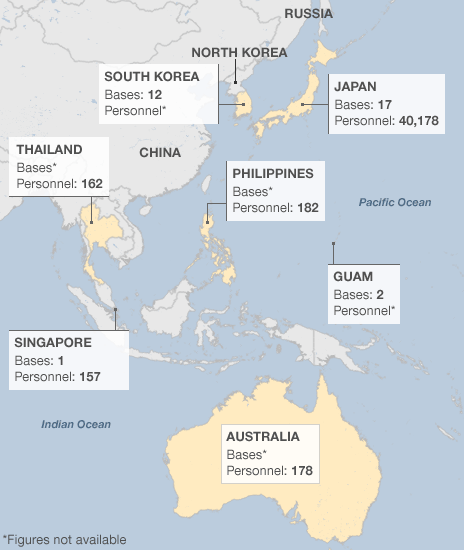
In tandem with the overall surge in military presence throughout Asia-Pacific, the U.S. is refurbishing long-abandoned World War II bases scattered across the Pacificfor potential use in the event of a major conflict with China.
Source: BBC
“As part of the Air-Sea Battle concept,” reports Military.com, the U.S. is looking “to disperse its air forces stationed at its handful of major bases in the western Pacific in the event of a major conflict with China.”
The idea is to have enough U.S. bases peppered throughout the region so that China would be too surrounded to safely attack. “Doing so would make it more difficult for China to wipe out entire squadrons sitting on the ground with surprise attacks from its long range ballistic missiles.”
Last month, U.S. Marines rebuilt and restored the 8,000-foot runway at the abandoned North Field air base on the island of Tinian and subsequently engaged in a military exercise in coordination with nearby U.S. forces based in Guam.
Incidentally, the Tinian airbase is where the B-29s that dropped atomic bombs on Hiroshima and Nagasaki took off from in 1945.
The Obama administration’s so-called Asia pivot is an aggressive policy that involves surging American military presence throughout the region – in the Philippines, Japan, Australia, Guam, South Korea, Singapore, etc. – in an unprovoked scheme to contain rising Chinese economic and military influence.
This antagonistic posture has increased tensions between the U.S. and China as well as China and its weaker neighbors, like the Philippines. And U.S. preparations for a flare up with China are all the more troubling.
A recent report from the Center for Strategic International Studies predicted that next year “could see a shift in Chinese foreign policy based on the new leadership’s judgment that it must respond to a U.S. strategy that seeks to prevent China’s reemergence as a great power.”
“Signs of a potential harsh reaction are already detectable,” the report said. “The U.S. Asia pivot has triggered an outpouring of anti-American sentiment in China that will increase pressure on China’s incoming leadership to stand up to the United States. Nationalistic voices are calling for military countermeasures to the bolstering of America’s military posture in the region and the new U.S. defense strategic guidelines.”
Thursday, May 31, 2012
COIN: Dead Or Alive?

Members of the class of 2013 at the United States Military Academy practice for coming military maneuvers in the field.
Photo credit: Suzanne DeChillo/The New York Times
West Point Is Divided On A War Doctrine’s Fate
By ELISABETH BUMILLER
Published: May 27, 2012
Courtesy Of "The New York Times"
Now at another critical moment in American military history, the faculty here on the commanding bend in the Hudson River is deep in its own existential debate. Narrowly, the argument is whether the counterinsurgency strategy used in Iraq and Afghanistan — the troop-heavy, time-intensive, expensive doctrine of trying to win over the locals by building roads, schools and government — is dead.
Broadly, the question is what the United States gained after a decade in two wars.
“Not much,” Col. Gian P. Gentile, the director of West Point’s military history program and the commander of a combat battalion in Baghdad in 2006, said flatly in an interview last week. “Certainly not worth the effort. In my view.”
The debate at West Point mirrors one under way in the armed forces as a whole as the United States withdraws without clear victory from Afghanistan and as the results in Iraq remain ambiguous at best. (On the ABC News program “This Week” on Sunday, the defense secretary, Leon E. Panetta, called the Taliban “resilient” after 10 and a half years of war.)
But at West Point the debate is personal, and a decade of statistics — more than 6,000 American service members dead in Iraq and Afghanistan and more than $1 trillion spent — hit home.
Many of them are apprehensive about what they will find in Afghanistan — the news coming back from friends is often not good.
At West Point the arguments are more public than those in the upper reaches of the Pentagon, in large part because the military officers on the West Point faculty pride themselves on academic freedom and challenging orthodoxy. Colonel Gentile, who is working on a book titled “Wrong Turn: America’s Deadly Embrace With Counterinsurgency,” is chief among them.
Colonel Gentile’s argument is that the United States pursued a narrow policy goal in Afghanistan — defeating Al Qaeda there and keeping it from using the country as a base — with what he called “a maximalist operational” approach. “Strategy should employ resources of a state to achieve policy aims with the least amount of blood and treasure spent,” he said.
Counterinsurgency could ultimately work in Afghanistan, he said, if the United States were willing to stay there for generations. “I’m talking 70, 80, 90 years,” he said.
Colonel Meese’s opposing argument is that warfare cannot be divorced from its political, economic and psychological dimensions — the view advanced in the bible of counterinsurgents, the U.S. Army/Marine Corps Counterinsurgency Field Manual that was revised under General Petraeus in 2006. Hailed as a new way of warfare (although drawing on counterinsurgencies fought by the United States in Vietnam in the 1960s and the Philippines from 1899 to 1902, among others), the manual promoted the protection of civilian populations, reconstruction and development aid.
“Warfare in a dangerous environment is ultimately a human endeavor, and engaging with the population is something that has to be done in order to try to influence their trajectory,” Colonel Meese said.
Thursday, May 17, 2012
India Fortifies Its Island Defenses

By Sudha Ramachandran
May 8, 2012
Courtesy Of "Asia Times Online"
BANGALORE - The Indian Navy has commissioned a new base, Indian Naval Ship (INS) Dweeprakshak, in the Lakshadweep Islands. Located at Kavaratti, the island chain's capital, Dweeprakshak will provide the navy with a permanent and more robust presence in waters that are threatened by pirates.
The Lakshadweep archipelago (Lakshadweep means a hundred thousand islands in Sanskrit) consists of 36 islands, 12 atolls, three reefs and five submerged banks that are scattered in the southern Arabian Sea, 200-400 kilometers off the southern Indian coastal state of Kerala.
Since 1980, the Indian Navy has operated a detachment in the Lakshadweep Islands. However, in December 2010 a Coast Guard district headquarters was commissioned at Kavaratti and a Coast Guard station was set up at Minicoy. A second Coast Guard station was set up at Androth Island in April this year.
The facilities at Lakshadweep have been scaled up now to a full-fledged naval base.
INS Dweeprakshak is India's sixth naval base and the fourth protecting the country's western flank. It is India's second base in island territories, the other being the base at the Andaman and Nicobar Islands in the Bay of Bengal. Dweeprakshak will come under the Southern Naval Command.
The decision to beef up India's naval muscle at Lakshadweep has its roots in security concerns in the wake of the terrorist attacks in Mumbai in 2008 and the rising threat of pirate attacks in the Arabian Sea in recent years. Lakshadweep's strategic significance stems not only from its proximity to the Indian mainland but also, Nine Degree Channel - a 200-kilometer wide stretch of water through which much of the shipping between West Asia and South East Asia transits runs to the north of Minicoy, the southern-most of the islands.
The magnitude of India's concern over the safety of sea lanes can be gauged from the fact that over 97% percent of India's trade by volume and 75% by value is sea borne. The key role that the Arabian Sea and Indian Ocean play in meeting its India's energy requirements is evident from the fact that 67% of this comes from the Persian Gulf and 17% from Africa.
Although the vulnerability of India's coast to terrorist infiltration and attacks became apparent in the early 1990s - the huge quantity of explosives used in the serial blasts in Mumbai in March 1993 was transported through the sea route - it was only after the terror attacks there in November 2008 that the India establishment began acting to secure the coasts - investigations revealed that Lashkar-e-Toiba operatives from Pakistan entered Mumbai undetected via the Arabian Sea. India has now put in place a maritime defense plan to secure its 7,516-km long coast line, including the island territories of Laskhadweep.
The infrastructure set up in Lakshadweep is essential not only to safeguard the Indian mainland from terrorist attacks but also to prevent terrorists from taking sanctuary on the islands. Of Lakshadweep's 36 islands, 26 are uninhabited. That makes them vulnerable to misuse by terrorists for sanctuary or as training bases. Such anxieties have grown in the wake of the growing religious extremism, reported jihadi activity and political instability in the Maldives, which lie to the south of Lakshadweep.
Besides, there is the threat of piracy to Indian and other shipping near India's waters. Anti-piracy operations by the multi-national task force in the Gulf of Aden created a "balloon effect", which resulted in pirate attacks shifting further afield into the middle of the Indian Ocean, even the seas near the Indian coastline. There have been a series of incidents in recent years involving piracy and trespassing in the vicinity of the Lakshadweep Islands.
In March 2010, for instance, pirates sought to hijack a Maltese ship 200 nautical miles off Lakshadweep Islands in India's exclusive economic zone (EEZ). The attempt was foiled by the Indian Navy.
Then in May, eight Somali pirates were apprehended by the Indian navy off the Lakshadweep Islands. In November, two piracy attempts on container ships were successfully thwarted; one of the incidents happened just 150 nautical miles off Minicoy.
In December, a Bangladesh merchant ship was hijacked by Somalian pirates some 70 nautical miles from the Lakshadweep Islands. The same month an Indian warship on patrol apprehended an Iranian dhow with four Iranians and 15 Pakistanis on board some 300 nautical miles west of Lakshadweep's Bitra Island in India's EEZ. In November last year, a "mysterious" Iranian shipMV Assa that was reportedly armed was docked in the EEZ near Lakshadweep for around 40 days.
Surveillance and patrolling of the seas off the Lakshadweep Islands by the Indian Navy and Coast Guard have resulted in hundreds of pirates being apprehended over the past year. The setting up of a full-fledged naval base at Lakshadweep will substantially enhance India's capacity to ward off threats from pirates and terrorists.
India has deployed a warship in the Gulf of Aden as part of the multi-national anti-piracy force. It has stationed two warships in the central and eastern Arabian Sea "but in a flexible formation for redeployment on an as required basis", India Abroad News Service reported. Such efforts will be further strengthened by the base at Lakshadweep, which will have warships, aircraft and helicopters.
While the naval base will enhance the infrastructure and capacity of the coastal security network, the problems of India's coastal security seem rather basic and cannot be addressed by deploying more warships.
The flaws in the coastal security network were made visible rather dramatically during the turbulent monsoon months last year when unmanned ships slipped past radars and other high-tech "eyes" to drift undetected in Indian waters and ran aground at Mumbai's Juhu beach.
The first incident occurred on 12 June 2011, when a 9,000-ton cargo ship MV Wisdom that was headed to the Alang shipbreaking yard in Gujarat broke tow, and then drifted on to Juhu beach. Then on July 31, the 1,000-ton MV Pavit, which had been abandoned by its crew a month earlier near Oman, ran aground at Juhu beach. The 1,000-ton ship had drifted for over a hundred hours in India's territorial waters and slipped past a three-level coastal security network involving the navy, the coast guard and the coastal police before it crept up on to the beach.
These were not small fishing boats but massive vessels and that they could enter not just Indian waters but also ride right onto the coast undetected is a damning indictment of the coastal security network.
While analysts have focussed on the poor infrastructure in detailing the leaks in the coastal security network, it is the lack of communication and co-ordination between the navy, the coast guard and the coastal police that lies at the heart of its failures.
Consider the response to MV Pavit's advance onto the Indian coast. It appears that the ship was first sighted the previous night by a hotel manager looking at the sea through his binoculars. He alerted a police station at Juhu. A cop went to the beach but couldn't see the vessel. He did not pass on the information anyway to the Coast Guard.
The following morning, fishermen saw the vessel lurching towards the coast. The informed the police station, who again failed to alert the coast guard. When the cops finally informed the coast guard at around 8.30 am, the latter asked for the information to be faxed but the police station was not equipped with a fax machine. By then, MV Pavit had run aground at Juhu beach taking early morning joggers by surprise.
Very basic problems are causing the coastal security network to leak. These are problems that warships cannot fix.
According to Pushpita Das of the Delhi-based Institute for Defense Studies and Analyses, the "problem lies not in the measures adopted but in the inadequate attention paid to the functioning of the system at the ground level where the actual action takes place".
The little "coordination or information sharing" taking place at present between the navy, the coast guard and the coastal police "is largely based on personal rapport between the concerned officers", she observes, calling for the institutionalization of this "rapport".
A new naval base with warships and aircraft is a fine idea for enhancing security in the seas. But there is only so much it can do to secure the coast.
Sudha Ramachandran is an independent journalist/researcher based in Bangalore. She can be reached atsudha98@hotmail.com
(Copyright 2012 Asia Times Online (Holdings) Ltd. All rights reserved.)
Besides, there is the threat of piracy to Indian and other shipping near India's waters. Anti-piracy operations by the multi-national task force in the Gulf of Aden created a "balloon effect", which resulted in pirate attacks shifting further afield into the middle of the Indian Ocean, even the seas near the Indian coastline. There have been a series of incidents in recent years involving piracy and trespassing in the vicinity of the Lakshadweep Islands.
In March 2010, for instance, pirates sought to hijack a Maltese ship 200 nautical miles off Lakshadweep Islands in India's exclusive economic zone (EEZ). The attempt was foiled by the Indian Navy.
Then in May, eight Somali pirates were apprehended by the Indian navy off the Lakshadweep Islands. In November, two piracy attempts on container ships were successfully thwarted; one of the incidents happened just 150 nautical miles off Minicoy.
In December, a Bangladesh merchant ship was hijacked by Somalian pirates some 70 nautical miles from the Lakshadweep Islands. The same month an Indian warship on patrol apprehended an Iranian dhow with four Iranians and 15 Pakistanis on board some 300 nautical miles west of Lakshadweep's Bitra Island in India's EEZ. In November last year, a "mysterious" Iranian shipMV Assa that was reportedly armed was docked in the EEZ near Lakshadweep for around 40 days.
Surveillance and patrolling of the seas off the Lakshadweep Islands by the Indian Navy and Coast Guard have resulted in hundreds of pirates being apprehended over the past year. The setting up of a full-fledged naval base at Lakshadweep will substantially enhance India's capacity to ward off threats from pirates and terrorists.
India has deployed a warship in the Gulf of Aden as part of the multi-national anti-piracy force. It has stationed two warships in the central and eastern Arabian Sea "but in a flexible formation for redeployment on an as required basis", India Abroad News Service reported. Such efforts will be further strengthened by the base at Lakshadweep, which will have warships, aircraft and helicopters.
While the naval base will enhance the infrastructure and capacity of the coastal security network, the problems of India's coastal security seem rather basic and cannot be addressed by deploying more warships.
The flaws in the coastal security network were made visible rather dramatically during the turbulent monsoon months last year when unmanned ships slipped past radars and other high-tech "eyes" to drift undetected in Indian waters and ran aground at Mumbai's Juhu beach.
The first incident occurred on 12 June 2011, when a 9,000-ton cargo ship MV Wisdom that was headed to the Alang shipbreaking yard in Gujarat broke tow, and then drifted on to Juhu beach. Then on July 31, the 1,000-ton MV Pavit, which had been abandoned by its crew a month earlier near Oman, ran aground at Juhu beach. The 1,000-ton ship had drifted for over a hundred hours in India's territorial waters and slipped past a three-level coastal security network involving the navy, the coast guard and the coastal police before it crept up on to the beach.
These were not small fishing boats but massive vessels and that they could enter not just Indian waters but also ride right onto the coast undetected is a damning indictment of the coastal security network.
While analysts have focussed on the poor infrastructure in detailing the leaks in the coastal security network, it is the lack of communication and co-ordination between the navy, the coast guard and the coastal police that lies at the heart of its failures.
Consider the response to MV Pavit's advance onto the Indian coast. It appears that the ship was first sighted the previous night by a hotel manager looking at the sea through his binoculars. He alerted a police station at Juhu. A cop went to the beach but couldn't see the vessel. He did not pass on the information anyway to the Coast Guard.
The following morning, fishermen saw the vessel lurching towards the coast. The informed the police station, who again failed to alert the coast guard. When the cops finally informed the coast guard at around 8.30 am, the latter asked for the information to be faxed but the police station was not equipped with a fax machine. By then, MV Pavit had run aground at Juhu beach taking early morning joggers by surprise.
Very basic problems are causing the coastal security network to leak. These are problems that warships cannot fix.
According to Pushpita Das of the Delhi-based Institute for Defense Studies and Analyses, the "problem lies not in the measures adopted but in the inadequate attention paid to the functioning of the system at the ground level where the actual action takes place".
The little "coordination or information sharing" taking place at present between the navy, the coast guard and the coastal police "is largely based on personal rapport between the concerned officers", she observes, calling for the institutionalization of this "rapport".
A new naval base with warships and aircraft is a fine idea for enhancing security in the seas. But there is only so much it can do to secure the coast.
Sudha Ramachandran is an independent journalist/researcher based in Bangalore. She can be reached atsudha98@hotmail.com
(Copyright 2012 Asia Times Online (Holdings) Ltd. All rights reserved.)
Sunday, January 15, 2012
'New' U.S. Military Focus On Asia Is A Muddle

The aircraft carrier USS Carl Vinson anchors in Hong Kong waters for a routine port call. | AP Photo/Kin Cheung
By Nancy A. Youssef and Tom Lasseter
Posted on Thursday, January 12, 2012
Courtesy Of "McClatchy Newspapers"
WASHINGTON — The Obama administration pledge to shift American military strategy toward Asia overlooks a key fact: The United States never really dropped its focus on the region.
But the current budget proposal that might flow from that pledge contains a potentially crippling contradiction: The plan might cut the big-ticket items the United States needs to increase its presence in Asia and counter China's growing military capability.
The result, some analysts fear, is a muddled approach that could end up with a tough-talking United States saying it will do more in Asia but not committing the resources needed. That, they say, could leave America and its allies in the region exposed if China's military moves aggressively in the future.
An examination of the current U.S. posture in Asia, matched to China's own strategic positioning, underscores just how perplexing, complicated and confused the new U.S. military strategy is.
For instance, American officials talk on the one hand about a growing Chinese threat. On the other hand, however, the United States' own assessments show that China is years away from developing the kinds of weapons that would challenge American dominance in the Pacific.
Less than a week after President Barack Obama's announcement of a fundamental change in American military focus, Adm. Jonathan Greenert, the chief of naval operations, said Tuesday that the new defense strategy would not affect operations in East Asia.
Speaking to security experts and journalists at an event sponsored by the Center for a New American Security, a Washington think tank, Greenert said the Navy would take the strategic guidance just issued and "adjust accordingly." But he said he didn't expect much to change.
"My first assessment is we're in good shape in the Navy where we stand in the western Pacific," Greenert said.
The security challenges in the region are as tangled as they are vast.
At the core of current tensions is the South China Sea, which stretches across more than 1 million square miles and is home to both vital shipping lanes and untapped reserves of oil, gas and minerals. It is also the setting of competing claims between China and several countries, including Vietnam and the Philippines — both of which have drawn closer to the United States.
To the north, there is a lingering dispute between China and Japan, a core American ally, over the Senkaku chain of islands in the East China Sea (China calls the islands the Diaoyu). Nearby, the leadership of South Korea, which hosts a string of U.S. military bases, has expressed dismay that China is unwilling to condemn the erratic behavior of its neighbors in North Korea.
America keeps 28,000 troops in South Korea as well as about 38,000 ashore and 11,000 afloat in Japan.
U.S. alliances in the region have caused some in China, particularly in military circles, to charge that the United States is working to contain China's rise. The phrase harkens back to the Cold War and the globe-as-chessboard strategy of "containment" toward the Soviet Union.
U.S. officials counter that they are only continuing longstanding relationships and hope to forge stronger bonds with China.
Those tensions underline the delicacy of an evolving relationship between two nations that do $450 billion-plus in annual trade but harbor deep suspicions of one another's long-term intentions.
Even as it fought wars in Afghanistan and Iraq, the United States kept nearly half of all U.S. F-22s based in Asia; the jet, known as the Raptor, is among the most advanced stealth fighters in the world.
Two aircraft carriers, which not only provide key air power in the region but are the most powerful way the United States projects its presence anywhere in the world, routinely are posted in Asia or the Pacific.
The United States also has steadily provided weapons to its closest allies, including Taiwan, which China considers part of its territory.
What the U.S. now promises to do, however, is cut weapons systems that some analysts say would be exactly the kinds needed to defend U.S. interests and allies in the event of Chinese military action.
At the Pentagon announcement of the new strategy last week, Defense Secretary Leon Panetta said the department would be spending less on "Cold War-era" programs like nuclear submarines, missile defense and the F-35 Joint Strike Fighter — a stealth fighter jet still in development that, when deployed, would be the most potent tactical aircraft in existence.
Some argue, however, that those are the very sorts of weapons needed to check Chinese military ambitions. Rather than cut those programs, the United States should keep them and add more drones and air power, said Dan Blumenthal, a China expert at the Washington-based American Enterprise Institute, a conservative think tank.
"We are beating our chest about our defense strategy but not resourcing it," Blumenthal said, noting that China has spent on average an increased 10 percent on defense every year for at least 15 years, while U.S. spending in the region has remained stagnant. "It's not cheap, and we have to take the pain of China complaining. But they are complaining anyway."
Critics of increased defense spending in the region note that the U.S. military is far more sophisticated than China's — and will remain so for at least a generation. They argue that after a record 14 consecutive years of increased defense spending, including for the wars in Iraq and Afghanistan, the United States needs to cut back or risk the health of its own economy — all for an unknown threat.
"How much are we going to allow worst-case scenarios to dictate our posture?" asked Christopher Preble, the vice president for defense and foreign policy studies at the Cato Institute, a libertarian research center.
Will Beijing at some point insist on an Asian version of the Monroe Doctrine — the equivalent of the United States' 19th century redline of non-interference in the Americas? Might it in the future want to back up overseas investment in oil and other natural resources with gunboats?
The Pentagon noted in an August 2011 report to Congress that "it is unlikely that China will be able to project and sustain large forces in high-intensity combat operations far from China prior to 2020." For now, China's announced developments in military technology seem focused on what is commonly referred to as "anti-access and area denial" systems, which seek to deter other nations' militaries, such as America's, from entering areas it seeks to control.
The news in 2010 that the DongFeng 21-D anti-aircraft carrier missile system had reached initial operational capacity was widely seen as a step toward limiting the range of U.S. forces and their allies in the South China Sea. Chinese media say the missile is designed to have a range of more than 1,600 miles; a Pentagon assessment pegs its reach at "in excess" of 900 miles.
The same could be said for China's J-20 stealth fighter, which once it is deployed, something the Pentagon does not expect before 2018, would allow the Chinese to more easily strike targets such as regional air bases.
There are also the ongoing sea trials of the Varyag, a Soviet-era aircraft carrier bought and revamped by the Chinese. In itself, the Varyag does not represent any advance in naval technology, and the Chinese military likely faces steep challenges in learning to land jets on its deck. The Pentagon, in its 2011 report on Chinese military capabilities, said that "it will take several years" before China has "a minimal level of combat capability on an aircraft carrier."
Pentagon officials fear the bigger threat will come if China begins to manufacture its own carriers, a development that could one day see China capable of parking its carrier fleet off the shores of weaker nations or discouraging U.S. naval activity.
Beijing has responded to the American presence in the region with a cautious tone folded around a warning: The United States is welcome, but if it goes too far, there will be trouble.
In comments posted to China's Defense Ministry website on Monday, military spokesman Geng Yansheng said, "China's peaceful development presents opportunities rather than challenges for the international community, which also includes the U.S."
Geng added: "We hope that the United States will flow with the tide of the era, and deal with China and the Chinese military in an objective and rational way, will be careful in its words and actions, and do more that is beneficial to the development of relations between the two countries and their militaries and the peace and stability of the region."
Most in the United States believe China in the short term is seeking to establish a "green water" navy capable of exerting considerable influence in the region and curbing international access to Taiwan.
But there is no consensus on what it aspires to beyond that, or even when China can achieve its immediate aims.
China already has a potent mixture of capabilities stacked toward the Taiwan Strait, the epicenter of Beijing's desire to block what it would call American military interference in the region. China asserts that Taiwan is part of its sovereign territory. After Washington approved the sale of more than $6 billion of arms to Taiwan in 2010, Beijing suspended military exchanges that year.
China maintains between 1,000 and 1,200 short-range ballistic missiles, according to the Pentagon. Their estimated ranges could easily put Taiwan in the crosshairs.
The Pentagon report also pointed out, in a table titled "Taiwan Strait Military Balance," that of China's 49 diesel attack submarines — whose small size and ability to operate quietly would make a potent swarm against lumbering aircraft carriers — 33 are based with the country's East and South Sea Fleets. Those two fleets are headquartered to the north and southwest of Taiwan on China's coast.
Chinese officials have said repeatedly that the United States misunderstands its military aims. After growing to the second-largest economy in the world, they say, it's only natural that China would want to update its armed forces for strictly defensive aims.
"I think that America should understand that the rising economic power and rising military power of China contribute to regional stability and peace. ... America and China have common interests in the region," said Su Hao, director of a strategy and conflict management research center at China Foreign Affairs University, which is overseen by the nation's Foreign Affairs Ministry.
But speaking by phone this week, Su said that the United States must give the situation more breathing room.
"The way that America is going about this issue is going to create an escalation in tensions in this region. ... It will encourage countries to be more assertive toward China," he said. "At the moment, I think it will be confined to the diplomatic domain, but if America continues to get involved in a high-profile manner, there will likely be a military confrontation" between China and a neighboring state.
Analysts and officials in Beijing frequently point out that China's official defense budget is less than $100 billion. Even with higher projections from the West — the Pentagon recently put China's military-related spending at more than $160 billion for 2010 — the number is a mere fraction of the $556 billion baseline budget the Pentagon is expected to spend in 2012.
The last time U.S. defense expenditures were as low as China's was 1949, when Pentagon spending, expressed in 2010 dollars, was $163 billion, according to the Project on Defense Alternatives, a think tank in Cambridge, Mass.
China also spends a smaller percentage of its total economic output on defense than does the U.S.: 2 percent of gross domestic product, compared with 3.2 percent for the United States, according to Lawrence Korb, a budget expert at the Washington-based Center for American Progress.
But Pentagon officials argue that such comparisons overlook the rapid increase in China's defense spending, which grew by 54 percent between 2006 and 2010, while U.S. expenditures rose by 24 percent.
That rapid growth is what unnerves U.S. allies in the region.
"We provide a good security blanket, and the Chinese have managed to poke big holes in that security blanket" over the past 20 years as its expanded its defense spending, Blumenthal said. The result, he said, is "diluting U.S. capabilities."
(Youssef reported from Washington, Lasseter reported from Beijing.)
Saturday, April 23, 2011
The New Front Line Of Modern Warfare.

It Takes A Network
BY STANLEY A. MCCHRYSTAL
MARCH/APRIL 2011
Courtesy Of "Foreign Policy Magazine"
From the outset of my command in Afghanistan, two or three times each week, accompanied by a few aides and often my Afghan counterparts, I would leave the International Security Assistance Force headquarters in Kabul and travel across Afghanistan -- from critical cities like Kandahar to the most remote outposts in violent border regions. Ideally, we left early, traveling light and small, normally using a combination of helicopters and fixed-wing aircraft, to meet with Afghans and their leaders and to connect with our troops on the ground: Brits and Marines rolling back the enemy in Helmand, Afghan National Army troops training in Mazar-e-Sharif, French Foreign Legionnaires patrolling in Kapisa.
But I was not alone: There were other combatants circling the battlefield. Mirroring our movements, competing with us, were insurgent leaders. Connected to, and often directly dispatched by, the Taliban's leadership in Pakistan, they moved through the same areas of Afghanistan. They made shows of public support for Taliban shadow governors, motivated tattered ranks, recruited new troops, distributed funds, reviewed tactics, and updated strategy. And when the sky above became too thick with our drones, their leaders used cell phones and the Internet to issue orders and rally their fighters. They aimed to keep dispersed insurgent cells motivated, strategically wired, and continually informed, all without a rigid -- or targetable -- chain of command.
While a deeply flawed insurgent force in many ways, the Taliban is a uniquely 21st-century threat. Enjoying the traditional insurgent advantage of living amid a population closely tied to them by history and culture, they also leverage sophisticated technology that connects remote valleys and severe mountains instantaneously -- and allows them to project their message worldwide, unhindered by time or filters. They are both deeply embedded in Afghanistan's complex society and impressively agile. And just like their allies in al Qaeda, this new Taliban is more network than army, more a community of interest than a corporate structure.
For the U.S. military that I spent my life in, this was not an easy insight to come by. It was only over the course of years, and with considerable frustrations, that we came to understand how the emerging networks of Islamist insurgents and terrorists are fundamentally different from any enemy the United States has previously known or faced.
In bitter, bloody fights in both Afghanistan and Iraq, it became clear to me and to many others that to defeat a networked enemy we had to become a network ourselves. We had to figure out a way to retain our traditional capabilities of professionalism, technology, and, when needed, overwhelming force, while achieving levels of knowledge, speed, precision, and unity of effort that only a network could provide. We needed to orchestrate a nuanced, population-centric campaign that comprised the ability to almost instantaneously swing a devastating hammer blow against an infiltrating insurgent force or wield a deft scalpel to capture or kill an enemy leader.
WHEN I FIRST WENT TO IRAQ in October 2003 to command a U.S. Joint Special Operations Task Force (JSOTF) that had been tailored down to a relatively small size in the months following the initial invasion, we found a growing threat from multiple sources -- but particularly from al Qaeda in Iraq (AQI). We began a review of our enemy, and of ourselves. Neither was easy to understand.
Like all too many military forces in history, we initially saw our enemy as we viewed ourselves. In a small base outside Baghdad, we started to diagram AQI on white dry-erase boards. Composed largely of foreign mujahideen and with an overall allegiance to Osama bin Laden but controlled inside Iraq by the Jordanian Abu Musab al-Zarqawi, AQI was responsible for an extremely violent campaign of attacks on coalition forces, the Iraqi government, and Iraqi Shiites. Its stated aim was to splinter the new Iraq and ultimately establish an Islamic caliphate. By habit, we started mapping the organization in a traditional military structure, with tiers and rows. At the top was Zarqawi, below him a cascade of lieutenants and foot soldiers.
But the closer we looked, the more the model didn't hold. Al Qaeda in Iraq's lieutenants did not wait for memos from their superiors, much less orders from bin Laden. Decisions were not centralized, but were made quickly and communicated laterally across the organization. Zarqawi's fighters were adapted to the areas they haunted, like Fallujah and Qaim in Iraq's western Anbar province, and yet through modern technology were closely linked to the rest of the province and country. Money, propaganda, and information flowed at alarming rates, allowing for powerful, nimble coordination. We would watch their tactics change (from rocket attacks to suicide bombings, for example) nearly simultaneously in disparate cities. It was a deadly choreography achieved with a constantly changing, often unrecognizable structure.
Over time, it became increasingly clear -- often from intercepted communications or the accounts of insurgents we had captured -- that our enemy was a constellation of fighters organized not by rank but on the basis of relationships and acquaintances, reputation and fame. Who became radicalized in the prisons of Egypt? Who trained together in the pre-9/11 camps in Afghanistan? Who is married to whose sister? Who is making a name for himself, and in doing so burnishing the al Qaeda brand?
All this allowed for flexibility and an impressive ability to grow and to sustain losses. The enemy does not convene promotion boards; the network is self-forming. We would watch a young Iraqi set up in a neighborhood and rise swiftly in importance: After achieving some tactical success, he would market himself, make connections, gain followers, and suddenly a new node of the network would be created and absorbed. The network's energy grew.
In warfare, you make decisions based on indicators. When facing the enemy, you estimate its tactical strength and intuit its planned strategy. This is much simpler when the enemy is a column advancing toward you in plain sight. Our problem in both the Iraq of 2003 and the Afghanistan of today is that indicators popped up everywhere, unevenly and unexpectedly, and often disappeared as quickly as they emerged, flickering in view for only a moment.
We realized we had to have the rapid ability to detect nuanced changes, whether the emergence of new personalities and alliances or sudden changes in tactics. And we had to process that new information in real time -- so we could act on it. A stream of hot cinders was falling everywhere around us, and we had to see them, catch those we could, and react instantly to those we had missed that were starting to set the ground on fire.
SHORTLY AFTER TAKING COMMAND of the JSOTF, I visited one of our teams in Mosul, the largest city in northern Iraq, which was at that time under the able command of then-Maj. Gen. David Petraeus and the troops of the 101st Airborne Division. Although Mosul was still less violent than some other areas of the country, it was clear that al Qaeda was organizing to aggressively contest control of the city -- and, from there, all of northern Iraq.
Our special operations force there was small: about 15 men, supported by a single intelligence analyst. They were set up in a corner of a larger base, operating quietly from a modest white trailer. Although they coordinated with the military forces and civilian (particularly intelligence) agencies on the base, operational security procedures and cultural habits limited the true synergy of their effort against AQI and the fight for the city that lay outside the base's gates.
Moreover, the few antennas that adorned the trailer's roof were unable to pump enough classified information between them and our task force headquarters (or other teams in Iraq) with any timeliness. It wasn't a marooned outpost, thanks to the remarkable team that manned the effort. But it felt like one.

That night, on the plane back to Baghdad, I drew an hourglass on a yellow legal pad. The top half of the hourglass represented the team in Mosul; the other represented our task force HQ. They met at just one narrow point. At the top, our team in Mosul was accumulating knowledge and experience, yet lacked both the bandwidth and intelligence manpower to transmit, receive, or digest enough information either to effectively inform, or benefit from, its more robust task force headquarters. All across the country -- in Tikrit, Ramadi, Fallujah, Diyala -- we were waging similarly compartmentalized campaigns. It made our hard fight excruciatingly difficult, and potentially doomed.
The sketch from that evening -- early in a war against an enemy that would only grow more complex, capable, and vicious -- was the first step in what became one of the central missions in our effort: building the network. What was hazy then soon became our mantra: It takes a network to defeat a network.
But fashioning ourselves to counter our enemy's network was easier said than done, especially because it took time to learn what, exactly, made a network different. As we studied, experimented, and adjusted, it became apparent that an effective network involves much more than relaying data. A true network starts with robust communications connectivity, but also leverages physical and cultural proximity, shared purpose, established decision-making processes, personal relationships, and trust. Ultimately, a network is defined by how well it allows its members to see, decide, and effectively act. But transforming a traditional military structure into a truly flexible, empowered network is a difficult process.
Our first attempt at a network was to physically create one. We convinced the agencies partnered with the JSOTF to join us in a big tent at one of our bases so that we could share and process the intelligence in one location. Operators and analysts from multiple units and agencies sat side by side as we sought to fuse our intelligence and operations efforts -- and our cultures -- into a unified effort. This may seem obvious, but at the time it wasn't. Too often, intelligence would travel up the chain in organizational silos -- and return too slowly for those in the fight to take critical action.
It was clear, though, that in this fusion process we had created only a partial network: Each agency or operation had a representative in the tent, but that was not enough. The network needed to expand to include everyone relevant who was operating within the battlespace. Incomplete or unconnected networks can give the illusion of effectiveness, but are like finely crafted gears whose movement drives no other gears.
This insight allowed us to move closer to building a true network by connecting everyone who had a role -- no matter how small, geographically dispersed, or organizationally diverse they might have been -- in a successful counterterrorism operation. We called it, in our shorthand, F3EA: find, fix, finish, exploit, and analyze. The idea was to combine analysts who found the enemy (through intelligence, surveillance, and reconnaissance); drone operators who fixed the target; combat teams who finished the target by capturing or killing him; specialists who exploited the intelligence the raid yielded, such as cell phones, maps, and detainees; and the intelligence analysts who turned this raw information into usable knowledge. By doing this, we speeded up the cycle for a counterterrorism operation, gleaning valuable insights in hours, not days.
But it took a while to get there. The process started as a linear, relatively inefficient chain. Out of habit (and ignorance), each element gave the next group the minimum amount of information needed for it to be able to complete its task. Lacking sufficient shared purpose or situational awareness, each component contributed far less to the outcome than it could or should have.
This made us, in retrospect, painfully slow and uninformed. The linear process created what we called "blinks" -- time delays and missed junctures where information was lost or slowed when filtered down the line. In the early days of the effort, we had multiple experiences where information we captured could not be exploited, analyzed, or reacted to quickly enough -- giving enemy targets time to flee. A blink often meant a missed opportunity in an unforgiving fight.
The key was to reduce the blinks, and we did so by attempting to create a shared consciousness between each level of the counterterrorism teams. We started by sharing information: Video streamed by the drones was sent to all the participants -- not just the reconnaissance and surveillance analysts controlling them. When an operation was set in motion, information was continuously communicated to and from the combat team, so that intelligence specialists miles away could alert the team on the ground about what they could expect to find of value at the scene and where it might be. Intelligence recovered on the spot was instantly pushed digitally from the target to analysts who could translate it into actionable data while the operators would still be clearing rooms and returning fire. This knowledge was immediately cycled back through the loop to our intelligence and surveillance forces following the results of the raid in real time.
The intelligence recovered on one target in, say, Mosul, might allow for another target to be found, fixed upon, and finished in Baghdad, or even Afghanistan. Sometimes, finding just one initial target could lead to remarkable results: The network sometimes completed this cycle three times in a single night in locations hundreds of miles apart -- all from the results of the first operation. As our operations in Iraq and Afghanistan intensified, the number of operations conducted each day increased tenfold, and both our precision and success rate also rose dramatically.
Although we got our message out differently than did our enemies, both organizations increasingly shared basic attributes that define an effective network. Decisions were decentralized and cut laterally across the organization. Traditional institutional boundaries fell away and diverse cultures meshed. The network expanded to include more groups, including unconventional actors. It valued competency above all else -- including rank. It sought a clear and evolving definition of the problem and constantly self-analyzed, revisiting its structure, aims, and processes, as well as those of the enemy. Most importantly, the network continually grew the capacity to inform itself.
From its birth in Iraq, both the actual network -- and the hard-earned appreciation for that organizational model -- increasingly expanded to Afghanistan, especially as our nation's focus turned toward that theater. When I became the commander there, we set about building a robust communications architecture and worked to establish relationships with key actors, moving frequently around the country to instill the shared consciousness and purpose necessary for a networked modern army. But that was only the first part of the task. As we learned to build an effective network, we also learned that leading that network -- a diverse collection of organizations, personalities, and cultures -- is a daunting challenge in itself. That struggle remains a vital, untold chapter of the history of a global conflict that is still under way.
Retired Gen. Stanley A. McChrystal led the Joint Special Operations Command from 2003 to 2008 and served as commander of U.S. and NATO forces in Afghanistan in 2009 and 2010. He is currently writing his memoirs and a senior fellow at Yale University's Jackson Institute for Global Affairs.
Subscribe to:
Posts (Atom)
