Showing posts with label China. Show all posts

Sunday, January 25, 2015

China’s Ban On Islamic Veils Sends Uighurs Westward To Pray

Veils Banned
A veiled Muslim Uyghur woman walks passed a statue of Mao Zedong in Kashgar, Xinjiang Province, China. Last month the Urumqi legislature banned the wearing of veils in public areas. Photographer: Kevin Frayer/Getty Images

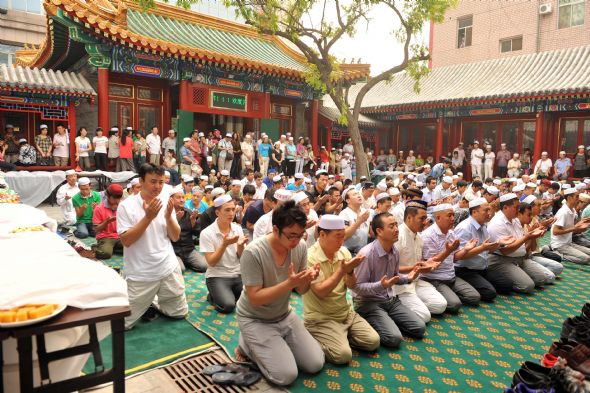
The Imam at one of Almaty’s biggest mosques gets busy around Ramadan when his Uighur “brothers and sisters” from China flock to the Kazakh city to pray, finding it increasingly difficult to practice Islam at home.
As the western Chinese region of Xinjiang grapples with ethnic tensions between Uighurs and Han Chinese, and President Xi Jinping vows to crush separatist activity, more Uighurs are finding a warmer reception about 235 miles (380 kilometers) away. In some parts of Xinjiang, Uighurs risk fines or detention for wearing veils or growing beards and some are warned against observing Ramadan -- Islam’s holiest month.
“Uighur Muslims want their religion and want to practice their religion freely,” Imam Knanat Ali said outside the blue-domed Prophet Muhammad Mosque in the industrial north of Almaty. “In China this is strictly controlled, so we see many Uighurs come here during Ramadan to pray, to fast, to learn more knowledge about Islam,” said Ali, who has presided over the mosque for three years.
The flow of worshippers to Kazakhstan, which has the biggest Uighur population outside Xinjiang, persists even as China is boosting ties with its neighbor, a gateway to the west in Xi’s plan to rebuild the ancient Silk Road route. China has displaced Russia as Kazakhstan’s biggest trading partner -- the two-way relationship accounts for around 70 percent of China’s trade with central Asia, and China is the biggest foreign investor in the country’s oil and gas sector.
China’s crackdown on violence in Xinjiang, which authorities have linked to Islamic extremism and terrorism, is driving Uighurs to come across the long, shared border with Kazakhstan. Uighurs have “quite a balanced position” with other ethnic groups in Kazakhstan, said Konstantin Syroezhkin, chief research fellow of the state-sponsored Kazakhstan Institute for Strategic Studies.

‘Fully Assimilated’

“They’re not restricted here,” Syroezhkin said. “There are around 260,000 Uighurs living in the country and they’re fully assimilated in the Kazakh society. Kazakhstan doesn’t support a policy of ethnic separatism.”
Many Uighurs have family in Xinjiang, the Imam said. There are around 10 million Uighurs in China’s western province, according to the Xinjiang Statistics Bureau. About 1.5 percent of Kazakhstan’s population are Uighurs, a Turkic language-speaking group, and many live in the Almaty area, says London-based Minority Rights Group International.
“We Uighurs are brothers and sisters; we care a lot about what’s happening in Xinjiang,” Ali said. “The Uighur rebellion” in Xinjiang has sprouted because “the Chinese government punishes them for their religion.”

Han Chinese

Uighur communities in Almaty, the former capital of Kazakhstan, live in compact, closely-knit neighborhoods where they have their own cafes, restaurants and mosques. That kinship prompted hundreds to rally in Almaty after riots in Xinjiang’s capital Urumqi in July 2009. The most violent clashes between Uighurs and Han Chinese in decades left nearly 200 dead, most of them Chinese.
Even though about 92 percent of China’s 1.3 billion population is Han, more than 45 percent of Xinjiang’s 22 million people are Uighurs.
Violence picked up in Xinjiang in 2014 and spilled to other Chinese cities such as Kunming and Guangzhou. In November, 15 people, including 11 assailants, were killed after a group hurled explosives at a food court in Kashgar in south Xinjiang. In September, 50 people, including 40 that police identified as rioters, were killed in what authorities called a terrorist attack in Luntai county, while in July, 96 people died in an assault on government offices in Shache county.

‘All Uighurs’

“During the 2009 riots, Uighur prayers here were crying because we all had relatives in Xinjiang,” said a 65-year-old mosque worker known as “Auntie Sonya” who moved to Almaty from Xinjiang in the late 1960s. “We didn’t know who was responsible for this conflict and who was guilty, but we felt for them because all Uighurs are family.”
Last month the Urumqi legislature banned the wearing of veils in public areas. Communist Party members, civil servants, teachers and students are “encouraged” to eat during the day over Ramadan “for the sake of their health, work and study,” state media reports say. Some officials must sign a document pledging not to observe Ramadan, according to the website Uighur Online, whose founder Ilham Tohti is serving life in jail for promoting separatism.
Source: Business Week

Monday, September 29, 2014

Help Obama Kickstart World War 3


Our president can’t launch into another war without you. And remember: when we voted for him in 2008 and 2012, we promised to support him no matter what.
And America is dead-ass broke, so our goal is to raise $1.6 trillion on behalf of the U.S. government.
That’s where you come in.
Even a small donation will make all the difference.
World War III is a very important, very progressive war that Obama tells me is very important. So it must be.
World War III is not going to be like those other Republican wars fought on just 1 percent of the world; this war is going to be fought on 99 percent of the world.
It will be everywhere: Russia, China, Africa, Cincinnati, your favorite brunch spot — the one with those kickass ranchero breakfast burritos.
As an incentive, those pledging $25 a piece of rubble from a war-torn Middle Eastern country, kissed by Sen. Lindsey Graham, while $100 donations gets donors a day pass to leave their local refugee camp.
It’ll be all over Twitter, Facebook, Vine, Pinterest, and whatever eventually replaces Pinterest, and I mean, just think of all the hilarious skits we can make of cats reacting to their owners’ homes being obliterated,” the video says. Lots of shock, but tons of awww.
Ten dollars gets one a “shout out” on social media. In fact, the video promises that World War III will be the most social media-focused war in history.
So please, help us reach our goal of $1.6 trillion so we can make World War III a reality. Why? Because Obama.
Let’s make World War 3 a reality!
By The Second City Network

Sunday, September 21, 2014

The Mystery Of The Cocaine Mummies


Partial Transcript Below: 

In the 21st dynasty of the Pharaos, 3,000 years ago, there took place one night at a temple, the funeral of Henut Taui - the Lady of the Two lands.

Compared to the great rulers of Egypt, her burial was a modest affair. But just like the Pharaos, she too was mummified, and her body placed in the depths of a desert tomb, in the belief it would give her immortality.

German scientist, Dr Svetla Balabanova, made a discovery which was to baffle Egyptologists, and call into question whole areas of science and archeology to chemistry and botany.

She discovered that the body of Henut Taui contained large quantities of cocaine and nicotine. The surprise was not just that the ancient Egyptians had taken drugs, but that these drugs come from tobacco and coca, plants completly unknown outside the Americas, unheard of until Sir Walter Raleigh introduced smoking from the New World, or until cocaine was imported in the Victorian era.

It was seemingly impossible for the ancient Egyptians to get hold of these substances.

For thousands of years people in the Andes have been chewing coca leaves, to get out the cocaine with it's stimulant, anaesthetic and euphoric properties. There are actually species of the coca family which grow in Africa, but only the South American species has ever been shown to contain the drug.

DR SVETLA BALABANOVA - Institute of Forensic Medicine, Ulm: 
"The cocaine of course remains an open question. It's a mystery - it's completely unclear how cocaine could get into Africa. On the other hand, we know there were trade relationships long before Columbus, and it's conceivable that the coca plant had been imported into Egypt even then."

NARRATOR:
Was it possible that coca - a plant from South America had been finding it's way to Egypt 3,000 years ago?

If the cocaine found in mummies could not be explained by contamination, or fake mummies or by Egyptian plants containing it, there appeared to be only one remaining possibility... An international drug trade who's links extended all the way to the Americas.

NARRATOR: 
But on the other side of the Atlantic Ocean, where the moving current of the Gulf Stream arrives in Mexico directly from the west coast of Africa, there is a professionally-employed anthropologist who does seriously beleive in such possibilities.

PROF ALICE KEHOE - Anthropologist, Marquette University: 
"I think there is good evidence that there was both trans-atlantic and trans-pacific travel before Columbus." 

But the idea that the ability of the ancients to cross the oceans might have been underestimated continues to be quietly whispered about. Over the years evidence has grown which suggests it might be time to look again at such voyages. To imagine that the Egyptians, who apparently only sailed up and down the Nile or into the Red Sea, might get as far as the Americas perhaps sounds fantastical. But in science, what is one day thought absurd, can next day become accepted as fact.

[Picture of a Norse settlement in Newfoundland]

One senior academic thinks it's important to remember that before the discovery of this Norse settlement in Newfoundland in 1965 theories about Viking voyages to America were dismissed as nonsense.

PROF MARTIN BERNAL - Historian, Cornell University: 
"What we've seen is a shift from the idea of Viking landings in America being seen as completely fantastic or partisan, to being accepted by every scholar in the field."

NARRATOR: 
The fact that evidence of the Viking crossings was hidden has encouraged Martin Bernal to contemplate even earlier voyages that are likewise dismissed as impossible.

PROF MARTIN BERNAL - Historian, Cornell University: 
"I have no reason to doubt that there were others - but what they were, and how much influence they had on American society is open to question. But that trans-oceanic voyages are possible - or were possible - seems to me to be overwhelmingly likely."

NARRATOR: 
Yet discovery of minute strands of silk found in the hair of a mummy from Luxor could suggest the trade stretching from Egypt to the Pacific. For silk at this time was only known to come from China.

PROF MARTIN BERNAL - Historian, Cornell University: 
"We're getting more and more evidence of world trade at an earlier stage. You have the Chinese silk definitely arriving in Egypt by 1000BC. I think modern scholars have a tendency to believe rigidly in progress and the idea that you could only have a worldwide trading network from the 18th century onwards, is our temporal arrogance - that it's only modern people that can do these things."

NARRATOR: 
The evidence for ancient trade with America is limited, and most of it is disputed, but it can't be completely ruled out as explaining the apparent impossibility of Balabanova's results, results that at first seemed so absurd many thought they would be explained away by a simple story of a botch-up in a lab, results that still without firm explanation continue to crop up in unexpected places.

For in Manchester, the mummies under the care of Rosalie David, the Egyptologist once so sure that Balabanova had made a mistake, produced some odd results of their own.

ROSALIE DAVID - Keeper of Egyptology, Manchester Museum: 
"We've received results back from the tests on our mummy tissue samples and two of the samples and the one hair sample both have evidence of nicotine in them. I'm really very surprised at this."

DR SVETLA BALABANOVA - Institute of Forensic Medicine, Ulm: 
"The results of the tests on the Manchester mummies have made me very happy after all these years of being accuesed of false results and contaminated results, so I was delighted to hear nicotine had been found in these mummies, and very, very happy to have this enormous confirmation of my work."

NARRATOR: 
The tale of Henut Taui shows that in science facts can be rejected if they don't fit with our beleifs while what is believed proven, may actually be uncertain.

Little wonder then, that a story that began with one scientist, a few mummies and some routine tests, in no time at all could upset whole areas of knowledge we thought we could take for granted.

Saturday, July 05, 2014

U.S. Plan For Nuclear First Strike Attack On Russia And China


RT: US revives plans for a nuclear first strike on Russia. Coming up.
Announcer: “Soft assassinations” of anti-NATO leaders.
Star Wars tested for Eastern Europe.
And US space weapons quote an “unofficial declaration of war.”
RT: Secret clauses of NATO membership state, the US can and will depose Europe’s governments on the orders of the White House.
Giuseppe De Lutiis, NATO author: Even if the electorate were to show a different inclination, secret protocols guarantee alignment by any means.
RT: “By any means” means exactly that. Early NATO whistleblower Hans Otto exposed ‘”kill lists” of leading European politicians that defied investigators’ belief, but were subsequently confirmed by police.
Officers found 15 pages of members of the German Communist Party to be assassinated, and 80 pages on Germany’s Social Democrats, one of the two major parties in the country.
The documents state these assassinations would take place “in case of X”. X may refer, writes NATO scholar Dr. Daniele Ganser, to mass protests against a US-backed government, or an election victory of a genuinely left-wing party.
Instructions for such operations were kept at NATO military headquarters south of Brussels.
Der Spiegel reveals a quote “a strictly secured wing of the building. A grey, steel bank vault door prohibits trespassing to the unauthorized.” Papers on NATO operations in Europe are marked “American eyes only.”
When the EU Parliament officially demanded NATO stop these operations, which have become known by the codename Gladio, the US simply ignored it.
Richard Cottrell is a former Member of the European Parliament. NATO tried to ban his investigation Gladio, NATO’s Dagger at the Heart of Europe, which reports both so-called “soft assassinations” – smearing non-aligned EU politicians through mainstream media to make them unelectable – and real assassinations of politicians that still got elected.
Richard joins us, really great to see you, what’s going on?
Richard Cottrell, author of Gladio, NATO’s Dagger at the Heart of Europe: The United States is not prepared to tolerate governments which are unfavorable to the regime. Let’s give the example of Syriza in Greece at the moment, which has just won, come top of the list in the European elections. This is an example of a government which is not going to be tolerated by the United States of America.
RT: You write a prototype “soft assassination”, British Prime Minister Harold Wilson, whose “blasphemy in American eyes” was to “flirt with nuclear disarmament”.
Cottrell: Yes, it’s become a little bit more difficult to, shall we say, use violent means, than it was in the past. So now you’re going to see more of the Harold Wilson tactics. And they will now increase and I will tell you why – because this weekend the European elections were held. And this has resulted in a very large bloc of anti-Europeans, led by the “Penista”, the National Front of France, which has come out on top in the European elections. Nigel Farage, leader of the United Kingdom Independence Party in the UK, who has come from virtually nowhere to become the leader of the third largest party. This will not be allowed to happen, so there will have to be Harold Wilson-type moves now to remove those leaderships, and those parties in those various countries.
RT: NATO is attempting to supersede and actually replace the United Nations, reveals former Assistant General Hans Sponeck.
Its revised doctrine refuses the UN monopoly on the use of force, reports Global Research News.NATO now promotes itself as the military wing of the UN itself.
The doctrine reserves the right to intervene anywhere in the world where there’s “movements of large numbers of persons.” Its newly formed Partners Across The Globe program’s already incorporated Australia, New Zealand, Japan, Pakistan, and Iraq, and leads the occupation of Afghanistan.
With the expected addition of states like Colombia and El Salvador, NATO will be on all six inhabited continents.
Obama’s foreign policy guru, Zbigniew Brzezinski, calls people in countries under US control “vassals,” a medieval term for slaves.
American armed forces are now in over 150 countries. The unofficial figure, including clandestine US forces, is thought to be much higher.
The Pentagon recently formed the United States Africa Command. Since then, NATO’s dispatched the continent’s most developed nation to a “Hobbesian anarchy”, overthrew the Ivory Coast, and chopped Sudan’s oil-rich southern half into a new state, leaving just two and a half countries still outside its military grid.
Leading military analyst, editor of the newslist Stop NATO Rick Rozoff joins us, great to see you. What’ll happen to people when the last countries fall to US control?
Rick Rozoff, Stop NATO newslist: Global enslavement is the answer to that, and we see it manifested for example in ways that may not be immediately obvious, but after certain amount of analysis we can see for example votes that’ve come up in the United Nations General Assembly in the last year and a half, two years, particularly I’m thinking on the question of Syria. We see that the US through a number of factors – economic bribery, diplomatic blackmail, subversion but also through bilateral, multilateral military programs, has been able to secure the overwhelming compliance or servility of other nations. And that’s one of the reasons why there’s no diplomatic and political independence in nations, because they are beholden to the United States and, frankly speaking, they’re fearful of US economic and ultimately military retaliation should they not go along with the US diktat.
Barack Obama: So today, I state clearly, and with conviction, America’s commitment to seek the peace and security of a world without nuclear weapons. I’m not naive.
RT: Obama’s duplicity is perhaps historically unparalleled. As soon as he envisioned a planet without nuclear weapons, he mushroomed nuclear weapons spending to levels above the height of the Cold War.
He has expanded the infamous Bush Doctrine of a nuclear strike against any country, regardless of international law.
“Full spectrum dominance” is the official term used by his administration, meaning “control everything, everywhere on sea, land, air, space, and outer space.” US Space Command documents plan to even “deny other nations the use of space.”
The “one remaining power” with the capacity to stop what the Pentagon calls full spectrum dominance, writes intelligence analyst William Engdahl, is Russia.
By design or coincidence, crisis in Ukraine provided the perfect excuse for US military control of the region.
Ten days ago the administration tested its Star Wars system for Eastern Europe, which will now be rolled out starting in Romania. Obama brands his system the “stronger, smarter and swifter” version of Ronald Reagan’s initial Star Wars program.
Under the plan, the US attacks Russia with nuclear weapons, while NATO missile defense in Eastern Europe mops up any attempted response.
NSNBC News writes “it is most likely and understandable” Russia interprets NATO’s Star Wars deployment on its border as an “unofficial declaration of war.”
Aerospace analysts told Global Research that US Space Command is planning a nuclear first strike on Russia, as well as one on China in 2016.
Bruce Gagnon of the Global Network Against Weapons in Space joins us, thank you very much for coming on, what do we know about the first strike plans?
Bruce Gagnon, Global Network Against Weapons in Space: This is in the planning process today. The US Space Command practicing engaging in a first strike attack and this is the key element here. These are first strike attack planning, these so-called missile defense systems are key elements in US first strike attack planning. The idea is to hit China or Russia first with a first strike, and then when they try to fire their nuclear retaliatory capability, it is then that the so-called missile “defense” systems would be used to pick off any retaliatory strike, so after a first strike sword is thrust into the heart of China or Russia, then the missile defense shield would be used to pick off any retaliation giving the US the a “successful” first strike attack.
It has nothing at all to do with defense, it has nothing to do with freedom or democracy, or any of those words that are used all the time to disguise the true intentions; it’s all about full spectrum dominance.
RT: Several decades ago the first Star Wars initiative faced intense public and industry debate.
Today the US is controlled by just six mainstream media, all totally suborned to the White House. The result is an Orwellian silence on perhaps the most dangerous issue today.
Europeans may decide they want their leaders chosen by NATO, or even that they support nuclear strikes on China and Russia.
Since the US-controlled mainstream’s never even informed the public these apocalyptic plans are on the agenda, the first people may hear of it, would be this. Seek truth from facts. This is The Truthseeker.

Tuesday, June 10, 2014

IMF May Relocate To Beijing In The Future

The International Monetary Fund’s headquarters may one day shift to Beijing from Washington, aligning with China’s growing influence in the world economy, the fund’s managing director said.
Christine Lagarde, speaking late today in London, said IMF rules require the main office be located in the country that is the biggest shareholder, which the U.S. has been since the fund was formed 70 years ago.
The IMF founding members “decided that the institution would be headquartered in the country which had the biggest share of the quota, which chipped in the biggest amount and contributed most. And that is still today the United States,” she said in response to questions at the London School of Economics.
“But the way things are going, I wouldn’t be surprised if one of these days the IMF was headquartered in Beijing for instance,” she said. “It would be the articles of the IMF that would dictate it.”
Lagarde said the IMF has a good relationship with China, the world’s second largest economy and she praised the government’s commitment to fighting corruption.
She had less kind things to say about the U.S., which remains the “outlier” among Group of 20 countries to approve an overhaul of the ownership of the 188-member organization. The plan would give emerging markets more influence and would elevate China to the third-largest member nation.
Lagarde said there is “frustration by countries like China, like Brazil, like India, with the lack of progress in reforming the IMF by adopting the quota reform that would give emerging-market economies a bigger voice, a bigger vote, a bigger share in the institution and I share that frustration immensely.”
“The credibility of the institution, its relevance in the world in conducting the mission that it was assigned 70 years ago is highly correlated with its good representation of the membership,” she said. “We cannot have a good representation of the membership when China has a teeny tiny share of quota, share of voice when it has grown to where it has grown.”

Tuesday, May 13, 2014

China's Hanification Of Xinjiang Is Failing


In the last few decades Beijing's concerted Hanification efforts (i.e., to Sinicize Xinjiang) have only planted unfathomed mistrust and widened the animosity between the Uyghurs and the Han settlers. Tension has led to violence and brutal reprisals.

On Saturday, March 1, more than 10 assailants slashed scores of people with knives at the Kunming train station in Yunnan province in southern China in what state media said Sunday was a terrorist assault by ethnic Uyghur (also spelled as Uighur) separatists from the far west. Twenty-nine slash victims and four attackers were killed and 143 people wounded. 

Most attacks blamed on Uyghur (a Muslim, Turkic-speaking people) separatists take place in China's oil-rich and ethnically sensitive far-western Chinese province of Xinjiang (formerly known as East Turkestan), where clashes between ethnic Uyghurs and members of China's ethnic Han majority are frequent. But Saturday's assault happened more than 1,000 kilometers to the southeast in Yunnan, which has not had a history of such unrest.

In July 2009, Xinjiang experienced violence between Uyghurs and Han Chinese (China's ethno-national majority). Media reported that more than 100 people were killed and 800 injured from the disturbance which broke out in the provincial capital, Urumqi. The disturbances occurred after a year of rising tensions between the dominant Han Chinese authorities and the Uyghur ethnic minority - the historical ethnic majority in Xinjiang - who say they have been socially and economically marginalized by Beijing's policies that introduce 'domestication' - or more properly Hanification (Sinicization) - of the region. 

On August 4, 2008, four days before the start of the Beijing Olympics, two ethnic Uyghurs drove a stolen dump truck into a group of some 70 Chinese border police - accused of brutally repressing the indigenous people - in the town of Kashi in Xinjiang, killing at least 16 of the officers. The attackers carried knives and home-made explosive devices.

In recent months, more than 100 Uyghurs have been shot and killed by armed police officers or soldiers. Exile groups attribute much of the bloodshed to security forces who they say have been given a green light to use excessive force, including against unarmed protesters.

The violence in Kunming came at a sensitive time as political leaders in Beijing prepared for Wednesday's opening of the annual legislature where the government of President Xi Jinping will deliver its first one-year work report. 

Learning the truth about such incidents is difficult. Except for the government version of events, the subject is off limits to the domestic news media. Foreign journalists cannot freely report in the region.

The Saturday's violence, if it is truly done by Uyghur separatists, show that they could be changing tactics and aiming to strike at soft targets elsewhere in China. The use of rudimentary weaponry also shows that such attacks do not appear linked to any global terrorist network.

Ethnic riots do not occur in vacuum. So the questions are what is fueling the separatist movement in Xinjiang, a region which until recently had appeared like a black hole in the Asian landmass? Why have some young Uyghurs, a minority group comprising roughly half the population of Xinjiang province, lost trust in the state and its institutions? What causes have contributed to the anti-Chinese campaign – both violent and non-violent – by young Uyghurs? Has the Uyghur unrest anything to do with radicalization along religious line, the al-Qaeda variety that we have noticed in some parts of the Muslim world in the post-9/11 era?
To understand the reason, the history of the region can be our starting point. Just as Soviet Union had been formed from the heterogeneous territories of the Russian Czarist Empire, what we call People’s Republic of China (PRC) today is similarly inherited lands conquered by the Manchu Qing dynasty before its collapse in 1911. Only in the 1760s the Qing generals were able to conquer East Turkestan incorporating it as Xinjiang (meaning: New Dominion), reflecting the imperial perspective; but their rule was repeatedly broken. They lost the region to Ya’qub Beg (Bek) in the 19th century. General Zou’s re-conquest did not survive the collapse of the imperial court at the beginning of the 20th century, and full control passed on to the Chinese only in 1949.
Despite a harsh landscape and climate, “Xinjiang has a rich past: sand-buried cities, painted cave shrines, rare creatures, and wonderfully preserved mummies of European appearance. Their descendants, the Uyghurs, still farm the tranquil oases that ring the dreaded Taklamakan, the world’s second largest sand desert, and the Kazakh and Kirghiz herdsmen still roam the mountains,” writes Christian Tyler.
The PRC calls it Xinjiang Uyghur Autonomous Region (XUAR) because of its Uyghur population. Mao tried to sell the Marxist-Leninist thought to the ethnic problem. Not only did the CCP (Chinese Communist Party) fail but Mao’s social engineering of the Turkis (Uyghurs) was highly destructive and led to the widespread discrimination and segregation prevalent today. The Communists developed it as a penal colony, as a nuclear testing ground and dumping ground for radioactive wastes (that is responsible for unusually high birth defects and mortality rate amongst the inhabitants) and as a buffer against invasion, and as a supplier of raw materials and living space for an overpopulated country.
Determined to end the push and pull of centuries, Mao’s successors have resorted to Sinicization (i.e., Hanification) of the region. They have changed the demography of the region by settling Han Chinese from other parts. They have curtailed the region’s millennium-plus-years old rich Muslim culture and are practicing widespread religious repression against the ethnic Uyghurs. They have conducted forced abortion on Uyghur women. They have closed down Qur’anic and Uyghur language schools to cut down their Islamic and cultural ties with other Muslims. Because of the Mandarin-based educational policy of the state, the Uyghurs can’t pass and find jobs in their own land. The party-state has institutionalized discrimination based on Uyghur’s distinct religion, habitus, physiognomy, language culture and socioeconomic status. In so doing, they have only widened the gap between the settlers and the indigenous inhabitants.
Consequently, what the PRC sees as its property, the Uyghurs regard as theft by an alien occupier. In its revisionist attempt, the Chinese government has tried to falsify history and portray the Uyghurs as part of the great family of the Chinese nations and asserts that Xinjiang has been an integral part of Chinese national territory since the ancient times. Uyghurs reject such a mischaracterization of both their people and their homeland maintaining that they are a distinct ethnic group with its distinct history, geography, language, culture and tradition. They have neither accepted Chinese occupation nor their incorporation into the Chinese nation-state.
Uyghurs have no political representation in the PRC government. Top CCP party officials at all levels in Xinjiang have been overwhelmingly Han Chinese. The text books present a very slanted history of the region. Recorded expressions of dissent, criticism or discontent are thwarted. All mass media, including electronic, are censored. Every poem, song, short story, essay and novel must pass through a battery of censors before being published, which can be banned later if deemed ‘harmful’ to the state. Uyghur intellectuals face constant surveillance and imprisonment. On January 15 of this year Professor Ilham Tohti, a Uyghur scholar who has taught at Beijing’s Minzu University was taken away by police on unspecified charges. He was one of the few Chinese citizens willing to openly criticize the government policies he said were alienating young Uyghurs:
religious restrictions, education policies that favor Mandarin over the Uyghur language and economic development that disproportionately benefits newly arrived Han migrants. In 2009 Professor Tohti was held for around six weeks without charge during a flare-up of violence in Xinjiang. Last year, he was barred from boarding a plane in Beijing to accept a teaching position at Indiana University in an episode that was criticized by the U.S. government and others.
In the last few decades Beijing’s concerted Hanification efforts (i.e., to Sinicize Xinjiang) have only planted unfathomed mistrust and widened the animosity between the Uyghurs and the Han settlers. Tension has led to violence and brutal reprisals.
The result is further militarization of the Xinjiang region and establishment of aggressive global network against the Uyghur separatists. In the mid-1990s, there were frequent security searches and low-level operations named as the “Strike Hard” campaigns by the Chinese security forces, aiming at arresting known, suspected or potential violent separatists- a pattern that would be repeated well into the next decade. Many of the Uyghurs were caught up in these security campaigns. These operations did not make life easier for many innocent Uyghurs, and instead radicalized them to vent their anger against the Han Chinese settlers. Chinese intelligence agents are also suspected in the mysterious death of many exiled Uyghurs.
In the post-9/11 period, the CCP leadership tried to (1) associate the Uyghur separatist struggle for self-determination as terrorism both to its Chinese people and global audience, and (2) pressure the US to view the movement as an al-Qaeda linked terrorist organization in its global war on terror. It was able to fool some but not all.
In his well-researched book – The Uyghurs: Strangers in Their Own Land – Gardner Bovingdon has shown that Uyghur resistance to Chinese rule is prompted by nationalism and not Islam. China’s Nation-building experiment has succeeded in her core province but not in peripheral regions that were annexed and had very little in common with China.
Simply Put: in spite of decades of programming, China’s nation-building project has miserably failed in China’s far west – Xinjiang and Tibet. As much as the Chinese government is trying to construct its aggressive nation-building the Uyghurs and Tibetans are trying to deconstruct that myth through their resistance movement and in so doing raising new claims of nationhood of their peoples.
Uyghurs will not be satisfied with anything less than a substantial expansion of autonomy in Xinjiang, which allows them to get educated in their own language and find jobs that are meaningful to support their families, and allows them a bigger share of the regional administration and economy. Sadly, China’s leaders show no sign of compromise, and in fact, appear to do just the opposite further marginalizing the Uyghurs in their own land in every respect. This Chinese policy is suicidal and absurd.
The world recognizes that if the people of one nation do not want to co-habit in the same polity because of widespread persecution, repression and discrimination, then partition should not be automatically neglected as a viable solution. This might be one way to manage the Uyghurs’ (who are a nation by any definition) legitimate demands for political space. But the road is still wide open for a political solution: either separation or consociation. The latter can be a good model for China, if the Chinese leadership has the wisdom, sincerity of intent and purpose.
Xinjiang desperately needs inter-ethnic peace because there has already been too much blood shedding. The longer the global community keeps silent on the question of the Uyghurs without adopting any measures to seek justice for them, the stronger the polarizations would happen along ethnic and religious fault-lines, particularly among the poor Uyghurs – who already find them relegated in all aspects, and the nastier may be the consequences for global peace and regional security, because such a global indifference and/or impotence may persuade some Uyghurs to further radicalize along powerful Islamic symbols, further swelling the links, which have hitherto been weak, with transnational Muslim radicals who are not afraid of death.
The Uyghurs currently lack military or organizational resources that would facilitate their legitimate struggles for self-determination. The Chinese control appears complete and has succeeded in denying all those tools and resources to reaching the Uyghur separatists.
They are also trying to strip Uyghurs of rhetorical weapons. Such an all-out policy to squelching dissidence completely may prove imprudent and inane in our time when nationalistic feelings are proving to be important.
Only time would tell how long China’s coercion policy will succeed to stem nationalistic feelings of the Uyghur people. If PRC is serious about nation-building it must change its failed strategy, which relies on strong arm tactics of coercion and not on integration where Uyghurs and other nationalities feel equal and welcome in this multi-national, -religious, -ethnic country that refuses to learn from the Soviet and Balkan experience.
*****
Dr. Siddiqui is an author of 13 books and a human rights and peace activist. Dr. Imtiyaz teaches Chinese politics and ethnic conflict in the Asian Studies/Political Science Department at Temple University, Philadelphia, USA.

Monday, February 17, 2014

Uyghurstan "East Turkestan"


Episode 2 - My Brother Whom I Don't Know

The series is an informative video series on Muslims and the oppressed Muslim minorities from all around the globe. 

Video Series produced by OnIslam.net.
Director: Sarah M. Masry

Thursday, November 28, 2013

China Restricts Islam


With prayers banned in public areas, private hajj trips not allowed, teaching of the Noble Qur'an not allowed in private and students and government officials forced to eat during Ramadan, China is enforcing laws and regulations restricting the practice of Islam.
"Of course this makes people angry," Mohammad, a teacher, told The New York Times on Sunday, October 19.
"Excitable people think the government is wrong in what it does. They say that government officials who are Muslims should also be allowed to pray."
In recent week, Chinese authorities have enforced laws restricting the ability of Muslims in the northwestern region of Xinjiang from practicing their faith.
In Khotan, signs posted in front of the grand mosque say the weekly Friday prayer sermon must not extend beyond than a half-hour.
Prayers in public areas outside the mosque is forbidden and residents are banned from worshipping at mosques outside their town.
Under the rules, imams are banned from teaching the Qur'an in private and only official versions of the Qur'an are allowed.
Studying Arabic is only allowed at special government schools.
Government workers are banned from showing the slightest sign of religious devotion.
For example, a Muslim civil servant could be sacked for donning hijab.
Many of the rules have been on the books for years, but local authorities have publicly highlighted them in recent weeks with banners hanged in towns.
They began posting regulations mandating women not to wear hijab and men to shave their beards.
Uighur Muslims are a Turkish-speaking minority of more than eight million in Xinjiang, a northwest vast area that borders Central Asia.
Atheist China recognizes five religions — Islam, Protestantism, Catholicism, Taoism and Buddhism — and tightly regulates their administration and practice.
Official Hajj
Under the rules, two of Islam's five pillars – the Ramadan fasting and hajj – are strictly controlled.
Students and government workers are compelled to eat during the holy fasting month of Ramadan.
China has also revived a law prohibiting Muslims from arranging their own trips to Saudi Arabia to perform hajj.
Signs painted on mud-brick walls in the winding alleyways of old Kashgar warn against making "illegal" hajj.
"Implement the policy of organized and planned pilgrimage; individual pilgrimage is forbidden," reads a red banner hanging on a large mosque in Urumqi, the regional capital of Xinjiang.
Authorities have also confiscated passports of Uighur Muslims across Xinjiang to force them to join government-run hajj tours rather than their own trips.
Once a person files an application, the authorities do a background check into the family.
If the applicant has children, the children must be old enough to be financially self-sufficient, and the applicant is required to show that he/she has substantial savings in the bank.
To get a passport to go on an official hajj or a business trip, applicants must leave a deposit of nearly $6,000.
Now virtually no Uighurs have passports, though they can apply for them for short trips.
This has made life especially difficult for businessmen who travel to neighboring countries.
Critics say the government is trying to restrict contacts with world Muslims, fearing that could highlight the sufferings of Muslims in Xinjiang and possibly build pressures on China.
[OnIslam.net]

Wednesday, November 27, 2013

China’s Forgotten Muslims

By Azizudin El-Kaissouni

Amnesty International recently issued an extensive report on the policies of the Chinese government towards the Uighur minority in Xinjiang Uighur Autonomous Region (XUAR).1 The 24-page document details the various legislative provisions recently introduced into Chinese law with a view to curbing “terrorist, separatist and illegal religious activities.” Loosely translated, China is attempting to create domestic legal sanctions for the post-September 11th crackdown on Muslims and Islam in XUAR.
By no means is a Chinese crackdown on organized religion unique; China has a long-standing antagonism towards religion, as evidenced by the highly publicized crack down on the Falun Gong sect a few years back, and the ongoing persecution of the Tibetans. However, unlike Falun Gong, Uighurs are not exceptionally popular in the West, and unlike the Buddhists of Tibet, have no charismatic leader in exile or celebrity converts in Hollywood to rally to their cause.
The report, however, is a poignant reminder of a persecuted Muslim community that has been ignored far too long.
China’s New Dominion
A note on names: Xinjiang Uighur Autonomous Region is the name given to Eastern Turkistan by the Chinese government, and is the cause of much resentment; Xinjiang is Chinese for “New Dominion,” or “New Frontier,” a legacy of their former Manchu rulers, who invaded Eastern Turkistan in 1759 and incorporated it into China. The reference, understandably, does not go down well with Uighur nationalists.
One feels the need to stress that, while this article focuses on Eastern Turkistan and the Uighur population thereof, this is in no way meant to denigrate or disregard the suffering of countless other Muslims at the hands of the Chinese government.
Who are the Uighurs?
Uighur girl in Kucha
The Uighurs are not the only Muslims in China; the Hui Muslims are also a recognized minority of several millions, and minorities of Tajiks, Kyrgyz, and Kazakhs are to be found in Xinjiang.2Two percent of China’s population is Muslim; a deceptively small statistic until one realizes the reference is to a country with a population of 1.2 billion, leading to a total of 24 million.3The Uighurs, however, are distinct for various reasons.
Ethnically, the Uighurs are a Turkic people, their language being part of the larger Altaic family. Since their adoption of Islam in the 10th century, during the reign of the Karakhanid kings, the Uighurs used Arabic script until the Chinese forced them to adopt a new Latin-based alphabet. Eventually, the Uighurs were allowed, in one of the Chinese government’s parsimonious concessions to their “national” minorities, to return to their Arabic script in 1983.4
Eastern Turkistan Republics
Military of the Eastern Turkistan Republic (1944-1949)
Historically, the Uighurs have a rich and distinct history, a fact official Chinese propaganda has long sought to bury. The Manchu rule of Eastern Turkistan was violently opposed by the Uighurs until they were successfully expelled in 1862. Independence was short-lived, however, with the Manchu reoccupying the land in 1876, and annexing it proper in 1884. Resistance to Chinese rule continued, regardless of whether the rulers were the Imperial Manchu dynasty or the Kuomintang nationalist government, culminating in the establishment of two republics in the 20th century, one of which was crushed with the assistance of Soviet troops in 1934. The second and more important state was the Eastern Turkistan Republic (ETR) established on November 12th, 1944. Coming under intense pressure from both the Kuomintang and the Communists, the leaders of the ETR accepted an invitation to Beijing for negotiations. Their plane never arrived at Beijing. It was announced months later that it had crashed en route in the Soviet Union. In October of 1949, People’s Liberation Army (PLA) troops marched into the Eastern Turkistan Republic, effectively ending the ETR.
Though lasting only five years before coming under the occupation of Mao Zedong’s PLA troops, the creation of the Republic was an epic moment for the Uighurs, the memory of which is cherished and marked by Uighur nationalists to this day.
Under Communist Rule (1949 - Present)
Mao’s Cultural Revolution was a period of terrible suffering for the Uighurs. Religion was identified as a “bourgeois” conception and therefore bore the brunt of the Red Army’s wrath. A Human Rights Watch report, “Xinjiang, China’s Restive Northwest” tells of how the Uighurs were forced to breed pigs, and mosques were shut down and occasionally used as pork warehouses, to add terrible insult to devastating injury.5
Fast-forward a few decades. An aggressive population transfer policy has seen the rapid growth of the Han community in XUAR, from an original 6% in 1949 to 40% in 1978, and has effectively made the Uighurs second-class citizens in their country, discriminated against in both employment and education.
Animosity is rife between the Uighurs and the Hans; one reporter relates asking a group of Han children gathered near a statue of Chinese revolutionary Wang Zhen why he was considered a hero. The answer: “Because he killed many Uighurs.” Such a response from a ten year old is perhaps somewhat indicative of the feelings of the Han colonialists toward the indigenous Uighurs.
Tensions are also exacerbated by the fact that Han enterprises exercise a monopoly on most of the area’s scarce resources. All this, coupled with the obvious hatred and disdain the Chinese feel towards the Uighurs and their religion, mean that it comes as no surprise that some Uighurs have concluded that armed resistance is the only option available.
Human Rights Abuses
Violent opposition to Chinese rule in East Turkistan is sporadic; occasional bombings or shootings take place and are met with a terrible fury. Every so often, reports are issued about the arrest, trial and execution of “terrorists” or “ethnic splittists” as the Chinese insist on calling them. Even peaceful protests are met with excessive force.
On one notable occasion in 1997, the town of Ghulja was brought to a halt by large-scale Uighur demonstrations in Ramadan; in response, the Chinese government sealed off the town, imposed a press black-out, and proceeded to viciously quell the protests. The official count suggested 10 deaths and 198 injured, and 500 arrests, according to Human Rights Watch. Uighur sources insist the numbers were many times higher. A similar situation occurred in the town of Baren, where an alleged armed insurgency was quelled with military forces, reportedly leaving dozens, if not hundreds dead.
The Human Rights Watch report is also particularly illuminating. The report describes the various forms of repression and persecution suffered by the Muslims of Eastern Turkistan under Chinese rule.
It is particularly painful to hear of the draconian measures utilized by the Chinese to stamp out any manifestations of religious sentiment among the Uighurs in the aftermath of September 11. Examples of this are plentiful in Amnesty International,6Human Rights Watch, and the U.S. Department of State’s reports. These include but are not limited to nighttime patrols of student dormitories to ensure no prayers are taking place, the banning of fasting during Ramadan, outlawing of Qur’an study meetings and religious schools, the curbing of mosque building, the identification and surveillance of religious leaders, and the banning of history books that do not conform to the “accepted” version of history. There is also the ominous-sounding “political education” that Imams are subjected to. One is led to understand this consists of extensive indoctrination to, as it was put, provide them with “a clearer understanding of the Party’s ethnic and religious policies.”
Old Mosque in Urumci
Eastern Turkistan is also home to the Lop Nur desert, the Chinese nuclear test grounds in the south of XUAR.7 China was, relatively speaking, one of the most aggressive states in terms of nuclear weapons acquisition policy, testing its first hydrogen bomb 32 months after its first fission bomb test. The fallout from these tests has resulted in the wide-scale contamination of water sources and land, in turn resulting in a disproportionately large number of cancer cases, congenital birth defects, and various other related diseases among the Uighur population.8
All the above, combined with China’s notoriously repressive birth control policies (including but not limited to forced abortions), would seem to suggest to the observer that Eastern Turkistan is one of the worst places in the world to be a Muslim right now. In the context of the ongoing global war on Islam, that says something.
It is of little surprise that China, like so many other countries, has chosen to take advantage of September 11th to further its own political agenda and silence - ruthlessly so- internal dissent. All recent human rights reports point to a drastic escalation of persecution and repression against the Uighur minority. UN High Commissioner Mary Robinson expressed her concern over the treatment of the Uighurs in a November visit to China. The Chinese government, predictably, responded that “terrorism,” that ephemeral and much-abused term, is an infringement of human rights and is a threat to international peace and security. Case closed.
Forgotten?
The question that inevitably comes to mind upon reading of such terrible persecution is: What can we do about it? Islamically, we are obliged to keep track of conditions of Muslim communities around the globe, particularly when said communities are the target of state-sponsored terror and persecution, numerous as they have become. However, our abilities and efficacy vary substantially depending, sadly enough, on location.
Here in the Arab world, our role is substantially limited by a government blatantly antagonistic to the concept of pan-Islamism or even just plain old concern for fellow Muslims, going so far as to arrest and try people who collect money for Chechnya or similar causes. It also virtually impossible to seek to influence government policy in any sense, due to the autocratic nature of the regimes.
Muslims in most places in the West, on the other hand, have more flexibility with regards to issues of this type. The minimum we can set out to do is seek to be aware of the situation in East Turkistan. Those who can should attempt to raise others’ awareness of the situation by any means possible, whether by a simple talk, or by trying to get something published in a local or campus paper. In this regard, The Uyghur Human Rights Coalition (www.uyghurs.org) has compiled a small, yet comprehensive list on how one can contribute to the support of the Uighurs. While the list is tailored for a Western audience, a number of the suggestions can be undertaken by Muslims anywhere.
In that regard, I would urge readers to explore and bookmark the links in this article, as a gateway to information on the plight of the Uighurs in China.
To conclude, one need not point out that we as Muslims are having our identity systematically erased. One minor way to counter this purposeful erasure is to ensure a consistent and dedicated effort to maintain and cultivate links to and an awareness of the larger community of Muslims around us.
We can longer afford to disregard Islam outside our borders. Where possible, we must aggressively lobby the media and the government to bring these issues to the forefront of domestic and international attention, not so much for the benefit of the Western audience, but rather for the benefit of the uninformed amongst us Muslims. And while it is only natural that the question of Palestine will be more central to many of us, we cannot allow it to completely overshadow the suffering of Muslims elsewhere, who have for years suffered in silence.
1- Amnesty International “China: Extensive crackdown on Uighurs to counter “terrorism” must stop”
2- China’s Official Gateway to News and Information “Ethnic Minorities”
4- Office of the High Commissioner for Human Rights: Universal Declaration of Human Rights (Uighur version)
6- Amnesty International Report 2002 “China”
7- Nuclear Threat Archive “Lop Nur Nuclear Weapons Test Base”
8- Uyghur Human Rights Coalition “China’s Violations of Uyghur Human Rights”