


Showing posts with label Archaeology. Show all posts
Showing posts with label Archaeology. Show all posts
Sunday, September 21, 2014
The Mystery Of The Cocaine Mummies
Partial Transcript Below:
In the 21st dynasty of the Pharaos, 3,000 years ago, there took place one night at a temple, the funeral of Henut Taui - the Lady of the Two lands.
Compared to the great rulers of Egypt, her burial was a modest affair. But just like the Pharaos, she too was mummified, and her body placed in the depths of a desert tomb, in the belief it would give her immortality.
German scientist, Dr Svetla Balabanova, made a discovery which was to baffle Egyptologists, and call into question whole areas of science and archeology to chemistry and botany.
She discovered that the body of Henut Taui contained large quantities of cocaine and nicotine. The surprise was not just that the ancient Egyptians had taken drugs, but that these drugs come from tobacco and coca, plants completly unknown outside the Americas, unheard of until Sir Walter Raleigh introduced smoking from the New World, or until cocaine was imported in the Victorian era.
It was seemingly impossible for the ancient Egyptians to get hold of these substances.
For thousands of years people in the Andes have been chewing coca leaves, to get out the cocaine with it's stimulant, anaesthetic and euphoric properties. There are actually species of the coca family which grow in Africa, but only the South American species has ever been shown to contain the drug.
DR SVETLA BALABANOVA - Institute of Forensic Medicine, Ulm:
"The cocaine of course remains an open question. It's a mystery - it's completely unclear how cocaine could get into Africa. On the other hand, we know there were trade relationships long before Columbus, and it's conceivable that the coca plant had been imported into Egypt even then."
NARRATOR:
Was it possible that coca - a plant from South America had been finding it's way to Egypt 3,000 years ago?
If the cocaine found in mummies could not be explained by contamination, or fake mummies or by Egyptian plants containing it, there appeared to be only one remaining possibility... An international drug trade who's links extended all the way to the Americas.
NARRATOR:
But on the other side of the Atlantic Ocean, where the moving current of the Gulf Stream arrives in Mexico directly from the west coast of Africa, there is a professionally-employed anthropologist who does seriously beleive in such possibilities.
PROF ALICE KEHOE - Anthropologist, Marquette University:
"I think there is good evidence that there was both trans-atlantic and trans-pacific travel before Columbus."
But the idea that the ability of the ancients to cross the oceans might have been underestimated continues to be quietly whispered about. Over the years evidence has grown which suggests it might be time to look again at such voyages. To imagine that the Egyptians, who apparently only sailed up and down the Nile or into the Red Sea, might get as far as the Americas perhaps sounds fantastical. But in science, what is one day thought absurd, can next day become accepted as fact.
[Picture of a Norse settlement in Newfoundland]
One senior academic thinks it's important to remember that before the discovery of this Norse settlement in Newfoundland in 1965 theories about Viking voyages to America were dismissed as nonsense.
PROF MARTIN BERNAL - Historian, Cornell University:
"What we've seen is a shift from the idea of Viking landings in America being seen as completely fantastic or partisan, to being accepted by every scholar in the field."
NARRATOR:
The fact that evidence of the Viking crossings was hidden has encouraged Martin Bernal to contemplate even earlier voyages that are likewise dismissed as impossible.
PROF MARTIN BERNAL - Historian, Cornell University:
"I have no reason to doubt that there were others - but what they were, and how much influence they had on American society is open to question. But that trans-oceanic voyages are possible - or were possible - seems to me to be overwhelmingly likely."
NARRATOR:
Yet discovery of minute strands of silk found in the hair of a mummy from Luxor could suggest the trade stretching from Egypt to the Pacific. For silk at this time was only known to come from China.
PROF MARTIN BERNAL - Historian, Cornell University:
"We're getting more and more evidence of world trade at an earlier stage. You have the Chinese silk definitely arriving in Egypt by 1000BC. I think modern scholars have a tendency to believe rigidly in progress and the idea that you could only have a worldwide trading network from the 18th century onwards, is our temporal arrogance - that it's only modern people that can do these things."
NARRATOR:
The evidence for ancient trade with America is limited, and most of it is disputed, but it can't be completely ruled out as explaining the apparent impossibility of Balabanova's results, results that at first seemed so absurd many thought they would be explained away by a simple story of a botch-up in a lab, results that still without firm explanation continue to crop up in unexpected places.
For in Manchester, the mummies under the care of Rosalie David, the Egyptologist once so sure that Balabanova had made a mistake, produced some odd results of their own.
ROSALIE DAVID - Keeper of Egyptology, Manchester Museum:
"We've received results back from the tests on our mummy tissue samples and two of the samples and the one hair sample both have evidence of nicotine in them. I'm really very surprised at this."
DR SVETLA BALABANOVA - Institute of Forensic Medicine, Ulm:
"The results of the tests on the Manchester mummies have made me very happy after all these years of being accuesed of false results and contaminated results, so I was delighted to hear nicotine had been found in these mummies, and very, very happy to have this enormous confirmation of my work."
NARRATOR:
The tale of Henut Taui shows that in science facts can be rejected if they don't fit with our beleifs while what is believed proven, may actually be uncertain.
Little wonder then, that a story that began with one scientist, a few mummies and some routine tests, in no time at all could upset whole areas of knowledge we thought we could take for granted.


Monday, September 08, 2014
The Dreadnoughtus
A supermassive dinosaur that would have weighed as much as 60 small cars has been found in Argentina, where it likely perished in a bog some 77 million years ago, paleontologists said Thursday, September 4.
Dubbed Dreadnoughtus schrani (the 'Dreadnoughtus' part coming from "fear nothing" in old English), the long-necked lizard would have measured 26 meters (85 feet) from nose to tail and weighed some 60 tons – about as much as seven Tyrannosaurus rex put together.
And the giant wasn't even fully grown when it got bogged down in a flooded plain, where it died next to a smaller companion, researchers reported in the journal Scientific Reports.
"With a body the size of a house, the weight of a herd of elephants, and a weaponized (9-meter, muscled) tail, Dreadnoughtus would have feared nothing," study co-author Kenneth Lacovara of Drexel University in Philadelphia said of the mighty beast.
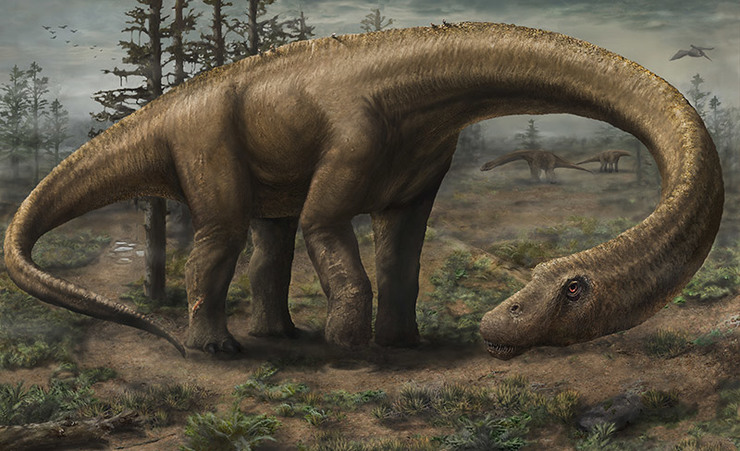
MASSIVE ANIMAL. Rendering of the massive Dreadnoughtus schrani in life. Dreadnoughtus had a 37-foot-long neck, 30-foot tail, and weighed an estimated 65 tons, making it the most massive land animal whose size can be confidently calculated. Illustration by Jennifer Hall/Drexel University
The fossilized skeleton is the most complete yet found in the category of super-sized, plant-eating dinosaurs called Titanosaurs– which makes it the largest land animal for which a weight has been calculated with such a degree of accuracy.
The find comprised over 70% of the types of bones in the dinosaur's body – 45% of its total skeleton. There were no skull bones.
Paleontologists uncovered most of the vertebrae from the lizard's tail, a neck vertebra with a diameter of over one yard (0.9 meters), ribs, toes, a claw, a section of jaw and a tooth, and nearly all the bones from its four limbs, including a humerus (upper arm bone) and a femur (thigh bone) over six feet tall.
The femur and humerus are key to calculating the mass of extinct four-legged animals.
"Because the Dreadnoughtus type specimen includes both these bones, its weight can be estimated with confidence," said a Drexel University statement.
"It is by far the best example we have of any of the most giant creatures to ever walk the planet," added Lacovara, who discovered the skeleton in southern Patagonia in 2005 and oversaw its four-year excavation.
Dino Misfortune, Science's Luck
To sustain its massive bulk, Dreadnoughtus would have had to eat vast quantities of plants growing in the temperate forest on the continent's southern tip.
"I imagine their day consists largely of standing in one place," said Lacovara.
"You have this 37-foot-long (11-meter) neck balanced by a 30-foot-long (9-meter) tail in the back. Without moving your legs, you have access to a giant feeding envelope of trees and green ferns. You spend an hour or so clearing out this patch that has had thousands of calories in it, and then you take three steps over to the right and spend the next hour clearing out that patch."
The dimensions of all previously discovered supermassive dinosaurs had been pieced together from relatively fragmentary fossil remains.
Prior to Dreadnoughtus, another Patagonian giant, Elaltitan, held the title for the dinosaur with the greatest calculable weight, at 43 tons.
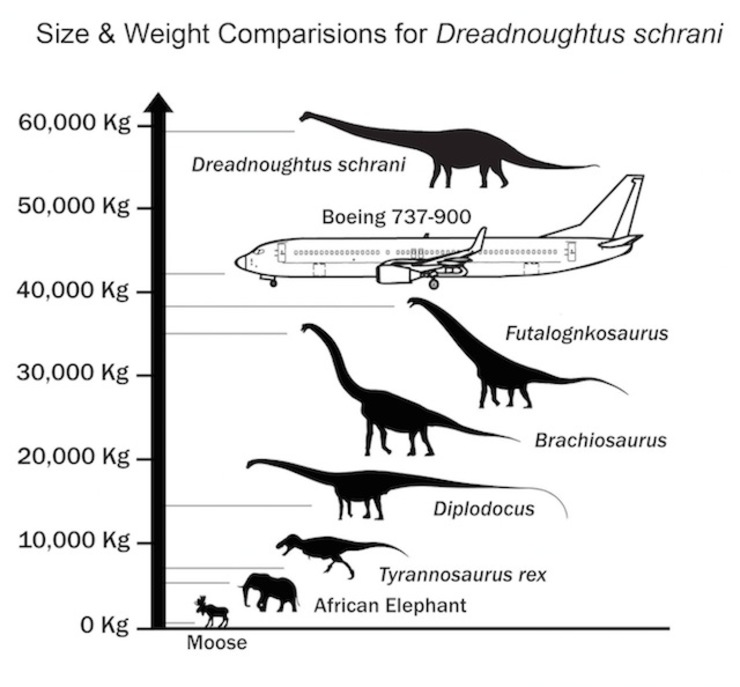
Argentinosaurus, also from Argentina, was thought to be of a comparable or even greater mass than Dreadnoughtus, and longer, at about 37m.
But Argentinosaurus is known only from a half-dozen vertebrae in its mid-back, a shinbone and a few other fragments but no upper limb bones, said the researchers.
An adult Dreadnoughtus would likely have been too large to fear any predators, but would have made a great feast for scavengers after their death, the team added.
They discovered several teeth of small predatory and scavenging dinosaurs at the excavation site, which also included a secondDreadnoughtus skeleton, though smaller and much less complete.
From the preservation of the skeletons, the team concluded theDreadnoughtus pair was buried soon after death, but not before their carnivore cousins took a few bites.
"These two animals were buried quickly after a river flooded and broke through its natural levee, turning the ground into something like quicksand," said Lacovara.
"The rapid and deep burial of the Dreadnoughtus type specimen accounts for its extraordinary completeness.
"It's misfortune was our luck."
Source: Rappler
Saturday, March 30, 2013
Down To The Earth's Core
Down to the Earth's Core takes viewers from the sidewalk to the center of the planet in one epic unbroken shot. Using spectacular computer generated imagery; the camera smashes through almost 9 000 kilos of solid rock to explore the hidden world beneath our feet.
Experience an earthquake inside the San Andreas Fault, blast out of a volcano, encounter bizarre cave-dwelling creatures and enter caves full of giant crystals -- all inside planet Earth.
As the camera lowers into Earth's bosom, the planet's extraordinary story, is laid bare layer by layer, showing how prehistoric forests became modern-day fuel, witnessing the dinosaur's cataclysmic death, and watching as stalactites form and gold grows before our eyes.
Deeper, beyond the reach of any mine, any drill, we find wonders beyond imagination: towering molten metal tornadoes, forests of solid iron crystals, until we reach the strangest, least understood place on the planet -- the core. To infinity and beyond, this is Earth like never before.
Thursday, March 28, 2013
Sunday, February 24, 2013
Eternal Embrace

It could be humanity's oldest story of doomed love.
Archaeologists have unearthed two skeletons from the Neolithic period locked in an eternal embrace and buried outside Mantua, Italy, just 25 miles south of Verona, the city where Shakespeare set the star-crossed tale of Romeo and Juliet.
After being found at the site where a factory is planned, people worldwide have speculated on the circumstances surrounding the couple's deaths.
They are thought to have died young because they both had all their teeth intact. But beyond that, the skeletons are a mystery.
Archaeologists announced Monday that they will move the entire block of earth the skeletons are resting in for further study and eventual display in a museum.
Photo by: NewsCom/Gamma Presse
February 12, 2007 3:14 PM PST
Via: C|Net
Friday, February 22, 2013
The Lovers
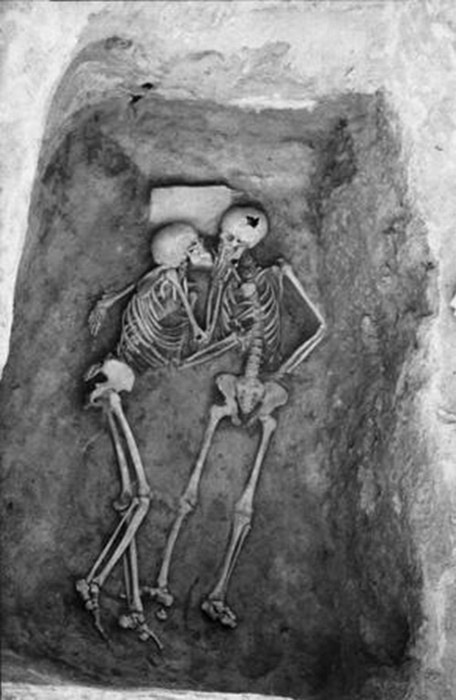
Hasanlu is an archaeological excavation site in Iran, Western Azerbaijan, Solduz Valley.
Theses skeletons were found in a Bin with no objects. The only feature is a stone slab under the head of the skeleton on the left hand side.
From 1972 season at Hasanlu
Via: Penn State University Museum
Thursday, February 14, 2013
Ancient Egyptians Paid Monthly Fee To Be Temple Slaves

Image via: StuffPoint.com
2200 years ago, some Egyptians voluntarily signed up to become temple slaves.
Not only that, they even paid a monthly fee for the “privilege.”
The revelation comes from the work of Egyptologist Kim Ryholt of the University of Copenhagen, who has been studying papyrus slave contracts found in a rubbish dump in the ancient Egyptian temple city of Tebtunis.
“I am your servant from this day onwards, and I shall pay 2½ copper-pieces every month as my slave-fee before Soknebtunis, the great god.”
This is part of the translation of 100 of these papyrus slave contracts that Ryholt has spent years trying to collect and analyse. The documents were scattered in fragments across Egypt, Europe and the US after they were illicitly excavated. In one example, a contract was divided between Copenhagen and the British Museum.
Ryholt is the first to analyze these papyri collectively, publishing his findings in a recent article titled: A Self-Dedication Addressed to Anubis – Divine Protection against Malevolent Forces or Forced Labour?
Among his findings was that these voluntary slaves also signed up their descendants.
“I am your servant with my children and the children of my children,” read the contracts, which were written in Demotic script – an ancient Egyptian language.
While these contracts bound them as slaves, they also protected them from being subject to forced labours such as digging canals and other harsh and often fatal projects. However, as temple slaves, they were mainly engaged in agriculture and were exempt from forced labour.
This loophole for escaping forced labour was likely only open during a 60 year period from around 190 BC to 130 BC, with no other evidence that this practice existed during other periods in ancient Egypt. Ryholt speculates that this is because reigning monarchs could not afford losing too many potential labourers to temples in the long-run.
Via: "Nature"
Monday, February 11, 2013
'T. Rex' Of The Seas

An artist's illustration of the giant ichthyosaur ruled the oceans some 244 million years ago. (Image: Raul Martin/National Geographic Magazine)
The researchers say the 28-foot long predator probably could have tackled victims as large as itself or larger.
Newfound fossils of a giant dolphin-shaped reptilian predator are now shedding light on how the world recovered after the most devastating mass extinction in history, researchers say.
This prehistoric sea monster could provide information on how the planet might deal with the mass extinction humans are causing now, scientists added.
The giant marine predator was at least 28 feet (8.6 meters) long, fossils showed. The carnivore was recovered over a course of three weeks in 2008 from what is today a mountain range in central Nevada, and is now kept at the Field Museum in Chicago.
This new species, formally named Thalattoarchon saurophagis — which means "lizard-eating ruler of the sea" — was an early member of the ichthyosaurs, marine reptiles that evolved from land reptiles just as modern whales did from land mammals. Ichthyosaurs cruised the oceans for 160 million years, apparently going extinct about 90 million years ago, some 25 million years before the age of dinosaurs ended.
"They were the most highly adapted of all marine reptiles, acquiring a fishlike shape and giving birth to live young," said researcher Martin Sander, an evolutionary biologist at the University of Bonn in Germany.
Thalattoarchon possessed a massive skull and jaws armed with large teeth with cutting edges used to seize and slice prey. The researchers say it probably could have tackled victims as large as itself or larger. [See Images of the Prehistoric Sea Monster]
"Our new carnivorous ichthyosaur was a top predator, meaning that it had the same role as killer whales in the sea and Tyrannosaurus or the big cats of today on land," Sander said. "This is the first predator in a long row of predators down to this day. The players have changed, but not the game."
Most of the animal was preserved, including the skull — except the front of the snout — parts of the fins, and the complete vertebral column up to the tip of the tail. The fossil was christened "Jim" after its discoverer, Jim Holstein, of the Field Museum.
The newfound carnivore apparently lived 244 million years ago, just 8 million years before the greatest mass extinction in Earth's history, a die-off at the end of the Permian period that killed as many as 80 to 96 percent of all ocean species. Relatively small species were the main survivors.
"Our 'Jim' was thus the first in a long row of T. rexes of the sea, which is why we named him Thalattoarchon, 'ruler of the seas,'" Sander said.
The fact that a giant predator capable of tackling similarly large prey arose so soon after the end-Permian mass extinction reveals that ecosystems recovered rapidly after the die-off.
"A top predator is a very good indicator that the ecosystem was complete, because if the highest level in the food web is there, the lower levels must have been there as well. Otherwise it won't work," Sander said.
Ichthyosaurs diversified very rapidly. "We hope that by studying this group we can better understand the processes of evolution at the grand scale," researcher Lars Schmitz, an evolutionary biologist at Claremont McKenna College, told LiveScience.
"Ecosystem recovery has been a big topic of research for a while, partially because we as humans are causing one of the biggest extinctions right now," Sander said. "People thus have a keen interest in knowing how long it takes to rebuild things once you have destroyed them."
Thursday, January 17, 2013
The Races Of Ancient America
Courtesy Of "TEDx"
A Racist Paradigm Has Been Created To Push Native Americans Off The Land.
Vieira's research over the last 20 years has led him down a bizarre road of intrigue and mystery surrounding the races and built structures of Ancient America. Vieira has compiled thousands of accounts of giant skeleton reports from the New York Times, Smithsonian Ethnology Reports, American Antiquarian, Scientific American as well as town and county histories to make the case that the history of our past has not only been deliberately covered up, but is vastly different then what we are told.
With passions in writing, researching, ancient stone work, spirituality and metaphysics, Jim is a stone mason and co-owner of North Wind Stonework in Ashfield, Massachusetts, USA doing dry masonry in and around the Berkshire Highlands for 15 years. Jim belongs to the Northeast Antiquities Research Association, a clearinghouse of information regarding mysterious monuments of antiquity. Jim is a regular contributing columnist for the Shelburne Falls & West County Independent and the national publication, Ancient American Magazine.
Monday, December 24, 2012
Art Of The Scribe: Works On Papyrus
By Aakheperure Meret Sekhmet
A selection of my Ancient Egyptian papyrus artwork from my Art of the Scribe Collection (2011-2012) with my original soundtrack.
Pieces featured in this video are available from my Redbubble store: http://bit.ly/GQSbWa
Saturday, December 01, 2012
Egypt's Lost Rival
Courtesy Of "National Geographic's Expedition Week"
The ancient city of Qatna once challenged Egypt’s dominance but was wiped off the face of the earth as it grew too powerful. In 2009, archaeologists revealed their ground breaking discoveries of this lost city.
Egypt’s Lost Rival is the story of Qatna, a city that challenged Egypt’s dominance in the ancient Middle East. Located between the warrior kingdom of the Hittites and the powerful empire of Egypt, this ancient city was wiped off the face of the earth as it grew too powerful - its role in the rise of the Egyptian empire forever lost in desert sands. Like the proverbial “Lost City of Atlantis”, Qatna and its many treasures lay hidden from humanity. Hidden, until now. In ten years of archaeological digs in the Syrian Desert, the lost city of Qatna has been rediscovered and a team of international scientists has excavated its long held secrets. Culminating with a return to Qatna in 2009, Egypt’s Lost Rival chronicles ground breaking archaeological discoveries hidden from the world for millennia.
The ancient city of Qatna once challenged Egypt’s dominance but was wiped off the face of the earth as it grew too powerful. In 2009, archaeologists revealed their ground breaking discoveries of this lost city.
Above info via: NatGeoTV
Qatna (Arabic قطنا, modern Tell el-Mishrife, Arabic المشرفة) is an archaeological site in the Wadi il-Aswad, a tributary of the Orontes, 18 km northeast of Homs, Syria. It consists in a tell occupying 1 km², which makes it one of the largest Bronze Age towns in western Syria. The tell is located at the edge of the limestone-plateau of the Syrian desert towards the fertile Homs-Bassin.
The first finds at Qatna date to the mid- to late 3rd millennium BC, although this early period is not well represented.
The find of a 12th Dynasty Egyptian sphinx belonging to Princess Ita, daughter of Amenemhat II (1875–1840 BC) shows early Egyptian influence, although it is not clear at what time the sphinx got to Qatna (the sphinx was found within the debris of the Late Bronze Age palace).
The first king of Qatna (Qatanum) known by name from the Mari archives is Ishi-Adad ("Haddad" or "Adad is my help"), an Amurru or "Amorite". He was a confederate of Shamshi-Adad of upper Mesopotamia. He was succeeded by his son Amut-pî-el who had been governor of Nazala as crown prince. This was in the time of Hammurabi of Babylon (1792–1750 BC). Beltum, the sister of Amut-pî-el was married to Jasmah-Addu of Mari. Contracts between Mari and Qatna define her as the principal wife of Jasmah-Addu. Her mother might have been Lammassi-Ashur from Assur or Ekallatum. Zimrilim of Mari was married to another princess from Qatna, Dam-hurasim. After the destruction of Mari by Hammurapi, the written sources become sparse. Aleppo (Yamkhad) now became Qatna's most powerful neighbour, during the reign of Jarim–Lim III. Qatna was temporarily dominated by Aleppo.
With the development of the Mitanni empire in upper Mesopotamia, Qatna was incorporated but was located in disputed territory between the Mitanni and Egypt. The inscriptions of the so-called Nin-Egal temple (part of the Royal palace, room C) show that Mittanni were resident in Qatna. The campaigns of Pharaohs Amenhotep I (1515–1494 BC) and Thutmose I (1494–1482 BC) in Syria might have reached Qatna, but there is no conclusive evidence. On the 7th Pylon of the temple of Amun in Karnak, Thutmose III (1479–1425 BC) mentions that he stayed in the land of Qatna in the 33rd year of his reign.[citation needed] Amenhotep II (1427–1401 BC) was attacked by the host of Qatna[citation needed]while crossing the Orontes, but of course he remained victorious and acquired booty, among which the equipment of a Mitanni charioteer is mentioned. Qatna is mentioned[citation needed] in Egyptian topographic lists till the time of Ramesses III (1180 BC). Cuneiform tablets discovered under the Royal palace in Qatna mention a previously unknown king Idanda who ruled ca. 1400 BC.
During the Syrian campaign of the Hittite king Suppiluliuma I (1380–1340 BC), Prince Akizzi of Qatna asked for the help of Akhenaten/Amenhotep IV[citation needed], but as he was only concerned with his monotheistic reform symbolized by his own throne name Akhnaton and his new capital Amarna (abandoned after his death as all reforms were reversed), the town was among several Syrian city-states captured and plundered by the Hittites, the inhabitants deported to Hatti. During this same Amarna letters period, Prince Akizzi wrote 5 letters to Akhenaten. Texts from Emar describe how Qatna was attacked by Aramaic tribes in the late Bronze Age, so the town must still have been in existence.
The tell was settled in Neo-Babylonian times as well (a hilani has been excavated), but the town remained insignificant as nearby Emesa had taken over its position on the trade routes.
Subscribe to:
Posts (Atom)
