


Showing posts with label Marine Life. Show all posts
Showing posts with label Marine Life. Show all posts
Thursday, December 12, 2013
MYSTERY OF THE WHORL TOOTH SHARK
The whorl tooth shark or helicoprion has a spiraling coil of serrated teeth. Placement and function of this bizarre structure has been a mystery to scientists for almost a century.
Ray Troll has been searching for answers for the better of 20 years and much of his art has been inspired by this amazing creature.


Wednesday, December 11, 2013
THRESHER SHARKS KILL PREY WITH TAIL
The thresher shark has evolved a deadly hunting tactic to kill its prey with its tail.
Saturday, November 02, 2013
'Whales' and Dolphins Work Together

False killer whales (Pseudorca Crassidens)
False killer whales and bottlenose dolphins in New Zealand form long-term partnerships that might help them fend off predators or find food, researchers suggest.
Masters student Jochen Zaeschmar, and colleagues, from Massey University's Coastal-Marine Research Group, report their findings in a recent issue of Mammal Review.
"There is a long-term association between, not just the two species, but between actual individuals," says Zaeschmar.
False killer whales (Pseudorca crassidens) are actually a rare type of dolphin that are sometimes found together with bottlenose dolphins (Tursiops truncatus).
But, until now there has been little research to investigate whether this association is just a matter of coincidence, or whether there issomething more to it.
"The first time I ever saw them together I was intrigued straight away because it seemed to be not random," says Zaeschmar. "They were so happy in each others' company. It was almost like it was one species."
False killer whales are three times the volume and two times the length of bottle nose dolphins and are jet black rather than grey.
Fin Identification System
In a study spanning 17 years and 700 kilometres of territory in New Zealand waters, Zaeschmar and colleagues studied the movements of 61 false killer whales and 200 bottle nose dolphins, identifying individual animals by unique markings on their fins.
"There are nicks and notches and cuts in the backs of their fin that they accumulate over time - and they're permanent," says Zaeschmar. "We produced an identification catalogue for each species."
The study was challenging, with researchers having to get up close to take photos of the fins while the animals were moving in the open ocean.
But the findings have been worth the trouble.
"Not only are we seeing the same whales over and over again, but also the same dolphins," says Zaeschmar.
"They basically do everything together. They feed together, they travel together, they rest together. We have not seen any physical state where they have not been together."
The animals also have physical contact and have been known to produce viable hybrids in captivity.
"It's a pretty exciting thing that these relationships last much longer than we thought," says Zaeschmar.
Safety In Numbers
Zaeschmar offers a number of theories as to why this long-term association exists.
One idea is that there is safety in numbers - the more individuals there are in a group, the more eyes there are looking out for predators, and if a predator does come, the less chance there is of any one individual being chosen.
"It's a win-win," says Zaeschmar.
Another idea is that joining forces makes it easier to spot food sources. In the open ocean food can be tricky to find, but is usually in great abundance once it is found, he says.
"There may also be just a strong social component," adds Zaeschmar.
He says the animals have similar vocalisations so it stands to reason they can communicate with each other, and the two have also been known to hybridise in captivity.
But, says Zaeschmar, it is very difficult to test the different hypotheses because the animals are always together.
The study was only able to observe the false killer whales and bottle nose dolphins during the period of December to May, when the animals are assumed to be following warmer currents in search of food.
Zaeschmar says his team has no idea where the animals go during the other months of the year but future studies could use satellite tagging to investigate whether the animals continue to associate with each other during this time.
False killer whales were originally confused with real killer whales in the 1800s because of similarities in their skull structure. The animals also have big teeth like killer whales.
And it is a curious fact that in some parts of the world they sometimes eat other dolphins or whales, says Zaeschmar.
"In New Zealand they obviously have a very different relationship with dolphins, which all adds to the mystery," he says.
Thursday, October 24, 2013
Coming Ashore
Predators are forced to specialize and devise new strategies when they're confined by geography, other species... or changing conditions.
Thursday, August 08, 2013
Speed Kills: Ocean
Courtesy Of The Smithsonian Channel
Dive into the animal kingdom's underwater battlefield, where marlins attack at breakneck speeds, dolphins coordinate complex strikes, and stone Fish hide in plain sight.
Thursday, June 20, 2013
Friday, March 15, 2013
National Geographic Wild Worlds Weirdest Freaks Of Nature
A national geographic documentary on the life of extraordinary species and the way the live and hunt other animals, very thrilling and educational.
Psychiatric Drugs Changing Fish Behavior

Pharmaceuticals Are Reaching Waterways and Affecting The Way Fish Act.
Researchers found that wild European perch exposed to the anxiety-moderating drug oxazepam in an experimental pond in Sweden were less fearful and are more aggressive feeders.
Ecologists worry that such changes in fish behavior could lead to unexpected ecological consequences, including changing the composition of species in waterways and increasing the risk of potentially toxic algal blooms.
"This is only one of hundreds of kinds of [pharmaceutical drugs] that are passed through wastewater plants, and we don't know what their environmental effects will be," said study coauthor Micael Jonsson, an ecologist at Sweden's Umea University.
The new study, detailed in this week's issue of the journal Science, also found that water downstream from sewage treatment plants in Sweden contain concentrations of Oxazepam that experiments have shown are capable of changing fish behavior.
The findings add to a growing body of evidence that pharmaceutical drugs can do more than just poison fish or change their physical characteristics. An earlier study conducted by scientists in Minnesota at St. Cloud State University showed that fathead minnows exposed to various antidepressants in the laboratory were slower at avoiding predators.
This latest study expands the list of mood altering chemicals to a different class of drugs – those used to treat anxiety disorders.
"Before this, people had talked at [scientific] meetings about how you would expect this kind of drug to affect fish behavior, but what these researchers have done is show, very elegantly, how fish behavior has changed, and not just one aspect either, but several aspects," said Patrick Phillips, a hydrologist with the U.S. Geological Survey in Troy, N.Y., who was not involved in the study.
Perch are normally shy and hunt in schools. But Jonsson and his team found that those exposed to Oxazepam were bolder, less interested in hanging out with the group, and more likely to strike out on their own to explore novel, potentially dangerous areas.
"We were actually a bit surprised because [Oxazepam] is supposed have a soothing effect. Humans usually become calmer. But we saw the opposite in fish," Jonsson said.
"When they get exposed to this drug, they lose that inhibition, so they don't care anymore," Jonsson said.
Not only were the medicated perch braver, they also ate faster. In the long term, this combination of fearlessness and a larger appetite could lead to ecological disturbances that are hard to predict, scientists warn. Perch feed on tiny microorganisms called zooplankton, which in turn feed on algae.
"If the zooplankton decrease in number, the algae might increase, and you could have a situation where you have more algal blooms," Jonsson said.
Alternatively, the perch population might actually decrease because drugs have made them foolhardy towards predators. But then again, "we don't know how larger fish will react to this kind of medication," Jonsson said.
There is also worry that some drug effects on wildlife won't be apparent for years or decades.
"We're just beginning to understand what the ultimate consequences may be from these kinds of exposures," said research hydrologist Dana Kolpin, of the USGS Toxics Substances Hydrology Program, who also did not participate in the study.
According to scientists, it's also likely that the ecological changes they worry about are already happening.
"It's not all of a sudden that [medicines] are in the environment," Kolpin said. "There are papers going back to the 1970s that say pharmaceuticals are potential environmental contaminants. We just didn't have the analytical tools until more recently [to prove it]."
"We just do not know enough about aspects such as sensitive populations" – including infants and pregnant women – "or effects from chronic exposures to complex chemical mixtures," Kolpin said.
Via: "Inside Science"
Sunday, March 03, 2013
Dolphins Form Life Raft To Help Dying Friend
Everybody's favourite cetacean just got a little more lovable. For the first time, dolphins have been spotted teaming up to try to rescue an injured group member. The act does not necessarily mean dolphins are selfless or can empathise with the pain of their kin, however.
Kyum Park of the Cetacean Research Institute in Ulsan, South Korea, and colleagues were surveying cetaceans in the Sea of Japan in June 2008. They spent a day following a group of about 400 long-beaked common dolphins (Delphinus capensis).
In the late morning they noticed that about 12 dolphins were swimming very close together. One female was in difficulties: it was wriggling and tipping from side to side, sometimes turning upside-down. Its pectoral flippers seemed to be paralysed.
Life Raft
The other dolphins crowded around it, often diving beneath it and supporting it from below. After about 30 minutes, the dolphins formed into an impromptu raft: they swam side by side with the injured female on their backs. By keeping the injured female above water, they may have helped it to breathe, avoiding drowning (see video, above).
After another few minutes some of the helper dolphins left. The injured dolphin soon dropped into a vertical position. The remaining helpers appeared to try and prop it up, possibly to keep its head above the surface, but it soon stopped breathing, say the researchers. Five dolphins stayed with it and continued touching its body, until it sank out of sight.
"It does look like quite a sophisticated way of keeping the companion up in the water," says Karen McComb at the University of Sussex in Brighton, UK. Such helping behaviours are only seen in intelligent, long-lived social animals. In most species, injured animals are quickly left behind.
animals. In most species, injured animals are quickly left behind.For The Love Of Pod
While it may seem selfless to help an injured fellow, McComb says the helper dolphins might get some benefit. Rescuing the struggling dolphin could help maintain their group, and thus control of their territory. Furthermore, if the group contains close relatives, protecting those relatives helps the dolphins preserve their shared genes.
The simple act of working together could also bond the group more strongly. "It makes a lot of sense in a highly intelligent and social animal for there to be support of an injured animal," McComb says.
The act of helping also seems to suggest that the dolphins understand when others are suffering, and can even empathise: that is, imagine themselves in the place of the suffering dolphin. But while this is possible, McComb says the helping behaviour could evolve without the need for empathy.
There have been reports of single dolphins helping others, generally mothers helping their calves, but no cases of groups of dolphins working together to help another. Dolphins have also been seen interacting with the corpses of dead dolphins, which some researchers interpret as a form of mourning.
Via: "New Scientist"
Monday, February 11, 2013
'T. Rex' Of The Seas

An artist's illustration of the giant ichthyosaur ruled the oceans some 244 million years ago. (Image: Raul Martin/National Geographic Magazine)
The researchers say the 28-foot long predator probably could have tackled victims as large as itself or larger.
Newfound fossils of a giant dolphin-shaped reptilian predator are now shedding light on how the world recovered after the most devastating mass extinction in history, researchers say.
This prehistoric sea monster could provide information on how the planet might deal with the mass extinction humans are causing now, scientists added.
The giant marine predator was at least 28 feet (8.6 meters) long, fossils showed. The carnivore was recovered over a course of three weeks in 2008 from what is today a mountain range in central Nevada, and is now kept at the Field Museum in Chicago.
This new species, formally named Thalattoarchon saurophagis — which means "lizard-eating ruler of the sea" — was an early member of the ichthyosaurs, marine reptiles that evolved from land reptiles just as modern whales did from land mammals. Ichthyosaurs cruised the oceans for 160 million years, apparently going extinct about 90 million years ago, some 25 million years before the age of dinosaurs ended.
"They were the most highly adapted of all marine reptiles, acquiring a fishlike shape and giving birth to live young," said researcher Martin Sander, an evolutionary biologist at the University of Bonn in Germany.
Thalattoarchon possessed a massive skull and jaws armed with large teeth with cutting edges used to seize and slice prey. The researchers say it probably could have tackled victims as large as itself or larger. [See Images of the Prehistoric Sea Monster]
"Our new carnivorous ichthyosaur was a top predator, meaning that it had the same role as killer whales in the sea and Tyrannosaurus or the big cats of today on land," Sander said. "This is the first predator in a long row of predators down to this day. The players have changed, but not the game."
Most of the animal was preserved, including the skull — except the front of the snout — parts of the fins, and the complete vertebral column up to the tip of the tail. The fossil was christened "Jim" after its discoverer, Jim Holstein, of the Field Museum.
The newfound carnivore apparently lived 244 million years ago, just 8 million years before the greatest mass extinction in Earth's history, a die-off at the end of the Permian period that killed as many as 80 to 96 percent of all ocean species. Relatively small species were the main survivors.
"Our 'Jim' was thus the first in a long row of T. rexes of the sea, which is why we named him Thalattoarchon, 'ruler of the seas,'" Sander said.
The fact that a giant predator capable of tackling similarly large prey arose so soon after the end-Permian mass extinction reveals that ecosystems recovered rapidly after the die-off.
"A top predator is a very good indicator that the ecosystem was complete, because if the highest level in the food web is there, the lower levels must have been there as well. Otherwise it won't work," Sander said.
Ichthyosaurs diversified very rapidly. "We hope that by studying this group we can better understand the processes of evolution at the grand scale," researcher Lars Schmitz, an evolutionary biologist at Claremont McKenna College, told LiveScience.
"Ecosystem recovery has been a big topic of research for a while, partially because we as humans are causing one of the biggest extinctions right now," Sander said. "People thus have a keen interest in knowing how long it takes to rebuild things once you have destroyed them."
Sunday, February 10, 2013
Giant Squid Filmed In Pacific Depths
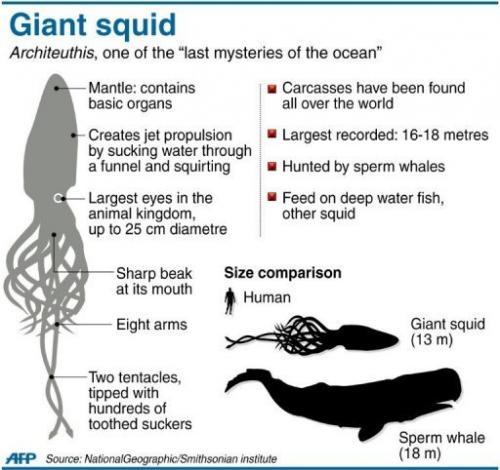
Japan's National Science Museum succeeded in filming the deep-sea creature at a depth of more than half a kilometre (a third of a mile) after teaming up with Japanese public broadcaster NHK and the US Discovery Channel.
The creature is thought to be the genesis of the Nordic legend of Kraken, a sea monster believed to have attacked ships in waters off Scandinavia over the last millennium.
Modern-day scientists on their own Moby Dick-style search used a submersible to descend to the dark and cold depths of the northern Pacific Ocean, where at around 630 metres (2,066 feet) they managed to film a three-metre specimen.
After around 100 missions, during which they spent 400 hours in the cramped submarine, the three-man crew tracked the creature from a spot some 15 kilometres (nine miles) east of Chichi island in the north Pacific.
Museum researcher Tsunemi Kubodera said they followed the enormous mollusc to a depth of 900 metres as it swam into the ocean abyss.

NHK showed footage of the silver-coloured creature, which had huge black eyes, as it swam against the current, holding a bait squid in its arms.
Kubodera said the creature had its two longest arms missing, and estimated it would have been eight metres long if it had been whole. He gave no explanation for its missing arms.
He said it was the first video footage of a live giant squid in its natural habitat—the depths of the sea where there is little oxygen and the weight of the water above exerts enormous pressure.
"Researchers around the world have tried to film giant squid in their natural habitats, but all attempts were in vain before," Kubodera said.
Kubodera said the two successful sightings of the squid—in 2012 and 2006—were both in the same area, some 1,000 kilometres south of Tokyo, suggesting it could be a major habitat for the species.
The giant squid, "Architeuthis" to scientists, is sometimes described as one of the last mysteries of the ocean, being part of a world so hostile to humans that it has been little explored.
Researchers say Architeuthis eats other types of squid and grenadier, a species of fish that lives in the deep ocean. They say it can grow to be longer than 10 metres.
Via: "Phys"
Friday, February 08, 2013
Whales Give Dolphins A Lift
Many species interact in the wild, most often as predator and prey. But recent encounters between humpback whales and bottlenose dolphins reveal a playful side to interspecies interaction.
In two different locations in Hawaii, scientists watched as dolphins "rode" the heads of whales: the whales lifted the dolphins up and out of the water, and then the dolphins slid back down.
The two species seemed to cooperate in the activity, and neither displayed signs of aggression or distress.
Whales and dolphins in Hawaiian waters often interact, but playful social activity such as this is extremely rare between species.
The latest Bio Bulletin from the Museum's Science Bulletins program presents the first recorded examples of this type of behavior. Visitors to AMNH may view the video in the Hall of Biodiversity until February 9, 2012.
Science Bulletins is a production of the National Center for Science Literacy, Education, and Technology (NCSLET), part of the Department of Education at the American Museum of Natural History.
Find out more about Science Bulletins athttp://www.amnh.org/sciencebulletins/.
Sunday, January 13, 2013
Found: Pygmy Whale Thought Extinct For 2 Million Years

The pygmy whale, a mysterious cetacean that looks radically different from all living whales, is actually the last living member of a group thought to have gone extinct 2 million years ago.
The pygmy right whale, a mysterious and elusive creature that rarely comes to shore, is the last living relative of an ancient group of whales long believed to be extinct, a new study suggests.
The findings, published Tuesday in the Proceedings of the Royal Society B, may help to explain why the enigmatic marine mammals look so different from any other living whale.
"The living pygmy right whale is, if you like, a remnant, almost like a living fossil," said Felix Marx, a paleontologist at the University of Otago in New Zealand. "It's the last survivor of quite an ancient lineage that until now no one thought was around."
of Otago in New Zealand. "It's the last survivor of quite an ancient lineage that until now no one thought was around."
The relatively diminutive pygmy right whale, which grows to just 21 feet long, lives out in the open ocean. The elusive marine mammals inhabit the Southern Hemisphere and have only been spotted at sea a few dozen times. As a result, scientists know almost nothing about the species' habits or social structure.
The strange creature's arched, frownlike snout makes it look oddly different from other living whales. DNA analysis suggested pygmy right whales diverged from modern baleen whales such as the blue whale and the humpback whale between 17 million and 25 million years ago. However, the pygmy whales' snouts suggested they were more closely related to the family of whales that includes the bowhead whale. Yet there were no studies of fossils showing how the pygmy whale had evolved, Marx said.
To understand how the pygmy whale fit into the lineage of whales, Marx and his colleagues carefully analyzed the skull bones and other fossil fragments from pygmy right whales and several other ancient cetaceans.
The pygmy whale's skull most closely resembled that of an ancient family of whales called cetotheres that were thought to have gone extinct around 2 million years ago, the researchers found. Cetotheres emerged about 15 million years ago and once occupied oceans across the globe.
The findings help explain how pygmy whales evolved and may also help shed light on how these ancient "lost" whales lived. The new information is also a first step in reconstructing the ancient lineage all the way back to the point when all members of this group first diverged, he said.
Via: "MSNBC"
Saturday, October 13, 2012
When Killer Whales Attack
This fascinating documentary on Orcas show that they:
- Assess situations, workout a plan then execute it with perfection.
- Communicate and coordinate in the hunt.
- Outhink and outlast a prey during the hunt.
- Each pod has unique hunting techniques, depending on the region and prey.
- Share their wisdom with one another.
- Adapt and evolve.
Subscribe to:
Posts (Atom)
