Showing posts with label Sharks. Show all posts

Monday, June 16, 2014

'Super Predator' Devoures Great White Shark


A team of Australian researchers are attempting to hunt down the mystery 'sea monster' that “savagely devoured” a nine-foot-long Great White Shark.


The incident came to light four months after the researchers tagged the animal as part of Australia’s first large scale great white shark tagging project to study their movement patterns along the coast.

The device was discovered when it washed ashore 2.5 miles from where the creature was initially tagged.

Data from the device showed the healthy female shark suddenly plunged at high speed to a depth of 1,900-foot, (580 metres) beneath the surface.  

The tag recorded a dramatic temperature shift from 7°C to 25°C, suggesting the tag was inside the stomach of another animal as it ate the shark.

"When I was first told about the data that came back from the tag that was on the shark, I was absolutely blown away," filmmaker David Riggs said.

"The question that not only came to my mind but everyone's mind who was involved was, 'What did that?' It was obviously eaten. What's going to eat a shark that big? What could kill a 3-meter (9-foot) great white?"

Sunday, June 15, 2014

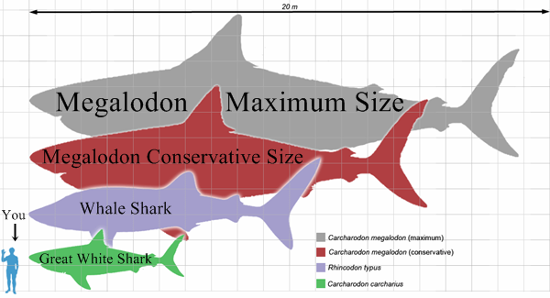
The Nightmarish Megalodon


Megalodon (/ˈmɛɡələdɒn/ meg-ə-lə-don; meaning "big tooth", from Ancient Greekμέγας (megas) “big, mighty” + ὀδόν(odon) (from ὀδούς (odous) "tooth"),[1] is an extinct species of shark that lived approximately 28 to 1.5 million years ago, during the Cenozoic Era (late Oligocene to early Pleistocene).

The taxonomic assignment of C. megalodon has been debated for nearly a century, and is still under dispute. The two major interpretations are Carcharodon megalodon (under family Lamnidae) or Carcharocles megalodon (under familyOtodontidae). Consequently, the scientific name of this species is commonly abbreviated C. megalodon in the literature.


C. megalodon is regarded as one of the largest and most powerful predators in vertebrate history, and likely had a profound impact on the structure of marine communities. Fossil remains suggest that this giant shark reached a maximum length of 14–18 metres (46–59 ft), and also affirm that it had a cosmopolitan distribution. Scientists suggest that C. megalodon looked like a stockier version of the great white shark, Carcharodon carcharias.


Thursday, December 12, 2013

MYSTERY OF THE WHORL TOOTH SHARK


The whorl tooth shark or helicoprion has a spiraling coil of serrated teeth. Placement and function of this bizarre structure has been a mystery to scientists for almost a century. 

Ray Troll has been searching for answers for the better of 20 years and much of his art has been inspired by this amazing creature.

Wednesday, December 11, 2013

THRESHER SHARKS KILL PREY WITH TAIL


The thresher shark has evolved a deadly hunting tactic to kill its prey with its tail. 

Saturday, April 13, 2013

Last Shark Standing


Shark Cannibalism and Early Life


Ovoviviparous shark pups depend on yolk for nutrition, and when an embryo has expended its own yolk sac, it turns to the eggs around it. Some species practice intrauterine cannibalism, or eating the other fertilized or unfertilized eggs in the womb.
The best-known intrauterine cannibal is the sand tiger shark. Although the sand tiger shark has two uteri and produces many eggs, each litter yields just two pups -- one from each uterus. That's because as the sharks develop their embryonic teeth, they start to eat the other embryos, killing their unborn brothers and sisters, as well as the unfertilized eggs. It's survival of the fittest in the womb, until only one shark remains. Because of their pre-birth diet, sand tiger pups enter the world bigger than other pups; they measure approximately three feet (one meter) long [source: National Aquarium].
The sand tiger's cannibalism is known as adelphophagy, which literally means "eating one's brother" [source: Martin]. But other sharks practice cannibalism as well, albeit in a slightly more subdued form known as oophagy, which is the eating of eggs that haven't been fertilized. Approximately 14 species of sharks are thought to practice some form of intrauterine cannibalism [source: Martin].
Frank Greenaway/Dorling Kindersley/Getty Images
The swell shark as an embryo...and as a two-month-old pup.­
The number of shark pups in a litter varies among species; the sand tiger shark gives birth to one or two, while the viviparous blue shark has been known to give birth to 134 pups in one litter [source: Cooper]. The whale shark has given birth to 300, but such high numbers are rare [sources: ConrathGreven]. But whether hatched from an egg or born live, shark pups emerge as miniature versions of the sharks they will become.
Shark pups are also very independent, and those that are born live swim away from their mothers as soon as they're born, perhaps to avoid being eaten. Even the tiniest sharks face the world on their own. Shark pups don't receive any further nourishment or support from their parents. It's up to the pup to find food and evade predators.
A shark pup's success in life is largely determined by its size at birth and whether the female shark has used a nursery area, or a shallow part of the sea with fewer predators than the open sea. Some shark species grow very slowly, putting them in danger of being eaten by bigger sharks for longer. If few pups survive to maturity and reproduce themselves, shark species could be in danger, particularly those subject to other pressures, such as fishing.
Source: Discovery

Thursday, March 29, 2012

Tonic Immobility

Posted by "CavalierZee"


Tonic immobility is a natural state of paralysis that animals enter, in most cases when presented with a threat. Some scientists relate it to mating in certain animals like the shark.

Some sharks can be placed in a tonic state. The shark remains in this state of paralysis for an average of fifteen minutes before it recovers. Scientists have exploited this phenomenon to study shark behaviour. 

The effects of chemical shark repellent have been studied to test effectiveness and to narrow down dose sizes, concentrations, and time to awaken.

Sharks may not always respond to tonic immobility by physical inversion of the animal, as has been demonstrated with lemon and Reef sharks. 

With tiger sharks 3–4 metres (10 to 15 feet) in length, tonic immobility may be achieved by placing hands lightly on the sides of the animal's snout approximate to the general area surrounding its eyes. 

Great White sharks have been shown to be not as responsive as other species whenever tonic immobility has been attempted. Scientists believe that tonic immobility, displayed by sharks, may be linked with defense, because female sharks seem more responsive than others. 

During tonic immobility, the dorsal fin(s) straighten, and both breathing and muscle contractions become more steady and relaxed. [WikiPedia]