Showing posts with label Super Predator. Show all posts

Monday, June 16, 2014

'Super Predator' Devoures Great White Shark


A team of Australian researchers are attempting to hunt down the mystery 'sea monster' that “savagely devoured” a nine-foot-long Great White Shark.


The incident came to light four months after the researchers tagged the animal as part of Australia’s first large scale great white shark tagging project to study their movement patterns along the coast.

The device was discovered when it washed ashore 2.5 miles from where the creature was initially tagged.

Data from the device showed the healthy female shark suddenly plunged at high speed to a depth of 1,900-foot, (580 metres) beneath the surface.  

The tag recorded a dramatic temperature shift from 7°C to 25°C, suggesting the tag was inside the stomach of another animal as it ate the shark.

"When I was first told about the data that came back from the tag that was on the shark, I was absolutely blown away," filmmaker David Riggs said.

"The question that not only came to my mind but everyone's mind who was involved was, 'What did that?' It was obviously eaten. What's going to eat a shark that big? What could kill a 3-meter (9-foot) great white?"

Sunday, June 15, 2014

The Nightmarish Megalodon


Megalodon (/ˈmɛɡələdɒn/ meg-ə-lə-don; meaning "big tooth", from Ancient Greekμέγας (megas) “big, mighty” + ὀδόν(odon) (from ὀδούς (odous) "tooth"),[1] is an extinct species of shark that lived approximately 28 to 1.5 million years ago, during the Cenozoic Era (late Oligocene to early Pleistocene).

The taxonomic assignment of C. megalodon has been debated for nearly a century, and is still under dispute. The two major interpretations are Carcharodon megalodon (under family Lamnidae) or Carcharocles megalodon (under familyOtodontidae). Consequently, the scientific name of this species is commonly abbreviated C. megalodon in the literature.


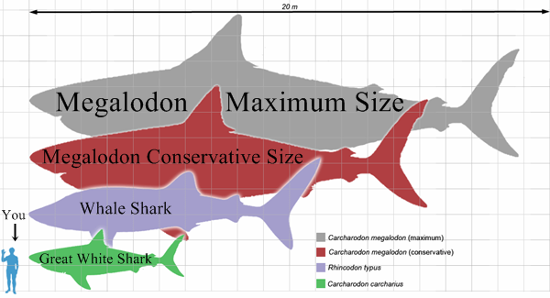
C. megalodon is regarded as one of the largest and most powerful predators in vertebrate history, and likely had a profound impact on the structure of marine communities. Fossil remains suggest that this giant shark reached a maximum length of 14–18 metres (46–59 ft), and also affirm that it had a cosmopolitan distribution. Scientists suggest that C. megalodon looked like a stockier version of the great white shark, Carcharodon carcharias.