Showing posts with label Discovery. Show all posts

Monday, September 08, 2014

The Dreadnoughtus


A supermassive dinosaur that would have weighed as much as 60 small cars has been found in Argentina, where it likely perished in a bog some 77 million years ago, paleontologists said Thursday, September 4.
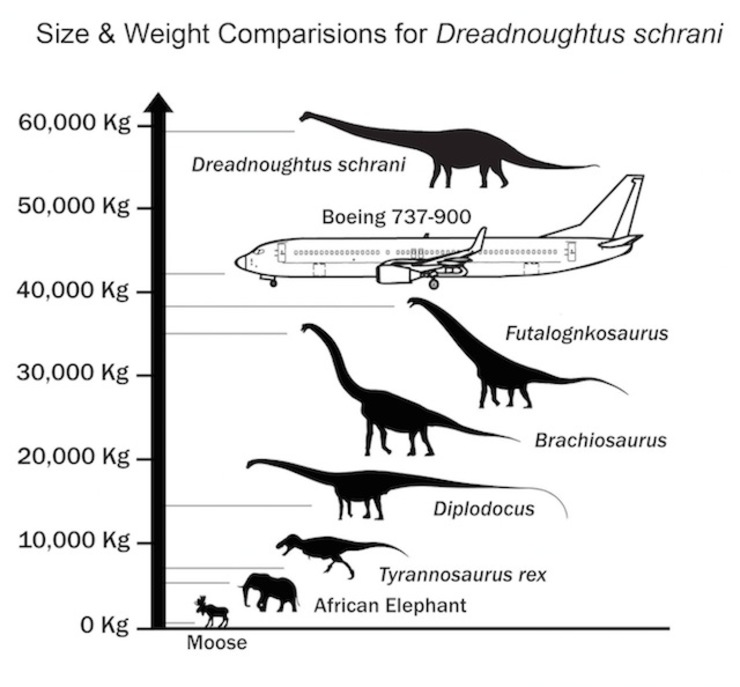
Dubbed Dreadnoughtus schrani (the 'Dreadnoughtus' part coming from "fear nothing" in old English), the long-necked lizard would have measured 26 meters (85 feet) from nose to tail and weighed some 60 tons – about as much as seven Tyrannosaurus rex put together.
And the giant wasn't even fully grown when it got bogged down in a flooded plain, where it died next to a smaller companion, researchers reported in the journal Scientific Reports.
"With a body the size of a house, the weight of a herd of elephants, and a weaponized (9-meter, muscled) tail, Dreadnoughtus would have feared nothing," study co-author Kenneth Lacovara of Drexel University in Philadelphia said of the mighty beast.
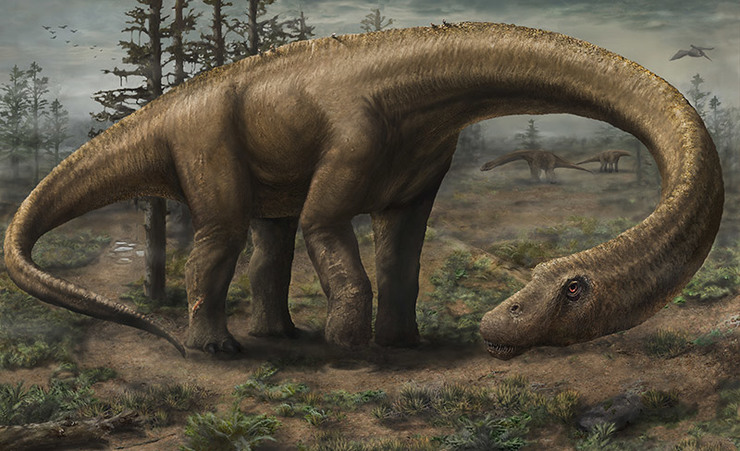
MASSIVE ANIMAL. Rendering of the massive Dreadnoughtus schrani in life. Dreadnoughtus had a 37-foot-long neck, 30-foot tail, and weighed an estimated 65 tons, making it the most massive land animal whose size can be confidently calculated.  Illustration by Jennifer Hall/Drexel University
MASSIVE ANIMAL. Rendering of the massive Dreadnoughtus schrani in life. Dreadnoughtus had a 37-foot-long neck, 30-foot tail, and weighed an estimated 65 tons, making it the most massive land animal whose size can be confidently calculated. Illustration by Jennifer Hall/Drexel University
The fossilized skeleton is the most complete yet found in the category of super-sized, plant-eating dinosaurs called Titanosaurs– which makes it the largest land animal for which a weight has been calculated with such a degree of accuracy.
The find comprised over 70% of the types of bones in the dinosaur's body – 45% of its total skeleton. There were no skull bones.
Paleontologists uncovered most of the vertebrae from the lizard's tail, a neck vertebra with a diameter of over one yard (0.9 meters), ribs, toes, a claw, a section of jaw and a tooth, and nearly all the bones from its four limbs, including a humerus (upper arm bone) and a femur (thigh bone) over six feet tall.
The femur and humerus are key to calculating the mass of extinct four-legged animals.
"Because the Dreadnoughtus type specimen includes both these bones, its weight can be estimated with confidence," said a Drexel University statement.
"It is by far the best example we have of any of the most giant creatures to ever walk the planet," added Lacovara, who discovered the skeleton in southern Patagonia in 2005 and oversaw its four-year excavation.
Dino Misfortune, Science's Luck
To sustain its massive bulk, Dreadnoughtus would have had to eat vast quantities of plants growing in the temperate forest on the continent's southern tip.
"I imagine their day consists largely of standing in one place," said Lacovara.
"You have this 37-foot-long (11-meter) neck balanced by a 30-foot-long (9-meter) tail in the back. Without moving your legs, you have access to a giant feeding envelope of trees and green ferns. You spend an hour or so clearing out this patch that has had thousands of calories in it, and then you take three steps over to the right and spend the next hour clearing out that patch."
The dimensions of all previously discovered supermassive dinosaurs had been pieced together from relatively fragmentary fossil remains.
Prior to Dreadnoughtus, another Patagonian giant, Elaltitan, held the title for the dinosaur with the greatest calculable weight, at 43 tons.
MEGA DINO. Dreadnoughtus schrani was substantially more massive than any other supermassive dinosaur for which mass can be accurately calculated. Image courtesy Lacovara Lab/Drexel University; Size and weight comparisons citations at http://bit.ly/1oI5acS
Argentinosaurus, also from Argentina, was thought to be of a comparable or even greater mass than Dreadnoughtus, and longer, at about 37m.
But Argentinosaurus is known only from a half-dozen vertebrae in its mid-back, a shinbone and a few other fragments but no upper limb bones, said the researchers.
An adult Dreadnoughtus would likely have been too large to fear any predators, but would have made a great feast for scavengers after their death, the team added.
They discovered several teeth of small predatory and scavenging dinosaurs at the excavation site, which also included a secondDreadnoughtus skeleton, though smaller and much less complete.
From the preservation of the skeletons, the team concluded theDreadnoughtus pair was buried soon after death, but not before their carnivore cousins took a few bites.
"These two animals were buried quickly after a river flooded and broke through its natural levee, turning the ground into something like quicksand," said Lacovara.
"The rapid and deep burial of the Dreadnoughtus type specimen accounts for its extraordinary completeness.
"It's misfortune was our luck."
Source: Rappler

Saturday, June 14, 2014

Massive Underground Ocean Exists Beneath Earth's Crust


Summary: The first terrestrial discovery of Ringwoodite confirms the presence of massive amounts of water 400 to 700 kilometers beneath Earth's surface. Ringwoodite is a form of the mineral peridot, believed to exist in large quantities under high pressures in the transition zone. Ringwoodite has been found in meteorites but, until now, no terrestrial sample has ever been unearthed because scientists haven't been able to conduct fieldwork at extreme depths.


Scientists scanning the deep interior of Earth have found evidence of a vast water reservoir beneath eastern Asia that is at least the volume of the Arctic Ocean.

The discovery marks the first time such a large body of water has found in the planet's deep mantle. [The World's Biggest Oceans and Seas]

Water covers 70 percent of Earth's surface and one of its many functions is to act like a lubricant for the movement of continental plates.

The crust thickness averages about 18 miles (30 kilometers) under the continents, but is only about 3 miles (5 kilometers) under the 
oceans. It is light and brittle and can break. In fact it's fractured into more than a dozen major plates and several minor ones. It is where most earthquakes originate.

The Earth’s radius is about 4,000 miles (6,400 kilometers). The main layers of its interior are in descending order: crust, mantle and core.


The mantle is more flexible – it flows instead of fractures. It extends down to about 1,800 miles (2,900 kilometers) below the surface.

The core consists of a solid inner core and a fluid outer core. The fluid contains iron, which, as it moves, generates the Earth’s magnetic field. The crust and upper mantle form the lithosphere, which is broken up into several plates that float on top of the hot molten mantle below.

SOURCE: LiveScience

Thursday, January 23, 2014

Was A Muslim Scholar The First To Discover America?

Sebastian Munster's map, published in 1540, the first to show America as a continent. AKG Images

Abu Raihan Al-Biruni, An Islamic Scholar From Central Asia, May Have Discovered The New World Centuries Before Columbus


For more than a century an army of scholars, enthusiasts and outright eccentrics has delved into the question of who discovered America. Some of the claims are truly exotic, with fanciful reportage on ancient Phoenicians in Rhode Island or Chinese from the Middle Kingdom in the Bay Area. Back in the 1950s the colourful Norwegian ethnographer and adventurer Thor Heyerdahl contended that Peruvians in sailboats made of balsa wood were commuting back and forth between the Americas and Polynesia centuries before Columbus set sail.

Leaving aside patently absurd theories, there are a number of serious­ claimants for the title. First comes Zuan Chabotto (c.1450-99), the Venetian navigator and explorer. His claim turns on the fact that Columbus did not reach the American mainland until 1498, while he touched the North American shore a full year earlier. That he had set sail from England caused him to be remembered in the Anglophone world as John Cabot and shifted bragging rights from Venice to the ‘Sceptred Isle’. Then it turned out that, while Cabot found investors in Bristol and received a patent from Henry VII, his principal financial backer was an Italian banking house in London. The laurels shifted back to Italy.

Discoveries and Doubts

In 1966 an English scholar, Alwyn Ruddock, discovered a letter of 1498 written to Columbus by an English merchant named John Day. In it, Day asserted that it was ‘considered certain’ that the North American mainland, which Cabot had visited the previous year, had been ‘found and discovered in the past’ by seamen from the port of Bristol (which happened to be Ruddock’s home town). Ruddock unearthed more papers suggesting that these pioneering Englishmen had reached America as early as 1470. Unfortunately Ruddock ordered all of these papers to be destroyed at her death in 2005. Just as it seemed that the prize was about to head north again, fresh doubts set in.
Amid this ping-pong match, Francesco Guidi-Bruscoli, the Italian historian who had discovered information on Cabot’s Italian backers, came across a yellowed parchment map with an intriguing notation suggesting that Cabot may have been dispatched to confirm a discovery made many years earlier. Written in Italian, it states that ‘Giovanni Chabotte’ (Cabot) from Venice had been commissioned to sail to the ‘new land’. That the reference to new land was preceded in Italian by the definite article, il, rather than the indefinite un suggested to Guidi-Bruscoli that Cabot’s sponsors already knew of the Americas, thanks to reports by an earlier explorer. Cabot was simply verifying what was already known.
Meanwhile scholars from Scandinavia have examined the Norse sagas for evidence that their forebears had sailed to North American shores before the English and Italians. The story of Vikings plowing the waves in their narrow-hulled boats to explore and settle Greenland is by now well known and confirmed by archaeological finds along Greenland’s south-western coast. At the beginning of the 20th century Professor Gustav Storm of the University of Christiania in Oslo produced evidence that Norsemen had made several trips to within sight of the Canadian coast, identifying and naming Markland (southern Labrador), Helluland (Baffin Island) and Vinland, which is thought to be Nova Scotia.

Norse Sagas

Among these adventurers Leif Ericson (970-1020), the son of Eric the Red (c.950-1003), who had discovered Greenland, entered the history books for his sighting of Vinland in about 1000. True, one saga from 1387 states that a certain Bjarni, Son of Herjulf, had beaten Leif to Vinland, having been blown off course and sighted land there as early as 985-6. But no further support for the Bjarni claim has turned up.
Just what is meant, then, by this Norse ‘discovery’ of North America? Leif Ericson was a Christian missionary who had been sent to Greenland by King Olaf I of Norway (r.995-1000) with orders to bring the faith to settlements there. On the return voyage his boat was blown so far south that he was brought within view of Nova Scotia. The authors of the Norse sagas, amazed that he survived this adventure, dubbed him ‘Leif the Lucky’.
Except for Ericson, most of the other Norsemen who made contact with North America were traders by profession. Had their commercial interests fared better, they might have given the continent a second look, but they didn’t. Their one serious venture onto North American territory resulted in a fight with native Americans, after which they quickly fled to their boats. The southernmost confirmed evidence of Vikings in the New World was discovered in 1960 at L’Anse aux Meadows, on the northern tip of Newfoundland.
From the sod houses and primitive artefacts that archaeologists excavated at L’Anse aux Meadows and in Greenland these Norse traders emerge as hardy adventurers. As to their ‘explorations’, they were carried out in a thoroughly ad hoc way, usually the result of accident or unfavourable winds. At their most deliberate the Vikings strove each time to sail a little further down a coastline than their immediate predecessor. Either way, when they returned to Greenland, Iceland or Norway they told their tales to wide-eyed listeners huddled around log fires. There is no evidence that any of the Viking leaders who headed towards North America were literate.
It took another three generations before Adam of Bremen (c.1050-1081/5) in northern Germany, wrote the Gesta Hammaburgensis Ecclesiae Pontificum, a chronicle which included the stories he had heard concerning the adventures of Leif the Lucky. Adam and other chroniclers and authors of the sagas offered their reports in a stolid and matter-of-fact way, with no indication that they had any idea of the implications of these remarkable travels.
At around the same time that the Vikings were venturing south and westward from their bases in Greenland, a very different process of discovery was taking place in landlocked territories many months’ journey from the nearest open salt water. Beginning more than 3,000 years ago, traders from the great urban centres of what is now Uzbekistan, Turkmenistan and Afghanistan had sent goods across Eurasia, from Europe to India and China. They moved their cargo in long camel caravans, which carried the equivalent of a dozen or more modern freight containers. Gold and silver coins minted in their cities were honoured as currency as far afield as Sri Lanka and England. Vikings, among others, collected hordes of these beautifully crafted coins because they knew they would be accepted widely. Once back home the Central Asian traders not only told their tales around neatly built hearths in solid multi-storey houses but wrote down detailed information on the geography and climates of the lands they had visited. Local scholars collected and analysed these reports.

A Curious Mind

The greatest of these scholars was Abu Raihan al-Biruni. Born in 973 near the Aral Sea in what is now Uzbekistan, while still a youth Biruni mastered mathematics, astronomy, mineralogy, geography, cartography, geometry and trigonometry. He spoke Persian, Arabic and Khwarazmian, the language of the Sunni dynasty that ruled Greater Iran between the 12th and 13th centuries. Later on he also studied Sanskrit.
While still a young man Biruni had calculated the latitude and longitude of his home town and had begun to collect similar co-ordinates for other places. Using ancient Greek sources he compiled data on hundreds of locales in the Mediterranean world and then began adding calculations on other locations from all points of the compass. From ancient writers like Claudius Ptolemy (c.150 BC), from more recent sources and from his own field observations he knew that the earth is round. By the time he was 30 Biruni was employing the most advanced systems of the day to calculate its precise circumference. In a pioneering effort not matched until the Renaissance he constructed a globe 16ft high showing the Earth’s terrestrial features.
Biruni followed in the footsteps of several other scientists from Central Asia. Among them was Ahmad al-Farghani, from what is now Uzbekistan, who in the ninth century had calculated the width of one degree of longitude at the equator, from which he deduced the earth’s circumference. His calculation, though less precise than Biruni’s, marked a significant improvement on those made by the ancient Greeks and assured a wide readership for his book on the subject, A Compendium of the Science of the Stars (c.833). Five centuries later Columbus came across a Latin translation of Farghani’s treatise. Besides welcoming confirmation that the Earth is round, Columbus used Farghani’s data to argue before sceptical potential sponsors that it was small enough for him potentially to circumnavigate. However, Columbus wrongly assumed that Farghani had presented his measurements in Roman miles rather than Arab miles. This caused him to understate the actual circumference of the earth by 25 per cent. His misreading caused (or, if it was deliberate, enabled) Columbus to place Cipango, or Japan, near the Virgin Islands. This convenient error proved crucial in Columbus obtaining funding for what he estimated would be a relatively short voyage to China.
Biruni had also delved into mineralogy, specifically the relative density and weight of minerals of all types and how the separate minerals interact in nature. In the process of this research he discovered the concept of specific gravity.
Just how Biruni acquired his passion for precise measurement is a mystery. It certainly owed something to his education, which included study of the classical Greek scientist Pythagoras, who had proclaimed that ‘things are numbers’. Biruni’s constant urge to quantify whatever he observed, combined with his enquiring mind, was to plunge him down a path that led to epochal insights, which in most respects put Columbus, Cabot and the Vikings in the shade.
By 1017 Biruni had become an honoured scientist at Gurganch, the intellectual capital of his home region of Khwarazm. But in that year a fierce and religiously fanatical Muslim ruler from Ghazni in Afghanistan, crushed Khwarazm and destroyed its capital. Mahmud of Ghazni, as he was known, was a brutal man but, like many rulers in the region, tried to surround himself with poets and learned scholars. He ordered Biruni to come to Ghazni and bring the results of his research with him.
Biruni, with no way out, not only complied but seized upon the move as an opportunity to learn more about India, which Mahmud had conquered over the previous decade. But Mahmud was as difficult as he was ruthless and Biruni quickly realised that he had to distance himself from his court. He removed to Lahore, now in Pakistan, where he penned the world’s first book on comparative religion, focusing on Hinduism and Islam. Gathering his notes and no equipment other than a simple astrolabe, he then withdrew to a heavily fortified hilltop castle at Nandana, not far from what is now Islamabad.
There Biruni returned to the old problem of measuring the earth’s circumference. To this end he devised a new technique, which involved careful observation, spherical trigonometry and the application of the law of sines. Besides being far simpler than using two distant points on flat land, this method produced a measure of the earth’s circumference that was a mere 10.44 miles less than the definitive modern measurement.
After Mahmud’s death in 1030, Biruni hauled his field notes and papers back to Ghazni in Afghanistan, where Mahmud’s son, Masud I (r.1031-40), welcomed him and helped him to settle into a quiet life of research and writing. Biruni wrote up his lifetime’s research on specific gravity and then turned to writing a vast tome, known as the Codex Masudicus, in which he summarised everything known at the time about astronomy and allied disciplines.
It was in the Codex Masudicus that Biruni considered the possibility that the sun is stationary and that the earth revolves around it. He stopped short of fully embracing a heliocentric view, noting instead that the notion of a heliocentric universe is no less logical than its alternative and called on mathematicians and astronomers either to refute it or accept it. It is no wonder that historians of science judge the Codex Masudicus to be the greatest work on astronomy from the period between late antiquity and the modern era. In his codex Biruni also hypothesised about the existence of North and South America.
Biruni began by presenting the research on the earth’s circumference that he had carried out at Nandana. He then set about fixing all known geographical locations onto his new, more accurate map of the globe. His list of longitudes and latitudes had grown substantially since his earliest collection and now included more than 70 sites in India alone, as well as hundreds of other locations stretching across the Eurasian land mass.
When Biruni transposed these data onto his map of the earth he noticed at once that the entire breadth of Eurasia, from the westernmost tip of Africa to the easternmost shore of China, spanned only about two fifths of the globe. This left three fifths of the Earth’s surface unaccounted for.

A World Ocean

The most obvious way to explain this gap of 15,000 miles was to invoke the explanation that all geographers from antiquity down to Biruni’s day had accepted: that the Eurasian land mass was surrounded by a ‘World Ocean’. But was three fifths of the Earth’s circumference really nothing but water? Biruni considered this possibility but rejected it on the grounds of both observation and logic. From his study of specific gravity he knew that most solid minerals were heavier than water. Would so watery a world not give rise to serious imbalances to which the planet would have had to adjust over time? And why, he asked, would the forces that had given rise to land on two fifths of the earth’s belt not also have had an effect on the other three fifths as well? Biruni concluded that somewhere in the vast expanses of ocean between Europe and Asia there must be one or more unknown land masses or continents.
Were these unknown continents empty wildernesses or ones inhabited by human beings? To address this question Biruni turned to his data on longitudes. He noted that human beings inhabit a broad north-south band stretching from Russia to southern India and the heart of Africa. If the unknown continent or continents were uninhabited, he reasoned, they would have to lie either north or south of this band.
To pursue this hypothesis Biruni went beyond his field observations and employed Aristotelian logic, a reasoning process built from propositions. Noting that the Eurasian land mass stretched roughly around the Earth’s belt, he hypothesised that it must have been the result of powerful processes that would surely have obtained elsewhere. Known evidence of the Earth gave him no grounds for believing that the unknown continents would be squashed into the northernmost and southernmost latitudes. He concluded that the unknown land masses between the Atlantic and Pacific Oceans would have to be inhabitable as, in fact, they were.
Biruni reached these momentous conclusions about the existence of the New World by 1037, basing them on research he had conducted over the preceding three decades.
Did Biruni discover America in the first third of the 11th century? In one sense, definitely not. He never laid eyes on the New World or the continents about which he wrote. By contrast the Norsemen had actually touched land in North America shortly before ad 1000; briefly, to be sure, and without really understanding what they had found. Leif Ericson was so uninterested in the forested shore of North America that he did not bother to return later, nor did any of those who heard oral reports of Ericson’s travels or read about them in later Norse documents. Still, if ‘discovery’ includes the unreflective processes of Norse seafaring, then the prize must go to the Vikings.
Yet Biruni is at least as deserving of the title of North America’s discoverer as any Norseman. Moreover, the intellectual process by which he reached his conclusions is no less stunning than the conclusions themselves. His tools were not the hit-or-miss methods of Venetian seamen or Norse sailors but an adroit combination of carefully controlled observation, meticulously assembled quantitative data and rigorous logic. Only after a further half-millennium did anyone else apply such rigorous analysis to global exploration.
Having assembled all known knowledge of the subject, studying the wisdom of ancient Greeks and Indians as well as medieval Arabs and fellow Central Asians, Biruni devised completely new methods and technologies to generate his voluminous and precise data and processed it with the latest tools of mathematics, trigonometry and spherical geometry as well as the austere methods of Aristotelian logic. He was careful to present his conclusions in the form of hypotheses, on the understanding that other researchers would want to test and refine his findings. This did not happen for another five centuries. In the end European explorers confirmed his hypotheses and vindicated his bold proposals.

Breaking Free

This son of Central Asia was arguably the greatest explorer between the ancient world and the great age of European exploration. Two features of Biruni’s work warrant this conclusion. First, he achieved what he did through the systematic and rigorous application of reason and logic, unconstrained by religious or secular dogmas, folklore or anecdotes. He was a Muslim, but broke free of the culture-bound assumptions of Islam in a way that scientists in the Christian West struggled for several more centuries to achieve. He carried out his breathtaking intellectual explorations while living far from the sea in a landlocked region and without leaving his study except to carry out scientific measurements. While he was absolutely confident in his conclusions, his written presentation of them indicated the precise paths by which someone seeking to disprove him might proceed.
Who today can better the credo that this Central Asian polymath penned a thousand years ago?
… in an absolute sense, science is good in itself, apart from its [content of] knowledge; its lure is everlasting and unbroken … [The servant of science] should praise the assiduous [ones] whenever their efforts [arises from] delight [in science itself] rather than from [the hope of achieving] victory in argument.
Even today, Biruni’s modus operandi strikes one as astonishingly modern, a voice of calm and dispassionate scientific enquiry sounding forth from the depths of the irrational and superstitious medieval world. 
Biruni accomplished all this while living and working in a region which many still regard as backward, a region immersed in superstition, fanaticism and violence. His birthplace in western Uzbekistan is close to the Aral Sea, where from the 1950s the Soviet Union created one of the most fearful ecological disasters of modern times. His achievements took place in a bleak zone on the northern border of Turkmenistan, far from the enormous gas fields that are today transforming that country into a Central Asian Kuwait. His research at Nandana, in what is now the West Punjab territory of Pakistan, put him within an hour of Jammu and Kashmir, the future scenes of a half century of armed struggle between Pakistan and India. As to Ghazni in Afghanistan, where he penned his renowned Codex Masudicus, simply to reach this town today is a dangerous task, requiring armoured vehicles and armed guards to traverse the heavily mined road from Kabul or Kandahar.
But one can do so nonetheless and can, amid the desolate remains of ancient Ghazni, ferret out the actual tomb of Biruni. Here in the very heart of Afghanistan lie the remains of the most modern explorer of the Middle Ages, a man who was open to the entire world and to all the knowledge it contains.
If and when Afghanistan gains a stable government and begins to develop, travellers and tourists will visit Ghazni, the scene of Biruni’s great work as a global explorer, and pay their respects at the tomb of one whose achievements match those of Columbus.
S. Frederick Starr is research professor at the Paul H. Nitze School of Advanced International Studies at Johns Hopkins University and a founding chairman of the Central Asia-Caucasus Institute.


Friday, July 12, 2013

Extremely Tiny Fairyfly Species Found In Costa Rica

Micrograph of Tinkerbella nana magnifies the delicate fairyfly structure. Scale line - 100 μm (Jennifer Read / Natural Resources Canada)
Micrograph of Tinkerbella nana magnifies the delicate fairyfly structure. Scale line – 100 μm (Jennifer Read / Natural Resources Canada)

Entomologists Dr John Huber From The Canadian National Collection Of Insects and Dr John Noyes From The Natural History Museum, UK, Have Described A New Genus and Species Of FairyFly From Costa Rica.


The minute insect, named Tinkerbella nana, is 250 micrometers long – that’s 2.5 times the width of a human hair.
Entomologists discovered Tinkerbella nana in the tropical forests of Costa Rica. They used methods adapted for catching extra tiny creatures, which included gently dragging a sweep net fitted with a 4 mm screen through the vegetation and then carefully searching the collected debris and extracting specimens by hand.
“What surprised me the most was that I found so many of them,” Dr Noyes explained.
“Can you imagine finding something less than 0.2mm in a 250 ml soup of material that includes lots of plant debris and other insects up to 8 mm long. It is possibly equivalent to finding a solitary needle in 200 haystacks.”
Tinkerbella nana, described in a paper published in the Journal of Hymenoptera Research, is one of the smallest known arthropods. It belongs to the familyMymaridae that includes Kikiki huna, the smallest winged insect at 158 micrometers long.
Tinkerbella nana is 2.5 times the width of a human hair. Scale line - 100 μm (Jennifer Read / Natural Resources Canada)
Tinkerbella nana is 2.5 times the width of a human hair. Scale line – 100 μm (Jennifer Read / Natural Resources Canada)
The minute insect, named Tinkerbella nana, is 250 micrometers long – that’s 2.5 times the width of a human hair.
Entomologists discovered Tinkerbella nana in the tropical forests of Costa Rica. They used methods adapted for catching extra tiny creatures, which included gently dragging a sweep net fitted with a 4 mm screen through the vegetation and then carefully searching the collected debris and extracting specimens by hand.
“What surprised me the most was that I found so many of them,” Dr Noyes explained.
“Can you imagine finding something less than 0.2mm in a 250 ml soup of material that includes lots of plant debris and other insects up to 8 mm long. It is possibly equivalent to finding a solitary needle in 200 haystacks.”
Tinkerbella nana, described in a paper published in the Journal of Hymenoptera Research, is one of the smallest known arthropods. It belongs to the familyMymaridae that includes Kikiki huna, the smallest winged insect at 158 micrometers long.


Tinkerbella seemed a very appropriate generic name for this particular insect. It is surprising that it has not been used before. The species name is a play onnanos, Greek for dwarf, and Nana – the name of the dog in Peter Pan.”
“This discovery really shows how diverse insect life is on this planet and how much there is to discover, especially in the tropics,” Dr Noyes said.
The discovery raises many questions about how something so small can exist in a habitat such as a tropical forest.

Thursday, May 16, 2013

Pandemic


Courtesy Of The BBC

A simple virus brewed in the belly of a dead bird is set to embark on a global killing spree. The likely culprit is H5N1 - a bird flu virus with the dangerous potential to mutate into the next pandemic flu virus.

In a feature-length special, we tell the story of what could happen if a flu pandemic hits. Experts predict the next pandemic will be more disruptive than any disease we've seen before. And they're particularly worried that it will be most deadly for the young and otherwise healthy.

The last flu pandemic in 1918 killed an estimated 50 million people worldwide. Nowadays, with extensive global travel and movement, the virus will be able to spread even more easily. The estimates are that hundreds of millions could be infected and potentially die.

Monday, May 13, 2013

Drain The Ocean


Courtesy Of The Discovery Channel

Saturday, March 30, 2013

Down To The Earth's Core


Down to the Earth's Core takes viewers from the sidewalk to the center of the planet in one epic unbroken shot. Using spectacular computer generated imagery; the camera smashes through almost 9 000 kilos of solid rock to explore the hidden world beneath our feet. 

Experience an earthquake inside the San Andreas Fault, blast out of a volcano, encounter bizarre cave-dwelling creatures and enter caves full of giant crystals -- all inside planet Earth. 

As the camera lowers into Earth's bosom, the planet's extraordinary story, is laid bare layer by layer, showing how prehistoric forests became modern-day fuel, witnessing the dinosaur's cataclysmic death, and watching as stalactites form and gold grows before our eyes. 

Deeper, beyond the reach of any mine, any drill, we find wonders beyond imagination: towering molten metal tornadoes, forests of solid iron crystals, until we reach the strangest, least understood place on the planet -- the core. To infinity and beyond, this is Earth like never before.

Saturday, March 23, 2013

The Search For Earth-Like Planets


The search for Earth-like planets is reaching a fever-pitch. Does the evidence so far help shed light on the ancient question: Is the galaxy filled with life, or is Earth just a beautiful, lonely aberration? If things dont work out on this planet Or if our itch to explore becomes unbearable at some point in the future Astronomers have recently found out what kind of galactic real estate might be available to us. Well have to develop advanced transport to land there, 20 light years away. The question right now: is it worth the trip?

If things don't work out on this planet...

Or if our itch to explore becomes unbearable at some point in the future... 

Astronomers have recently found out what kind of galactic real estate might be available to us.

We'll have to develop advanced transport to land there, 20 light years away.... But that's for later.

The question right now: is it worth the trip? The destination is a star that you can't see with your naked eye, in the southern constellation Libra, called Gliese 581. 

Identified over 40 years ago by the German astronomer Wilhelm Gliese, it's a red dwarf with 31% of the Sun's mass... and only 1.3% of its luminosity. 

Until recently, the so-called M Stars like Gliese 581 flew below the radar of planet hunters. 

They give off so little energy that a planet would have to orbit dangerously close just to get enough heat. 

Now, these unlikely realms are beginning to show some promise... as their dim light yields to precision technologies... 

...as well as supercomputers... honed in the battle to understand global changes on this planet... Earth. 

Will we now begin to detect signs of alien life? 

Or will these worlds, and the galaxy itself, turn out to be lifeless... and Earth, just a beautiful, lonely aberration?

To some, like astronomer and author Carl Sagan, the sheer number and diversity of stars makes it, as he said, "far more likely that the universe is brimming over with life."

This so-called "many worlds" view can be traced back to ancient observers... in China, India, Greece and Egypt. The Qur'an, the Talmud, and many Hindu texts all imagined a universe full of living beings. 

In the 16th Century, this view got a boost from astronomer and mathematician Nikolas Copernicus... who came to believe that Earth is not the center of the universe, but revolves around the Sun.

Seven decades after Copernicus, Galileo Galilei used his newly developed telescope to show that our Sun was just one among countless other stars in the universe. 

By the modern era, the "many worlds" view held sway in scientific circles. A variety of thinkers considered what and who inhabited worlds beyond our own. 

From Martians desperate to get off their planet... to alien invaders intent on launching pre-emptive strikes against ours... or simple life forms on an evolutionary track to complexity.

But other thinkers have been struck by a different view.

The Greek philosophers Aristotle and Ptolemy believed that humans and Earth are unique. 

With the spread of Christianity, this Ptolemaic system became widely accepted. 

The latest variation on this theme is what's called the "Rare Earth" hypothesis. It holds that Earth and sophisticated life were the result of fortuitous circumstances that may not be easy to find again in our galaxy. 

Does the current search for planets shed light on this debate... sending it in one direction or the other?

So far, our only good reference for recognizing an Earth-like planet is... Earth. 

It does have some fortuitous characteristics... it's dense, it's rocky -- with a complex make-up of minerals and organic compounds -- and it has lots and lots of water. 

It's also got a nearly circular orbit around the Sun, at a distance that allows liquid water to flow... not too close and not too far away, in the so-called "Habitable Zone." 

That's defined as the range of distance from a parent star that a planet would need to maintain surface temperatures between the freezing and boiling points of water. 

Of course, that depends on the size of the planet, the make-up of its atmosphere, and a host of other factors. 

And whether the parent star is large; medium like the Sun; or small. 

Some scientists also believe we live in a "Galactic Habitable Zone." We're close enough to the galactic center to be infused with heavy elements generated by countless stellar explosions over the eons...

But far enough away from deadly gamma radiation that roars out of the center. 

If there is a galactic habitable zone... it's thought to lie 26,000 light years from the center... about where we are... give or take about 6,000 light years.

Monday, February 25, 2013

The Hubble Ultra Deep Field In 3D


I've recently discovered an animation that was rendered using the measured redshift of all 10,000 galaxies in the Hubble Ultra Deep Field image.

I've written a short script that leads you through a quick history of both deep field images and this video ends with a fly-through of the Ultra Deep Field.

Every galaxy in the image is in its proper distance as viewed from the telescope line of sight.

As if this image wasn't amazing enough.

Animation Credit:

Hubble Cosmological Redshift Animation Courtesy:
http://hubblesite.org/newscenter/archive/releases/2004/28/video/b/

Mike Gallis

http://phys23p.sl.psu.edu/phys_anim/Phys_anim.htm
http://www.youtube.com/watch?v=e6G2Z6iD-9M

Music Used in this video was purchased from stockmusic.net and belongs to the Spirit Legends Collection.

The tunes I used were:

Voice Redo B
Voice in the Dark

Link to demos:

http://www.stockmusic.net/index.cfm/page/main.collectionDetails/collectionId/67

Sunday, February 24, 2013

Eternal Embrace

Skeletons locked in eternal embrace. It could be humanity's oldest story of doomed love. Archaeologists have unearthed two skeletons from the Neolithic period locked in an eternal embrace and buried outside Mantua, Italy, just 25 miles south of Verona.
After being found at the site where a factory is planned, people worldwide have speculated on the circumstances surrounding the couple's deaths. They are thought to have died young because they both had all their teeth intact. But beyond that, the skeletons are a mystery. Archaeologists announced Monday that they will move the entire block of earth the skeletons are resting in for further study and eventual display in a museum.


It could be humanity's oldest story of doomed love. 

Archaeologists have unearthed two skeletons from the Neolithic period locked in an eternal embrace and buried outside Mantua, Italy, just 25 miles south of Verona, the city where Shakespeare set the star-crossed tale of Romeo and Juliet.

After being found at the site where a factory is planned, people worldwide have speculated on the circumstances surrounding the couple's deaths. 

They are thought to have died young because they both had all their teeth intact. But beyond that, the skeletons are a mystery. 

Archaeologists announced Monday that they will move the entire block of earth the skeletons are resting in for further study and eventual display in a museum.

Photo by: NewsCom/Gamma Presse
February 12, 2007 3:14 PM PST
Via: C|Net

Sunday, February 17, 2013

Asteroid Discovery From 1980 - 2010


Video Created by Scott Manley, this is a view of the solar system showing the locations of all the asteroids starting in 1980, as asteroids are discovered they are added to the map and highlighted white so you can pick out the new ones. 

The final colour of an asteroids indicates how closely it comes to the inner solar system. 

Earth Crossers are Red

Earth Approachers (Perihelion less than 1.3AU) are Yellow

All Others are Green

Notice now the pattern of discovery follows the Earth around its orbit, most discoveries are made in the region directly opposite the Sun. You'll also notice some clusters of discoveries on the line between Earth and Jupiter, these are the result of surveys looking for Jovian moons. Similar clusters of discoveries can be tied to the other outer planets, but those are not visible in this video.

As the video moves into the mid 1990's we see much higher discovery rates as automated sky scanning systems come online. Most of the surveys are imaging the sky directly opposite the sun and you'll see a region of high discovery rates aligned in this manner.

At the beginning of 2010 a new discovery pattern becomes evident, with discovery zones in a line perpendicular to the Sun-Earth vector. These new observations are the result of the WISE (Widefield Infrared Survey Explorer) which is a space mission that's tasked with imaging the entire sky in infrared wavelengths. 

The scale of the video at 1080P resolution is roughly 1million kilometers per pixel, and each second of video corresponds to 60 days.

Currently we have observed over half a million minor planets, and the discovery rates show no sign that we're running out of undiscovered objects, scientific estimates suggest that there are about a billion asteroids larger than 100metres (about the size of a football field) .

Orbital elements were taken from the 'astorb.dat' data created by Ted Bowell and associates at ftp://ftp.lowell.edu/pub/elgb/astorb.htm­l

Music is 'Transgenic' by Trifonic:http://www.amazon.com/Emergence-Trifo... - they're awesome guys, give them some love.

Check out todays asteroid map athttp://szyzyg.arm.ac.uk/~spm/neo_map....
Quite a few journalists, bloggers and tweeters are attributing this to NASA or Arecibo Observatory - while they do fine work they had nothing to do with this. If you write a story you can credit it to Scott Manley. 

If you are needing a higher quality video or images for a specific purposes - education, news or just eye candy I can supply them on a case by case basis.