Showing posts with label Asteroid. Show all posts

Thursday, May 01, 2014

B612 Asteroid Impact Video


By Spine Films

Between 2000 and 2013, a network of sensors that monitors Earth around the clock listening for the infrasound signature of nuclear detonations detected 26 explosions on Earth ranging in energy from 1 to 600 kilotons – all caused not by nuclear explosions, but rather by asteroid impacts. These findings were recently released from the Nuclear Test Ban Treaty Organization, which operates the network.
To put this data in perspective, the atomic bomb that destroyed Hiroshima in 1945 exploded with an energy impact of 15 kilotons. While most of these asteroids exploded too high in the atmosphere to do serious damage on the ground, the evidence is important in estimating the frequency of a potential “city-killer-size” asteroid.
A list of the impacts shown in the video can be found here.
b612foundation.org/list-of-impacts-from-impact-video/
For more information on this data, please check out our Impact Video FAQ.
b612foundation.org/impact-video-faq/
You can read or download the press release about today’s event here.
b612foundation.org/wp-content/uploads/2014/04/B612_PR_042214.pdf


Sunday, February 17, 2013

Asteroid Discovery From 1980 - 2010


Video Created by Scott Manley, this is a view of the solar system showing the locations of all the asteroids starting in 1980, as asteroids are discovered they are added to the map and highlighted white so you can pick out the new ones. 

The final colour of an asteroids indicates how closely it comes to the inner solar system. 

Earth Crossers are Red

Earth Approachers (Perihelion less than 1.3AU) are Yellow

All Others are Green

Notice now the pattern of discovery follows the Earth around its orbit, most discoveries are made in the region directly opposite the Sun. You'll also notice some clusters of discoveries on the line between Earth and Jupiter, these are the result of surveys looking for Jovian moons. Similar clusters of discoveries can be tied to the other outer planets, but those are not visible in this video.

As the video moves into the mid 1990's we see much higher discovery rates as automated sky scanning systems come online. Most of the surveys are imaging the sky directly opposite the sun and you'll see a region of high discovery rates aligned in this manner.

At the beginning of 2010 a new discovery pattern becomes evident, with discovery zones in a line perpendicular to the Sun-Earth vector. These new observations are the result of the WISE (Widefield Infrared Survey Explorer) which is a space mission that's tasked with imaging the entire sky in infrared wavelengths. 

The scale of the video at 1080P resolution is roughly 1million kilometers per pixel, and each second of video corresponds to 60 days.

Currently we have observed over half a million minor planets, and the discovery rates show no sign that we're running out of undiscovered objects, scientific estimates suggest that there are about a billion asteroids larger than 100metres (about the size of a football field) .

Orbital elements were taken from the 'astorb.dat' data created by Ted Bowell and associates at ftp://ftp.lowell.edu/pub/elgb/astorb.htm­l

Music is 'Transgenic' by Trifonic:http://www.amazon.com/Emergence-Trifo... - they're awesome guys, give them some love.

Check out todays asteroid map athttp://szyzyg.arm.ac.uk/~spm/neo_map....
Quite a few journalists, bloggers and tweeters are attributing this to NASA or Arecibo Observatory - while they do fine work they had nothing to do with this. If you write a story you can credit it to Scott Manley. 

If you are needing a higher quality video or images for a specific purposes - education, news or just eye candy I can supply them on a case by case basis.

Saturday, February 16, 2013

Meteorite Crash In Russia-1


Meteorite Crash In Russia-2


Visualization Of An Asteroid Impact To San Francisco

Thursday, February 07, 2013

NASA's Dawn Mission


A Voyage To The Origins Of The Solar System

Narrated by Leonard Nimoy


In 1996, science writer John Horgan published a book called The End of Science in which he claimed that we had learned all we could know about the natural world. And in 2008, Wired magazine devoted an issue to, you guessed it, “The End of Science.” Snappy, grandiose titles may sell copy, but it’s also the case that each time someone or other declares the end of something massive—science, history, war, and periodically, the world–we can look back and be astonished at the hubris. It now seems that there are frontiers we are just beginning to explore, and they are the frontiers of our evolutionary beginnings. While biophysicists like Peter Hoffmann chart the boundaries between life and nonlife at the molecular level, NASA scientists explore the outer reaches to discover what Leonard Nimoy, narrator of the video above, calls “the very beginning of us.”
It’s a little wonky at times, but the short film above is nonetheless a fascinating overview of NASA’s Dawn mission, a spacecraft designed to collect data from the asteroid belt. The ship itself is a marvel. Outfitted with massive solar panel wings that can power it for years, Dawn converts xenon gas into plasma, which it propels from its engine at speeds up to 78,000 miles per hour (or 21 miles per second) for maximum acceleration. In fact, Dawn is the fastest ship NASA has ever launched. Even at top speeds, Dawn required four years to reach its first stop, the asteroid Vesta, the brightest asteroid in the solar system and the only one visible to the naked eye. Departing Earth in 2007, the ship reached Vesta in July of 2011 and departed last September for the asteroid Ceres, which it will reach in February of 2015.
These two asteroids are part of what is called the “protoplanetary disk,” a once-chaotic ring of dust and gas that began to coalesce into our solar system some 4.6 billion years ago. One NASA scientist above describes the asteroid belt as the “boneyard” of deep space—remains from the earliest epochs of time. Dawn’s mission isn’t just a foray to uncharted space; it’s also a journey billions years into the past, into the origins of our solar system.

Wednesday, December 26, 2012

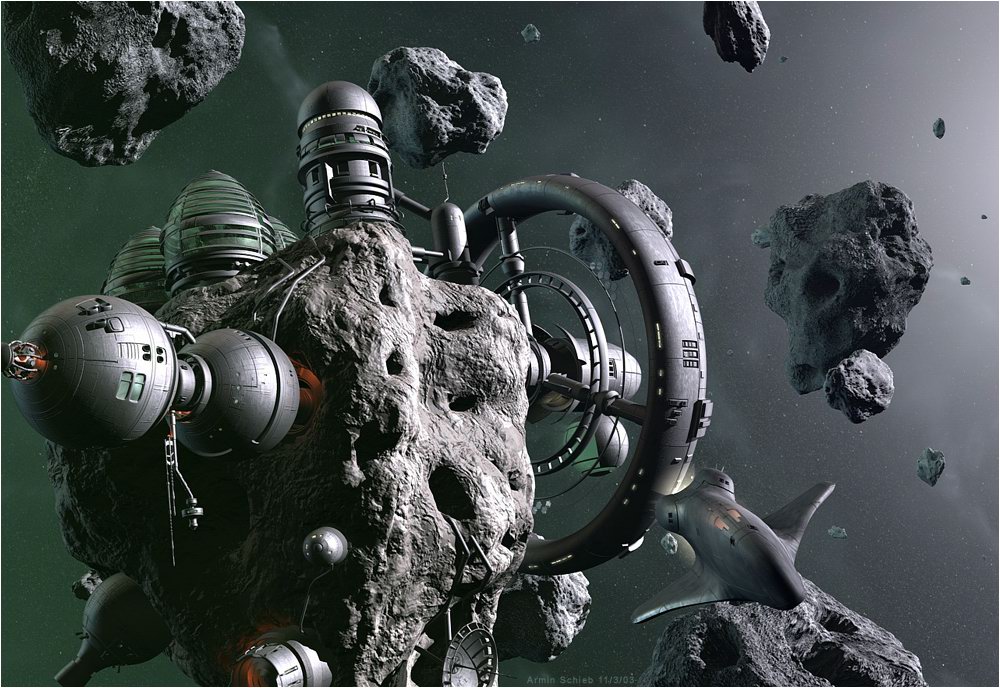
NASA To Turn Asteroid Into Space Station Orbiting The Moon


Image via: Century 22 pbem
National Aeronautics and Space Administration (Nasa) scientists are planning to capture a 500,000 kg asteroid, relocate it and transform it into a space station for astronauts to refuel at on their way to Mars.
This will be the first time a celestial object has ever been moved by humans. 
The White House’s office of science and technology will consider the $2.6 billion plan in the coming weeks as it prepares to set its space exploration agenda for the next decade.
A feasibility report prepared by Nasa and California Institute of Technology scientists outlined how they would go about capturing the asteroid.
An ‘asteroid capture capsule´ will be attached to an old Atlas V rocket and directed to the asteroid between the Earth and the Moon. Once close, the asteroid capsule will release a bag with diameter of 50 feet to wrap around the spinning rock using drawstrings. The craft would then turn on its thrusters, using an estimated 300 kg of propellant, to stop the asteroid in its tracks and tow it into a gravitationally neutral spot. From here space explorers will have a stationary base from which to launch trips deeper into space.
NASA, ... believed that technology would make it possible within 10-12 years. The technology would also open up the possibility of mining other asteroids for their metals and minerals. Some are full of iron which could be used for in the making of new space stations, others are made up of water which could be broken down into hydrogen and oxygen to make fuel.