Showing posts with label Moon. Show all posts

Friday, April 18, 2014

Waterton Lake Eclipse


Explanation: Recorded on April 15th, this total lunar eclipse sequence looks south down icy Waterton Lake from the Waterton Lakes National Park in Alberta, Canada, planet Earth. The most distant horizon includes peaks in Glacier National Park, USA. An exposure every 10 minutes captured the Moon’s position and eclipse phase, as it arced, left to right, above the rugged skyline and Waterton town lights. In fact, the sequence effectively measures the roughly 80 minute duration of the total phase of the eclipse. Around 270 BC, the Greek astronomer Aristarchus also measured the duration of lunar eclipses – though probably without the benefit of digital clocks and cameras. Still, using geometry, he devised a simple and impressively accurate way to calculate the Moon’s distance, in terms of the radius of planet Earth, from the eclipse duration. This modern eclipse sequence also tracks the successive positions of Mars, above and right of the Moon, bright star Spica next to the reddened lunar disk, and Saturn to the left and below.
Image Credit & Copyright: Yuichi Takasaka

Tuesday, November 26, 2013

1171


The moon had been observing the earth close-up longer than anyone.
It must have witnessed all of the phenomena occurring – and all of the acts carried out – on this earth.
But the moon remained silent; it told no stories.
All it did was embrace the heavy past with a cool, measured detachment.
On the moon there was neither air nor wind.
Its vacuum was perfect for preserving memories unscathed.
No one could unlock the heart of the moon.
Art by: AshenSorrow
Quote by: Haruki Murakami, 1Q84
Quote provided by: CZ

Saturday, October 26, 2013

Full Moon


“The Chinese considered the moon to be yin, feminine and full of negative energy, as opposed to the sun that was yang and exemplified masculinity. I liked the moon, with its soft silver beams. It was at once elusive and filled with trickery, so that lost objects that had rolled into the crevices of a room were rarely found, and books read in its light seemed to contain all sorts of fanciful stories that were never there the next morning.” 

[Quote by Yangsze Choo, The Ghost Bride... Provided by CZ]

Taken on: May 7, 2009
Location: Near Yangshuo, China

Wednesday, March 06, 2013

The Robot That'll Extract Water From The Moon

[optional image description]
The RASSOR robot climbs a hill during a recent test at NASA's Kennedy Space Center in Florida. (NASA)


One of the biggest challenges of space travel has very little to do with the traveling itself, and more to do with everything that happens afterward. How will humans sustain themselves if we send them back to the moon (and, as planned, to Mars)? Food, even freeze-dried, is heavy. Water, too. Maintenance is expensive, in every sense of the word. So if manned space travel is to become a long-term reality, we'll need to find ways to cultivate the places and planets we visit: to mine their soil for nutrients, to find the water hidden in their depths, to generate the air that will make everything else possible.

NASA has an idea for doing all that, and it takes the form -- as so many innovative ideas seem to these days -- of a robot. 

Meet ... the Regolith Advanced Surface Systems Operations Robot -- RASSOR, for short. The robot (pronounced as "razor") is an excavator device, designed to extract (yes) water, (yes) ice, and (yes) fuel from the soil of the moon. And from the soil of similarly dusty bodies (like, say, Mars). NASA is envisioning that RASSOR, currently in development in prototype form, will not only perform the Greek-fable-meets-rocket-science-reality task of getting water from rocks; it will also take the remaining dust and convert the chemicals it contains into two things crucial to astronauts: air for breathing, and fuel for moving. "The robot," NASA says, "would be the feeder for a lunar resource processing plant, a level of industry never before tried anywhere besides Earth."

[optional image description]
With a pair of drums positioned on arms, the RASSOR can take on a number of different shapes to accomplish its work. (NASA)

So. How do you design a device that can do all that work? How do you create an automaton that is rover and water filtration center and power plant all rolled in one rolling vehicle? One obvious challenge is mass. On the one hand, the robot in question has to be light enough to feasibly fly on a rocket. (It takes about $4,000, NASA says, to send a single pound of payload into space.) On the other hand, though, the machine has to be heavy enough to operate in less gravity than that offered by Earth. (In the moon's case: less than 20 percent of that gravity.) It also has to be generally substantial enough to dig into soil without tipping over, and to operate -- like its fellow lunar and Martian rovers -- as a kind of multi-purpose machine.

[optional image description]
The RASSOR can climb over large obstacles, like the boulders that are strewn on the moon. To test that ability on Earth, engineers used a stepping stool to challenge the robot. (NASA)

The current prototype has solved many of those problems by applying its multi-purpose intentions to multi-purpose design. The drums that the machine will use to gather soil double as legs -- which can, in turn, help the robot to navigate dusty terrain. (They also allow the 100-pound, 2.5-foot-tall device to dig effectively, since one of those drums can act as a grip to balance the robot as it does its work.) Though the current design has given the RASSOR a tank-like shape, with tracks to balance the robot as it roves other worlds, NASA is considering replacing that base with wheels -- which would make the next RASSOR iteration a little more Martian-rover-like than the current one. But the modular capability, ostensibly, would be a constant.

So: a shape-shifting, water-mining spacebot! If you, like I, would like to see what the final version of this could look like, you don't have long to wait. NASA is expecting that the RASSOR 2 -- the next generation of the spunky little power plant -- will begin testing in early 2014.

Sunday, February 17, 2013

MoonWalk


The ultimate full moon shot.

Dean Potter walks a highline at Cathedral Peak as the sun sets and the moon rises.

Shot from over 1 mile away with a Canon 800mm and 2X by Michael Schaefer

This shot was part of a bigger project for National Geographic called The Man Who Can Fly

Music track is Will Bolton

Friday, January 04, 2013

Lunar Gravity Map Reveals A Battered Moon


The moon and other rocky bodies in the inner solar system were pounded by long-ago impacts far more violently than previously thought, two NASA spacecraft have found.
NASA's twin Grail probes have created an ultra-precise gravity map of the moon, revealing that its crust is almost completely pulverized. The surprising find suggests that Earth, Mercury, Venus and Mars endured a similar beating billions of years ago, researchers said.
The $496 milion Grail mission launched in September 2011 to map the moon's gravity field with unprecedented precision.
The twin probes, named Ebb and Flow, fly in formation around the moon, detecting the tiny changes in the distance between them caused by lunar mountains, craters and subsurface mass concentrations.
The Grail team has used such measurements to create a new lunar gravity map, which researchers say is the highest-resolution map of this kind ever generated for a celestial body. And it revealed some interesting information about the moon.
For starters, the lunar crust is incredibly porous, suggesting it was fractured by countless impacts long ago. The crust is also thinner than previously thought — just 21 to 27 miles (34 to 43 kilometers), compared to earlier estimates ranging from 30 to 40 miles (48 to 64 km).
Ebb and Flow also spotted many large, linear structures under the moon's surface that can run for up to 300 miles (480 km). These subsurface "dikes" of solidified magma are covered by craters, suggesting that they predate most of the moon's violent impacts.
The dikes could only have formed if the moon's crust were extending, making room for the magma, researchers said. This would happen if the moon's interior were heating up and expanding, as predicted by the leading theory for the moon's origin — the Giant Impact hypothesis.
This idea posits that a Mars-size body smashed into Earth about 4.5 billion years ago, and the moon coalesced from pieces of our planet that were blasted into space.
"The process of building a moon out of that debris should result in a situation where the moon is cooler on the inside and warmer on the outside," said Grail guest scientist Jeff Andrews-Hanna of the Colorado School of Mines. "And then what naturally happens is that the interior will warm up and expand during that first billion years."
"This had been predicted theoretically a long time ago, but there was no direct observational evidence to support this period of early lunar expansion until this Grail data," Andrews-Hanna added.
Grail's revelations about the violent early history of the inner solar system suggest that the upper crusts of its rocky planets are highly and deeply fractured, Zuber said.
Such cracks could provide a pathway for fluids, perhaps explaining what happened to the ocean that some scientists think existed long ago on the surface of Mars.
"That ocean could well be underground," Zuber said.
As the Martian surface dried out over the years, such undergound water may have provided a refuge for surface microbes, if they ever existed. Microbes "could have gone very deep within the crust of Mars," Zuber said.
Ebb and Flow wrapped up their primary science mission in May and are currently embarked on an extended mission that will end in mid-December. Shortly thereafter, they will be crashed intentionally onto the lunar surface; exactly where and when that will happen is still being worked out, researchers said.
Via: "Space"

Wednesday, December 26, 2012

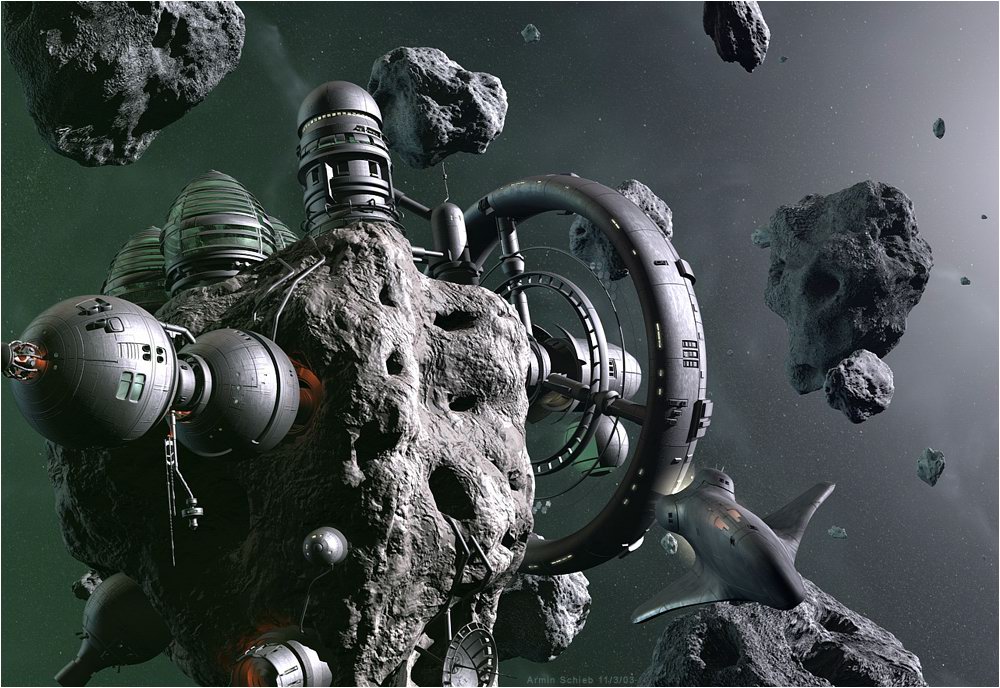
NASA To Turn Asteroid Into Space Station Orbiting The Moon


Image via: Century 22 pbem
National Aeronautics and Space Administration (Nasa) scientists are planning to capture a 500,000 kg asteroid, relocate it and transform it into a space station for astronauts to refuel at on their way to Mars.
This will be the first time a celestial object has ever been moved by humans. 
The White House’s office of science and technology will consider the $2.6 billion plan in the coming weeks as it prepares to set its space exploration agenda for the next decade.
A feasibility report prepared by Nasa and California Institute of Technology scientists outlined how they would go about capturing the asteroid.
An ‘asteroid capture capsule´ will be attached to an old Atlas V rocket and directed to the asteroid between the Earth and the Moon. Once close, the asteroid capsule will release a bag with diameter of 50 feet to wrap around the spinning rock using drawstrings. The craft would then turn on its thrusters, using an estimated 300 kg of propellant, to stop the asteroid in its tracks and tow it into a gravitationally neutral spot. From here space explorers will have a stationary base from which to launch trips deeper into space.
NASA, ... believed that technology would make it possible within 10-12 years. The technology would also open up the possibility of mining other asteroids for their metals and minerals. Some are full of iron which could be used for in the making of new space stations, others are made up of water which could be broken down into hydrogen and oxygen to make fuel.

Saturday, November 17, 2012

The Polaris Moon Rover

Polaris rover will travel to the Moon in search of polar resources, try to survive the long lunar night

The Polaris rover is for catching solar rays which shine almost horizontally at the Moon's north pole, a location Polaris is due to explore before 2016. 

Built by Astrobotic Technology, it'll be ferried aboard the SpaceX Falcon 9 rocket to our celestial companion, where it'll drill into the surface in search of ice

The company, spun out of the Carnegie Mellon Universityhopes to identify resources at a depth of up to four feet that could be used to support manned Moon expeditions in the future. 

The plan is to complete the mission during a 10-day window of sunlight, digging at up to 100 sites over a three-mile stretch. However, if it can live through the harsh two-week-long nights, then it may continue to operate "indefinitely."

NASA is backing the project, providing ice-prospecting gear and money, although Astrobotic hopes to get more cash for its work -- over $20 million from Google's Lunar X Prize


Via: "EnGadget"