Showing posts with label Planet Earth. Show all posts

Thursday, November 07, 2013

What The World Would Look Like If All The Ice Melted


(North America)


(South America)


(Africa)


(Europe)


(Asia)


(Australia)


(Antarctica)

If all of the ice in the world melted, sea levels would raise some 216 feet. But what exactly would that look like? And more specifically, what would such a worse-case scenario mean for the Earth’s population?
National Geographic has created a fascinating visual representation of this thought experiment and provided an analysis of how each continent would be affected by such a catastrophic change.
First off, this is not a blanket statement about climate change. As National Geographic notes, even scientists tracking the melting of ice around the world say it would take some 5,000 years for all the world’s ice to melt.
Still, it’s interesting to look at exactly what would happen if this scenario was taken to its most extreme conclusion.
As a result of the drastic rise in sea levels, the average temperature around the Earth would rise from 58 degrees to 80 degrees.
In North America, the entire Atlantic seaboard would vanish beneath the waves, including Florida and the Gulf Coast. Much of California would be underwater. Millions of Americans would be permanently dislocated from their homes to say nothing of the potentially insurmountable impact on natural wildlife.
And again, this scenario is only based on current population figures. Who knows what the Earth will look like in 5,000 years and how many people will be living here?

In South America, Buenos Aires, coastal Uruguay and most of Paraguay would be submerged.
Africa would technically be largely untouched but much of its would become inhabitable because of the increased temperature. In Egypt, Alexandria and Cairo would be “swamped” by flooding waters from the Mediterranean.
Many of Europe’s greatest landmarks would be destroyed: London would disappear, Venice, gone. The Netherlands and most of Denmark would also be entirely underwater.
In Asia, National Geographic says land currently inhabited by 600 million Chinese would be underwater, as would all of Bangladesh and coastal India.
As for Australia, they would gain a new sea in the center of the continent, but lose the coastal strip where more than 80 percent of the population lives.
And Antarctica? Virtually unrecognizable. After all, that’s where the vast majority of the Earth’s ice resides today.

The Environmental Protection Agency says that overall ice reduction will depend on several factors, including: The rate at which levels of greenhouse gas concentrations in our atmosphere continue to increase, how strongly features of the climate (e.g., temperature, precipitation, and sea level) respond to the expected increase in greenhouse gas concentrations and natural influences on climate (e.g., from volcanic activity and changes in the sun's intensity) and natural processes within the climate system (e.g., changes in ocean circulation patterns)
(Photo credit: Jason Treat, Matthew Twombly, Web Barr, Maggie Smith, NGM Staff; Art: Kees Veenenbos. Sources: Philippe Huybrechts, Vrije Universiteit Brussel; Richard S. Williams Jr., Woods Hole Research Center; James C. Zachos, University of California Santa Cruz; USGS, NOAA, ETOPO1 Bedrock; 1 Arc-Minute Global Relief Model)

Monday, May 13, 2013

Drain The Ocean


Courtesy Of The Discovery Channel

Friday, March 15, 2013

National Geographic Wild Worlds Weirdest Freaks Of Nature


A national geographic documentary on the life of extraordinary species and the way the live and hunt other animals, very thrilling and educational.

Thursday, March 07, 2013

Amazing Planet Earth


Immerse yourself into our amazing planet. For best experience, I recommend you view this in full screen.

Saturday, February 16, 2013

Meteorite Crash In Russia-1


Meteorite Crash In Russia-2


Visualization Of An Asteroid Impact To San Francisco

Sunday, January 27, 2013

Mans Impact On Earth


Man vs. Earth - The Battle Is On

YouTube user Steve Cutts illustrates the fight between humans and the place we all call home. Who will triumph? 

Watch all three-and-a-half minutes to learn the surprising identity of the winner.

Via: "Mashable"

Wednesday, January 16, 2013

Tuesday, January 15, 2013

The Future Says:


Dear mortals;
I know you are busy with your colourful lives;
I have no wish to waste the little time that remains
On arguments and heated debates;
But before I can appear
Please, close your eyes, sit still
And listen carefully
To what I am about to say;
I haven't happened yet, but I will.
I can't pretend it's going to be
Business as usual.
Things are going to change.
I'm going to be unrecognisable.
Please, don't open your eyes, not yet.
I'm not trying to frighten you.
All I ask is that you think of me
Not as a wish or a nightmare, but as a story
You have to tell yourselves -
Not with an ending
In which everyone lives happily ever after,
Or a B-movie apocalypse,
But maybe starting with the line
'To be continued...'
And see what happens next.
Remember this; I am not
Written in stone
But in time - 
So please don't shrug and say
What can we do?
It's too late, etc, etc, etc.
Dear mortals,
You are such strange creatures
With your greed and your kindness,
And your hearts like broken toys;
You carry fear with you everywhere
Like a tiny god
In its box of shadows.
You love festivals and music
And good food.
You lie to yourselves
Because you're afraid of the dark.
But the truth is: you are in my hands
And I am in yours.
We are in this together,
Face to face and eye to eye;
We're made for each other.
Now those of you who are still here;
Open your eyes and tell me what you see.” 

Poem by Nick Drake

Art Name: No-Ticia
By Delacruz-Art
Via: Deviant Art

Sunday, July 29, 2012

The Crisis Of Civilization


A dark comedy remix mash-up bonanza about the end of industrial civilization. 

Website http://crisisofcivilization.com


Listen to our response to some of the your comments herehttp://crisisofcivilization.com/podcast2/


Directed by Dean Puckett


Animations by Lucca Benney

Based on the Book by Nafeez Mosaddeq Ahmed :http://crisisofcivilization.com/book/

Monday, July 23, 2012

Earth: The Making Of A Planet


Imagine cameras have been around since the creation of Earth to record every major event.

Take a photographic journey thorough time from the violent birth of our planet four and a half billion years ago, through ice-ages, massive volcanic eruptions and the dinosaurs' reign to the first humans. For the first time, see the incredible story of our planet unfold in one single, seamless camera move.

Wednesday, July 04, 2012

Northern Lights From Balloon (Project Aether Alaska)

Post by "CavalierZee"


In April 2012, I was part of a team of scientists, teachers and students who travelled to Alaska to observe the Northern Lights or Aurora Borealis. Our mission was a unique one - to launch weather balloons up to 100,000 feet loaded with experiments, tracking devices and HD cameras. This is the result of our trip, produced for Catalyst on ABC1 http://www.abc.net.au/catalyst/

Friday, June 29, 2012

Necessity Is The Mother Of Evolution

Post by "CavalierZee"


If my tongue was as long as the tube-lipped nectar bat, it would be over 9 feet long. It’s only 5 cm long, but has a 9 cm tongue! This uniquely-outfitted creature was only discovered in 2005, and its feeding captured here for the first time by National Geographic cameramen.
By the way, did you know that bats constitute the second largest order of mammals after rodents?! More than 1,200 separate species have been identified.
The tube-lipped nectar bat and its favorite flower food source, C. nigricans, are an amazing example of coevolution. Here’s how it likely worked:
If you’re a flowering plant, your whole goal is to get pollinated. So a nectar-producing flower wants to make its nectar hard enough to reach that a pollinator (like the bat) has to really try to get at their snack, maximizing the potential for rubbing up against the flower and getting a good dusting of pollen. But the flower can’t make it so difficult to reach that the bat goes elsewhere for food. So evolutionary pressure says you might make your nectar tube as long as the bat can reach.
If you’re a bat, your goal is to eat. That means that in addition to learning how to hover like a bird (which is a big deal in itself), you need to possess a tongue that’s long enough to reach down and get your food. Pollen? You don’t eat pollen. You don’t care about pollen. But you just happen to get some on your head while slurping up dinner, and maybe you drop it in the next flower you visit. Evolutionary pressure says that you will be driven to have a long enough tongue in order to reach down into the flower as well as a head that fits inside the flower opening.
That’s exactly what we see here!! Two species triggering change in the other species based on selective pressures. And it’s stunning to behold.


Thursday, June 28, 2012

Earth As Art : Masterpieces Of Stone and Ice

Post by "CavalierZee"


Revel in Earth as Art. Make sure you watch in glorious 1080p. Landsat missions were launched for scientific purposes, but they make up one of the most awe-inspiring collections of beautiful images of our home planet.

For the last few centuries, artists have been exploring Earth's untamed and awe-inspiring vistas, often as an antidote to life in the modern world. They evoked the grandeur of the Hudson River, the peace of Scandinavian fiords, or the omnipotent power of the ocean. This romantic ideal today has gained a new vantage point, from space, and a new set of brushes for capturing the beauty of our planet.

Landsat images feature colors tuned to record geological or even human forces at work. More than that, though, this great gallery of Earth explores its timeless beauty, its uncertain path forward.

So take this tour of Earth's great landforms as seen from space. We travel to Africa and the Sahara and Namib deserts, to Argentina and Bolivia, the American heartland, and the great Canadian land and ice forms. Then it's on to Greenland, Iceland, Russia, India, China, and finally the continent down under.

We wrap our journey in a small corner of the vast Great Sandy Desert. The satellite has brought out the scarring action of natural wildfires. The narrow sand dunes that cut across the scene are like cracks on an ancient brittle canvas. A masterpiece, from the turbulent imagination of an artist, whose brushes are wind, and fire, and time.

Monday, June 18, 2012

Baboons Kidnap and Raise Feral Dogs As Pets

Posted by "CavalierZee"

From the documentary "Animals Like Us"

Saturday, June 16, 2012

TimeScapes: Rapture 4K

Posted by "CavalierZee"

By "Tom Lowe"


"This is production footage from my forthcoming debut film, "TimeScapes," a portrait of the American Southwest. This video was filmed and edited at 4K (4069x2304) resolution, four times greater than regular 1080p HD. A 4K DCP file is available upon request. Shot on Red Epic and Canon RAW still cameras.

You can pre-order the movie "TimeScapes" here: timescapes.org/pre_order.asp

Follow the film here: 


1) twitter.com/timescapes 
2) facebook.com/TimeScapes 
3) gplus.to/tomlowe

If you have a 30" monitor and fast computer you can download a 2560x1440 copy of this video here: red.cachefly.net/TimeScapes4K2560p.mp4 4K version only if you have a 4K monitor or projector: coming soon

Thank you to Terrence Malick and Godfrey Reggio for their support and inspiration. Also thanks to Eric Kessler, Curt Morgan, Jim Jannard, Vincent Laforet, Bruce Allen, Phil Plait, Dave Finley, and to Helio Collective for the beautiful title logo. My most sincere and humble respect to Mark Magidson and Ron Fricke.

Thank you to my sponsors Kessler Crane, Adobe, camBLOCK, Vinten, Canon USA, TVLogic, Borrow Lenses, Wooden Camera, and KATA.

Music by Nigel "John" Stanford: johnstanfordmusic.com"

Earth May Reach Tipping Point


Posted by "CavalierZee"


By ALEXANDER ABAD-SANTOSJUN 7, 2012
Courtesy Of "The Atlantic Wire"


A new study by 22 biologists and ecologists has found that environmental changes on our planet are reaching a point of no return that leads to mass extinctions and harms human welfare. The situation, said one scientist, “scares the hell out of me.” That would be James H. Brown, one of the authors of alarming paper published by Nature, talking to New York Times Green blogger Justin Gillis. Brown is not one of your everyday cranks predicting raptures and the end of days. He is a macroecologist at the University of New Mexico. And as The Atlantic's James Fallows, who pointed out this terrifying study to us, writes, this could be the most important news of 2012. How soon do these scientists expect the world as we know it to end? Gillis writes, "within a few human generations, if not sooner." The most frightening thing is that this finding isn't about what will come if we do not act, but that our effects on the planet's environment -- global warming, population growth, and overall resource extraction -- means that we've already passed a "tipping point." This isn't a plea for change. These are things scientists have been warning us about for decades.
Here's a video from one of the scientists involved: 

Friday, June 15, 2012

Divinity Revealing Itself

Posted by "CavalierZee"


Music: "Velvet Reptile"
Artist: "Solar Fields"


In every moment of every day,
Through a thousand individual manifestations of Itself,
Is Divinity revealing Itself.

Quote by: "Neale Donald Walsch"


Saturday, May 19, 2012

Earth Has Less Water Than You Think


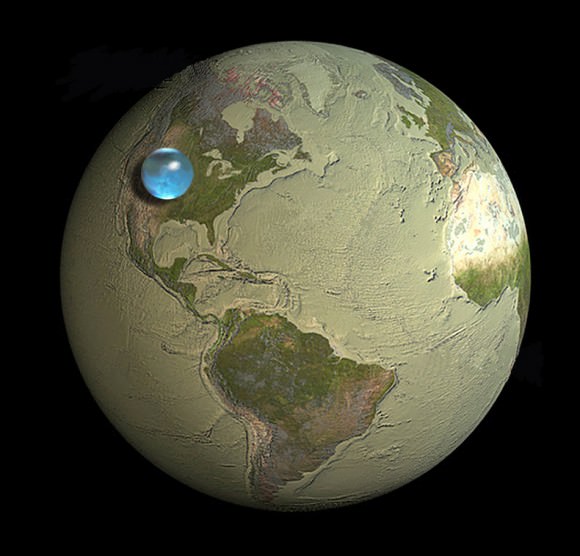
All the water on Earth would fit into a sphere 860 miles (1,385 km) wide. (Jack Cook/WHOI/USGS) 

By JASON MAJOR
On MAY 8, 2012
Courtesy Of "Universe Today"


If you were to take all of the water on Earth — all of the fresh water, sea water, ground water, water vapor and water inside our bodies — take all of it and somehow collect it into a single, giant sphere of liquid, how big do you think it would be? 

According to the U. S. Geological Survey, it would make a ball 860 miles (1,385 km) in diameter, about as wide edge-to-edge as the distance between Salt Lake City to Topeka, Kansas. That’s it. Take all the water on Earth and you’d have a blue sphere less than a third the size of the Moon.
Feeling a little thirsty?
And this takes into consideration all the Earth’s water… even the stuff humans can’t drink or directly access, like salt water, water vapor in the atmosphere and the water locked up in the ice caps. In fact, if you were to take into consideration only the fresh water on Earth (which is 2.5% of the total) you’d get a much smaller sphere… less than 100 miles (160 km) across.
Even though we think of reservoirs, lakes and rivers when we picture Earth’s fresh water supply, in reality most of it is beneath the surface — up to 2 million cubic miles (8.4 million cubic km) of Earth’s available fresh water is underground. But the vast majority of it — over 7 million cubic miles (29.2 cubic km) is in the ice sheets that cover Antarctica and Greenland.
Of course, the illustration above (made by Jack Cook at the Woods Hole Oceanographic Institution) belies the real size and mass of such a sphere of pure liquid water. The total amount of water contained within would still be quite impressive — over 332.5 million cubic miles (1,386 cubic km)! (A single cubic mile of water equals 1.1 trillion gallons.) Still, people tend to be surprised at the size of such a hypothetical sphere compared with our planet as a whole, especially when they’ve become used to the description of Earth as a “watery world”.
Makes one a little less apt to take it for granted.
Read more on the USGS site here, and check out some facts on reducing your water usage here.
Water, water, every where,
And all the boards did shrink;
Water, water, every where,
Nor any drop to drink.
– from The Rime of the Ancient Mariner, Samuel Taylor Coleridge


Tuesday, May 15, 2012

Welcome To The Anthropocene

Posted by "CavalierZee"


A 3-minute journey through the last 250 years of our history, from the start of the Industrial Revolution to the Rio+20 Summit. The film charts the growth of humanity into a global force on an equivalent scale to major geological processes. 

The film was commissioned by the Planet Under Pressure conference, London 26-29 March, a major international conference focusing on solutions.planetunderpressure2012.net

The Anthropocene is a recent and informal geologic chronological term that serves to mark the evidence and extent of human activities that have had a significant global impact on the Earth's ecosystems. 

The term was coined by ecologist Eugene F. Stoermer but has been widely popularized by the Nobel Prize-winning atmospheric chemist Paul Crutzen, who regards the influence of human behavior on the Earth's atmosphere in recent centuries as so significant as to constitute a new geological era for its lithosphere.

In 2008 a proposal was presented to the Stratigraphy Commission of the Geological Society of London to make the Anthropocene a formal unit of geological time.

A large majority of that Stratigraphy Commission decided the proposal had merit and should therefore be examined further. Steps are being taken by independent working groups of scientists from various geological societies to determine if the Anthropocene will be formally accepted into the Geological Time Scale.

Many scientists are now using the term and the Geological Society of America titled its 2011 annual meeting: Archean to Anthropocene: The past is the key to the future. 

The Anthropocene has no precise start date, but based on atmospheric evidence may be considered to start with the Industrial Revolution (late 18th century). Other scientists link it to earlier events, such as the rise of agriculture.

Evidence of relative human impact such as the growing human influence on land use, ecosystems, biodiversity and species extinction is controversial, some scientists believe the human impact has significantly changed (or halted) the growth of biodiversity.

The Anthropocene may have begun as early as 14,000 to 15,000 years before present, based on lithospheric evidence; this has led other scientists to suggest that "the onset of the Anthropocene should be extended back many thousand years"; this would be closely synchronous with the current term, Holocene. 


[Info via: WikiPedia]