


Showing posts with label Peaceful CoExistence. Show all posts
Showing posts with label Peaceful CoExistence. Show all posts
Saturday, August 16, 2014
Jerusalem: Jews, Muslims, Christians Living Under The Ottomans
Incredible footage of Palestine and Jerusalem from the year 1896. Muslims, Jews and Christians lived next to each other and peacefully under the auspices of the Ottoman (Uthmani) Caliphate/Empire.


Tuesday, November 19, 2013
What Europe's Far-Right Parties Can Learn From Islam
By Craig Considine
Today's far-right parties in Europe, such as the National Front in France and the Party for Freedom in Holland, are surging in popularity and calling for legal bans on veils, mosques, minarets, sha'ria, and even the outright expulsion of Muslims from the continent. In short, the far-right perceives Muslims as "inassimilable" and their religion as "evil" and "backward."
Ironically, however, Muslims have a rich history of harmony, justice, and compassion for humanity. These historical facts raise the question of whether Europe's far-right parties should look to Muslim history for direction and guidance in their approach to handling minority communities.
Prophet Muhammad set the precedent for Muslims in regards to tolerance in the Constitution of Medina, one of history's first legal documents to safeguard human rights. Also called the Medina Charter, Prophet Muhammad's Constitution provided equal rights to non-Muslims living under an Islamic government around the year 622. According to the Constitution, "Strangers" in Muhammad's Muslim society were to be treated with special consideration and "on the same ground as [Muslims]."
Six years after creating the Medina Constitution, Muhammad sent a letter to Christian monks at St. Catherine's in the Sinai, Egypt, to show his desire to protect vulnerable religious communities. In the letter, Muhammad offered the Christians peace and called on his fellow Muslims to "defend [Christians], because Christians are my citizens."
Muhammad's letter to the Christian monks also includes advice on how Christian judges are not to be removed from their offices, nor are the monks to be forced out of their monasteries. "No one is to destroy a house of their religion," Muhammad stated, "or to carry anything from it to the Muslims' houses." He added: "Their churches are to be respected. They are neither to be prevented from repairing them nor the sacredness of their covenants."
On Mount Arafat in 632 AD, Muhammad left another "charter" for human rights. In his "Final Sermon," he claimed that "an Arab has no superiority over a non-Arab, nor a non-Arab has any superiority over an Arab... a white person has no superiority over black nor does a black have any superiority over white except by piety and good action." The Final Sermon shows how Muhammad had great care for all people, regardless of their ethnic composition, and that diversity should be celebrated instead of eradicated from society.
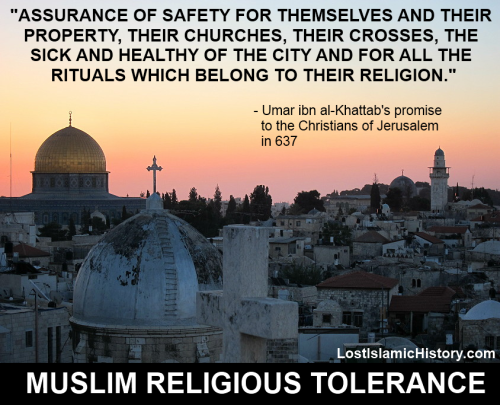
Other Muslims leaders, such as Caliph Umar, advised his predecessors "to treat ahl al-dhimmah (Jews and Christians) well, to defend them against their enemies and not burden them with more than they can bear."
Umar also stated: "Treat all people as equal... I advise you not to let yourself or anyone else do wrong to ahl al-dhimmah." Umar was following in Muhammad's footsteps in treating Jews and Christians as equal to Muslims.
Abu Bakr, one of Muhammad's trusted advisors, is also on record stating that "the most important foundation of a truly Muslim country is justice and equality for all. In fact, a country that is bereft of justice and equality, though it may be inhabited by Muslims, is not really a Muslim country at all."
Another Muslim leader, Akbar the Great of the Mughal Empire, would echo Muhammad, Umar, and Abu Bakr's message of tolerance and harmony centuries later. Upon assuming power, Akbar ended the jizya, or poll tax, on non-Muslims and invited people of all religious backgrounds to his court to engage in interfaith dialogue.
Moreover, Akbar had tremendous respect for Christianity, visible in the Buland Darwaze, a large gate-structure at the city of Fatehpur Sikri, on which he had transcribed the Qur'anic inscription: "Isa [Jesus], son of Mary, said: This world is a bridge. Pass over it, but build no houses on it. He who hopes for an hour may hope for eternity. The world endures but an hour. Spend it in prayer, for the rest is unseen."
Rumi, the famous Sufi poet of the 13th century, also revered Jesus and extended his hand in friendship to non-Muslims. Rumi's most powerful words echo love and peace to all regardless of ethnic background:
I am neither Christian, nor Jewish, nor Muslim I am not of the east, nor of the west... I have put duality away, I have see the two worlds as one; One I seek, One I know, One I see, One I call (Divan-i Sham-i Tabriz, II)
Members of Europe's far-right parties can look to these great Muslim leaders for guidance in how to treat Muslims in their societies. However, Europeans today can also look to the example on their continent - Muslim Spain, between the 8th and 15th centuries - when Muslims ruled a diverse society of Jews and Christians in a relative state of harmony, which was utterly unthinkable in other Christian European cities such as London or Paris.
Muslim Spain reached a state of tolerance which has its very own name - convívencía - which can literally be translated as "living with-ness," or "requiring tolerance."
Perhaps its time for Europeans to adopt a 21st century style convívencía so they can come to grips with what Muslims and Islam can offer to European society.
Tuesday, October 29, 2013
Muslims and Jews Vow To Stand Up For Each Other
By Rabbi Marc Schneier and Russell Simmons
There is a widely accepted belief that Muslims and Jews are enemies and will always remain so. However, nothing could be further from the truth.
For the past six years The Foundation for Ethnic Understanding has not only challenged this narrative, but has facilitated a global dialogue between Muslims and Jews that is taking place on all six populated continents.
This Muslim-Jewish dialogue is our annual Weekend of Twinning which encourages joint Muslim and Jewish programming on the grassroots level in every community across the world where Muslims and Jews reside.
For the past six years The Foundation for Ethnic Understanding has not only challenged this narrative, but has facilitated a global dialogue between Muslims and Jews that is taking place on all six populated continents.
This Muslim-Jewish dialogue is our annual Weekend of Twinning which encourages joint Muslim and Jewish programming on the grassroots level in every community across the world where Muslims and Jews reside.
Our efforts reveal the actual harmony that exists between these two faiths and peoples and here is a video that we produced with Unity Productions Foundation, which documents this global Muslim Jewish coalition that is vowing to stand up for one another by combating Islamophobia, Anti-Semitism and all forms of hatred.
Next month, in cities around the world, these peacemakers will come together and break bread and discuss ways of improving the world as part of the Weekend of Twinning, which officially takes place November 15-17th.
Monday, September 16, 2013
Bosnia Muslims Integrity Model For Europe

Responding to repeated arguments about the integration of Muslims in Europe, a group of scholars and professors have met in Stuttgart to discuss the model of Islam in Bosnia-Herzegovina which accommodated morals of democracy and better interfaith understanding for centuries.
"For one thing, Islam has long been practiced there in a secular environment and in a secular state,” Armina Omerika, Islam scholar at the University of Bochum in western Germany, told Deutsche Welle on Friday, November 25.
“Also, there's a high level of institutionalization of Islam there, and that institutionalization has become the strongest support for the religion in that country."
The calls about integrating Muslims in Europe appeared following 9/11 attacks on the US. Amid such debates, many professors quoted the way Islam is practiced in Bosnia-Herzegovina as the answer for European Muslims.
Bosnia, a small country on the Balkan Peninsula, is home to three ethnic "constituent peoples": mainly Muslim Bosniaks, Serbs and Croats.
Out of Bosnia and Herzegovina's nearly 4 million population, some 40 percent are Muslims, 31 percent Orthodox Christians and 10 percent Catholics.
Living with such diversity, a Muslim institution was created which was modeled on the structures of Christian churches.
Afterwards, the role of the Grand Mufti, the leader of Bosnian Muslims, was established. Omerika believes this kind of organization of the religion could make Islam more welcome in Europe.
"It's this form of institutionalization that represents a known quantity for many Europeans, because they see parallels with religious organization in church structures," he said.
Historically, a tolerant Islam did not stop a Serb aggression in which thousands of Bosnian Muslims in one of the most shocking massacres in modern history.
Bosnia fell into civil war in 1992 that left 200,000 people dead and displaced millions as Serb forces launched ethnic cleansing campaign against Bosnian Muslims.
During the 43-month war, which claimed some 200,000 lives, nearly two million people fled their homes, half a million of them are still listed as refugees.
In the final months of the three-year war, Serb forces, led by General Ratko Mladic, overran Srebrenica, killing some 8,000 Muslim men and boys.
Unique Flavor
While some professors praised Bosnia example of Islam for Europe, the idea of “European Islam” was criticized by many scholars who say Islam is not necessarily a foreign element within Europe.
"The main problem is that there's a basic assumption that Islam is something foreign, something different, something that's not from Europe - and that the religion must therefore be domesticated, Europeanized or nationalized,” said Kerem Öktem of the European Studies Centre at Oxford.
Öktem argues that is not the case, as Islam has existed in Europe for centuries.
He added that Bosnia was not the only example, referring to Turkey, Albania and Bulgaria.
Moreover, there are the Tatars, who've lived in Poland for over 600 years and currently make up under 1 percent of the population.
But, according to Adam Was, an Islamic studies scholar at the Catholic University in Lublin, they've now been joined by a second wave of Muslims from Turkey, Algeria, Albania, Pakistanis and Iranians.
"Those are the students from various Arab lands who came to Poland in the second half of the 20th century. Most married in Poland and started families, and that's how the second group came to be," he said.
Composed of different cultures, an Islam with a European flavor was urged by some scholars to unify a rich and diverse European Muslim community.
"We need an Islam with certain European characteristics: democracy, human rights, freedom of religion," said Was.
"And that's a discussion to which Muslims who have already been in Europe for centuries can contribute."
Saturday, September 14, 2013
The Bosnians’ Coexistence: Long History To Be Read
By Amir Telibečirović
"No 'Westerner' can erase the Islamic influences in Bosnia, and no 'Easterner' can impose their own influences on our way of life."
This statement, overheard at a Sarajevo coffee bar, explains the unique character and identity of Bosnia and Herzegovina.
Despite the conflict of the previous decade, it is still a unique case of a country following a middle path of coexistence between individuals with different religions and ethnicities.
Islam was introduced to Bosnians in the 15th and 16th centuries during the Ottoman Empire.
Bosnian Muslims, ethnically identified as Bosniaks, have long been neighbors with ethnic Serbs who are largely Orthodox Christian, predominantly Catholic Croats and other ethnic and religious minorities, such as Sephardic Jews, Albanians, Roma and others.
If you talk to members of the older generation in Bosnia and Herzegovina, they will recall a time when Yugoslav communist leader Josip Broz Tito pointed to Bosnia and Herzegovinia as a model for Yugoslavia to coexist without conflict.
Though there has been intolerance and conflict between members of various religious and ethnic groups, tensions never pitted the entire populations of one group against another. Most conflicts in Bosnia's history were imported or orchestrated from Istanbul, Vienna, Berlin, Belgrade and Zagreb – for territorial occupation or the exploitation of local natural resources.
 |
| Since the war, however, restoring the middle path of coexistence has been the goal of ordinary Bosnians working with non-governmental organizations in local cities. |
The War Woes…
One critical exception in recent history was the Bosnian War (1992 to 1995), which erupted as a result of the breakup of Yugoslavia and brought much misery and destruction to the region.
But after the Dayton Peace Accords in 1995, which brought an end to the three-year war, refugees returned to their homes to find their cities divided – sometimes physically – along ethnic lines. And local laws limiting freedom of movement exacerbated these tensions and obstructed reconciliation efforts.
As a result, parts of Bosnia and Herzegovina remain divided – politically, religiously and ethnically – even today.
Since the war, however, restoring the middle path of coexistence has been the goal of ordinary Bosnians working with non-governmental organizations in local cities.
Reconstruction has served as a way for various groups to work together for a common good. Non-governmental organizations such as the Sarajevo-based International Forum Bosnia, which houses the Center for Interreligious Dialogue and facilitates dialogue among different religious groups, and the International Mennonite Organization which aids in home reconstruction and youth programs, are hard at work to ease remaining tensions in this post-conflict society.
But what is the most notable are those places where coexistence between ordinary people of different religions and ethnicities never stopped, not even during the war. These are the communities that the rest of the region can learn from, the people that adhered to the middle path and refused to align with those who committed acts of violence along ethnic or religious lines and turned against their neighbors in times of trouble.
 |
| Despite the violent upheaval in the 1990s and the tumultuous years that followed, coexistence amongst the diverse population of Bosnia and Herzegovina has endured. |
Cities like Sarajevo, Mostar and Tuzla, were known to have the largest inter-ethnic populations in the Balkans. In various sieges throughout the war, neighbors came together, regardless of ethnicity or religion, to protect one another and their towns from destruction. In fact, the heavy artillery raining down upon them created solidarity among them, instead of separating them.
Historically, neighborhoods in these cities were not divided between one group or another. There had been inter-ethnic and inter-religious mixing for generations, and this kind of coexistence was considered the norm, unlike other towns in the region where one ethnic or religious group comprised the majority.
This attitude of coming together during the war demonstrated that not all communities can be driven apart along ethnic or religious lines, even in times of war. In fact, people of various backgrounds came together in reaction to the aggressive attempts to divide them.
Despite the violent upheaval in the 1990s and the tumultuous years that followed, coexistence amongst the diverse population of Bosnia and Herzegovina has endured.
The resilience of the people in the region, particularly those still working to build united communities out of divided groups, serves as an example not only in the Balkans, but for conflict-torn countries around the world.
Subscribe to:
Posts (Atom)
