Showing posts with label Islamic Sharia. Show all posts

Monday, January 26, 2015

What Is Islamic Democracy?


Islamic Democracy refers to a political ideology that seeks to apply Islamic principles to public policy within a democratic framework. In practice, there are three kinds of political systems in the Muslim-majority countries today; the basis of the distinction between them has to do with how comprehensively Islam is incorporated into the affairs of the state:
  1. Secular democracies, in secular states such as Azerbaijan and Turkey, that do not recognize any religion as its state religion and, therefore, does not incorporate religious principles into its public policy and other state affairs.
  2. Religious democracies; that recognize Islam as its state religion and a source of legislation, such as Malaysia and Maldives. The application of religious principles into public policy varies from country to country, since Islam is not the only source of law, such as Pakistan.
  3. Theocracies; that endeavor to institute Sharia, in full force,[1] and offers more comprehensive inclusion of Islam into the affairs of the state. Presently, Iran is the only example of an Islamic state in the form of Islamic republics.
The concepts of liberalism and democratic participation were already present in the medieval Islamic world. The Rashidun Caliphate is perceived by its proponents as an early example of a democratic state.

The key features of Islamic governance that I have found in Islamic sources – Quran and the Prophetic precedence (Sunnah), and contemporary Muslim discussions on the Islamic State – are Constitution,Consent, and Consultation. Muslims who seek to implement the Shariah are obliged to emulate the Prophet’s precedence and, given the rather narrow definitions of Shariah and Sunnah that most Islamist operate with, there is no escape for them from the three key principles identified here. While these principles need to be explored and articulated in the specific socio-cultural context of different Muslim societies, it is important to understand that they are essential.
Constitution
The compact, or constitution, of Medina that Prophet Muhammad adopted provides a very important occasion for the development of Islamic political theory. After Prophet Muhammad migrated from Mecca to Medina in 622 CE, he established the first Islamic state. For ten years, Prophet Muhammad was not only the leader of the emerging Muslim community in Arabia, but also the political head of the state of Medina. As the leader of Medina, Prophet Muhammad exercised jurisdiction over Muslims as well as non-Muslims. The legitimacy of his sovereignty over Medina was based on his status as the Prophet of Islam, as well as on the basis of the compact of Medina.
As Prophet of God, he had sovereignty over all Muslims by divine decree. But Muhammad did not rule over the non-Muslims of Medina because he was the messenger of Allah. He ruled over them by virtue of the compact that was signed by the Muhajirun (Muslim immigrants from Mecca), the Ansar (indigenous Muslims of Medina), and the Yahud (several Jewish tribes that lived in and around Medina). It is interesting to note that Jews were constitutional partners in the making of the first Islamic state.
The compact of Medina can be read as both a social contract and a constitution. A social contract, a model developed by English philosophers Thomas Hobbes and John Locke, is an imaginary agreement between people in the state of nature that leads to the establishment of a community or a State. In the state of nature people are free and are not obliged to follow any rules or laws. They are essentially sovereign individuals. However, through the social contract they surrender their individual sovereignty to a collective one and create a community or a State.
The second idea that the compact of Medina manifests is that of a constitution. In many ways, the constitution is the document that enshrines the conditions of the social contract upon which any society is founded. The compact of Medina clearly served a constitutional function, since it was the constitutive document for the first Islamic state. Thus, we can argue that the compact of Medina serves the dual function of a social contract and a constitution. Clearly the compact of Medina by itself cannot serve as a modern constitution. It would be quite inadequate, since it is a historically specific document and quite limited in its scope. However, it can serve as a guiding principle to be emulated, rather than a manual to be duplicated. Today, Muslims worldwide can emulate Prophet Muhammad and draw up their own constitutions, historically and temporally specific to their conditions.
Consent
An important principle of the Constitution of Medina was that Prophet Muhammad governed the city-state of Medina by virtue of the consent of its citizens. He was invited to govern, and his authority to govern was enshrined in the social contract. The constitution of Medina established the importance of consent and cooperation for governance.
The process of bayah, or the pledging of allegiance, was an important institution that sought to formalise the consent of the governed. In those days, when a ruler failed to gain the consent of the ruled through a formal and direct process of pledging of allegiance, the ruler’s authority was not fully legitimised. This was an Arab custom that predates Islam, but, like many Arab customs, was incorporated within Islamic traditions. Just as Prophet Muhammad had done, the early Caliphs of Islam, too, practiced the process of bayah after rudimentary forms of electoral colleges had nominated the Caliph, in order to legitimise the authority of the Caliph. One does not need to stretch one’s imagination too far to recognise that in polities that have millions rather than hundreds of citizens, the process of nomination followed by elections can serve as a necessary modernisation of the process of bayah. Replacing bayah with ballots makes the process of pledging allegiance simple and universal. Elections, therefore, are neither a departure from Islamic principles and traditions, nor inherently un-Islamic in any form.
The Quran, too, recognises the authority of those who have been chosen as leaders, and in a sense extends divine legitimacy to those who have legitimate authority.
O you who believe! Obey Allah and obey the Messenger and
those in authority from among you. [Quran 4:59] 
Consultation
The third key principle of Islamic governance is consultation, or Shura in Arabic. This is a very widely known concept, and many Islamic scholars have advanced the Islamic concept of Shura as evidence for Islam’s democratic credentials. Indeed, many scholars actually equate democracy with Shura. 
…and consult them in affairs (of moment). 
Then, when thou hast taken a decision put thy trust in Allah. [Quran 3:159]
[righteous are those] …who conduct their affairs through [shura baynahum] mutual Consultation. [Quran 42:38]
Muslim scholars dispute whether the Quranic injunction for consultation is advisory or mandatory, but it nevertheless remains a divine sanction. Pro-democracy Muslims see it as necessary, and those who fear democratic freedoms and prefer authoritarianism interpret these injunctions as divine suggestions and not divine fiats. The Prophet himself left behind a very important tradition that emphasised the importance of collective and democratic decision making. He said that “the community of Muhammed will never agree upon error.” Consultative governance, therefore, is the preferred form of governance in Islam, and any Muslim who chooses to stay true to his faith sources cannot but prefer a democratic structure over all others to realise the justice and wellbeing promised in Islamic sources.
Conclusion 
There is much in Islamic sources and Islamic tradition that is favorable to making democracy the vehicle for delivering the products of Islamic governance, such as social justice, economic welfare, and religious freedoms. I am convinced that Islam is not a barrier to, but instead a facilitator of, democracy, justice, and tolerance in the Muslim world. That said, for that to happen, Muslims must revisit their sources and re-understand them without a bias against things that they erroneously label as Western. Democracy is inherent to Islamic values and Islamic historical experience.
References 
Al-Raysuni, Ahmad. Al-Shura: The Quranic Principle of Consultation (London: International Institute of Islamic thought, 2011).
El Fadl, Khaled Abou, et al. Islam and the Challenge of Democracy (Princeton, NJ: Princeton University Press, 2004).
Esposito, John L., Mohammed A. Muqtedar Khan, and Jillian Schwedler. “Religion and Politics in the Middle East.” Understanding the Contemporary Middle East (Boulder and London: Lynne Rienner Publishers, 2000).
Esposito, John L. and John O. Voll. Islam and Democracy (New York: Oxford University Press, 1996).
Haykal, M. H. The Life of Muhammad (trans.) Ismael R. Al Faruqi (Indianapolis: NAIT, 1988), pp. 180-83.
Khan, Muqtedar. “Shura and Democracy.” Ijtihad.Org.
Khan, M. A. Muqtedar. Debating Moderate Islam: The Geopolitics of Islam and the West (Salt Lake, Utah, University of Utah Press, 2007).
Khan, Muqtedar Khan. “Islam, Democracy and Islamism after the Counterrevolution in Egypt.” Middle East Policy XXI.1 (2014): 75-86.
Khan, M. A. Muqtedar. “The Islamic States,” in M. Hawkesworth and M. Kogan (Eds.), Encyclopedia of Government and Politics, (London: Routledge Press, 2003).
Siddiqui, A. H. The Life of Muhammad (Des Plaines, IL: Library of Islam, 1991).
By M.A. Muqtedar Khan is Associate Professor in the department of Political Science and Contributors International Relations at the University of Delaware and a Fellow of the Institute for Social Policy and Understanding.

Friday, January 16, 2015

Rabbi Admits Islam Is The Oldest Religion


"A common root, a common faith, a fundamental religion in which all men are born into... This fundamental faith is called: Islam."

"Islam is an ancient religion. Islam is the religion of Noah. Islam is the religion of Adam himself."

Monday, June 30, 2014

Ireland ‘The Most Truly Muslim Country In The World’


The country in the world most faithful to the values of the Koran is Ireland according to an Iranian-born academic at George Washingon University in the US. Next areDenmarkSweden and the UK.

Not a single majority Muslim country made the top 25 and no Arab country is in the top 50.
... when their ‘Islamicity index’ was applied onlyMalaysia (33) and Kuwait (42) featured in its top 50 countries, compared to the US at 15, the Netherlands also at 15, whileFrance is at 17.
Saudi Arabia rated 91st, with Qatar at 111st.
In carrying out the study, they applied the ideals of Islam in the areas of a society’s economic achievements, governance, human and political rights, and international relations.
On that index “Muslim countries do very badly,” and accused them of using religion as an instrument of power.
Last Novembe Prof Askari said that “we must emphasize that many countries that profess Islam and are called Islamic are unjust, corrupt, and underdeveloped and are in fact not ‘Islamic’ by any stretch of the imagination.”
“Looking at an index of Economic Islamicity, or how closely the policies and achievements of countries reflect Islamic economic teachings - Ireland, Denmark, Luxembourg, Sweden, the United KingdomNew ZealandSingaporeFinlandNorway, and Belgium round up the first 10”.
In their ‘Overall Islamicity Index’, a measure that encompasses laws and governance, human and political rights, international relations, and economic factors, “the rankings are much the same: New Zealand, Luxembourg, Ireland, Iceland, Finland, Denmark,Canada, the United Kingdom, Australia, and the Netherlands; and again only Malaysia (38) and Kuwait (48) make it into the top 50 from Muslim countries,” he said.
“If a country, society, or community displays characteristics such as unelected, corrupt, oppressive, and unjust rulers, inequality before the law, unequal opportunities for human development, absence of freedom of choice (including that of religion), opulence alongside poverty, force, and aggression as the instruments of conflict resolution as opposed to dialogue and reconciliation, and, above all, the prevalence of injustice of any kind, it is prima facie evidence that it is not an Islamic community, ...
“ Islam is, and has been for centuries, the articulation of the universal love of Allah for his creation and for its unity, and all that this implies for all-encompassing human and economic development.

Tuesday, November 19, 2013

What Europe's Far-Right Parties Can Learn From Islam


By Craig Considine

Today's far-right parties in Europe, such as the National Front in France and the Party for Freedom in Holland, are surging in popularity and calling for legal bans on veils, mosques, minarets, sha'ria, and even the outright expulsion of Muslims from the continent. In short, the far-right perceives Muslims as "inassimilable" and their religion as "evil" and "backward."
Ironically, however, Muslims have a rich history of harmony, justice, and compassion for humanity. These historical facts raise the question of whether Europe's far-right parties should look to Muslim history for direction and guidance in their approach to handling minority communities.
Prophet Muhammad set the precedent for Muslims in regards to tolerance in the Constitution of Medina, one of history's first legal documents to safeguard human rights. Also called the Medina Charter, Prophet Muhammad's Constitution provided equal rights to non-Muslims living under an Islamic government around the year 622. According to the Constitution, "Strangers" in Muhammad's Muslim society were to be treated with special consideration and "on the same ground as [Muslims]."
Six years after creating the Medina Constitution, Muhammad sent a letter to Christian monks at St. Catherine's in the Sinai, Egypt, to show his desire to protect vulnerable religious communities. In the letter, Muhammad offered the Christians peace and called on his fellow Muslims to "defend [Christians], because Christians are my citizens." 
Muhammad's letter to the Christian monks also includes advice on how Christian judges are not to be removed from their offices, nor are the monks to be forced out of their monasteries. "No one is to destroy a house of their religion," Muhammad stated, "or to carry anything from it to the Muslims' houses." He added: "Their churches are to be respected. They are neither to be prevented from repairing them nor the sacredness of their covenants."
On Mount Arafat in 632 AD, Muhammad left another "charter" for human rights. In his "Final Sermon," he claimed that "an Arab has no superiority over a non-Arab, nor a non-Arab has any superiority over an Arab... a white person has no superiority over black nor does a black have any superiority over white except by piety and good action." The Final Sermon shows how Muhammad had great care for all people, regardless of their ethnic composition, and that diversity should be celebrated instead of eradicated from society.
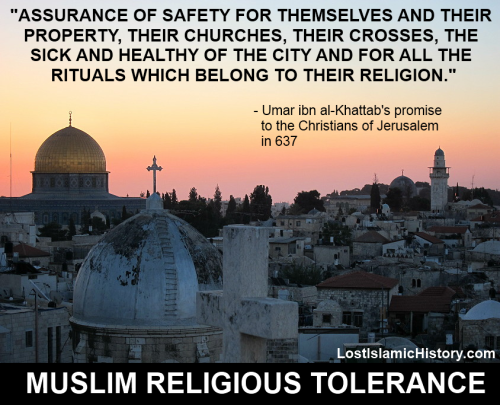
Other Muslims leaders, such as Caliph Umar, advised his predecessors "to treat ahl al-dhimmah (Jews and Christians) well, to defend them against their enemies and not burden them with more than they can bear." 
Umar also stated: "Treat all people as equal... I advise you not to let yourself or anyone else do wrong to ahl al-dhimmah." Umar was following in Muhammad's footsteps in treating Jews and Christians as equal to Muslims.
Abu Bakr, one of Muhammad's trusted advisors, is also on record stating that "the most important foundation of a truly Muslim country is justice and equality for all. In fact, a country that is bereft of justice and equality, though it may be inhabited by Muslims, is not really a Muslim country at all."
Another Muslim leader, Akbar the Great of the Mughal Empire, would echo Muhammad, Umar, and Abu Bakr's message of tolerance and harmony centuries later. Upon assuming power, Akbar ended the jizya, or poll tax, on non-Muslims and invited people of all religious backgrounds to his court to engage in interfaith dialogue.
Moreover, Akbar had tremendous respect for Christianity, visible in the Buland Darwaze, a large gate-structure at the city of Fatehpur Sikri, on which he had transcribed the Qur'anic inscription: "Isa [Jesus], son of Mary, said: This world is a bridge. Pass over it, but build no houses on it. He who hopes for an hour may hope for eternity. The world endures but an hour. Spend it in prayer, for the rest is unseen." 
Rumi, the famous Sufi poet of the 13th century, also revered Jesus and extended his hand in friendship to non-Muslims. Rumi's most powerful words echo love and peace to all regardless of ethnic background:
I am neither Christian, nor Jewish, nor Muslim I am not of the east, nor of the west... I have put duality away, I have see the two worlds as one; One I seek, One I know, One I see, One I call (Divan-i Sham-i Tabriz, II)
Members of Europe's far-right parties can look to these great Muslim leaders for guidance in how to treat Muslims in their societies. However, Europeans today can also look to the example on their continent - Muslim Spain, between the 8th and 15th centuries - when Muslims ruled a diverse society of Jews and Christians in a relative state of harmony, which was utterly unthinkable in other Christian European cities such as London or Paris.
Muslim Spain reached a state of tolerance which has its very own name - convívencía - which can literally be translated as "living with-ness," or "requiring tolerance." 
Perhaps its time for Europeans to adopt a 21st century style convívencía so they can come to grips with what Muslims and Islam can offer to European society.

Monday, March 18, 2013

What Is Shariah and Why Does It Matter?


Sherman A. Jackson writes:


At the most basic level, shariah is the Muslim universe of ideals. It is the result of their collective effort to understand and apply the Quran and supplementary teachings of the Prophet Muhammad (called Sunna) in order to earn God's pleasure and secure human welfare in this life and attain human salvation in the life to come. While the Quran and Sunna are transcendent and unchangeable, shariah itself is the negotiated result of competing interpretations. In fact, most Muslims tend to speak not of shariah but of fiqh, which literally means "understanding" and underscores the distinction between God's prescriptions on the one hand and the human attempt to understand these on the other. This in turn explains two other unavoidable characteristics of shariah: diversity of opinion, and inevitable change. In Sunni Islam (and to do Shiism justice would require a separate treatment) there are four "schools" of fiqh, all equally orthodox, all equally authoritative. This is because Sunnism never established a single ecclesiastical authority or "church" to decide doctrine. Instead, the only doctrines deemed binding on the community as a whole were those on which the community's scholars reached a unanimous -- not majority! -- consensus. In the absence of this, competing parties would simply have to agree to disagree, as no school or individual -- not even the Caliph or temporal ruler -- could claim the infallible right to impose a doctrine as unassailable truth.
As for change, the rules of shariah are divided into two categories: religious observances (prayer, fasting, etc.) and civil-criminal matters (marriage, sales, adultery, jihad, etc.). While religious observances are relatively static and fixed, the rules on civil-criminal matters are subject to change in accordance with circumstances. Here, in fact, we come to a fourth important feature of shariah: in addition to interpreting scripture in order to apply it to reality, shariah also includes the attempt to process reality to determine how scripture, Prophetic teaching and the cumulative tradition of deliberation would have one respond to it. In this capacity, shariah may end up sanctioning, or even including, all kinds of ideas and institutions that were not dictated by scripture. For example, there were no domes, schools of fiqh or minarets in the Prophet's Arabia. Likewise, the fact that there was no democracy or "human rights" does not automatically render these "un-Islamic." In short, shariah includes the attempt to proffer God-conscious responses to an ever-changing reality. And in this capacity, many of its rules are subject to change with changes in the circumstances to which it seeks to respond.
Having said all of this, shariah is not just "rules." While the common translation, "Islamic law," is not entirely wrong, it is under-inclusive, for shariah includes scores of moral and ethical principles, from honoring one's parents to helping the poor to being good to one's neighbor. Moreover, most of the "rules" of shariah carry no prescribed earthly sanctions at all. The prescriptions covering ablution or eating pork or how to dress are just as much a part of shariah as are those governing sale, divorce or jihad. Yet there are no earthly punishments prescribed for those who violate these dictates. Like the bulk of shariah's "rules," reward and punishment in these areas are the preserve of God in the Afterlife.
Unfortunately, many Americans have been led to believe that shariah equals not only rules but criminal punishments -- floggings, for example. Three quick points: First, criminal sanctions constitute a tiny sliver of shariah. Of the 1,081 pages of the two-volume Arabic text from which I studied shariah, only 60 pages were devoted directly to criminal sanctions! (Jihad, incidentally, took up only 19.) Second, the criminal sanctions of shariah did not emerge as the property or instrument of the Muslim state but functioned in fact to impose limits on the use of state power. Third, the punishments for criminal behavior cannot be separated from the evidentiary rules -- equally shariah! -- that provide for their application (e.g., multiple eye-witnesses). In practical terms, in other words, short of confession, rules on such things as adultery or fornication function almost entirely as moral exhortations. God-consciousness spawned by shariah, not fear of being punished, sustains these ideals. Of course, many Americans will object that such issues should not be subject to any rules or religious exhortations at all. But given some of our increasingly worrisome realities (out-of-wedlock births, etc.), perhaps this would make for fruitful conversation.
Why does shariah matter? It matters for Muslims because it represents the ideals that define a properly constituted Islamic existence. Islam without shariah would be Islam without Islamic ideals. While most non-Muslim Americans may think of Islam without shariah as simply Islam without rules or criminal sanctions, for Muslims Islam without shariah would also mean Islam without prescriptions on ablution, prayer, alms, sales, diet, filial piety, civics, etc. While the discourse in America around shariah will probably continue to succumb to the self-serving tendency to "compare my ideals with your realities," shariah itself will continue to inspire Muslims, especially in their personal lives, to strive, with hope and humility, to narrow the gap between the unacceptable "is" and the ever-elusive "ought."
 

Saturday, February 09, 2013

Prophet Muhammad's Views On Slavery


Islam and Slavery:


In Sharia (Islamic law), the topic of Islam and slavery is covered at great length. The legal legislations brought two major changes to the practice of slavery inherited from antiquity, from Ancient Rome, and from the Byzantine Empire, which were to have far-reaching effects. 

The Qur'an considers emancipation of a slave to be a highly meritorious deed, or as a condition of repentance for many sins. The Qur'an and Hadith contain numerous passages supporting this view.  In chapter 2 , verse 177, God says most emphatically:

“ It is not righteous that ye turn your faces towards east or west; but it is righteousness - to believe in God and the Last Day, and the Angels, and the Book, and the Messengers; to spend of your substance, out of love for Him, for you kin, for orphans, for the needy, for the wayfarer, for those who ask, and for the ransom of slaves; to be steadfast in prayer and to practice regular charity, to fulfil the contracts which ye have made and to be firm and patient. Such are the people of truth and God-fearing”.

People Personally Freed By Prophet Muhammad:

Muhammad encouraged manumission of slaves, even if one had to purchase them first. Traditional biographies of Muhammad give many examples where Muhammad's companions, at his direction, freed slaves in abundance. Abul Ala Maududi reports that Muhammad freed as many as 63 slaves. Meer Ismail, a medieval historian, writes in Buloogh al Muram that his household and friends freed 39,237 slaves.

It was a practice and tradition of Muhammad to release from captivity those females who would face the risk of being disgraced or humiliated as a result of being held as captives or slaves, and those who came from respected backgrounds that were known for their philanthropic contributions to the general masses, regardless if their charitable deeds benefited Muslims or non-Muslims.

During the lifetime of Muhammad, the tribe of Tayy that lived to the northeast of the city of Medina, engaged in banditry and highway robbery, and came in conflict with the Muslims of Medina, which led to battles between them that led to the Tayy's defeat, and the subsequent captivity of some of their tribes folk.

Abū Ḥāmed Muḥammad ibn Muḥammad Ghazālī narrated in his Ihya' ulum al-din (Ihya'e UlumuddinThe Revival of Religious Sciences), that when the daughter of Hatim al-Tai, Safana bint Hatem, was taken as a captive, she came to Muhammad asking for her release, and not to be made a subject of humiliation amongst the various Arab quarters, as her father, Hatim al-Tai, was a person who used to aid the needy, feed the hungry, spread greetings, free slaves, and never refused an assisting request; to which Muhammad replied that these described qualities of her father are those of the believers, and if her father was a Muslim then indeed he would have asked for (Divine) mercy on him. He then asked his companions to release her stating that her father loved the noble-character, and God loves the noble-character. The Prophet said: “Whoever frees a slave, Allah will save all the parts of his body from the Fire, as he has freed the body-parts of the slave.” (Bukhari, vol 3, hadith no. 693)

Female Slaves

  • Safiyya bint Huyayy, according to Islamic accounts she adopted Islam and became a wife of Muhammad. She lived more than a decade after him as a widow and became involved in the first power politics of the early Muslim community and left a large inheritance to her Jewish family.
  • Maria al-Qibtiyya, a Coptic slave given to Muhammad by Muqawqis, a Byzantine official. She gave birth to Ibrahim ibn Muhammad whom Muhammad loved dearly. Some sources indicate that she was freed and became Muhammad's wife.
  • Rayhana, captured after siege of Banu Qurayza.

Male Slaves

  • Zayd ibn Harithah, was freed to become Muhammad's adopted son, until adoption was replaced with guardianship in Islam, upon which Muhammad became his guardian.


Sunday, November 11, 2012

Jewish Sages On “Lesser Jihad” and “Greater Jihad”

By Svend White,


There is a famous hadith wherein the Prophet, peace be on him, tells followers returning from a battle, “You have returned from the lesser jihad to the greater jihad…the struggle against one’s self [nafs].”  This tradition is one of the classic sources for the widespread interpretation of Jihad as a primarily personal spiritual struggle against ones own sinful inclinations and only secondarily a military conflict.  (Incidentally, on this point, Islamophobes eagerly endorse the worldview of jihadis and fundamentalists, arguing that this longstanding reading is a fringe “Sufi” reading, despite the fact that it is implied by numerous verses in the Quran.)

Obviously, this prophetic saying has inspired countless Muslims for centuries, but it turns out it and other Sufi teachings have even been borrowed by Jewish sages and incorporated in their own spiritual teachings.


Muslim influence can sometimes be found far from Arabia.  The first book of Eastern European Hasidism, Toledot Yaakov Yosef by Rabbi Yaakov Yosef of Polnoye, disciple of the Baal Shem Tov (1780) twice includes the saying:  “The wise man has said:  You have returned from the minor war, now prepare yourselves for the major war”.  That is, prepare for spiritual struggle which is more important than any material struggle. This is a well-known Sufi saying, usually attributed to Muhammad.  It probably found its way into Hasidic tradition through its appearance in Rabbenu Bachya’s Duties of the Heart.  Rabbenu Bachya included many Sufi teachings and stories in his work, ascribing them to anonymous sages. (see Paul Fenton, “Judaeo-Arabic Mystical Writings of the XIIIth-XIVth Centuries”, in Golb, Judaeo-Arabic Studies (1997), 89.)

Personally, I’ve long been struck by how philosophically kindred Hasidism seems to the Sufi tradition in Islam, but I couldn’t have asked for a more dramatic confirmation of the shared spiritual heritage of Islam and Judaism than this.  

Everyone who’s reasonably well informed knows about the deep parallels between Islamic shariah and Jewish halakha, but who would’ve guessed that Jewish scholars had freely borrowed from Sufism in this manner?

And the fact that these Jewish scholars were not only inspired by Islamic mysticism but specifically by Islamic teachings on jihad—yes, jihad—is doubly intriguing as it not only displays a deep affinity for and awareness of Islamic thought, but shows that great Jewish mystics customarily viewed as apolitical pacifists could understand warfare in much the same way as traditional Muslim scholars.

Sunday, June 24, 2012

Heaven on Earth: A Journey Through Sharia Law

By Eric Walberg.
Wednesday, Jun 13, 2012
Courtesy Of "Axis Of Logic"


by Sadakat Kadri
New York: Farrar, Straus and Giroux, 2012
 
There are 50 Muslim-majority states in the world; 11 of them, including Egypt, have constitutions that acknowledge Islam as a source of national law. In Heaven on Earth, Sadakat Kadri, an English barrister and New York attorney, provides a much-needed and highly readable overview of Islamic legal history and an entertaining survey of the state of Islamic law today, full of fascinating anecdotes.

For instance, have you heard the one about the eleventh-century Sufi mystic whose prayers were interrupted by a familiar voice: "Oh, Abu Al-Hasan!" it boomed. "Do you want me to tell people what I know about your sins, so that they stone you to death?" "Oh, Lord," Al-Hasan whispered back. "Do you want me to tell people what I know about your mercy, so that none will ever feel obliged to bow down to you again?" "Keep your secret," came God's conspiratorial reply. "And I will keep mine."

Such risqué offerings aside, Kadri looks at the development of Islamic law from the time of the Prophet, focussing on attitudes to war, criminal justice, religious tolerance, and movements of reform through history. He provides valuable background for all those concerned and/or excited about today's resurgence of Islam. As the fastest growing religion, second only to Christianity in numbers (and surely first in terms of sincere practitioners), Islam is an increasingly powerful force not only in the world of religion, but in the realms of culture, politics and even economics.

The conventional wisdom about Islamic law is that the Prophet set out the legal basics in the Medinah surahs, the sharia, which was later codified as fiqh (jurisprudence) under the Umayyad and Abbasid caliphates as the four schools -- Hanafi, Maliki, Shafii and Hanbali. The original dynamism of Islamic jurisprudence, characterised especially in the Hanafi school by ijtihad (legal interpretation) was lost and "the gates of ijtihad closed" by the 14th century, as the Mongols devastated the Muslim world.

Today's Islam is supposedly eight centuries out of date and, according to the likes of religious scholar Hans Kung, needs both a Reformation and an Enlightenment a la Western civilisation to bring it into the 21st century.

The truth is very different. Yes, there was a burst of creativity in the 8th-11th centuries, which resulted in the Islamic world being far more "civilised" than a Europe stumbling through the Dark Ages. The transformation of sharia into fiqh began under the Abbasid Caliph Al-Mahdi (ruled 775-785), when the rising class of religious scholars (ulama) and the law itself gradually became independent of the ruler, and legal decisions had to be "witnessed and validated by upstanding men of the Muslim community, bound by oath: a jury, some four hundred years older than its English equivalent".

Interpretation, reasoning by analogy, consensus, and consultation flourished, creating a body of legal theory that did not so much "close" by the 14th century, but achieved a completeness that ensured that Islam would spread and remain the most vibrant of the world's religions over time. Kadri describes the development of Islamic fiqh as an "immense achievement. Formulated over the course of a few centuries, it took root across three continents and outshone Christendom for almost a millennium." It adapted to local conditions and customs, and "helped bind civilisations that were as diverse as any the world has seen."

The problem, as Kadri argues, is in the past century, especially the past "four decades of legal revivalism", that "have promoted theories that are eliminating space for fresh ideas and dissent wherever they gain ground".

Kadri provides a dispassionate analysis of the rise of violence within Islam which occurred since the 1970s, pointing to the Wahhabi movement, which in turn was inspired by a late arrival to fiqh -- the 13th century Ahmed Ibn Taymiyya, and his pupil Ibn Qayyim, whose stern warnings against apostasy and devotion to the salafi (the first few generations of Muslims) provide the stereotype of the austere and rigid approach to Islam so prominent in Western discourse today, one which indeed refuses innovation, calling on followers to imitate those who lived in the heroic period of Islamic history (taqlid).

The author traces how in the past few decades the call to violence and to the overthrow of kafir (unbeliever) leaders led to justifying killing of Muslims and anyone else who got in the way. Such innovations were formulated by the Egyptian Ayman Al-Zawahiri and Saudi Osama Bin Laden, inspired by their own reading of Ibn Taymiyya and the writings of Egyptian Sayyid Qutb in the 1960s.

But a higher proportion of US Muslims condemn military attacks on civilians than do Christian or Jewish Americans, and most victims of so-called Islamic terrorism are Muslims. Though he downplays the overwhelming violence of the US in its many wars over the past half-century, beside which Islam-inspired violence pales, Kadri does point out that violence is promoted just as much by such Islamophobes as Oslo-based American Bruce Bawer, author of While Europe Slept: How Radical Islam Is Destroying the West from Within (2010). Bawer argues -- hysterically -- that Europeans are yielding up their freedoms to the Muslim invaders, and that Muslims are reproducing "beyond the point of no return", which will soon mean "subservience or civil war" in Europe. Fellow Osloite Anders Breivik made 22 references to Bawer's writing in his online justification of the murder of more than 70 Norwegians in July 2011.

How Muslim emigres fit in to their new societies these days is an important theme in Heaven on Earth. The US is built on a culture of mass immigration and rapid assimilation, and despite the Islamophobia of especially the post 9/11 era, Muslims have adapted well to life in America and have prospered. In contrast, "Britain has historically received newcomers with a combination of curiosity, hostility, and indifference" fostering a "self-absorption in immigrant communities". The great militancy of British Muslims is the result.

In both countries -- infuriating local Islamophobes -- sharia has slipped in and now forms an essential element in those supposedly superior legal systems. The US federal arbitration law, passed by Congress in 1925, allows religious tribunals, and their judgments are given force of law by state and federal courts. Recent attempts to outlaw sharia (notably a referendum in Oklahoma) will fail with First Amendment appeals, predicts Kadri. After all, US Jews have had had their beth din religious courts for more than a century, and there are now Christian conciliators for those Christians who prefer canon law to the secular law of the land.

US courts "have been positively encouraging [its] use since the 1980s" for inheritance, business, and matrimonial disputes, "sorted out by Islamic scholars according to the sharia. "The precepts of Islamic law, like those of other religious codes, therefore have judicial force in the US already." Muftis near Birmingham UK set up the "Muslim Arbitration Tribunal to offer consenting parties the right to have their commercial and family disputes resolved according to Islamic law, for a small fee."

Kadri’s measured take on touchy subjects is well illustrated by his consideration of the infamous Danish cartoons defaming Mohammad. Though not condoning the violent response to the cartoons, he puts the blame on the Western promoters of "free speech": "Arguments about free speech and fair comment are beside the point when it comes to acknowledging sensitivities."

Kadri emphasises inner jihad -- the need to recognise that sharia governs one’s ego as well as society, and is a "path to salvation" rather than just a "set of orders". The new ferment in the Arab world gives rise to optimism for Kadri. Building on the 19th century Islamic reform movement, the Iranian revolution (which Kadri provides startling material on, based on his travels and interviews there), and recent events in the Arab world, the process of adapting democracy to Islam is well underway in our era of mass literacy. "The idea has spread that people should work out problems for themselves -- simply by reading the Quran, perhaps, or by thinking hard about what the Prophet, his companions, and the salafs of seventh century Arabia would have done."

"Sins are ultimately for God to judge." Mohammad and the early jurists preferred repentance to compulsion, and Muslim scholars mostly avoid the temptations of worldly power. Countering Western media hype, Kadri documents the "perennial reluctance of Muslim states to enforce the emblematic hadd (Quran-based) penalities".

All in all, the author concludes, this is "an excellent basis for social harmony today. The belief in a route toward salvation has always sought to transcend sins more than suppress them ... and humanity has no business anticipating the terrors of the hereafter." Warns Kadri, "mortals can only fail when they play God in the here and now."

Eric writes for Al-Ahram Weeklyhttp://weekly.ahram.org.eg/You can order his Postmodern Imperialism: Geopolitics and the Great Games or reach him athttp://ericwalberg.com/

Saturday, March 03, 2012

Use It Before It's Gone


Giving for the sake of God means more than donating money. Time can be a gift. By offering some of it for a good cause, you diminish none of what you have for yourself. Allah actually puts barakah in your time. 

By: Nour Habib 
February 18, 2012 
Courtesy Of "IslamiCity"


A Few Days ago, my mom came home from work and related a conversation she had there. The talk turned to exercise, and her colleague endorsed walking as a good option, since one can also make use of it for other purposes.

I pray for others while I walk, she said. That way I don't waste the time.

I thought, subhanallah, she is selfless enough to exercise to stay healthy and still put her time to wise use.

And she was not Muslim.

What do we, as Muslims, do with our time? Do we make use of every second? Time, the Sunnah tells us, is the most precious of all worldly commodities, for once it's gone, it never comes back. We need, then, to ensure we don't let it pass in vain. We should make certain that when we stand before Allah for Judgment we can justify how we spent His priceless gift.

The Prophet Muhammad, sallallahu alayhe wa sallam, said: "Take advantage of five, before five! Youth before old age. Good health before sickness. Free time before occupation. Wealth before poverty. And life before death" (Al-Hakim).
In the fast-paced societies we live in, people really do come to feel they have no time. They are working, studying, chauffeuring children, doing business on the cell between errands-running a gauntlet of daily obligations.

Time itself seems to be shrinking- a true sign, in fact, of our approaching Hour of Judgment, according to the Prophet, sallallahu alayhe wa sallam. Days become weeks. Weeks, months. Months, years. Before you know it, a decade's got behind you. And you wonder, What have I done with my life?

In the course of our talk, my mother pointed out her colleague's admirable concern with giving time to others. Walking is no waste of it, of course. It is worship, if properly intended to please God and maintain His grant of health.

Still it is done for one's own benefit. What, my mother asked me, have you done for others?

I answered honestly. Not as much as I would like, though helping others- as countless ahadeeth attest and the Prophet's own glowing example ceaselessly shows-can take on many forms. Teaching people a skill you have, making dawah, organizing masjid events, or just taking the time to talk to others about their problems-all are shapes of volunteerism, of help.

Giving for the sake of God means more than donating money. Time can be a gift. By offering some of it for a good cause, you diminish none of what you have for yourself. Allah actually puts barakah in your time. He blesses it so you get more done with it when you spend it wisely in His path.

Give of your time, and you shall be rewarded. Give of your time, and you shall surely use it more effectively for your own benefit.

When I tell others I have no time, I wonder, What am I trying to achieve? Am I making up selfish excuses about why I can't part with it? Or is it just me trying to persuade myself of this?

Sure, I am busy. But I can't fool myself. There are times when I have nothing to do, or am doing nothing. No doubt, we all "do" some of this. Yet if we reconsider our priorities and refine our attitudes, we will find we have substantial time on our hands. We can choose to put it to some good use, or lose it.
*****

Article provided by Al Jumuah Magazine, a monthly Muslim lifestyle publication, which addresses the religious concerns of Muslim families across the world.

To subscribe please visit https://www.aljumuah.com/subscription

Tuesday, February 21, 2012

Dispelling The Hysteria Around Sharia

America Muslim jurist Abed Awad, a Partner at Awad & Khoury, LLP says that while US courts routinely encounter cases where implementing certain principles of Sharia is required, the hysteria surrounding the "intrusive" role of Sharia in US courts is extremely misguided... 

By: Abed Awad 
February 15, 2012 
Courtesy Of "IslamiCity"

In November 2010, Oklahoma voters approved an amendment to the state constitution expressly prohibiting Oklahoma state judges from considering international law or Sharia in their decisions. Munir Awad filed a complaint against the Oklahoma State Board of Elections challenging this, alleging that the anti-Sharia amendment to the Oklahoma Constitution, if certified, would violate the Establishment and Free Exercise Clauses of the First Amendment of the US Constitution. More specifically, Awad alleged that the amendment targets his religion for negative treatment and creates excessive state entanglement with religion. Stigmatizing him and other Muslims, Awad proffered, the amendment would inhibit the practice of his religion and would prevent a court from probating his Sharia-compliant last will and testament. The US District Court for the Western District of Oklahoma agreed with Awad, issuing a preliminary injunction against the certification of the amendment pending the litigant's claims were adjudicated on the merits. 

Last month, in Awad v. Ziriax, the US Court of Appeals for the Tenth Circuit affirmed the district court's preliminary injunction but utilized a different constitutional scrutiny standard. The district court below evaluated the plaintiff's claims under the Lemon v. Kurtzman guidelines. Lemon provides that the scrutinized legislation must have a secular purpose that primarily does not inhibit or advance religion and does not foster excessive government entanglement with religion. The Tenth Circuit reached the same conclusion but evaluated the plaintiff's claims under the more stringent standard enunciated in Larson v. Valente. 

Larson held that the three prong test from Lemon was appropriate in cases where religion benefited at the expense of non-religious citizens. However, when one religion is preferred over another, a strict scrutiny evaluation is required (i.e., a legislation that discriminates among religions is valid on only if it is "closely fitted to the furtherance of any compelling interest"). 

The Tenth Circuit held that Oklahoma's "one sentence" stating that "Oklahoma certainly has a compelling interest in determining what law is applied in Oklahoma courts" failed to "identify any actual problem the challenged amendment seeks to solve." Without "any concrete problem, any harm Appellants seek to remedy with the proposed amendment is speculative at best and cannot support a compelling interest." 

Without a compelling interest, the Tenth Circuit concluded it was not necessary to proceed to the "closely fitted" prong of the strict scrutiny test. The Oklahoma amendment was deemed unconstitutional. Be that as it may, the Tenth Circuit made several interesting observations about the closely fitted prong. "Even if the state could identify and support a reason to single out and restrict Sharia law," the Tenth Circuit hypothecated, the amendment is not "closely fitted" as its "complete ban of Sharia law is hardly an exercise of narrow tailoring."

The anti-Sharia movement seeking to legislate its political agenda is directly at odds with a basic principle laid out by the Supreme Court in Larson: "the clearest command of the Establishment Clause" that mandates "governmental neutrality between religion and religion ... The State may not adopt programs or practices ... which aid or oppose any religion ... This prohibition is absolute." 

So, What Is Sharia After All? After briefly describing Sharia, I will use several examples to illustrate the role of Sharia or any religious and/or foreign law for that matter, in a US court. 

Sharia is more than simply "law" in the prescriptive sense, it is also the methodology through which a jurist engages the foundational religious texts (Qur'an and Sunna) to search for divine will. As a jurist-made law, the outcome of this process of ascertaining divine will is called fiqh (positive law), which is the moral and legal anchor of a Muslim's total existence. Everything from the way Muslims eat, to how they treat animals and protect the environment, to the way they conduct commercial trade, to the way they solemnize their marriage and to the way their estate must be distributed at death is governed by Sharia, for Sharia dictates every aspect of an observant Muslim's moral life. Therefore, Sharia is extremely personal to the majority of Muslims regardless of their level of religiosity. 

Of course, this type of relationship with religion applies to most devout Christian, Jews, Hindus and others, for religious principles and laws are very personal to all religious Americans. Whether it is Jews submitting to the jurisdiction of Rabbinic courts, Christians submitting to Christian Conciliation tribunals or US political activists advocating a religious position on abortion, capital punishment, sex education, same-sex marriage and many other issues, religion and religious law has been alive and thriving in the US since its founding. Of course, the role of religious law or religious principles in the US court system continues to be subject to public policy and constitutional constraints. In the end, however, the US Constitution is the law of the land. 

The modern manifestations of Sharia are either a source of legislation or actual nation-state law in the majority of Muslim countries. Sharia is the supreme law of the land in Saudi Arabia. Islamic law is a primary source of the family law codes of Egypt, Jordan, the United Arab Emirates, Qatar and many other Muslim countries, and Sharia is the gap filler in almost all of the civil codes of Muslim countries. 

The globalization of domiciles, marriages, divorces, corporations and commercial transactions requires US courts to regularly interpret and apply foreign law - including Islamic law - to everything from the recognition of foreign divorces and custody decrees, the validity of marriages, the enforcement of money judgments or the damages elements in a commercial dispute or negligence matters. 


Sharia is relevant in a US court either as a foreign law or as a source of information to understand the expectations of the parties in a dispute. As an attorney, consultant or expert witness I have handled more than 100 matters involving a component of Sharia or the laws of the Middle East. I will use several examples to explain the actual role Sharia or the laws of the Middle East play in litigation in the US.

A, a New York resident, married B, a UK resident, in a European country. Their marriage was solemnized by a Muslim clergy. The parties live in both countries. They have one child together. B filed for divorce in England. A countered, alleging that their marriage was not legal. Which jurisdiction governs the validity of the marriage and the place of the marriage, UK law or New York law? If New York law governs, the marriage would be valid as long as the marriage was valid under Sharia.

A, an employee of a US corporation negligently caused the death of B in a country utilizing Sharia. The estate of B institutes an action against A in the US. Based on US conflicts of law, the law where the tort occurred would govern the dispute. The court would require expert testimony regarding the tort law of the country using Sharia, which would include issues relating to Sharia.

A, a Saudi company, enters into a joint venture agreement with B, a US company. Their joint venture agreement provides that Saudi law would govern any disputes. A sues B in state court. State court applies Saudi law to the dispute. Saudi law is based on Sharia law. The primary issue of the dispute is then whether Sharia law provides for consequential damages.

A and B are married. They have lived in New York for the past twenty years. A and B are originally from Jordan. While A and B are visiting Jordan, A divorces B. Upon return, A seeks to enforce the Jordanian divorce. The court must determine whether the Jordanian divorce should be recognized. In this circumstance, the state judge must determine whether the Jordanian divorce violated American public policy. Where the wife was not a resident of Jordan, did not participate in the Jordanian proceeding and where the majority of the marital assets are in New York, the court is more than likely to hold that the Jordanian divorce violates New York public policy.

The above examples illustrate Sharia as a foreign law. Sharia, then, is extremely relevant for US judges adjudicating matters within the strictures of our law. Of course, the US judge is applying US conflicts of law to determine the applicable law. In other words, even though the judge is applying a foreign law to the dispute, it is US law that dictates that he apply the foreign law.

Here are two examples of how Sharia is relevant to a US judge not as a foreign law but as a source of information to understand the surrounding circumstances to an agreement or dispute or to clarify an ambiguity or correct a mistake.

A, a New Jersey resident, married B, also a New Jersey resident. Both are Muslim. They had a Muslim Imam solemnize their marriage, which included execution of a Muslim marriage contract. The Muslim marriage contract has a provision called Mahr, which directs the husband to pay the wife the sum of $20,000 in the event of divorce. The wife, A, filed for divorce in the New Jersey Superior Court, seeking the enforcement of the $20,000. The court heard testimony about Muslim marriages, marriage contracts, the meaning of Mahr and related information surrounding the execution of the marriage contract. The judge then considers this information to better understand the expectations of the parties at the time of the marriage and applies New Jersey contract law. The judge enforces the Muslim marriage contract finding it satisfied all of the elements of New Jersey contract law.

Same facts as above, but B, the groom, at the wedding ceremony, for the first time, is asked to sign the marriage contract for $20,000. Embarrassed and pressured before 300 guests, the groom signed the document. In addition, the document was in Arabic, and he does not read or write Arabic. Several years later, the wife filed for divorce and asks for the $20,000. The New Jersey judge finds that there was no meeting of the minds because of the circumstances surrounding the execution of the document. In other words, the marriage contract between these parties did not satisfy all of the elements of a valid contract under New Jersey law.

In sum, most legal experts would agree with the Tenth Circuit's conclusions. Why then is there paranoia around the country? Why are warnings that Sharia threatens the constitutional system still raging and picking up steam? Almost every Republican presidential candidate has affirmed his opposition to the imaginary threat of Sharia. For attorneys and legal experts, the above examples are very simple and first-year law student material. These nuances, unique facts and legal subtleties are absent from the discussion about Sharia in America. Their absence is not an innocent coincidence. It is intentional in order to fuel the misinformation and distortion about Islam and Muslims.

As attorneys, we have an obligation to correct the truth about the role of any foreign law in our system. It is always subject to the limits of the Constitution. That is the law of the land. The politicization of this issue is undermining the integrity of our judicial system and constitutional protections. US judges are equipped with the necessary legal tools to evaluate the legal and factual issues before them without the requirement of bright line rules, especially those that originate out of misinformation, distortion and outright discrimination. 

Abed Awad is a Partner and founding member of Awad & Khoury, LLP, a New Jersey-based law firm. His areas of expertise includes civil litigation, complex matrimonial litigation and international law. He is a renowned Sharia specialist who often testifies as an expert witness in many US cases involving Sharia. He is also the cofounder of a blog dedicated to educating others about Sharia and its role in US courts.