Showing posts with label Tolerance. Show all posts

Tuesday, November 19, 2013

What Europe's Far-Right Parties Can Learn From Islam


By Craig Considine

Today's far-right parties in Europe, such as the National Front in France and the Party for Freedom in Holland, are surging in popularity and calling for legal bans on veils, mosques, minarets, sha'ria, and even the outright expulsion of Muslims from the continent. In short, the far-right perceives Muslims as "inassimilable" and their religion as "evil" and "backward."
Ironically, however, Muslims have a rich history of harmony, justice, and compassion for humanity. These historical facts raise the question of whether Europe's far-right parties should look to Muslim history for direction and guidance in their approach to handling minority communities.
Prophet Muhammad set the precedent for Muslims in regards to tolerance in the Constitution of Medina, one of history's first legal documents to safeguard human rights. Also called the Medina Charter, Prophet Muhammad's Constitution provided equal rights to non-Muslims living under an Islamic government around the year 622. According to the Constitution, "Strangers" in Muhammad's Muslim society were to be treated with special consideration and "on the same ground as [Muslims]."
Six years after creating the Medina Constitution, Muhammad sent a letter to Christian monks at St. Catherine's in the Sinai, Egypt, to show his desire to protect vulnerable religious communities. In the letter, Muhammad offered the Christians peace and called on his fellow Muslims to "defend [Christians], because Christians are my citizens." 
Muhammad's letter to the Christian monks also includes advice on how Christian judges are not to be removed from their offices, nor are the monks to be forced out of their monasteries. "No one is to destroy a house of their religion," Muhammad stated, "or to carry anything from it to the Muslims' houses." He added: "Their churches are to be respected. They are neither to be prevented from repairing them nor the sacredness of their covenants."
On Mount Arafat in 632 AD, Muhammad left another "charter" for human rights. In his "Final Sermon," he claimed that "an Arab has no superiority over a non-Arab, nor a non-Arab has any superiority over an Arab... a white person has no superiority over black nor does a black have any superiority over white except by piety and good action." The Final Sermon shows how Muhammad had great care for all people, regardless of their ethnic composition, and that diversity should be celebrated instead of eradicated from society.
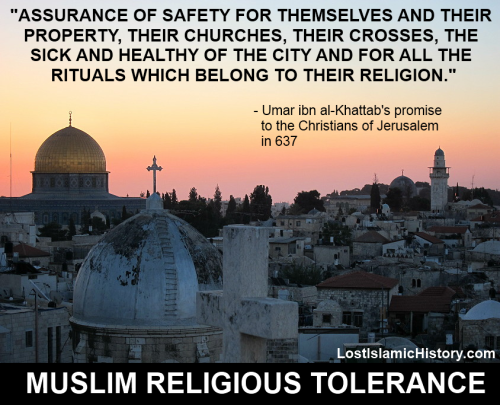
Other Muslims leaders, such as Caliph Umar, advised his predecessors "to treat ahl al-dhimmah (Jews and Christians) well, to defend them against their enemies and not burden them with more than they can bear." 
Umar also stated: "Treat all people as equal... I advise you not to let yourself or anyone else do wrong to ahl al-dhimmah." Umar was following in Muhammad's footsteps in treating Jews and Christians as equal to Muslims.
Abu Bakr, one of Muhammad's trusted advisors, is also on record stating that "the most important foundation of a truly Muslim country is justice and equality for all. In fact, a country that is bereft of justice and equality, though it may be inhabited by Muslims, is not really a Muslim country at all."
Another Muslim leader, Akbar the Great of the Mughal Empire, would echo Muhammad, Umar, and Abu Bakr's message of tolerance and harmony centuries later. Upon assuming power, Akbar ended the jizya, or poll tax, on non-Muslims and invited people of all religious backgrounds to his court to engage in interfaith dialogue.
Moreover, Akbar had tremendous respect for Christianity, visible in the Buland Darwaze, a large gate-structure at the city of Fatehpur Sikri, on which he had transcribed the Qur'anic inscription: "Isa [Jesus], son of Mary, said: This world is a bridge. Pass over it, but build no houses on it. He who hopes for an hour may hope for eternity. The world endures but an hour. Spend it in prayer, for the rest is unseen." 
Rumi, the famous Sufi poet of the 13th century, also revered Jesus and extended his hand in friendship to non-Muslims. Rumi's most powerful words echo love and peace to all regardless of ethnic background:
I am neither Christian, nor Jewish, nor Muslim I am not of the east, nor of the west... I have put duality away, I have see the two worlds as one; One I seek, One I know, One I see, One I call (Divan-i Sham-i Tabriz, II)
Members of Europe's far-right parties can look to these great Muslim leaders for guidance in how to treat Muslims in their societies. However, Europeans today can also look to the example on their continent - Muslim Spain, between the 8th and 15th centuries - when Muslims ruled a diverse society of Jews and Christians in a relative state of harmony, which was utterly unthinkable in other Christian European cities such as London or Paris.
Muslim Spain reached a state of tolerance which has its very own name - convívencía - which can literally be translated as "living with-ness," or "requiring tolerance." 
Perhaps its time for Europeans to adopt a 21st century style convívencía so they can come to grips with what Muslims and Islam can offer to European society.

Tuesday, January 22, 2013

Love Thy Neighbor


By Aviva Shen

Standing in Denver’s main mosque on Christmas Eve, Christian, Muslim and Jewish community leaders launched an ad campaign promoting understanding and tolerance between the religious groups. “Love Thy Neighbor” ads on Denver buses are intended to combat anti-Muslim ads produced by the American Freedom Defense Initiative. The controversial group attracted attention with hateful posters in New York subways and DC metro stations.
The Colorado Muslim Society paid $5,000 for the “Love Thy Neighbor” ads, which focus on love as “a shared concept in the three religions.” Other religious leaders and interfaith groups then publicly embraced the message:
They said the ad they unveiled — at a time on the calendar devoted to love and understanding — is meant to respond to recent national tragedies and to replace anti-Muslim ads placed on buses last month.
“Our country is in the midst of a lot of divisions,” Temple Emanuel Senior Rabbi Joe Black said. “Hatred is only going to further violence and the breakdown of society.”
Denver’s tolerance initiative follows the lead of many faith groups around the countryprotesting the Islamophobic ads. The Denver ads proclaim: “9,757 Deadly Islamic Attacks Since 9/11/01. It’s Not Islamophobia. It’s Islamorealism.” Colorado’s religious leaders also stood together in solidarity after the 9/11 attacks in 2001.
Public renunciation of anti-Muslim bigotry is much needed, as hate crimes against Muslims have held steady at a record high. Meanwhile, anti-Islamic rhetoric has become commonplace in mainstream media.

Saturday, December 29, 2012

What Did The Muslims Do For The Jews?


David J Wasserstein writes,


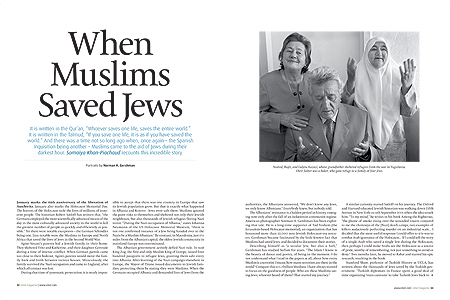
Islam saved Jewry. This is an unpopular, discomforting claim in the modern world. But it is a historical truth. The argument for it is double. First, in 570 CE, when the Prophet Mohammad was born, the Jews and Judaism were on the way to oblivion. And second, the coming of Islam saved them, providing a new context in which they not only survived, but flourished, laying foundations for subsequent Jewish cultural prosperity - also in Christendom - through the medieval period into the modern world.
By the fourth century, Christianity had become the dominant religion in the Roman empire. One aspect of this success was opposition to rival faiths, including Judaism, along with massive conversion of members of such faiths, sometimes by force, to Christianity. Much of our testimony about Jewish existence in the Roman empire from this time on consists of accounts of conversions.
Great and permanent reductions in numbers through conversion, between the fourth and the seventh centuries, brought with them a gradual but relentless whittling away of the status, rights, social and economic existence, and religious and cultural life of Jews all over the Roman empire.
A long series of enactments deprived Jewish people of their rights as citizens, prevented them from fulfilling their religious obligations, and excluded them from the society of their fellows.
Had Islam not come along, Jewry in the west would have declined to disappearance and Jewry in the east would have become just another oriental cult
This went along with the centuries-long military and political struggle with Persia. As a tiny element in the Christian world, the Jews should not have been affected much by this broad, political issue. Yet it affected them critically, because the Persian empire at this time included Babylon - now Iraq - at the time home to the world's greatest concentration of Jews.
Here also were the greatest centres of Jewish intellectual life. The most important single work of Jewish cultural creativity in over 3,000 years, apart from the Bible itself - the Talmud - came into being in Babylon. The struggle between Persia and Byzantium, in our period, led increasingly to a separation between Jews under Byzantine, Christian rule and Jews under Persian rule.
Beyond all this, the Jews who lived under Christian rule seemed to have lost the knowledge of their own culturally specific languages - Hebrew and Aramaic - and to have taken on the use of Latin or Greek or other non-Jewish, local, languages. This in turn must have meant that they also lost access to the central literary works of Jewish culture - the Torah, Mishnah, poetry, midrash, even liturgy.
The loss of the unifying force represented by language - and of the associated literature - was a major step towards assimilation and disappearance. In these circumstances, with contact with the one place where Jewish cultural life continued to prosper - Babylon - cut off by conflict with Persia, Jewish life in the Christian world of late antiquity was not simply a pale shadow of what it had been three or four centuries earlier. It was doomed.
Had Islam not come along, the conflict with Persia would have continued. The separation between western Judaism, that of Christendom, and Babylonian Judaism, that of Mesopotamia, would have intensified. Jewry in the west would have declined to disappearance in many areas. And Jewry in the east would have become just another oriental cult.
But this was all prevented by the rise of Islam. The Islamic conquests of the seventh century changed the world, and did so with dramatic, wide-ranging and permanent effect for the Jews.
Within a century of the death of Mohammad, in 632, Muslim armies had conquered almost the whole of the world where Jews lived, from Spain eastward across North Africa and the Middle East as far as the eastern frontier of Iran and beyond. Almost all the Jews in the world were now ruled by Islam. This new situation transformed Jewish existence. Their fortunes changed in legal, demographic, social, religious, political, geographical, economic, linguistic and cultural terms - all for the better.
First, things improved politically. Almost everywhere in Christendom where Jews had lived now formed part of the same political space as Babylon - Cordoba and Basra lay in the same political world. The old frontier between the vital centre in Babylonia and the Jews of the Mediterranean basin was swept away, forever.
Political change was partnered by change in the legal status of the Jewish population: although it is not always clear what happened during the Muslim conquests, one thing is certain. The result of the conquests was, by and large, to make the Jews second-class citizens.
This should not be misunderstood: to be a second-class citizen was a far better thing to be than not to be a citizen at all. For most of these Jews, second-class citizenship represented a major advance. In Visigothic Spain, for example, shortly before the Muslim conquest in 711, the Jews had seen their children removed from them and forcibly converted to Christianity and had themselves been enslaved.
In the developing Islamic societies of the classical and medieval periods, being a Jew meant belonging to a category defined under law, enjoying certain rights and protections, alongside various obligations. These rights and protections were not as extensive or as generous as those enjoyed by Muslims, and the obligations were greater but, for the first few centuries, the Muslims themselves were a minority, and the practical differences were not all that great.
Along with legal near-equality came social and economic equality. Jews were not confined to ghettos, either literally or in terms of economic activity. The societies of Islam were, in effect, open societies. In religious terms, too, Jews enjoyed virtually full freedom. They might not build many new synagogues - in theory - and they might not make too public their profession of their faith, but there was no really significant restriction on the practice of their religion. Along with internal legal autonomy, they also enjoyed formal representation, through leaders of their own, before the authorities of the state. Imperfect and often not quite as rosy as this might sound, it was at least the broad norm.
The political unity brought by the new Islamic world-empire did not last, but it created a vast Islamic world civilisation, similar to the older Christian civilisation that it replaced. Within this huge area, Jews lived and enjoyed broadly similar status and rights everywhere. They could move around, maintain contacts, and develop their identity as Jews. A great new expansion of trade from the ninth century onwards brought the Spanish Jews - like the Muslims - into touch with the Jews and the Muslims even of India.
A ll this was encouraged by a further, critical development. Huge numbers of people in the new world of Islam adopted the language of the Muslim Arabs. Arabic gradually became the principal language of this vast area, excluding almost all the rest: Greek and Syriac, Aramaic and Coptic and Latin all died out, replaced by Arabic. Persian, too, went into a long retreat, to reappear later heavily influenced by Arabic.
The Jews moved over to Arabic very rapidly. By the early 10th century, only 300 years after the conquests, Sa'adya Gaon was translating the Bible into Arabic. Bible translation is a massive task - it is not undertaken unless there is a need for it. By about the year 900, the Jews had largely abandoned other languages and taken on Arabic.
The change of language in its turn brought the Jews into direct contact with broader cultural developments. The result from the 10th century on was a striking pairing of two cultures. The Jews of the Islamic world developed an entirely new culture, which differed from their culture before Islam in terms of language, cultural forms, influences, and uses. Instead of being concerned primarily with religion, the new Jewish culture of the Islamic world, like that of its neighbours, mixed the religious and the secular to a high degree. The contrast, both with the past and with medieval Christian Europe, was enormous.
Like their neighbours, these Jews wrote in Arabic in part, and in a Jewish form of that language. The use of Arabic brought them close to the Arabs. But the use of a specific Jewish form of that language maintained the barriers between Jew and Muslim. The subjects that Jews wrote about, and the literary forms in which they wrote about them, were largely new ones, borrowed from the Muslims and developed in tandem with developments in Arabic Islam.
Also at this time, Hebrew was revived as a language of high literature, parallel to the use among the Muslims of a high form of Arabic for similar purposes. Along with its use for poetry and artistic prose, secular writing of all forms in Hebrew and in (Judeo-)Arabic came into being, some of it of high quality.
Much of the greatest poetry in Hebrew written since the Bible comes from this period. Sa'adya Gaon, Solomon Ibn Gabirol, Ibn Ezra (Moses and Abraham), Maimonides, Yehuda Halevi, Yehudah al-Harizi, Samuel ha-Nagid, and many more - all of these names, well known today, belong in the first rank of Jewish literary and cultural endeavour.
W here did these Jews produce all this? When did they and their neighbours achieve this symbiosis, this mode of living together? The Jews did it in a number of centres of excellence. The most outstanding of these was Islamic Spain, where there was a true Jewish Golden Age, alongside a wave of cultural achievement among the Muslim population. The Spanish case illustrates a more general pattern, too.
What happened in Islamic Spain - waves of Jewish cultural prosperity paralleling waves of cultural prosperity among the Muslims - exemplifies a larger pattern in Arab Islam. In Baghdad, between the ninth and the twelfth centuries; in Qayrawan (in north Africa), between the ninth and the 11th centuries; in Cairo, between the 10th and the 12th centuries, and elsewhere, the rise and fall of cultural centres of Islam tended to be reflected in the rise and fall of Jewish cultural activity in the same places.
This was not coincidence, and nor was it the product of particularly enlightened liberal patronage by Muslim rulers. It was the product of a number of deeper features of these societies, social and cultural, legal and economic, linguistic and political, which together enabled and indeed encouraged the Jews of the Islamic world to create a novel sub-culture within the high civilisation of the time.
This did not last for ever; the period of culturally successful symbiosis between Jew and Arab Muslim in the middle ages came to a close by about 1300. In reality, it had reached this point even earlier, with the overall relative decline in the importance and vitality of Arabic culture, both in relation to western European cultures and in relation to other cultural forms within Islam itself; Persian and Turkish.
Jewish cultural prosperity in the middle ages operated in large part as a function of Muslim, Arabic cultural (and to some degree political) prosperity: when Muslim Arabic culture thrived, so did that of the Jews; when Muslim Arabic culture declined, so did that of the Jews.
In the case of the Jews, however, the cultural capital thus created also served as the seed-bed of further growth elsewhere - in Christian Spain and in the Christian world more generally.
The Islamic world was not the only source of inspiration for the Jewish cultural revival that came later in Christian Europe, but it certainly was a major contributor to that development. Its significance cannot be overestimated.
David J Wasserstein is the Eugene Greener Jr Professor of Jewish Studies at Vanderbilt University. This article is adapted from last week's Jordan Lectures in Comparative Religion at the School of Oriental and African Studies.

Thursday, November 01, 2012

Hanging With The Muslims


By Steven Scholl,


On Labor Day weekend, I spent four days hanging out with 15,000 Muslims at theIslamic Society of North America’s 49th annual convention in Washington, D.C. As one of the few non-Muslims in attendance, I was able to eavesdrop on hundreds of conversations swirling around me, take in several talks by prominent Muslims and attend author Karen Armstrong’s address to the big donors to ISNA. I wish all America could have listened in on these startling and revealing declarations of faith from the North American Muslim front. I am sure most Americans would have been shocked by the content of the discourse at ISNA.
Shocked, because what Muslims say to each other when they are hanging out together is so radically ordinary.
Let’s start with the theme of the convention: “One Nation Under God: Striving for the Common Good.” How radical is that? There was a strong emphasis in workshops and speeches on how American Muslims can integrate the commandments of the Quran to better serve the poor, the oppressed, those in need within the Muslim community, and in cooperation with interfaith groups to help all people regardless of faith.
Finding common ground to further the common good as faithful citizens was a recurring theme throughout the Labor Day weekend gathering.
The Sanctity Of All Creation
I dropped into a talk by best-selling author-scholar Seyyed Hossein Nasr on moral values from an Islamic perspective. Nasr made a passionate plea to his Muslim audience that they remember that the Quran speaks of the sanctity of all creation and not just the human world. Nasr spoke of how most contemporary thought — especially social and economic theories — places humans at the center of creation.
He contrasted this with the Quran’s creation-based theology, arguing that it is critical for Muslims to advocate for green solutions, especially while environmental degradation is being advanced in the name of human comfort and economic greed. He exhorted Muslims to be more active in protecting the earth in the spirit of Islamic values.
Controversial Swiss scholar Tariq Ramadan seemed to be everywhere during the convention. He spoke at least seven times on major stages and in smaller rooms on panels. Ramadan had been banned from entering the United States in 2004, when he had been offered a tenured position at the University of Notre Dame’s Joan B. Kroc Institute for International Peace Studies. Citing the U.S. Patriot Act, the U.S. Immigration and Customs Enforcement revoked his U.S. visa. His offense? Making a donation to two Muslim charities that had tenuous ties to Hamas. After a U.S. Federal Appeals Court sided with Ramadan, his ban was lifted by Secretary of State Hillary Clinton in 2010.
At ISNA he spoke on the themes of his newest book,Islam and the Arab Awakening, on the fragile rise of democratic institutions in the Arab world and the role Islam will play in this unfolding process. He also spoke passionately to young Muslims one night, urging that Muslim women continue to assert themselves as leaders within the American Muslim community.
One of my favorite moments came watching Ramadan sign books after one of his panel talks. The two young boys, no older than 13, asked the scholar to sign his weighty, Oxford University Press tome. I could not catch the details of the conversation, but Ramadan spent extra time with these young Muslims, listening to their stories and questions and not rushing to sign the book and move on to the next buyer. His care and concern and focus on these teenagers was heartfelt and a joy to see.
Embedded With The Muslims
But more than the headliners, I was most interested in the rank and file Muslims attending the convention. I had a booth where I was selling books for my publishing house, White Cloud Press. For four days I witnessed a steady parade of Muslims, from infants to octogenarians, many who stopped for a few moments to talk about books and religion or just to talk about their hopes and aspirations.
There were great conversations with twenty something Muslims about marriage and how ISNA is a great meeting place for a young Muslim to meet a prospective spouse. Like Jewish and Christian conferences and conventions, at ISNA opportunities are created for young, singles to find their future mate. Journalist Obaid Siddiqui told me that besides the banquet there is always a big open area where singles can mingle to “see and be seen” at the hotel next to the convention center.
As I was flying home thinking about my four days “embedded” with American Muslims, what kept coming back to me was the very distinct vibe given off by the majority of Muslims I met and observed. The vibe can best be summed up by the Arabic word adab, which translates a range of English terms: Good manners, etiquette, refinement and morals.
As I mixed with Muslims I was inevitably met with incredible kindness and concern for my well-being, and I watched how this adab was taking place all around me. I was not just getting special treatment for being the guest. If I might generalize, Muslims manifest a simple yet profound sense of decorum displayed in their conversations and interactions that is sincere and very moving. They care for the needs of others.
In a very tangible way, these Muslims practice the Golden Rule found in all faith traditions, to do unto others as you would have done to yourself.
The Beauty Of Adab
This is all the more impressive when considering the seemingly endless rants against, and outright violence directed at, American Muslims. American Muslims, and especially American Muslim women, are often stuck in an impossible lose-lose situation. Tea Party militants accuse all Muslim men of hating women and abusing Muslim women as a matter of faith. Then the Tea Bag Taliban folk turn around andaccuse prominent American Muslim women, women who have achieved positions of influence in American society (Huma Abedin, Samar Ali, and Linda Sarsour, for example) of being Muslim terrorists.
Attacks on American Muslims remains a troubling constant in our lives today. Firebombing and defacing of mosques are frequent and hate crimes against Muslims, and those mistaken for Muslims like the Sikhs, are surging.
In August there was a surge in violence toward Muslims with eight attacks taking place in 11 days, including the mass killing at the Wisconsin Sikh Gurdwara (temple), a firebomb attack on a Muslim home, an attempted bombing of a mosque during prayers in Lombard, Illinois, a burning of a mosque in Joplin, Missouri, and assorted attacks and vandalism in Rhode Island, Oklahoma, and California.
Just a week ago, another mosque was burned in what was deemed by police to be anact of arson at the Islamic Center of Greater Toledo in Toledo, Ohio.
Through all of this, the American Muslim community’s response has been to work with law enforcement and to redouble efforts to educate Americans about their faith. In doing so, they have shown us that adab is an effective nonviolent way to confront hatred and violence. Adab is more than just making nice and giving up your seat on the metro. If you are an American Muslim, it means standing firm and facing hatred with dignity and forbearance and always being ready to make peace.
One of the most profound examples of the practice of Islamic values and especially of adab is the reaction of American Muslim men, women, and children in Orange County, California, when confronted with an angry mob screaming their hate in the name of their Christian faith. The scene was this: Orange County Muslims were holding a fundraiser for homeless relief efforts, not just for Muslims, but for the general community. The video of what went down is sickening at one level and beautiful at another.
It is difficult to stomach the hate speech in the name of God and country. But the beautiful thing to watch is the Muslims response. Walking through the hatemongers, the Muslims never flinch, they do not stop in entering the hall in order to do their Islamic duty of helping out their non-Muslim neighbors, and they never strike back or even argue with the Tea Party belligerents. They walk with purpose and dignity through the verbal bile directed their way: Their faith strong and their adab in full display.
Steven Scholl is publisher of White Cloud Press and a writer on religion and culture. He did graduate studies in Islamic thought, lived for a year in Cairo, Egypt, and leads tours to the Middle East through his company Imagine Adventures.

American Muslims Can Help Improve America’s World Image


Ever since the 9/11 attacks, American Muslims have been subject to an intense campaign which has questioned their loyalty to the United States. Charges ranged from claiming that they have not been outspoken enough in their condemnation of terrorism to complicity, incitement, and even specious claims of active participation in anti-American activities. Several prominent Muslim organizations, large mosques, and some civil rights advocacy organizations, have argued that the charges were baseless and deliberately malign the true views of Islam and its adherents.
Times have changed, but serious challenges remain an impediment to a fuller and active international role by the Muslim community. These challenges include the trust deficit that so defines the relationship between law enforcement and the Muslims. Add to this the incendiary statements by Internet-based pundits (Pamela Geller and Steve Emerson) and even public officials (Cong. Peter King and Cong. Michel Bachmann) a series of laws (The Patriot Act) and the NYPD espionage activities. All these efforts aim to strip Muslim citizens of their basic rights, are all present hindrances.
Notwithstanding these obstacles, the community, motivated by both internal and external factors, appears to be on the verge of a yet-uncharted path to becoming America’s de facto ambassador to the Arab and Muslim world. The community has reached an identifiable confluence of factors that portend of a rising constituency confident of its achievements, of the American constitution and laws, and like, others before it, desirous of “marketing” the United States to the world.
America’s often problematic and exceedingly controversial relationship with its over 6 million Muslims is the subject of much debate, political pandering, and downright hateful acts. An entire industry of Islamophobes and self-styled experts have attained national prominence due to their advocacy of the impending and irreversible existential divide between the backward world of Islam and the enlightened West. Regardless, American Muslims have put aside these matters and engaged in a significant campaign here in the US and abroad, fulfilling a role usually reserved for skilled and seasoned diplomats versed in the art of diplomacy. In essence, American Muslims have taken the role of goodwill ambassadors. Their role was twofold: first, to situate the aftermath of the recent vile anti-Islam movie (the protests and the killing of American officials) in its proper context for both fellow Americans and people in Muslim countries.
Several New Jersey mosques I have contacted confirmed their weekly congregational sermons (on Fridays) focused on the proper response to the recent American-made 14-minute movie titled “Innocence of Muslims,” that portrayed the Prophet Muhammad, Islam’s founder, as a villainous, homosexual, and child-molesting buffoon.
In what was perhaps one of his most passionately delivered sermons since arriving in the US in 1996, Imam Mohammad Qatanani of the Paterson Islamic Center of Passaic County prodded his congregation not to rush to judgment and not to make blanket accusations against all Coptic Christians. Eloquent and well researched as is customary, Imam Qatanani implored the community to recognize that the incessant attacks on Islam have done little in the way of precluding more people from becoming Muslims or weakened the faith of Muslims around the world. “Islam and its revered prophet are much bigger than any cheaply made movie or specious book or expedient political stance.”
The Imam stated further that the evolving events should avail us of “an opportunity to educate our fellow Americans that Islam is not represented by the actions of a few extremists.” Similarly, ‘it is incumbent upon us to remind our brethren that America did support the desire of the Arab peoples to rid themselves of the dictatorships and oppressors.”
The Imam added further, “Muslims should be offended by the movie. But they should also consider the source. The offensive video is no more representative of America than it is of the extremists who co-opted the video as a means to incite violence in the Arab world.”
CAIR, the Council on American Islamic relations, in a pioneering fashion, released an Arabic language video plea urging the protesters to understand the true implications of their actions. (See video of similar appeal in other languages) Nihad Awad, national executive director, told viewers in the Middle East that ordinary Americans and the U.S. government should not be blamed for the religious hatred expressed in the film.
Speaking in fluent classical Arabic, Mr. Awad said: "Islamic traditions include a number of instances in which the Prophet Muhammad (PBUH) had the opportunity to retaliate against those who abused him, but refrained from doing so. "One tradition, or hadith, states: 'You do not do evil to those who do evil to you, but you deal with them with forgiveness and kindness.'
Perhaps the most symbolic of the community’s assertiveness to combat extremism came in the formal union of Muslim and Coptic Christians in a Jersey City mosque. Mutual respect of all faiths and categorical denouncements of bigoted acts were their message. Their message will reverberated all over the Middle East.

Via: "The Examiner"

Photo: "Understanding Islam"
Via: "Deviant Art"

Friday, October 05, 2012

‘Choose Love’: Pro-Muslim Ads To Appear In NYC


(Image from Rabbis for Human Right – North America website http://www.rhr-na.org/chooselove)

Decent Human Beings Spreading Subway Love For Muslims

By Joe Coscarelli,

As soon as anti-Islam activist Pamela Geller's purposefully offensive new subway ads went up, they were promptly ruined and remixed by protesters, at least one of whom was arrested

The guerrilla campaign was one thing, but now the "Defeat Jihad" posters, which allude to Muslims as "savages" in ten stations around New York City, will have some legal competition: The Jewish group Rabbis for Human Rights and the Christian organization Sojourners are debuting a counterattack next week. 

"In the choice between love and hate, choose love. Help stop bigotry against our Muslim neighbors," says the Rabbis' version, while the other reads simply, "Love your Muslim neighbors." 

Rabbi Jill Jacobs explained to theTimes, "We wanted to make it clear that it is in response to the anti-Islam ad." Point taken — and appreciated.

Via: "NY Magazine"

Thursday, September 27, 2012

A Theologian’s Response To “Innocence Of Muslims”

Karen Leslie Hernandez writes,


As we are all aware, the recent outbreak of violence in many Arab-Muslim countries because of the film Innocence of Muslims, is on many people’s minds and hearts around the world.
With the deaths and injuries of several Americans since last week, and Al Qaeda using this film as an impetus for violence against Americans worldwide, it seems this crisis is far from over.

I am here to simply ask when this madness will stop—when is it enough? When do we stop killing each other? When every American is dead? When every Muslim is dead?

I am not denying that this film is incredibly blasphemous, and portrays the Prophet Muhammad (peace and blessings be upon him) in a less than favorable light. I am disgusted at the film maker’s message, which at the beginning of the film is sent with visionary images of Jesus situated in a humble, Christian home, as Muslims attack outside.

I am disgusted at the inaccurate use of scripture. I am disheartened at the incorrect, historical references to the Qur’an, to the downright wrong portrayal of historical events in Islamic exegesis. I am appalled that anyone would make such a film, with little regard about the group of people it is attacking.

As a Christian and as a Theologian, I condemn this film.

We have a lot of people here in the United States with this kind of agenda against Muslims.

Islamophobes who hold events such as Islamofacist Awareness Week, to books written by Americans entitled, Stop the Islamization of America, and much more. America is alive and well with fear and hate. However, what is important to note is that hate in America is not just directed at those who are Muslim.

Who faces hate, racism and intolerance here in the United States? Everyone! Who are the perpetrators of this intolerance? Everyone! This is to say that no one in America is capable of complete tolerance.

Complete tolerance of our fellow human beings is not something any human maintains, in any country, anywhere, because if we did have complete, even unconditional tolerance, we wouldn’t have war, poverty, and inequality worldwide.

Not Justified…

I must point out something to those who are enacting out their rage right now in Yemen, Egypt, Tunisia, Pakistan, and elsewhere. This film is atrocious, yes, but, in all sincerity, your actions are not justified.

For one, this film, if you have watched it, is so poorly made and acted, and the cinematography is that if a seven year old’s work. Two, this film is one of many that have depicted Islam and the Prophet in a negative light.

I understand how you must be insulted, but to hurt people, to pursue violence in the name of Islam, or to pursue violence in the name of any religion, is not condoned in any of our holy texts.

This brings me to my third point. In your religion of Islam, there are people who are considered Islamic extremists who have made other kinds of films which are just as derogatory and hurtful to people. Lest we not forget the film of Journalist, Danny Pearl, and his beheading, lest we also not forget the films made by other Islamic extremists such as Al Qaeda that illustrate hate and intolerance, and call for the death and destruction of Christians and Jews.

Extremism in All Religions

I also note here that there are religious extremists in every religion, whose agenda is to simply hurt people, in any way possible. No religion is immune from this type of ignorance and misunderstanding. This is important to recognize if we are ever going to coexist on this increasingly globalized planet of ours.

When I watched this film, I was also reminded that this type of rhetoric is not new. One can view films made by the Third Reich during World War II that illustrate the Jewish religion and those who practiced Judaism, as dirty and as rats. As well, during World War II, the United States put all Japanese Americans in internment camps—you can easily view photos online of how these American citizens were portrayed during that time in America.

It seems the film maker of Innocence of Muslims has not read his historical fact sheet on the Crusades, or the Rape of Nanking, or the Rwandan Genocide—all incidents of violence where women were mercilessly raped and millions were killed. It is a fact that in almost every war on our planet, religion and culture were the driving force.

My message here is simple. We must stop hating, because of hate. We must stop holding anger, because of anger. Have we not all had enough of this? Will inciting violence for violence solve these issues? Will making films such as Innocence of Muslims do any kind of good for our world? Will killing people because of an ignorantly made film, make anyone feel better?

What will, however, ease this sense of exclusivity, is a sense of viewing each other as humans first, with respect, wonder, and awe. Recognizing that we all are here on this planet, and we all must view each other through God’s lens and not our own lens, is imperative.

We must treat people as we want to be treated. The Golden Rule exists in almost every major faith in the world. 

In Judaism, “What is hateful to you, do not do to your neighbor: that is the whole of the Torah; all the rest of it is commentary.” Talmud, Shabbat, 31a.

In Christianity, “In everything, do to others as you would have them do to you; for this is the law and the prophets.” Matthew 7:12.

As well as in Islam, “Not one of you is a believer until he loves for his brother what he loves for himself.”  Prophet Muhammad said in a Hadit.  (An-Nawawi)

This is easy: love each other, as God loves us. All of us!

Again, as a Christian and as a Theologian, I condemn the film, Innocence of Muslims. However, I also condemn hatred, violence, intolerance, retaliation, and anything that harms any person.

As a fellow human being, I implore you to reach beyond your self-made boundaries and I hope, regardless of what religion you are, what the color of your skin is, and what country you are from, you join me, and condemn not only this film, but religious intolerance all together.

Karen Leslie Hernandez is a Theologian with a focus on Christian-Muslim Understanding, as well as religious fundamentalism and extremism. She writes, teaches and lectures on Islam, Christian-Muslim relations worldwide (past and present), Jesus in the Qur’an, Al Qaeda, Islamophobia, and theological responses to terrorism.  Karen has a Master of Sacred Theology in Religion and Conflict Transformation, Boston University School of Theology; a Master of Theological Research in Christian-Muslim Understanding, Andover Newton Theological School; and a BA in Peace and Justice Studies with a concentration in Islam, Wellesley College.  

Saturday, July 07, 2012

Austria Celebrates 'Model' Law On Islam

Austria's 100-year-old Law on Islam is seen as a symbol of tolerance.

The law gives Muslims the same rights as other officially recognised religions in Austria, such as Catholicism, Lutheranism, Judaism and Buddhism.

At the weekend senior members of the Austrian government and the country's Islamic Community attended ceremonies to mark the centenary.

So Islam has been an officially recognised religion in Austria for 100 years.

The Law on Islam, described as unique in Europe by members of the Austrian Islamic Community, guarantees Muslims in the country wide-ranging rights including religious education in state schools, administration of internal affairs and public worship.

In a speech at Vienna's neo-Gothic town hall, the head of Austria's Islamic Community, Fuat Sanac, described the law as an example for the rest of Europe. Islam in Austria, he said, was seen by most people as an enrichment, not as a danger.

Austria's President Heinz Fischer, speaking at the same ceremony, called for peaceful and respectful relations. He stressed that Austria's official religions, because of their legal status, were obliged to "respect and accept the laws of the state".

A Vienna City councillor, Omar Al-Rawi, says the law does much to integrate Muslims into Austria, giving them a sense of being accepted.

"Austria is a model in Europe in dealing with Islam, but the Austrian Muslims are also a European model," he said.

"The Muslims know that with rights there are also obligations and duties. And if you have a lot of rights and benefits, you also have something to lose," he said.

"Austrian Muslims go all over the world saying we are Austrians, we belong to this country that gave us respect and recognition and gave us a lot of benefits that even some Muslim countries don't enjoy. And that is why they are very proud saying that they are Austrians."
The Law on Islam was brought into force in 1912, under the Habsburg Emperor Franz Joseph, as a result of Austria's annexation of Bosnia-Hercegovina.

It began as an attempt to integrate Muslim Bosnian soldiers into the Habsburg Army, and referred at first just to adherents of the "Hanafi rite of Islam". It was later expanded to include other forms of Sunni and Shia Islam, who are now all represented by the Austrian Islamic Community.

After the empire collapsed at the end of World War I, Austria's Muslim population was reduced to a few hundred people.

But it started growing after World War II with the arrival of Turkish and Yugoslav workers in the 1960s and Bosnian refugees in the 1990s.

Now about half a million Muslims live in Austria, about 6% of the population. In Vienna, Islam is the second-largest religious grouping, after Roman Catholicism.

About 60,000 children take part in Muslim religious education classes in Austrian state schools, according to the Islamic Community. The classes are held in German.
Via: "The BBC"

Saturday, September 10, 2011

American Muslims Most Tolerant In United States

By Muqtedar Khan
Associate Professor of Islam and Global Affairs at the University of Delaware
Posted: 8/23/11 08:44 PM ET
Courtesy Of "The Huffington Post"


Newark, Delaware - A superficial study of the media coverage in the past two years conveys a misleading picture about the state of American Muslims and their relationship with the rest of the nation. The terrible attack on Fort Hood by Major Nidal Malik Hasan, the attempted June 2010 bombing of Times Square, the shrill rhetoric and legislative activism of the anti-sharia brigade, and the incessant targeting of Islam and Muslims by conservative politicians, media personalities and political entrepreneurs all combine to suggest that life for Muslims in America must be tough.
But on the contrary, large sample surveys and in-depth studies conducted recently provide a more complex and optimistic picture about Muslim American reality, especially when it comes to three of the most talked-about issues: radicalization, American Muslims' perceptions of the United States and religious tolerance.
A US Department of Justice study about Muslim American radicalization, conducted in 2010 by researchers from two North Carolina universities, argued that terrorism actually committed by American Muslims was surprisingly low. They attributed this low number to the anti-radicalization efforts of various Muslim communities and mosques in the United States. This in-depth study not only reassures law enforcement agencies that the fear of Muslim radicalism in America is overblown, but it also underscores the reality that US mosques are allies in the struggle against extremism -- not a source of extremism as some right-wing pundits and politicians insist.
When it comes to how American Muslims perceive America, there is more that is surprising. Another study, "Muslim Americans: Faith Freedom and the Future," a large sample survey conducted over a period of two years by Gallup, reveals that American Muslims -- more than members of any other community -- claim that they are "thriving in America." This is a remarkable condition for a community which is under so much scrutiny from the media, law enforcement and the US Congress itself.
Neither bad economy nor odious politics seem to faze American Muslims' faith in America. Eight out of ten American Muslims approve of US President Barack Obama, whose overall approval ratings are at the lowest point since he assumed the presidency, and American Muslims have the most confidence in the honesty of the American political system, more than any other religious community.
But perhaps the findings on religious tolerance offer the most reason for optimism. The Gallup report found that American Muslims are, along with Mormons, the most religiously tolerant of groups. Only eight percent of American Muslims feel estranged from other faiths, while 92 percent of them are "tolerant" or "tolerant and accepting" of other faiths!
I suspect that this high regard for pluralism is actually a reflection of holding a high regard for religion itself. Muslims who attach a great deal of significance to their faith naturally have an affinity towards those who share their reverence for God.
I hope that those Americans who are being misled by the so-called anti-sharia initiatives in the United States read this report. It casts serious doubts on the assertions that Muslims -- members of America's most tolerant religious community -- aspire to impose their faith on others.
Finally, there is an interesting sub-story in this report, especially for those Muslims who believe that all Jews are "out to get" Islam and Muslims. According to the Gallup poll, American Jews more than any other group recognize the prevailing Islamophobia and prejudice against Muslims in America. In fact, 80 per cent of American Jews, next only to American Muslims (93 per cent), believe that American Muslims are loyal to America. Of all religious communities, Jewish Americans are least likely to believe that American Muslims might be Al Qaeda sympathizers. Both Muslims and Jews in America also have very similar views about the Arab-Israeli conflict: 78 per cent of Jews and 81 percent of Muslims support the vision of a Palestinian state coexisting alongside Israel.
I hope these findings give further impetus to the Muslim-Jewish dialogue and relations in the United States.
As we reflect on the tragedy of 9/11 and its aftermath, I hope we allow facts and reality to shape our thinking and reject the dark incitements that led to the tragedy in Norway.

Dr. Muqtedar Khan is Associate Professor at the University of Delaware and a Fellow of the Institute for Social Policy and Understanding. He is the author of American Muslims: Bridging Faith and Freedom and his website is www.ijtihad.org. This article was written for the Common Ground News Service (CGNews).


Follow Muqtedar Khan on Twitter: www.twitter.com/muqtedar