Showing posts with label Drought. Show all posts

Saturday, May 04, 2013

Trees Call For Help

Single tree on hillside, late afternoon.
A tree stands alone in the drought-stricken Salmon-Challis National Forest, Idaho, in an undated picture.

Scientists Identify The Sounds Made By Drought-Stressed Trees.

Gape Popkin reports in National Geographic 


In the lab, a team of French scientists has captured the ultrasonic noise made by bubbles forming inside water-stressed trees. Because trees also make noises that aren't related to drought impacts, scientists hadn't before been able to discern which sounds are most worrisome. (Watch a video: Drought 101.)

"With this experiment we start to understand the origin of acoustic events in trees," said Alexandre Ponomarenko, a physicist at Grenoble University in France, whose team conducted the research.

This discovery could help scientists figure out when trees are parched and need emergency watering, added Ponomarenko, who presented his team's resultslast month at an American Physical Society meeting in Baltimore, Maryland.

To figure out how to listen to trees, the French scientists drew on their knowledge of how trees take in water—essentially by drinking from a really long "straw."

Inside tree trunks are bundles of specialized tubes called xylem, which rely on the attractive forces between water molecules as well as those between water and plant cells to lift liquid to the highest leaves and branches. (See National Geographic's tree pictures.)

Because trees are so tall, the liquid in the xylem can be under intense pressure—many times that of the atmosphere around us—but the attractive forces between neighboring water molecules keep the water column intact.

In drought-stricken trees, this increased pressure can cause the water column to break, allowing dissolved air to form bubbles that block water flow.

These events are called cavitations, and while trees can withstand some, too many can be deadly.

Since cavitations can kill trees, scientists and forest managers want to know when they are increasing. (Also see "Pictures: Saving and Studying Tasmania's Giant Trees.")

Scientists have known for decades that microphones can pick up the noises that cavitations make. But because they couldn't see inside the tree, they weren't certain of the origins of these sounds, which could have resulted from wood creaking or breaking or xylem cells collapsing.

To answer the question, the team put a thin slice of pine wood into a liquid-filled gel capsule to mimic conditions inside a living tree.

The scientists then evaporated water from the gel, simulating a drought. As the wood began cavitating, the scientists filmed bubbles forming while recording with a microphone.

The scientists found that around half the sounds they picked up were associated with cavitations. The rest were from other processes, such as bubbles invading neighboring cells. Most important, the sound waves from each type of event made a distinct pattern. All of them are above the range of human hearing.

The researchers think they can compare sounds from living trees with these patterns, and determine which processes are creating the sounds.

According to Ponomarenko, the findings could lead to the design of a handheld device that allows people to diagnose stressed trees using only microphones.

Such a device may be particularly important if droughts become more common and more severe, as many global warming models predict they will. (Read "The New Dust Bowl" in National Geographic magazine.)

In fact, a study published in Nature last fall suggested that trees in many places—from tropical rain forests in South America to arid woodlands in the U.S. West—already "live on the edge," meaning their cavitation rate is almost as high as they can sustain.

Ponomarenko's method could provide an early warning that cavitations are increasing.

For instance, he envisions a device that would attach to a tree and constantly listen for sounds of thirst. If needed, the device could then trigger an emergency-watering system.

Ponomarenko's research is promising, added Cornell University's Abe Stroock, whose lab designed the gel capsule the French team used. He said the result "opens a new mode of observation" into cavitation. (See pictures of the 2012 drought that parched much of the United States.)

But he also noted that the wood samples used in the team's study had to be "excised and abused," so they don't necessarily behave exactly like wood in a living tree.

"Translating [these findings] to a living plant and into different species is a lot of work, potentially," he said.

Saturday, May 19, 2012

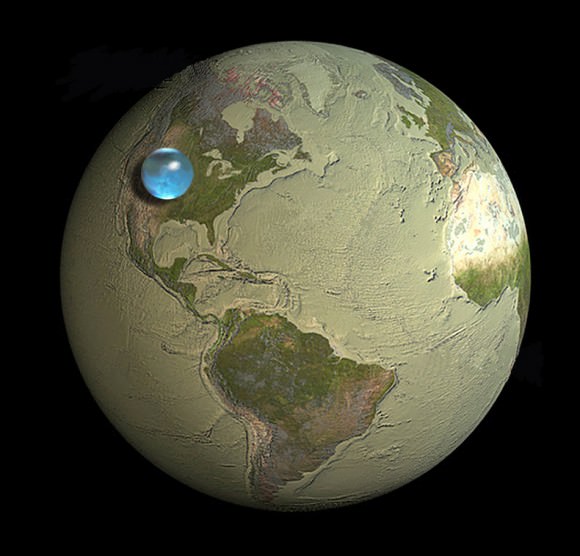
Earth Has Less Water Than You Think


All the water on Earth would fit into a sphere 860 miles (1,385 km) wide. (Jack Cook/WHOI/USGS) 

By JASON MAJOR
On MAY 8, 2012
Courtesy Of "Universe Today"


If you were to take all of the water on Earth — all of the fresh water, sea water, ground water, water vapor and water inside our bodies — take all of it and somehow collect it into a single, giant sphere of liquid, how big do you think it would be? 

According to the U. S. Geological Survey, it would make a ball 860 miles (1,385 km) in diameter, about as wide edge-to-edge as the distance between Salt Lake City to Topeka, Kansas. That’s it. Take all the water on Earth and you’d have a blue sphere less than a third the size of the Moon.
Feeling a little thirsty?
And this takes into consideration all the Earth’s water… even the stuff humans can’t drink or directly access, like salt water, water vapor in the atmosphere and the water locked up in the ice caps. In fact, if you were to take into consideration only the fresh water on Earth (which is 2.5% of the total) you’d get a much smaller sphere… less than 100 miles (160 km) across.
Even though we think of reservoirs, lakes and rivers when we picture Earth’s fresh water supply, in reality most of it is beneath the surface — up to 2 million cubic miles (8.4 million cubic km) of Earth’s available fresh water is underground. But the vast majority of it — over 7 million cubic miles (29.2 cubic km) is in the ice sheets that cover Antarctica and Greenland.
Of course, the illustration above (made by Jack Cook at the Woods Hole Oceanographic Institution) belies the real size and mass of such a sphere of pure liquid water. The total amount of water contained within would still be quite impressive — over 332.5 million cubic miles (1,386 cubic km)! (A single cubic mile of water equals 1.1 trillion gallons.) Still, people tend to be surprised at the size of such a hypothetical sphere compared with our planet as a whole, especially when they’ve become used to the description of Earth as a “watery world”.
Makes one a little less apt to take it for granted.
Read more on the USGS site here, and check out some facts on reducing your water usage here.
Water, water, every where,
And all the boards did shrink;
Water, water, every where,
Nor any drop to drink.
– from The Rime of the Ancient Mariner, Samuel Taylor Coleridge


Tuesday, July 19, 2011

A Grotesque Symbol Of Starving Africa

Mothers, especially, bind their stomachs to lessen hunger pangs: 'Only the rich around here don't tie a rope in times like this,' says Zippora Mbungo (above) of Makima, Kenya


Desperate Women Bind Their Stomachs To Deaden Hunger Pains, Eating Next To Nothing So Children Can Be Fed

By David Randall and Nada Issa
Sunday, 17 July 2011
Courtesy Of "The Independent"

Increasing numbers of children are dropping dead on the long trek to refugee camps. Those who do get there are more severely malnourished than ever before. And, says the UN, the number of people under threat has now reached 11 million – equivalent to every man, woman and child in Belgium facing starvation. Thus, the chronic food crisis of the Horn of Africa edges with every hungry day towards full-blown famine.

One image captures the degrading awfulness now facing millions. It is not that of a wide-eyed, swollen-bellied child crying for food – although there are countless numbers of them. It is the sight of mothers using rope to bind their stomachs so they will deaden the pangs of hunger as they give what little food they can get to their children – a grotesque parody of the gastric bands used for slimming in the West.

This potentially life-threatening practice has been highlighted by ActionAid. Zippora Mbungo, an 86-year-old grandmother from Makima, Kenya, told the agency's workers: "I tie this rope around my waist to hold my stomach in and avoid feeling hungry. Most of the time we have very little food, so I give it to my grandchildren first, leaving little or nothing for me. That is why I tie this rope around me. Only the rich people around here don't tie a rope in times like this." She added: "This is one of the worst droughts I have ever seen in my life." Philip Kilonzo, of ActionAid Kenya, said: "This practice shows just how desperately hungry women are. But it can be lethal – women have died after suddenly untying their stomachs once food is available."

The disaster, described by Unicef as "the worst humanitarian crisis in the world", is the result of one of the most terrible droughts in 60 years, which has led to repeated harvest failures and the death of large numbers of livestock. About 2.9 million people in Somalia – a third of the population – need humanitarian aid, while some 4.5 million, out of a population of 80 million, are affected in Ethiopia. In Kenya, the region's economic powerhouse, some 3.5 million are at risk of starvation, the UN says. Duncan Harvey, the acting country director for Save the Children in Ethiopia, said: "In terms of the sheer numbers of people affected, this is one of the worst droughts the world has seen in a long time."

Hunger and hopelessness in their own areas have driven hundreds of thousands to trek for days across arid lands to camps in Ethiopia and Kenya. Late last week, for instance, US officials spoke to a mother who had arrived at one camp with six children, including a seven-year-old suffering from polio, whom she had carried on her back.

The severity of this long-distance ordeal can be measured by those who do not make it. Outside the vast refugee complex of Dadaab in Kenya, young, lifeless bodies abandoned by their parents lie on the sandy path to the camp. No one knows how many have died before they reached even that point, and, in other cases, parents have perished on the journey, leaving children to trek through the wilderness alone. Andrew Wander, a spokesman for Save the Children, said his agency has provided care to more than 300 unaccompanied children found on roadsides after their parents died or abandoned them.

The UN's refugee agency says about 40 per cent of the Somali children arriving at Dadaab are malnourished. More children have died here in the first four months of the year than all of last year. Every day, more than 1,400 arrive at this sprawling complex filled with makeshift homes of sticks and tarpaulines, where more than 440,000 people are crammed into and around a camp built for 90,000. Alexandra Lopoukhine, of Care International, said: "This has led to the registration process taking much longer. As opposed to a few hours, or a day at most, it is now taking us three to four weeks at the least." She said the UN and the Kenyan government are currently holding meetings for permission to expand the camp.

Cases of rape and other violent attacks against women have doubled among refugees fleeing conflict and hunger in East Africa, according to member agencies of the Disasters Emergency Committee. Care International staff at two reception centres at the camp say reported cases have risen to 136 in the first six months of this year, compared with 66 in the same period in 2010. Ms Lopoukhine said: "The most dangerous period for refugees is when they are on the move. Women and girls are especially vulnerable to rape, abduction, illness and even being killed on the journey. Many women set out on the journey alone with their children, leaving husbands behind, and they may walk for weeks in search of food and safety."

In Ethiopia, Somalis fleeing drought and intensified fighting have been arriving at the rate of more than 1,700 a day. The overall mortality rate at the camps in Ethiopia is seven people out of 10,000 per day, when a normal crisis rate is two per day, a US government official said. The reason deaths are so high here and across the region is not just hunger but because disease is getting a formidable grip on people weakened by many months of malnourishment. The World Health Organisation (WHO) said that there is now a high risk of infectious diseases spreading, especially polio, cholera and measles.

Five million people are at risk of cholera in Ethiopia, where acute watery diarrhoea has broken out in crowded, unsanitary conditions, the WHO said on Friday. Cholera, an acute intestinal infection, causes watery diarrhoea that can quickly lead to severe dehydration and death if treatment is not given promptly. And, said the WHO, nearly nine million are at risk of malaria. There is also measles, with two million Ethiopian children at risk: the disease can be fatal for children. Ethiopian officials reported 17,584 measles cases and 114 deaths during the first half of the year. It has also broken out in the Kenyan camps, with 462 cases confirmed, including 11 deaths, the WHO said.

In response to the food and health crises, a massive aid operation is swiftly gathering force. Over eight days, the British public has given £18m to the Disasters Emergency Committee appeal (see panel). The British Government yesterday announced a further £52m in aid, which will, among other things, provide treatment for nearly 70,000 acutely malnourished children in Somalia, give healthcare and clean water to 130,000 in the Dadaab camps, similar assistance to 100,000 in Ethiopian camps, and provide extra aid to 300,000 Kenyans, including special rations for malnourished children.

Reuben E Brigety, a US State Department official responsible for assistance to refugees and conflict victims in Africa, said: "There are many seasoned relief professionals who would tell you we haven't seen a crisis this bad in a generation." He added: "It will get worse before it gets better."


What The Aid Agencies Are Doing
Some £18m has so far been raised by the Disasters Emergency Committee East Africa appeal. Here's what DEC agencies are doing:
ActionAid Food, water and income-generation for more than 220,000 in Kenya and Somaliland.
AgeUK Together with Cafod, cash grants to older people for food, job creation, plus animal feed and care.
Red Cross Food aid, safe water, community health. Somali Red Crescent has 44 mobile and static clinics.
Care International Food, water and primary education in Dadaab, plus help going to Ethiopia and Somalia.
Christian Aid Water supplies for 77,400 people in Kenya, plus 25,210 in Ethiopia. Animal feed provided.
Concern Worldwide Cash transfers and food vouchers,in Somalia. 400,000 beneficiaries across region.
Islamic Relief Food aid, nutrition, water and sanitation across region.
Merlin Food, plus 15 new clinics, health facilities and feeding centres in Kenya. Plus programmes in Somalia.
Plan UK Food, water, shelter, medical assistance, child protection, education, health and food in Ethiopia.
Save the Children Cash transfers for acutely malnourished families in Somalia. Treatment of malnourished children in Kenya being scaled up.
Tearfund Cash for work programmes in Ethiopia, and, in Kenya, water trucking.
To make a donation to the DEC East Africa Crisis Appeal visit www.dec.org.uk