Showing posts with label Dinosaurs. Show all posts

Monday, September 08, 2014

The Dreadnoughtus


A supermassive dinosaur that would have weighed as much as 60 small cars has been found in Argentina, where it likely perished in a bog some 77 million years ago, paleontologists said Thursday, September 4.
Dubbed Dreadnoughtus schrani (the 'Dreadnoughtus' part coming from "fear nothing" in old English), the long-necked lizard would have measured 26 meters (85 feet) from nose to tail and weighed some 60 tons – about as much as seven Tyrannosaurus rex put together.
And the giant wasn't even fully grown when it got bogged down in a flooded plain, where it died next to a smaller companion, researchers reported in the journal Scientific Reports.
"With a body the size of a house, the weight of a herd of elephants, and a weaponized (9-meter, muscled) tail, Dreadnoughtus would have feared nothing," study co-author Kenneth Lacovara of Drexel University in Philadelphia said of the mighty beast.
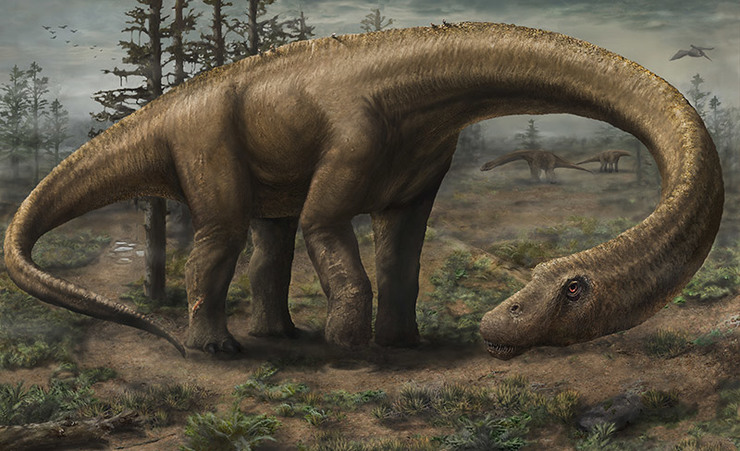
MASSIVE ANIMAL. Rendering of the massive Dreadnoughtus schrani in life. Dreadnoughtus had a 37-foot-long neck, 30-foot tail, and weighed an estimated 65 tons, making it the most massive land animal whose size can be confidently calculated.  Illustration by Jennifer Hall/Drexel University
MASSIVE ANIMAL. Rendering of the massive Dreadnoughtus schrani in life. Dreadnoughtus had a 37-foot-long neck, 30-foot tail, and weighed an estimated 65 tons, making it the most massive land animal whose size can be confidently calculated. Illustration by Jennifer Hall/Drexel University
The fossilized skeleton is the most complete yet found in the category of super-sized, plant-eating dinosaurs called Titanosaurs– which makes it the largest land animal for which a weight has been calculated with such a degree of accuracy.
The find comprised over 70% of the types of bones in the dinosaur's body – 45% of its total skeleton. There were no skull bones.
Paleontologists uncovered most of the vertebrae from the lizard's tail, a neck vertebra with a diameter of over one yard (0.9 meters), ribs, toes, a claw, a section of jaw and a tooth, and nearly all the bones from its four limbs, including a humerus (upper arm bone) and a femur (thigh bone) over six feet tall.
The femur and humerus are key to calculating the mass of extinct four-legged animals.
"Because the Dreadnoughtus type specimen includes both these bones, its weight can be estimated with confidence," said a Drexel University statement.
"It is by far the best example we have of any of the most giant creatures to ever walk the planet," added Lacovara, who discovered the skeleton in southern Patagonia in 2005 and oversaw its four-year excavation.
Dino Misfortune, Science's Luck
To sustain its massive bulk, Dreadnoughtus would have had to eat vast quantities of plants growing in the temperate forest on the continent's southern tip.
"I imagine their day consists largely of standing in one place," said Lacovara.
"You have this 37-foot-long (11-meter) neck balanced by a 30-foot-long (9-meter) tail in the back. Without moving your legs, you have access to a giant feeding envelope of trees and green ferns. You spend an hour or so clearing out this patch that has had thousands of calories in it, and then you take three steps over to the right and spend the next hour clearing out that patch."
The dimensions of all previously discovered supermassive dinosaurs had been pieced together from relatively fragmentary fossil remains.
Prior to Dreadnoughtus, another Patagonian giant, Elaltitan, held the title for the dinosaur with the greatest calculable weight, at 43 tons.
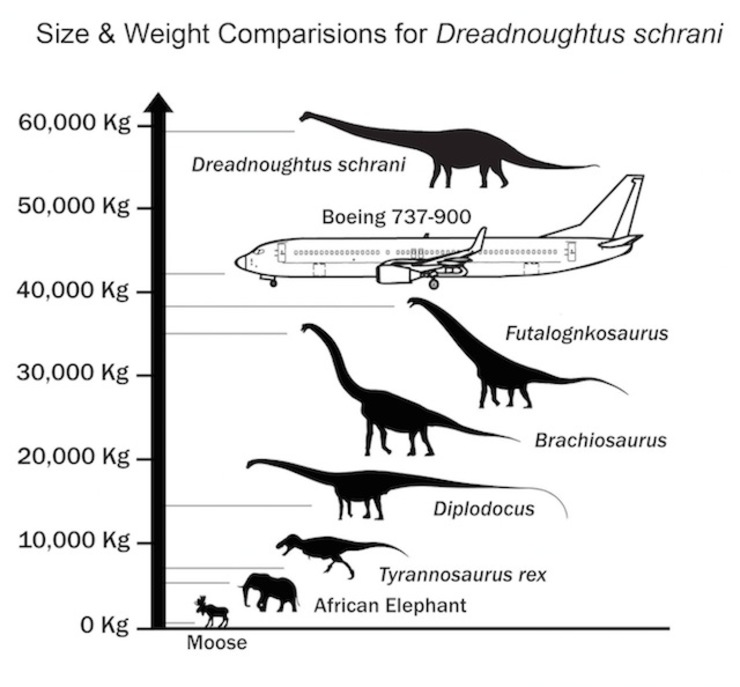
MEGA DINO. Dreadnoughtus schrani was substantially more massive than any other supermassive dinosaur for which mass can be accurately calculated. Image courtesy Lacovara Lab/Drexel University; Size and weight comparisons citations at http://bit.ly/1oI5acS
Argentinosaurus, also from Argentina, was thought to be of a comparable or even greater mass than Dreadnoughtus, and longer, at about 37m.
But Argentinosaurus is known only from a half-dozen vertebrae in its mid-back, a shinbone and a few other fragments but no upper limb bones, said the researchers.
An adult Dreadnoughtus would likely have been too large to fear any predators, but would have made a great feast for scavengers after their death, the team added.
They discovered several teeth of small predatory and scavenging dinosaurs at the excavation site, which also included a secondDreadnoughtus skeleton, though smaller and much less complete.
From the preservation of the skeletons, the team concluded theDreadnoughtus pair was buried soon after death, but not before their carnivore cousins took a few bites.
"These two animals were buried quickly after a river flooded and broke through its natural levee, turning the ground into something like quicksand," said Lacovara.
"The rapid and deep burial of the Dreadnoughtus type specimen accounts for its extraordinary completeness.
"It's misfortune was our luck."
Source: Rappler

Monday, February 11, 2013

'T. Rex' Of The Seas


An artist's illustration of the giant ichthyosaur ruled the oceans some 244 million years ago. (Image: Raul Martin/National Geographic Magazine)

The researchers say the 28-foot long predator probably could have tackled victims as large as itself or larger.


Newfound fossils of a giant dolphin-shaped reptilian predator are now shedding light on how the world recovered after the most devastating mass extinction in history, researchers say.
 
This prehistoric sea monster could provide information on how the planet might deal with the mass extinction humans are causing now, scientists added.
 
The giant marine predator was at least 28 feet (8.6 meters) long, fossils showed. The carnivore was recovered over a course of three weeks in 2008 from what is today a mountain range in central Nevada, and is now kept at the Field Museum in Chicago.
 
This new species, formally named Thalattoarchon saurophagis — which means "lizard-eating ruler of the sea" — was an early member of the ichthyosaurs, marine reptiles that evolved from land reptiles just as modern whales did from land mammals. Ichthyosaurs cruised the oceans for 160 million years, apparently going extinct about 90 million years ago, some 25 million years before the age of dinosaurs ended.
 
"They were the most highly adapted of all marine reptiles, acquiring a fishlike shape and giving birth to live young," said researcher Martin Sander, an evolutionary biologist at the University of Bonn in Germany.

Thalattoarchon possessed a massive skull and jaws armed with large teeth with cutting edges used to seize and slice prey. The researchers say it probably could have tackled victims as large as itself or larger. [See Images of the Prehistoric Sea Monster]
 
"Our new carnivorous ichthyosaur was a top predator, meaning that it had the same role as killer whales in the sea and Tyrannosaurus or the big cats of today on land," Sander said. "This is the first predator in a long row of predators down to this day. The players have changed, but not the game."
 
Most of the animal was preserved, including the skull — except the front of the snout — parts of the fins, and the complete vertebral column up to the tip of the tail. The fossil was christened "Jim" after its discoverer, Jim Holstein, of the Field Museum.
 
The newfound carnivore apparently lived 244 million years ago, just 8 million years before the greatest mass extinction in Earth's history, a die-off at the end of the Permian period that killed as many as 80 to 96 percent of all ocean species. Relatively small species were the main survivors.
 
"Our 'Jim' was thus the first in a long row of T. rexes of the sea, which is why we named him Thalattoarchon, 'ruler of the seas,'" Sander said.
 
The fact that a giant predator capable of tackling similarly large prey arose so soon after the end-Permian mass extinction reveals that ecosystems recovered rapidly after the die-off.
 
"A top predator is a very good indicator that the ecosystem was complete, because if the highest level in the food web is there, the lower levels must have been there as well. Otherwise it won't work," Sander said.

Ichthyosaurs diversified very rapidly. "We hope that by studying this group we can better understand the processes of evolution at the grand scale," researcher Lars Schmitz, an evolutionary biologist at Claremont McKenna College, told LiveScience.
 
"Ecosystem recovery has been a big topic of research for a while, partially because we as humans are causing one of the biggest extinctions right now," Sander said. "People thus have a keen interest in knowing how long it takes to rebuild things once you have destroyed them."