Showing posts with label invertebrates. Show all posts

Sunday, February 10, 2013

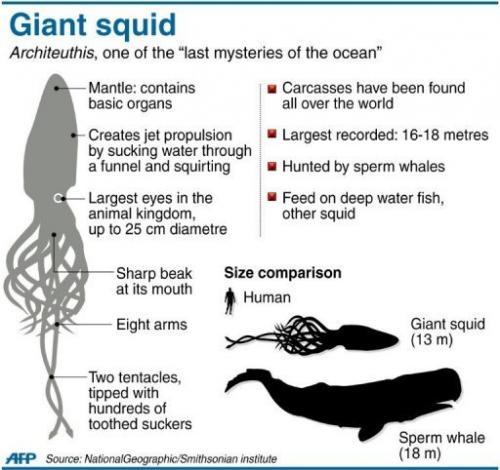
Giant Squid Filmed In Pacific Depths


Japan's National Science Museum succeeded in filming the deep-sea creature at a depth of more than half a kilometre (a third of a mile) after teaming up with Japanese public broadcaster NHK and the US Discovery Channel. 

The creature is thought to be the genesis of the Nordic legend of Kraken, a sea monster believed to have attacked ships in waters off Scandinavia over the last millennium. 

Modern-day scientists on their own Moby Dick-style search used a submersible to descend to the dark and cold depths of the northern Pacific Ocean, where at around 630 metres (2,066 feet) they managed to film a three-metre specimen. 

After around 100 missions, during which they spent 400 hours in the cramped submarine, the three-man crew tracked the creature from a spot some 15 kilometres (nine miles) east of Chichi island in the north Pacific. 

Museum researcher Tsunemi Kubodera said they followed the enormous mollusc to a depth of 900 metres as it swam into the ocean abyss.


NHK showed footage of the silver-coloured creature, which had huge black eyes, as it swam against the current, holding a bait squid in its arms. 

Kubodera said the creature had its two longest arms missing, and estimated it would have been eight metres long if it had been whole. He gave no explanation for its missing arms. 

He said it was the first video footage of a live giant squid in its natural habitat—the depths of the sea where there is little oxygen and the weight of the water above exerts enormous pressure.

"Researchers around the world have tried to film giant squid in their natural habitats, but all attempts were in vain before," Kubodera said. 

Kubodera said the two successful sightings of the squid—in 2012 and 2006—were both in the same area, some 1,000 kilometres south of Tokyo, suggesting it could be a major habitat for the species. 

The giant squid, "Architeuthis" to scientists, is sometimes described as one of the last mysteries of the ocean, being part of a world so hostile to humans that it has been little explored. 

Researchers say Architeuthis eats other types of squid and grenadier, a species of fish that lives in the deep ocean. They say it can grow to be longer than 10 metres. 

Via: "Phys"

Saturday, January 26, 2013

The Parasite That Alters Human Behavior


Image via: MySpace
The protozoan parasite, called Toxoplasma Gondii, has long been considered to be an "asymptomatic" parasite in humans. But lab tests and a new report suggest that it may cause or intensify severe forms of schizophrenia, could have an impact on how human hormones are secreted in the brain, and may cause personality changes.
Scientists have determined that the parasite, which thrives in rats and reproduces in house cats, tricks rats into getting into harm's way.
"The parasite grows in a rodent, but it needs to get into a cat somehow to reproduce," says Shelley Adamo, a biologist who studies neuroparasitology at Dalhousie University in Halifax, Canada. "When a rat becomes infected, the parasite somehow makes rats become attracted to cat urine, when it would normally avoid it."
The CDC estimates that more than 60 million Americans carry the single-celled parasite. Most people get it from infected, undercooked meat or from cats. According to the agency, "of those who are infected, very few have symptoms because a healthy person's immune system usually keeps the parasite from causing illness." But scientists are starting to rethink that theory.

In a study published Wednesday in the Journal of Experimental Biology, Jaroslav Flegr, a scientist at Charles University in Prague, suggests that people infected with Toxoplasma have slower reaction times and are "less altruistic" than non-infected people.
Women infected with Toxoplasma "more often report that diplomacy is not their strong point…that some people have the power to impose their will on others with hypnosis… and that they have a weak instinct for self-preservation: in situations where somebody else might be afraid, for example being alone in a forest or in an empty house at night, they remain calm."
... the widespread prevalence of Toxoplasma infection makes it an ideal "model for studying manipulative activity in humans." He says there are a "large number of parasitic organisms … that may influence the human host even more than the Taxoplasma."
"It's quite possible and plausible that if you have an agent affecting dopamine, it could influence people's behaviors," Adamo says.
A disease that completely alters a human's behavior isn't unprecedented. A human infected by rabies will nearly always display a fear of water, just the way a dog would—so it's not beyond the realm of possibility that a parasite could influence a human's behavior in more subtle ways.
"In invertebrates, the effects are far more drastic. In mammals, the effects are smaller. I say that, but then you look at something like rabies," Adamo says. "And you see that things like this can cause huge changes in behavior."

Via: "US News"