Showing posts with label Latin America. Show all posts

Monday, October 27, 2014

The War On Democracy


'The War On Democracy' (2007), It explores the current and past relationship of Washington with Latin American countries such as Venezuela, Bolivia and Chile.

The film shows how serial US intervention, overt and covert, has toppled a series of legitimate governments in the Latin American region since the 1950s. 

The democratically elected Chilean government of Salvador Allende, for example, was ousted by a US backed coup in 1973 and replaced by the military dictatorship of General Pinochet. Guatemala, Panama, Nicaragua, Honduras and El Salvador have all been invaded by the United States.

John Pilger interviews several ex-CIA agents who took part in secret campaigns against democratic countries in the region. 

He investigates the School of the Americas in the US state of Georgia, where Pinochet’s torture squads were trained along with tyrants and death squad leaders in Haiti, El Salvador, Brazil and Argentina.

The film unearths the real story behind the attempted overthrow of Venezuela's President Hugo Chávez in 2002 and how the people of the barrios of Caracas rose up to force his return to power.

It also looks at the wider rise of populist governments across South America lead by indigenous leaders intent on loosening the shackles of Washington and a fairer redistribution of the continent's natural wealth.

John Pilger says: 


"[The film] is about the struggle of people to free themselves from a modern form of slavery. These people describe a world not as American presidents like to see it as useful or expendable, they describe the power of courage and humanity among people with next to nothing. They reclaim noble words like democracy, freedom, liberation, justice, and in doing so they are defending the most basic human rights of all of us in a war being waged against all of us."

Sunday, September 21, 2014

The Mystery Of The Cocaine Mummies


Partial Transcript Below: 

In the 21st dynasty of the Pharaos, 3,000 years ago, there took place one night at a temple, the funeral of Henut Taui - the Lady of the Two lands.

Compared to the great rulers of Egypt, her burial was a modest affair. But just like the Pharaos, she too was mummified, and her body placed in the depths of a desert tomb, in the belief it would give her immortality.

German scientist, Dr Svetla Balabanova, made a discovery which was to baffle Egyptologists, and call into question whole areas of science and archeology to chemistry and botany.

She discovered that the body of Henut Taui contained large quantities of cocaine and nicotine. The surprise was not just that the ancient Egyptians had taken drugs, but that these drugs come from tobacco and coca, plants completly unknown outside the Americas, unheard of until Sir Walter Raleigh introduced smoking from the New World, or until cocaine was imported in the Victorian era.

It was seemingly impossible for the ancient Egyptians to get hold of these substances.

For thousands of years people in the Andes have been chewing coca leaves, to get out the cocaine with it's stimulant, anaesthetic and euphoric properties. There are actually species of the coca family which grow in Africa, but only the South American species has ever been shown to contain the drug.

DR SVETLA BALABANOVA - Institute of Forensic Medicine, Ulm: 
"The cocaine of course remains an open question. It's a mystery - it's completely unclear how cocaine could get into Africa. On the other hand, we know there were trade relationships long before Columbus, and it's conceivable that the coca plant had been imported into Egypt even then."

NARRATOR:
Was it possible that coca - a plant from South America had been finding it's way to Egypt 3,000 years ago?

If the cocaine found in mummies could not be explained by contamination, or fake mummies or by Egyptian plants containing it, there appeared to be only one remaining possibility... An international drug trade who's links extended all the way to the Americas.

NARRATOR: 
But on the other side of the Atlantic Ocean, where the moving current of the Gulf Stream arrives in Mexico directly from the west coast of Africa, there is a professionally-employed anthropologist who does seriously beleive in such possibilities.

PROF ALICE KEHOE - Anthropologist, Marquette University: 
"I think there is good evidence that there was both trans-atlantic and trans-pacific travel before Columbus." 

But the idea that the ability of the ancients to cross the oceans might have been underestimated continues to be quietly whispered about. Over the years evidence has grown which suggests it might be time to look again at such voyages. To imagine that the Egyptians, who apparently only sailed up and down the Nile or into the Red Sea, might get as far as the Americas perhaps sounds fantastical. But in science, what is one day thought absurd, can next day become accepted as fact.

[Picture of a Norse settlement in Newfoundland]

One senior academic thinks it's important to remember that before the discovery of this Norse settlement in Newfoundland in 1965 theories about Viking voyages to America were dismissed as nonsense.

PROF MARTIN BERNAL - Historian, Cornell University: 
"What we've seen is a shift from the idea of Viking landings in America being seen as completely fantastic or partisan, to being accepted by every scholar in the field."

NARRATOR: 
The fact that evidence of the Viking crossings was hidden has encouraged Martin Bernal to contemplate even earlier voyages that are likewise dismissed as impossible.

PROF MARTIN BERNAL - Historian, Cornell University: 
"I have no reason to doubt that there were others - but what they were, and how much influence they had on American society is open to question. But that trans-oceanic voyages are possible - or were possible - seems to me to be overwhelmingly likely."

NARRATOR: 
Yet discovery of minute strands of silk found in the hair of a mummy from Luxor could suggest the trade stretching from Egypt to the Pacific. For silk at this time was only known to come from China.

PROF MARTIN BERNAL - Historian, Cornell University: 
"We're getting more and more evidence of world trade at an earlier stage. You have the Chinese silk definitely arriving in Egypt by 1000BC. I think modern scholars have a tendency to believe rigidly in progress and the idea that you could only have a worldwide trading network from the 18th century onwards, is our temporal arrogance - that it's only modern people that can do these things."

NARRATOR: 
The evidence for ancient trade with America is limited, and most of it is disputed, but it can't be completely ruled out as explaining the apparent impossibility of Balabanova's results, results that at first seemed so absurd many thought they would be explained away by a simple story of a botch-up in a lab, results that still without firm explanation continue to crop up in unexpected places.

For in Manchester, the mummies under the care of Rosalie David, the Egyptologist once so sure that Balabanova had made a mistake, produced some odd results of their own.

ROSALIE DAVID - Keeper of Egyptology, Manchester Museum: 
"We've received results back from the tests on our mummy tissue samples and two of the samples and the one hair sample both have evidence of nicotine in them. I'm really very surprised at this."

DR SVETLA BALABANOVA - Institute of Forensic Medicine, Ulm: 
"The results of the tests on the Manchester mummies have made me very happy after all these years of being accuesed of false results and contaminated results, so I was delighted to hear nicotine had been found in these mummies, and very, very happy to have this enormous confirmation of my work."

NARRATOR: 
The tale of Henut Taui shows that in science facts can be rejected if they don't fit with our beleifs while what is believed proven, may actually be uncertain.

Little wonder then, that a story that began with one scientist, a few mummies and some routine tests, in no time at all could upset whole areas of knowledge we thought we could take for granted.

Monday, May 20, 2013

America's Friend and Ally Convicted Of Genocide and Crimes Against Humanity


Mike McDonald of Reuters reports that:

Former Guatemalan dictator Efrain Rios Montt was found guilty on Friday of genocide and crimes against humanity during the bloodiest phase of the country's 36-year civil war and was sentenced to 80 years in prison.

Rios Montt, now 86, took power after a coup in 1982 and was accused of implementing a scorched-earth policy in which troops massacred thousands of indigenous villagers thought to be helping leftist rebels.

At the height of the bloodshed, the number of killings and disappearances reached more than 3,000 per month.


Prosecutors say Rios Montt turned a blind eye as soldiers used rape, torture and arson to try to rid Guatemala of leftist rebels during his 1982-1983 rule, the most violent period of a 1960-1996 civil war in which as many as 250,000 people died.

He was tried over the killings of at least 1,771 members of the Maya Ixil indigenous group, just a fraction of the number who died during his rule.
"He had full knowledge of everything that was happening and did not stop it," Judge Yasmin Barrios, who presided over the trial, told a packed courtroom where Mayan women wearing colorful traditional clothes and head-dresses closely followed proceedings.
Throughout his mass atrocities, Montt continued to receive extensive support from the United States. President Reagan, America’s freedom-loving hero of the 80′s, described Montt as “a man of great personal integrity.” The Reagan administration actively covered up and aided Montt’s ruthless crimes against humanity –  you know, for the sake of democracy.
Former U.S. President Ronald Reagan said in late 1982 that the dictator was getting a "bum rap" from rights groups for his military campaign against left-wing guerrillas during the Cold War.

He also once called Rios Montt "a man of great personal integrity".

Sunday, March 31, 2013

Operation Condor


The Thirty Years Dirty War In Latin America

Pierre Abramovici writes,

The ramifications of Operation Condor were first revealed in December 1992 by several tonnes of documents from the Stroessner dictatorship, soon dubbed the “archives of terror”, discovered in a police station in Lambare, 15 miles from the Paraguayan capital of Asuncion. The tale they told was confirmed in detail by CIA documents declassified last November.
The United States had begun warning South American military commanders about the dangers of communism at the Inter-American Conference on the Problems of War and Peace, held at Chapultepec Castle in Mexico City in February 1945. Bilateral agreements on mutual military assistance followed in 1951. They covered the supply of US arms and funding to Latin American countries, the secondment of US military advisers, and the training of Latin American officers in the US and at the US army’s School of the Americas in the Panama Canal Zone.
The move towards “continental defence against communism” was speeded by the victory of Castro’s revolution in 1959. The following year General Theodore F Bogart, US Southern Command supremo, invited his Latin American colleagues to a “friendly meeting” at his base in the Canal Zone to discuss problems of common interest. The outcome was an annual Conference of American Armies (CAA), first held at Fort Amador in Panama. In 1964 it was transferred to West Point, and from 1965 it met every two years. The West Point venue, a secretive meeting place symptomatic of cold war paranoia, was the heart of the future Operation Condor.

Sharing intelligence

Apart from “international communism”, a convenient catchphrase for all political opponents, Latin American military commanders were obsessed with links between their intelligence services. At its second meeting, the CAA called for the creation of a standing committee in the Panama Canal Zone to exchange information and intelligence (1). In response, a continent-wide communication network was established and top-secret bilateral intelligence meetings were held between Argentina and Paraguay, Argentina and Brazil, Argentina and Uruguay, Paraguay and Bolivia, and others.
Files made available by those countries were circulated through a network of military attachés known as Agremil. Most were supplied by military intelligence services (G-2), but others came from security police or shadier bodies like the Organismo Coordinador de Operaciones Antisubversivas (Ocoa), a Uruguayan death squad that carried out interrogations, torture and executions, mainly in Argentina (2).
At the CAA’s 10th meeting, held in Caracas on 3 September 1973, General Breno Borges Fortes, commander-in-chief of the Brazilian army, agreed that the struggle against communism was exclusively a matter for the armed forces of the individual countries. As far as collective action was concerned, “the only effective methods are the exchange of experience and information, plus technical assistance when requested” (3). On this basis, the CAA decided to “strengthen information exchange in order to counter terrorism and control subversive elements in each country” (4).
From the time of Juan Domingo Peron’s return to power in 1973 to the 1976 putsch, when most of South America was gradually coming under the thumb of military regimes on the Brazilian model, Argentina lived through a curious transition period. Its police and armed forces stepped up repression and authorised the establishment of death squads like the Argentine Anticommunist Alliance (AAA). But, at the same time, it was the only country in the Southern Cone in which thousands of mainly Chilean and Uruguayan victims of political and social repression were able to take refuge.
In March 1974 Chilean, Uruguayan and Bolivian police leaders met with the deputy chief of the Argentinian federal police, Alberto Villar (joint founder of the AAA), to investigate ways of working together to destroy what they saw as the hotbed of subversion constituted by the presence of thousands of foreign political refugees in Argentina. The Chilean representative, a general of thecarabinieri (military police), proposed that a police officer or member of the armed forces be accredited to every embassy as a security agent in order to coordinate operations with the police and security authorities of each country. He also called for the creation of “an intelligence centre where we can obtain information on individual Marxists and … exchange programmes and information about politicians. In addition,” he argued, “we must be able to move freely across the frontiers between Bolivia, Chile and Argentina and operate in all three countries without an official warrant” (5).
Villar promised that the Argentinian Federal Police’s Foreign Affairs Department (DAE) would deal with foreigners that neighbouring juntas wanted out of the way. In August 1974 the corpses of foreign, especially Bolivian, refugees started to appear on Buenos Aires refuse tips. On 30 September a bomb placed in Buenos Aires by a Chilean commando group led by CIA agent (or former agent) Michael Townley killed General Carlos Prats, commander-in-chief of the Chilean army under the Popular Unity government, who was the spearhead of opposition to Pinochet.
Police and military commando groups now crossed borders at will. In March and April 1975 more than two dozen Uruguayans were arrested in Buenos Aires by Argentinian and Uruguayan police officers, who interrogated them jointly in Argentinian police stations. Jorge Isaac Fuentes Alarcon, an Argentinian militant, was arrested on the Paraguayan border by Paraguayan police. As Chile’s National Commission on Truth and Reconciliation (the Retting commission) subsequently established in its report of 8 February 1991 to President Patricio Aylwin (6), he was interrogated not only by Paraguayan police and Argentinian intelligence officers but also by officials of the US embassy in Buenos Aires, who passed information on to Chile’s National Intelligence Directorate (Dina).

State within a state

Meanwhile, Chile had put the finishing touches to its own system of repression. Following the putsch of 11 September 1973, for which US president Richard Nixon and his secretary of state Henry Kissinger bore direct responsibility, Pinochet gave Colonel Manuel Contreras full powers to “extirpate the cancer of communism” from the country. Dina soon became a state within the state.
The Chilean dictatorship was particularly exercised by the presence of large numbers of implacable opponents abroad. It had managed to kill General Prats, but in February 1975 the anti-Castro Cubans recruited for the purpose bungled the assassination of Carlos Altamirano and Volodia Teitelboim, the leaders of the exiled Chilean Socialist and Communist parties. In early April Contreras visited the Latin American capitals in order to persuade the security services of the whole continent to set up a special anti-exile force. On 25 August he was at CIA headquarters in Washington, where he met Vernon Walters, deputy director responsible for Latin America.
Two days later he had a meeting with Rafael Rivas Vasquez, assistant director of the Venezuelan intelligence agency (Disip), in Caracas: “He explained … that he wanted to place agents in all Chilean embassies abroad and that he was already training embassy officials who were prepared to act as intelligence agents if required. He said he had already made several successful trips to obtain the support of Latin American intelligence services. Everything was based on unwritten agreements” (7). According to Rivas, the Venezuelan government ordered the Disip to reject Contreras’ overtures. It was the only refusal. All the other countries (Brazil, Argentina, Uruguay, Paraguay and Bolivia) agreed.
At the same time the order was given to set up an anti-subversion network in Europe based on Italian rightwing terrorist groups. Unable to get at Carlos Altamirano, who was living under armed guard in the Federal Republic of Germany, the assassins turned their attention to Bernardo Leighton, Chile’s former vice president and a founder member of the Christian Democratic Party. On 6 October 1975 Leighton and his wife were attacked by a fascist hit squad in Rome. They survived the shooting, but Mrs Leighton was left permanently paralysed. Despite this failure, Pinochet had a meeting with Stefano Delle Chiaie, leader of the Italian commando groups, who agreed to remain at Chile’s disposal.
At its meeting of 19-26 October 1975 in Montevideo, the CAA gave the go-ahead for a first “working meeting on national intelligence services”, prepared by Contreras. It took place from 25 November to 1 December in Santiago de Chile and was classified top secret. Contreras’ main proposal was the creation of a continental database “similar to the Interpol database in Paris, but specialising in subversion”. This was the beginning of the Chilean contribution to Operation Condor.
According to the CIA, which claims not to have heard of Condor until 1976 (8), three of the countries involved, namely Chile, Argentina and Uruguay, “extended cooperation on anti-subversion activities to the assassination of high-ranking terrorists living in exile in Europe”. Although it had been accepted for years that information was to be exchanged bilaterally, “a third, top-secret phase of Operation Condor apparently involved training special teams from member countries for joint operations that included the assassination of terrorists and terrorist sympathisers. When a terrorist or sympathiser from a member country was identified, a team would be sent to locate the target and keep him under surveillance. Then a hit squad would be despatched. The special teams were made up of people from one or several Condor states who were supplied with false identity papers issued by member countries.”
The CIA claims that the operation centre for phase three was in Buenos Aires, where a special team had been set up. Meanwhile, bilateral meetings between the countries of the Southern Cone continued as usual under the aegis of the CAA, and their effects were just as devastating (9).
Many Condor meetings took place in 1976. They were often attended by the same people who took part in CAA bilateral meetings. According to the CIA, “although cooperation between the various intelligence and security services had existed for some time, it was not formalised until late May 1976 at a Condor meeting in Santiago de Chile, where the main topic was long-term cooperation between the services of the participating countries going well beyond the exchange of information. The Condor member countries identified themselves by code numbers: Condor One, Condor Two, etc.
It was a bad year for their political opponents, who had taken refuge wherever they could. Under the pretext of attacking terrorists committed to armed resistance, the murderers struck out at anyone, crossing frontiers at will. Increasing numbers of political opponents were assassinated or “disappeared”. On 8 June, in the course of a friendly chat in Santiago, Kissinger assured Pinochet that “the people of the United States are wholeheartedly behind you … and wish you every success” (10).

Flying like a condor

But the scale of repression made the existence of Condor increasingly difficult to hide. The CIA itself became a source of embarrassing rumours as staff exchanged quips about colleagues sent abroad because they could “fly like a condor”. Finally, Contreras’ own policy of targeted assassinations put paid to the operation. On 21 September 1976 he had Chile’s former foreign minister, Orlando Letelier, assassinated in Washington. It was a major blunder. The US investigators were determined to identify those responsible. The FBI’s chief officer in Buenos Aires filed a special report on phase three of Operation Condor, and extracts found their way into the American press. A Congressional committee of inquiry was quickly set up. The Chileans responded by disbanding Dina and replacing it by another organisation. Contreras was ditched.
The newly elected US president Jimmy Carter had made human rights part of his platform. He was not prepared to countenance Condor-type operations. At the very least, he did not want the US involved in them. The prevailing view is that the Carter administration pressured the Latin American countries to close Condor down.
Representatives of all the Condor member states met in Buenos Aires on 13-15 December 1976 to discuss future plans in the light of the new situation. The Argentinians, who had outstripped all the other dictatorships in the ferocity of their methods since the putsch of 23 March, took matters in hand. With help from Paraguay, they sought a more secure and discreet channel for anti-subversion operations in the form of the Latin American Anti-Communist Federation (CAL), an offshoot of the World Anti-Communist League (WACL).
The CAL held its third meeting in Asuncion in March 1977. It was attended by the top brass of the dictatorships, including General Gustavo Leigh, a member of the Chilean junta, and General Jorge Videla, the Argentinian president, together with an assortment of Latin America’s torturers and death squad members. Their main problems were the US’ new strategy of re-establishing democracy in Latin America, the spread of guerrilla movements in Central America, and the position of whole sections of the Catholic Church that appeared to be an integral part of the international communist movement.
A plan proposed by the Bolivians, named after the Bolivian dictator, was adopted. Its purpose was to “eradicate” proponents of liberation theology. Under the Banzer plan, which culminated in the assassination of Archbishop Oscar Romero in San Salvador, hundreds of priests, monks, nuns, lay members of religious communities and bishops were executed,

An end to formal restraints

Taking charge of repression throughout Latin America, the Argentinians discarded all formal restraints. The coordination of repression was entrusted to death squads. Even though some were composed of soldiers and policemen, this was tantamount to privatising anti-subversion operations. At the same time bilateral intelligence meetings of national security agencies, as well as meetings of the CAA, continued under the aegis of the US. In 1977 the CAA met in Managua, Nicaragua, and in 1979 in Bogota, Colombia. The Argentinians also sent several missions to Central America to assist local armed forces and political police. In the spring of 1979 they started anti-subversion training courses in Buenos Aires to reduce dependence on the US war schools. The fall of the Somoza regime in July 1979 encouraged the Latin American dictatorships to standardise their anti-subversion methods.
The CAL’s fourth meeting, chaired by Argentinian general Suarez Mason in Buenos Aires in September 1980, favoured the adoption of an “Argentinian solution” throughout Latin America. From April 1980 the US Department of Defence was aware that Chile, Argentina, Uruguay, Paraguay and Brazil were once again pursuing the idea of an “international anti-terrorist organisation” – Condor in a new guise. Meanwhile, the CAL was coordinating massacres carried out by death squads and security forces in Central America. The Agremil files continued to circulate in the general staffs, yielding a rich harvest of cross-border arrests, exchanges of prisoners and international torture squads.
In 1981 the CAA meeting was held in Washington, following the election of a Republican president, Ronald Reagan. Developments took a new turn as the Sandinista victory in Nicaragua gave fresh impetus to anti-subversion cooperation (11). The participants decided to renew their bilateral agreements on the exchange of information about so-called terrorists and to set up a permanent CAA secretariat. This came into being on 24 May 1984 in Santiago de Chile.
When Argentina returned to democracy in 1985, the Chilean military regime was left as the last rampart against communism in South America except for Paraguay. The Reagan administration entrusted its programme of secret war in Central America to the CIA , the CAL and the private sector. The CAA remained committed to an ideology of war against international communism, except that the term now included human rights activists as well as leftwing and clerical opponents. Judges and journalists calling for torturers to be brought to trial were gradually included, as were critics of corruption, in which the military were deeply implicated..
Operation Condor as such vanished in the jungles of Central America when the US took over the struggle against the Nicaraguan Sandanistas. But it was the end of the cold war and the accumulation of its own excesses that dealt it a fatal blow. Strictly speaking, it was directed against only a few dozen or few hundred targeted victims. But the overall toll of repression in the Southern Cone alone during the period of its existence totalled over 50,000 murdered, 35,000 disappeared and 400,000 imprisoned.
Although torture and executions are no longer institutionalised on a continental scale, there is no reason to believe these practices have ceased. The crimes of the Colombian paramilitaries linked to sections of the country’s armed forces are clear evidence to the contrary. On 8 May 2000 a report by the Committee on Hemispheric Security of the Organisation of American States (OAS) reviewed 10 years of anti-subversion cooperation among the various South and Central American states. While the designated enemy is now drugs-traffickers rather than communists and there are references to human rights, the message is still the same.
Numerous Latin American states have concluded agreements among themselves and with the US aimed at greater bilateral or multilateral cooperation against terrorism, money laundering and drug trafficking. These agreements confirm the role of the armed forces in social control.
Similarly, since the mid-1990s and under the aegis of the US, the Latin American countries have increased their bilateral exchange arrangements. In the intelligence field alone, dozens of arrangements are in force, in addition to the annual conference of the intelligence services of the armies of the OAS member states. The CAA still meets (in Argentina in 1995 and in Ecuador in 1997). A multilateral military conference on intelligence services, the first since the meeting set up by Contreras in 1975, was organised by the Bolivian army on 8-10 March 1999. It was attended by representatives of Argentina, Brazil, Colombia, Ecuador, Paraguay, the US (Southern Command), Uruguay and Venezuela.
“Security in the Americas”, so dear to the US, does not necessarily give first place to democracy. It would not take much for Operation Condor to rise from the ashes.
______________________________
Notes:
(1) Permanent Executive Secretariat of the Conference of American Armies (PESCAA), Information Bulletin no. 1, Santiago, Chile, 1985
(2) See Nunca Más (never again): a report by Argentina’s National Commission on Disappeared People, Faber in association with Index on Censorship, London, 1986.
(3) See Diffusion de l’information sur l’Amérique Latine (DIAL), no. 125, Paris, 25 October 1973
(4) PESCAA, Information Bulletin No.1, op. cit.
(5) Stenographer’s record published by El Autentico, Buenos Aires, 10 December 1975.
(6) The full text of the report is available in English translation at www.nd.edu/
(7) Testimony given on 29 June 1979 to a Washington court during the trial of Orlando Letelier’s assassins.
(8) Whether this claim is true or false, the fact remains that Contreras was a CIA informer from 1974 to 1977 and was on the agency’s payroll until 1975 (“by mistake”, the CIA claims), as revealed by a declassified document submitted to the US Congress at its request on 19 September 2000. See El Nuevo Herald, Miami, 20 September 2000.
(9) The Argentinians alone did not rely entirely on the United States in their “dirty war”. In 1976 a French military mission was sent to Buenos Aires to train the Argentinian armed forces in anti-subversion operations.
(10) Declassified document quoted in El Pais, 28 February 1999
(11) On 1 December 1981 the US administration released $19m to fund the training of an initial contingent of 500 Contras (Nicaraguan counter-revolutionaries) by Argentinian officers.
Le Monde Diplomatique (English edition), translated by Barry Smerin,  August 2001
link to the original version in French:
Carlos Osorio and Peter Kornbluh also add,

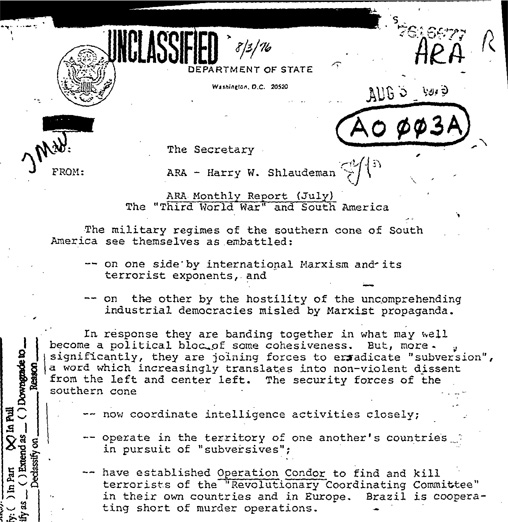
Former military officers from Argentina and Uruguay went on trial this week in Buenos Aires for their human rights abuses in Operation Condor, a cross-border conspiracy of dictatorships in the 1970s and 1980s to “eradicate ‘subversion,’ a word which increasingly translates into non-violent dissent from the left and center left,” according to declassified documents posted today by the National Security Archive ( www.nsarchive.org).
Today’s posting of documents and evidence provided by the Archive to Argentine prosecutors includes the first briefing report, from August 1976, to then-Secretary of State Henry Kissinger on the secret police collaboration in the Southern Cone to “find and kill” opponents of their military regimes.
“The documents are very useful in establishing a comprehensive analytical framework of what Operation Condor was,” said Pablo Enrique Ouvina, the lead prosecutor in the case.
Founded by the Pinochet regime in November 1975, Operation Condor was the codename for a formal Southern Cone collaboration that included transnational secret intelligence activities, kidnapping, torture, disappearance and assassination, according to the National Security Archive’s documentary evidence from U.S., Paraguayan, Argentine, and Chilean files.
Prominent victims of Condor include two former Uruguayan legislators and a former Bolivian president, Juan Torres, murdered in Buenos Aires, as well as former Chilean ambassador Orlando Letelier and his 26-year old American colleague, Ronni Moffitt, assassinated by a car bomb in downtown Washington D.C.
The historic trial charges 25 high-ranking military officials, including former Argentine presidents Jorge Videla and Reynaldo Bignone, with conspiracy to “kidnap, disappear, torture and kill” 171 opponents of the military dictatorships that dominated the Southern Cone in the 1970s and 1980s. Among the victims are approximately 80 Uruguayans, 50 Argentines, 20 Chileans and a dozen from Paraguay, Bolivia, Peru and Ecuador who were targeted by Condor operatives. The kidnapping and disappearance of two Cuban Consulate officials in Buenos Aires on August 9, 1976, is also part of the prosecution.
“Condor was a latter day rendition, torture and assassination program,” noted Carlos Osorio, who directs the Archive’s Southern Cone Documentation project. “Holding these officials accountable for the multinational crimes of Condor,” he said, “cannot help but set a precedent for more recent abuses of a similar nature.”
Besides Generals Videla and Bignone, those indicted included 22 Argentine military intelligence officers and agents. In preparation for the trial, prosecutors sought the extradition of several foreign high ranking officers from Chile and Paraguay among other Condor countries. The only foreigner sitting at the courtroom, however, is Uruguayan Army Major Manuel Cordero, charged with participating in death squads and torture at the infamous Orletti Motors secret detention center in Buenos Aires. He was extradited by Brazil where he was living.
Of the 171 Condor victims cited in the indictments, approximately forty-two survived and a number of them are expected to testify in court. One hundred twenty others were killed and/or disappeared.


THE DOCUMENTS

Document l: Department of State, Report to Kissinger, SECRET, “The Third World War and South America,” August 3, 1976.
This report, based on CIA intelligence, was written by Assistant Secretary of State for Latin America, Harry Shlaudeman and presented to Secretary of State Henry Kissinger in August 1976. The document summarizes the coordination of Southern Cone security forces:
“[T]hey are joining forces to eradicate ‘subversion,’ a word which increasingly translates into non-violent dissent from the left and center left. The security forces of the Southern Cone now coordinate intelligence activities closely; operate in the territory of one another’s countries in pursuit of ‘subversives’; have established Operation Condor to find and kill terrorists…in their own countries and in Europe. Brazil is cooperating short of murder operations.”
Document 2: Defense Intelligence Agency, [Report on Operation Condor] “Special Operations Forces,” SECRET, October 1, 1976.
This comprehensive intelligence report, based on information gathered by the FBI legal attaché in Buenos Aires, provides details on the collaboration between Argentina, Uruguay, and other Southern Cone military dictatorships. The document provided critical information to prosecutors on a joint operation with Uruguayan intelligence agents in late September 1976, in which dozens of Uruguayan members of the militant leftist movement OPR-33 were rounded up, detained, tortured, and a number killed in Buenos Aires. “The entire OPR-33 infrastructure in Argentina has been eliminated,” the document states. The kidnapped Uruguayans are among the over one hundred disappeared victims included in the Operation Condor trial. The document goes on to describe the “formation of special teams” to “carry out operations to include assassinations” in countries as far away as Portugal and France. The report cited a “favorite remark” of Southern Cone military officers as saying that “one of their colleagues is out of country because he is flying like a condor.”
Document 3: CIA, SECRET, A Brief Look at Operation Condor, August 22, 1978.
In the aftermath of the Letelier-Moffitt assassination, the CIA prepared this short briefing paper for Eugene Propper, the Justice Department’s lead prosecutor in the case. “Operation Condor is a cooperation effort by the intelligence/security services of several South American countries to combat terrorism and subversion. The original members included services from Chile, Argentina, Uruguay, Paraguay, Brazil and Bolivia; Peru and Ecuador recently became members.”
Document 4: Department of State, SECRET, “Conversation with Argentine Intelligence Source,” April 7, 1980.
In this revealing memorandum to Ambassador Castro, James J. Blystone, the Regional Security Officer (RSO) at the US Embassy in Buenos Aires, details his April 2 meeting with an Argentine intelligence source. The anonymous Argentine source describes how Horacio Campiglia and Susana Binstock, two militant Montoneros, were captured by Argentine officers of Battalion 601 (in coordination with Brazilian intelligence), taken to Argentina and held at the Campo de Mayo Army base. Campiglia and Binstock who were never seen again, are amongst the more than a hundred victims included in the Operation Condor trial.

Friday, October 26, 2012

USAID Spying In Latin America


By Nil Nikandrov
Courtesy Of "Global Research"

The ejection of USAID from Russia was a long-awaited and welcome development. Moscow has repeatedly warned its US partners via an array of channels of communication that the tendency of USAID to interfere with Russia’s domestic affairs was unacceptable and, particularly, that the radicalism of its pet NGOs in the Caucasus would not be tolerated. When, on October 1, the decision made by the Russian leadership takes effect, the Moscow-based USAID staff which has been stubbornly ignoring the signals will have to pack and relocate to other countries facing allegations of authoritarian rule…In Latin America, USAID has long earned a reputation of an organization whose offices are, in fact, intelligence centers scheming to undermine legitimate governments in a number of the continent’s countries. The truth that USAID hosts CIA and US Defense Intelligence Agency operatives is not deeply hidden, as those seem to have played a role in every Latin American coup, providing financial, technical, and ideological support to respective oppositions. USAID also typically seeks engagement with the local armed forces and law-enforcement agencies, recruiting within them agents ready to lend a hand to the opposition when the opportunity arises.
To varying extents, all of the Latin American populist leaders felt the USAID pressure. No doubt, Venezuela’s H. Chavez is the number one target on the USAID enemies list. Support for the regime’s opponents in the country shrank considerably since the massive 2002-2004 protests as the nation saw the government refocus on socioeconomic issues, health care, housing construction, and youth policies. The opposition had to start relying more on campaigns in the media, around 80% of which are run by the anti-Chavez camp. Panic-provoking rumors about imminent food supply disruptions, overstated reports about the crime level in Venezuela (where, actually, there is less crime than in most countries friendly to the US), and allegations of government incompetence in response to technological disasters which became suspiciously frequent as the elections drew closer are bestowed on the audiences as a part of the subversive scenario involving a network ofVenezuelan NGOs. In some cases, the membership of the latter can be limited to 3-4 people, but, coupled to strong media support, the opposition can prove to be an ominous force. Pro-Chavez commentators are worried that USAID agents will contest the outcome of the vote and, synchronously, paramilitary groups will plunge Venezuelan cities into chaos to give the US a pretext for a military intervention.
USAID is known to have contributed to the recent failed coup in Ecuador, during which president R. Correa narrowly escaped an assassination attempt. Elite police forces heavily sponsored by the US and the media which made use of the liberal free speech legislation to smear Correa were the key actors in the outbreak. Subsequently, it took Correa serious efforts to get a revised media code approved in the parliament contrary to the USAID-lobbied resistance.
Several bids to displace the government of Evo Morales clearly employed the USAID operative potential in Bolivia. According to journalist and author Eva Golinger, USAID poured at least $85m into destabilizing the regime in the country. Initially, the US hoped to achieve the desired result by entraining the separatists from the predominantly white Santa Cruz district. When the plan collapsed, USAID switched to courting the Indian communities with which the ecology-oriented NGOs started to get in touch a few years before. Disorienting accounts were fed to the Indians that the construction of an expressway across their region would leave the communities landless, and the Indian protest marches to the capital that followed ate away at the public standing of Morales. It transpired shortly that many of the marches including those staged by the TIPNIS group, had been coordinated by the US embassy. The job was done by embassy official Eliseo Abelo, a USAID curator for the Bolivian indigenous population. His phone conversations with the march leaders were intercepted by the Bolivian counter-espionage agency and made public, so that he had to escape from the country while the US diplomatic envoy to Bolivia complained about the phone tapping.
In June 2012, foreign ministers of the ALBA bloc countries passed a resolution on USAID. It read: «Citing foreign aid planning and coordination as a pretext, USAID openly meddles in sovereign countries’ domestic affairs, sponsoring NGOs and protest activities intended to destabilize legitimate governments which are unfavorable from Washington’s perspective. Documents released from the US Department of State archives carry evidence that financial support had been provided to parties and groups oppositional to the governments of ALBA countries, a practice tantamount to undisguised and audacious interference on the US behalf. In most ALBA countries, USAID operates via its extensive NGO networks, which it runs outside of the due legal framework, and also illicitly funds media and political groups. We are convinced that our countries have no need for external financial support to maintain the democracy established by Latin American and Caribbean nations, or for externally guided organizations which try to weaken or sideline our government institutions». The ministers called the ALBA leaderships to immediately deport USAID representatives who threaten the sovereignty and political stability of the countries where they work. The resolution was signed by Bolivia, Cuba, Ecuador, the Dominican Republic, Nicaragua, and Venezuela.
Paul J. Bonicelli was confirmed by the US Senate as the USAID Assistant Administrator for Latin America and the Caribbean last May. Former USAID chief Mark Feuerstein gained such notoriety in Latin America as the brain behind the ousters of the legitimate leaders of Honduras and Paraguaythat the continent’s politicians simply had to learn to avoid him. The USAID credibility is increasingly drying up, and it is unlikely that Bonicelli, a PhD and a conservative, will be able to reverse the tendency. His record includes heading various USAID divisions and «promoting democracy» in concert with the US National Security Council.
Bonicelli’s views are reflected in his papers in the Foreign Policy journal. To Bonicelli, Chavez is not a democrat but a leader eager to get rid of all of his opponents. The new USAID boss holds that, apart from the drug threat, Chavez – having inspired populist followers in Ecuador, Bolivia, and Nicaragua – poses the biggest challenge to the US interests in Latin America. Bonicelli therefore urges the US to prop up the Venezuelan opposition in every way possible, providing material support and training, so that it can maximally take part in elections and civilian activities.
Another paper by Bonicelli portrays Russia’s present-day evolution as grim regress and a slide towards «neo-Tsarism». Based on the perception, Bonicelli argues that the West should hold Russia and its leaders accountable in whatever concerns freedom and democracy – even if freedom in the country is important to just a handful of people – and cites the case of Poland where the US used to stand by Lech Wałęsa.
Chances are slim that a reform of USAID would restore the agency’s credibility in Latin America. Sticking to a trimmed list of priorities, USAID axed a few minor programs and shut down its offices in Chile, Argentine, Uruguay, Costa Rica, and Panama, with Brazil next in line. USAID believes that the above countries are already in reasonable shape and no longer need assistance, so that the agency can throw its might against its main foes – the populists and Cuba, and do its best to have the politicians unfriendly to Washington removed across the Western Hemisphere. The stated USAID budget for Latin America is $750m, but estimates show that the secret part of the funding, which is leveraged by the CIA, may total twice the amount.

Monday, September 24, 2012

The US and Honduras


 US Financial Aid To A Police and Army Linked To A Campaign Of Extra-Judicial Killings

Honduras has become the newest front in the US war on drugs in Latin America. The US has provided financial support for both the police and the military there in spite of its deep corruption issues.

Furthermore, members of both institutions have been linked to a range of killings. Political dissidents, human rights workers and members of the lesbian, gay, bisexual and transgender (LGBT) community have all been killed at alarming rates.

In May, a mission in the Moskitia region, which was led by the Drug Enforcement Administration (DEA), left four innocent civilians killed and four others wounded. It was followed by two more incidents where a US DEA agent shot and killed an alleged drug trafficker. Local communities have demanded a thorough investigation but so far nothing has been done.

The US has a long and controversial history in Honduras. In the 1980s, the US built a base there and trained an elite Honduran military unit. That unit went on to carry out tortures, kidnappings and killings.

Who is responsible? What should be the role of the US in Honduras? And what happened that night in the Moskitia when a US raid ended up leaving innocent people dead?

Sunday, July 08, 2012

Welcome To 'Democraship'

By Pepe Escobar
July 4, 2012
Courtesy Of "Asia Times Online"

Let's start with a bomb. Over 10 days ago a new brand of coup d'etat took place in Paraguay against elected president Fernando Lugo. It was virtually unnoticed by global corporate media. 

Anything unexpected? Not really. A March 2009 cable from the US Embassy in Asuncion, revealed by WikiLeaks, [1] had already detailed how oligarchs in Paraguay were busy devising a "democratic coup" in congress to depose Lugo. 

At the time, the US embassy noted political conditions were not ideal for a coup. Key among the plotters was former president Nicanor Duarte (2003 to 2008), severely bashed by progressive South American governments for having allowed US Special Forces in Paraguayan soil to conduct "educational courses", "domestic peacekeeping operations" and "counter-terrorism training". 

This US Special Forces drive was happening decades after "one of our bastards", notorious dictator-general Alfredo Stroessner (in power from 1954 to 1989) had allowed the set up of a giant US-owned semi-clandestine landing strip near the Argentina-Brazil-Paraguay Triple Border - later to become part of the war on drugs, and then the war on terror. 

So it's a no-brainer which was the first government to recognize last Friday's coup plotters in Paraguay: the United States of America. 

Forget About Sharing Our Cake

Progressive Egyptians are now realizing new democracies take years, sometimes decades, of co-existing with the nightmare of dictatorship. It happened, for instance, in Brazil - now universally lauded as a new, global powerhouse. During the 1980s and 1990s, some form of institutional re-democratization was going on. But for years Brazil really did not turn into a full democracy - economically, socially and culturally. It took a long 17 years - until president Luiz Inacio Lula da Silva first came to power in 2002 - for Brazil to start on the road of becoming less outrageously unequal than its rapacious ruling classes always wanted it to be. 

The same historical process is now at work in both Egypt and Paraguay. Both countries suffered dictatorships for decades. When a dictatorship seems to be on its death throes, only political parties linked - or mildly tolerated - by the ancien regime find themselves in the best position to profit from the long, tortuous transition towards democracy. These countries then become what Brazilian political scientist Emir Sader has dubbed "democraships". 

This applies to the Liberal Party in Paraguay and the Muslim Brotherhood in Egypt. In the Egyptian presidential election, we had a former Hosni Mubarak crony against an Ikhwan (Muslim Brotherhood) cadre. It remains to be seen whether the Orwellian SCAF (Supreme Council of the Armed Forces) in Egypt will allow this new "democraship" to turn into a real democracy, and to what extent the Ikhwan is fully committed to the notion of democracy. 

Paraguay was already in a more advanced stage than Egypt. Yet four years after a democratic presidential election, congress was still dominated by two dictatorship-friendly parties, Liberal and Colorado. It was a piece of cake for this bipartisan oligarchy to gang up and take Lugo down. 

A Medium-Rare Impeachment, Please

Lugo was evicted by a coup disguised as an impeachment, processed in only 24 hours. Regime change practitioners in Washington must have been ecstatic; if only we could do that in Syria ... 

This simulacrum had to be concocted by what is the most corrupt senate in the Americas - and that's a huge understatement. Lugo was found guilty of incompetence in dealing with a very murky story linked - inevitably - with an issue that is absolutely key all across the developing world: agrarian reform. 

On June 15, a group of policemen and commandos about to enforce an eviction order in Curuguaty, 200 kilometers from Asuncion, close to the Brazilian border, was ambushed by snipers infiltrated among farmers. The order came from a judge protecting a wealthy landowner, Blas Riquelme, not by accident a former president of the Colorado party and a former senator. 

Through legal shenanigans, he had taken possession of 2,000 hectares that actually belonged to the Paraguayan state. These lands were then occupied by landless peasants, who for some time had been asking the Lugo government to redistribute them. 

The School of the Americas Watch has already documented how enormous tracts of land in Paraguay were actually stolen from farmers and "donated" to military and upper-class cronies during those decades under the Stroessner dictatorship. 

The result in Curuguaty was 17 dead - six policemen and 11 farmers - and at least 50 wounded. It simply doesn't make sense; the elite members of the eviction force, a hardcore unit named Special Operations Group, were trained in counterinsurgency tactics in Colombia - under the right-wing Uribe government - as part of the US-concocted Plan Colombia. 

Plan Paraguay, for its part, was very simple; absolute criminalization of every peasant organization, forcing them to leave the countryside for transnational agribusiness. 

So this was, essentially, a trap. Paraguay's rabid right-wingers - joined to the hip with Washington, for example trying to prevent, by all means, Venezuela's entrance into the Mercosur common market - were just waiting to pounce on a regime that had not, yet, affected its interests, but had opened up plenty of spaces for social protest and popular organization. 

Lugo, a former bishop elected in 2008 with large rural support, might have seen it coming, but he did nothing to stop it. Compared with his power to mobilize people in the streets, he had minimum support in Congress: only two senators. Over 40% of Paraguayans live in the countryside, but they are hardly mobilized. And 30% live under the poverty line. 

The "winners" in Paraguay had to be the usual suspects: the landowning oligarchy - and its concerted campaign to demonize farmers; multinational agribusiness interests such as Monsanto; and the Monsanto-linked media (as in the ABC Color daily, which accused ministers not acting as Monsanto stooges of being "corrupt"). 

Agribusiness giants such as Monsanto and Cargill pay virtually no taxes in Paraguay because of the right-wing controlled Congress. Landowners don't pay taxes. Needless to add, Paraguay is one of the most unequal countries in the world; 85% of land - like 30 million hectares - is controlled by the 2% composing the rural aristocracy, a great deal of them involved in land speculation. 

Thus their Miami Vice-style mansions in Uruguay's hip Punta del Este resort or, for that matter, Miami Beach; the money, of course, is in the Cayman islands. Paraguay is de facto ruled by this cream of the 2% mixing agribusiness with the neoliberal financial casino. 

And by the way, as Martin Almada, a top Paraguayan human-rights activist and alternative Nobel Peace Prize winner, has noted, this concerns Brazilian landowners as well. The wealthiest soya bean producer in Paraguay is a "Braziguayan", double nationality holder Tranquilo Favero, who made his fortune under Stroessner. 

A Coup On The Rocks, Please
 
The Union of South American Nations (Unasur) treated what happened in Paraguay for what it is; a coup. Same with Mercosur. The contrast with Washington's position couldn't be more glaring. Coup plotter Federico Franco is a darling of the US Embassy in Asuncion. 

Argentina, Uruguay, Venezuela and Ecuador won't recognize the coup plotters. Venezuela cut off oil sales to Paraguay. Brazilian President Dilma Rousseff has proposed the expulsion of Paraguay from both Unasur and Mercosur. 

Paraguay is already suspended; this means coup plotter Federico Franco was prevented from attending a key Mercosur meeting last week in Mendoza, Argentina, when the temporary Mercosur presidency would be handed over to Paraguay. The Paraguayan oligarchy - under Washington's orders - was blocking Venezuela's entrance in Mercosur. Not anymore; Venezuela becomes a full member by the end of the month. 

Yet South American progressive governments must be very careful. If Paraguay is expelled from both Unasur and Mercosur, it will inevitably ask Washington for commercial and military help. That could translate into a nightmare - US military bases in Paraguay. 

Paraguay's oligarchs, the media they control, and last but not least the reactionary Catholic church hierarchy, calculate they will extend their power when elections take place in April 2013. 

Lugo was in fact facing a Sisyphean task - trying to steer a weak state, with minimum income from taxes (less than 12% of GNP), and under severe pressure by powerful transnational lobbies and comprador elites. This, by the way, is the structural reality of a great deal of Latin America - and, roughly, one might add, of Egypt. 

On a geopolitical level, what progressives everywhere - from South and North America to the Arab world - should worry about is how, since the June 2009 coup against Manuel Zelaya in Honduras, Latin America is being turned into a giant laboratory testing all sorts of "democratic" coup d'etat mutations. 

Paraguay is one such mutation. Another one was the failed coup against Ecuador's Rafael Correa in September 2010. All these coups are against progressive governments who privilege social advances. 

Not by accident, Correa, who was almost evicted by a coup, said that if it succeeded this time in Paraguay it would "open a dangerous precedent" in the whole region. 

And in terms of poetic justice, nothing beats Correa - the target of a coup - currently studying the possibility of offering political asylum to Julian Assange, whose WikiLeaks revealed, among other things, how the Paraguayan elite was plotting their own coup. 

In Egypt, a military coup happened even before a presidential election. Progressive Egyptians who actually led the Arab Spring must be extremely alert; Paraguay is showing how the rocky road towards democracy may end up in a "democraship". 

Note: 1. See here

Pepe Escobar is the author of Globalistan: How the Globalized World is Dissolving into Liquid War (Nimble Books, 2007) and Red Zone Blues: a snapshot of Baghdad during the surge. His most recent book, just out, is Obama does Globalistan (Nimble Books, 2009).