Showing posts with label Coup's. Show all posts

Saturday, January 05, 2013

THE CORPORATIST INTELLIGENCE AGENCY


By Tim Kelly
Courtesy Of "The Future Of Freedom Foundation"


While the CIA is commonly understood to be an intelligence agency, we shouldn’t forget the important role it has played in carrying out clandestine operations that have benefited the financial elite.
This accusation is substantiated by the CIA’s elitist origins, its well-documented connections to Wall Street, and its sordid history of carrying out assassinations, staging coups, and fomenting civil wars.
The CIA and the financial elite have always had shared goals, interests, and backgrounds. Those in the upper echelons at Langley have often attended the same universities, belonged to the same fraternities, and attended the same clubs and parties as the Wall Street elite. This is why the intelligence community is often described as the “old boy network.”
This collusion is perhaps best illustrated by the career of Allen Welsh Dulles. Dulles was an operative of the Office of Strategic Services (OSS), the American WWII intelligence organization and forerunner of the CIA. He was also a senior partner of Sullivan & Cromwell, a well-connected Wall Street law firm representing several large American corporations, and a board member of J. Henry Schroeder Bank, a multinational investment house. Dulles’s international business concerns created myriad conflicts of interest while he headed the CIA from 1953 to 1961.
When Dulles was assigned the task of drafting the proposal for the organization that was to become the Central Intelligence Agency, he created an advisory group of a half dozen men, all of them Wall Street investment bankers and lawyers. Incidentally, Dulles had intended to be installed as Director of Central Intelligence (DCI) as early as 1949, but when President Harry Truman defeated New York Governor Thomas Dewey (Dulles was Dewey’s speech writer) in the 1948 presidential election, his plans were put on hold.
Such conflicts of interest had existed within the intelligence community from the start. During World War II, the OSS recruited almost exclusively from the nation’s elite universities and corporate boardrooms. The international scope of many American corporations, particularly those in the insurance and petroleum industries, made them ideally suited for intelligence gathering. The alliance was refined, if not formalized, after the war with the creation of the CIA in 1947.
During the Cold War, U.S. corporations routinely provided CIA agents with cover, secret funding, resources, and contacts overseas. The CIA often reciprocated by giving these corporations multibillion dollar contracts, providing them immunity from media scrutiny by invoking “national security,” propping up “pro-American” puppet regimes, and, when necessary, overthrowing recalcitrant foreign governments.
Under Dulles’s directorship, there were two major operations carried out by the CIA that illustrate perfectly the agency’s corporatist mission.
In 1953, the CIA, working with the British MI6, overthrew the democratically elected Iranian government of Mohammed Mossadegh, citing a communist threat. But there was no such threat. The Soviets had withdrawn from the country in 1945, and the Iranian communist party, the Tudeh, was weak and in no position to seize power.
The real reason for the CIA-backed coup that smothered Iran’s nascent democracy and installed the tyrannical Shah was Mossadegh’s threat to nationalize his country’s oilfields. This policy might have jeopardized the profits of British and American oil companies, but it certainly posed no threat to the security of the United States.
The CIA’s toppling of the democratically elected government of Jacobo Arbenz in Guatemala in 1954 was also justified as an anti-communist operation. But again, there was no communist threat. Arbenz’s government had run afoul of the United Fruit Company by instituting a land-reform program that called for the compensated taking of portions of the company’s vast property holdings. The CIA Red-baited Arbenz, staged a coup that overthrew him, and installed the brutal dictator Colonel Castillo Armas. The operation was considered an unambiguous success by the CIA and, no doubt, by the board of United Fruit — but it proved to be a disaster for the Guatemalan people, who would endure 40 years of civil war.
And of course the CIA’s corporatist operations did not end with Dulles’s ouster in 1961.
In 1973, the CIA orchestrated a coup against Chile’s democratically elected leader, Salvador Allende. Allende had crossed the U.S. financial elite by nationalizing foreign-owned interests like the country’s copper mines and telephone system. The CIA responded with a coup that resulted in Allende’s death and the installation of General Augusto Pinochet as the country’s dictator. Pinochet’s reign would last another 15 years, during which his regime tortured and murdered thousands of political opponents.
In 1987, the former CIA station chief in Angola, John Stockwell, said that the CIA was responsible for tens of thousands of covert actions and destabilization programs since its inception. At the time, Stockwell estimated that over 6 million people had died in CIA covert actions. Former State Department official and author William Blum has called this an “American Holocaust.”
That this alliance between the intelligence and business communities would lead to much mischief, mayhem, and bloodshed abroad is hardly surprising. Secrecy in the name of “national security” enabled both the CIA and corporate America to avoid accountability, rise above the law, and increase their power and profits.
Moreover, the destabilization of so-called third-world countries provided an arena for the Agency’s “fun-and-games” branch (clandestine operations). Weapons and narcotics trafficking flourished in the various hot spots stoked by Western intelligence agencies. These conflicts had nothing to do with national security, but they kept the spies employed and made a few arms dealers very wealthy. If millions of innocents suffered and perished in the senseless fighting, well,C’est la guerre.
In 1975, Philip Agee, an ex-CIA agent and author of Inside the Company, one of the first detailed exposés of the CIA, made this insightful observation:
To the people who work for it, the CIA is known as The Company. The Big Business mentality pervades everything. Agents, for instance, are called assets. The man in charge of the United Kingdom desk is said to have the “U.K. account.”…
American multinational corporations have built up colossal interests all over the world, and you can bet … that wherever you find U. S. business interests, you also find the CIA.… The multinational corporations want a peaceful status quo in countries where they have investments, because that gives them undisturbed access to cheap raw materials, cheap labor and stable markets for their finished goods. The status quo suits bankers, because their money remains secure and multiplies. And, of course, the status quo suits the small ruling groups the CIA supports abroad, because all they want is to keep themselves on top of the socioeconomic pyramid and the majority of their people on the bottom. But do you realize what being on the bottom means in most parts of the world? Ignorance, poverty, often early death by starvation or disease.
Throughout the Cold War, the CIA served the interests of the financial elite by artificially inflating estimates of Soviet military strength. These gross overestimates ensured the passage of enormous military-appropriation bills by Congress, thus enriching a few corporations within the military-industrial complex.
When the Cold War ended and the CIA found itself without an adversary, it was quick to come up with a new mission: corporate espionage. Journalist Robert Dreyfuss writes,
Since the end of the Cold War, Washington has been abuzz with talk about using the CIA for economic espionage. Stripped of euphemism, economic espionage simply means that American spies would target foreign companies, such as Toyota, Nissan, and Honda, and then covertly pass stolen trade secrets and technology to U.S. corporate executives.
The CIA’s behavior is hardly an American innovation. Indeed, it goes back at least as far as the British East India Company and is part of the game of empire. To gain insight into how this game is played, I recommend Baker’s Family of Secrets and John Perkins’ Confessions of an Economic Hitman.

Wednesday, October 10, 2012

The Crowd-Sourcing Project

Ken Dilanian reports that,

Nine years ago, Congress blocked a Pentagon agency from setting up a website that would have allowed anyone with a credit card to bet on the likelihood of foreign assassinations, coups and terrorist attacks.

The idea was to take advantage of the "wisdom of crowds," a social science maxim that contends the average of a group of forecasters, under certain circumstances, tends to be more accurate than even the most knowledgeable single forecaster.

But lawmakers worried the proposed predictions market could allow terrorists to profit from their own misdeeds. Congress forced the Defense Advanced Research Projects Agency — the military's cutting-edge research arm, known as DARPA — to scuttle the program.

Now terrorism futures are back.

DARPA's sister agency — the Intelligence Advanced Research Projects Activity, which funds experimental projects for the U.S. intelligence community — is running a four-year, $50-million program that pays people willing to predict major world events, including wars and terrorist strikes. Unlike the earlier scheme, participants can't profit from their predictions.

Now in its second year, the so-called crowd-sourcing project involves competing corporate and university teams, including UC Irvine. Each team includes more than a dozen social scientists and as many as 2,000 participants, who can answer hundreds of questions each if they want.

The study, known as Aggregative Contingent Estimation, is designed to see whether the 17 agencies in the U.S. intelligence community can aggregate the judgment of its thousands of analysts — rather than rely on the expertise of just a few — to issue more accurate warnings to policy makers before and during major global events.

Participants in the project give their best guesses on whether the Free Syrian Army will gain control of Aleppo, for example, or whether Kim Jong Un will resign as the leader of North Korea before April 1, 2013, according to project websites.

Initial results are promising, according to Philip Tetlock, aUniversity of Pennsylvania professor who leads one of the teams. His 2005 book, "Expert Political Judgment: How Good Is It? How Can We Know?" showed that political pundits often fared worse in predictions than the proverbial dart-throwing monkey.

"The idea that the average of a group of forecasters is more accurate than any one forecaster goes back 100 years," Tetlock said. In 1906, British scientist Francis Galton determined that the average of 787 guesses about the weight of an ox at a county fair was startlingly accurate.

The teams are trying to beat the average by using algorithms that, over time, give greater weight to the most successful crystal gazers among their participants and weed out the worst. Tetlock's group, the Good Judgment Project, is in the lead so far.

"In year one, we beat the unweighted average by about 57%, which was big," he said. A control group, run by Mitre Corp., averages scores without giving weight to participants who tally the best results.

Predicting world-changing events is never easy. U.S. intelligence agencies failed to foresee the fall of the Soviet Union, to predict the terrorist attacks of Sept. 11, 2001, and, more recently, to anticipate political upheaval across the Arab world.

The CIA and other agencies tend to rely on small groups of experts who hash out consensus judgments. If there is strong disagreement among the analysts, or between different agencies, an intelligence report will note that.

Crowd-sourcing would mean, in theory, polling large groups across the 200,000-person intelligence community, or outside experts with security clearances, to aggregate their views about the strength of the Taliban, say, or the likelihood that Iran is secretly building a nuclear weapon.

For now, there is deep skepticism in intelligence circles.

"I don't believe in the wisdom of crowds," said Mark Lowenthal, a former senior CIA and State Department analyst (and 1988"Jeopardy!" champion) who now teaches classified courses about intelligence. "Crowds produce riots. Experts produce wisdom."

Others argue that intelligence analysis can benefit from data-driven social science. The CIA's venture capital arm, In-Q-Tel, was an early investor in a private company called Recorded Future, headquartered in Cambridge, Mass., and Göteborg, Sweden, which uses data on the Internet, from securities filings to Facebook posts to government statistics to make connections and spot trends.

A National Academy of Sciences report last year commissioned by former National Intelligence Director Dennis C. Blair found that intelligence practices "have been only weakly informed by the behavioral and social sciences." It recommended that "science and evidence-based protocols" be introduced and evaluated alongside the spy agencies' traditional reliance on expert judgment.

The crowd-sourcing project is one result. Each team recruited its own forecasters, whose names are not made public. A few are or have been affiliated with intelligence agencies, organizers said. Some teams require participants to have college degrees, while others take all comers.

"We would prefer people who actually have a background and an interest in current events," said Charles Twardy, who is co-directing the team at George Mason University in Virginia. "But it's open to anyone who wants to participate."

Pure futures markets using real money, such as an Irish company called Intrade, allow participants to buy shares in a prediction. For example: "Bashar al-Assadto no longer be President of Syria before midnight ET 31 Dec 2012."

If Assad is out by year's end, the contract will pay $10 a share. If he stays in power, it will pay zero. Intrade's website recently had five shares available for $5.99, meaning the market set the probability of Assad's ouster by Dec. 31 at about 60%.

Intrade's consensus called every state correctly in the 2004 U.S. presidential election and all but two right in 2008. But it also estimated a 77% chance the U.S. Supreme Courtwould throw outPresident Obama's signature healthcare legislation (it didn't) and recently predicted a cautious vice presidential pick by Mitt Romney (he surprised many when he chose Rep. Paul Ryan).

Tetlock praised the willingness to fund a study that could expose weaknesses in how spy services do their work.

"It's not often that government agencies do something that has the potential to make them look not so good," he said.

Via: "The LA Times"

Monday, October 01, 2012

Where Is The Domestic Jihad?

"Kelley B. Vlahos" writes,


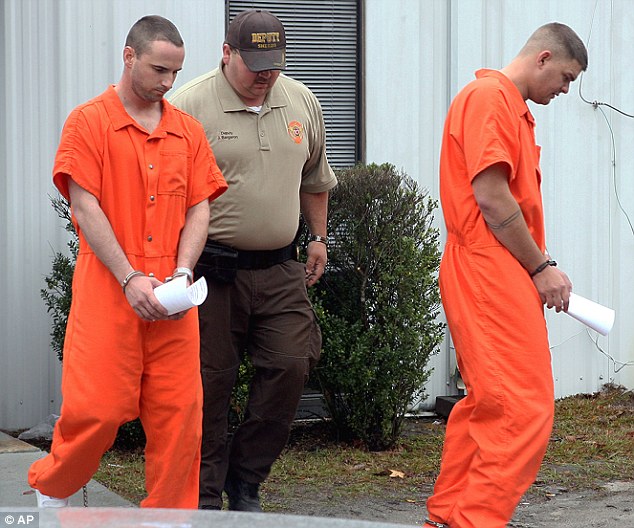
In what papers are calling “one of the most startling and potentially serious cases of an anti-government militia to be brought before the courts in recent years,” three U.S. soldiers have been arraigned for murder and may get the death penalty, stemming from charges they amassed an arsenal, plotted several domestic terror attacks, and killed two friends who had become “loose ends” in their diabolic plans.
You haven’t heard of this? Not surprising, since this story doesn’t square with the narrative that homegrown Muslim radicals are not only infiltrating the government,and the military, but plotting the next big domestic terror assault on American soil. These militiamen, arrested in Georgia where they were stationed at Fort Stewart, are white. They don’t pray in a mosque and certainly don’t want to build one. According to reports, however, they were members of FEAR — Forever Enduring Always Ready — which has been loosely described as an anarchist group set on overthrowing the government and killing President Obama.

Georgia militiamen
These aren’t the first white militia types to be arrested in recent years. Indeed, they join a string of supposed Muslim plotters arrested since 2001. The difference between the recent Georgia case and many of the others is the FBI wasn’t involved from the beginning to set them up and lead them by the nose (the Muslim community is quite familiar with these tactics). These FEAR guys were apparently the real deal. They boughtreal weapons, and a lot of them, and in the case of the Fort Stewart gang, they committed real murder, killing the guy who allegedly helped to get them the weapons and his girlfriend, execution style, after luring them into the woods.

Wade Michael Page
Turns out there’s been a number of cases that have brought to light the existence of individuals associated with, or who had exhibited proclivities for, white nationalism or neo-Nazism, including Wade Michael Page, who was responsible for the shooting deaths of 12 Sikh worshipers in their suburban Milwaukee temple earlier last month. Page was reportedly a troubled man, an apparent alcoholic, who had been kicked out of the military and was connected with skinhead rock bands, white supremacists and neo-Nazis for the last 10 years.
Sikhs, often mistaken for Muslims, have been the target of numerous hate crimes, including violence, since 9/11.
Indeed there have been only four known cases of Muslim individuals successfully carrying out apparent terrorist attacks/hate crimes against non-Muslims on American soil since 9/11 (chart here). The most high profile occurred in 2009, when U.S. Army Maj. Nidal Hasan killed 13 fellow service members in a bloody shooting rampage at Fort Hood in Texas.
So far, of the successful killers, only the Little Rock shooter, Abdulhakim Mujahid Muhammad, has been tied to some sort of al-Qaeda training overseas. Though it has been tried, Hasan has not yet been tied to any organized jihad, or holy war, against the U.S.
In Hasan’s case, emails have been recovered between Hasan and his old Imam Anwar al-Awlaki, who was suspected of al-Qaeda ties and overseas terror plots, and used to preach in suburban Virginia. No one has established whether Awlaki had played a greater role in the Ft. Hood murders other than “inspiring” the clearly disturbed Hassan to pull them off. No one can really know, since Awlaki, also an American citizen, was targeted and killed by a U.S. drone in Yemen in 2011.
An exception to all this might be Pakistani-born Faisal Shahzad who tried, but failed, to set off a carload of explosives in Times Square in 2011. He reportedly acted in revenge for U.S. drone attacks in Pakistan and has been connected to a Taliban group there.
But consider all of the domestic terror attacks conducted by non-Muslims that have not been so widely reported, like when Jim Adkisson walked into the Knoxville Unitarian Universalist Church on July 27, 2008 and sprayed a youth group with gunfire, killing two and injuring several others. Police said he was motivated to kill “liberals and Democrats.”
Or Keith Luke, who murdered two people and shot one more in Brockton, Mass., in 2009, and plotted to murder more in an effort to kill as many non-whites and Jews as he could before killing himself. Or prison guard Raymond Franklin Peake, who was sentenced to life without parole in April after killing a man and stealing a gun he reportedly planned to use in anti-government plot with other militiamen.
A useful compendium of non-Islamist domestic terror plots and attacks can be foundhere, thanks to The American Muslim website.
We’ve all heard of Muslim extremists, but there have been so many foiled plots by anti-abortionists, anarchists, skinheads, Ku Klux Klan and schizophrenic lone wolves that have not received the same attention. When you put it all together, it renders a much more complicated picture of politics and violence and mental illness than the media and Washington allows us to see.
Instead, angry Muslims have dominated the domestic terror story since 9/11, leaving very little else for examining extremism in other forms. Think about it, when an internal Department of Homeland Security report (.pdf) about domestic extremism suggested the possible rise of homegrown anti-government hate groups and dared to suggest that recent veterans might be able recruits in this arena, the department was lambasted by the right-wing, and forced to withdraw the report.
It just didn’t jibe with the predominant right-wing agenda, which at that time had the ear of the compliant mainstream media and had struck fear in the hearts of vulnerable Democratic pols everywhere.
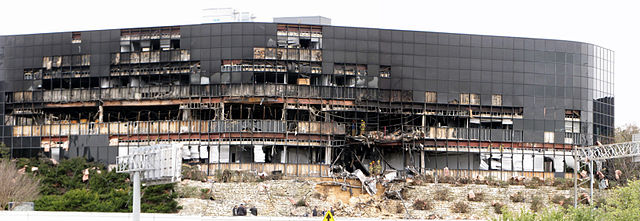
Case in point: as it happened, the Feb. 18, 2010 incident in which a suicide pilot flew his plane into the IRS building in Austin, Texas, occurred on the opening day of the Conservative Political Action Conference in Washington, the biggest congregation of young and old Republican conservatives of the year.

Texas IRS building after Andrew Joseph Stack flew his plane into it in February 2010
I was covering the event for Antiwar.com that day, and wondered briefly if news that the pilot, a white Caucasian male by the name of Andrew Joseph Stack, had a bone to pick with the government, would penetrate the buzz in the cavernous ballroom or exhibition hall (which, that year, was seriously packed with Tea Party patriots high on a big electoral win that fall).
But that was silly. I knew from experience that the only talk at this confab about terrorists — domestic or otherwise — would involve the Muslim kind. A white guy flying his plane into the IRS certainly did not fit their shopworn but comfortable terror meme.
I was right — while all the right-wing acolytes stayed far away from the what was to be the only successful suicide attack in the U.S. involving a plane since 9/11 (the disgruntled engineer killed one 63-year-old IRS manager and injured 13 others) their attention was focused elsewhere — like how to torture and deprive suspected terrorists (implicit, Muslims) of their Miranda rights. Meanwhile, a capacity crowd listened to Islamophobe jihad hunters Pamela Geller and Richard Spencer talk about how Islamists (implicit, terrorists) have “infiltrated” every level of the U.S. government.
11 Years On and No Jihad
But while Liz Cheney was demanding loyalty oaths from the Justice Department lawyers (suggesting they had ties to terrorists), and Homeland Security Committee Chairman Rep. Peter King joined his Senate counterpart Joe Lieberman in raising the alarms over “homegrown jihad,” and Newt Gingrich was talking about how Sharia law was a “mortal threat to the survival of freedom in the United States and in the world as we know it,” a funny thing happened on the way to the truth: the jihadist threat never really materialized, at least not enough to match the hype.
Instead, experts say the number of hate groups involving white nationalists and racists and anti-government groups have increased, and, as this New America Foundation study indicates, the most dangerous domestic terror plots — the ones in which suspects actually acquired weapons of mass destruction like cyanide and ricin — involved right-wing extremists.
From Stephen Coll, president of New America on Aug. 9:
The entire decade-long domestic death toll from terrorism (that is, where a political or ideological motive was apparent) was thirty. By comparison, the rate of annual deaths from mass shootings by non-ideological deranged killers—such as the gunman who attacked moviegoers in Aurora, Colorado, last month—runs more than thirty times higher (on average, about a hundred deaths each year). In all, there are about fifteen thousand murders in America each year.
Of the three hundred domestic-terrorism cases studied, about a quarter arose from anti-government extremists, white supremacists, or terrorists animated by bias against another religion. And all of the most frightening cases—involving chemical, biological, and radiological materials—arose from right-wing extremists or anarchists. None arose from Islamist militancy.
Then Coll asks, “Why do these statistics seem so poorly publicized? Is the media a symptom of this problem or a cause?”
Good question. I would say both: the poor media coverage is a symptom of the narrative driven by not only the most unreconstructed right-wing interests in government (as all national security affairs have been crafted since 9/11), but by a corporate culture for which maintaining the fear of a radical enemy on American soil is good for business. By ignoring statistics and compliantly pushing the preferred story along, the media has had no small hand in stirring this unfortunate pot of public paranoia.
Good News?
Islam-bashing and even the paranoia over American jihad seems to have hit a plateau in America, despite all the efforts of the aforementioned American patriots of peace. Newt Gingrich lost his attempt at becoming the presidential nominee, even after he apparently read the tea leaves and toned down his Cassandra-like wailing over Sharia. Glenn Beck, who loved to stoke the Islamophobic fires on his once wildly-popular Fox News television program, is barely mentionable in Republican Party circles today.
A full-on rebuke from Sen. John McCain of fellow Republican Rep. Michele Bachmann after she tried to link Hillary Clinton’s long time aide, who is Muslim, with the Muslim Brotherhood, suggests, too, that the Islamophobes are on a short leash even in the GOP. The same goes for the unceremonious dumping of Frank Gaffneyfrom Grover Norquist’s Tuesday meetings, which are invite-only, and a must-do for Washington beltway conservatives.
It also doesn’t help their cause when one of the most brutal post 9/11 attacks in the western world involved a right-wing extremist who quoted Islamophobes like Geller and Spencer in his online manifesto 250 times before killing 77 people and injured hundreds in a terrifying July 2011 spree.
Certainly, politics have always played a role in fear mongering over domestic terrorism. Liberals under the auspices of the Clinton Administration and with Hollywood’s loving touch kept the focus on right-wingers and Christian cults during the 1990’s. History tells us we should’ve been paying more attention to Osama bin Laden, too.
But Timothy McVeigh did exist, and so do a lot of other individuals and groups bent on destruction. It does us no great service to ignore the skinheads because the right-wing politicians and their loyal loonosphere are telling us to look for a jihad that may or may not even exist.

Sunday, July 08, 2012

Welcome To 'Democraship'

By Pepe Escobar
July 4, 2012
Courtesy Of "Asia Times Online"

Let's start with a bomb. Over 10 days ago a new brand of coup d'etat took place in Paraguay against elected president Fernando Lugo. It was virtually unnoticed by global corporate media. 

Anything unexpected? Not really. A March 2009 cable from the US Embassy in Asuncion, revealed by WikiLeaks, [1] had already detailed how oligarchs in Paraguay were busy devising a "democratic coup" in congress to depose Lugo. 

At the time, the US embassy noted political conditions were not ideal for a coup. Key among the plotters was former president Nicanor Duarte (2003 to 2008), severely bashed by progressive South American governments for having allowed US Special Forces in Paraguayan soil to conduct "educational courses", "domestic peacekeeping operations" and "counter-terrorism training". 

This US Special Forces drive was happening decades after "one of our bastards", notorious dictator-general Alfredo Stroessner (in power from 1954 to 1989) had allowed the set up of a giant US-owned semi-clandestine landing strip near the Argentina-Brazil-Paraguay Triple Border - later to become part of the war on drugs, and then the war on terror. 

So it's a no-brainer which was the first government to recognize last Friday's coup plotters in Paraguay: the United States of America. 

Forget About Sharing Our Cake

Progressive Egyptians are now realizing new democracies take years, sometimes decades, of co-existing with the nightmare of dictatorship. It happened, for instance, in Brazil - now universally lauded as a new, global powerhouse. During the 1980s and 1990s, some form of institutional re-democratization was going on. But for years Brazil really did not turn into a full democracy - economically, socially and culturally. It took a long 17 years - until president Luiz Inacio Lula da Silva first came to power in 2002 - for Brazil to start on the road of becoming less outrageously unequal than its rapacious ruling classes always wanted it to be. 

The same historical process is now at work in both Egypt and Paraguay. Both countries suffered dictatorships for decades. When a dictatorship seems to be on its death throes, only political parties linked - or mildly tolerated - by the ancien regime find themselves in the best position to profit from the long, tortuous transition towards democracy. These countries then become what Brazilian political scientist Emir Sader has dubbed "democraships". 

This applies to the Liberal Party in Paraguay and the Muslim Brotherhood in Egypt. In the Egyptian presidential election, we had a former Hosni Mubarak crony against an Ikhwan (Muslim Brotherhood) cadre. It remains to be seen whether the Orwellian SCAF (Supreme Council of the Armed Forces) in Egypt will allow this new "democraship" to turn into a real democracy, and to what extent the Ikhwan is fully committed to the notion of democracy. 

Paraguay was already in a more advanced stage than Egypt. Yet four years after a democratic presidential election, congress was still dominated by two dictatorship-friendly parties, Liberal and Colorado. It was a piece of cake for this bipartisan oligarchy to gang up and take Lugo down. 

A Medium-Rare Impeachment, Please

Lugo was evicted by a coup disguised as an impeachment, processed in only 24 hours. Regime change practitioners in Washington must have been ecstatic; if only we could do that in Syria ... 

This simulacrum had to be concocted by what is the most corrupt senate in the Americas - and that's a huge understatement. Lugo was found guilty of incompetence in dealing with a very murky story linked - inevitably - with an issue that is absolutely key all across the developing world: agrarian reform. 

On June 15, a group of policemen and commandos about to enforce an eviction order in Curuguaty, 200 kilometers from Asuncion, close to the Brazilian border, was ambushed by snipers infiltrated among farmers. The order came from a judge protecting a wealthy landowner, Blas Riquelme, not by accident a former president of the Colorado party and a former senator. 

Through legal shenanigans, he had taken possession of 2,000 hectares that actually belonged to the Paraguayan state. These lands were then occupied by landless peasants, who for some time had been asking the Lugo government to redistribute them. 

The School of the Americas Watch has already documented how enormous tracts of land in Paraguay were actually stolen from farmers and "donated" to military and upper-class cronies during those decades under the Stroessner dictatorship. 

The result in Curuguaty was 17 dead - six policemen and 11 farmers - and at least 50 wounded. It simply doesn't make sense; the elite members of the eviction force, a hardcore unit named Special Operations Group, were trained in counterinsurgency tactics in Colombia - under the right-wing Uribe government - as part of the US-concocted Plan Colombia. 

Plan Paraguay, for its part, was very simple; absolute criminalization of every peasant organization, forcing them to leave the countryside for transnational agribusiness. 

So this was, essentially, a trap. Paraguay's rabid right-wingers - joined to the hip with Washington, for example trying to prevent, by all means, Venezuela's entrance into the Mercosur common market - were just waiting to pounce on a regime that had not, yet, affected its interests, but had opened up plenty of spaces for social protest and popular organization. 

Lugo, a former bishop elected in 2008 with large rural support, might have seen it coming, but he did nothing to stop it. Compared with his power to mobilize people in the streets, he had minimum support in Congress: only two senators. Over 40% of Paraguayans live in the countryside, but they are hardly mobilized. And 30% live under the poverty line. 

The "winners" in Paraguay had to be the usual suspects: the landowning oligarchy - and its concerted campaign to demonize farmers; multinational agribusiness interests such as Monsanto; and the Monsanto-linked media (as in the ABC Color daily, which accused ministers not acting as Monsanto stooges of being "corrupt"). 

Agribusiness giants such as Monsanto and Cargill pay virtually no taxes in Paraguay because of the right-wing controlled Congress. Landowners don't pay taxes. Needless to add, Paraguay is one of the most unequal countries in the world; 85% of land - like 30 million hectares - is controlled by the 2% composing the rural aristocracy, a great deal of them involved in land speculation. 

Thus their Miami Vice-style mansions in Uruguay's hip Punta del Este resort or, for that matter, Miami Beach; the money, of course, is in the Cayman islands. Paraguay is de facto ruled by this cream of the 2% mixing agribusiness with the neoliberal financial casino. 

And by the way, as Martin Almada, a top Paraguayan human-rights activist and alternative Nobel Peace Prize winner, has noted, this concerns Brazilian landowners as well. The wealthiest soya bean producer in Paraguay is a "Braziguayan", double nationality holder Tranquilo Favero, who made his fortune under Stroessner. 

A Coup On The Rocks, Please
 
The Union of South American Nations (Unasur) treated what happened in Paraguay for what it is; a coup. Same with Mercosur. The contrast with Washington's position couldn't be more glaring. Coup plotter Federico Franco is a darling of the US Embassy in Asuncion. 

Argentina, Uruguay, Venezuela and Ecuador won't recognize the coup plotters. Venezuela cut off oil sales to Paraguay. Brazilian President Dilma Rousseff has proposed the expulsion of Paraguay from both Unasur and Mercosur. 

Paraguay is already suspended; this means coup plotter Federico Franco was prevented from attending a key Mercosur meeting last week in Mendoza, Argentina, when the temporary Mercosur presidency would be handed over to Paraguay. The Paraguayan oligarchy - under Washington's orders - was blocking Venezuela's entrance in Mercosur. Not anymore; Venezuela becomes a full member by the end of the month. 

Yet South American progressive governments must be very careful. If Paraguay is expelled from both Unasur and Mercosur, it will inevitably ask Washington for commercial and military help. That could translate into a nightmare - US military bases in Paraguay. 

Paraguay's oligarchs, the media they control, and last but not least the reactionary Catholic church hierarchy, calculate they will extend their power when elections take place in April 2013. 

Lugo was in fact facing a Sisyphean task - trying to steer a weak state, with minimum income from taxes (less than 12% of GNP), and under severe pressure by powerful transnational lobbies and comprador elites. This, by the way, is the structural reality of a great deal of Latin America - and, roughly, one might add, of Egypt. 

On a geopolitical level, what progressives everywhere - from South and North America to the Arab world - should worry about is how, since the June 2009 coup against Manuel Zelaya in Honduras, Latin America is being turned into a giant laboratory testing all sorts of "democratic" coup d'etat mutations. 

Paraguay is one such mutation. Another one was the failed coup against Ecuador's Rafael Correa in September 2010. All these coups are against progressive governments who privilege social advances. 

Not by accident, Correa, who was almost evicted by a coup, said that if it succeeded this time in Paraguay it would "open a dangerous precedent" in the whole region. 

And in terms of poetic justice, nothing beats Correa - the target of a coup - currently studying the possibility of offering political asylum to Julian Assange, whose WikiLeaks revealed, among other things, how the Paraguayan elite was plotting their own coup. 

In Egypt, a military coup happened even before a presidential election. Progressive Egyptians who actually led the Arab Spring must be extremely alert; Paraguay is showing how the rocky road towards democracy may end up in a "democraship". 

Note: 1. See here

Pepe Escobar is the author of Globalistan: How the Globalized World is Dissolving into Liquid War (Nimble Books, 2007) and Red Zone Blues: a snapshot of Baghdad during the surge. His most recent book, just out, is Obama does Globalistan (Nimble Books, 2009). 

Saturday, June 23, 2012

American Coup d' etat

Military Thinkers Discuss The Unthinkable

By A.J. Bacevich, Charles J., Jr. Dunlap, Richard H. Kohn, and Edward N. Luttwak
April 2006
Courtesy Of "Harpers"


Eternal vigilance being the price of liberty, Americans—who spent decades war-gaming a Soviet invasion and have taken more recently to daydreaming about “ticking bomb” scenarios—should cast at least an occasional thought toward the only truly existential threat that American democracy might face today. We now live in a unipolar world, after all, in which conquest of the United States by an outside power is nearly inconceivable. Even the best-equipped terrorists, for their part, could dispatch at most a city or two; and armed revolution is a futile prospect, so fearsomely is our homeland secured by police and military forces. To subdue America entirely, the only route remaining would be to seize the machinery of state itself, to steer it toward malign ends—to carry out, that is, a coup d'état.
Given that the linchpin of any coup d'état is the participation, or at least the support, of a nation's military officers, Harper's Magazine assembled a panel of experts to discuss the state of our own military—its culture, its relationship with the wider society, and the steadfastness of its loyalty to the ideals of democracy and to the United States Constitution.
The following forum is based on a discussion that took place in January at the Ruth's Chris Steak House in Arlington, Virginia. Bill Wasik served as moderator.
ANDREW J. BACEVICH is a professor of international relations at Boston University and the author, most recently, of The New American Militarism. He served as an officer in the U.S. Army from 1969 to 1992.
BRIG. GEN. CHARLES J. DUNLAP JR. is a staff judge advocate at Langley Air Force Base in Virginia. In 1992 he published an essay entitled “The Origins of the American Military Coup of 2012.” (His views here are personal and do not reflect those of the U.S. Department of Defense.)
RICHARD H. KOHN is the chair of the curriculum in Peace, War, and Defense at the University of North Carolina at Chapel Hill and editor of the book The United States Military Under the Constitution of the United States, 1789‒1989, among others.
EDWARD N. LUTTWAK is a senior adviser at the Center for Strategic and International Studies and the author of many books, including Coup D'Etat: A Practical Handbook.
BILL WASIK is a senior editor of Harper's Magazine.
I.
BILL WASIK: Let us begin with the most straightforward approach. Would it be possible for a renegade group of military officers, or the officer corps as a whole, to simply plot and carry out a coup d'état in the United States?
EDWARD LUTTWAK: If somebody asked me to plan such a coup, I wouldn't take on the assignment.
CHARLES DUNLAP: I wouldn't either. [Laughs]
LUTTWAK: I've done it for other countries. But it just wouldn't work here. You could go down the list and take over these headquarters, that headquarters, the White House, the Defense Department, the television, the radio, and so on. You could arrest all the leaders, detain or kill off their families. And you would have accomplished nothing.
ANDREW BACEVICH: That's right. What are you going to seize that, having seized it, gives you control of the country?
LUTTWAK: You would sit in the office of the Secretary of Defense, and the first place where you wouldn't be obeyed would be inside your office. If they did follow orders inside the office, then people in the rest of the Pentagon wouldn't. If everybody in the Pentagon followed orders, people out in the military bases wouldn't. If they did, as well, American citizens would still not accept your legitimacy.
RICHARD KOHN: It's a problem of public opinion. All of the organs of opinion in this country would rise up with one voice: the courts, the media, business leaders, education leaders, the clergy.
LUTTWAK: You could shut down the media—
KOHN: You can't shut it down. It's too dispersed.
LUTTWAK: No, you could shut down the media, but even if you did shut down the media, you still wouldn't be able to rule. Because, remember, in order to actually rule, you have to have acceptance. Think of Saddam Hussein: he was not a very, you know,popular leader, but he did have to be obeyed at the very minimum by his security forces, his Republican Guards. So there is a minimum group that one needs in order to control any country. But in this country, you could never control such a minimum group.
KOHN: I've raised this point before with military audiences: Do you really think you can control New York City without the cooperation of 40,000 New York police officers? And what about Idaho, with all those militia groups? Do you think you can control Idaho? I'm not even going to talk about Texas.
BACEVICH: And this comes back to the federal system. As Edward pointed out, even if you seized Washington, Americans are willing to acknowledge that Washington is the seat of political authority only to a limited extent. The coup plotters could sit in the Capitol, but up in Boston we're going to ask, “What's this got to do with us?”
DUNLAP: It's also impossible given the culture of the military. The notion of a cabal of U.S. military officers colluding to overthrow the government is almost unthinkable. Civilian control of the military is too deeply ingrained in the armed forces.
BACEVICH: The professional ethic within the military is firmly committed to the principle that they don't rule.
WASIK: So we can agree, then, that the blunt approach won't work. Was there ever a time in our history when the United States was in danger of an outright military takeover?
KOHN: The closest, I would say, was a faction in the military at Newburgh, New York, in March of 1783. The army felt like it was about to be abandoned in the oncoming peace; officers were concerned about their reintegration into American society, that they wouldn't get the pay that had been promised them. They got caught up in a very complex plot, in which they were used by a faction in the Congress that was trying to change the Articles of Confederation to give the central government the power to tax. Nationalist leaders in Congress basically provoked a coup attempt and then double-crossed the officers that they induced to do it by tipping off George Washington. All this led to a famous meeting of the officers when it was proposed that they see to their own interests, and either march on the Congress or, if the war continued, retire to the West and abandon the country. Washington faced down the conspirators in an emotional moment at Newburgh on March 15, 1783.
DUNLAP: He was reading a letter from a congressman, as I recall, and then at one point he said, “Gentlemen, you will permit me to put on my spectacles. For I have not only grown gray but almost blind in the service of my country.”
KOHN: And this caused a kind of emotional break at the meeting, according to the people who were there.
DUNLAP: Because they realized how much he had sacrificed. And it humiliated them.
LUTTWAK: So the point here is to make sure your army has excellent retirement benefits. This was an industrial action. It was about getting paid.
KOHN: The pay represented a lot more than just the money, though. There was deep political intrigue involved, and personal animosity.
LUTTWAK: In other words, the republic was in great danger in 1783. Which doesn't cause immediate alarm these days in the streets of Manhattan.
BACEVICH: But this does bring up another crucial reason there could never be a military coup in the United States: the military has learned to play politics. It doesn't need to have a coup in order to get what it wants most of the time. Especially since World War II, the services have become very skillful at exploiting the media and at manipulating the Congress—particularly on the defense budget, which is estimated now to be equal to that of the entire rest of the world combined.
DUNLAP: I agree, though I wouldn't characterize it negatively. The military works within the system to achieve its needs.
LUTTWAK: A few years back, the president of Argentina told the country's air force that its budget for the next year would be $80 million. Now, Argentina has a fairly large air force; $80 million was enough for one base, basically. But the air force had no recourse, no back channels to Congress, no talk shows to go on. That could never happen in the United States.
BACEVICH: Right. Our military doesn't need to overthrow the government, because it has learned how to play politics in order to achieve its interests.
II.
WASIK: Are there any unforeseen circumstances in which a coup might becomepossible in the United States?
KOHN: One could conceive of situations in which the military would be invited to exercise extraconstitutional authority. Imagine rolling biological attacks, with the need to quarantine whole cities or regions. A military takeover might arise, indeed, from a politician wanting to simply retain order in the country. It might be supported by the American people—and Congress and the courts might go along.
LUTTWAK: Such a scenario would probably play out through a multi-stage transformation. After all, take any group of nice people on a trip; if five bad things happen to them in a row, they will end up as cannibals. How many adverse events are needed before a political system, arguably the most firmly rooted constitutional system in the history of the world, becomes uprooted? How many September 11ths, on what scale? How much panic, what kind of leadership? All of us can say that it is foolish to talk of a coup in the United States, but any of us could design a scenario by which a coup becomes possible.
DUNLAP: If there were a massive attack by a nuclear weapon, or by some other weapon of mass destruction, the immediate crisis might require the use of the armed forces. But obviously there are plans for those scenarios, and if they're executed, then control would be maintained under the Constitution.
BACEVICH: But these are scenarios in which the military would be invited to overstep its role.
KOHN: Yes. I cannot conceive that in such a situation the military would aggrandize its position on its own.
WASIK: So a weapon of mass destruction might cause the military to assume greater power. What about a purely political crisis? Could the military step in if, say, the Constitution were unclear on a course of action?
DUNLAP: One interesting scenario would be a crisis between the branches of government that are expected to control the military. I.e., if the armed forces were caught between the orders of the president, the Congress, or even the courts, and there were no constitutional path to resolve the disagreement.
KOHN: Wouldn't the armed forces simply freeze? They'd be paralyzed.
LUTTWAK: It's a very interesting line of inquiry. Let's say a president, exercising his proper and legitimate presidential authority, initiates a military action. Then Congress wakes up and says, “Wait a minute, this president is berserk; he's starting a war, and we're against it.” But in the meantime, the military force has already been put in a very compromised situation. If things were moving very fast, the military might well take an unconstitutional action.
KOHN: Something similar actually happened during Reconstruction: there were conflicting orders from the Congress and the president.
LUTTWAK: What were the details?
KOHN: It was 1867, when Grant was the commanding general.
BACEVICH: The president, Andrew Johnson, was in favor of a rapid reconciliation and minimal political change. The Congress, under the control of radical Republicans, wanted to impose change on the South, and also thereby consolidate Republican control of the region. This dispute came to a head when Congress passed laws that essentially stripped Johnson of his control over the army: as far as Reconstruction was concerned, Grant and Edwin Stanton, who was secretary of war, were to take their marching orders from Congress. When Johnson fired Stanton, Grant found himself both the commanding general of the army and the acting secretary of war. But he struck an obedient, apolitical pose, and he continued to do the bidding of Congress.
LUTTWAK: What about a situation in which the military was ordered to start a war that it did not believe could be won? Imagine that President Bush orders the American armed forces to effect a landing in Fujian province and march up to Beijing. The army would say, “Of course, Mr. President, we're willing to obey orders. But we have to have a universal military conscription, we have to bring our forces up to four million and a half.” And imagine that Bush refuses.
BACEVICH: The military would leak it to the Washington Post, and the war would never happen. It's the Bosnia case: when President Clinton wanted to intervene in Bosnia, General Barry McCaffrey testified to Congress and gave a wildly inflated projection of the number of occupation troops that would be required. By overstating the cost of the operation, the generals changed the political dynamic and Clinton found his hands tied, at least for a period of time.
WASIK: Let's get back, though, to the subject of crises, whether real or contrived. It seems as though the American public wants to see the military step in during these situations. A poll taken just after Hurricane Katrina found that 69 percent of people wanted to see the military serve as the primary responder to natural disasters.
DUNLAP: People don't fully appreciate what the military is. By design it is authoritarian, socialistic, undemocratic. Those qualities help the armed forces to serve their very unique purpose in our society: namely, external defense against foreign enemies. In the military we look to destroy threats, not apprehend them for processing through a system that presumes them innocent until proven guilty. And I should add that if you do try to imprint soldiers with the restraint that a police force needs, then you disadvantage them against the ruthless adversaries that real war involves.
WASIK: Then why do so many Americans say they want to see the military get involved in law enforcement, “peacekeeping,” etc.?
DUNLAP: Americans today have an incredible trust in the military. In poll after poll they have much more confidence in the armed forces than they do in other institutions. The most recent poll, just this past spring, had trust in the military at 74 percent, while Congress was at 22 percent and the presidency was at 44 percent. In other words, the armed forces are much more trusted than the civilian institutions that are supposed to control them.
III.
BACEVICH: The question that arises is whether, in fact, we're not already experiencing what is in essence a creeping coup d'état. But it's not people in uniform who are seizing power. It's militarized civilians, who conceive of the world as such a dangerous place that military power has to predominate, that constitutional constraints on the military need to be loosened. The ideology of national security has become ever more woven
into our politics. It has been especially apparent since 9/11, but more broadly it's been going on since the beginning of the Cold War.
KOHN: The Constitution is being warped.
BACEVICH: Here we don't need to conjure up hypothetical scenarios of the president deploying troops, etc. We have a president who created a program that directs the National Security Agency, which is part of the military, to engage in domestic eavesdropping.
LUTTWAK: I don't know if this would be called a coup.
KOHN: Because it's so incremental?
LUTTWAK: It's more like an erosion. The president is usurping additional powers. Although what's interesting is that the president's usurpation of this particular power was entirely unnecessary. The Foreign Intelligence Surveillance Act court, which approves terrorism-related requests for wiretaps, can be summoned over the telephone in a matter of minutes. In its entire history, it has said no to a request for surveillance only a handful of times, and those were cases where there was a mistake in the request. Really, even a small-town sheriff can get any interception he wants, so long as after the fact he can show a judge that there was reasonable cause.
BACEVICH: Bush's move was unnecessary if the object of the exercise was to engage in surveillance. It was very useful indeed if the object is to expand executive power.
KOHN: Which is exactly what has been the agenda since the beginning of this administration.
LUTTWAK: Now you're attributing motives.
BACEVICH: Yes, I am! If you read John Yoo, he suggests that one conscious aim of the project was to eliminate constraints on the chief executive when it comes to matters of national security.
DUNLAP: I will say that even if it was a completely legal project, there is a question of how appropriate it is for the armed forces to be involved in that kind of activity. Since, as I noted before, the American people have much less confidence in those institutions of civilian control than they do in the armed forces, we need to be very careful about what we ask the military to do, even assuming it's legal.
WASIK: If we are talking about a “creeping coup” that is already under way, in what direction is it creeping?
BACEVICH: The creeping coup deflects attention away from domestic priorities and toward national-security matters, so that is where all our resources get deployed. “Leadership” today is what is demonstrated in the national-security realm. The current presidency is interesting in that regard. What has Bush accomplished apart from posturing in the role of commander in chief? He declares wars, he prosecutes wars, he insists we must continue to prosecute wars.
KOHN: By framing the terrorist threat itself as a war, we tend to look upon our national security from a much more military perspective.
BACEVICH: We don't get Social Security reform, we don't get immigration reform. The role of the president increasingly comes to be defined by his military function.
KOHN: And so our foreign policy becomes militarized. We neglect our diplomacy, de-emphasize allies.
DUNLAP: Well, without commenting on this particular subject—
KOHN: You shouldn't. [Laughs]
DUNLAP: —is this not something that is decided at the ballot box? I mean, aren't these the kinds of issues that the American people decide when they elect a president?
KOHN: But you imply by that statement, Charlie, that the ballot box exists as a kind of pristine, uncontextualized Athenian gathering at the square to vote. In fact, the ballot box in this country is the product of how things are framed by the political parties, by the political leaders. Also, very few of our congressional districts now are really contested, after gerrymandering. Very few of our Senate seats are real contests.
LUTTWAK: It becomes about personalities: you ask an American citizen to choose between Laura Bush and Teresa Heinz Kerry, and they choose Laura Bush. But it doesn't mean that they favor the misuse of the American military to try and change the political culture of Afghanistan. This is madness—and it is bipartisan madness.
BACEVICH: That's a key point.
LUTTWAK: Bipartisan madness. This is not even militarism. Militarism had to do with eminent professors of Greek desperate to become reserve officers so they could be invited to the military ball. That's militarism. This is an intoxication about what the actual capabilities of any military force could be.
DUNLAP: This intoxication with the military's capabilities certainly isn't coming from the uniformed military officers.
BACEVICH: Except insofar as they are involved in the playing of politics, in constantly pressing for more resources. Meanwhile, we've underfunded the State Department for twenty-five years.
LUTTWAK: I once was privy to a peace negotiation conducted in the corridors of the State Department. The State Department literally had no funds to give lunch to the participants, a fact that both sides complained bitterly about.
DUNLAP: Well, I don't think it's anything new that the State Department is underfunded. The State Department has no bases in any state, so it does not have a constituency. But in terms of the expenditure of resources in the Department of Defense, that is very much controlled by civilians and not military commanders.
LUTTWAK: But it is still the military that has the resources.
BACEVICH: And so over time—because this has happened over time—you create a bias for military action. Which agency of government has the capacity to act? Well, the Department of Defense does. And that bias gets continually reinforced, and helps to create a circumstance in which any president who wants to appear effective, and therefore to win reelection, sees that the opportunity to do so is by acting in the military sphere.
IV.
WASIK: I want to address the question of partisanship in the military. Insofar as there is a “culture war” in America, everyone seems to agree that the armed forces fight on the Republican side. And this is borne out in polls: self-described Republicans outnumber Democrats in the military by more than four to one, and only 7 percent of soldiers describe themselves as “liberal.”
KOHN: It has become part of the informal culture of the military to be Republican. You see this at the military academies. They pick it up in the culture, in the training establishments.
DUNLAP: The military is an inherently conservative organization, and this is true of all militaries around the world. Also the demographics have changed: people in the South who were Democratic twenty years ago have become Republican today.
BACEVICH: Yes, all militaries are conservative. But since 1980 our military has become conservative in a more explicitly ideological sense. And that allegiance has been returned in spades by the conservative side in the culture war, which sees soldiers as virtuous representatives of how the country ought to be.
KOHN: And meanwhile there is a streak of anti-militarism on the left.
BACEVICH: It's not that people on the left disdain the military but rather that they are just agnostic about it. They don't identify with soldiers or soldiering.
LUTTWAK: And their children have less of a propensity to serve in the military. Parents who describe themselves as liberal are less likely to make positive noises to their children about the armed forces.
DUNLAP: Which brings up a crucial point. Let's accept as a fact that the U.S. military has become more overtly ideological since 1980. What has happened since 1980? Roughly, that was the beginning of the all-volunteer force. What we are seeing right now is the result of twenty-five years of an all-volunteer force, in which people have self-selected into the organization.
BACEVICH: But the military is also recruited. And it doesn't seem to me that the military has much interest in whether or not the force is representative of American society.
KOHN: I don't think that's true.
BACEVICH: Where do you think recruiting command is focused right now? It's focused on those evangelicals, it's on the rural South. We are reinforcing the lack of representativeness in the military because of the concentrated recruiting efforts among groups predisposed to serve.
DUNLAP: They are so focused on getting qualified people. The military is going to the Supreme Court so that it can recruit on campuses where currently we're not able to.
KOHN: That's just law schools.
DUNLAP: But it has implications across the armed forces.
BACEVICH: The recruiters go for the rich turf, which is where the evangelicals are. You have to work a hell of a lot harder to recruit people from Newton and Wellesley, Massachusetts.
KOHN: Or anywhere in the well-to-do or even middle-class suburbs.
BACEVICH: In an economic sense, the services are behaving quite rationally. But in doing so they perpetuate the fact that we have a military that in no way “looks like” American society.
DUNLAP: The other part of the problem is the behavior of the politicians. They realize the affection that American people have for people in uniform.
BACEVICH: And so they land on aircraft carriers to prance around in the flight suit of a fighter jock. Both parties now see the military vote as being a part of politics, as a constituency. It's a constituency that the Republicans think they own and intend to continue to own. It's a constituency that the Democrats want to pry away.
KOHN: And partisanship in the military overall, i.e., the percentage of the military that identifies with a party as opposed to being “independent” or non-affiliated, is much greater overall. Not only are military officers more partisan than the general population; they're more partisan than, say, business leaders and other elite groups. I've tracked the numbers of retired four-star generals and admirals endorsing a candidate in presidential campaigns, and it's vastly up in the last two elections.
BACEVICH: Remember at the Democratic National Convention, where General Claudia Kennedy introduced General John Shalikashvili to address the delegates? Why were they up there? There was only one reason: to try to match the parade of retired senior officers that the Republicans have long been trotting out on political occasions.
KOHN: But is that to get military votes? Or just to connect with the American people on national security and patriotism?
BACEVICH: It's both. In 2000, the Republican National Committee put ads in theArmy Times and other service magazines attacking the Clinton/Gore record. To me that was, quite frankly, contemptible.
WASIK: It seems as if the two are related: if it's reported that you have the support of the military—as was the case before the 2004 election, when newspapers noted that Kerry had less than 20 percent support within the military—then you get a halo effect among the rest of the voters. Does the partisanship of our military present a danger to the nation?
KOHN: One of the great pillars in our history that has prevented military intervention in politics has been the military's nonpartisan attitude. That's why General George Marshall's generation of officers essentially declined to vote at all, as did generations before them. In fact, for the first time in over a century we now have an officer corps that does identify overwhelmingly with one political party. And that is corrosive.
V.
KOHN: Consider this glaring example of political manipulation by the military: After every other American war before the Cold War, the country demobilized its wartime military establishment. Even during the Cold War, when we kept a large standing military, we expanded and contracted it for shooting wars. But in 1990 and 1991, the military—through General Colin Powell, who was head of the Joint Chiefs of Staff at the time—intervened and effectively prevented a demobilization.
BACEVICH: More accurately, I'd say that he prevented any discussion of a demobilization.
KOHN: That's right.
DUNLAP: We did have a reduction in the size of the military. There were cuts of around 9 percent, in both dollars and manpower.
KOHN: But it was nothing compared to the end of great American wars prior to that.
BACEVICH: Powell is explicit on this in his memoirs. “I was determined to have the Joint Chiefs drive the military strategy train,” he wrote. He was not going to have “military reorganization schemes shoved down our throat.”
KOHN: This was not a coup, but it was very clearly a circumvention of civilian political authority.
BACEVICH: Let us also consider the classic case of gays in the military. Bill Clinton ran for the presidency saying he would issue an executive order that did for gays what Harry Truman did for African Americans. He wins the election. When he tries to do precisely what he said he would do, it triggers a firestorm of opposition in the military. This was not the chairman of the Joint Chiefs of Staff merely saying, in private, “Mr. President, I would like to give you my professional opinion.”
KOHN: It was the most open revolt the American military as a whole has ever engaged in.
LUTTWAK: Ever?
KOHN: Open revolt, yes.
BACEVICH: Now, Clinton's actions were ill-advised, to put it mildly. But what we got was something like rebellion. Two Marines published an op-ed in the Washington Post, warning the Joint Chiefs that if they failed to stop this policy from being implemented, they were likely to lose the loyalty of junior officers. I mean, holy smokes.
DUNLAP: Which brings up the issue: How transparent should the uniformed side of the armed forces be about their opinions? I will tell you, it is very difficult for serving officers to figure out exactly where the line is. There are points where they feel that their military values require them to speak out.
KOHN: I'm not sympathetic. As professional military officers, they are called upon to make far more difficult decisions in far more ambiguous and dangerous situations. The civil-military relationship is one of the most important parts of their profession, and if they are not educated and prepared enough to make the proper judgments, then they don't belong in high-ranking positions.
LUTTWAK: It seems as though we should take into account the views of the armed forces in regard to military questions and nothing more. The military is like a surgeon. If you go to a hospital—even if you own the hospital—you will defer to the surgeon if he tells you that you need your appendix out rather than your leg cut off. But if the surgeon starts talking about religion or politics or homosexuality, you wouldn't defer to him at all.
KOHN: But with gays in the military, the officers framed it in military terms. They said that revoking the ban would destroy the good order and discipline of the armed forces.
LUTTWAK: In the showers.
KOHN: Exactly. In retrospect, it was a foolish argument—but that was how they framed it, in military terms.
LUTTWAK: So how should it have been done differently? President Clinton comes in and wants to allow homosexuals to serve in the military. Do soldiers have the right to express themselves on this?
KOHN: Not publicly.
DUNLAP: By law, you can contact your congressman.
LUTTWAK: Right.
DUNLAP: That may be the answer. The answer may be you can just do it on an individual basis.
KOHN: On a private basis.
LUTTWAK: But let's consider a more recent example. One day General Eric Shinseki, chief of staff of the U.S. Army, happened to be testifying on Capitol Hill. Somebody asked him about a possible invasion of Iraq, and General Shinseki—reflecting what, as I understand it, was the view of anyone who had ever looked at that country and counted its population—said that it would take several hundred thousand troops to control Iraq. Whereupon Shinseki was publicly contradicted by his civilian superiors, who ridiculed his professional opinion.
DUNLAP: Right. Dick, do you consider that to have been appropriate feedback for him?
KOHN: No, Shinseki behaved appropriately. In contradicting and disparaging him, the civilians signalled to the military that they did not want candor even when it is required, which is in front of Congress.
DUNLAP: There are two other interesting examples with General Pace, our current chairman. One was when he differed with Defense Secretary Rumsfeld about what a military person should do if he or she is present when there's an abuse during an interrogation process. Pace insisted that the military had the obligation to intervene—which I think is the right answer.
KOHN: But afterward he fudged it and claimed that there was no disagreement with the secretary.
DUNLAP: Be that as it may, I think it was the right answer. The second and, I think, more difficult scenario was when Representative Jack Murtha said that he wouldn't join the armed forces today, nor would he expect others to do so. General Pace publicly criticized Murtha's remarks. Here was another instance in which the senior representative of the uniformed military spoke out in what was arguably a political context against civilian leadership. But in this case again, I thought it was appropriate.
WASIK: So it seems clear that whether we like it or not, the military has learned how to use the political system to protect its interests and also to uphold what it sees as its values. Thinking over the long term, are there any dangers inherent in this?
KOHN: Well, at this point the military has a long tradition of getting what it wants. If we ever attempted to truly demobilize—i.e., if the military were suddenly, radically cut back—it could lead if not to a coup then to very severe civil-military tension.
BACEVICH: Because the political game would no longer be prejudiced in the military's favor.
KOHN: That's right.
BACEVICH: But there is a more subtle danger too. The civilian leadership knows that in dealing with the military, they are dealing with an institution whose behavior is not purely defined by adherence to the military professional ethic, disinterested service, civilian subordination. Instead, the politicians know that they're dealing with an institution that to some degree has its own agenda. And if you're dealing with somebody who has his own agenda, well, you can bargain, you can trade. That creates a small opening—again, not to a coup but to the military making deals with politicians whose purposes may not be consistent with the Constitution.