Showing posts with label White Supremacist. Show all posts

Tuesday, August 20, 2013

When A White Person Does It, It's Not Terrorism


(Photo Credit: Jeanne Noonan / New York Daily News)

The Not-So-Complex World of Michael Bloomberg

By Nima Shirazi

Last week, a threatening letter laced with the deadly chemical ricin was sent fromShreveport, Louisiana to New York City Mayor Michael Bloomberg as a response to the mayor's outspoken support for stricter gun control laws.  Two identicalletters, also containing the lethal substance, were addressed to both President Barack Obama and the head of the Washington D.C. lobbying group, Mayors Against Illegal Guns, which is managed and funded by Bloomberg himself.

The contents of the letters are clearly the work of a right-wing gun nut and read as follows:
"You will have to kill me and my family before you get my guns. Anyone wants to come to my house will get shot in the face. The right to bear arms is my constitutional, god-given right and I will exercise that right till the day I die. What's in this letter is nothing compared to what I've got planned for you."
Despite lethally targeting civilians and non-military officials far from any active battlefield, no one is referring to these acts as terrorism.  Not the press, not the intended victims.  No one.

In fact, Bloomberg himself was nonplussed by the whole ordeal, telling reporters on Thursday May 30, "I'm not angry. There are people who I would argue do things that may be irrational, do things that are wrong, but it's a very complex world out there and we just have to deal with that."

Yes, Mike, it is a very complex world. 

This world is so complex, in fact, that an easily identifiable act of terrorism isn't considered terrorism for one simple reason: it probably wasn't committed by a Muslim, but rather by some white guy in the South.

Clearly, while white guys who send murderous mail are merely acting irrationally and doing something wrong, potential violence by members of the Muslim faith present a singular threat to our civilized society. So much so, in fact, that Michael Bloomberg himself believes our own laws and the bedrock of that very society are not good enough to defend against such a scourge to humanity.

Last month, following the horrific Boston Marathon bombing, Bloomberg declared that the American obsession with privacy, civil rights and basic freedoms were antiquated and trite when compared to the dire threat posed by hypothetical barbarian hordes of 'Islamists.'

At a press conference at the Lower Manhattan Security Initiative, Bloomberg said, "The people who are worried about privacy have a legitimate worry. But we live in a complex world where you're going to have to have a level of security greater than you did back in the olden days, if you will. And our laws and our interpretation of the Constitution, I think, have to change."

Yes, how complex it is.

So complex that, although a 2010 study by Duke University and the University of North Carolina found that Islamic terrorism accounted for only six percent of all terrorist attacks in the United States between 1980 and 2005 while a 2012 analysisby the Center for American Progress reported that a whopping "[f]ifty-six percent of domestic terrorist attacks and plots in the U.S. since 1995 have been perpetrated by right-wing extremists," Michael Bloomberg has made it his duty to illegally spy on and harass Muslim communities in the New York Metro area.

Bloomberg has presided over a massive, illegal covert domestic surveillance and ethno-religious profiling program that have targeted, alienated and traumatized Muslims throughout the Northeast, despite the fact that, following the September 11, 2001 attacks, more Americans have been killed in right-wing terrorist plots than by Islamic terrorists.

"NYPD surveillance has impacted every facet of American Muslim life," explainsNermeen Arastu, a volunteer attorney with the Asian American Legal Defense and Education Fund (AALDEF), which co-authored a March 2013 report entitled, "Mapping Muslims: NYPD Spying and Its Impact on American Muslims."

"The program has stifled speech, communal life and religious practice and criminalized a broad segment of American Muslims," Arastu added, "The isolationism that comes with being a 'spied on' community means that American Muslims are getting a fundamentally inferior opportunity to exercise their constitutional rights."

But, for Mayor Mike, just because a white guy tries to kill you via the postal service doesn't mean white people in general deserve to be spied on, rounded up, marginalized, and profiled.  Keep calm and carry on, he says.  These things happen.

This morning, on Chris Jansing's MSNBC show, USA Today Washington Bureau Chief Susan Page said it was "probably not fair to taint the entire gun rights movement with the actions of this disturbing letter because there is a serious debate and two sides to it when it comes to the issue of guns."  Jansing agreed. "Yeah, and it's unfortunate that, for a few, it comes to this," she said.

Not fair.  Unfortunate.

Last year, Bloomberg defended his Muslim surveillance program, claiming, "Everything the NYPD has done is legal, it is appropriate, it is constitutional," and invoking that sacred strawman, 9/11. "We have not forgotten the lesson of that terrible day on 9/11," he insisted, sanctimoniously adding, "We have to keep this country safe...Remind yourself when you turn out the light tonight."

Bloomberg's insistence that, "We don't target individuals based on race or religion. We follow leads," is fascinating because, just six months after he said this, theAssociated Press' report on court testimony by the NYPD stated, "In more than six years of spying on Muslim neighborhoods, eavesdropping on conversations and cataloguing mosques, the New York Police Department's secret Demographics Unit never generated a lead or triggered a terrorism investigation."

But Bloomberg's targeting of Muslims isn't his only method of rooting out the evil that lurks in the hearts of brown men.

A month ago, the billionaire mayor defended his racist Stop-and-Frisk policy by invoking - what else? - the ever-looming conversation-ender: the constant scourge and fear of terrorism. "Look at what's happened in Boston," he said. "Remember what happened here on 9/11. Remember all of those who've been killed by gun violence and the families they left behind."

Again he even claimed that our own laws and efforts not to discriminate against certain communities are making us less safe. "God forbid terrorists succeed in striking our city because of a politically driven law that undermines the N.Y.P.D.’s intelligence gathering efforts," he said.

The editors of the New York Times were unmoved by Bloomberg's fear-mongering defense of racial profiling.  "Mayor Michael Bloomberg trotted out shopworn, discredited arguments this week," they wrote, "while defending the constitutionally suspect police program under which hundreds of thousands of innocent New Yorkers have been detained and questioned on the streets every year."

They note, "[G]uns were seized in only 0.15 percent of all stops. In addition, only 5.4 percent of all stops resulted in an arrest, and about 6 percent led to a summons. This means that in nearly 90 percent of cases, the citizens who were stopped were doing nothing illegal. In some cases, prosecutors declined to automatically prosecute arrests made in connection with the program because they knew that the stops were illegal."

In 2011, 84 percent of all those stopped under the NYPD's Stop-and-Frisk rampage where black and Hispanic, despite respectively representing 23 and 29 percent of New York City’s total population.

Under Michael Bloomberg's reign, minority communities have been collectively punished for the criminal actions of a few.  In his complex world, blacks and Latinos are all potential gun-toting killers, while all Muslims are jihadists-in-training.  Yet, an actual gun-toting lunatic who actually tries to murder Bloomberg is an anomaly, an aberration, nothing to be concerned with. Simply something "we just have to deal with."

But terrorism?  No, never.  Not if the perpetrator is white.

Glenn Greenwald, a former constitutional lawyer and currently a columnist for The Guardian, has been addressing this double standard for years.  "Terrorism," hewrites, "is simultaneously the single most meaningless and most manipulated word in the American political lexicon. The term now has virtually nothing to do with the act itself and everything to do with the identity of the actor, especially his or her religious identity. It has really come to mean: 'a Muslim who fights against or even expresses hostility towards the United States, Israel and their allies.'"

So while the NYPD continues to terrorize minority communities and the FBI continues to foil phony Muslim terror plots that it itself devisesplans and funds, rest assured that all the well-armed and well-represented white folks in our noble nation will continue to live free from suspicion, scrutiny, and surveillance no matter how much postal poison they send and mass shootings they carry out.

Maybe it's not complex after all, maybe it's just complexion. 

Wednesday, April 17, 2013

FBI and Congress Politicizing Terrorism Intelligence


Laura W. Murphy reports in The ACLU


Since 1990, 670 people have been killed and 3,053 injured in attacks by far-right extremists in the United States, according to a new study by the Combating Terrorism Center (CTC) at West Point.  Perhaps more frightening, the CTC says its data shows the number of violent attacks has increased precipitously since the late 1990s, and especially since 2006.  The report has generated a predictable (and frankly deserved) backlash against it, highlighting the difficulty government agencies have had in analyzing politically-motivated violence in an objective manner.

Figure 1 - Attacks Initiated by Far-Right Groups/Individuals per Year
Chart courtesy of Arie Perliger, USMA West Point, Challengers from the Sidelines: Understanding America's Violent Far-Right
The CTC report is extremely valuable in that it highlights the relatively high level of violence coming from far-right extremists that the FBI and certain members of Congress have failed to acknowledge, and even downplayed in comparison to threats from other groups. In 2010, for instance, the FBI issued an intelligence report suggesting white supremacist violence dropped from 2007 to 2009, when the CTC shows a sharp increase in attacks from the far right over that time. And from 2001 through 2008 the FBI called environmental terrorists thenumber one domestic threat, even though attacks from such groups resulted in no deaths over this period. An FBI report on terrorism from 2002 to 2005shows relatively few instances of right-wing violence, whereas the CTC report suggests there were hundreds of attacks the FBI apparently ignored.
The CTC includes acts of vandalism within its dataset, which may not be appropriately considered “terrorism” and might artificially inflate the number of “attacks,” but the FBI included acts of vandalism from environmental groups in its terrorism report, so it should have captured these far-right incidents as well. The CTC report also makes clear that Rep. Peter King’s House Homeland Security Committee erred in holding a series of hearings questioning the loyalty of the Muslim-American community, and ignoring requests to take a broader look at other groups that posed significant security threats. The CTC report’s higher homicide rate for far-right extremists aligns much closer to recent academicstudies and think-tank reports than to previous government reports on the issue.
It is extremely troubling that more than 10 years after 9/11, almost 20 years since Oklahoma City, and despite millions of dollars and multiple reorganizations designed to turn it into an intelligence-driven agency, the FBI is still not properly tracking and analyzing acts of extremist violence against Americans. The only other possible explanation is worse: that both the FBI and Congress are intentionally obfuscating the nature of these threats and injecting politics into what should be a rigorously objective analysis. This Washington Times quote from an unnamed Republican congressional staffer seems to support this conclusion:
“Shouldn’t the Combating Terrorism Center be combating radical Islam around the globe instead of perpetuating the left’s myth that right-wingers are terrorists?” the staffer said. “The $64,000 dollar question is when will the Combating Terrorism Center publish their study on real left-wing terrorists like the Animal Liberation Front, Earth Liberation Front, and the Weather Underground?”
Of course while several property crimes have been attributed to the Animal Liberation Front and the Earth Liberation Front, neither group ever killed anyone, and the Weather Underground hasn’t existed for at least thirty years, which only highlights the problem with politicizing intelligence matters. Violent acts should not be viewed through a political lens. Terrorism is too serious a concern to Americans to allow one’s political viewpoint to obscure a clear analysis of all deadly threats to Americans. Politics simply has no place in intelligence analysis.
There are some serious problems with the CTC report, however, particularly its lengthy discussion of the ideologies of a multitude of far-right groups and its acceptance of the concept of “radicalization.” Its overbroad description of these ideologies, theologies and political movements on the far right sweep in many non-violent groups and individuals into the discussion and unfairly link them to criminal activity. For instance, the report’s description of what it calls the anti-federalist movement contains this description:
They also espouse strong convictions regarding the federal government, believing it to be corrupt and tyrannical, with a natural tendency to intrude on individuals’ civil and constitutional rights. Finally, they support civil activism, individual freedoms, and self government.
Many Americans share these beliefs, so it is hard to call them “extreme.” 
By spending so much time examining the far-right ideologies, theologies and political movements, rather than analyzing the specific criminal acts and those who commit them, the report tends to give the mistaken impression that people holding such opinions, or associating with those that do, are more prone to violence. Empirical studies of actual terrorists reveal no such direct link between ideas and violent actions. The truth is many Americans hold views that others might consider extreme, including those discussed in the report, but only a miniscule percentage of those holding extreme views engage in violent acts. Besides, the number of attacks the CTC attributes to the far right over more than 20 years, while high in comparison to other groups, is a tiny percentage of the 1.2 million violent crimes committed in the US on an annual basis, including more than 14,000 homicides each year.
Law enforcement officials reading the CTC report might get the idea that they need to investigate the groups it mentions or others that express similar beliefs, even without any specific evidence or reasonable suspicion they are doing anything wrong, just as they have in implementing extraordinary surveillance measures in Muslim-American communities. This result would be a mistake that would only further misdirect security resources. The First Amendment protects our right to hold whatever religious or political views we choose, to associate with others who hold similar views and to petition the government to address our grievances. Unwarranted surveillance of these activities chills the free exercise of these rights, regardless of the political viewpoints held. The CTC, FBI and Congress should avoid characterizing the political or religious views of the various groups they consider extreme, and should instead focus on investigating criminal acts in an apolitical and objective manner.
Hopefully the CTC report will cause the FBI to re-examine its intelligence priorities to focus on real threats, and scale back invasive surveillance and investigative measures taken against Muslim-American communities,environmental activists and others where there is no reasonable evidence of wrongdoing. The worst possible response would be for the FBI to broaden the number and types of groups it targets with is growing surveillance powers, which will only violate more Americans’ rights.

Most U.S. Domestic Terror Attacks Committed By...


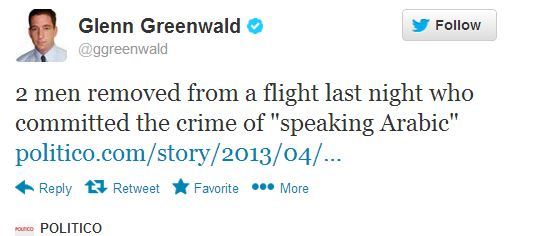
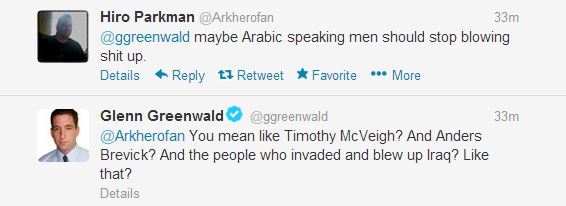
Arabic is one of the most widely spoken languages in the world and English doesn’t surpass it by much.

Most acts of terrorism in the United States have historically been committed by English-speaking white men. 
The KKK and other white supremacist/far-right groups have committed multiple 9/11s alone, especially over the last century, but we usually aren’t overly suspicious of English-speaking white men without any known ties to the aforementioned groups. 
In fact, since the early 90s, most terrorist attacks in the United States came from mostly white, right-wing groups and they’ve been steadily increasing, especially around 2006. 

Individuals of a Middle Eastern heritage and/or Muslims haven’t even come close. 

And yet, agencies like Homeland Security and the FBI have disassembled task forces and departments that focused on those groups, even refusing to track and analyze the terrorist attacks committed. Why could that be?

Saturday, April 13, 2013

US Gangster Marines


According to a recently released FBI report, Gang-related activity in the US military is increasing and poses a threat to law enforcement officials and national security.

The report, Gang Activity in the U.S. Armed Forces Increasing, dated January 12, states that members of nearly every major street gang have been identified on both domestic and international military installations. Members of nearly every major street gang, including the Bloods, Crips, Black Disciples, Gangster Disciples, Hells Angels, Latin Kings, The 18th Street Gang, Mara Salvatrucha (MS-13), Mexican Mafia, Nortenos, Surenos, Vice Lords, and various white supremacist groups, have been documented on military installations. Although most prevalent in the Army, the Army Reserves, and the National Guard, gang activity is pervasive throughout all branches of the military and across most ranks, but is most common among the junior enlisted ranks, according to the report. The extent of gang presence in the armed services is often difficult to determine since many enlisted gang members conceal their gang affiliation and military authorities may not recognize gang affiliation or may be inclined not to report such incidences.

The FBI reports that accurate data reflecting gang-related instances occurring on military installations is limited, since the military is not required to report criminal offense statistics occurring on post to the FBI. Consequently, military data reflecting criminal instances are not incorporated into the Uniform Crime Report (UCR).

The FBI believes that gang members may enlist in the military to escape their current environment or gang lifestyle. Some gang members may also enlist to receive weapons, combat, and convoy support training; to obtain access to weapons and explosives; or as an alternative to incarceration. Upon discharge, they may employ their military training against law enforcement officials and rival gang members. Such military training could ultimately result in more organized, sophisticated, and deadly gangs, as well as an increase in deadly assaults on law enforcement officers.

In May 2005 an Army recruit and suspected Crip member was assigned to the US Army Finance Battalion where he engaged in drug distribution. He was eventually discharged from the Army for misconduct.

According to open source reporting and multiple law enforcement reporting, soldiers—including gang members—are currently being taught urban warfare for combat in Iraq, including how to encounter hostile gunfire.


The Defense Criminal Investigative Service reported in 2006 that gang members, particularly MS-13 members, are increasing their presence on or near US military installations.

Even though the policy violates Military recruiting regulations, US criminal courts have allowed gang members to enter the service as an alternative to incarceration. Several instances wherein gang members have been recruited into the armed services while facing criminal charges or on probation or parole have been documented. In many instances, a gang member facing criminal charges may be provided the option to join the military or serve a jail sentence. Furthermore, some army recruiters have been known to conceal recruits' gang affiliation to help boost their enlistment numbers.

Sunday, January 20, 2013

It’s Not A Sudden Madness


Image

It’s Not A Sudden Madness, But A Long History Of Mass Murder Come Full Circle.

By Glen Ford,
Courtesy Of "Black Agenda Report"

As a native-born American, I grew up watching cowboy and Indian shoot-em-ups in which the highlight of the movie was when the white guys in the circled wagon train shot the Indians off their horses until all the red men were dead, and very silent. Indians didn’t do a lot of screaming in pain when they were shot; they just expired.

 Same thing with buck-toothed Japanese, line after line of them, charging into U.S. machine guns, falling instantly silent and dead. It was somehow quite clean, almost antiseptic, these cinematic rituals of death, all staged for the broadest popular consumption to demonstrate the inevitability - and cosmic justice - of ultimate white victory over the darker races.

This was mother’s milk to the white American nation - which is why Richard Pryor and kids like me rooted for the Indians. Mass murder is at the core of the American national religion, which is a celebration of a genocidal march across a continent filled with other, doomed human beings.

America’s contribution to European culture was to invite “all the nations of Europe” to come to these shores and become fellow “white” citizens, whose status was defined by the enforced inferiority of Blacks and the remnants of the Indians. Ritual burnings of Blacks were organized as great public festivals, attended by thousands, staged in order to affirm whites’ collective right to commit murder. This monopoly on violence was what made them white Americans.

U.S. foreign policy reflects the nation’s origins and ghastly evolution into a globe-strutting mob, that empowers itself to kill at will.

A million dead Filipinos at the turn of the 20th century; aerial bombing of Haitian villages less than a generation later; the totally unwarranted nuclear annihilation of two cities at the very end of World War Two; two million dead Koreans shortly thereafter; three million dead Vietnamese in the next decade,; and, since 1996, six million Congolese - all, and many, many more, slaughtered in the name of U.S. civilizational superiority - the ghastly opiate of the white American masses.

What kind of human beings does such a culture produce? To paraphrase the Bible, “By their massacres, ye shall know them.” The modern mass American murder is overwhelmingly a white phenomenon. Yet few whites ask the question, “What’s wrong with white America?” It is seems that white America lacks the capacity for self-examination. It cannot grasp the simple truth, that a culture that celebrates the annihilation of whole peoples, casually and without guilt or introspection, is devoid of human values at its very core.

In the end, it turns against itself. That is the simple lesson of Newtown, and Columbine, and Aurora. The same cultural deformity creates a huge market for games like the very popular Assassin’s Creed, whose latest version integrates individual and group murder with events of the American Revolutionary War. American kids can simulate mass murder all day long, and feel patriotic and smart while doing it. Assassin’s Creed features an inter-racial cast of killers - possibly in deference to the brown guy in the White House who owns the ultimate Kill List. It’s the modern equivalent of the cowboys and Indians movies of my youth. The same sickness.

Saturday, January 19, 2013

Does The Bible Make Americans More Violent?


By Valerie Tarico
Courtesy of "AlterNet"

My friend Li is an Evangelical Christian and, in keeping with her family values she keeps an eye on what her children view and read. In the summer, she took her 12-year-old daughter to the Hunger Games. “It’s the perfect movie for her,” Li commented. “No swearing and no sex.” No swearing; no sex. Just people stalking and killing each other.
The Motion Picture Association of America agrees with Li’s priorities. So did the writers of the Bible.  Our love-hate-love affair with violence goes way back.
It goes way back, and it also appears to be changing. In his 2011 book, The Better Angels of our Nature, Stephen Pinker lined up information from a wide variety of sources to show that human societies are less violent now than ever in recorded history. Violence dropped precipitously with the agricultural revolution, and then again with the Enlightenment and more recently, with the emergence of universal human rights. In the U.S., recent decades have seen a decline in murder rates and gun ownership. This finding is counterintuitive for several reasons. We have become more sensitized to kinds of violence that once were accepted as normal, like child and wife abuse; modern weapons of war have made killings more dramatic; we forget how brutish our ancestors really were; and thanks to media, modern incidents of violence produce shockwaves of trauma that once were impossible. All of this obscures a long and vast trend line toward—it sounds weird to say it—a kinder, gentler world. A medieval British man was fifty times more likely to die at the hands of another man than is his modern descendant.
We might be even farther along this path were it not for a love affair with fantasy violence that, if anything, appears to be growing.
The Motion Picture Association of America has been rating sex, violence and profanity in movies since 1968, with the goal of limiting how much of each children absorb—or at least giving parents a tool that lets them make the judgment call. In 2006, the Annenberg Public Policy Center reviewed the top grossing movies since the rating system began.  In fact, they reviewed movies all the way back to 1950. They found that explicit sex and violence had both increased over time, but that “ratings creep” affected only violence. Explicit sex is still reserved for “R” rated films; explicit violence is not.
Many parents naively trust that media targeted at young children are developmentally harmless even though brain science suggests otherwise. They similarly tend to assume that a G-Rating means a movie is low on violence. In reality, it may mean simply that the violence is less realistic or designed to trigger laughter rather than fear. A Harvard study published in 2000 reviewed every animated feature film produced between 1933 and 1999, 74 in total. At the time, the findings made headlines because they were startling:
-- Every single film had at least one violent act. The amount of footage devoted to violence ranged from 6 seconds to 24 minutes.
-- Most of the films showed physical fighting as a means of resolving conflict.
-- Characters used weapons including swords and guns and every-day objects.
-- In half of the movies at least one character gave violence a thumbs-up at some point by cheering or laughing.
follow up  in 2004 showed that G-rated movies, like all others, gradually are becoming more violent. A 2007 study sampled 77 PG-13 films and tallied 2251 violent actions, with nearly half causing one or more death.  Researchers classified most of the incidents as “happy violence” meaning it was “cool, swift, and painless.” Today, by the age of 11, the typical American kid has seen almost 8000 murders on TV. Why? Because we like it that way. Movies that are rated R for violence make more money than those that are rated R for other reasons. We are attracted to violence and we are inured to violence.  Most Americans—not just my friend Li--find murder to be more acceptable fare for children than sex or swear words.
Our peculiar hierarchy of priorities may be due in part to the influence of Abrahamic religion on Western Civilization and the unique standing accorded to the Bible in American Christianity specifically. The Bible amalgamates the mythology and legal codes of a specific kind of culture: a clan-based tribal society in which herdsmen struggling for survival in an arid and increasingly denuded environment. Males competed to control females and territory while maintaining the purity of bloodlines and inheritance; gods that were modeled on warlords competed for fealty. Consequently, while codes governing sexuality and blasphemy were strict, codes governing violence were complicated.
Yahweh himself originated as a war god. Non-Hebrews were regarded with hostility and indeed, much of the founding story of the Israelite people comprises tales of triumphal genocide. The violence in in the Bible is so extreme that it defines vast portions of the book:
[Edmund Leach] looked at the Bible through the eyes of a communications engineer and asked: what message are these authors trying to get through to the reader? The answer, Leach thought, was that they were trying to obscure the fact that mankind began through incest (Adam and Eve) and so the strategy was to compile a list of atrocities so heinous that, in the end, the original incest would come to look like a harmless act.
Whether history or mythology or some fusion of the two, the Bible stories, when tallied, include an estimated 25 million violent deaths. And yet, like any people, the internal narrative of God’s Chosen Ones is one of yearning for peace and prosperity, the dream of an idyllic past in which the lion lay down with the lamb; an idyllic future in which men will beat their swords into plowshares and the lamb and lion will lie down together again.
Like the ancient Israelites, we Americans see ourselves as peacemakers. During the midwinter holiday season, Peace on Earth is sung from choir lofts and hung in shopping malls. We complain about our role as “policeman to the world.”  And yet, if we could see ourselves as others see us, we would see a people who, like the ancient Israelites have created unparalleled archetypes of violence: the Rambo, the mushroom cloud, the Tommy Gun, the Cowboy. Hollywood ensures that, even independent of the world’s best funded military, violence is one of our top exports.
I once rode a bus to a then small town in Mexico called San Cristobal de las Casas. The ride was my introduction to a new phenomenon that would become a bane during subsequent budget travel: video on buses and trains. It was also my first awakening to the level of violence we Americans export to the world as storytellers. Real dialogue can be hard to translate; psychological or social nuance almost impossible. But sex and violence are universals, which means they are even more ubiquitous in the movies that cross cultural and economic lines than those that don’t.
On this particular bus ride, the gratis entertainment was about a serial killer who was making snuff films. As we swayed around mountain switchbacks, the sound blared. Men, traditionally clad women, and small children pressed against each other, with no option but to face the screen depicting death scene after death scene. My savage hope was that the other passengers were motion sick like me and that the pairing of the film and switchbacks was conditioning a permanent visceral aversion to sexual violence.  Later that year, on an all-night bus, I would find myself assaulted by my first movie about people hunting people. The male lead was a hunky white supremacist, a farmer by day who secretly liked to hunt Blacks.
In movies, of course, it is the bad guys who do the unprovoked killing. Any violence perpetrated by the protagonist, meaning by us at a fantasy level, is vengeance or justice. Most people are deeply ambivalent about violence. We are both attracted and repelled by it. We enjoy and fear it. It turns us on and it horrifies us. Consequently, to get the satisfaction of a good blockbuster we need those bad guys to instigate things. The violence we like best is righteous violence, and—in movies and stories--most violence is just that. It protects innocence and restores justice. It safeguards women and children and the homeland.
Ironically, those who most relish the fantasy power of righteous violence are those who in real life are most likely to perpetrate unrighteous violence. Masculinity, the substance of action films, is defined by the Oxford Online Dictionary thus: possession of the qualities traditionally associated with men: a need for men to prove their masculinity through domination over women. Hypermasculine men hit women more, and a woman being pregnant is no deterrent. In the real world, tough guys are good guys until suddenly, sometimes, they are not. In the real world, most murders are triggered by the same motives we find so satisfying on the screen: righteous anger, a sense of violated fairness or honor, the outrage of feeling wronged, the conviction that the one murdered was the bad guy.
Most of us will never kill. These days, most of us don’t even hit. Even so, if we hope to continue the trend toward less violence, the challenge is not whether we can call up the heroism to face down villains and demons like those in our stories but whether we can continue to face away from our own dark fascinations. Alexander Solzhenitsyn posed the painful conundrum: “If only there were evil people somewhere insidiously committing evil deeds and it were necessary only to separate them from the rest of us and destroy them. But the line dividing good and evil cuts through the heart of every human being. And who is willing to destroy a piece of his own heart?
Who of us is willing even, to miss the next blockbuster? In The Hunger Games, the bad people are the citizens of the Capitol who demand that outlying districts provide sacrificial contestants for their high tech version of the Roman Coliseum. Movie viewers and readers root for the kids and scorn those who give them no choice but to kill or be killed, those who watch the blood sport for entertainment. But the books and movie work only because we, as readers and viewers, ignore the disturbing obvious: we arethe Capitol. The Hunger Games were staged for us; we are and always were the only intended audience.  Suzanne Collins offered us a chance to watch kids hunting and killing each other, and we ate it up. Did she laugh we flocked to the book stores and theater, as we downloaded DVD’s and shared dog-eared copies and checked sequel release dates? Did she cry? Did she care? Do we
Valerie Tarico is a psychologist and writer in Seattle, Washington and the founder ofWisdom Commons. She is the author of "Trusting Doubt: A Former Evangelical Looks at Old Beliefs in a New Light" and "Deas and Other Imaginings." Her articles can be found at Awaypoint.Wordpress.com.

Friday, January 18, 2013

We Are A Country Drenched In Bloodshed


There are many causes of violence in our culture, but the least understood is the heavy influence of media.

By Don Hazen, Jan Frel
Courtesy Of "Alter-Net"


The horrific massacre of schoolchildren and their teachers in Newtown, Connecticut, has unleashed an unprecedented debate about how to address the problem of mass violence in our country. There is an increasing sense that American society is incapable of protecting its citizens, including young children, the most vulnerable among us.
Yes, it's important to focus attention on the increase in the size andsavagery of the murders: Six of the 12 most deadly shootings in our history have occurred within the past five years. The vast majority of the world's worst mass shootings have taken place in the United States. And there have been 65 mass shootings since Rep. Gabby Giffords was shot in 2009. Still, despite their horror, mass murders like Newtown are thankfully rare. So we must pay attention to the daily violence, too. Nearly 13,000 homicides were committed in theU.S. in 2010, 8,775 with firearms. So in addition to the most heartbreaking, large-scale killings, the problem is pervasive and the bloodshed overwhelming.
What About Violence in the Media? 
It's revealing, that amidst the millions of written words, TV discussions and proposed solutions, regulating the violence that pervades mass media -- movies, TV, the toy industry, gaming, and the Internet -- is not often seen as a productive avenue for reform of our violent culture. This seems especially true of liberals and progressives. We invest a great deal of energy pushing strongly for gun control, which is more concrete and tangible, with clearly defined targets and enemies. But we stop short of going after purveyors of violence in the media. Traditionally, this has been more of a priority for conservatives. 
But when we looked into the impact of violence in the media, we were shocked at what we found. We, like many people we know, and perhaps you reading this, had a series of wrong-headed notions about the nature of the problem. We found that the issue has been studied for well over 40 years, and has been the subject of over 1,000 studies -- including reports from the Surgeon General's office in 1972, and the National Institute of Mental Health. The studies "point overwhelmingly to a causal connection between media violence and aggressive behavior in some children," according to theAmerican Academy of Pediatrics.  
We were especially surprised to learn that researchers, as summarized by the French Canadian media activist andresearcher Jacques Brodeur, claim to have proven that "the effect of media violence is bigger than the effect of exposure to lead on children’s brain activity, bigger than the effect of calcium intake on bone mass, bigger than the effect of homework on academic achievement, bigger than the effect of asbestos exposure on cancer, bigger than the effect of exposure to secondhand smoke on lung cancer." 
Are you surprised? We certainly were. If you are like us, you probably think that the research linking steady exposure to violence in the media to anti-social attitudes and acts has not been proven, which of course, is what the entertainment industry has insisted over and over again.
In line with arguments made by the entertainment industry, you might also have bought into the notion that violence in the media simply reflects the violence in society -- even though that is patently absurd when you look at the numbers. Or, because the First Amendment is sacred, expressions of violence, no matter how unrealistic, inaccurate or gruesome, are protected or should be protected.
But most media violence is a commercial creation, designed to addict people to violence and make billions of dollars. This has almost nothing to do with free speech.
Multitudinous Causes in the Mix
Before we go any further we want to stipulate that there is no one cause, or small number of causes, behind the culture of violence in America. There are many culprits but especially culpable are alcohol abuse, which often leads to violence; the war on drugs, which make drugs hugely valuable, increasing the violence (though much of the worst violence takes place in Mexico); the return of hundreds of thousands of soldiers from two long and brutal wars, many trained killers, many with PTSD; the militarization of police departments, with heavy surveillance technology designed to make even a normal person paranoid; mass incarceration in prisons run frequently by companies trying to make a lot of profit off crime, and where for inmates, prison is often a graduate course in more advanced crime, especially since there are no jobs and almost zero help in integrating ex-cons into productive lives after they leave prison; and high levels of unemployment, especially among the working class and those without college diplomas.
Certainly, the political climate over the past five years, with the emergence of the gun-toting Tea Party, has raised the specter of violence. There has been a marked increase in militia groups and right-wing extremists. Threats upon the president's life have increased, likely stoked by the relentless and aggressive lies about President Obama's birthplace, his roots and his intentions. Attacks on Obama get huge attention in the media, exacerbating divisions and frustrations. There have been powerful propaganda campaigns by the NRA to scare people into stockpiling massive amounts of ammo, based on the completely out-of-touch-with-reality notion that the Obama administration is going to take away their guns and ammo. (Actually, President Obama has increased the rights of gun owners, and articulated an aggressive interpretation of the Second Amendment.) It's hard to measure the levels of paranoia and fear that cloud the judgments of millions of Americans, enhanced by a number of conspiracy theories and the presence of media idiots like Donald Trump to give them exposure. That too must be factored in when it comes to understanding the ingredients of the violence. 
Then there is what is often called the "masculinity crisis." The changing roles of men, inspiring feelings of uselessness; the growing success and prominence of women and the increased maladaptiveness of many masculine traits, which are not so useful in day-to-day life in America in 2013 as they have been in the past. The end result, for whatever combination of reasons, is that virtually all the violence in America is executed by men.  
 What About Mental Illness?
Notice that mental illness is not on the above list of the most obvious causes of violence. While people who commit mass murder and suicide are obviously ill, Dr. Richard Friedman,writing in theNY Times, explains that only 4% of the violence in the U.S. can be attributed to mental illness -- and that the lifetime prevalence of violence among people with very serious illnesses is only 16% compared to 7% of people with no mental illness. Friedman adds that people who abuse alcohol and/or drugs were nearly seven times as likely as those without substance abuse problem to commit violent acts. And then, the mass murderers are not predictable: expert and psychiatrist Dr. Michael Stone at Columbia says, "Most of these killers are young men who are not floridly psychotic. They tend to be paranoid loners who hold a grudge and are full of rage."
Add Guns and Media to the Mix
Add to this gnarly mix of causes 300 million handguns in a third of American homes -- and you have a ticking time bomb. Then, you place all of the elements in the context of the pervasive violence in media, so prevalent that it's almost like the air we breathe. It starts with "killer" toys aimed at toddlers, moves to the most violent video games imaginable, then to films and television shows with numerous acts of violence, seen daily by hundreds of millions of people. Many of these depictions glorify brutishness, macho insensitivity, misogyny, racism, and barbaric behavior. According toSophie Janicke of Florida State University, who references the National Television Study (1998), two out of three TV programs contain violence, amounting to six violent acts an hour. The majority of this content is shown in children's programming (69%). It has been estimated that by the age of 18, the American youth will have seen 16,000 murders, and 200,000 acts of violence only on television."  
The end result is the mess we are in as a society. And there is no easy way out.
Because the problem of violence is so omnipresent, clouding many people's daily lives with fear, real or imagined, distorting relationships and many aspects of human interaction, we must start to seriously look at the prevalence of media violence and try to imagine how we might make it better. We must acknowledge that the media adds to the dangerous brew of violence in our culture.
Gun Control or Gun Safety
The rush for some kind of symbolic or even modestly substantive gun control legislation is understandable. There is no question that reducing the number of guns in the country, especially making them harder to access when someone has the urge to kill, will result in fewer violent deaths. However, gun control is not a quick, easy or comprehensive solution to the problem of perpetual violence. The battle for gun safety -- given the political realities and the pervasiveness of guns -- won't even begin to address the massive, interlocking and mutually reinforcing violent aspects of our culture.
Future generations may benefit from whatever we are able to accomplish now in terms of gun reforms. But there are many other factors to tackle, and solely focusing on gun control is not enough.
A Reflection of Society
You may wonder, as the heads of the Motion Picture Association have told us over and over, doesn't media simply reflect the society we live in?
The notion that media merely holds a mirror to society is easily disproven. Iowa State'sBrad J. Bushman and Craig A. Anderson explain
"Even in reality-based TV programs, violence is grossly overemphasized. For example, one study compared the frequency of crimes occurring in the real world with the frequency of crimes occurring in the following reality-based police TV programs: America's Most Wanted, Cops, Top Cops, FBI, The Untold Story, and  American Detective (Oliver, 1994). The real-world crime rates were obtained from the U.S. Federal Bureau of Investigation (FBI; 1951-1999) Uniform Crime Reports, which divide seven major types of crimes into two categories, violent and nonviolent. About 87% of the crimes occurring in the real world are nonviolent crimes, whereas only 13% of crimes occurring in reality-based TV programs are nonviolent crimes. The largest discrepancy between the real world and the world depicted on television is for murder, the most violent crime of all. Only 0.2% of the crimes reported by the FBI are murders, whereas about 50% of the crimes shown in reality-based TV programs are murders."
What About the First Amendment?
As you might expect, given the huge dollars involved, any attempt to constrain big media, entertainment, video game and toy manufacturers, will result in screaming about "freedom of expression." And it is true that the FCC regulates indecency and offensive speech but not violence, because content regulation can be construed as a First Amendment concern as much as a matter of commerce.
However, the First Amendment, like the Second Amendment, has been substantially altered by powerful forces influencing the courts over time. As Adam Gopnick writes intheNew Yorker:
"…..  the blood lobby still blares out its certainties, including the pretense that the Second Amendment—despite the clear grammar of its first sentence—is designed not to protect citizen militias but to make sure that no lunatic goes unarmed. (Jill Lepore wrote about the history of the Second Amendment in the New Yorker recently.) Make sure that guns designed for no reason save to kill people are freely available to anyone who wants one—and that is, and remains, the essential American condition—and then be shocked when children are killed."
To many, the Second Amendment now means the freedom to carry a concealed handgun almost anywhere, including schools.
Over time, the First Amendment -- the right to free speech -- has also been distorted to serve the interests of the corporations that in dominating our media are never at a loss for the right to speak. It's not unlike the infamousCitizens United Supreme Court decision, where the courts have expanded corporations' rights to expression to include investing unlimited money in political campaigns, without even identifying themselves, and at the expense of the individual person's rights.
According to Mary Megee,in the U.S., "most cultural messages are strained through a commercial filter which uses gratuitous violence as an industrial ingredient to keep viewers tuned in, ratings high and profits up."
For corporations, the law of commerce and the market is the ultimate rule. In their highly sophisticated propaganda efforts, media corporations try to obscure the fact that they operate on the public airwaves, with licenses. The government intervenes if a swear word is uttered on air, or when Janet Jackson's nipple was exposed for a brief moment during a Super Bowl show. But the most gratuitous, destructive, dehumanizing violence is not considered worthy of focus, because of the power of the media to shape reality, as well as significantly affect the careers of elected officials and the "fear" associated with tangling with the First Amendment.
It's ironic that parents who push for less violence on TV are labeled "pro-censorship," when in fact the omnipresence of programming filled with violence often displaces more constructive material from the air. "The preference for violence, is made by somebody, elected by nobody, prisoner of a toxic culture," who knows that whomever is in charge expects them "to give priority to cruelty, aggression and hatred," writes Jacques Brodeur. 
The tobacco industry offers a relevant analogy. Tobacco companies (along with the ACLU), in the face of overwhelming negative health data about tar in cigarettes, insisted that the regulation of cigarettes, and the advertising for them, interfered with free expression. It took many years to marginalize the cigarette industry. Twenty percent of the population still smokes,falling by half from 1965 when 42% of adults smoked.  
Changing behavior and fighting corporate power is a long and arduous process, but it's possible.
Isn't Violence Going Down?
We do face a paradox in society where the hugely visible mass murders are increasing, while violence as a whole, as measured by crime statistics, has gone down -- great news. For example, violent crime in Los Angeles is four times lower than it was in 1992. The interesting thing is that no one can explain exactly why. Of course, there is no end of politicians and police officials who take credit for it. The high number of people in jail may be a contributing factor, although many are in jail for non-violent crimes, mostly drug offenses. The high number of police in some cities like New York may contribute to less crime. On the other hand, in Chicago, where the high ratio of police to citizens is second only to New York, crime appears to be out of control.
Nevertheless, it's important to keep in mind how the U.S., despite drops in crime, still dwarfs all developed countries in the number of guns, level of violence, number of mass murders, and number of people in jail and under supervision by the criminal justice system. The fact that violent crime has dropped is certainly good news. But we made the bar so high that we still have epidemics of violence, bloodshed and murder in our society. 
It's worth noting that in the wake of the Newtown massacre in Connecticut, TV and film executives purposefully avoided broadcasting violent programming. TheNew York Times noted thatUSA Today stopped broadcasting violent police and detective shows; Quentin Tarantino's gory new film had its red carpet event scaled back; previews of Tom Cruise's new film were canceled; and "Hollywood’s power lunches have been filled in recent days with conversations about hypocrisy."
History tells us that this momentary moral pang will dissipate and the hunt for profit through violence will continue. If we want to get serious and confront this issue, we will have to establish a framework for regulating media violence made by businesses seeking to sell tickets, ads and products to the American public. 
Time to Put TV Under Scrutiny
The ultimate trouble we face as a society is the powerlessness of most people in the face of corporate dominance. We lack responsive democratic institutions to leverage change in policy to make us less vulnerable to domination by corporate interests. The pervasive and accurate feelings that the political system is bought and sold, that most elected officials belong primarily to the "money party" or their "future million-dollar job" party in whatever industry they choose to specialize, leave many people in despair, and in some cases angry and violent. 
In a political system as out-of-whack as ours, where billionaires pour untold millions into elections to seal their outcomes, where corporations spend billions on lobbyists who promote their interests, building on citizen outrage and turning it into change is a difficult challenge. 
AsBrodeur writes, over the past 40 years there were industries polluting our air, water and food, while the entertainment industry "increasingly poisoned children's cultural environment with violence carried by TV programs, movies and video games. While society agreed to regulate the pollution of air, water, food, governments have been unable to regulate use of violence in entertainment products for children."
The executives of a handful of big media conglomerates think they own the freedom of the press and it's their right to decide what will be aired to children (and adults) in the global market. Of course, not all TV is toxic; some of it's often inspiring, but a lot of it is the opposite. 
Still we have to face the music. We need to challenge our assumptions about why our society is so violent. Yes, there are many reasons, and it's often next to impossible to separate them, as they do feed on each other. But that is no excuse for not trying to address all of the causes and not spend all our political capital on gun control and fighting the NRA. There is no avoiding that violence in the media, for children and adults, which along with the absurdly easy availability of guns, is central to our society being drenched in violence.
Television, quintessentially American, may very well be our biggest culprit. Brandon Centerwall argues thatresearch demonstrates "that crime rates more than double within 10 to 15 years of the introduction of television to any society." He points out that homicide doubled in the US after the introduction of TV in the 1950s andthat the relationship is causal
It's time to take a closer look at the dark side of the ubiquitous and beloved television, and ask what television programming contributes to a very imperfect society. Is your TV making you less safe?