Showing posts with label Uigher Muslim's. Show all posts

Sunday, January 25, 2015

China’s Ban On Islamic Veils Sends Uighurs Westward To Pray

Veils Banned
A veiled Muslim Uyghur woman walks passed a statue of Mao Zedong in Kashgar, Xinjiang Province, China. Last month the Urumqi legislature banned the wearing of veils in public areas. Photographer: Kevin Frayer/Getty Images

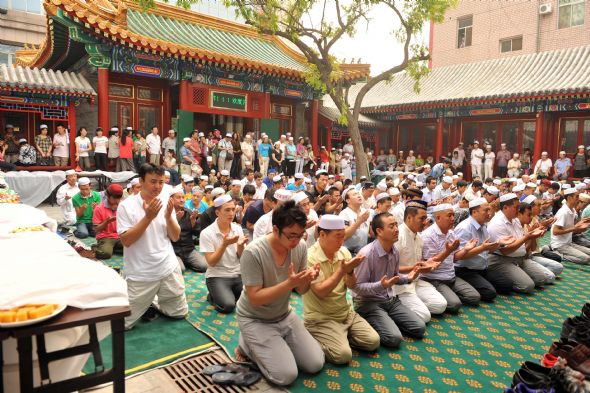
The Imam at one of Almaty’s biggest mosques gets busy around Ramadan when his Uighur “brothers and sisters” from China flock to the Kazakh city to pray, finding it increasingly difficult to practice Islam at home.
As the western Chinese region of Xinjiang grapples with ethnic tensions between Uighurs and Han Chinese, and President Xi Jinping vows to crush separatist activity, more Uighurs are finding a warmer reception about 235 miles (380 kilometers) away. In some parts of Xinjiang, Uighurs risk fines or detention for wearing veils or growing beards and some are warned against observing Ramadan -- Islam’s holiest month.
“Uighur Muslims want their religion and want to practice their religion freely,” Imam Knanat Ali said outside the blue-domed Prophet Muhammad Mosque in the industrial north of Almaty. “In China this is strictly controlled, so we see many Uighurs come here during Ramadan to pray, to fast, to learn more knowledge about Islam,” said Ali, who has presided over the mosque for three years.
The flow of worshippers to Kazakhstan, which has the biggest Uighur population outside Xinjiang, persists even as China is boosting ties with its neighbor, a gateway to the west in Xi’s plan to rebuild the ancient Silk Road route. China has displaced Russia as Kazakhstan’s biggest trading partner -- the two-way relationship accounts for around 70 percent of China’s trade with central Asia, and China is the biggest foreign investor in the country’s oil and gas sector.
China’s crackdown on violence in Xinjiang, which authorities have linked to Islamic extremism and terrorism, is driving Uighurs to come across the long, shared border with Kazakhstan. Uighurs have “quite a balanced position” with other ethnic groups in Kazakhstan, said Konstantin Syroezhkin, chief research fellow of the state-sponsored Kazakhstan Institute for Strategic Studies.

‘Fully Assimilated’

“They’re not restricted here,” Syroezhkin said. “There are around 260,000 Uighurs living in the country and they’re fully assimilated in the Kazakh society. Kazakhstan doesn’t support a policy of ethnic separatism.”
Many Uighurs have family in Xinjiang, the Imam said. There are around 10 million Uighurs in China’s western province, according to the Xinjiang Statistics Bureau. About 1.5 percent of Kazakhstan’s population are Uighurs, a Turkic language-speaking group, and many live in the Almaty area, says London-based Minority Rights Group International.
“We Uighurs are brothers and sisters; we care a lot about what’s happening in Xinjiang,” Ali said. “The Uighur rebellion” in Xinjiang has sprouted because “the Chinese government punishes them for their religion.”

Han Chinese

Uighur communities in Almaty, the former capital of Kazakhstan, live in compact, closely-knit neighborhoods where they have their own cafes, restaurants and mosques. That kinship prompted hundreds to rally in Almaty after riots in Xinjiang’s capital Urumqi in July 2009. The most violent clashes between Uighurs and Han Chinese in decades left nearly 200 dead, most of them Chinese.
Even though about 92 percent of China’s 1.3 billion population is Han, more than 45 percent of Xinjiang’s 22 million people are Uighurs.
Violence picked up in Xinjiang in 2014 and spilled to other Chinese cities such as Kunming and Guangzhou. In November, 15 people, including 11 assailants, were killed after a group hurled explosives at a food court in Kashgar in south Xinjiang. In September, 50 people, including 40 that police identified as rioters, were killed in what authorities called a terrorist attack in Luntai county, while in July, 96 people died in an assault on government offices in Shache county.

‘All Uighurs’

“During the 2009 riots, Uighur prayers here were crying because we all had relatives in Xinjiang,” said a 65-year-old mosque worker known as “Auntie Sonya” who moved to Almaty from Xinjiang in the late 1960s. “We didn’t know who was responsible for this conflict and who was guilty, but we felt for them because all Uighurs are family.”
Last month the Urumqi legislature banned the wearing of veils in public areas. Communist Party members, civil servants, teachers and students are “encouraged” to eat during the day over Ramadan “for the sake of their health, work and study,” state media reports say. Some officials must sign a document pledging not to observe Ramadan, according to the website Uighur Online, whose founder Ilham Tohti is serving life in jail for promoting separatism.
Source: Business Week

Tuesday, May 13, 2014

China's Hanification Of Xinjiang Is Failing


In the last few decades Beijing's concerted Hanification efforts (i.e., to Sinicize Xinjiang) have only planted unfathomed mistrust and widened the animosity between the Uyghurs and the Han settlers. Tension has led to violence and brutal reprisals.

On Saturday, March 1, more than 10 assailants slashed scores of people with knives at the Kunming train station in Yunnan province in southern China in what state media said Sunday was a terrorist assault by ethnic Uyghur (also spelled as Uighur) separatists from the far west. Twenty-nine slash victims and four attackers were killed and 143 people wounded. 

Most attacks blamed on Uyghur (a Muslim, Turkic-speaking people) separatists take place in China's oil-rich and ethnically sensitive far-western Chinese province of Xinjiang (formerly known as East Turkestan), where clashes between ethnic Uyghurs and members of China's ethnic Han majority are frequent. But Saturday's assault happened more than 1,000 kilometers to the southeast in Yunnan, which has not had a history of such unrest.

In July 2009, Xinjiang experienced violence between Uyghurs and Han Chinese (China's ethno-national majority). Media reported that more than 100 people were killed and 800 injured from the disturbance which broke out in the provincial capital, Urumqi. The disturbances occurred after a year of rising tensions between the dominant Han Chinese authorities and the Uyghur ethnic minority - the historical ethnic majority in Xinjiang - who say they have been socially and economically marginalized by Beijing's policies that introduce 'domestication' - or more properly Hanification (Sinicization) - of the region. 

On August 4, 2008, four days before the start of the Beijing Olympics, two ethnic Uyghurs drove a stolen dump truck into a group of some 70 Chinese border police - accused of brutally repressing the indigenous people - in the town of Kashi in Xinjiang, killing at least 16 of the officers. The attackers carried knives and home-made explosive devices.

In recent months, more than 100 Uyghurs have been shot and killed by armed police officers or soldiers. Exile groups attribute much of the bloodshed to security forces who they say have been given a green light to use excessive force, including against unarmed protesters.

The violence in Kunming came at a sensitive time as political leaders in Beijing prepared for Wednesday's opening of the annual legislature where the government of President Xi Jinping will deliver its first one-year work report. 

Learning the truth about such incidents is difficult. Except for the government version of events, the subject is off limits to the domestic news media. Foreign journalists cannot freely report in the region.

The Saturday's violence, if it is truly done by Uyghur separatists, show that they could be changing tactics and aiming to strike at soft targets elsewhere in China. The use of rudimentary weaponry also shows that such attacks do not appear linked to any global terrorist network.

Ethnic riots do not occur in vacuum. So the questions are what is fueling the separatist movement in Xinjiang, a region which until recently had appeared like a black hole in the Asian landmass? Why have some young Uyghurs, a minority group comprising roughly half the population of Xinjiang province, lost trust in the state and its institutions? What causes have contributed to the anti-Chinese campaign – both violent and non-violent – by young Uyghurs? Has the Uyghur unrest anything to do with radicalization along religious line, the al-Qaeda variety that we have noticed in some parts of the Muslim world in the post-9/11 era?
To understand the reason, the history of the region can be our starting point. Just as Soviet Union had been formed from the heterogeneous territories of the Russian Czarist Empire, what we call People’s Republic of China (PRC) today is similarly inherited lands conquered by the Manchu Qing dynasty before its collapse in 1911. Only in the 1760s the Qing generals were able to conquer East Turkestan incorporating it as Xinjiang (meaning: New Dominion), reflecting the imperial perspective; but their rule was repeatedly broken. They lost the region to Ya’qub Beg (Bek) in the 19th century. General Zou’s re-conquest did not survive the collapse of the imperial court at the beginning of the 20th century, and full control passed on to the Chinese only in 1949.
Despite a harsh landscape and climate, “Xinjiang has a rich past: sand-buried cities, painted cave shrines, rare creatures, and wonderfully preserved mummies of European appearance. Their descendants, the Uyghurs, still farm the tranquil oases that ring the dreaded Taklamakan, the world’s second largest sand desert, and the Kazakh and Kirghiz herdsmen still roam the mountains,” writes Christian Tyler.
The PRC calls it Xinjiang Uyghur Autonomous Region (XUAR) because of its Uyghur population. Mao tried to sell the Marxist-Leninist thought to the ethnic problem. Not only did the CCP (Chinese Communist Party) fail but Mao’s social engineering of the Turkis (Uyghurs) was highly destructive and led to the widespread discrimination and segregation prevalent today. The Communists developed it as a penal colony, as a nuclear testing ground and dumping ground for radioactive wastes (that is responsible for unusually high birth defects and mortality rate amongst the inhabitants) and as a buffer against invasion, and as a supplier of raw materials and living space for an overpopulated country.
Determined to end the push and pull of centuries, Mao’s successors have resorted to Sinicization (i.e., Hanification) of the region. They have changed the demography of the region by settling Han Chinese from other parts. They have curtailed the region’s millennium-plus-years old rich Muslim culture and are practicing widespread religious repression against the ethnic Uyghurs. They have conducted forced abortion on Uyghur women. They have closed down Qur’anic and Uyghur language schools to cut down their Islamic and cultural ties with other Muslims. Because of the Mandarin-based educational policy of the state, the Uyghurs can’t pass and find jobs in their own land. The party-state has institutionalized discrimination based on Uyghur’s distinct religion, habitus, physiognomy, language culture and socioeconomic status. In so doing, they have only widened the gap between the settlers and the indigenous inhabitants.
Consequently, what the PRC sees as its property, the Uyghurs regard as theft by an alien occupier. In its revisionist attempt, the Chinese government has tried to falsify history and portray the Uyghurs as part of the great family of the Chinese nations and asserts that Xinjiang has been an integral part of Chinese national territory since the ancient times. Uyghurs reject such a mischaracterization of both their people and their homeland maintaining that they are a distinct ethnic group with its distinct history, geography, language, culture and tradition. They have neither accepted Chinese occupation nor their incorporation into the Chinese nation-state.
Uyghurs have no political representation in the PRC government. Top CCP party officials at all levels in Xinjiang have been overwhelmingly Han Chinese. The text books present a very slanted history of the region. Recorded expressions of dissent, criticism or discontent are thwarted. All mass media, including electronic, are censored. Every poem, song, short story, essay and novel must pass through a battery of censors before being published, which can be banned later if deemed ‘harmful’ to the state. Uyghur intellectuals face constant surveillance and imprisonment. On January 15 of this year Professor Ilham Tohti, a Uyghur scholar who has taught at Beijing’s Minzu University was taken away by police on unspecified charges. He was one of the few Chinese citizens willing to openly criticize the government policies he said were alienating young Uyghurs:
religious restrictions, education policies that favor Mandarin over the Uyghur language and economic development that disproportionately benefits newly arrived Han migrants. In 2009 Professor Tohti was held for around six weeks without charge during a flare-up of violence in Xinjiang. Last year, he was barred from boarding a plane in Beijing to accept a teaching position at Indiana University in an episode that was criticized by the U.S. government and others.
In the last few decades Beijing’s concerted Hanification efforts (i.e., to Sinicize Xinjiang) have only planted unfathomed mistrust and widened the animosity between the Uyghurs and the Han settlers. Tension has led to violence and brutal reprisals.
The result is further militarization of the Xinjiang region and establishment of aggressive global network against the Uyghur separatists. In the mid-1990s, there were frequent security searches and low-level operations named as the “Strike Hard” campaigns by the Chinese security forces, aiming at arresting known, suspected or potential violent separatists- a pattern that would be repeated well into the next decade. Many of the Uyghurs were caught up in these security campaigns. These operations did not make life easier for many innocent Uyghurs, and instead radicalized them to vent their anger against the Han Chinese settlers. Chinese intelligence agents are also suspected in the mysterious death of many exiled Uyghurs.
In the post-9/11 period, the CCP leadership tried to (1) associate the Uyghur separatist struggle for self-determination as terrorism both to its Chinese people and global audience, and (2) pressure the US to view the movement as an al-Qaeda linked terrorist organization in its global war on terror. It was able to fool some but not all.
In his well-researched book – The Uyghurs: Strangers in Their Own Land – Gardner Bovingdon has shown that Uyghur resistance to Chinese rule is prompted by nationalism and not Islam. China’s Nation-building experiment has succeeded in her core province but not in peripheral regions that were annexed and had very little in common with China.
Simply Put: in spite of decades of programming, China’s nation-building project has miserably failed in China’s far west – Xinjiang and Tibet. As much as the Chinese government is trying to construct its aggressive nation-building the Uyghurs and Tibetans are trying to deconstruct that myth through their resistance movement and in so doing raising new claims of nationhood of their peoples.
Uyghurs will not be satisfied with anything less than a substantial expansion of autonomy in Xinjiang, which allows them to get educated in their own language and find jobs that are meaningful to support their families, and allows them a bigger share of the regional administration and economy. Sadly, China’s leaders show no sign of compromise, and in fact, appear to do just the opposite further marginalizing the Uyghurs in their own land in every respect. This Chinese policy is suicidal and absurd.
The world recognizes that if the people of one nation do not want to co-habit in the same polity because of widespread persecution, repression and discrimination, then partition should not be automatically neglected as a viable solution. This might be one way to manage the Uyghurs’ (who are a nation by any definition) legitimate demands for political space. But the road is still wide open for a political solution: either separation or consociation. The latter can be a good model for China, if the Chinese leadership has the wisdom, sincerity of intent and purpose.
Xinjiang desperately needs inter-ethnic peace because there has already been too much blood shedding. The longer the global community keeps silent on the question of the Uyghurs without adopting any measures to seek justice for them, the stronger the polarizations would happen along ethnic and religious fault-lines, particularly among the poor Uyghurs – who already find them relegated in all aspects, and the nastier may be the consequences for global peace and regional security, because such a global indifference and/or impotence may persuade some Uyghurs to further radicalize along powerful Islamic symbols, further swelling the links, which have hitherto been weak, with transnational Muslim radicals who are not afraid of death.
The Uyghurs currently lack military or organizational resources that would facilitate their legitimate struggles for self-determination. The Chinese control appears complete and has succeeded in denying all those tools and resources to reaching the Uyghur separatists.
They are also trying to strip Uyghurs of rhetorical weapons. Such an all-out policy to squelching dissidence completely may prove imprudent and inane in our time when nationalistic feelings are proving to be important.
Only time would tell how long China’s coercion policy will succeed to stem nationalistic feelings of the Uyghur people. If PRC is serious about nation-building it must change its failed strategy, which relies on strong arm tactics of coercion and not on integration where Uyghurs and other nationalities feel equal and welcome in this multi-national, -religious, -ethnic country that refuses to learn from the Soviet and Balkan experience.
*****
Dr. Siddiqui is an author of 13 books and a human rights and peace activist. Dr. Imtiyaz teaches Chinese politics and ethnic conflict in the Asian Studies/Political Science Department at Temple University, Philadelphia, USA.

Monday, February 17, 2014

Uyghurstan "East Turkestan"


Episode 2 - My Brother Whom I Don't Know

The series is an informative video series on Muslims and the oppressed Muslim minorities from all around the globe. 

Video Series produced by OnIslam.net.
Director: Sarah M. Masry

Thursday, November 28, 2013

China Restricts Islam


With prayers banned in public areas, private hajj trips not allowed, teaching of the Noble Qur'an not allowed in private and students and government officials forced to eat during Ramadan, China is enforcing laws and regulations restricting the practice of Islam.
"Of course this makes people angry," Mohammad, a teacher, told The New York Times on Sunday, October 19.
"Excitable people think the government is wrong in what it does. They say that government officials who are Muslims should also be allowed to pray."
In recent week, Chinese authorities have enforced laws restricting the ability of Muslims in the northwestern region of Xinjiang from practicing their faith.
In Khotan, signs posted in front of the grand mosque say the weekly Friday prayer sermon must not extend beyond than a half-hour.
Prayers in public areas outside the mosque is forbidden and residents are banned from worshipping at mosques outside their town.
Under the rules, imams are banned from teaching the Qur'an in private and only official versions of the Qur'an are allowed.
Studying Arabic is only allowed at special government schools.
Government workers are banned from showing the slightest sign of religious devotion.
For example, a Muslim civil servant could be sacked for donning hijab.
Many of the rules have been on the books for years, but local authorities have publicly highlighted them in recent weeks with banners hanged in towns.
They began posting regulations mandating women not to wear hijab and men to shave their beards.
Uighur Muslims are a Turkish-speaking minority of more than eight million in Xinjiang, a northwest vast area that borders Central Asia.
Atheist China recognizes five religions — Islam, Protestantism, Catholicism, Taoism and Buddhism — and tightly regulates their administration and practice.
Official Hajj
Under the rules, two of Islam's five pillars – the Ramadan fasting and hajj – are strictly controlled.
Students and government workers are compelled to eat during the holy fasting month of Ramadan.
China has also revived a law prohibiting Muslims from arranging their own trips to Saudi Arabia to perform hajj.
Signs painted on mud-brick walls in the winding alleyways of old Kashgar warn against making "illegal" hajj.
"Implement the policy of organized and planned pilgrimage; individual pilgrimage is forbidden," reads a red banner hanging on a large mosque in Urumqi, the regional capital of Xinjiang.
Authorities have also confiscated passports of Uighur Muslims across Xinjiang to force them to join government-run hajj tours rather than their own trips.
Once a person files an application, the authorities do a background check into the family.
If the applicant has children, the children must be old enough to be financially self-sufficient, and the applicant is required to show that he/she has substantial savings in the bank.
To get a passport to go on an official hajj or a business trip, applicants must leave a deposit of nearly $6,000.
Now virtually no Uighurs have passports, though they can apply for them for short trips.
This has made life especially difficult for businessmen who travel to neighboring countries.
Critics say the government is trying to restrict contacts with world Muslims, fearing that could highlight the sufferings of Muslims in Xinjiang and possibly build pressures on China.
[OnIslam.net]

Wednesday, November 27, 2013

China’s Forgotten Muslims

By Azizudin El-Kaissouni

Amnesty International recently issued an extensive report on the policies of the Chinese government towards the Uighur minority in Xinjiang Uighur Autonomous Region (XUAR).1 The 24-page document details the various legislative provisions recently introduced into Chinese law with a view to curbing “terrorist, separatist and illegal religious activities.” Loosely translated, China is attempting to create domestic legal sanctions for the post-September 11th crackdown on Muslims and Islam in XUAR.
By no means is a Chinese crackdown on organized religion unique; China has a long-standing antagonism towards religion, as evidenced by the highly publicized crack down on the Falun Gong sect a few years back, and the ongoing persecution of the Tibetans. However, unlike Falun Gong, Uighurs are not exceptionally popular in the West, and unlike the Buddhists of Tibet, have no charismatic leader in exile or celebrity converts in Hollywood to rally to their cause.
The report, however, is a poignant reminder of a persecuted Muslim community that has been ignored far too long.
China’s New Dominion
A note on names: Xinjiang Uighur Autonomous Region is the name given to Eastern Turkistan by the Chinese government, and is the cause of much resentment; Xinjiang is Chinese for “New Dominion,” or “New Frontier,” a legacy of their former Manchu rulers, who invaded Eastern Turkistan in 1759 and incorporated it into China. The reference, understandably, does not go down well with Uighur nationalists.
One feels the need to stress that, while this article focuses on Eastern Turkistan and the Uighur population thereof, this is in no way meant to denigrate or disregard the suffering of countless other Muslims at the hands of the Chinese government.
Who are the Uighurs?
Uighur girl in Kucha
The Uighurs are not the only Muslims in China; the Hui Muslims are also a recognized minority of several millions, and minorities of Tajiks, Kyrgyz, and Kazakhs are to be found in Xinjiang.2Two percent of China’s population is Muslim; a deceptively small statistic until one realizes the reference is to a country with a population of 1.2 billion, leading to a total of 24 million.3The Uighurs, however, are distinct for various reasons.
Ethnically, the Uighurs are a Turkic people, their language being part of the larger Altaic family. Since their adoption of Islam in the 10th century, during the reign of the Karakhanid kings, the Uighurs used Arabic script until the Chinese forced them to adopt a new Latin-based alphabet. Eventually, the Uighurs were allowed, in one of the Chinese government’s parsimonious concessions to their “national” minorities, to return to their Arabic script in 1983.4
Eastern Turkistan Republics
Military of the Eastern Turkistan Republic (1944-1949)
Historically, the Uighurs have a rich and distinct history, a fact official Chinese propaganda has long sought to bury. The Manchu rule of Eastern Turkistan was violently opposed by the Uighurs until they were successfully expelled in 1862. Independence was short-lived, however, with the Manchu reoccupying the land in 1876, and annexing it proper in 1884. Resistance to Chinese rule continued, regardless of whether the rulers were the Imperial Manchu dynasty or the Kuomintang nationalist government, culminating in the establishment of two republics in the 20th century, one of which was crushed with the assistance of Soviet troops in 1934. The second and more important state was the Eastern Turkistan Republic (ETR) established on November 12th, 1944. Coming under intense pressure from both the Kuomintang and the Communists, the leaders of the ETR accepted an invitation to Beijing for negotiations. Their plane never arrived at Beijing. It was announced months later that it had crashed en route in the Soviet Union. In October of 1949, People’s Liberation Army (PLA) troops marched into the Eastern Turkistan Republic, effectively ending the ETR.
Though lasting only five years before coming under the occupation of Mao Zedong’s PLA troops, the creation of the Republic was an epic moment for the Uighurs, the memory of which is cherished and marked by Uighur nationalists to this day.
Under Communist Rule (1949 - Present)
Mao’s Cultural Revolution was a period of terrible suffering for the Uighurs. Religion was identified as a “bourgeois” conception and therefore bore the brunt of the Red Army’s wrath. A Human Rights Watch report, “Xinjiang, China’s Restive Northwest” tells of how the Uighurs were forced to breed pigs, and mosques were shut down and occasionally used as pork warehouses, to add terrible insult to devastating injury.5
Fast-forward a few decades. An aggressive population transfer policy has seen the rapid growth of the Han community in XUAR, from an original 6% in 1949 to 40% in 1978, and has effectively made the Uighurs second-class citizens in their country, discriminated against in both employment and education.
Animosity is rife between the Uighurs and the Hans; one reporter relates asking a group of Han children gathered near a statue of Chinese revolutionary Wang Zhen why he was considered a hero. The answer: “Because he killed many Uighurs.” Such a response from a ten year old is perhaps somewhat indicative of the feelings of the Han colonialists toward the indigenous Uighurs.
Tensions are also exacerbated by the fact that Han enterprises exercise a monopoly on most of the area’s scarce resources. All this, coupled with the obvious hatred and disdain the Chinese feel towards the Uighurs and their religion, mean that it comes as no surprise that some Uighurs have concluded that armed resistance is the only option available.
Human Rights Abuses
Violent opposition to Chinese rule in East Turkistan is sporadic; occasional bombings or shootings take place and are met with a terrible fury. Every so often, reports are issued about the arrest, trial and execution of “terrorists” or “ethnic splittists” as the Chinese insist on calling them. Even peaceful protests are met with excessive force.
On one notable occasion in 1997, the town of Ghulja was brought to a halt by large-scale Uighur demonstrations in Ramadan; in response, the Chinese government sealed off the town, imposed a press black-out, and proceeded to viciously quell the protests. The official count suggested 10 deaths and 198 injured, and 500 arrests, according to Human Rights Watch. Uighur sources insist the numbers were many times higher. A similar situation occurred in the town of Baren, where an alleged armed insurgency was quelled with military forces, reportedly leaving dozens, if not hundreds dead.
The Human Rights Watch report is also particularly illuminating. The report describes the various forms of repression and persecution suffered by the Muslims of Eastern Turkistan under Chinese rule.
It is particularly painful to hear of the draconian measures utilized by the Chinese to stamp out any manifestations of religious sentiment among the Uighurs in the aftermath of September 11. Examples of this are plentiful in Amnesty International,6Human Rights Watch, and the U.S. Department of State’s reports. These include but are not limited to nighttime patrols of student dormitories to ensure no prayers are taking place, the banning of fasting during Ramadan, outlawing of Qur’an study meetings and religious schools, the curbing of mosque building, the identification and surveillance of religious leaders, and the banning of history books that do not conform to the “accepted” version of history. There is also the ominous-sounding “political education” that Imams are subjected to. One is led to understand this consists of extensive indoctrination to, as it was put, provide them with “a clearer understanding of the Party’s ethnic and religious policies.”
Old Mosque in Urumci
Eastern Turkistan is also home to the Lop Nur desert, the Chinese nuclear test grounds in the south of XUAR.7 China was, relatively speaking, one of the most aggressive states in terms of nuclear weapons acquisition policy, testing its first hydrogen bomb 32 months after its first fission bomb test. The fallout from these tests has resulted in the wide-scale contamination of water sources and land, in turn resulting in a disproportionately large number of cancer cases, congenital birth defects, and various other related diseases among the Uighur population.8
All the above, combined with China’s notoriously repressive birth control policies (including but not limited to forced abortions), would seem to suggest to the observer that Eastern Turkistan is one of the worst places in the world to be a Muslim right now. In the context of the ongoing global war on Islam, that says something.
It is of little surprise that China, like so many other countries, has chosen to take advantage of September 11th to further its own political agenda and silence - ruthlessly so- internal dissent. All recent human rights reports point to a drastic escalation of persecution and repression against the Uighur minority. UN High Commissioner Mary Robinson expressed her concern over the treatment of the Uighurs in a November visit to China. The Chinese government, predictably, responded that “terrorism,” that ephemeral and much-abused term, is an infringement of human rights and is a threat to international peace and security. Case closed.
Forgotten?
The question that inevitably comes to mind upon reading of such terrible persecution is: What can we do about it? Islamically, we are obliged to keep track of conditions of Muslim communities around the globe, particularly when said communities are the target of state-sponsored terror and persecution, numerous as they have become. However, our abilities and efficacy vary substantially depending, sadly enough, on location.
Here in the Arab world, our role is substantially limited by a government blatantly antagonistic to the concept of pan-Islamism or even just plain old concern for fellow Muslims, going so far as to arrest and try people who collect money for Chechnya or similar causes. It also virtually impossible to seek to influence government policy in any sense, due to the autocratic nature of the regimes.
Muslims in most places in the West, on the other hand, have more flexibility with regards to issues of this type. The minimum we can set out to do is seek to be aware of the situation in East Turkistan. Those who can should attempt to raise others’ awareness of the situation by any means possible, whether by a simple talk, or by trying to get something published in a local or campus paper. In this regard, The Uyghur Human Rights Coalition (www.uyghurs.org) has compiled a small, yet comprehensive list on how one can contribute to the support of the Uighurs. While the list is tailored for a Western audience, a number of the suggestions can be undertaken by Muslims anywhere.
In that regard, I would urge readers to explore and bookmark the links in this article, as a gateway to information on the plight of the Uighurs in China.
To conclude, one need not point out that we as Muslims are having our identity systematically erased. One minor way to counter this purposeful erasure is to ensure a consistent and dedicated effort to maintain and cultivate links to and an awareness of the larger community of Muslims around us.
We can longer afford to disregard Islam outside our borders. Where possible, we must aggressively lobby the media and the government to bring these issues to the forefront of domestic and international attention, not so much for the benefit of the Western audience, but rather for the benefit of the uninformed amongst us Muslims. And while it is only natural that the question of Palestine will be more central to many of us, we cannot allow it to completely overshadow the suffering of Muslims elsewhere, who have for years suffered in silence.
1- Amnesty International “China: Extensive crackdown on Uighurs to counter “terrorism” must stop”
2- China’s Official Gateway to News and Information “Ethnic Minorities”
4- Office of the High Commissioner for Human Rights: Universal Declaration of Human Rights (Uighur version)
6- Amnesty International Report 2002 “China”
7- Nuclear Threat Archive “Lop Nur Nuclear Weapons Test Base”
8- Uyghur Human Rights Coalition “China’s Violations of Uyghur Human Rights”

Tuesday, November 26, 2013

Uyghurs: When "Turning A Blind Eye" Lasts Forever


Interview With Mr. Alim Seytoff, President Of Uyghur American Association

East Turkestan, China, has been the home for a group of Muslim Turks for 4,000 years; what is also known as Xingijang Uyghur Autonomous Region first saw Islam in the middle of the tenth century.
Xinjiang witnessed in 1933 and 1944 the establishment of an independent Eastern Turkestan Republic, which is located along the famous "Silk Road."
By the rise of the Chinese Communist Party in 1949, the Eastern Turkestan Republic was cracked down to become a part of a government thataims at "diluting the religious environment" of Muslims by forcing them to accept the Chinese government brutal rule.
The Chinese government aims at pacifying Muslims to dissolve their dream of an independent Muslim state. Recently, it prominently positioned flags in mosques over the Mihrab — the traditional prayer niche that points the direction to Mecca.
OnIslam.net interviews Mr. Alim Seytoff on the status of Muslims in East Turkestan.   
The prominent advocate for human rights in East Turkestan, Mr. Seytoff, is the President of Uyghur American Association (UAA) based in Washington DC and the Director of the Uyghur Human Rights Project (UHRP).
OnIslam.net (OI): What is nature of the conflict between the Uyghurs and the Chinese government?
Mr. Alim Seytoff: The nature of the conflict between the Uyghur people and the Chinese government is that the authoritarian Chinese state intends to wipe out the Muslim Uyghur people as a distinct and indigenous people with a separate language, culture, tradition, values, and certain ways of life, so that it eventually and forcibly assimilate the Uyghur people into the Chinese culture to make them disappear from our modern world, just like the Manchu's in today's China.
Uyghurs are a proud nation who have a civilization of more than 3,000 years of history and who had established states and empires in the past, and they simply do not want to accept China's ill-intentioned engineering for their future.
They want to remain who they are: Uyghurs and Muslims. Therefore, Uyghurs' ethnic and religious identity is demonized and attacked vehemently by the Chinese government.
OI:  Would you say that the Chinese authority is fighting Uyghur for being Muslims, for standing for their freedom, for having a different ethnicity other than the Han, or for other reasons?
Mr. Seytoff: For all of the abovementioned reasons. China sees the Uyghur people's belief in Islam as a direct threat to its colonial rule in East Turkestan. Therefore, China attempts to criminalize Uyghurs' religious identity, banning Uyghur men from growing beards and women from wearing veils; banning women and minors from praying in the mosques; outlawing religious education for minors; labeling Uyghur religious opposition as "terrorism" and "extremism;" and allowing extrajudicial killing of praying men in a worship service at Uyghurs' houses.
The recent killings of Uyghur men are a good example. The Uyghur people are also under attack for demanding the very freedoms enshrined under China's Constitution and Regional Ethnic Autonomy Laws. Chinese authorities also do not like the Uyghur people very much because they do not resemble the Chinese culture. Instead, Uyghurs are not oriental people. They are a Turkic Muslim nation who resembles the peoples of Central Asia.
In the past, the Chinese directors used Uyghurs in Chinese movies as foreigners. Therefore, it is very hard for China to justify that East Turkestan (Xinjiang) was part of China since the people living there are not really Chinese.
OI:  To what would you compare the suffering of the Uyghurs: Palestinians, Muslims under Ataturk, Blacks in South Africa, Jews under Hitler, or others?
China used its powerful propaganda machine to portray the Uyghurs as ungrateful and uncivilized barbarians to the Chinese people and demonized them as the enemy — terrorists, extremists and separatists — of the Chinese people. 
Mr. Seytoff: I am not familiar with the suffering of Muslims under Ataturk. But, the suffering of Uyghurs closely resemble the suffering of Palestinians, Blacks in South Africa, and even the Jews under Hitler's rule before he started WWII. Uyghur suffering is like Palestinians, because we are under occupation and colonization, and treated as enemies by the Chinese security forces.
While Uyghurs rarely commit any act of terrorism, China labels them "terrorist" anyway for any kind of legitimate and even peaceful opposition. We are like Blacks in South Africa because we are facing apartheid enforced by the Chinese security forces. Chinese security forces patrol the Chinese neighborhoods in East Turkestan to protect them while they patrol Uyghur neighborhoods to crackdown on them.
The Chinese state, security forces, and courts protect the Han immigrants in East Turkestan while they use all state power to attack the Uyghurs.
Uyghurs are like the Jews under Hitler's rule before he started WWII because Chinese state incited ethnic Han hatred towards the Uyghur Muslims since the massacre of Uyghurs by the Chinese security forces on July 5, 2009 in Urumchi City.
China used its powerful propaganda machine to portray the Uyghurs as ungrateful and uncivilized barbarians to the Chinese people and demonized them as the enemy — terrorists, extremists, and separatists — of the Chinese people.
That is how the Chinese people see the Uyghur people today. Chinese laws are there to protect the Chinese immigrants and laws are used against the indigenous Muslim Uyghurs. If China does not change such demonization of Uyghur Muslims and continue to portray them as the enemy of Chinese people, then Uyghur Muslims may even face future genocide.
OI:  The crackdown on Muslims through linking them to terrorism is a pattern that one can see repeated in several countries world-wide; how true is it the Chinese claim that Uyghur harbor terrorists in East Turkestan?
Mr. Seytoff: This is a complete fabrication by the Chinese state to justify its continuous occupation and colonization of East Turkestan and to justify the heavy-handed repressive policies against the Muslim Uyghurs. Prior to 9/11, China had never claimed it had faced any kind of terrorist threat from Uyghurs and had never used the word "East Turkestan" in public.
In fact, a week before 9/11, then Xinjiang Party Secretary Wang Lequan spoke to a group of Hong Kong businessmen that Xinjiang is stable and does not face any terrorist threat. Everything changed after 9/11.
China saw 9/11 as a historic opportunity to justify, otherwise unjustifiable, colonial rule as its own "War on Terror."
Overnight, China claimed itself a victim of "Uyghur terrorism" and supported the US War on Terror for its own purposes. Since then, all Uyghur opposition, peaceful or otherwise, has been labeled as terrorism, extremism, or separatism.
But we are seriously concerned that current heavy-handed Chinese policies against peaceful Uyghur Muslims will eventually radicalize some of them. In other words, Chinese policies in East Turkestan are counter-productive at the moment and will eventually backfire.
OI:  What do you think is the entity that should be responsible for extending its hands to help Uyghurs in their struggle for freedom?
We are like Blacks in South Africa because we are facing apartheid enforced by the Chinese security forces. Chinese security forces patrol the Chinese neighborhoods in East Turkestan to protect them while they patrol Uyghur neighborhoods to crackdown on them.
Mr. Seytoff: The Uyghur people are an oppressed Turkic Muslim people fighting for their human rights, democracy, and self-determination under Chinese rule. Therefore, the Turkish world, the Muslim world, and the West should support the Uyghur people's legitimate struggle. Turkey and the Central Asian Turkic nations should support the Uyghur people.
The Arab and Muslim nations should raise this serious issue with China. Organization of Islamic Cooperation (OIC) should not allow China to commit cultural genocide in East Turkestan by forcibly assimilating Uyghur Muslims into Chinese culture.
The UN should put the Uyghur issue on the UN agenda as a priority and raise it directly with China since it is one of the five permanent Security Council Members. The US, as a leader of the free world, should also pursue a peaceful resolution to the Uyghur issue.
OI:  How would you evaluate the position of the successive US presidents towards human rights violations in China in general, and the Uyghur case in particular?
Mr. Seytoff: The US is always concerned with human rights violation in China and raises it aggressively each year during the annual human rights dialogue. We deeply appreciate their strong support on the Uyghur issue. Since China takes the US position seriously, the strong stance of the US presidents is very important to support the Uyghur people.
We hope such deep concern of Uyghur issue by the US presidents will continue unabated until there is a peaceful solution to the Uyghur issue in East Turkestan.
OI:  What makes you think that a soon-to-be superpower would give up part of what it believes to be its land for a minority like the Uyghur?
How long will the Muslims all over the world stay ignorant of China's cultural genocide of Uyghur Muslims and how long the Muslim countries will continue to turn a blind eye to Chinese atrocities against Uyghur Muslims?
Mr. Seytoff: No empire will give its colonized land back to the colonized people. No authoritarian government will give back the freedom of the oppressed. The colonized people should rightfully demand their land and the oppressed should continue to struggle for their freedom.
Therefore, it is important for us to make an international case about how China acquired our land and how its government is brutally ruling our people. China cannot simply commit genocide against the Uyghur Muslims in the 21stcentury. It must find a solution for its own long-term interest — which is to find a peaceful negotiated settlement.
OI:  Do you have a final word for Muslims all over the world?
Mr. Seytoff: When the Muslims all over the world usually hear about the most oppressed Muslims in the world, they tend to think of the Palestinians. When the Muslims all over the world usually hear about China, they tend to think of China as a great country and friend of the Muslims. Both are not true. I believe the least known but most oppressed Muslim group in the world is the Uyghur Muslims under Chinese rule.
Whenever something happens in Palestine, it is either on CNN or Al-Jazeera. Whenever something happens to the Uyghur Muslims, China shuts the Internet, blocks the information communications, ban of foreign journalists and diplomats to visit East Turkestan, and then just blame the Uyghurs for the purported violence and execute them as "terrorists" and "extremists."
The entire Arab and Muslim countries are behind the Palestinians. There is not a single Arab and Muslim country that openly supports the Uyghur Muslims. Unfortunately, due to influential Chinese propaganda in the Muslim world, the Muslims have a romantic and distorted view of China.
China has never been a friend of Muslims. China is one of the most brutal persecutors of Muslims that attempts to wipe the Islamic identity of Uyghur Muslims. China courts Muslims countries for two things: cheap oil and silence on its severe persecution of Uyghur Muslims.
The question is: How long will the Muslims all over the world stay ignorant of China's cultural genocide of Uyghur Muslims and how long will the Muslim countries continue to turn a blind eye against Chinese atrocities of Uyghur Muslims?
And if you are real Muslim and have seen the suffering and oppression of another Muslim, what is your obligation as an individual Muslim and as a Muslim state? If China hears the roar of the Muslim World today the Uyghur issue will be peacefully resolved tomorrow.
[Source: OnIslam.net]