Showing posts with label White Phosphorus. Show all posts

Thursday, November 06, 2014

How Much Moral High Ground Does The US Have Over ISIS?


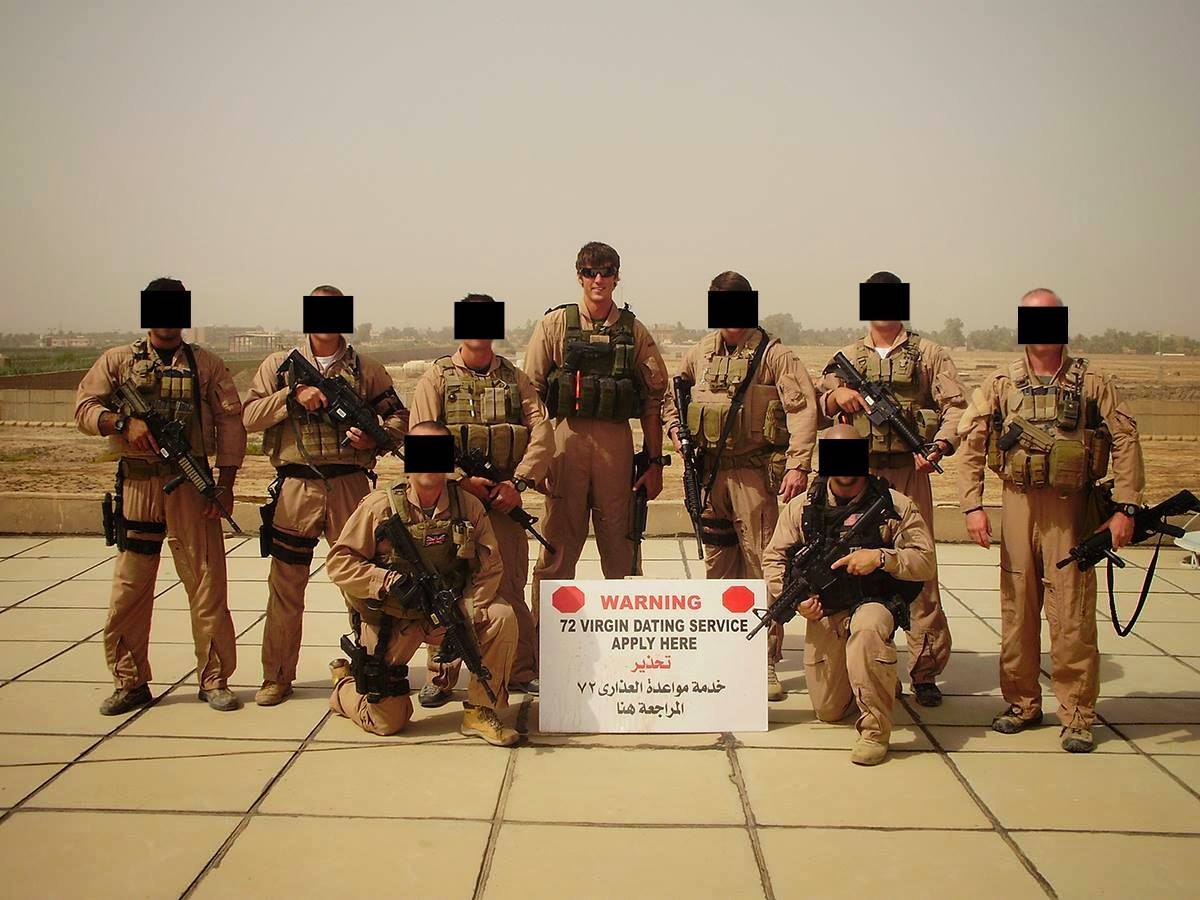
Warning: 72 virgin dating service. Apply here


The United States' war on sexual violence, mass murder and religious persecution should begin at home.
Without question, ISIS is an abomination. However, it is unclear whether America is the right agent to see this through. Part of the trouble relates to the Obama administration's strategy, which seems likely to empower ISIS even as it undermines the security and interests of the Unted States and its allies - but there is an ethical dimension as well.
While ISIS poses a serious (although likely overstated) threat to the governments of Iraq and Syria, over the last two administrations, the United States has itself forcibly overthrown the governments of Iraq and Libya - each time in defiance of international law. And along with ISIS, the United States has spent the last three years seeking to undermine the Syrian government. Additionally, it has sheltered Israel from meaningful accountability to the international community, allowing the crisis in Palestine to fester.
It would not be a stretch to say that the United States is actually a greater threat to peace and stability in the region than ISIS - not least because US policies in Iraq, Libya and Syria have largely paved the way for ISIS's emergence as a major regional actor.
But perhaps more disturbingly, many of the same behaviors condemned by the Obama administration and used to justify its most recent campaign into Iraq and Syria are commonly perpetrated by US troops and are ubiquitous in the broader American society. Until these problems are better addressed, United States' efforts to undermine ISIS will be akin to using a dirty rag to clean an infected wound.
Sexual Violence
The initial driver of US involvement was the outrage over ISIS' capture of thousands of Yazidi women and the sexual violence subsequently exercised against them - horrors which provided moral credence to the war against ISIS in much the same way that the 2001 US war against the Taliban was justified in part by highlighting the plight of Afghan women living under their rule.
However, over the course of that war, and the subsequent 2003 war in Iraq, US soldiers and contractors repeatedly used rape as a weapon of war, both against prisoners and the local civilian population. But perhaps more disturbing than the crimes committed by US personnel against Iraqis and Afghans were the atrocities committed by servicemen against their fellow soldiers.
As many as one out of three female soldiers are raped over the course of their military careers. Up to 80 percent of these assaults go unreported, in large part because reported cases rarely result in convictions or proportional punishment. In fact, the victims are frequently punished socially and professionally for reporting abuse, and they are barred from suing the government for reparations even when wrongdoing is proven.
The stats are not much better in the broader population. As many as one in five women who attend college in America are sexually assaulted over the course of their academic career, often with no justice even when the crimes are reported. This is commensurate with the broader trend in America - according to White House estimates, roughly a fifth of all American women are raped at some point in their lives.
As in the military, most of these crimes are not reported to the police, and most reported rapes are never prosecuted - let alone result in convictions for the perpetrators.
If the crimes against thousands of women in Iraq and Syria justify a US mobilization that costs nearly $10 million per day, how much more militant should Americans be about resolving the tens of thousands of cases of sexual violence that go unpunished and largely unnoticed in the United States each year?
Astonishing Cruelty
In addition to sexual violence, there was widespread outrage over ISIS's uncompromising brutality and the pornographic way they record and broadcast these acts - which include beheadings, crucifixions, and occasional incidences of cannibalism.
Of course, US soldiers and contractors have and continue to torture their enemies, often taking obscene photos to brag about and reminisce upon their acts. The contractors who were implicated in these abuses have never been prosecuted. Instead, one whistleblower who initially exposed these crimes, Chelsea Manning, has been sentenced to 35 years in prison.
There are further reports of US servicemen committing massacres, desecrating the corpses of their enemies, or even hunting the locals for sport while collecting photos, and even body parts, as trophies. And these are just a sampling of the acts which have been picked up by war correspondents and detailed in the media - many more crimes have never received exposure abroad, with crimes committed against Iraqis and Afghans by US servicemen going largely under-prosecuted or altogether unprosecuted.
Because these atrocities are not sufficiently dealt with by the United States, the governments of Iraq and Afghanistan have demanded the right to try Americans in their own courts. However, as protecting US politicians and soldiers from international accountability formed the basis of US opposition to establishing or joining the International Criminal Court, the Obama Administration refused to cede anything to these nascent states. 
As a result, concerns about accountability proved to be the main obstacle in the US reaching a security agreement with Afghanistan - and Iraq's refusal to grant US soldiers immunity was the reason the US ultimately abandoned the pursuit of a status of forces agreement there, contributing significantly to the security vacuum that allowed ISIS to rebuild in Iraq and expand into Syria. That is, ISIS's crimes were largely enabled by America's refusal to face up to its own.
Americans should bear this in mind as the Obama Administration loosens its already overly permissive standards vis à vis collateral damage and targeting civilians in its current campaign. The killing of innocents is not somehow morally superior if committed remotely by a drone or missile rather than the tools at ISIS' disposal.
Religious Persecution
Finally, many Westerners have been horrified by ISIS's persecution of religious minorities (especially crimes against Christians). However, the United States is complicit in this as well: US policies in Iraq helped spark this cycle of sectarian violence.
Meanwhile, its own armed forces were indoctrinated with anti-Muslim propaganda - complete with recommendations for servicemen to resort to "Hiroshima tactics," in a "total war against Islam," in which protections for civilians were "no longer relevant." 
Reflective of this mentality, the armed forces have been heavily infiltrated by white-supremacists, neo-Nazis and other hate groups who believe and act as though they are engaged in a holy war to begin in the Middle East and then be carried back into America. This institutionalized misrepresentation of Islam and dehumanization of Muslims probably played a significant role in the aforementioned atrocities.
However, this is hardly just an issue in the Army. Anti-Muslim discrimination and hate crimes are pervasive in America, from the classroom to the boardroom. In the popular culture, Islamophobia transcends the political spectrum and is fairly mainstream - to the point where pundits and politicians can openly call for Muslim internment camps, or push for laws restricting or altogether banning Muslims from practicing their faith, even as many of these same people work to obliterate the lines between the (Christian) church and state.
Muslim voices which could unapologetically challenge these tropes are largely excluded from the public discourse in favor of "house-Muslims" who will nod their heads in condemnation of terrorism (emphasizing that most Muslims are "moderates") while uncritically calling for (liberal) reform and revolution in Muslim lands of which they are no longer residents (if they ever were) - and all without voicing much (if any) substantive criticism of the Western countries in which they reside, beyond the narrow concerns about discrimination and persecution.
And yet despite these compliant spokespeople, and the fact that only 6 percent of terror incidents in the United States have been carried out by Muslims over the last 30 years (and the threat of terrorism is itself overblown), Muslims are frequently subjected to arbitrary surveillance and detention, as well as legal entrapment
All of these practices are considered crimes against humanity according to the Universal Declaration of Human Rights, which the US ostensibly champions everywhere else in the world . . . perhaps nowhere more than in Muslim-majority countries - seven of which the US has bombed in the last 6 years, almost always under the auspices of "humanitarian intervention."
Authentic Outrage, Authentic Patriotism
Criticisms like these invariably evoke charges of anti-Americanism among reactionary readers - unduly. If one were truly committed to defending America and promoting its values, if sincerely outraged by the sorts of atrocities committed by ISIS - rather than sanctioning condescending and counterproductive incursions abroad, Americans should dedicate much more time and energy to responding to these same problems within the United States and its institutions abroad. 
In this way, the United States could respond to the ISIS challenge by growing better and stronger, rather than undermining American's interests and freedoms in the name of "security." 
By Musa al-Gharbi

Thursday, July 24, 2014

Israel Drops Cancer-Inducing Bombs On Gazans


IMEMC – According to Al Ray Palestinian Media Agency, Dr. Erik Fosse recently stated to Press TV that the majority of patients hospitalized in Gaza are civilians injured in attacks on their homes, and that about thirty percent of these victims are children.
Dense Inert Metal Explosiveknown as DIME, is an explosive device developed to minimize damage to things that are incidental to the intended target, known as “collateral damage”.
The bombs reportedly effect a relatively small but rather significantly damaging blast radius, and are believed by medical experts to have severe biological effects on those hit with the bomb’s micro-shrapnel.
DIME munitions were developed by the US Air Force, in 2006, and have since been tested repeatedly on the people of Gaza, who, according to the Electronic Intifada, have long served as involuntary lab rats for Israel’s weapons industry.
DIME bombs contain tungsten, a cancer-causing metal which helps to produce blasts which slice through flesh and bone, often completely destroying the lower limbs of people within the blast radius.
The doctor also says that some Palestinians in the besieged enclave have been wounded by a new type of weapon which even doctors with previous experience in war zones do not recognize.
Israel has used banned weapons in the past, including depleted-uranium and white phosphorus, which is nearly impossible to extiguish and leaves its victim hideously burned and scarred, should he or she even survive such an attack.
The ground assault continues in Gaza, today, with nearly 300 reported deaths and over 2,000 wounded in Gaza, to include elderly, disabled and children not even a year old — all victims of targets which include mostly civilian homeshospitals and municipal facilities.
(Warning — graphic images)

Thursday, December 19, 2013

The 5 Worst Weapons Still In Use


We've put together a list of the top five worst weapons that are still in regular legal use, today. From downright nasty technology to devastating to local civilians, many of these weapons are in the process of being banned, or have had campaigns launched to outlaw them.

Wednesday, September 04, 2013

Moral Obscenity: Toxic Background To US Chemical 'Highground'


Courtesy Of: Russia Today

WARNING! Some images in this report could be disturbing for some users.

While the British Parliament stands divided over whether to strike at Syria, 


Washington claims there's a moral reason to attack. But the use of chemical weapons was of no concern in the wars that the US waged in the past.

Monday, July 29, 2013

Israeli Death Merchants And Palestinian Guinea Pigs

By Gilad Atzmon

“The Lab” is a new groundbreaking Israeli documentary film that redefines our entire understanding of the Jewish state, its aims, its identity and its global destructive role. It is a fundamental and most important commentary on Israel.

In “The Lab”, Director Yotam Feldman exposes the Israeli military industry and its operation, and interviews key figures in Israel’s “security’ trade. He elaborates on the role of the industry within the Israeli society and economy – in the last few years Israeli “security” exports reached an unprecedented 7 billion US dollars a year. A full 20 per cent of Israeli exports are military or military related. Approximately 150,000 families in Israel are dependent on that industry. Israel is now the fourth biggest military exporter.

Here is a clip from “The Lab”:


In the last decade every Israeli military operation led to an immediate and sharp increase in Israeli military export around the world: weaponry, systems, intelligence, strategies, doctrines, knowledge and experience.

Feldman gives us a glimpse into a very organized universe. We visit Israeli weapon fairs around the world and see arenas filled to capacity with foreign generals, officials and diplomats shopping for Israeli military products. The message is clear: the 7 billion dollars is just part of the story. The Israeli military elite is now deeply interwoven with the political and military elite of every country around the globe. This emerging Israeli business buys the Jewish state influence and support.

Watch foreign generals shopping for Israeli military products:


“The Lab” makes it evidently clear that the Palestinian civilian population in the West Bank and Gaza are viewed as guinea pigs for Israeli tactics, weaponry and fighting philosophy (“Fighting Torah” – Torat Lechima – as the Israelis call it). The destruction of the Palestinians has now been transformed into a very profitable industry. We are dealing here with nothing short of highly calculated murder.

Through a set of fascinating interviews, Feldman conveys a very genuine picture of the Israeli death merchants. Feldman lets them talk, he hardly interferes. They are sharp, they are genuine, they are even funny at times, occasionally witty, and a few of them, might even be charming if you did not know who they are. But make no mistake: they are sinister, and some of them are clearly psychotic. They are mass murderers and they are free. They sell destruction and havoc and do it very successfully.

Watch the Israeli army’s Yoav Galant, the planner and executioner of Operation Cast Lead, coldly discussing “ratios”:


As an Israeli-born and raised musician and writer, I think I can recognize Israeli dedication, perseverance and creativity when I see it, no matter in what field it is deployed. (Perhaps I was lucky to be rescued by bebop.) The talent of those Israeli death angels is used to amplify human misery. The consequences are tragic.

Game Changer

It is hadrly a secret that a century of Palestinian struggle has led to practically nothing. The state of the Palestinian solidarity movement is even more embarrassing. Feldman’s film, “The Lab”, is a game changer, for it can explain decades of impotence.

We are immersed in flawed terminology – “colonialism”, “apartheid”, “conflict resolution”, “Zionism” are just a few examples. Gaza is now a vast laboratory – the Israelis are the “scientists” and the “technicians”, the Palestinians are the “guinea pigs”.

Watching “The Lab” must lead all of us to fundamentally question our notions. We are dealing with a premeditated war crime. The notion of resolution (as in “two-state solution”), for instance, is not applicable. It is clear beyond doubt that in the real world the “scientist” does not negotiate with the “guinea pig”. The “scientist” also doesn’t consider sharing reality with his “guinea pig” in a “one democratic state”. Yotam Feldman’s “The Lab” is a glimpse into the Israeli mind: you clearly do not find much compassion there.

For decades we were foolish to examine the success and failure of Israeli military operations with reference to Israeli military and political “objectives” as we surmised them. We were clearly wrong.

As we learn from Feldman’s film, the real objective of Israeli operations may as well be examining new doctrines and operational systems in order to distribute them around the world soon after. Ehud Barak, for instance, wasn’t exactly the most sophisticated Israeli minister of defence – he clearly failed to defend his people or even make them feel secure. However, he was very successful in selling Israeli weapons and doctrines.

The prospect of Tel Aviv being subjected to a barrage of rockets may be seen by Israelis as devastating news but, from a military-industrial point of view, it was a golden opportunity to examine and promote the Israeli anti-missile system, the Iron Dome. If I am correct here, it becomes clear that, as with the Palestinians, more and more Israelis are also becoming “guinea pigs” in this ever growing military laboratory.

One may wonder how and when “the Zionist dream” transformed itself into a military business. Only a few of us, writers and scholars, have attempted to answer this question. The transformation of the Jewish state into an oppression factory seems to be a direct outcome of Israel’s supremacist ideology. If we want to understand what is happening in the Jewish state, we must first grasp the notions of choseness, Jewishness and Jewish identity politics.

I guess that enough Palestinians in Gaza do realize by now that they have been part of an Israeli experiment. Too often we learn from Palestinian doctors that while treating casualties of Israeli aggression they encounter new types of wounds. “The Lab” explains it but it isn’t Palestine alone. We also witness a growing similarity between the operational mode of police forces around the world and the Israeli military’s treatment of the Palestinians.

Watching Yotam Feldman’s “The Lab” explains it all. We are all Palestinians. We are either occupied by Israel or by its proxy forces around the world – those who are trained in Israel and implement Israeli weaponry and tactics.

Gilad Atzmon is an Israeli-born musician, writer and anti-racism campaigner..His New Book: The Wandering Who? A Study Of Jewish Identity Politics http://www.gilad.co.uk

Tuesday, December 25, 2012

‘Iraqis Cannot Forget What Americans Have Done Here’


Kathy Breen relays the follwoing:

“It is not written in our hearts, it is carved in our hearts.” I awoke this morning still shaken with these words in my head.

I sat in on a lecture, given in English, to maybe fifty or more young men and women at a college in Ramadi. They were all about 22 and 23 years of age, in their last year of a 5-year program. That means they were about 13 or 14 years old during the U.S. led invasion and beginning of the occupation.

An impassioned young woman from the middle of the lecture hall spoke up. It was obviously not easy for her. “It is not,” she said, “about lack of water and electricity [something I had mentioned]. You have destroyed everything. You have destroyed our country. You have destroyed what is inside of us! You have destroyed our ancient civilization. You have taken our smiles from us. You have
taken our dreams!”

Someone asked, “Why did you this? What did we do to you that you would do this to us?”

“Iraqis cannot forget what Americans have done here,” said another. “They destroyed the childhood. You don’t destroy everything and then say ‘We’re sorry.’ “You don’t commit crimes and then say ‘Sorry.’”

“To bomb us and then send teams to do investigations on the effects of the bombs…No, it will not be forgotten. It is not written on our hearts, it is carved in our hearts.”

We are happy to make bridges between people, but we will not forget. In Fallujah 30% of the babies are born deformed.”

He spoke of how he’d met an American soldier in the airport. He was part of the Special Forces in Iraq. The soldier told him “But we were taught to kill, to kill for nothing. Just kill. I am so sorry.”

“Build bridges? the president repeated. Apologize? he said. What can you do?” There was no rancor in his tone or demeanor, only anger and deep pain.

A young man said….The U.S. is still here. There are fifteen thousand people at the U.S. embassy in Baghdad. [and 5,000 security personal to protect them]. They have their collaborators. The war is not over.

We later visited a Sheik in Fallujah in his home. He and Sami embraced warmly and he welcomed us into the sitting area. In the course of our sharing we spoke of our visit to nearby Ramadi, of what was said there. “War always results in two losers,” he said sorrowfully.

Via: "Global Research"

Saturday, October 20, 2012

Permission To Engage


Victims' families and an ex-US soldier unpick the Wikileaks film that showed US forces killing Iraqi civilians in 2007.


On July 12, 2007, the US military shot several Iraqi civilians in Baghdad, an event that shocked the world when footage of the attack was later released by Wikileaks.

"The attack took place on a Thursday, when residents of the area had gone to a local market," explains filmmaker Shuchen Tan. "When they saw helicopters hovering over, they ran to their houses, thinking they'd be safe in there but it was those very houses that were blown up."

Permission to Engage traces the people involved in that fateful day and hears their versions of what happened.

Those killed included a young Iraqi photojournalist and his assistant, a father out with his children and some neighbours who were caught in the attack while trying to help the wounded.

"It was quite challenging to track down the victims and their families. We didn't have names, didn't have addresses, we didn't have anything," explains Tan.

"And when we found them, most of them didn't want to share their stories. They felt they had been left by the West and not treated well."

The families of the victims and a disillusioned former US soldier who was serving in Iraq around that time unpick the footage in forensic detail and relate their accounts of what happened.

Friday, September 28, 2012

Saddam Hussein: The Trial You Will Never See


This is an excellent documentary showing how the western country was involved in his atrocities. Infact, this documentary was never showed in US because of known reasons...

Thursday, August 30, 2012

Bibi’s Secret War Plan


Richard Silverstein reports,

In the past few days, I received an Israeli briefing document outlining Israel’s war plans against Iran. The document was passed to me by a high-level Israeli source who received it from an IDF officer. My source, in fact, wrote to me that normally he would not leak this sort of document, but “These are not normal times. I’m afraid Bibi and Barak are dead serious.”
The reason the source leaked it is to expose the arguments and plans advanced by the Bibi-Barak two-headed warrior. Neither the IDF leaker, my source, nor virtually any senior military or intelligence officer wants this war. While whoever wrote this briefing paper had use of IDF and intelligence data, I don’t believe the IDF wrote it.
I’ve translated the document from Hebrew with the help of Dena Shunra.
This is Bibi’s sales pitch for war. Its purpose is to be used in meetings with members of the Shminiya, the eight-member security cabinet which currently finds a 4-3 majority opposed to an Iran strike.
This is shock and awe, Israel-style. It is Bibi’s effort to convince high-level Israeli officials that Israel can prosecute a pure technology war that involves relatively few human beings (Israeli human beings, that is) who may be put in harm’s way and will certainly cost few lives of IDF personnel.
Bibi’s sleight of hand here involves no mention whatsoever of an Iranian counterattack against Israel. The presumption must be that the bells and whistles of all those marvelous new weapons systems will decapitate Iran’s war-making ability and render it paralyzed. The likelihood of this actually happening is nearly nil.
...The authenticity of this document is real. Or I should say that while it’s real, it is the product of the Israeli dream factory that manufactures threats and then creates fabulist military strategies to address them. The dream factory always breaks the hearts of the families of those whose members fall victim to it. It never produces the result it promises, nor will it do so here.
Remember Bush-era shock and awe? Remember those promises of precision-guided cruise missiles raining death upon Saddam Hussein’s Iraq? Remember Bush’s “Mission Accomplished” ceremony on the deck of the USS Lincoln, only six or seven years premature? Remember the promises of decisive victory? Remember 4,000 U.S. dead, not to mention hundreds of thousands of Iraqis?
Now, think of what an Israeli war against Iran could turn into. Think about how this sanitized version of 21st-century war could turn into a protracted, bloody conflict closer to the nine-year Iran-Iraq War:
The Israeli attack will open with a coordinated strike, including an unprecedented cyberattack which will totally paralyze the Iranian regime and its ability to know what is happening within its borders. The Internet, telephones, radio and television, communications satellites, and fiber optic cables leading to and from critical installations — including underground missile bases at Khorramabad and Isfahan — will be taken out of action. The electrical grid throughout Iran will be paralyzed, and transformer stations will absorb severe damage from carbon fiber munitions which are finer than a human hair, causing electrical short circuits whose repair requires their complete removal. This would be a Sisyphean task in light of cluster munitions which would be dropped, some time-delayed and some remote-activated through the use of a satellite signal.
A barrage of tens of ballistic missiles would be launched from Israel toward Iran. 300-km ballistic missiles would be launched from Israeli submarines in the vicinity of the Persian Gulf. The missiles would not be armed with unconventional warheads [WMDs], but rather with high-explosive ordnance equipped with reinforced tips designed specially to penetrate hardened targets.
The missiles will strike their targets — some exploding above ground like those striking the nuclear reactor at Arak, which is intended to produce plutonium and tritium — and the nearby heavy-water production facility; the nuclear fuel production facilities at Isfahan and facilities for enriching uranium-hexafluoride. Others would explode underground, as at the Fordow facility.
A barrage of hundreds of cruise missiles will pound command-and-control systems, research and development facilities, and the residences of senior personnel in the nuclear and missile development apparatus. Intelligence gathered over years will be utilized to completely decapitate Iran’s professional and command ranks in these fields.
After the first wave of attacks, which will be timed to the second, the “Blue and White” radar satellite, whose systems enable us to perform an evaluation of the level of damage done to the various targets, will pass over Iran. Only after rapidly decrypting the satellite’s data will the information be transferred directly to warplanes making their way covertly toward Iran. These IAF planes will be armed with electronic warfare gear previously unknown to the wider public, not even revealed to our U.S. ally. This equipment will render Israeli aircraft invisible. Those Israeli war planes which participate in the attack will damage a short list of targets which require further assault.
Among the targets approved for attack: Shahab 3 and Sejil ballistic missile silos, storage tanks for chemical components of rocket fuel, industrial facilities for producing missile control systems, centrifuge production plants, and more.
While the level of specificity in this document is, in some senses, impressive, in one critical aspect it is deficient. Muhammad Sahimi points out that the current chief of the Revolutionary Guards, when he assumed his position in 2007, deliberately addressed the issue of overcentralization of command-and-control by dividing the nation into 31 districts. Each of these has its own independent command-and-control facilities and mechanisms. So Israel wouldn’t be able to knock out a single facility and paralyze the IRG. It would need to knock out 31 separate sets of facilities, a much harder task.
There seems also to be an assumption that Iran’s leaders and nuclear specialists live nice domestic lives and that Israeli intelligence knows where they all live and can easily target them. In truth, the most senior Iranian military and scientific figures live clandestine lives, and it’s hard for me to believe even the Mossad knows where they are and how to target them.
So it appears that Netanyahu believes he’s fighting Saddam circa 2003. During that war, the Iraqi Revolutionary Guards were centralized and knocking out one command-and-control center could decapitate the entire military apparatus. But Iran has learned from Saddam’s mistakes. It isn’t fighting the last war as Bibi appears to be. It is preparing for the next one. While Israel may have new tricks up its sleeve that no one in the world has yet seen, if it doesn’t understand the nature of the enemy, its defenses, its structure, etc., then it can’t win.

Monday, August 13, 2012

Did the US Cause Fallujah's Birth Defects?

As Deformities Spike In The Iraqi City, We Ask If The US Has Been Honest About Weaponry Used During The 2004 Assaults.


New research is underway on the alarming increase in birth defects in the Iraqi city of Fallujah.

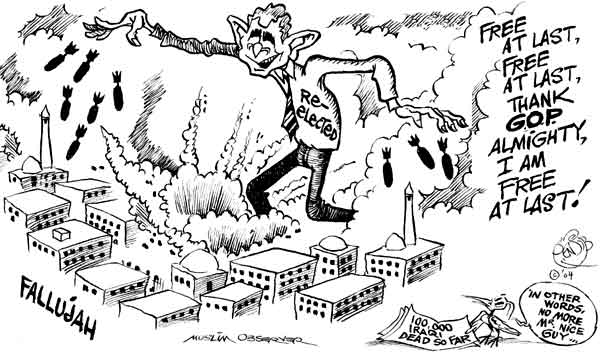
In November 2004, the US led an assault on Fallujah - a stronghold of opposition against the US occupation, west of Baghdad. Intense bombardment left many of its buildings destroyed and displaced much of the 300,000-strong population.


Eventually, the US was forced to admit that amongst its arsenal was white phosphorus - a substance the Pentagon described as a 'chemical weapon' when it was used by Saddam Hussein against the Kurds. In addition, eyewitnesses claimed the US military used "unusual weapons".

Subsequent investigations have focused on the possible use of depleted uranium by the US for its armour-piercing qualities. The US, however, denies using such weaponry. Research has shown elevated levels of radioactivity in Fallujah and across Iraq. Iraqi physicians have also long reported a spike in cases involving severe birth defects in Fallujah since 2004. They have reported children born with multiple heads, serious brain damage, missing limbs and with extra fingers and toes.

A report published in 2011 on the level of uranium and other contaminants in hair from the parents of children with congenital anomalies in Fallujah partly concluded that:

"Whilst caution must be exercised about ruling out other possibilities, because none of the elements found in excess are reported to cause congenital diseases and cancer except uranium, these findings suggest the enriched uranium exposure is either a primary cause or related to the cause of the congenital anomaly and cancer increases. Questions are thus raised about the characteristics and composition of weapons now being deployed in modern battlefields."

Al Jazeera's Sebastian Walker reporting for the programme Fault Linesexamined the legacy of the US occupation in Iraq and described what he saw on a road trip across Iraq after the withdrawal of US troops.

"What we found by visiting the general hospital there is that there are extremely high rates of birth defects, some five times the international norm, and many of the doctors who work in those hospitals believe that this is a direct result of the kind of weapons the US forces were using in those campaigns." 

Many researchers say uranium from the shelling may be to blame. However, no conclusive proof of a link has been established. In this episode Inside Story Americas asks: Is the US being honest about the use of unconventional weapons, and the possible link with the rising incidence of birth defects in Fallujah?

Joining the discussion with presenter Shihab Rattansi are guests: Ross Caputi, a former US marine who fought in the battle for Fallujah in November 2004 and co-founder of the Justice for Fallujah Project; Dai Williams, a weapons researcher whose work focuses on community health in conflict zones associated with new types of weapons; and Raed Jarrar, an Iraq analyst and the executive director for a Washington-based global strategy firm.

"The promises at that time were that the US will go in and get rid of all the bad guys and rebuild the city, [but] that did not happen. We saw a total destruction of Fallujah and the use of so many unconventional weapons ...."
Raed Jarrar, a Middle East and North Africa expert

WHITE PHOSPHORUS IN FALLUJAH:

US forces used the chemical in the Iraqi city in November 2004, purportedly to light up the battlefield.
Its use is legal as long as civilians are not targeted.
The US has used white phosphorus in some form or another since World War I.
US officials initially denied its use in Fallujah, but in 2005 General Peter Pace confirmed it.
White phosphorus particles burn through clothes to the bone, stick to skin and cannot be relieved by water.
The substance spontaneously ignites at about 30 Celcius, and continues to burn until it is deprived of oxygen.
Depleted uranium bullets were used heavily in the second battle for Fallujah, in tank armour and to reinforce steel. They were also used in Iraq in 1991 and again in 2003.

Saturday, August 04, 2012

The Occupier Left, But Its Traces Still Remain


Iraq: After The Americans

Fault Lines travels across Iraq to take the pulse of a country and its people after nine years of foreign occupation and nation-building.

Now that US troops have left, how are Iraqis overcoming the legacy of violence and toxic remains of the US-led occupation, and the sectarian war it ignited? Is the country on the brink of irreparable fragmentation?

Friday, July 06, 2012

Populated Areas Will Be Targeted In Next Lebanon Invasion


Israeli General Predicts New Lebanon Invasion After Collapse of Syria

Six years after the outbreak of the Second Lebanon War, the IDF is saying openly that Israel is preparing for another Lebanon war.

The commander of the IDF's 91st Division, Brigardier-General Hertzi Halevy told journalists on Thursday, In IDF simulations of what a third Lebanon war would look like:

"The next war will be different, and therefore we should stop it as quickly as possible, in order to make things easier for the home front. This means carrying out a very strong attack against Lebanon, and the damage will be enormous," says a senior officer in the Northern Command.
"The Goldstone report will pale in comparison to what will be here next time. There is no choice but to fight against the enemy where he is, and that is in the heart of a populated area."

The next confrontation, they point out, will cause even more damage. In the event that the situation would erupt, said Halevy,

"the IDF is preparing seriously and professionally for another Lebanon war. The response will need to be sharper, harder, and in some ways very violent. The next war will be with very heavy exchanges of fire on both sides, and so both need to make every effort to stop this happening. In the Goldstone Report, the community and the world tended to get confused and think that this can be done in a nicer way. It cannot be nice. Without the use of great force, we will find it difficult to achieve the aim, and the enemy should also know that. "

Via: "Haaretz"

Sunday, June 17, 2012

White Phosphorus: The New Napalm

White phosphorus: The new napalm?
(Credit: AP/Nick Ut)

Forty Years After Vietnam's Most Famous Photo, Incendiary Weapons Still Kill and Injure Children

BY STEVE GOOSE AND BONNIE DOCHERTY
FRIDAY, JUN 8, 2012 11:12 AM EDT
Courtesy Of "Salon"


“Too hot! Too hot!” wailed 9-year-old Kim Phuc as sticky napalm burned through her clothes and skin. Forty years ago this week, Kim Phuc was photographed running down the road away from her burning village after a South Vietnamese plane dropped incendiary weapons.
The photograph, taken by Huynh Cong “Nick” Ut for Associated Press on June 8, 1972, became emblematic of the terrible impact on civilians of the U.S.-led bombing campaigns over Southeast Asia.
In the decade that followed, the shocking consequences that napalm inflicted on civilians in Vietnam and elsewhere became a major factor motivating adoption of a new international law restricting the use of some incendiary weapons. But that law, Protocol III to the Convention on Conventional Weapons (CCW), has failed to live up to its promise.
Today, children continue to endure the devastating impacts of incendiary weapons. It is time for governments to revisit CCW Protocol III and strengthen existing law to minimize that suffering.
Napalm is the most notorious incendiary substance, but it is only one of more than 180. The harm caused by white phosphorus munitions, used in more recent conflicts, exemplifies these weapons’ humanitarian problems.
The Associated Press reported that an 8-year-old Afghan girl, Razia, was injured when a white phosphorus shell ripped through her home in the Tagab Valley of Kapisa province in June 2009. When she reached the operating room, white powder covered her skin, the oxygen mask on her face started to melt, and flames appeared when doctors attempted to scrape away the dead tissue.
White phosphorus munitions cause particularly severe injuries, including chemical burns down to the bone. Wounds contaminated by white phosphorus can reignite days later when bandages are removed, produce poisoning that leads to organ failure and death, and lead to lifetime health problems.
White phosphorus munitions are not banned. They are generally designed to be used by militaries as smokescreens to obscure their operations on the ground and to illuminate and mark targets at night. Yet in Afghanistan and elsewhere, actors ranging from high-tech military powers to non-state armed groups are using white phosphorus as an incendiary weapon to ignite fuel supplies, ammunition and other materiel.
The New York Times has documented that, as recently as October 2011, U.S. and other international forces in Afghanistan were using white phosphorus rounds against Taliban rocket positions. A U.S. military spokesperson said at the time that officials could not be certain whether it was their own round or an enemy round that hit Razia’s house.
In another recent conflict, the Israel Defense Forces used white phosphorus in densely populated areas of Gaza in 2009, killing and injuring civilians and damaging infrastructure, including a United Nations school where civilians were taking shelter. Local doctors and witnesses described to Human Rights Watch researchers injuries that burned civilians to the bone and reignited during surgery.
Stockpiling these weapons is also a cause for concern. Across Libya in 2011, weapons depots containing white phosphorus and napalm were left unsecured, endangering civilians. In Benghazi, Human Rights Watch found leaking drums of napalm powder abandoned at a military depot alongside casings and igniters for napalm bombs. It found white phosphorus and mortar shells at multiple sites as recently as March 2012.
Efforts are under way to secure Libya’s abandoned ordnance. But there hasn’t been diplomatic enthusiasm to tackle the broader problem – the loopholes and inconsistent restrictions that limit CCW Protocol III’s effectiveness.
The protocol’s definition is too narrow, encompassing only munitions “primarily designed” to set fires or cause burn injuries, and creating exceptions for those with “incidental” incendiary effects. Thus, some governments, including the U.S., believe that white phosphorus munitions are not covered by Protocol III, even when used intentionally for incendiary effects. A broader, effects-based definition of incendiary weapons should be created to encompass multipurpose munitions with incendiary effects, such as white phosphorus.
In addition, the protocol prohibits attacks in populated areas with air-dropped incendiary weapons yet permits the same kinds of attacks with ground-launched models under certain circumstances. At the least, countries should bolster the protocol’s restrictions by prohibiting the use of all incendiary weapons in civilian areas.
A complete ban on incendiary weapons would have the most humanitarian benefits and provide the strongest protection under international law.
Over the past two years, at least 20 countries that have ratified the convention have expressed concern about incendiary weapons including white phosphorus, and many have said they are willing to reexamine the protocol.
In November, diplomats will convene in Geneva for their annual review of the convention. They should discuss the incendiary weapons protocol’s humanitarian shortcomings and make a commitment to revisit and strengthen it. They owe it to Kim Phuc, Razia and other victims of these exceptionally cruel weapons.
Steve Goose is director of the Arms Division at Human Rights Watch. Bonnie Docherty is a senior researcher in the Arms Division and Harvard Law School lecturer.

Wednesday, January 11, 2012

Iraq: A Country In Shambles

Despite Promises Made For Improvements, Iraq’s Economy and Infrastructure Are Still A Disaster. 

By Dahr Jamail 
Last Modified: 08 Jan 2012 17:36 
Courtesy Of "Al-Jazeera"


Baghdad, Iraq - As a daily drum beat of violence continues to reverberate across Iraq, people here continue to struggle to find some sense of normality, a task made increasingly difficult due to ongoing violence and the lack of both water and electricity.

During the build-up to the US-led invasion of Iraq, the Bush administration promised the war would bring Iraqis a better life, and vast improvements in their infrastructure, which had been severely debilitated by nearly 13 years of strangling economic sanctions.

More jobs, improved water availability, better electricity, and major rehabilitation of the medical infrastructure were promised.

But now that the US military has ended its formal military occupation of Iraq, nearly eight years of war has left the promises as little more than a mirage.

Ongoing Water Shortages

Hashim Hassan is the Deputy Director of the Baghdad Water Authority (BWA), and he admits to an ongoing shortage of clean drinking water for Baghdad's seven million residents.

"We produce 2.5 million cubic litres daily, so there is a shortage of 1m cubic litres every day," Hassan explained to Al Jazeera. "We've added projects to increase water availability, and we are hoping to stop the ongoing shortage by the end of 2012."

According to Hassan, 80 per cent of the Baghdad's piping network needs rehabilitation - work currently underway - in addition to positioning 100 compact units around the city, which would increase clean water availability until larger plants can come fully online.

Several water treatment plants are already being extended, including one that would increase the capacity of a wastewater treatment facility in Sadr City, a sprawling slum of roughly three million people.

Follow in-depth coverage of the nation in flux
Hassan said that health committees and the Ministry of Environment carry out tests, and along with BWA testing, 1,000 water samples are checked daily, "less than one per cent of the samples fail" he said. The "acceptable threshold" is five per cent.

Bechtel, a multi-billion dollar US-based global engineering and construction company - whose board members haveclose ties to the former Bush administration - received $2.3bn of Iraqi reconstruction funds and US taxpayer money, but left the country without completing many of the tasks it set out to.

Bechtel's contract for Iraq had included reconstruction of water treatment systems, electricity plants, sewage systems, airports and roads.

Managers at water departments around Iraq say that the only repairs they managed during the US occupation were through UN offices and humanitarian aid organisations. The ministry provided them with very little chlorine for water treatment. "New projects" were no more than simple maintenance operations that did little to halt collapsing infrastructure.

Bechtel was among the first companies, along with Halliburton (where former US Vice-President Dick Cheney once worked), to have received fixed-fee contracts drawn to guarantee profit.

Ahmed al-Ani who works with a major Iraqi construction contracting company told Al Jazeera the model Bechtel adopted was certain to fail.

"They charged huge sums of money for the contracts they signed, then they sold them to smaller companies who resold them again to small inexperienced Iraqi contractors," Ani said. "These inexperienced contractors then had to execute the works badly because of the very low prices they get, and the lack of experience."

According to a March 2011 report by the UN's Inter-Agency Information and Analysis Unit, one in five Iraqi households use an unsafe source of drinking water, and another 16 per cent report daily supply problems.

The situation is even worse in rural areas, where only 43 per cent have access to safe drinking water, and water available for agriculture is usually scarce and of very poor quality. These facts have led more Iraqis than ever to leave rural communities in search of water and work in the cities, further compounding already existing problems there.

The UN report states: "Quality of water used for drinking and agriculture is poor, violating Iraq National Standards and WHO guidelines. Leaking sewage pipes and septic tanks contaminate the drinking water network with wastewater. 80 per cent of households do not treat water before drinking. Furthermore, just 18 per cent of wastewater is treated, with the rest released directly into waterways."

And this is exactly what many Iraqis experience first-hand.

"Sometimes we turn on the tap and nothing comes," explained Baghdad resident Ali Abdullah. "Other times the colour is brown, or yellow, or sometimes even smells of benzene."

Electricity and Sewage

Street side electricity generators are now a common sight around Iraq's capital city, where the average home receives between four and eight hours of electricity each day. Some areas, such as Sadr City, receive an average of less than five hours a day, with some portions of the area receiving a mere hour to two a day - and sometimes none at all.

Many people opt to simply pay private vendors for electricity from the generators, whose owners run lines to their respective clients.

Some areas of Baghdad continue to receive one to five hours of electricity a day [Dahr Jamail/Al Jazeera]
Nabil Toufiq is a generator operator who serves 220 homes for 12 hours each day.

"We buy our diesel on the black market, not from the government," he told Al Jazeera. "We expect this business to continue forever because government corruption prevents them from fixing our problems."

Abu Zahra, a media liaison worker with the office of Shia cleric Muqtada al-Sadr in Sadr City, Baghdad, explained that, in addition to the ongoing lack of electricity, every aspect of the infrastructure in the area needs improvement.

"We are depending on the street generators," Zahra said, before going on to say that roads have been resurfaced, but due to corruption causing corners to be cut, the pavement begins to fracture and break apart within six months, causing the cycle to begin again.

This is readily apparent, as the garbage-strewn roads are bumpy, cracking, with potholes abundant.

Turn off one of the main thoroughfares through the area and one quickly finds dirt roads with sewage streaming down the gutters.

Zahra said that one of the hopes of Sadr joining the political fray was that this area of Baghdad would obtain better services - but this has clearly not come to pass.

"Sadr asked the government to give better services and jobs here, but nothing has happened," he said, while children played near raw sewage. "There have been demonstrations here where people carried shovels asking for work, and empty kerosene cans asking for fuel. Meanwhile, we have a totally failed sewage system that needs complete reconstruction."

While water borne diseases and diarrhoea are common across Baghdad, but they are rampant in Sadr City, where the lack of potable water, coupled with raw sewage flowing through many of the streets, make the spread of disease inevitable.

Toufiq pointed out an issue that does not bode well for the future - and likely aptly describes the root of Iraq's myriad problems.

"Many people make a living from the system being broken," he said. "From the government, to me, to the gas sellers."

Broken Economy

According to the UNDP, Iraq has a poverty rate of 23 per cent, which means roughly six million Iraqis are plagued by poverty and hunger, despite the recent increase in Iraq's oil exports. Iraq's Ministry of Planning has also announced that the country needed some $6.8bn to reduce the level of poverty in the country.

Zahra concurs.

"No-one in my family has a job," he said. "And in my sister's house, they are seven adults, and only two of them work."

Inside a busy market, Hassan Jaibur, a medical assistant who cannot find work in his field, is instead selling fruit. 

"The situation is bad and getting worse," he said. "Prices continue to rise, and there are no real jobs. All we can do is live today."

Jaibur said he and his family are living on the fruit he sells, but he has a sick child and any profits he earns all go to medication.

"All of my relatives and friends are in a similar situation," he added. "Most of them try to find work as day labourers."
Gheda Karam, like so many in Iraq today, is the sole supporter of her family [Dahr Jamail/Al Jazeera]
Gheda Karam sells dates and fruits. Her husband was paralysed during the Iraq-Iran war, and the benefits they get from the government for his disability are not enough.

"My family is suffering too much," she told Al Jazeera. "Even yesterday we did not eat dinner. We are 20 of us in an old house, and I'm the only one with work."

She paused to cry, then wiped away the tears.

"My children see things in the market they want to eat or drink, but we can afford none of it, and I am in debt to the fruit sellers. God help us."

The state of the economy in Iraq is a disaster. Yet this irony is highlighted by the fact that Iraq has proven oil reserves third only behind Saudi Arabia and Iran - hence one would expect it to be one of the wealthiest countries in the world.

But nowhere is the lack of economic growth more evident than in Baghdad. According to the Central Bank of Iraq, unemployment and "under-employment" are both at 46 per cent, although many in Iraq feel this is a generously low estimate.

Iraq continues to have a cash economy; meaning there are no credit cards, almost no checking accounts, no transfer of electronic funds, and only a few ATMs.

Iraq lacks a functioning postal service, has no public transportation, nor a national airline - and most goods sold in Iraq are imported.

Only in the autonomous Kurdish region in northern Iraq is there rapid development and an effectively functioning government.

Iraq is ranked the eighth most corrupt country in the world, according to Transparency International. That means Iraq is tied with Haiti, and just barely less corrupt than Afghanistan.

One of Iraq's ministers recently took a forced resignation because he signed a billion-dollar contract with a bankrupt German company, along with a shell company in Canada, which had no assets or operations, only an address.

Lack Of Security

Recent spates of coordinated bombings that have killed more than 100 Iraqis and wounded more than 200 in the past few weeks are evidence of Iraq's current security situation.

Despite Iraq's own forces numbering 280,000 soldiers with 645,000 police and border guards, for a total of nearly one million men, and a capital city clogged with checkpoints, security remains elusive.

As Prime Minister Nour al-Maliki said recently, there can be no security without political stability. Given that his critics accuse al-Maliki of upsetting the delicate political balance within the Iraqi government by ordering the arrest of Vice President Tareq al-Hashimi, his words ring truer than ever.

Despite most of the daily violence in Iraq having long since fallen from the headlines, reports are constant and blood continues to flow.

Reported attacks around the country on January 3 included a roadside bomb killing an Iraqi soldier near Mosul, a sticky bomb seriously wounding a Pershmerga guard in Kirkuk, gunmen killing a Sahwa militia member and his wife in Muqdadiya, and a roadside bomb which wounded three civilians in Baghdad - to name but a few.

When most Iraqis are asked what their main concern is, "security" tends to be the first answer, then followed by electricity, water, jobs, and healthcare. Yet security is the foundation upon which the rest of the infrastructure can be built, so ongoing attacks across Iraq, and the chaos they bring, do not bode well for the future.

In December 2011, Iraq signed a deal worth roughly $3bn to buy 18 more F-16 fighter jet planes from the United States - a controversial move given that it occurred while Maliki was making moves his critics say were nothing more than consolidating power.

During a December press conference with al-Maliki, President Obama said, "We've got to train [Iraq's] pilots and make sure that they're up and running and that we have an effective Iraqi air force."

Most Iraqis would prefer to have their streets safe, before worrying about their air space.

And for people like Gheda Karam, whose family are having to skip meals on a regular basis, a government that would spend $3bn on improving infrastructure and the economy would be preferred over one that buys highly advanced war planes.

Follow Dahr Jamail on Twitter: @DahrJamail