Showing posts with label Netanyahu. Show all posts

Tuesday, November 25, 2014

Don’t Believe Netanyahu: The Palestinians Want Peace


Unfortunately many Israelis bought into the fallacy of this argument, and indeed, if Israel were to precipitately withdraw from the West Bank, as it did from Gaza, a similar result could theoretically reoccur.

The three violent wars between Hamas and Israel – Operation Cast Lead in 2008, Operation Pillar of Defense in 2012, and this year’s Operation Protective Edge – are used by Netanyahu to falsely demonstrate the consequences of the Gaza withdrawal, rather than the consequences of maintaining the fragile conditions between Israel and the Palestinians.

Using lofty phrases to describe these operations against Hamas is not the answer. Depicting Hamas’ behavior and its doctrine of promoting Israel’s destruction to justify Israel’s treatment of the Palestinians in the West Bank only plays into the hands of extremist Palestinians.

Netanyahu is deliberately misleading the public to justify his obdurate refusal to embark on a significant withdrawal from the West Bank by rewriting the history of the withdrawal from Gaza and linking it directly to national security concerns.

Israeli intelligence at that time knew that Hamas was politically popular and had military capabilities that could overwhelm the PA’s internal security forces under Abbas in any confrontation.

But the desire of then-Prime Minister Sharon to rid Israel of a densely-populated Palestinian area, and his belief, as stated in the Kadima Party Platform, that  “…in order to maintain a Jewish majority, part of the Land of Israel must be given up to maintain a Jewish and democratic state,” provided the impetus to evacuate Gaza first.

To demonstrate his intentions that the withdrawal would not be limited to Gaza, in August 2005 Sharon ordered the evacuation of Sa-Nur and Homesh in northern West Bank, thus setting the nation on a course that could have ended the Israeli-Palestinian conflict.

However, Sharon ignored the need to fully coordinate the evacuation of Gaza with the PA and failed to produce a well thought-out plan to implement the withdrawal in stages, which had significant national security implications.

Ideally, following the withdrawal, the Palestinians should have immediately embarked on building the infrastructure of a state and developing a substantial economic program to provide jobs and opportunities to tens of thousands of young Palestinians while demonstrating their commitment to live side-by-side Israel in peace.

The fact that this did not happen in Gaza should not affect the situation in the West Bank, especially since the PA, following the end of the second Intifada in 2005, officially renounced the use of force to achieve its political objective—an independent Palestinian state.
The PA has begun in earnest to build the foundations of a state with schools, clinics, a network of roads, and private and government institutions. They were even praised by Israel’s top security officials for their full cooperation with Israel on all security matters, even in times of increased tension between the two sides.
The Gaza experience in a way was positive and instructive in that it has shown the mistakes that Sharon made and how to avoid similar mistakes in any future disengagement from territories in the West Bank.
Leave it to Netanyahu, however, to use the Gaza experience to justify the continuation of the occupation rather than working out airtight plans with the PA that would entail security measures to ensure that the West Bank does not become a staging ground for attacks on Israel.
Although both Sharon and Netanyahu believe that “the Israeli nation has a national and historic right to the whole of Israel,” Sharon realized that he must give up part of it to preserve the Jewish national identity of the state.

Conversely, Netanyahu is driven by his conviction that Israel is not an occupying power and that the establishment of a Palestinian state on the same land forfeits Israel’s inherent right to the entire land.

That said, Israel is in a perfect position to withdraw from most of the West Bank without risking any aspect of its legitimate security concerns. In fact, a withdrawal based on preconceived plans and procedures will enhance rather than undermine Israel’s national security.
No one in their right mind can suggest that Israel should withdraw from the West Bank precipitously like it did from Gaza and Sothern Lebanon in 2000 almost overnight, with no coordination and no agreement with the PA or the Lebanese/Syrian governments, respectively.

Instead, it should be based on a number of agreed upon phases to be implemented over a period of five to ten years and entail well-defined reciprocal measures to be executed on schedule by both sides with monitoring mechanisms to ensure full compliance and prevent escalation.

In addition, mutual security arrangements should be determined in advance and a comprehensive economic development program must be central to any agreement so that the Palestinians develop vested interests and have the incentive to preserve it.

The Netanyahu government finds it extremely convenient to exploit the current violence in Jerusalem and the death of innocent Israelis and Palestinians by pointing out the “wisdom” of his policy to maintain the occupation and his refusal to make territorial concessions, presumably because of national security considerations.
Regardless of what precipitated the current violence, it only demonstrates that the status quo is untenable. The Israeli occupation is an occupation by any definition and is the mother of all evil that plagues Israeli-Palestinian relations.
Whether or not Israel has biblical or historic rights to the land is no longer relevant given the unshakable reality of the Palestinians, but Netanyahu and his company are too possessed to see the light.
It is time for the Israeli public, which has been systematically misled, to shed the fallacy behind the withdrawal from Gaza and demand that the Netanyahu government resign and elect new leaders who are totally committed to ending the Israeli-Palestinian conflict.
I know this is a tall order, but there is always a moment in time when people rise above their human frailty. I believe that it is time for the Israelis to create that moment.

Dr. Alon Ben-Meir is a professor of international relations at the Center for Global Affairs at NYU. He teaches courses on international negotiation and Middle Eastern studies. 

Sunday, July 27, 2014

"We Are Trying To Maximize The Number Of Civilian Casualties"


A Dutch television network has aired a fake video of Prime Minister Netanyahu bragging to US Secretary of State Clinton about how many Gaza civilian casualties Israel caused. The video is meant to be 'satire.'
A Dutch news show has stirred controversy by airing a fake satirical video of Israeli Prime Minister Binyamin Netanyahu bragging to US Secretary of State Hillary Clinton about civilian deaths in Gaza.
“We are trying to maximize the number of civilian casualties. We prefer that,” Netanyahu is seen telling Clinton in the video, which the broadcaster Vara aired on November 21, as part of the satirical corner of the prime-time news show De Wereld Draait Door. Approximately 1.5 million viewers watch the show every evening. 
The video, made to appear genuine through seamless splicing of sound bites from previous speeches by Netanyahu, was spread by thousands of Twitter and Facebook users who advertised it under the headline “Netanyahu finally tells the truth.”
“We are conducting these surgical operations against schools, mosques, hospitals, children,” Netanyahu is heard saying, adding: “This is something I don’t have to explain to Americans.”
Let's go to the videotape.

"We are trying to maximize the number of civilian casualties," Netanyahu says in a fake satirical video edited to appear genuine. Ultimately, the joke's on Netanyahu's supposed constituency, the people of Israel, the IDF, for whom Netanyahu seems incapable of mustering the strength to decimate their enemies.

Tuesday, July 15, 2014

How Netanyahu Provoked This War With Gaza

His antagonism to all Palestinians – to Mahmoud Abbas’ Palestinian Authority no less than to Hamas – started and steadily fueled the chain reaction that led to the current misery.
On Monday of last week, June 30, Reuters ran a story that began:
Prime Minister Benjamin Netanyahu accused Hamas on Monday of involvement, for the first time since a Gaza war in [November] 2012, in rocket attacks on Israel and threatened to step up military action to stop the strikes.
So even by Israel’s own reckoning, Hamas had not fired any rockets in the year-and-a-half since “Operation Pillar of Defense” ended in a ceasefire. (Hamas denied firing even those mentioned by Netanyahu last week; it wasn’t until Monday of this week that it acknowledged launching any rockets at Israel since the 2012 ceasefire.)
So how did we get from there to here, here being Operation Protective Edge, which officially began Tuesday with 20 Gazans dead, both militants and civilians, scores of others badly  wounded and much destruction, alongside about 150 rockets flying all over Israel (but no serious injuries or property damage by Wednesday afternoon)?
We got here because Benjamin Netanyahu brought us here. He’s being credited in Israel for showing great restraint in the days leading up to the big op, answering Gaza’s rockets with nothing more than warning shots and offering “quiet for quiet.” But in fact it was his antagonism toward all Palestinians – toward Mahmoud Abbas’ Palestinian Authority no less than toward Hamas – that started and steadily provoked the chain reaction that led to the current misery.
Israeli tanks on the border with Gaza. (photo: Activestills)
And nobody knows this, or should know it, better than the Obama administration, which is now standing up for Israel’s “right to defend itself.”
It was Netanyahu and his government that killed the peace talks with Abbas that were shepherded by U.S. Secretary of State John Kerry; the Americans won’t exactly spell this out on-the-record, but they will off-the record. So a week before those negotiations’ April 29 deadline, Abbas, seeing he wasn’t getting anywhere playing ball with Israel and the United States, decided to shore things up at home, to end the split between the West Bank and Gaza, and he signed the Fatah-Hamas unity deal – with himself as president and Fatah clearly the senior partner. The world – even Washington – welcomed the deal, if warily so, saying unity between the West Bank and Gaza was a good thing for the peace process, and holding out the hope that the deal would compel Hamas to moderate its political stance.
Netanyahu, however, saw red. Warning that the unity government would “strengthen terror,” he broke off talks with Abbas and tried to convince the West to refuse to recognize the emerging new Palestinian government – but he failed. He didn’t stop trying, though. At a time when Hamas was seen to be weak, broke, throttled by the new-old Egyptian regime, unpopular with Gazans, and acting as Israel’s cop in the Strip by not only holding its own fire but curbing that of Islamic Jihad and others, Netanyahu became obsessed with Hamas – and obsessed with tying it around Abbas’ neck. Netanyahu’s purpose, clearly enough, was to shift the blame for the failure of the U.S.-sponsored peace talks from himself and his government to Abbas and the Palestinians.
But it wasn’t working. Then on June 12 something fell into Netanyahu’s lap which he certainly would have prevented if he’d been able to, but which he also did not hesitate exploiting to the hilt politically: the kidnapping in the West Bank of Gilad Sha’ar and Naftali Fraenkel, both 16, and Eyal Yifrah, 19.
Netanyahu blamed Hamas for the kidnapping. He said he had proof. To this day, neither he nor any other Israeli official has come forward with a shred of proof. Meanwhile, it is now widely assumed that the Hamas leadership did not give the order for the kidnapping, that it was instead carried out at the behest of a renegade, Hamas-linked, Hebron clan with a long history of blowing up Hamas’ ceasefires with Israel by killing Israelis. Besides, it made no sense for Hamas leaders to order up such a spectacular crime – not after signing an agreement with Abbas, and not when they were so badly on the ropes. Khaled Meshal, while refusing to confirm or deny giving the order, and saying he had no idea of the three boys’ whereabouts, lauded the kidnapping as a means of freeing Palestinian prisoners. This showed a certain moral idiocy on Meshal’s part, and on the part of his audience – the many, many Palestinians who likewise cheered the kidnapping – but it did not show that the Hamas leadership had ordered the deed. And we are still waiting to see that proof.
Israeli soldiers in the West Bank city of Hebron take part in the search operation for three kidnapped Israeli teenagers, June 18, 2014. (Photo by Oren Ziv/Activestills.org)
But Netanyahu used the kidnappings to go after Hamas in the West Bank. The target, as one Israeli security official said, was “anything green.” The army raided, destroyed, confiscated and arrested anybody and anything having to do with Hamas, killed some Palestinian protesters and rearrested some 60 Hamasniks who had been freed in the Gilad Shalit deal, throwing them back in prison.
Meanwhile, in Gaza, Israel had already escalated matters on June 11, the day before the kidnappings, by killing not only a wanted man riding on a bicycle, but a10-year-old child riding with him. Between that, the kidnappings a day later and the crackdown on Hamas in the West Bank that immediately followed, Gaza and Israel started going at it pretty fierce – with all the casualties and destruction, once again, on Gaza’s side only.
And that was basically it. Netanyahu had given orders to smash up the West Bank and Gaza over the kidnapping of three Israeli boys that, as monstrous as it was, apparently had nothing to do with the Hamas leadership. Thus, he opened an account with Israel’s enemies, who would wish for an opportunity to close it.
On June 30, the bodies of the three kidnapped Israeli boys were found in the West Bank. “Hamas is responsible, Hamas will pay,” Netanayhu intoned. That payment was delayed by the burning alive of Mohammed Abu Khdeir, 15, which set off riots in East Jerusalem and Israel’s “Arab Triangle,” and which put Israel on the defensive. It probably encouraged the armed groups in Gaza to step up their rocketing of Israel, while Netanyahu kept Israel’s in check. Then on Sunday, as many as nine Hamas men were killed in a Gazan tunnel that Israel bombed, saying it was going to be used for a terror attack. The next day nearly 100 rockets were fired at Israel. This time Hamas took responsibility for launching some of the rockets – a week after Netanyahu, for the first time since November 2012, accused it of breaking the ceasefire.
And the day after that, “Operation Protective Edge” officially began. By Wednesday afternoon, there were 35 dead and many maimed in Gaza, Israelis were ducking rockets, and no one can say when or how it will end, or what further horrors lie in store.
Netanyahu could have avoided the whole thing. He could have chosen not to shoot up the West Bank and Gaza and arrest dozens of previously freed Hamasniks (along with hundreds of other Palestinians) over what was very likely a rogue kidnapping. Before that, he could have chosen not to stonewall Abbas for nine months of peace negotiations, and then there wouldn’t have even been a unity government with Hamas that freaked him out so badly – a reaction that was, of course, Netanyahu’s choice as well.

But Israel’s prime minister is and always has been at war with the Palestinians – diplomatically, militarily and every other way; against Abbas, Hamas and all the rest – and this is what has guided his actions, and this is what provoked Hamas into going to war against Israel.

Saturday, March 02, 2013

Kill Him Silently

Part-1


Part-2


The S tory Behind Mossad's Bungled Bid To Assassinate Hamas Leader Khaled Meshaal.

On September 25, 1997, the Israeli secret service tried to kill Khaled Meshaal, the Palestinian political leader of the Hamas movement. A six-member team had arrived in the Jordanian capital, Amman, a week before the date set for the assassination of the head of the Hamas political bureau who was living in exile. The Israeli agents had entered through Jordan's Queen Alia International airport from Amsterdam, Toronto and Paris using false Canadian passports.

Meshaal says: "The Israeli threats started that summer. Israel had tried but failed to prevent Palestinian operations. So it escalated its threats especially against Hamas leaders abroad. With hindsight, those threats reveal what the Israelis were planning. But at the same time we felt relatively at ease since Israel had never carried out an operation in Jordan."

Mossad's move to assassinate Meshaal came in the wake of a series of suicide bombings Hamas carried out in Jerusalem and Tel Aviv. The attacks had left over 20 Israelis dead and hundreds injured. Israel was enraged and Binyamin Netanyahu, the Israeli prime minister, called for an urgent meeting with his security services, including Mossad. He wanted a significant and telling strike against Hamas. The objective was clear: retaliation.

Netanyahu gave the green light for the Mossad covert operation against Meshaal. It was to involve a slow-acting but lethal poison that would gradually shut down the brain's respiratory centre, leading to death. The plan was to spray the toxin into Meshaal's ears, leaving no apparent trace of any weapon, and leading to death within 48 hours.

One of Meshaal's bodyguards, Muhammad Abu Saif, had chased the two Mossad agents who had carried out the operation and, with the help of a passing Palestinian Liberation Army officer, later captured them. The failed assassination proved to be one of the greatest fiascos in the history of special operations, and a pivotal moment in the rise of Hamas.

Retired Major-General Ali Shukri, who was the manager of the office of Jordan's King Hussein back in 1997, played a key role in managing the crisis that ensued following the Israeli attack on Meshaal. "King Hussein called President Clinton and informed him of what had happened. Clinton listened with astonishment. He couldn't believe that could happen in Jordan. By the end of the conversation Clinton was angry and said: "That man is impossible!", referring to Netanyahu.
"King Hussein informed Clinton of his demands – the antidote and the nature of the [toxins] used against Meshaal. He told him the peace treaty between Jordan and Israel would be over if Meshaal died."

At the same time, Danny Yatom, then chief of the Mossad, immediately travelled to Amman to meet King Hussein, who was reportedly furious with Yatom.

With tensions running high, King Hussein ordered his security forces to surround the Israeli embassy in Amman, where other members of the Mossad assassination squad were believed to be hiding.

Meanwhile doctors at the Hussein Medical City hospital were struggling to diagnose Meshaal, who already lay in a coma.

After expert consultation the doctors concluded that a large amount of an opiate-like drug had been administered to Meshaal. Tests showed it was a drug similar to morphine, which if administered in high doses, would have the effect of disabling the body's respiratory system.

On September 27, Meshaal came out of the coma, appearing to return from the dead.

The Israeli government and the secret service came under Israeli media fire for a double humiliation – of failing to kill the Hamas leader without being caught and of being forced to release the founder of Hamas from jail in a prisoner exchange deal.

Saturday, February 02, 2013

Netanyahu: Iran Yet To Cross Nuclear Red Line


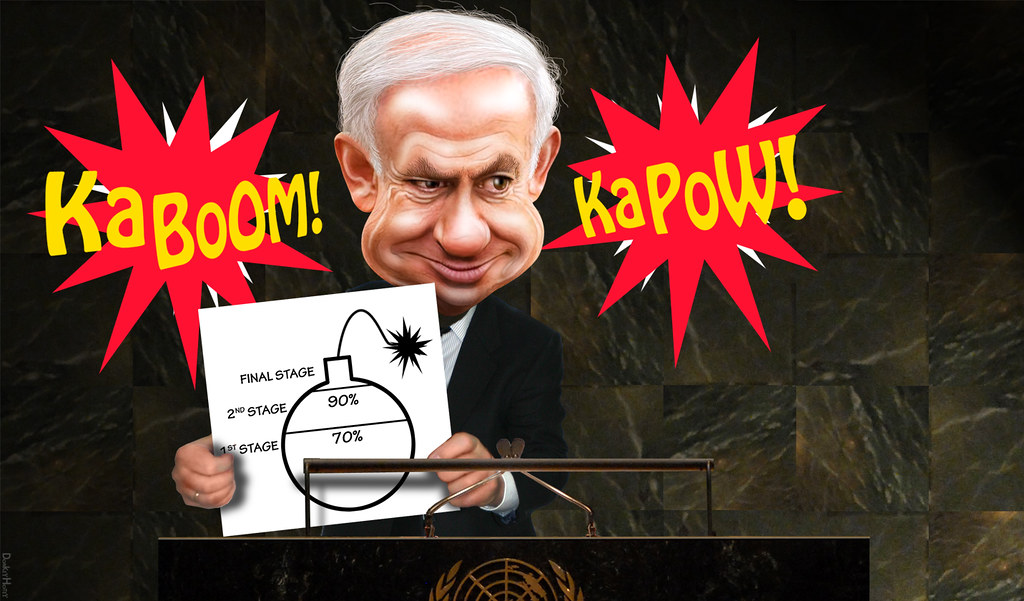
Image:  Bibi Shows Cartoon of Mass Destruction to UN, by DonkeyHotey

PM tells Israeli ambassadors gathered in Jerusalem "... as of now Iran has yet to cross it".


During a speech at the UN in September, the prime minister held up a cartoon-like drawing of a bomb with a fuse and literally drew a red line just below a label reading "final stage" to a bomb, in which Iran was 90% along the path of having sufficient weapons-grade material.

Experts put that at the point that Iran has amassed enough uranium, purified to a level of 20%, that could quickly be enriched further and be used to produce an atomic bomb.

Via: "Y-Net News"

Saturday, January 19, 2013

Israel Preparing To Attack Hamas, Again!


Netanyahu Warns Hamas: We’re Not Finished With You Yet. IDF Preparing To Hit 'With A Still Heavier Blow.'


The Israeli army is preparing to deal Hamas “a heavier blow” than it sustained in last month’s Operation Pillar of Defense, Prime Minister Benjamin Netanyahu said in a television interview broadcast on Saturday night.
“I’d suggest that Hamas not celebrate” any ostensible victory in the wake of that eight-day operation, Netanyahu told Channel 10, indicating that Israel was not finished yet with Hamas.
“We inflicted a very heavy blow” on Gaza’s Islamist government, he said. “We destroyed almost all of their long-range rockets,” he noted. “But I’m telling you that the IDF is preparing to strike a still-heavier blow. Our account with Hamas is not closed.”

Wednesday, January 09, 2013

How We Became Israel


By ANDREW J. BACEVICH
Courtesy Of "The American Conservative"


Peace means different things to different governments and different countries. To some it suggests harmony based on tolerance and mutual respect. To others it serves as a euphemism for dominance, peace defining the relationship between the strong and the supine.
In the absence of actually existing peace, a nation’s reigning definition of peace shapes its proclivity to use force. A nation committed to peace-as-harmony will tend to employ force as a last resort. The United States once subscribed to this view. Or beyond the confines of the Western Hemisphere, it at least pretended to do so.
A nation seeking peace-as-dominion will use force more freely. This has long been an Israeli predilection. Since the end of the Cold War and especially since 9/11, however, it has become America’s as well. As a consequence, U.S. national-security policy increasingly conforms to patterns of behavior pioneered by the Jewish state. This “Israelification” of U.S. policy may prove beneficial for Israel. Based on the available evidence, it’s not likely to be good for the United States.
Here is Israeli Prime Minister Benjamin Netanyahu describing what he calls his “vision of peace” in June 2009: “If we get a guarantee of demilitarization … we are ready to agree to a real peace agreement, a demilitarized Palestinian state side by side with the Jewish state.” The inhabitants of Gaza and the West Bank, if armed and sufficiently angry, can certainly annoy Israel. But they cannot destroy it or do it serious harm. By any measure, the Israel Defense Forces (IDF) wield vastly greater power than the Palestinians can possibly muster. Still, from Netanyahu’s perspective, “real peace” becomes possible only if Palestinians guarantee that their putative state will forego even the most meager military capabilities. Your side disarms, our side stays armed to the teeth: that’s Netanyahu’s vision of peace in a nutshell.
Netanyahu asks a lot of Palestinians. Yet however baldly stated, his demands reflect longstanding Israeli thinking. For Israel, peace derives from security, which must be absolute and assured. Security thus defined requires not simply military advantage butmilitary supremacy.
From Israel’s perspective, threats to supremacy require anticipatory action, the earlier the better. The IDF attack on Iraq’s Osirak nuclear reactor in 1981 provides one especially instructive example. Israel’s destruction of a suspected Syrian nuclear facility in 2007 provides a second.
Yet alongside perceived threat, perceived opportunity can provide sufficient motive for anticipatory action. In 1956 and again in 1967, Israel attacked Egypt not because the blustering Colonel Gamal Abdel Nasser possessed the capability (even if he proclaimed the intention) of destroying the hated Zionists, but because preventive war seemingly promised a big Israeli pay-off. In the first instance, the Israelis came away empty-handed. In the second, they hit the jackpot operationally, albeit with problematic strategic consequences.
For decades, Israel relied on a powerful combination of tanks and fighter-bombers as its preferred instrument of preemption. In more recent times, however, it has deemphasized its swift sword in favor of the shiv between the ribs. Why deploy lumbering armored columns when a missile launched from an Apache attack helicopter or a bomb fixed to an Iranian scientist’s car can do the job more cheaply and with less risk? Thus has targeted assassination eclipsed conventional military methods as the hallmark of the Israeli way of war.
Whether using tanks to conquer or assassins to liquidate, adherence to this knee-to-the-groin paradigm has won Israel few friends in the region and few admirers around the world (Americans notably excepted). The likelihood of this approach eliminating or even diminishing Arab or Iranian hostility toward Israel appears less than promising. That said, the approach has thus far succeeded in preserving and even expanding the Jewish state: more than 60 years after its founding, Israel persists and even prospers. By this rough but not inconsequential measure, the Israeli security concept has succeeded. Okay, it’s nasty: but so far at least, it’s worked.
 What’s hard to figure out is why the United States would choose to follow Israel’s path. Yet over the course of the Bush/Clinton/Bush/Obama quarter-century, that’s precisely what we’ve done. The pursuit of global military dominance, a proclivity for preemption, a growing taste for assassination—all justified as essential to self-defense. That pretty much describes our present-day MO.
Israel is a small country with a small population and no shortage of hostile neighbors. Ours is a huge country with an enormous population and no enemy, unless you count the Cuban-Venezuelan Axis of Ailing Dictators, within several thousand miles. We have choices that Israel does not. Yet in disregarding those choices the United States has stumbled willy-nilly into an Israeli-like condition of perpetual war, with peace increasingly tied to unrealistic expectations of adversaries and would-be adversaries acquiescing in Washington’s will.
Israelification got its kick-start with George H.W. Bush’s Operation Desert Storm, a triumphal Hundred-Hour War likened at the time to Israel’s triumphal Six-Day War. Victory over the “fourth largest army in the world” fostered illusions of the United States exercising perpetually and on a global scale military primacy akin to what Israel has exercised regionally. Soon thereafter, the Pentagon announced that henceforth it would settle for nothing less than “Full Spectrum Dominance.”
Bill Clinton’s contribution to the process was to normalize the use of force. During the several decades of the Cold War, the U.S. had resorted to overt armed intervention only occasionally. Although difficult today to recall, back then whole years might pass without U.S. troops being sent into harm’s way. Over the course of Clinton’s two terms in office, however, intervention became commonplace.
The average Israeli had long since become inured to reports of IDF incursions into southern Lebanon or Gaza. Now the average American has become accustomed to reports of U.S. troops battling Somali warlords, supervising regime change in Haiti, or occupying the Balkans. Yet the real signature of the Clinton years came in the form of airstrikes. Blasting targets in Afghanistan, Bosnia, Serbia, and Sudan, but above all in Iraq, became the functional equivalent of Israel’s reliance on airpower to punish “terrorists” from standoff ranges.
In the wake of 9/11, George W. Bush, a true believer in Full Spectrum Dominance, set out to liberate or pacify (take your pick) the Islamic world. The United States followed Israel in assigning itself the prerogative of waging preventive war. Although it depicted Saddam Hussein as an existential threat, the Bush administration also viewed Iraq as an opportunity: here the United States would signal to other recalcitrants the fate awaiting them should they mess with Uncle Sam.
More subtly, in going after Saddam, Bush was tacitly embracing a longstanding Israeli conception of deterrence. During the Cold War, deterrence had meant conveying a credible threat to dissuade your opponent from hostile action. Israel had never subscribed to that view. Influencing the behavior of potential adversaries required more than signaling what Israel might do if sufficiently aggravated; influence was exerted by punitive action, ideally delivered on a disproportionate scale. Hit the other guy first, if possible; failing that, whack him several times harder than he hit you: not the biblical injunction of an eye for an eye, but both eyes, an ear, and several teeth, with a kick in the nuts thrown in for good measure. The aim was to send a message: screw with us and this will happen to you. This is the message Bush intended to convey when he ordered the invasion of Iraq in 2003.
Unfortunately, Operation Iraqi Freedom, launched with all the confidence that had informed Operation Peace for Galilee, Israel’s equally ill-advised 1982 incursion into Lebanon, landed the United States in an equivalent mess. Or perhaps a different comparison applies: the U.S. occupation of Iraq triggered violent resistance akin to what the IDF faced as a consequence of Israel occupying the West Bank. Two successive Intifadas had given the Israeli army fits. The insurgency in Iraq (along with its Afghan sibling) gave the American army fits. Neither the Israeli nor the American reputation for martial invincibility survived the encounter.
By the time Barack Obama succeeded Bush in 2009, most Americans—like most Israelis—had lost their appetite for invading and occupying countries. Obama’s response? Hew ever more closely to the evolving Israeli way of doing things. “Obama wants to be known for winding down long wars,” writes Michael Gerson in the Washington Post. “But he has shown no hesitance when it comes to shorter, Israel-style operations. He is a special ops hawk, a drone militarist.”
Just so: with his affinity for missile-firing drones, Obama has established targeted assassination as the very centerpiece of U.S. national-security policy. With his affinity for commandos, he has expanded the size and mandate of U.S. Special Operations Command, which now maintains an active presence in more than 70 countries. In Yemen, Somalia, the Philippines, and the frontier regions of Pakistan—and who knows how many other far-flung places—Obama seemingly shares Prime Minister Netanyahu’s expectations: keep whacking and a positive outcome will eventually ensue.
 The government of Israel, along with ardently pro-Israel Americans like Michael Gerson, may view the convergence of U.S. and Israeli national-security practices with some satisfaction. The prevailing U.S. definition of self-defense—a self-assigned mandate to target anyone anywhere thought to endanger U.S. security—is exceedingly elastic. As such, it provides a certain cover for equivalent Israeli inclinations. And to the extent that our roster of enemies overlaps with theirs—did someone say Iran?—military action ordered by Washington just might shorten Jerusalem’s “to do” list.
Yet where does this all lead? “We don’t have enough drones,” writes the columnist David Ignatius, “to kill all the enemies we will make if we turn the world into a free-fire zone.” And if Delta Force, the Green Berets, army rangers, Navy SEALs, and the like constitute (in the words of one SEAL) “the dark matter … the force that orders the universe but can’t be seen,” we probably don’t have enough of them either. Unfortunately, the Obama administration seems willing to test both propositions.
The process of aligning U.S. national-security practice with Israeli precedents is now essentially complete. Their habits are ours. Reversing that process would require stores of courage and imagination that may no longer exist in Washington. Given the reigning domestic political climate, those holding or seeking positions of power find it easier—and less risky—to stay the course, vainly nursing the hope that by killing enough “terrorists” peace on terms of our choosing will result. Here too the United States has succumbed to Israeli illusions.

Tuesday, November 27, 2012

"Netanyahu Finally Tells The Truth”


Satirical Dutch TV Video, Shows Prime Minister Bragging To Hillary Clinton About Killing Innocents

"I know that you're very concerned about the civilian casualties. Well, we don not share your concern about civilian casualties, at all!

In fact, we are conducting these surgical operations against: Schools, Mosques, Hospitals, Universities, Children, and one of the things we're doing is trying is to maximize the number of civilian casualties. We prefer that!

Ah, I know that you ubderstand this. But if not, This is something that I don't have to explain to Americans, President Obama, you and the international community."


Wednesday, October 24, 2012

Who Is The Client State?

By Stanley Kutler
Courtesy Of "The Huffington Post"

Benjamin Netanyahu pointedly assailed his presumed ally, the Obama administration, over its reluctance to set "red lines" to prevent Iran from any further uranium enrichment program. 

Exactly which regime change does Israeli Prime Minister Benjamin Netanyahu have in mind -- Iran's or that of the United States, specifically with the ascent of his old/new pal Mitt Romney to the White House? 

Romney blatantly is willing to outsource the making of our Israel policy allowing Netanyahu to advance his agenda, an agenda not only not ours, but probably not a majority of Israelis'. Like everything else, Netanyahu's policies are always subordinated to his political needs. He lost his office once before, losing the microphone and perks he so cherishes. He is determined not to allow that again.

We need not look back too far in history to realize the danger of handing blank checks to client states. In 1914, the lights went out all over Europe as its nations embarked on a war that eventually spread to the rest of the world, lasting until 1945. The war resulted when the Great Powers, England, Germany, and Russia, blindly supported the extremist ambitions of their feeble client nations, Serbia and Austria. The long-range results were catastrophic, far beyond any anticipated, including the Holocaust, which Netanyahu twists into an all-purpose rationalization for Israeli behavior. 

Netanyahu's remarks smack of his usual political opportunism and willingness to interfere in American domestic affairs. This is from a man who supposedly understands the United States. 

Netanyahu's own political problems are myriad, with his willingness to appease the extreme right-wing and racist allies in his coalition, the settlers, and a collection of war hawks, eager to stand up to the United States, suffering as they do from their perceived client status. Probably a majority of Israelis are reluctant to attack Iran, but that is not the nature of Israeli politics. The prime minister stirs the pot to maintain his political alliances. Such is his definition of leadership. The usual suspects of American allies, Senators Joseph Lieberman, John McCain, and Lindsay Graham, sing in the Romney chorus, with Lieberman proclaiming that this will seal the deal for Obama to lose Florida. 

Make no mistake: domestic politics are very much in play. The White House hurriedly announced that the president had spoken with the prime minister for an hour "as part of their ongoing consultations." We received the usual boilerplate confirming American determination to prevent Iran from gaining a nuclear weapon and they agreed to continue their "close consultations." The statement gratuitously concluded that Netanyahu never requested a meeting with Obama in Washington. What a wonderful way to invoke "plausible deniability." 

In measuring the political calculus, Israel is no different than we. Friends and opponents alike threaten Netanyahu. He plays his moral authority and a stiff neck to the Americans to overcome any criticism. Dan Meridor, Netanyahu's deputy prime minister for intelligence and atomic affairs, and certainly no peacenik, bluntly undercut the PM, telling Israeli Army radio, "I don't want to set red lines or deadlines for myself." The Kadima opposition leader, Shaul Mofaz, strongly criticized the Prime Minister but some of his party members worried he may have gone too far and cost the party votes. After all, as one said, Netanyahu is more popular than Obama in Israel.

Netanyahu is coming to the United States ostensibly to address the UN; of course he and his American supporters wanted the legitimacy of a White House meeting. Why else would Netanyahu come to the United States? To speak to all of his close friends and allies at the UN, who tuned him out long ago? Sheldon Adelson, his best money friend, is in Las Vegas. The trip to New York is hardly a subtle provocation. It deserves the back of the president's hand, and not such a polite one.

Dennis Ross, the American special envoy to the Middle East for many years, in his book, The Missing Peace, quotes President Bill Clinton as telling his aides after his first meeting with Prime Minister Netanyahu in July 1996 that "he thinks he is the superpower and we are here to do whatever he requires." 

As Israel has isolated itself further from the international community, they have mostly themselves to blame. But the United States likewise has much to answer for because of its long-standing indulgence of extreme Israeli views, and worse yet, to their small, well-financed, well-placed, and shrill supporters in the United States. Why is the Obama administration so diffident toward Ross, an AIPAC man, who periodically doubles as the president's Middle Eastern adviser, or even to the deservedly out of power neo-con crowd, including Elliott Abrams, Paul Wolfowitz, Charles Krauthammer, et al. Why are they so fearful of Eric Cantor, AIPAC's favorite Capitol Hill shill? 

The Israeli prime minister's blustering demands for his way while threatening the possibility of Israel's annihilation -- or, in one of his more inelegant statements, the prospect of "Auschwitz" -- is a false choice. Israel remains militarily powerful; its economy is innovative and prosperous; and it has American guarantees for its security, not to mention a treasure of aid and bribes. Netanyahu would be well advised to look to his own "tsouris," and deal with the blood sport of Israeli politics rather than meddle in ours.

Netanyahu should reflect on what he wishes for. His postures have provoked unprecedented critical American media reaction, focusing on matters rarely raised, including the American military's forceful opposition in 2006, and again this year, to any military action against Iran, or in any way enabling an Israeli attack. The media now reports the opposition within Israeli intelligence and military circles to any attack on Iran because Israel lacks the bomb power, and even if it did, the Iranians only would rebuild. They offer a withering critique of Netanyahu's blatant interference in U.S. domestic politics, and they tell of the Netanyahu's egomaniacal press "conferences," which brook no opposition or criticism. Altogether, a rather refreshing moment which should give Netanyahu real pause.

For nearly seven decades, American Jews have walked a fine line on the issue of dual loyalties. One thing is certain: they will not support Israel or any nation that so blatantly interferes in our domestic affairs. On the whole, they have managed that line quite well, acknowledging at once their emotional attachment to the Land of Israel, supporting its militarily and needs, probably beyond what actually may be needed, and they have created a lobby that rivals the force and power of the NRA. Yet American Jews are on record as opposing the harsh brutality of the occupation -- except when AIPAC or the likes of the Israeli government overwhelms their voice. They have accepted the dubious support of fundamentalist Christians, even those whose root ideology favors the return of all Jews to Israel to ensure the Second Coming. Polls consistently reveal that American Jewry's doubts about American policy to Israel is marginalized in single figures. Any charge of disloyalty simply cannot hold water.

So, will Netanyahu now force American Jews to choose between the stakes and interests of their own government, or his own political needs and ambitions? Who can doubt the outcome? 

Friday, October 19, 2012

Netanyahu, Not Iran, Is An Existential Threat To Israel

MJ Rosenberg writes the following:

One ex-Israeli official put it best. Prime Minister Binyamin Netanyahu seems to be “going berserk.”

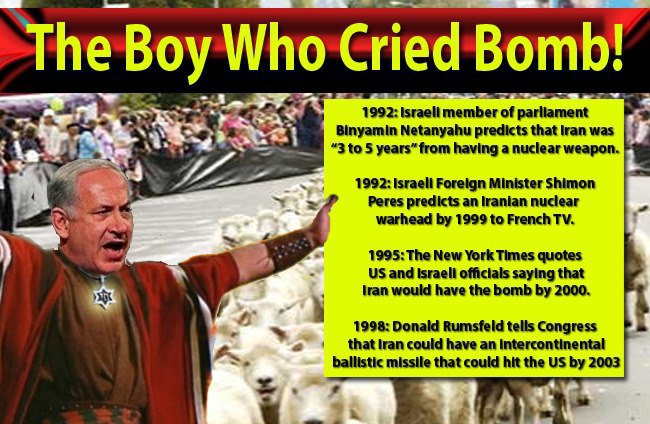
Netanyahu is now demanding that the United States set a “red line” that, once crossed, will automatically initiate a U.S. attack on Iran. Bibi doesn’t even bother to pretend that war with Iran is in the interests of the U.S. He just wants the U.S. to recognize his red line and give him his war trigger. And he is increasingly fearful that he won’t get it.

His latest tantrum was produced by last week’s New York Times op-ed by its former executive editor, Bill Keller. He wrote that even if Iran develops nuclear weapons, they would not necessarily pose a significant threat to Israel, let alone to the United States. The Iranians are not insane. In fact the Middle East leader who behaves most irrationally is Netanyahu himself.

Keller suggested what many Israelis say privately: 


This whole Iran scare is not about nukes per, but about the fear that a nuclear Iran jeopardizes Israel’s geostrategic supremacy. Bibi fears that he would lose his ability to do whatever he wants, to whomever he wants, whenever he wants.
Bomb Gaza. Bomb Lebanon. Bomb relief ships. Bomb whatever.
It is all about regional hegemony. After all, Israel’s military can more than handle Iran and everyone understands that. Iran certainly does. That is why Israelis do not share Netanyahu’s enthusiasm for war.

Not only do Israelis not want war, they rightly fear that an attack on Iran would result in thousands of missiles being launched against Israeli population centers by Hezbollah and Hamas. Even though Defense Minister Ehud Barak promises that only 500 Israeli civilians would be killed (how did he come up with that number?), Israelis do not want their kids to be among them.

None of this seems to matters to Netanyahu, who acts less as an Israeli patriot than as a U.S. neoconservative. That is why he is the first Israeli prime minister not even to go through the motions of serious negotiations. He is not interested.

The only force in the United States that favors war with Iran is the Israel lobby (AIPAC and its satellite organizations), neoconservative pundits and some Christian rightists.

The bottom line then is that all Netanyahu is accomplishing with his ugly saber-rattling and interference in our election is threatening the survival of the US-Israel relationship especially if, as seems likely, Obama wins.

Don’t kid yourself. No matter what Obama says publicly, he cannot stand Netanyahu. Privately, it is hard to imagine that even Republicans like seeing the their country being treated with such contempt by a tiny country we sustain with $3.5 billion a year in aid (exempt from all cuts, unlike every other program) and UN vetoes that make America look like Israel’s satellite.

The only thing that keeps everyone quiet is intimidation and campaign contributions. That won’t last forever, particularly as younger American Jews have moved toward indifference to Israel due to the policies it has pursued since an Israeli fanatic killed Yitzhak Rabin.

Israelis need to wake up. I.L. Kenen, the founder of AIPAC, said the United States was Israel’s defense line. It is. And Bibi is jeopardizing it.

Binyamin Netanyahu poses an existential threat to the Jewish state. Those who claim to care about Israel need to speak out. Will we really allow this rightist egomaniac to destroy a 2000 year old dream?

Friday, September 28, 2012

NetanYAHOOOEY


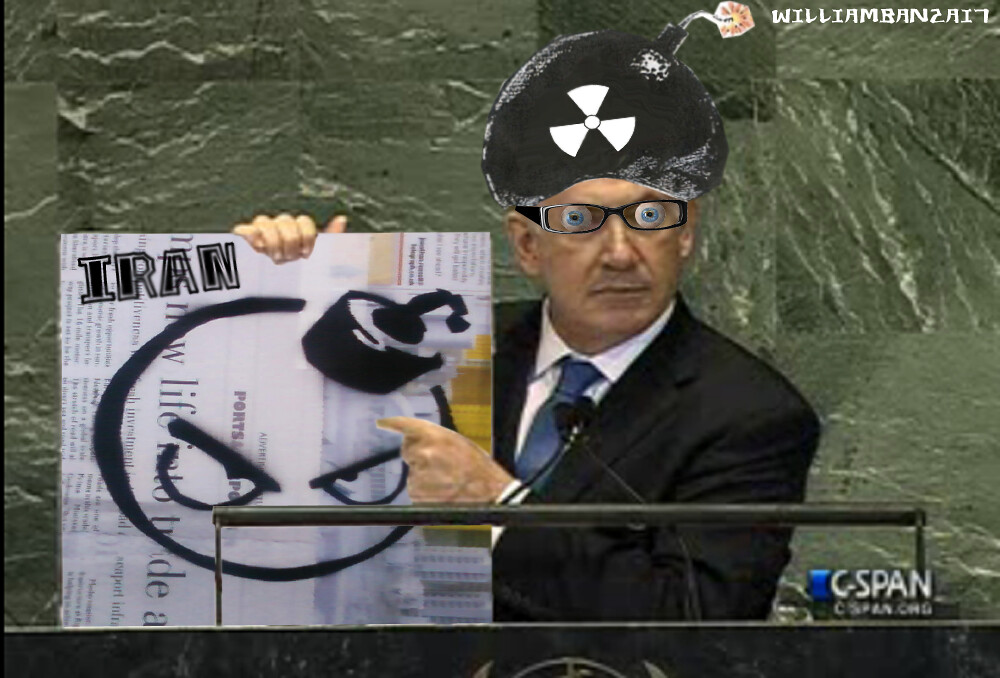
Introducing "NetanYAHOOOEY": the man who desperately wants to start World War 4

The New Yorker magazine quipped about "The Bibi Bomb": "if Wile E. Coyote ever gets hold of this, the Roadrunner is toast."

By Colonel Flick
This photo was taken on September 27, 2012.
Via: "Flickr"

Wednesday, September 12, 2012

It Wasn't Enough For Israel


In the midst of the scramble for Palestine, while the UN Special Committee on Palestine was still debating over trusteeship and trying to establish a truce between Zionists and Palestinian-Arabs(1), at the stroke of midnight when the British Mandate expired Jewish leaders declared the new state of Israel knowing it would trigger a war and cause immense suffering. Eleven minutes later, the United Statesrecognized Israel's traumatic birth. Meanwhile, unarmed Palestinianvillagers were ordered into a community square, lined up against the wall, and summarily executed by the Irgun, a Jewish terrorist organization. When the trapped villagers attempt to flee, Irgun commanders tracked them down killing them with hand grenades and knives. Almost 300 men, women, and children laid dead in the smoldering village ruins. Word quickly spread to other Palestinians that unless they fled and left their homes, the fate of Deir Yassin would be their fate.(2)

Mr. Netanyahu: Wasn't it enough for Israel's ruling regimes to have occupied the UN's fledgling Zionist/Palestinian-Arab peace process with militarism and acts of terror and...????

But Israel, acting unilaterally, sought security and peace through militarism and hubris. Not only did the 1948 Jewish War of "Independence" force 750,000 Palestinians off their territories while creating massive refugee camps, but future conflicts were used to justify Israeliexpansionism, increased settlement building, religious supremacy, and the military occupations of East JerusalemWest Bank, and Gaza Strip. Due to Zionist ideology, Jewish victimization, various Jewish lobbying groups, and a romanticized image of Israel, these gross violations were overlooked and in some cases, even indirectly supported. At the same time, numerous UN resolutions denounced Israel's military occupations of Palestinian lands. However, they were either vetoed by the U.S.-a permanent member of the UN Security Council, sabotaged by a host of Jewish lobbying groups, or completely ignored by Israeli political and military leaders.

Mr. Netanyahu: Wasn't it enough for Israel's ruling regimes to have occupied the UN's fledgling Zionist/Palestinian-Arab peace process with militarism and acts of terror, to have occupied Palestinian lands and...???

When an Israeli soldier, one of thousands who refused to serve in Occupied Territory, declared: "The army is a sacred cow in Israel. Our refusal is an act of despair. We believe that the situation now is so desperate that the only way to shake this country, the only way to shake our leaders...is to say, 'We're no playing this game any more. Give us a future!'"(3), he was speaking for many Israelis who realized the ruling regime was acting pre-emptively, unilaterally, and without restraint. He also understood that military power and hubris, when used externally, can easily be projected internally. Decades of preemptive invasions and military occupations of Palestine have had a paradoxical effect. Inequalities of power are now being imposed on Israeli citizensAusterity measures are now being imposed, causing dozens of protests that have either turned violent or led some to commit self-immolation. New laws, like universal conscription, are being enforced too.

Mr. Netanyahu: Wasn't it enough for Israel's ruling regimes to have occupied the UN's fledgling Zionist/Palestinian-Arab peace process with militarism and acts of terror, to have occupied Palestinian lands, to have occupied Israel and...??

It was no surprise, then, when Israeli Prime Minister Benjamin Netanyahu told UN Secretary General Ban Ki-moon that he would be making a "big mistake" by attending an international peace summit in Iran. "Mr. Secretary General," declared Netanyahu, "you do not belong in Tehran!" Although the UN has not confirmed if Ban plans to attend the Non-Aligned Meeting, such commanding and imposing utterances reflects how authoritative Netanyahu and his Likud Party has become. Though Israel still occupies Palestinian lands and has enforced dozens of harsh measures against Palestinians, along with being the sole nation in the region that has nuclear weapons, Netanyahu announced Iran's nuclear enrichment program (Iran claims it is for civilian uses) poses an existential threat. And despite Israel's recent assassinations of several Iranian scientists, Netanyahu continues to maintain that Iran is the largest exporter of terrorism in the world.

Mr. Netanyahu: Wasn't it enough for Israel's ruling regimes to have occupied the UN's fledgling Zionist/Palestinian-Arab peace process with militarism and acts of terror, to have occupied Palestinian lands, to have occupied Israel, to have again occupied the UN and...?

In other words, was it not enough that your nation has illegally occupied Palestinian lands for sixty-four years? 

Was it not enough that for decades, your country has ignored UN resolutions and "land for peace" principles by increasing Jewish settlement building on Palestinian territories

Was it not enough that your Israeli Defense Forces have on many occasions militarily invaded and razed Palestinian homes, farms, and orchards, and that you have maintained barriers of separation and armed checkpoints? 

Was it not enough for Israeli forces to have fired on peaceful demonstrators, raid homes, and to have falsely imprisoned thousands of Palestinians? 

Was it not enough to have sustained a punitive economic blockade against Palestinians and then prevent humanitarian aid from reaching them? Was it not enough to have occupied both Palestine and the UN?

And now, Mr. Netanyahu: Do you and your ruling regime not only want to occupy the UN's fledgling Zionist/Palestinian-Arab peace process with militarism and acts of terror, occupy Palestinian lands, occupy Israel, occupy the UN again, but to also occupy Iran?

(Dallas Darling is the author of Politics 501: An A-Z Reading on Conscientious Political Thought and Action, Some Nations Above God: 52 Weekly Reflections On Modern-Day Imperialism, Militarism, And Consumerism in the Context of John's Apocalyptic Vision, and The Other SideOf Christianity: Reflections on Faith, Politics, SpiritualityHistory, and Peace. He is a correspondent for www.worldnews.com. You can read more of Dallas' writings at www.beverlydarling.com andwn.com//dallasdarling.)

(1) Spiegel, Steven L. The Other Arab-Israeli Conflict: Making America's Middle East Policy, From Truman To ReaganChicago, Illinois:University of Chicago Press1985., p. 37ff.

(2) SmithMichael K. Portraits of Empire: Unmasking Imperial Illusions from the "American Century" to the "War on Terror". Monroe, Maine:Common Courage Press2003., p. 32.

(3) Ibid., p. 350.