Showing posts with label Client State. Show all posts

Monday, January 28, 2013

Move Over BRICS, Here Comes FUKUS


There's a hot new acronym in international affairs: FUKUS.

The United States of America has joined its FUKUS Axis partners France and the UK in recognising the Syrian opposition as the only "legitimate representative" of the Syrian people.

Via: "Foreign Policy"


Wednesday, October 24, 2012

Who Is The Client State?

By Stanley Kutler
Courtesy Of "The Huffington Post"

Benjamin Netanyahu pointedly assailed his presumed ally, the Obama administration, over its reluctance to set "red lines" to prevent Iran from any further uranium enrichment program. 

Exactly which regime change does Israeli Prime Minister Benjamin Netanyahu have in mind -- Iran's or that of the United States, specifically with the ascent of his old/new pal Mitt Romney to the White House? 

Romney blatantly is willing to outsource the making of our Israel policy allowing Netanyahu to advance his agenda, an agenda not only not ours, but probably not a majority of Israelis'. Like everything else, Netanyahu's policies are always subordinated to his political needs. He lost his office once before, losing the microphone and perks he so cherishes. He is determined not to allow that again.

We need not look back too far in history to realize the danger of handing blank checks to client states. In 1914, the lights went out all over Europe as its nations embarked on a war that eventually spread to the rest of the world, lasting until 1945. The war resulted when the Great Powers, England, Germany, and Russia, blindly supported the extremist ambitions of their feeble client nations, Serbia and Austria. The long-range results were catastrophic, far beyond any anticipated, including the Holocaust, which Netanyahu twists into an all-purpose rationalization for Israeli behavior. 

Netanyahu's remarks smack of his usual political opportunism and willingness to interfere in American domestic affairs. This is from a man who supposedly understands the United States. 

Netanyahu's own political problems are myriad, with his willingness to appease the extreme right-wing and racist allies in his coalition, the settlers, and a collection of war hawks, eager to stand up to the United States, suffering as they do from their perceived client status. Probably a majority of Israelis are reluctant to attack Iran, but that is not the nature of Israeli politics. The prime minister stirs the pot to maintain his political alliances. Such is his definition of leadership. The usual suspects of American allies, Senators Joseph Lieberman, John McCain, and Lindsay Graham, sing in the Romney chorus, with Lieberman proclaiming that this will seal the deal for Obama to lose Florida. 

Make no mistake: domestic politics are very much in play. The White House hurriedly announced that the president had spoken with the prime minister for an hour "as part of their ongoing consultations." We received the usual boilerplate confirming American determination to prevent Iran from gaining a nuclear weapon and they agreed to continue their "close consultations." The statement gratuitously concluded that Netanyahu never requested a meeting with Obama in Washington. What a wonderful way to invoke "plausible deniability." 

In measuring the political calculus, Israel is no different than we. Friends and opponents alike threaten Netanyahu. He plays his moral authority and a stiff neck to the Americans to overcome any criticism. Dan Meridor, Netanyahu's deputy prime minister for intelligence and atomic affairs, and certainly no peacenik, bluntly undercut the PM, telling Israeli Army radio, "I don't want to set red lines or deadlines for myself." The Kadima opposition leader, Shaul Mofaz, strongly criticized the Prime Minister but some of his party members worried he may have gone too far and cost the party votes. After all, as one said, Netanyahu is more popular than Obama in Israel.

Netanyahu is coming to the United States ostensibly to address the UN; of course he and his American supporters wanted the legitimacy of a White House meeting. Why else would Netanyahu come to the United States? To speak to all of his close friends and allies at the UN, who tuned him out long ago? Sheldon Adelson, his best money friend, is in Las Vegas. The trip to New York is hardly a subtle provocation. It deserves the back of the president's hand, and not such a polite one.

Dennis Ross, the American special envoy to the Middle East for many years, in his book, The Missing Peace, quotes President Bill Clinton as telling his aides after his first meeting with Prime Minister Netanyahu in July 1996 that "he thinks he is the superpower and we are here to do whatever he requires." 

As Israel has isolated itself further from the international community, they have mostly themselves to blame. But the United States likewise has much to answer for because of its long-standing indulgence of extreme Israeli views, and worse yet, to their small, well-financed, well-placed, and shrill supporters in the United States. Why is the Obama administration so diffident toward Ross, an AIPAC man, who periodically doubles as the president's Middle Eastern adviser, or even to the deservedly out of power neo-con crowd, including Elliott Abrams, Paul Wolfowitz, Charles Krauthammer, et al. Why are they so fearful of Eric Cantor, AIPAC's favorite Capitol Hill shill? 

The Israeli prime minister's blustering demands for his way while threatening the possibility of Israel's annihilation -- or, in one of his more inelegant statements, the prospect of "Auschwitz" -- is a false choice. Israel remains militarily powerful; its economy is innovative and prosperous; and it has American guarantees for its security, not to mention a treasure of aid and bribes. Netanyahu would be well advised to look to his own "tsouris," and deal with the blood sport of Israeli politics rather than meddle in ours.

Netanyahu should reflect on what he wishes for. His postures have provoked unprecedented critical American media reaction, focusing on matters rarely raised, including the American military's forceful opposition in 2006, and again this year, to any military action against Iran, or in any way enabling an Israeli attack. The media now reports the opposition within Israeli intelligence and military circles to any attack on Iran because Israel lacks the bomb power, and even if it did, the Iranians only would rebuild. They offer a withering critique of Netanyahu's blatant interference in U.S. domestic politics, and they tell of the Netanyahu's egomaniacal press "conferences," which brook no opposition or criticism. Altogether, a rather refreshing moment which should give Netanyahu real pause.

For nearly seven decades, American Jews have walked a fine line on the issue of dual loyalties. One thing is certain: they will not support Israel or any nation that so blatantly interferes in our domestic affairs. On the whole, they have managed that line quite well, acknowledging at once their emotional attachment to the Land of Israel, supporting its militarily and needs, probably beyond what actually may be needed, and they have created a lobby that rivals the force and power of the NRA. Yet American Jews are on record as opposing the harsh brutality of the occupation -- except when AIPAC or the likes of the Israeli government overwhelms their voice. They have accepted the dubious support of fundamentalist Christians, even those whose root ideology favors the return of all Jews to Israel to ensure the Second Coming. Polls consistently reveal that American Jewry's doubts about American policy to Israel is marginalized in single figures. Any charge of disloyalty simply cannot hold water.

So, will Netanyahu now force American Jews to choose between the stakes and interests of their own government, or his own political needs and ambitions? Who can doubt the outcome? 

Tuesday, July 24, 2012

Egypt: The Decline Of U.S. Influence?

What Leverage Will The US Have In Post-Mubarak Egypt?


Hillary Clinton, the US secretary of state, made her first visit to Egypt since the first democratically elected president was inaugurated.


Clinton has met with the two central players in the power struggle playing out in Egypt.

On Saturday, she held her first meeting with President Mohamed Morsi, an Islamist who emerged from the country's long-oppressed Muslim Brotherhood movement.

On Sunday, she met with Field Marshal Hussein Tantawi, who as the head of the Military Council has ruled Egypt for the last 16 months.

But the transition to civilian rule has not been smooth. The military has retained overwhelming powers for itself, including legislative power and control of the writing of a new constitution.

The US faces many difficulties when it comes to dealing with a post-Mubarak Egypt - not least its attempt to wield its influence amid the competing political power struggles. And making sure that Egypt respects its international agreements, especially its treaty with Israel.

Eager to be seen as a champion of democracy and human rights, the US has criticised Egypt's military as it grabs more power. And it has offered words of support for the Muslim Brotherhood, making those uncomfortable who are sceptical of the Brotherhood's intentions.

The discomfort manifested itself in protests at the weekend. On Sunday, some threw tomatoes, water bottles and shoes at Clinton's motorcade as she left a ceremony marking the opening of a new US consulate in Alexandria.

At a news conference in Cairo, Clinton was asked if she regretted America's past support for Hosni Mubarak.

She answered: "We worked with the government of the country at the time. We work with governments around the world, we agree with some of them, we disagree with others of them. We were consistent in promoting human rights and speaking out for an end to the emergency war, an end to political prisoners being detained so I think you have to put this in context."

Clinton also made clear that she wants the Egyptian army to withdraw from politics.

"The United States supports the full transition to civilian rule with all that entails and we have commended the SCAF for representing the Egyptian people in the revolution, as compared to what we are seeing in Syria, which is the military murdering their own people. The SCAF here protected the Egyptian nation and we commend them for overseeing a free, fair election process. But there is more work ahead," said the US secretary of state.
So, what influence does the US have in a post-Mubarak Egypt?

"Unfortunately, the United States' administration, for the past 60 years, has been supporting dictatorship(s) in the Arab and Muslim world. From what they saw happening in the Arab Spring, I think the people in the Arab world have spoken and the United States' administration has to listen to the voices of the people and they have no other option but to support democracy in Egypt as well as in the Arab world."
Abdulmawgoud Dardery, an MP who represents Luxor for the Freedom and Justice Party


Thursday, June 21, 2012

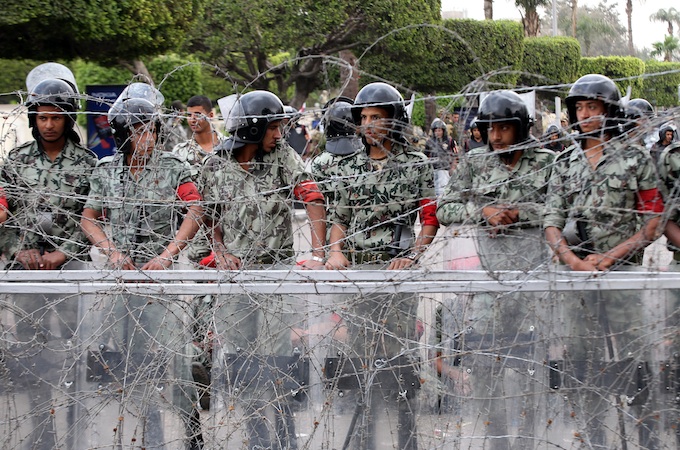
New Egyptian Military Arrest Powers Replaces Emergency Law


The decree will remain in effect at least until a new constitution is drafted, according to the justice ministry [EPA]


Last Modified: 13 Jun 2012 23:57
Courtesy Of "Al-Jazeera"


Egypt's justice ministry has issued a decree allowing military police and intelligence officers to arrest civilians suspected of crimes, restoring some of the powers of the decades-old emergency law which expired just two weeks ago.

The controversial order was drafted earlier this month, but was not announced until Wednesday.

The decree applies to a range of offences, including those deemed "harmful to the government," destruction of property, "obstructing traffic," and "resisting orders".

Several of those provisions would allow the military to detain peaceful protesters. Rallies in Tahrir Square routinely disrupt traffic, for example.

It will remain in effect at least until a new constitution is drafted, according to the ministry.

Members of parliament voted on Tuesday to appoint a constitutional assembly, but the process of drafting the document could take months.

Adel al-Mursi, the head of Egypt's military justice, was quoted by AFP news agency as saying that "the decision fills a legal vacuum", while Sayyed Hashim, a former military prosecutor, called it a temporary measure.

"The police force has not yet recovered completely, and security is not back," Hashim was quoted by Associated Press news agency as saying in a television interview.

Parliament Bypassed


Al Jazeera's Rawya Rageh, reporting from Cairo, said Egyptian activists see the current order as "much worse than the [previous] emergency law", in that it is seen as expanding the military's power.

"And it comes at a time when the ruling military council is expected to be handing over authority to a civilian authority in less than two weeks' time," she said, adding that the order bypassed the newly elected parliament.

"The initial reactions from the MPs has been very angry, specifically from the powerful Muslim Brotherhood.

Some of its members are saying that this is tantamount to a military coup."


The Muslim Brotherhood's Freedom and Justice Party (FJP), which has the largest number of seats in parliament, issued a statement on the controversial decree, suggesting that parliament will try to bring the issue under its supervision.

The brief statement quoted the party's deputy president, Essam El Erian, as saying parliament will be looking into the justice ministry's right to issue the decision and whether parliament can refuse it or not.

Parliament will seek to have oversight over the implementation of the decision "so that this mandate doesn't exceed its legal and constitutional limits," El Erian said in the statement.

"The Egyptian Revolution happened to get rid of injustice, corruption, autocracy and repression of freedoms - and the Egyptian people won't accept the return of any of that."

'Military Coup'


Mohamed Beltagy, another FJP member of parliament, called the decree a "military coup" in an interview with Al Jazeera, and said the measure was not discussed in parliament.

Mohammed Morsi, the Muslim Brotherhood's presidential candidate, said on Al Jazeera that the decision raises fears about the military's role.

Human rights organisations were also quick to criticise the decision, which they said confirmed that Egypt was a "military state".

Gamal Eid, a prominent human rights lawyer, said the decree made Egypt look like "a banana republic".

"Several of the crimes included in the decree are actually rights, such as the right to freedom of expression against ruling powers or established laws, demonstrations and strikes," according to a statement issued by 15 Egyptian rights groups.

The military has played an extensive and controversial role in the justice system over the last 18 months. More than 12,000 civilians have been hauled before military tribunals since the revolution; rights groups say the military courts do not provide basic standards of due process.

The 31-year-old state of emergency, imposed in 1981 after Anwar Sadat was assassinated, was finally allowed to expire at the end of May. It granted wide-ranging powers to former president Hosni Mubarak's security forces, including the right to detain suspects without trial.

Court Rulings


Amr Hamzawy, a liberal member of parliament from Cairo, said in a statement on his Facebook page that the ruling simply "reproduced" the emergency law.

"[It] reproduces the emergency law using new tools and threatens the state of law, for it gives military intelligence and military police powers of judicial execution in crimes committed by civilians," he wrote.

The decree comes just days before the country's presidential runoff, which pits Morsi against Ahmed Shafiq, the last prime minister in Mubarak's government.

It also comes a day before two crucial court rulings. The supreme constitutional court will decide on Thursday whether to expel Shafiq from the race because of the so-called "political isolation" law, which bars ex-regime officials from running for public office.

The court will also rule on whether parliament is unconstitutional; a lower court found that some provisions of the electoral law  - allowing political parties to compete with independent candidates for some seats - might have violated the constitution.


Wednesday, June 20, 2012

New Imperialistic Tool

UN Security Council Threatens Sanctions on Any Who ‘Disrupt’ Yemeni Govt.

Warns Against 'Spoilers' of Yemen's Single-Candidate Democracy

By Jason Ditz,
June 12, 2012
Courtesy Of "Anti-War"


That’s just the way the US likes it in Yemen, and according to a new resolution by the UN Security Council that’s how the international community likes it too. Following up on recommendations from officials, the resolution endorses the single candidate election that installed the US-backed Major General Abd-Rabbu Mansour Hadi.
Following in the footsteps of an executive decision by President Obama worded almost the exact same way, the Security Council resolution threatens sanctions against anyone who does anything to “undermine” the Yemeni democracy, candidate-free though it may be.
The resolution cites Article 41 of the UN charter, saying that empowers the council to impose economic and diplomatic sanctions on anyone who ignores their decisions, in this case the decision being that the election was just fine.
Hadi was installed as part of a negotiated settlement on the ouster of Ali Abdullah Saleh, with Hadi taking his position and the political opposition being given a few cabinet posts on the condition that no

Wednesday, May 02, 2012

The UN May Have Silenced The Afghan Public

By Kathy Kelly,
April 30, 2012
Courtesy Of "Anti-War"


“Today, Afghanistan and the U.S. initialed and locked the text of the strategic partnership agreement,” said President Hamid Karzai’s spokesman, Aimal Faizi. “This means the text is closed….”
Why “lock” or “close” the future of Afghanistan to 30 million ordinary Afghan citizens?
While the world may accept that the U.S. and Afghan governments have some “state” or “noble” considerations for not revealing the contents of the U.S. Afghan Strategic Partnership Agreement, what about the democratic consideration of involving Afghans in their own future?
Even the Afghan parliament was in the dark and uninvolved until it was recently given a peek when Afghanistan’s national security adviser, Rangin Dadfar Spanta, read “portions” of the Agreement to assembled parliamentarians on April 23, saying that the U.S. will defend Afghanistan from any outside interference via “diplomatic means, political means, economic means, and even military means.”
What is the Afghan public’s opinion regarding the U.S. Afghan Strategic Partnership Agreement?
Does anyone know?
[T]he Afghan public has outright rejected the U.S. plans as the results of a survey conducted by U.N. Assistance Mission in Afghanistan (UNAMA) suggest. UNAMA with its 23 offices in Afghanistan conducted the survey across the country some two months back and hasn’t published it. Although, the survey’s findings are widely known. If published, the stark survey results will undermine the U.S.’ future strategic plans.
Out of curiosity, the Afghan Peace Volunteers pursued the question of whether the U.N. had actually conducted such a survey.
We sent emails to friends with the Fellowship of Reconciliation U.S.A. who have correspondence and contact with the U.N. Below was the reply that was forwarded to us.
April 14, 2012
Dear XXX,
I sent an email inquiry to the U.N. coordinator in Afghanistan to ask about the survey.
As I suspected, I did not receive any response. It seems they are not willing to talk about it.
But I will keep watching for any future publications. 
Best,
XXX
We also asked a staff member at McClatchy newspapers in Kabul if he could ask some questions at the U.N. office in Kabul. We have not heard any news from the McClatchy staff.
So we still don’t know if there was ever such a survey conducted by the U.N. office in Kabul.
We feel that even if there was no such survey, then a survey should be conducted under the auspices of the U.N. and its results made known before the signing of the agreement, to rebuild trust in the U.N., the U.S., and Afghan governments’ democratic processes.
The contents of the U.S. Afghanistan Strategic Partnership Agreement should be “unlocked” to the American and Afghan publics, and the survey should be conducted among Afghans in every province, particularly in the provinces where the joint military operations of the Strategic Partnership Agreement will continue to be launched beyond 2014.
Has the U.N. silenced the Afghan public?
But perhaps, participation in today’s democracy is designed to be “locked” away.
We, the Afghan Peace Volunteers, respectfully ask for the key.

Wednesday, December 21, 2011

Republicans Hopefuls Rehearse AIPAC's Script

By Adam Kredo 
December 13, 2011 
Courtesy Of "The JTA"


WASHINGTON (JTA) -- Iran’s nuclear program appears to be racing ahead. The Middle East peace process is in shambles. And a series of recent flare-ups have highlighted ongoing tensions between the Obama administration and elements of the pro-Israel community.
It was against this backdrop that six Republican candidates took the stage Dec. 7 at the Republican Jewish Coalition's presidential candidates forum. The hopefuls took turns laying out their lines of attack against President Obama, offering a preview of how Middle East issues might play out in a general election battle.
The daylong event attracted hundreds of Republican Jews to the Ronald Reagan Building and International Trade Center here. They heard from the top GOP contenders with the exception of Rep. Ron Paul of Texas, who was not invited. (The RJC’s executive director, Matthew Brooks, cited the congressman’s “misguided and extreme views” as the reason for his exclusion.)
With less than a month to go until the Iowa caucuses, the current leaders of the GOP pack, Newt Gingrich and Mitt Romney, appeared to cement their status as favorites of Jewish Republicans, both receiving warm receptions and ample applause.
While the candidates touched on economic issues, most avoided addressing the social issues, such as abortion and religion, that tend to push Jewish voters away from Republicans.
Instead, their comments focused heavily on foreign policy, with each assailing the Obama administration for its policies toward Israel and Iran, and vowing that they would be better friends to the Jewish state and tougher foes for the Islamic Republic.
The ‘Appeasement’ Accusation
Former Pennsylvania Sen. Rick Santorum led off the forum by introducing a theme that the front-runners would echo.
“The president, for every thug and hooligan, for every radical Islamist, has had nothing but appeasement," Santorum said.
Later in the day, Romney accused Obama of an “appeasement strategy” toward America’s rivals and enemies, while Gingrich said he was "very, very worried about our entire relationship with radical Islam," saying it is based on self-deception and appeasement.
In response to a reporter’s question, Obama fired back the next day.
“Ask Osama bin Laden and the 22 out of 30 top al-Qaida leaders who have been taken off the field whether I engage in appeasement,” the president said.
Obama and Israel
Gingrich and Romney both placed their criticisms of Obama’s Israel policies within the context of broader foreign policy critiques.
Gingrich said the U.S. needs “a dramatically rethought strategy for the Middle East” and that the country is engaged in a “long struggle with radical Islamists.” The former House speaker took aim at recent remarks by Defense Secretary Leon Panetta, who urged Israel to “mend fences” with its neighbors.
“This one-sided continuing pressure that says it’s always Israel’s fault no matter how bad the other side is has to stop,” Gingrich said.
Romney accused the president of having “rushed to apologize for America, but he has hesitated to speak up for democracy and freedom.” The former Massachusetts governor depicted Israel as a case in point.
Obama “has immeasurably set back the prospect of peace in the Middle East,” Romney said, and his administration's policies have only “emboldened Palestinian hard-liners” who feel that “they can bypass Israel at the bargaining table.”
Texas Gov. Rick Perry said that Obama “has insisted on previously unheard-of preconditions for Israel, such as an immediate stop to all settlement activity.” Perry said he supports “the goal of a Palestinian state, but it should be the Palestinians who meet certain pre-conditions.”
First, Perry said, a Palestinian state must be “directly negotiated between Israeli and the Palestinian leaders.” Second, he demanded “Palestinian recognition of Israel’s right to exist as a Jewish state.” Finally, he said Palestinian leaders must “renounce the terrorist activities of Hamas.”
Perry’s pre-conditions closely resemble positions previously articulated by Obama. The president has condemned Palestinian efforts to achieve statehood outside of the context of negotiations, called previous Hamas-Fatah unity efforts “an enormous obstacle to peace” and said Israel should be “a Jewish state and the homeland for the Jewish people.”
The Iranian Threat
The candidates talked tough on Iran -- and had some tough words for the Obama administration.
“On Iran, the only rational long-term policy is regime replacement,” Gingrich said in response to a question from an audience member. He called for covert action to sabotage Iran’s gasoline supply and said the U.S. should fund Iranian dissident groups.
Regarding the country’s nuclear program, Gingrich said, “It’s better to stop them early than to stop them late.”
Perry warned that Obama's “failed policy of outreach to Tehran” has left the U.S. “with only two options: a military strike or a nuclear Iran.”
Romney called for keeping the threat of military action on the table while pursuing sanctions.
“We should make it very clear that we are developing, and have developed, military options,” Romney said in response to a question. “Nothing concentrates the mind like suffering from sanctions and seeing a military option. It is unacceptable for the U.S. to endure an Iran with a nuclear weapon.”
Moving The Embassy
Presidential candidates regularly promise to move the U.S. embassy in Israel from Tel Aviv to Jerusalem. Back in 1999, then-candidate George W. Bush told an RJC gathering that he would move the embassy, but he never followed through as president.
At the RJC forum, Gingrich reiterated his pledge -- made in a June speech to the RJC -- to move the embassy to Jerusalem. But it was Rep. Michelle Bachmann of Minnesota who took that promise into uncharted territory with her unconventional proposal to help finance the move.
"I already have secured from a donor who said they will personally pay for the ambassador's home to be moved from Tel Aviv to Jerusalem," Bachmann said.
Gingrich's State Man
Gingrich offered some red meat to the foreign policy hawks in the house and made the only real news of the night when he said that he would offer the job of secretary of state to former American diplomat John Bolton.
Bolton served for less than a year as U.S. ambassador to the United Nations during the second Bush administration as a recess appointment. Known for his confrontational style, Bolton is a favorite of conservatives who take a dim view of multilateral institutions such as the U.N. but a pariah to liberals who see him as an undiplomatic diplomat.
Bolton, who has not yet endorsed a candidate, later called the offer “very flattering” but did not say whether he would accept the job in a Gingrich administration.
Aid To Israel
One issue mostly missing from the RJC forum was aid to Israel.
The issue became a campaign flash point after Perry said at a debate that all U.S. aid allotments to foreign countries should start at zero and be considered anew each year, and Gingrich and Romney immediately agreed.
Asked at the debate whether his framework also would apply to Israel, Perry answered that it would, though he stressed that Israel would likely continue to receive funding at a “high level.”
Even the RJC had expressed concern over Perry’s formulation, warning in a Twitter post that it contradicts a previous memorandum of understanding between the two countries.
For weeks, leading Jewish Democrats have been highlighting the issue, accusing the Republican contenders of lacking commitment to American aid to Israel.
In an interview in advance of the forum, Brooks, the RJC’s executive director, expressed confidence that the candidates would "put to bed the political smears” from Democrats "that the leading Republicans want to cut aid to Israel."
At the forum, Perry did address the issue head on, saying that "I am adamant that any discussion of foreign aid should start at zero. But let me be clear: Israel is our strategic ally. America long ago ended traditional foreign aid to Israel. Strategic defense aid to Israel will increase under a Perry administration."
Yet the issue of aid was not mentioned by front-runners Gingrich and Romney -- and Democrats pounced.
"I am deeply disappointed that Governor Romney refused to state whether he supports the [Memorandum of Understanding] between the U.S. and Israel in his address this morning to the Republican Jewish Coalition," Rep. Steve Rothman (D-N.J.) said in a statement. "If Governor Romney isn't willing to support Israel's military and foreign aid package before an audience of pro-Israel, Republican Jews, many of us believe he simply doesn't support it!"
However, in a follow-up interview, Brooks dismissed the controversy surrounding aid to Israel as nonsense.
"The only one who had a perception problem on foreign aid was Perry as a result of his comments at the debate," Brooks said. "He laid that to rest unequivocally as predicted."
Post-Forum Headlines
While Jon Stewart of “The Daily Show” labeled the RJC’s event a “tuchus kiss-off” -- and Democrats used the opportunity to accuse the Republican candidates of politicizing the U.S.-Israel relationship -- the forum’s organizers said they were pleased with how things went.
“All of the candidates used the opportunity to demonstrate their strong pro-Israel credentials, their visions for how they want to lead America and provided a strong contrast between their visions and that of the failed policies of Barack Obama,” Brooks said.
But while the RJC forum garnered plenty of media attention, it did not yield much news. Instead the headlines -- and sparks -- over the Israeli-Palestinian issue came later in the week with the release of an interview that Gingrich did with The Jewish Channel.
In the interview, Gingrich labeled Palestinians as “an invented” people. After coming under criticism -- including from Romney, who called his opponent’s comments “incendiary” -- Gingrich said that he stood by his characterization but reaffirmed his support for a negotiated settlement including a Palestinian state.
(This article was produced in cooperation with The Washington Jewish Week.)

Americans Deviating From Blind Support Of Israel

Israel Rift Roils Democratic Ranks 

By: Ben Smith 
December 7, 2011 04:32 AM EST 
Courtesy Of "Politico"


Two of the Democratic Party’s core institutions are challenging a bipartisan consensus onIsrael and Palestine that has dominated American foreign policy for more than a decade.

The Center for American Progress, the party’s key hub of ideas and strategy, and Media Matters, a central messaging organization, have emerged as vocal critics of their party’s staunchly pro-Israel congressional leadership and have been at odds, at times, with Barack Obama’s White House, which has acted as a reluctant ally to Benjamin Netanyahu’s Israeli government.

The differences are ones of tone – but also of bright lines of principle – and while they have haven’t yet made any visible impact on Democratic policy, they’ve shaken up the Washington foreign policy conversation and broadened the space for discussing a heretical and often critical stance on Israel heretofore confined to the political margins.

The daily battle is waged in Media Matters’ emails, on CAP’s blogs, Middle East Progress and ThinkProgress and most of all on Twitter, where a Media Mattters official, MJ Rosenberg, regularly heaps vitriol on those who disagree as “Iraq war neocon liar” (the Atlantic’s Jeffrey Goldberg) or having “dual loyalties” to the U.S. and Israel (the Washington Post’s Jennifer Rubin). And while the Center for American Progress tends to walk a more careful line, warm words for Israel can be hard to find on its blogs.

Events of recent years such as GOP attacks on Obama as insufficiently loyal to Israel, Israel’s controversial raid on a Turkish ship bound for Gaza and debates over the Iranian nuclear program have deepened the divide between some on the Democratic left and the party’s mainstream foreign policy apparatus.

“Like segregation in the American South, the siege of Gaza (and the entire Israeli occupation, for that matter) is a moral abomination that should be intolerable to anyone claiming progressive values,” wrote Matt Duss, a CAP policy analyst and the director of Middle East Progress, last year, after an Israeli raid on a flotilla challenging the blockade of Gaza turned violent.

The two groups’ push is part of a larger revival of the liberal American Israel lobby, though one that has yet to make a policy impact. Stalwarts of the anti-settlement movement like Peace Now have new, more politically engaged counterparts like J Street and see their views reflected increasingly in the party’s central institutions. They represent – they hope – the Democratic Party’s future, if not its present, and have taken heart from recent criticism of Israel by Defense Secretary Leon Panetta and Secretary of State Hillary Clinton.

The shift is vividly reflected in the current debate over how the U.S. should handle the fledgling Iranian nuclear program. With both Obama and congressional Democrats working to increase pressure on what they view as alarming Iranian nuclear efforts, the Center for American Progress and Media Matters have made the case that both Iran’s belligerence and its level nuclear sophistication have been overstated – in some cases attacking hawkish hyperbole or Republican rhetoric, in others going after claims by the administration.

In one recent item, for instance, ThinkProgress National Security reporter Eli Clifton took issue with a Quinnipiac University poll that made reference to Iran’s “nuclear program.” The belief that such a program exists undergirds the Obama administration’s drive for sanctions, and was recently bolstered by a report from the International Atomic Energy Agency, which wrote of “increasing” concerns, though not definitive evidence.

“Such assertions, and the resulting polling statistics, serve to tilt public opinion toward preemptive military action when intelligence reports paint a far more complex picture of Iran’s nuclear program and the extremely risky outcomes of an Israeli and/or U.S. airstrike,” Clifton wrote.

Another recent column on the CAP website, one of several to prompt behind-the-scenes outrage from the powerful pro-Israel group AIPAC, featured Eric Alterman accusing AIPAC of campaigning for war in Iran, which Alterman described as its “big prize.”

Over at Media Matters, Rosenberg, a former AIPAC staffer turned apostate, labels American Israel hawks “Israel-firsters” and recently blasted Rep. Brad Sherman, a California Democrat, for pushing a sanctions on Iranian civilian aviation that would be “the most ugly expression yet of this country’s almost bizarre obsession with punishing Iran, its people along with its government.” (Sherman spokesman Ben Fishel, a former Media Matters staffer, said the organization “would agree with” Sherman if it understood how civilian planes were being used to ferry arms to the Syrian government.)

ThinkProgress also scrambled to call into question an alleged Iranian plot to assassinate Saudi diplomats in the United States, though the charges were leveled by Attorney General Eric Holder, a longtime Democratic Party stalwart. “With analysts and the media still scratching their heads over what to make of a convoluted plot alleged to have been hatched by an Iranian American in collusion with Mexican drug cartels,” Clifton wrote, “[conservative think tanks] – along with their friends in Congress — are quickly declaring the end of diplomatic strategies to curb Iran’s nuclear program and regional ambitions.”

The villain: AIPAC. “It would appear that AIPAC is now using the same escalating measures against Iran that were used before the invasion of Iraq,” Clifton wrote in August.

Clifton’s post and others like it, two sources said, drew a furious reaction from the pro-Israel group, whose executives called CAP chairman John Podesta and other senior officials at the organization to complain.

“There’s two explanations here – either the inmates are running the asylum or the Center for American Progress has made a decision to be anti-Israel,” said Josh Block, a former spokesman for AIPAC who is now a fellow at the center-left Progressive Policy Institute. “Either they can allow people to say borderline anti-Semitic stuff” – a reference to what he described as conspiracy theorizing in the Alterman column – “and to say things that are antithetical to the fundamental values of the Democratic party, or they can fire them and stop it.” (Alterman called the charge "ludicrous" and "character assassination," noted that he is a columnist for Jewish publications, and described himself as a "proud, pro-Zionist Jew.")

An AIPAC spokesman, Ari Goldberg, declined to comment on CAP’s views. But the suggestion that AIPAC is leading an Iraq-style drive for war with Iran also angered leading Jewish Democrats, many of whom are close to AIPAC.

“There’s a great difference between the widespread concern for Iran within the Democratic and Jewish communities versus the far right. Some extreme right-wingers may be beating the drums for war, but the vast mainstream — certainly including AIPAC — is most definitely not,” said David Harris, the CEO of the National Jewish Democratic Council, when asked about the AIPAC’s statements. He noted that even liberal, pro-Israel groups like Peace Now and J Street shy away from putting AIPAC at the heart of a pro-war cabal.

CAP officials have told angry allies that the bloggers don’t speak for the organization, and senior fellow Brian Katulis – whose work is more standard Clinton-Democrat fare – stressed that in an email.

“I think there are different voices on the Think Progress blog and some individual analysts - and some of that work, especially the blog, is I think aimed at reporting on and reflecting one aspect of the diversity of the views among the broad progressive community,” he said. “But what one blogger or analyst may write isn’t necessarily indicative of what our policy recommendations are for the administration or Congress when I’m doing meetings with our friends in government.”

The director of CAP’s national security program, Ken Gude, also drew a distinction between the blog, which is CAP’s loudest megaphone, and its less confrontational policy work.

“There’s a distinction here that we have between the policy work that we do and the blogging work that we do,” he said. Middle East Progress “is clearly a progressive blog and it does respond to arguments that are made most forcefully by conservatives and it responds in that way.”

Gude also said the Center’s experts view the allegations of an Iranian assassination plot as credible, despite initial doubts, and said he wasn’t sure whether that perspective had been reflected on its blogs, or why not.

In interviews, several ThinkProgress officials described the Center’s goals differently. Two of them suggested that criticizing the Israeli government and raising doubts about allegations against Iran serve a useful political purpose: They open political space on Obama’s left, and give the president room to maneuver.

Gude denied that motive.

“There is no decision on the part of the Center for American Progress to push any line that would be to the left of [the Administration],” he said.

AIPAC and its allies have not been satisfied by those explanations. “To suggest that the organization is not responsible for people who are ‘just bloggers’ is ludicrous and insulting to people’s intelligence,” Block said. But CAP has refused to give ground, and while CAP’s top officials didn’t respond directly to POLITICO, Gude said he was unaware of Jewish Democrats’ concerns.

The seams sometimes show in the organization, however. Podesta, who recently stepped down from his longtime position as CAP’s president, “always wanted to stay out of Israel stuff from the beginning, because it’s a no-win issue for them,” a liberal Israel policy thinker and CAP ally said. “They’re obviously a progressive place, but if you want to attract a mainstream Clinton, New Democrat milieu, you can’t really do real progressive Israel stuff.”

But the fact remains that the Center’s most audible voices on the Middle East aren’t the former Clinton staffers who populate much of the organization, and they come from different foreign policy traditions. Duss, a confrontational presence on Twitter but typically a more careful blogger,  was an intern for Anthony Cordesman of the Center for Strategic and International Studies, for instance. It’s the stream from which many Washington figures who would prefer the U.S. push Israel harder drink.

“This is where James Baker and George H.W. Bush were, this is where Brent Scowcroft is, this is where Tom Pickering and Colin Powell are – this is not crazy stuff, we’re talking about mainstream, bipartisan positions,” said Jeremy Ben Ami, the executive director of J Street, which has sought in recent years to build an American “pro-Israel, pro-peace” lobby.

Duss’s deputies hail from farther to the left: Clifton and his colleague Ali Gharib came to CAP from Inter Press Service; their work is still published, by agreement with the Center for American Progress, on the blog of the Inter Press Service’s Jim Lobe, a stalwart of a range of foreign policy views on the left of the Democratic foreign policy spectrum.

Duss dismissed his staffs’ intellectual roots – “they’re just two very good reporters” – or the implication that they were saying anything radical.

“That recognition – there are two narratives here, there are actually two sides to this – it’s a sad statement on the debate in DC that just saying that gets you qualified as anti-Israel,” he said.

But that more liberal stream of foreign policy thinking, in exile in the Clinton years, was vindicated for some Democrats when its leading voices opposed President Bush’s war in Iraq – a position the rest of the party came to late if at all. And CAP’s new views are, Duss said, in part generational.

“I’m really interested in the way in which America’s experience in the Middle East in the last decade has informed this younger generation of analysts and journalists and veterans,” he said.

Duss says he’s mischaracterized by his critics as anti-Israel. He is quick to note that he sympathizes with Israel, in part from his personal roots in American evangelical Christianity and that if American criticism of Israel should be harsher, it should also be done with the recognition that Israel is a democracy that should be held to high standards. Iran, meanwhile, is “abusing their own people, they support terrorism, and they say all sorts of horrible things about the U.S. and Israel,” he said.

But if CAP is at times cautious or muddled about its goals, Media Matters, by contrast, backs Rosenberg’s line, and makes no apologies for his sharp criticism of Democrats.

“Conservative misinformation on specific issues knows no partisan bounds,” said Media Matters executive vice president Ari Rabin-Havt. “There’s a difference between ideology and political party.”

And Rosenberg told POLITICO that his cadre of writers is looking less to sway votes on Capitol Hill today than to shift the Democratic Party’s conversation and its younger generation.

“We’re playing the long game here,” said Rosenberg.

The participants in the endless, bitter Israel policy arguments all demand a variety of labels: pro-Israel, pro-Palestinian, pro-American. Everyone argues that his case is win-win. But the new tone in Washington is also one that straightforwardly pro-Palestinian voices see as a welcome change, if one that has yet to be accompanied by a shift in American policy.

“What is actually happening is that the discourse that lot of people in the Palestine solidarity community and activists have been engaging in is starting to break down the walls of the Washington bubble,” said Ali Abunimah, a longtime activist and the co-founder of the site Electronic Intifada. “But political intimidation from Israel’s supporters is still a much more powerful force than any change in thinking at the CAP.”

CORRECTION: An earlier version of this article attributed to Jim Lobe a quote from an article that appeared under his byline on the website Antiwar.com. Lobe and the site's editor, Eric Garris, said the article was incorrectly attributed to him, and was in fact written by someone else. Also, the earlier version said that Matthew Duss considers himself a foreign policy "realist." He does not, he said.