Showing posts with label Emergency Powers. Show all posts

Friday, July 20, 2012

DHS Emergency Power Extended


The Obama administration has given the Department of Homeland Security powers to prioritize government communications over privately owned telephone and Internet systems in emergencies.
An executive order signed June 6 “gives DHS the authority to seize control of telecommunications facilities, including telephone, cellular and wireless networks, in order to prioritize government communications over private ones in an emergency,” said Amie Stephanovich, a lawyer with the Electronic Privacy Information Center (EPIC).
The White House says Executive Order 13618, published Wednesday in the Federal Register, is designed to ensure that the government can communicate during major disasters and other emergencies and contains no new authority.
“The [order] recognizes the creation of DHS and provides the Secretary the flexibility to organize the communications systems and functions that reside within the department as [she] believes will be most effective,”White House spokeswoman Caitlin Hayden said in an email. “The [order] does not transfer authorities between or among departments.”
She said the order replaced one originally signed in 1984 by President Reagan and amended in 2003 by President George W. Bush after DHSwas set up and took responsibility for emergency response and communications.
When the original order “was written during the Cold War, the motivating national security concern was maintaining communications capability following a devastating nuclear strike,” Ms. Hayden said.
The new order “address[es] a world in which our economy and government are far more reliant on communications technologies to maintain essential functions than we were then,” she wrote.
At issue is a provision of the four-page order that says Homeland Security Secretary Janet A. Napolitano “shall … satisfy [federal] priority communications requirements through the use of commercial, government, and privately owned communications resources.”
“The previous orders did not give DHS those authorities over private and commercial networks,” Ms. Stepanovich said. “That’s a new authority.”
“This should have been done by Congress, so there could have been proper debate about it,” she added. “This is not authority that should be granted by executive order.”
Ms. Hayden said the legal basis for the order is Section 706 of the 1934 Communications Act. The section authorizes the president to “cause the closing of any facility or station for wire communication” and gives him “control of any such facility or station” if a state of war, or the threat of one, exists.
The new order “extends Section 706 powers to the Internet,” said James Harper, an electronic-privacy advocate at the Cato Institute, a libertarian think tank.
The authorities “might have made sense in the 1930s,” but now the communication networks are too complex and interdependent, he said. “If you try to seize control of the Internet that way, you will break it.”
Under the previous executive orders, communications providers have long established priority access programs for federal users. In the telephone system, a special code the user inputs before dialing a number automatically tells the phone companies’ equipment to give the call priority.
“Mobile phones, the Internet, and social media are all now integral to the communications landscape,” Ms. Hayden said.

Thursday, June 21, 2012

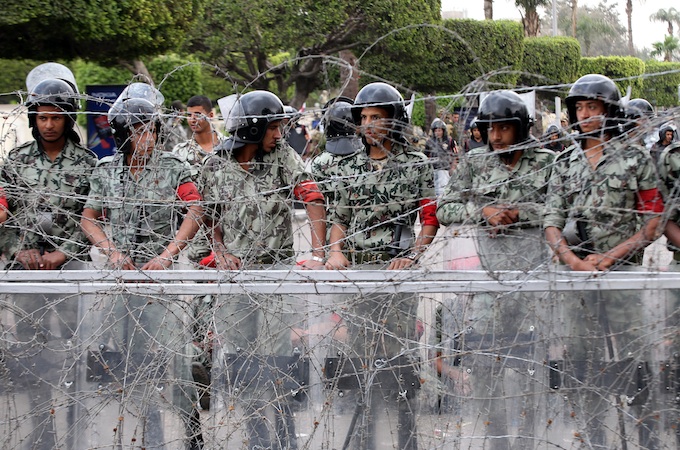
New Egyptian Military Arrest Powers Replaces Emergency Law


The decree will remain in effect at least until a new constitution is drafted, according to the justice ministry [EPA]


Last Modified: 13 Jun 2012 23:57
Courtesy Of "Al-Jazeera"


Egypt's justice ministry has issued a decree allowing military police and intelligence officers to arrest civilians suspected of crimes, restoring some of the powers of the decades-old emergency law which expired just two weeks ago.

The controversial order was drafted earlier this month, but was not announced until Wednesday.

The decree applies to a range of offences, including those deemed "harmful to the government," destruction of property, "obstructing traffic," and "resisting orders".

Several of those provisions would allow the military to detain peaceful protesters. Rallies in Tahrir Square routinely disrupt traffic, for example.

It will remain in effect at least until a new constitution is drafted, according to the ministry.

Members of parliament voted on Tuesday to appoint a constitutional assembly, but the process of drafting the document could take months.

Adel al-Mursi, the head of Egypt's military justice, was quoted by AFP news agency as saying that "the decision fills a legal vacuum", while Sayyed Hashim, a former military prosecutor, called it a temporary measure.

"The police force has not yet recovered completely, and security is not back," Hashim was quoted by Associated Press news agency as saying in a television interview.

Parliament Bypassed


Al Jazeera's Rawya Rageh, reporting from Cairo, said Egyptian activists see the current order as "much worse than the [previous] emergency law", in that it is seen as expanding the military's power.

"And it comes at a time when the ruling military council is expected to be handing over authority to a civilian authority in less than two weeks' time," she said, adding that the order bypassed the newly elected parliament.

"The initial reactions from the MPs has been very angry, specifically from the powerful Muslim Brotherhood.

Some of its members are saying that this is tantamount to a military coup."


The Muslim Brotherhood's Freedom and Justice Party (FJP), which has the largest number of seats in parliament, issued a statement on the controversial decree, suggesting that parliament will try to bring the issue under its supervision.

The brief statement quoted the party's deputy president, Essam El Erian, as saying parliament will be looking into the justice ministry's right to issue the decision and whether parliament can refuse it or not.

Parliament will seek to have oversight over the implementation of the decision "so that this mandate doesn't exceed its legal and constitutional limits," El Erian said in the statement.

"The Egyptian Revolution happened to get rid of injustice, corruption, autocracy and repression of freedoms - and the Egyptian people won't accept the return of any of that."

'Military Coup'


Mohamed Beltagy, another FJP member of parliament, called the decree a "military coup" in an interview with Al Jazeera, and said the measure was not discussed in parliament.

Mohammed Morsi, the Muslim Brotherhood's presidential candidate, said on Al Jazeera that the decision raises fears about the military's role.

Human rights organisations were also quick to criticise the decision, which they said confirmed that Egypt was a "military state".

Gamal Eid, a prominent human rights lawyer, said the decree made Egypt look like "a banana republic".

"Several of the crimes included in the decree are actually rights, such as the right to freedom of expression against ruling powers or established laws, demonstrations and strikes," according to a statement issued by 15 Egyptian rights groups.

The military has played an extensive and controversial role in the justice system over the last 18 months. More than 12,000 civilians have been hauled before military tribunals since the revolution; rights groups say the military courts do not provide basic standards of due process.

The 31-year-old state of emergency, imposed in 1981 after Anwar Sadat was assassinated, was finally allowed to expire at the end of May. It granted wide-ranging powers to former president Hosni Mubarak's security forces, including the right to detain suspects without trial.

Court Rulings


Amr Hamzawy, a liberal member of parliament from Cairo, said in a statement on his Facebook page that the ruling simply "reproduced" the emergency law.

"[It] reproduces the emergency law using new tools and threatens the state of law, for it gives military intelligence and military police powers of judicial execution in crimes committed by civilians," he wrote.

The decree comes just days before the country's presidential runoff, which pits Morsi against Ahmed Shafiq, the last prime minister in Mubarak's government.

It also comes a day before two crucial court rulings. The supreme constitutional court will decide on Thursday whether to expel Shafiq from the race because of the so-called "political isolation" law, which bars ex-regime officials from running for public office.

The court will also rule on whether parliament is unconstitutional; a lower court found that some provisions of the electoral law  - allowing political parties to compete with independent candidates for some seats - might have violated the constitution.