


Showing posts with label Boycott Israel. Show all posts
Showing posts with label Boycott Israel. Show all posts
Friday, September 12, 2014
Why Would A Texan Boycott Israel?
I finally realized that what I had been seeing all these years was not Israel defending itself, but rather Palestinians defending their homes and families, even when the best they could do was to throw rocks at tanks.


Sunday, March 03, 2013
The Colorado Campaign To Stop $30 Billion In Military Aid To Israel

Mission: Our mission is to educate Coloradans about the extent of US military aid to Israel ($30 billion over a 10-year period) in order to create grassroots opposition and a demand that the aid end.

Why the campaign is necessary: As reflective and responsible citizens, we have a moral responsibility to provide a check on our government’s foreign relations, and we know that the US government has aided and abetted Israel’s lawlessness and criminal conduct. By providing$30 billion in military aid to Israel over a 10-year period, the US government makes Israel's war crimes against the Palestinian people inevitable. We cannot afford to stand by while so much evil is done with our tax money and in our name. Nor is it in our self-interest to remain at odds with other nations, all of whom are appalled by the contradiction between the ideals we claim to hold and the crimes we aid and abet.

Ours is a moral call: We refuse to let our tax money be used to fund Israel's war crimes against Palestinians. Americans have no legitimate national interest in enabling Israel's colonialist war against an indigenous people. We say: Not in our name, not with our taxes.

Wednesday, February 06, 2013
Ending Mindless American Support For Israel

John Grant writes,
The legacy of the Zionist revolutionaries who once enraptured the parlors of Europe and America with talk of a Jewish homeland as a moral beacon in a benighted region has instead bequeathed to the Jewish world and the West a highly militarized dependency — a state that has achieved great feats of cultural and economic development but has failed to build strong enough institutions to balance its military zeitgeist with imaginative or engaging diplomacy.
Recently there have been cracks showing in the Israeli militarist right’s lock on free thinking in the minds of citizens of the United States.
This mind lock in America became evident to me some years ago when an Israeli gunship pilot from an Israeli anti-war group spoke in Philadelphia. He told about a conversation he had in Tel Aviv with a member of The American Israel Public Affairs Committee or AIPAC. With some threat in his tone, the man said,” Say anything you want here in Israel, but don’t go to America.” America, of course, is the bankroller for what Tyler calls the “highly militarized dependency” that Israel has become.
Serious cracks began to show up after the Palestinian Authority won statehood recognition in the UN and the Netanyahu government responded by publicly approving steps leading to a huge development east of Jerusalem that would make a two-state reality impossible.
First, there was the prominent upper west side New York synagogue that proudly broadcast its opposition to both Israeli and US leadership by declaring the UN General Assembly recognition of Palestine as a nation state in the world of nations as “a great moment for us as citizens of the world.”
Some Jewish American members of the B’nai Jewshurun synagogue were “delighted;” one said: “I think it was great.” Some members were, of course, “in a state of shock.” Responding to those in shock, the leaders of the synagogue accordingly back-peddled a half step. But they did not retract their enthusiastic approval of the UN General Assembly action.
Likewise, it’s clear cracks are developing in the support for the Israeli right’s militarist policy when New York Times columnist Thomas Friedman says from Tel Aviv, “I am stunned at what I see here politically.” He sees only two options being considered in Israeli politics: the “iron fist” and the “iron dome.” The former implies dictatorship and the latter a reliance on the so-called Iron Dome anti-rocket technology that will presumably create a shield to protect Israel in the future. Friedman might have used the term Iron Wall as well, the term coined in 1923 by the father of Israeli militarism, Se’ev Jabotinsky, to indicate how Jews should separate themselves from the Palestinians they militarily dominate and whose land they occupy.
Andrew Bacevich, a US Army veteran and conservative historian, recently published an essay titled “How We Became Israel” that explains what it means to associate peace with dominance — versus associating peace with harmony. His point is that the US is tragically following the Israeli militarist lead in this respect.
Though these voices are not from the traditional left, their ideas represent a political opening for the left. The recent US election arguably set the far right back on its heels here and seems to have opened some wiggle room for the left. At the same time, as the Middle East and North Africa go through waves of profound change and the Israeli militarist right doggedly moves farther to the right, it may be creating a line in the sand that some American Jews find hard to cross. The next step, then, is speaking out like the B’nai Jewshurun synagogue did.
From the point of view of Palestinians, a boot on your neck is a boot on your neck, whether it’s an Arab dictator like Mubarak or a militarist occupying state like Israel. At some point, the fear is it’s all going to catch up to the Israeli militarist right, and when it does, it will be explosive.
Ponder for a moment the powerful symbolism of the recent triumphant return of Hamas leader Khaled Meshal to Gaza. In 1997, an Israeli Mossad targeted assassination team tried and failed to murder Meshal in Amman, Jordan, with poison. The killers were caught and an embarrassed Netanyahu, in a prior stint as prime minister, had to order the antidote sent to Amman. It doesn’t get much more dramatic than that. So, now, Meshal, a man who Mubarak would not permit access to Gaza through Egypt, is allowed to enter through Egypt by President Morsi. Meshal tells thousands of gathered Gazans that it is his “third birth.” First, there was his natural birth, second his survival of the botched Mossad targeted assassination, and third, this moment, his triumphal return to Gaza. Netanyahu reportedly was ballistic.
Those on the right will poo-pah calls for diplomacy with people like Meshal, since the entire history of Israel has been founded and managed on the principle of militaristic dominance of Palestinians and, thus, a disdain for respectful diplomacy. And Meshal and Hamas are, like the Israeli right and unlike the Palestinian Authority, intensely militaristic from an underdog position.
In his new book Fortress Israel, Patrick Tyler lays out the history of how Israeli leaders’ militarism consistently trumped diplomacy. Echoing Bacevich’s notion of the US as a strange lackey for the Israeli militaristic right, Tyler quotes former Israeli intelligence chief Avi Dichter. “The state of Israel has turned targeted assassinations into an art form. Foreign delegations come here on a weekly basis to learn from us, not just Americans.” It’s an “art” all right — except when it fails, as with Meshal, then it’s dark Keystone Cops comedy.
This is what it has come to: This is why in the US we have an imperial President who, like our founding imperialist “bully” President, Theodore Roosevelt, has a Nobel Peace Prize. In President Obama’s case, he doesn’t send out river gunboats and waterboard Filipino guerrillas to bring light to the benighted corners of the world.  Rather, he has his own personal hit list for Seal Team targeted assassinations of globalized guerrilla networks.
Those targeted for assassination now in 2012 are essentially the updated counterparts of the guerrilla armies that fought the British, French and American colonial occupying armies of the early and middle 20th century in places like Kenya, Vietnam and the Philippines. As the old, classic empires crumbled and faded, colonialism became imperialism. Once capital and power became fully globalized, naturally the opposing elements of bottom-up opposition formed globalized networks themselves. Thus, we have the much feared al Qaeda and a host of others that ebb and flow. In need of demons, the forces in support of a US Global War On Terror do their best to make the al Qaedas of the world into enemies worthy of the Myth of American Exceptionalism.
The dance between entrenched power and the bottom-up impulse for liberation goes on. Each side pursues its game plan by demonizing and attempting to murder the other. It’s a very messy confrontation, now reaching into Africa, with lots of moral damnation to go around.
Via: "CounterPunch"
Wednesday, January 09, 2013
How We Became Israel
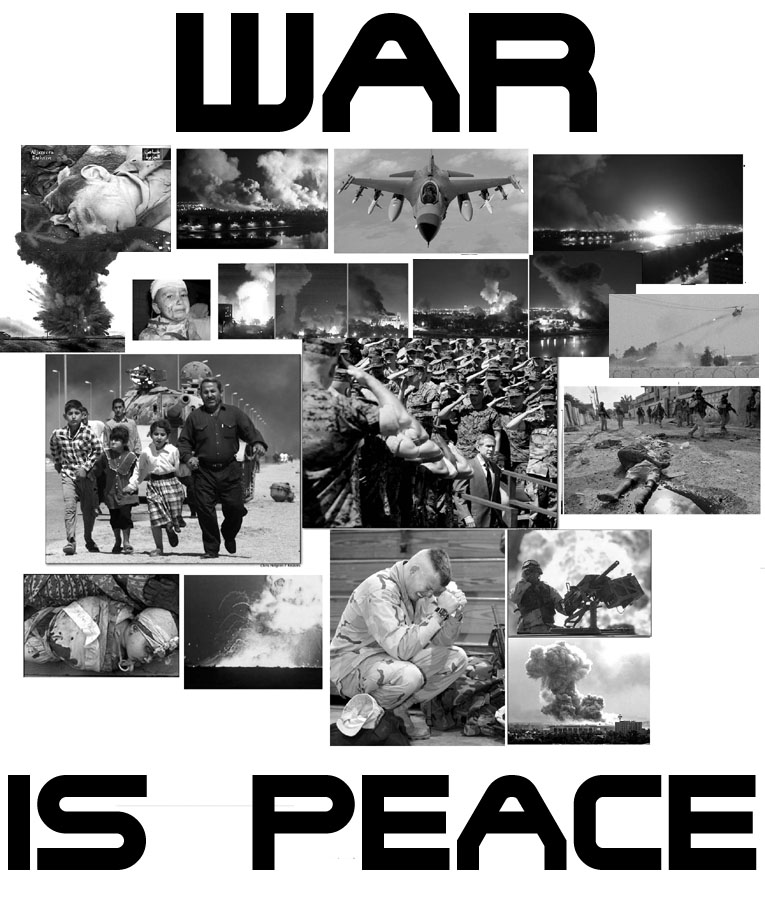
By ANDREW J. BACEVICH
Courtesy Of "The American Conservative"
Peace means different things to different governments and different countries. To some it suggests harmony based on tolerance and mutual respect. To others it serves as a euphemism for dominance, peace defining the relationship between the strong and the supine.
In the absence of actually existing peace, a nation’s reigning definition of peace shapes its proclivity to use force. A nation committed to peace-as-harmony will tend to employ force as a last resort. The United States once subscribed to this view. Or beyond the confines of the Western Hemisphere, it at least pretended to do so.
A nation seeking peace-as-dominion will use force more freely. This has long been an Israeli predilection. Since the end of the Cold War and especially since 9/11, however, it has become America’s as well. As a consequence, U.S. national-security policy increasingly conforms to patterns of behavior pioneered by the Jewish state. This “Israelification” of U.S. policy may prove beneficial for Israel. Based on the available evidence, it’s not likely to be good for the United States.
Here is Israeli Prime Minister Benjamin Netanyahu describing what he calls his “vision of peace” in June 2009: “If we get a guarantee of demilitarization … we are ready to agree to a real peace agreement, a demilitarized Palestinian state side by side with the Jewish state.” The inhabitants of Gaza and the West Bank, if armed and sufficiently angry, can certainly annoy Israel. But they cannot destroy it or do it serious harm. By any measure, the Israel Defense Forces (IDF) wield vastly greater power than the Palestinians can possibly muster. Still, from Netanyahu’s perspective, “real peace” becomes possible only if Palestinians guarantee that their putative state will forego even the most meager military capabilities. Your side disarms, our side stays armed to the teeth: that’s Netanyahu’s vision of peace in a nutshell.
Netanyahu asks a lot of Palestinians. Yet however baldly stated, his demands reflect longstanding Israeli thinking. For Israel, peace derives from security, which must be absolute and assured. Security thus defined requires not simply military advantage butmilitary supremacy.
From Israel’s perspective, threats to supremacy require anticipatory action, the earlier the better. The IDF attack on Iraq’s Osirak nuclear reactor in 1981 provides one especially instructive example. Israel’s destruction of a suspected Syrian nuclear facility in 2007 provides a second.
Yet alongside perceived threat, perceived opportunity can provide sufficient motive for anticipatory action. In 1956 and again in 1967, Israel attacked Egypt not because the blustering Colonel Gamal Abdel Nasser possessed the capability (even if he proclaimed the intention) of destroying the hated Zionists, but because preventive war seemingly promised a big Israeli pay-off. In the first instance, the Israelis came away empty-handed. In the second, they hit the jackpot operationally, albeit with problematic strategic consequences.
For decades, Israel relied on a powerful combination of tanks and fighter-bombers as its preferred instrument of preemption. In more recent times, however, it has deemphasized its swift sword in favor of the shiv between the ribs. Why deploy lumbering armored columns when a missile launched from an Apache attack helicopter or a bomb fixed to an Iranian scientist’s car can do the job more cheaply and with less risk? Thus has targeted assassination eclipsed conventional military methods as the hallmark of the Israeli way of war.
Whether using tanks to conquer or assassins to liquidate, adherence to this knee-to-the-groin paradigm has won Israel few friends in the region and few admirers around the world (Americans notably excepted). The likelihood of this approach eliminating or even diminishing Arab or Iranian hostility toward Israel appears less than promising. That said, the approach has thus far succeeded in preserving and even expanding the Jewish state: more than 60 years after its founding, Israel persists and even prospers. By this rough but not inconsequential measure, the Israeli security concept has succeeded. Okay, it’s nasty: but so far at least, it’s worked.
What’s hard to figure out is why the United States would choose to follow Israel’s path. Yet over the course of the Bush/Clinton/Bush/Obama quarter-century, that’s precisely what we’ve done. The pursuit of global military dominance, a proclivity for preemption, a growing taste for assassination—all justified as essential to self-defense. That pretty much describes our present-day MO.
Israel is a small country with a small population and no shortage of hostile neighbors. Ours is a huge country with an enormous population and no enemy, unless you count the Cuban-Venezuelan Axis of Ailing Dictators, within several thousand miles. We have choices that Israel does not. Yet in disregarding those choices the United States has stumbled willy-nilly into an Israeli-like condition of perpetual war, with peace increasingly tied to unrealistic expectations of adversaries and would-be adversaries acquiescing in Washington’s will.
Israelification got its kick-start with George H.W. Bush’s Operation Desert Storm, a triumphal Hundred-Hour War likened at the time to Israel’s triumphal Six-Day War. Victory over the “fourth largest army in the world” fostered illusions of the United States exercising perpetually and on a global scale military primacy akin to what Israel has exercised regionally. Soon thereafter, the Pentagon announced that henceforth it would settle for nothing less than “Full Spectrum Dominance.”
Bill Clinton’s contribution to the process was to normalize the use of force. During the several decades of the Cold War, the U.S. had resorted to overt armed intervention only occasionally. Although difficult today to recall, back then whole years might pass without U.S. troops being sent into harm’s way. Over the course of Clinton’s two terms in office, however, intervention became commonplace.
The average Israeli had long since become inured to reports of IDF incursions into southern Lebanon or Gaza. Now the average American has become accustomed to reports of U.S. troops battling Somali warlords, supervising regime change in Haiti, or occupying the Balkans. Yet the real signature of the Clinton years came in the form of airstrikes. Blasting targets in Afghanistan, Bosnia, Serbia, and Sudan, but above all in Iraq, became the functional equivalent of Israel’s reliance on airpower to punish “terrorists” from standoff ranges.
In the wake of 9/11, George W. Bush, a true believer in Full Spectrum Dominance, set out to liberate or pacify (take your pick) the Islamic world. The United States followed Israel in assigning itself the prerogative of waging preventive war. Although it depicted Saddam Hussein as an existential threat, the Bush administration also viewed Iraq as an opportunity: here the United States would signal to other recalcitrants the fate awaiting them should they mess with Uncle Sam.
More subtly, in going after Saddam, Bush was tacitly embracing a longstanding Israeli conception of deterrence. During the Cold War, deterrence had meant conveying a credible threat to dissuade your opponent from hostile action. Israel had never subscribed to that view. Influencing the behavior of potential adversaries required more than signaling what Israel might do if sufficiently aggravated; influence was exerted by punitive action, ideally delivered on a disproportionate scale. Hit the other guy first, if possible; failing that, whack him several times harder than he hit you: not the biblical injunction of an eye for an eye, but both eyes, an ear, and several teeth, with a kick in the nuts thrown in for good measure. The aim was to send a message: screw with us and this will happen to you. This is the message Bush intended to convey when he ordered the invasion of Iraq in 2003.
Unfortunately, Operation Iraqi Freedom, launched with all the confidence that had informed Operation Peace for Galilee, Israel’s equally ill-advised 1982 incursion into Lebanon, landed the United States in an equivalent mess. Or perhaps a different comparison applies: the U.S. occupation of Iraq triggered violent resistance akin to what the IDF faced as a consequence of Israel occupying the West Bank. Two successive Intifadas had given the Israeli army fits. The insurgency in Iraq (along with its Afghan sibling) gave the American army fits. Neither the Israeli nor the American reputation for martial invincibility survived the encounter.
By the time Barack Obama succeeded Bush in 2009, most Americans—like most Israelis—had lost their appetite for invading and occupying countries. Obama’s response? Hew ever more closely to the evolving Israeli way of doing things. “Obama wants to be known for winding down long wars,” writes Michael Gerson in the Washington Post. “But he has shown no hesitance when it comes to shorter, Israel-style operations. He is a special ops hawk, a drone militarist.”
Just so: with his affinity for missile-firing drones, Obama has established targeted assassination as the very centerpiece of U.S. national-security policy. With his affinity for commandos, he has expanded the size and mandate of U.S. Special Operations Command, which now maintains an active presence in more than 70 countries. In Yemen, Somalia, the Philippines, and the frontier regions of Pakistan—and who knows how many other far-flung places—Obama seemingly shares Prime Minister Netanyahu’s expectations: keep whacking and a positive outcome will eventually ensue.
The government of Israel, along with ardently pro-Israel Americans like Michael Gerson, may view the convergence of U.S. and Israeli national-security practices with some satisfaction. The prevailing U.S. definition of self-defense—a self-assigned mandate to target anyone anywhere thought to endanger U.S. security—is exceedingly elastic. As such, it provides a certain cover for equivalent Israeli inclinations. And to the extent that our roster of enemies overlaps with theirs—did someone say Iran?—military action ordered by Washington just might shorten Jerusalem’s “to do” list.
Yet where does this all lead? “We don’t have enough drones,” writes the columnist David Ignatius, “to kill all the enemies we will make if we turn the world into a free-fire zone.” And if Delta Force, the Green Berets, army rangers, Navy SEALs, and the like constitute (in the words of one SEAL) “the dark matter … the force that orders the universe but can’t be seen,” we probably don’t have enough of them either. Unfortunately, the Obama administration seems willing to test both propositions.
The process of aligning U.S. national-security practice with Israeli precedents is now essentially complete. Their habits are ours. Reversing that process would require stores of courage and imagination that may no longer exist in Washington. Given the reigning domestic political climate, those holding or seeking positions of power find it easier—and less risky—to stay the course, vainly nursing the hope that by killing enough “terrorists” peace on terms of our choosing will result. Here too the United States has succumbed to Israeli illusions.
Tuesday, January 08, 2013
The Cowardice At The Heart Of Our Relationship With Israel

By Peter Oborne,
Courtesy Of "The Telegraph"
It is impossible to understand the modern Conservative Party without a grasp of the scale and profundity of its links to the state of Israel. The connection dates back at least as far the historic meeting between the great Zionist leader Chaim Weizmann and the Conservative prime minister A J Balfour in 1905, during which Weizmann convinced Balfour of the case for a Jewish national state.
The warmth forged 107 years ago is today sustained by the Conservative Friends of Israel (CFI). Some 80 per cent of all Tory MPs are members, including most Cabinet ministers. No other lobbying organisation – and certainly not one that acts in the interests of a foreign country – carries as much weight at Westminster. Every year, it takes a significant number of parliamentarians to Israel. Meanwhile, its sponsors play an important role in financing both the Tories nationally, and MPs at the local level.
There is no doubt that the CFI has exercised a powerful influence over policy. The Conservative politician and historian Robert Rhodes James, writing in the Jerusalem Post in 1995, called it “the largest organisation in Western Europe dedicated to the cause of the people of Israel”. Its power has not waned since. On Tuesday, it hosted approximately 100 Tory MPs, including six Cabinet ministers, and a further 40 peers, at a lunch in central London. The speaker was David Cameron, who pronounced himself a “passionate friend” of Israel, making clear (as he has done in the past) that nothing could break that friendship.
This speech can be seen as part of a pattern. The CFI can call almost at will upon the Prime Minister, Chancellor of the Exchequer or Foreign Secretary. The Palestinians enjoy no such access. They would be lucky to get a single Conservative MP in the audience for their events, and perhaps some moribund peer to make an address. There is no such organisation as the Conservative Friends of Palestinians.
This lack of even-handedness reflects itself in policy. When William Hague denounced Israel’s 2006 invasion of Lebanon as “disproportionate”, the CFI (as I revealed in a film on the pro-Israeli lobby for Channel 4’s Dispatches) complained in person to David Cameron. It obtained a promise that the word would never be used again – one that was kept when Israel bombarded Gaza last month, even though the number of Palestinian deaths vastly exceeded those on the Israeli side.
As Foreign Secretary, Hague repeated without demur controversial Israeli claims that Hamas started the conflict (there was provocation on both sides, but the critical moment of escalation strikes me as Israel’s extra-judicial killing of the Hamas commander Ahmed Jabari). Britain has since bowed to Israeli pressure and refused to back the Palestinian bid for enhanced recognition at the United Nations. Recently, we summoned the Israeli ambassador for a richly deserved rollicking about the settlement programme, but this was part of a joint effort with a large number of other European countries, and has not been followed up.
To be fair to the Government, Tony Blair was worse, appearing at times to regard the interests of Britain and Israel as identical, and refusing even to call for a ceasefire for some time after the start of the appalling Lebanon war. William Hague and David Cameron have tried to be more robust. Unfortunately, they have largely failed. It is hard to be certain to what extent this reluctance to criticise Tel Aviv is due to the influence of the Israeli lobby in Britain, or fear of offending Israel’s international patron, the United States.
The formal position of the Government is excellent. Britain supports the two-state solution, which has been the basis of all serious peace discussions since the Oslo Accords 20 years ago. The trouble is that ministers refuse to take any concrete steps to bring it about. For example, they condemn the settlements, but only in a half-hearted way (the Prime Minister devoted 64 words to the issue on Tuesday, and almost 300 to the Iranian threat).
This is cowardice. There are times in personal as well as political life when friendship involves a great deal more than the kind of genial back-slapping with which the Prime Minister treated the Israel lobby on Tuesday. The brutal truth is that Benjamin Netanyahu is leading his country down the path to self-destruction. If he is allowed to go ahead with the latest plans for settlement construction, all hopes of Middle East peace will vanish and die.
Mark Simmonds, a junior Foreign Office minister, formally acknowledged this in a revealing but unreported Commons debate just a few hours after Tuesday CFI lunch, saying: “I think that the door is beginning to close on the realistic possibility of a two-state solution.” William Hague now believes that settlement construction will render it completely impossible within two years at most.
We will then be left with a greater Israel stretching from the Mediterranean to the Jordan river. Of course, this is a tidier geographical unit than the complicated mess which an attempt to return Israel to its 1967 boundaries would produce. But the Palestinians would suddenly find themselves in a majority. Israel would then face a choice between retaining its democracy, but ceasing to be a Jewish state, or embracing a form of apartheid in which Palestinians were refused basic rights. Judging from the rhetoric emanating from Mr Netanyahu and his unpleasant coalition allies, this is probably the choice today’s Israeli leadership would make.
On Monday night, one former British ambassador to Israel, the Hebrew-speaking Sir Sherard Cowper-Coles, made an eloquent speech from which it is important to quote at some length: “I believe passionately that Israel on its present course is embarked on a pathway to assisted suicide. Suicide assisted by the Congress of the United States. The idea that the problem can be solved by walling up the Palestinians in the Middle Eastern equivalent of the Bantustans, which the South African government embarked on in the 1940s, is not only offensive morally, it is deeply out of keeping with everything we know of human history. It will not work, it cannot work, it should not work. And anyone who has a real affection for the Jewish people will want to help them to avoid this looming disaster.”
All leaders of the Conservative Party stand in the line of succession of A J Balfour, who (as foreign secretary in 1917) signed the declaration which recognised the Jews’ right to their own homeland. I believe this inheritance gives Mr Cameron a special link to Israel – and a distinct responsibility. It means he is within his rights to spell out to the present Israeli leadership that it is embarking on a dark, ugly and futile course. Given the cowed inertia of President Obama, it is all the more important that the British Prime Minister steps forward.
I cannot speak for Britain’s Jewish community, but I have a strong impression that many of them would be delighted if Mr Cameron spoke out far more strongly than he has done so far. Indeed, it is essential that he should do so. Mr Cameron does not want to go down in history as the man upon whose watch all hope of a two-state solution died, and with it all hope of a secure and peaceful future for the country a Conservative prime minister helped to bring into existence.
Wednesday, November 28, 2012
Israel Creating ‘Catastrophic’ Situation With Palestinians

Former U.S. President Jimmy Carter said Monday during a visit to Jerusalem that the prospect of an Israel-Palestinian peace accord is “vanishing,” blaming Israeli settlement of the West Bank.
Carter, called the current situation “catastrophic” and blamed Israel for the growing isolation of east Jerusalem from the West Bank. He said a Palestinian state has become “unviable.”
“We’ve reached a crisis stage,” said Carter, 88. “The two-state solution is the only realistic path to peace and security for Israel and the Palestinians.”
The Palestinians say they will only return to the negotiating table if Israel freezes settlement construction on occupied lands claimed by the Palestinians.
Via: "CBS-DC"
Sunday, November 25, 2012
How Much Military Aid Do You Provide For Israel?

From 2009 to 2018, the United States is scheduled to give Israel--the largest recipient of U.S. assistance--$30 billion in military aid. Through its illegal 44-year military occupation of the Palestinian West Bank, East Jerusalem, and Gaza Strip, Israel misuses U.S. weapons in violation of U.S. law to kill and injure Palestinian civilians, destroy Palestinian civilian infrastructure, blockade the Gaza Strip, and build illegal settlements in West Bank and East Jerusalem.
How much of this total will your community provide? Is this a good use of your tax dollars? What else could your taxes be used for in your community? Find out on the interactive map below.
 Click on the map below to learn how much money your state will give in weapons to Israel from 2009-2018 and what that money could fund instead for community needs. Underneath, you can filter the results for your Congressional district, county, and city as well. Counties and cities with less than 20,000 people are not included in the map.
How to Interpret the Numbers. The amount of military aid to Israel is the estimated 10-year contribution from that state, Congressional district, county, or city. That same amount of money could fund instead each year one of the following programs for the number of people indicated: affordable housing vouchers for low-income families, green jobs training for unemployed workers, early reading programs for at-risk students, or primary health care for the uninsured.
Via" "Aid To Israel"
Thursday, November 08, 2012
UN: Boycott Businesses Profiting From Israeli Settlements

A United Nations independent expert today called on the world body’s General Assembly, as well as civil society, to take action against Israeli and international businesses that are profiting from Israeli settlements in the occupied Palestinian territory.
“My main recommendation is that the businesses highlighted in the report – as well as the many other businesses that are profiting from the Israeli settlement enterprise – should be boycotted, until they bring their operations into line with international human rights and humanitarian law and standards,” the Special Rapporteur on the situation of human rights in the occupied Palestinian territories, Richard Falk, said in a news release issued as he presented a report on his work to the Assembly.
Highlighting the activities of companies such as Caterpillar Incorporated of the United States, Veolia Environment of France, G4S of the United Kingdom, the Dexia Group of Belgium, Ahava of Israel, the Volvo Group of Sweden, the Riwal Holding Group of the Netherlands, Elbit Systems of Israel, Hewlett Packard of the USA, Mehadrin of Israel, Motorola of the USA, Assa Abloy of Sweden, and Cemex of Mexico, the Special Rapporteur noted that a wide range of Israeli and international businesses are involved in the establishment and maintenance of the Israeli settlements.
“All Israeli settlements in the West Bank, including East Jerusalem, have been established in clear violation of international law,” said Mr. Falk.
“Yet today Israeli settlements control over 40 percent of the West Bank and between 500,000 and 600,000 Israeli citizens are living in Palestinian territory,” he added. “In the last 12 months alone, the settler population has increased by over 15,000 persons.”He drew the Assembly’s attention to developing international law and standards concerning businesses and human rights, including the UN Global Compact and the UN Guiding Principles on Businesses and Human Rights.
“The principles outlined in the Global Compact are clear,” Mr. Falk said. “Businesses should support and respect the protection of internationally proclaimed human rights and ensure that they are not complicit in human rights abuses.”
The Global Compact is a strategic policy initiative for businesses that are committed to aligning their operations and strategies with ten universally accepted principles in the areas of human rights, labour, environment and anti-corruption. The Guiding Principles, endorsed by the Human Rights Council, provide a global standard for preventing and addressing the risk of adverse impacts on human rights linked to business activity.Mr. Falk also noted guidance developed by the International Committee of the Red Cross that points to the prospect of corporate and individual criminal responsibility for violations committed during a situation of armed conflict.
“In short, businesses should not breach international humanitarian law provisions. Nor should they be complicit in any breaches. If they do, they may be subject to criminal or civil liability. And this liability can be extended to individual employees of such businesses,” the Special Rapporteur said in presenting his report.“It is encouraging to be informed that Assa Abloy has moved its Mul-T-Locks factory from the West Bank to Israel, and that the Dexia Group, G4S, and Cemex are looking for ways to bring their operations into line with their commitments under the UN Global Compact,” he added.
Via: "The United Nations"
Saturday, October 27, 2012
Israel's Growing Isolation

Boycott Of Israel Crosses To Governments’ Realm
By Ramzy Baroud,
Should Israel be worried? Very much so, for the age of total impunity is coming to an end. Critical voices of the Israeli occupation and mistreatment of Palestinians are rising—not only within civil society circles, but among world governments as well.
... the world is not the United States’ government, which is defined by self-serving politics and a quisling corporate media that often places Israeli interests over those of the US itself. Now with the decline of the US as an economic superpower, and as other countries and regional blocs jockey for an advanced position in the new world order, Israel is sure to suffer further isolation in coming years.
Almost daily new evidence is emerging to demonstrate this increasingly stark reality. Israel’s friends are fully aware of this, as are Israeli politicians. The emerging new realization is that money and power are rarely enough to buy legitimacy. South Africa is expectedly leading the way towards that new global paradigm shift, and others countries are following suit.
Recently, South Africa’s cabinet passed a decision requiring Israel to distinguish between products made in Israel and those made in illegal Jewish colonies in the West Bank. The decision was both politically sound and morally consistent with the country’s anti-apartheid legacy. It was also a natural progression of South Africa’s policies, which have reflected impatience with Israel through the years.
It is clear that Israel has chosen the apartheid option, not just as a de facto outcome of its military policies, but through a decided legal and political pattern. South Africa’s decision, however, was not just motivated by political necessity. Veterans of the anti-apartheid struggle have had numerous influences on the country’s civil society. Even the new generation is intoned with a freedom discourse that unites most sectors of society. ‘Freedom for Palestine’ was a natural fit in that powerful discourse and no amount of Israeli propaganda has been enough to deter South Africans from standing in solidarity with Palestinians. The feelings are, of course, mutual.
The total output of Israeli trade with South Africa was modest to begin with. Since 2009, trade volumes dipped significantly, and political ties became colder than ever. This had much to do with the Israel war on Gaza (2008-09) and what was seen as an act of Israeli piracy against the Turkish ship the Mavi Marmara in May 31, 2011. South Africa, along with few other countries, withdrew its ambassador from Israel in protest of the deadly raid which killed nine peace activists.
The matter is of greater significance than dollars and cents. The latter will become a major factor when a global boycott reaches a critical mass. The real danger is the precedence that South Africa continues to set, which will provide other countries with legal and political references.
Soon after South Africa’s decision—which followed remarks made by various officials discouraging their nationals from visiting Israel, and was followed by another major university voting for divestment and boycott—pro-Israel officials have tried to mobilize. Denis McShane, British MP and Policy Council member for ‘Labour Friends of Israel’, reacted by making dismaying and historically inconsistent parallels between South Africa and Nazi Germany. Writing in the Jewish Chronicle on September 6, Moira Schneider said that MacShane “likened the boycott of Israeli products to the kauf nicht bei Juden imperative of Nazi Germany.”
“Criticism of Israel is perfectly legitimate, but we have to be clear that the new antisemitic trope is beyond the pale of legitimate criticism,” he was quoted as saying. “The notion of Israel as an apartheid state is deliberately promoted because an apartheid state cannot exist.”
While the flawed logic has been uttered numerous times in the past, MacShane’s alarm now can be explained outside the political context of South Africa, but rather in terms of what is happening in his own country. Indeed, there has been a string of statements pointing at efforts underway in several European countries to enact laws relevant to the illegality of the Jewish settlements.
Some recent statements include British Foreign Office Minister Alistair Burt “dropp(ing) the strongest hint yet that the UK may be moving towards a ban on goods from illegal Israeli settlements.” (The Electronic Intifada, July 5, 2012). Towards the end of last year, Ireland’s Minister of Foreign Affairs and Trade renewed his country’s commitment to the exclusion of settlement products from the EU. More recently, on September 5, Israel’s daily Haaretz reported on the Norwegian Foreign Minister’s comments regarding the import of goods produced in the settlements, “which we consider illegal according to international law.”
Still more, on September 7, The Jerusalem Post reported that “the European Union is considering instituting a ban on imports of products made in Israeli settlements, a Greek Foreign Ministry official was quoted as saying to a group of Israeli and Palestinian journalists in Athens…”
Such a shift in language would never have been achieved without the civil society mobilization that occurred in several countries. As in South Africa, governments are being held accountable by vigilant and tireless groups, collectively pushing for Boycotts, Divestment and Sanctions (BDS). They will not reduce their efforts until Israel changes course, respects international law, and frees Palestinians from decades-long military bondage.
Unable to fathom the global paradigm shift, Israeli politicians are responding with an incoherent strategy. Israeli Foreign Ministry spokesman, Yigal Palmor accused the government of South Africa of ‘exclusion and discrimination.’ The Israeli government decried the “blatant discrimination,” claiming it was “based on national and political distinction”. Deputy Foreign Minister Danny Ayalon went even further, accusing South Africa of exactly that which was alleged of Israel. “Unfortunately it turns out that the changes that took place in South Africa over the years have not brought about basic changes in the country, and it remains an apartheid state,” Ayalon said (Jerusalem Post, August 23).
But angry words aside, the world is changing. Israel, however, is digressing into a dark corner where racism and apartheid are still applied with impunity. Many Israelis are refusing to attest to their country’s fall into the abyss. A wakeup call can only arrive when the world treats the Israeli government in the same way that South Africa’s apartheid regime was once treated.
Via: "Foreign Policy Journal"
Tuesday, October 23, 2012
US Taxpayers Paid More To Israeli Defense Budget Than Israelis

Written by Alison Weir
Courtesy Of "The Council For The National Interest"
The Israeli army's chief of staff states that in the past three years, "US taxpayers have contributed more to the Israeli defense budget than Israeli taxpayers," according to a report in the Jerusalem Post, a prominent Israeli newspaper.
 According to the report, Lieutenant-General Gabi Ashkenazi made the statement during a speech on September 11th. In it he emphasized: "We must preserve ties with the United States. I believe this is a security necessity."
According to the newspaper the speech was at the Calcalist Conference, which appears to be an annual event in Tel Aviv sponsored by the Calcalist newspaper, an Israeli Hebrew-only daily financial newspaper. It is is part of the group that publishes Yedioth Ahronoth, the largest circulation newspaper in Israel.
American taxpayers give Israel over $3 billion per year (over $8 million per day), more than to any other nation, despite the fact that Israel is smaller than New Jersey and is in the top 30 richest countries in the world.
Per capita, Israelis receive $10,000 more U.S. tax money than average.
Some of the other top recipients of US tax money, Egypt and Jordan, were provided this assistance in return for diplomatic recognition of the Israeli state.
According to the Congressional Research Service, Israel is given this money in a lump sum at the beginning of the fiscal year. Americans then pay interest on money they have given to Israel, while Israel makes interest on it.
In recent years Israel has reported a lower unemployment rate than the US and a better account balance.
Ashkenazi's statements are extremely significant, since this is the first time that an Israeli leader has pointed out that American taxpayers pay more to Israel's defense budget than do Israelis.
If the costs of the Iraq war, which was largely pushed by Israel partisans in the Bush administration, were added into the equation, the American tax money on behalf of Israel would quite likely dwarf the amount paid by Israeli taxpayers. Some top economists predict that the cost of the Iraq war will be $3 trillion. Israel has a population of about 7 million people.
Today, Israel partisans are similarly pushing attacks on Iran.
Israel has frequently been accused of using American funds in violation of U.S. arms control laws.
Ashkenazi and War Crimes Accusations
IN 2010 Turkey issued an arrest warrant for Ashkenazi for Israeli forces' killing of 9 civilians, including one who held American citizenship.
In 2008 a complaint was filed at the Hague accusing Ashkenazi of war crimes. Accusers stated:
On 27th December 2008, the suspect, as Chief of Staff, ordered the Israeli army to attack densely populated areas in the Gaza Strip. For three weeks, 1,500 tons of bombs were dropped from the air on residential neighborhoods in Gaza and tens of thousands of artillery shells were fired from tanks. For 3 weeks, the army damaged and destroyed houses, schools, hospitals, infrastructure, water and electrical plants, killed more than 1,300 people, hundreds of them children, and injured about 5,300 people. Thousands of houses were bombed or shelled and 50,000 residents were made homeless, without shelter.Prior to this, the suspect was part of a group, which implemented a siege on 1.5 million people in the Gaza Strip, denying them a regular supply of food, water, medicine, fuel and electricity for 18 months.According to international law, it is absolutely prohibited to bomb residential areas in a way that interrupts the lives of civilians; to carry out executions without trial, to collectively punish; to destroy or damage hospitals, schools and homes. The prohibitions against collective punishment were enshrined in the Geneva Conventions after the behavior of the Nazis in Europe during World War II when they destroyed entire villages to punish residents for sheltering the resistance. 194 countries agree with the prohibitions of the Fourth Geneva Convention.In December 2008, a complaint was filed in the Hague against the suspect, on suspicion that he had committed war crimes and crimes against humanity for ordering the siege of Gaza.
Sunday, July 22, 2012
Stifling Free Speech As A Way Of Helping Israel

As taxpayers, we care how Congress spends our money. As citizens, we want our country to be generous but not reckless. Berman and vast majority of his Congressional colleagues continually demonstrate recklessness in wasting our treasure serving Israeli interests rather than fulfilling the needs of the American people.
By Jeff Warner and Shakeel Syed
July 13, 2012
Courtesy Of "The Daily News"
Our message was simple: "Tell Congress: Spend Our Money at Home, Not on the Israeli Military."
We wanted people to understand how their tax dollars are spent. We contracted with CBS Outdoor for a 28-day campaign of 23 billboards. They erected them in Los Angeles and surrounding cities in June, and we thanked them publicly for allowing free speech.
However, a week later, CBS Outdoor took down all our billboards, telling us laughably that our applauding them for allowing free speech was tantamount to their endorsement of our message. They wanted us to take our money and go away quietly. But we decided otherwise.
CBS Outdoor likely buckled to pressure from pro-Israeli groups and their paid shills in Congress. Rep. Howard Berman wrote a memo (available on his website) to the Coalition to Stop $30 Billion to Israel, the sponsor of the billboard campaign, condemning the billboards and referring to alleged complaints from his San Fernando Valley constituents.
In response, Berman received praise from pro-Israel groups such as the Simon Wiesenthal Center and the Anti-Defamation League, organizations who called the billboards "provocative."
So what if the billboards contained a message that Berman and these pro-Israel groups found provocative? Who are they to judge what political messages people in Los Angeles should be allowed to see? We believe that provocative discussions make democracy flourish and stifling discussion will kill democracy.
As taxpayers, we care how Congress spends our money. As citizens, we want our country to be generous but not reckless. Berman and vast majority of his Congressional colleagues continually demonstrate recklessness in wasting our treasure serving Israeli interests rather than fulfilling the needs of the American people.
The money the United States is spending on the Israeli military this year, if used at home, would help tens of thousands of Americans recover from the ongoing recession with affordable housing, college loans, green job training, health care, and other support.
Berman demands that America must keep aiding Israel although it was recently ranked by the Center for Public Integrity as one of the top 10 human rights abusers in the world receiving U.S. weapons.
Berman should stop pandering for military aid to Israel and instead start aiding Americans who are homeless and jobless, children and the elderly, libraries and schools, police and fire departments.
He can start with those right there in his San Fernando Valley district. For example, Los Angeles County's share of the money destined for the Israeli military under a $30 billion, 10-year agreement would provide primary health care to more than 800,000 people.
CBS Outdoor's slogan is, "Always On." Apparently it is on for some and off for others. Suppressing free speech, especially that which engenders a debate to mend the American economy, is not only un-American but anti-capitalist.
As Jewish and Muslim Americans who devote our lives to seeking peace among peoples of all faiths, we hold CBS Outdoor and Berman responsible for suppressing an important conversation; the billboards called on our nation to revisit its misplaced spending priorities.
We believe in a vibrant and provocative discussion through all lawful means, including by erecting billboards. This is an imperative and not an option.
American leaders say they want to see genuine peace and stability in the Middle East. To achieve that, America must first stop its financial and military aid to Israel and then use whatever integrity it has left to end the Israeli occupation of the Palestinian people.
As long as America's treasure is bled away to support the tyranny of the Israeli occupation, and as long as corporations and Congress members stifle debate and discussion, our country will continue to suffer.
*****
Jeff Warner is a Jewish-American and a member of Los Angeles Jews for Peace. Shakeel Syed is a Muslim-American and a board member of American Muslims for Palestine.
Wednesday, July 18, 2012
Israeli Lawmaker Tears Up "Abominable" New Testament

Throws It In Trash
A member of the Israeli parliament has torn up a copy of the New Testament and thrown it in the trash.
An edition of the Bible had been distributed to all members of the Knesset by Victor Kalish, the head of a Christian publishing society.
According to Israel’s NRG news website, Kalish sent the book along with a letter explaining that it was a new edition with thousands of references, “that sheds light on the [Old Testament] Scriptures and helps to understand them and also shows the close connection between the Scriptures and the New Testament and how many of their prophecies are fulfilled in the New Testament.”
New Testament belongs in “garbage can of history”
Ben-Ari, however termed the book a “provocation,” tore it up and threw it in the trash, an act that was apparently caught on camera.
“This abominable book [the New Testament] brought about the murder of millions of Jews in the Inquisition and autos da fé,” Ben-Ari was quoted as saying, “This is a provocation by church missionaries and there is no doubt that this book and those who sent it belong in the garbage can of history.”
Ben-Ari is also notorious for his role in inciting hatred against Africans, declaring at a rally against African migrants in Tel Aviv last year that, “We have come to expunge the darkness.”
Tzipi Hovotely, a member of Israeli Prime Minister Benjamin Netanyahu’s governing party, sent a request to the speaker of the Knesset urging him to ban the distribution of “missionary” materials, NRG reported.
Destruction of bible comes as Christian Zionists meet in Washington
Ben-Ari’s destruction of, and insults toward the Bible, come as Christians United for Israel(CUFI) – what claims to be the largest pro-Israel organization in the United States – meets for its annual conference in Washington.
Alice Bach attended the conference and heard the opening speech by its founder Pastor John Hagee who claims, in order to justify his support for Israel, that the bible is “a Zionist text.”
What would the thousands of Christian Zionists attending CUFI say if they saw an Israeli Knesset member destroying the Bible and dumping it in the trash?
Sunday, July 08, 2012
U.S. Presbyterian Church Votes For Israel Divestment

A Belgian demonstrator displays a sign reading "Boycott Israel, racist state" Photo by Reuters
A Sign That Discourse Among U.S. Christians On Israel Is About To Change.
By Natasha Mozgovaya
Jul.03, 2012 | 9:23 PM
Courtesy Of "Haaretz"
Following a lengthy and heated debate, committee 15 of the 220th General Assembly of the Presbyterian Church in the United States voted in favor of a motion calling for divestment from three companies that "profit from nonpeaceful pursuits" in Israel.
Whether or not the Boycott, Divestment, and Sanctions movement against Israel is gaining traction is one of the hottest questions being asked among the most politically active members of the Jewish community – as many people take the issue to heart.
Israel supporters claim that the numbers of participants in the annual "Israel apartheid" week have not grown significantly, and that the American Methodist and Presbyterian Churches, despite regularly raising the topic of divesting from companies that "profit from Israeli occupation," generally end up voting against it. The discourse is shifting – and not in Israel’s favor.
In 2008, the United Methodist Church (UMC) rejected an Israel divestment resolution. On May 2, the UMC general conference did it again, rejecting a resolution calling for divestment from three companies doing business with Israel (although the conference did adopt a measure recommending a boycott of products made in Israeli settlement).
This week, the topic was raised again in Pittsburgh, at the general assembly of the Presbyterian Church. Last time, the resolution didn't even pass the committee level, let alone the general vote.
This time, something different happened. Committee 15 of the 220th General Assembly of the Presbyterian Church voted in favor of a motion calling for divestment from Motorola, for providing surveillance equipment for Israeli settlements, Caterpillar, for providing bulldozers used for demolishing Palestinian houses, and Hewlett-Packard, for selling hardware used by Israel in its naval blockade of Gaza.
The motion also called for the church to increase investments in companies promoting peaceful pursuits. The final vote is expected at the general assembly later this week.
Rev. Dr. Walt Davis, Co-Chair of the Israel/Palestine Mission Network, called the decision "an encouraging step".
"We hope plenary voters will follow the lead of Committee 15 and the recommendations of the Mission Responsibility Through Investing committee and support divestment from these companies that are profiting from Israel's violations of Palestinian human rights. It’s been a long and thorough process and it’s finally time for the church to stop profiting from the suffering the peoples of the Holy Land,” said Davis.
But during Monday evening's debate, there were also concerns expressed over the possible impact of the decision on the relations with the Jewish community - and other sectors of the American Christian community.
Weeks before the general assembly opened on June 30, the proposal drew sharp criticism and warnings from Jewish American organizations, with the exception of those on the far left, such as the Jewish Voice for Peace. Over 1,300 Rabbis and over 12,000 American Jews signed letters to delegates of the biennial Presbyterian Church General Assembly, calling them to reject the "counterproductive" resolution.
In response, the Anti-Defamation League warned of the negative effect on the Jewish and American Christian relations. The American Jewish Committee called the resolutions generally put to votes every two years at the Presbyterian Church gatherings "an unfortunate tradition" meant to vilify Israel and adopt positions of “non-representative" Palestinian leaders.
Even Jeremy Ben-Ami, President of the leftist pro-Israeli lobby JStreet, wrote an article titled “Boycott, Divestment and Sanctions Put Allies at Odds."
"In our view, the one-sided, extreme rhetoric that accompanies the global BDS movement makes a mutually agreeable solution more difficult to achieve, not less" wrote Ben-Ami, stressing that he hopes that PCUSA "will avoid this unproductive path,"
Ben-Ami added, "even the limited divestment approach under consideration by PCUSA falls under the rubric of larger BDS efforts to place blame entirely on one side of the conflict. Such an approach encourages not reconciliation, but polarization.”
Some members of the general assembly committee that discussed the motion in Pittsburg said they do not understand why the resolution is interpreted as a threat - they insisted it's a moral issue, certainly not an anti-Semitic one, to stop pouring resources “into hurting people in another country."
"There's violence happening here. Someone is profiting from it. And we need to not be a part of that," said one of the Committee members.
It's not that Israel is running short of supporters among the American Christian community; in about two weeks, Christians United for Israel, a large Evangelical pro-Israel organization, will run its annual gathering in Washington DC. It's likely that the Presbyterian divestment motion will draw quite a bit of criticism there.
Dr. Nahida Halaby Gordon, moderator of the National Middle Eastern Presbyterian Caucus, told "Haaretz" she feels there is a good chance for the vote to pass.
"Sometimes the plenary votes contrary to the vote in the committee, but the numbers in the committee vote in favor of the divestment were high in favor of the divestment (36 members of the committee voted in favor, 11 against NM) - almost three to one, I feel there is a big support for this." If the vote fails, she says, she intends to come with other activists with the same message to the next GA. She stressed the decision "is not intended to demonize or delegitimize either Israel or Jewish community in this country."
As for the possible result of the divestment decision - she says it's not the hope it will seriously hurt these companies profits, but the message it sends.
"We are a small church, we don't own that many stocks and the divestment will probably occur over a year or two - it's not that we'll sell tomorrow all our stocks. But it's a moral message to these companies that you should not profit from the occupation."
Netanyahu Worked Inside Nuclear Smuggling Ring
Counterespionage Debriefing Reveals How Israel Targeted U.S.
By Grant Smith,
July 04, 2012
Courtesy Of "Anti-War"
By Grant Smith,
July 04, 2012
Courtesy Of "Anti-War"
On June 27, 2012, the FBI partially declassified and released seven additional pages[.pdf] from a 1985–2002 investigation into how a network of front companies connected to the Israeli Ministry of Defense illegally smuggled nuclear triggers out of the U.S.* The newly released FBI files detail how Richard Kelly Smyth — who was convicted of running a U.S. front company — met with Benjamin Netanyahu in Israel during the smuggling operation. At that time, Netanyahu worked at the Israeli node of the smuggling network, Heli Trading Company. Netanyahu, who currently serves as Israel’s prime minister, recently issued a gag order that the smuggling network’s unindicted ringleader refrain from discussing “Project Pinto.”
As revealed in previously released FBI files and the tell-all book Confidential: The Life of Secret Agent Turned Hollywood Tycoon Arnon Milchan, the Hollywood producer was recruited into Israel’s economic espionage division (LAKAM) in his 20s and learned how to establish front companies and secret bank accounts for smuggling operations. Arnon Milchan encouraged Smyth, a California engineer, to incorporate MILCO in 1972 and serve as a front for the Israel-based Heli Trading’s (also known as Milchan Limited) acquisitions of sensitive military technologies on behalf of the Ministry of Defense. Smyth fled the U.S. after being indicted for violating the Arms Export Control Act in the mid-1980s. In July 2001, Smyth was arrested in Spain by Interpol and returned to the U.S., and in November, he was convicted of exporting 800 nuclear triggers (called krytrons).
FBI agents interviewed Smyth on April 16-17, 2002, at the U.S. attorney’s office in Los Angeles. The secret interview report details how during a trip to Israel Smyth was “spotted” by Milchan, who claimed he worked as an exclusive purchasing agent for the Ministry of Defense. Smyth was introduced around to high military officials including then-general Ariel Sharon. Smyth was also put in contact with Benjamin Netanyahu, who worked at Heli Trading Company. According to the FBI report, “Smyth and [Netanyahu] would meet in restaurants in Tel Aviv and in [Netanyahu's] home and/or business. It was not uncommon for [Netanyahu] to ask Smyth for unclassified material.”
Milchan pulled Smyth into his glamorous, star-studded movie circuit. “While in the United States [Smyth] met with [Milchan] numerous times in Los Angeles. … Milchan and Smyth would have dinner frequently and would visit one another’s house often … it was quite common for [Milchan] to invite [Smyth] to various Hollywood parties and introduce [Smyth] to celebrities.”
During the 2002 Smyth counterintelligence debriefing, the FBI learned that the Ministry of Defense ordered and paid Heli Trading for krytrons. Heli in turn sourced them from MILCO in a clandestine operation codenamed Project Pinto. The report reveals how MILCO illegally shipped prohibited articles under general Commerce Department export licenses rather than smuggling them out via Israeli diplomatic pouches. The last time Smyth saw Milchan was in 1985. The Ministry of Defense issued a burn notice on Smyth after discussions with U.S. officials about the krytron smuggling. According to the FBI report, “Shortly thereafter, [Smyth] fled the United States.”
A March 2012 statement by the co-authors of Confidential claims that “Hollywood mega-producer and former secret agent Arnon Milchan has been asked directly by Israeli Prime Minister Benjamin Netanyahu and President Shimon Peres to avoid any public discussion of the book Confidential, asserting that the matter is too sensitive at this time.” Although the book’s authors point to the escalating tensions over Iran’s nuclear program, Netanyahu’s own hands-on involvement in nuclear weapons–related covert action against America is presumably a far more compelling reason for the gag order.
* The FBI referred an additional 164 pages of the Mandatory Declassification Review to another government agency — presumably the CIA — for further review. The additional pages will likely never be released. The CIA has refused requests for similar documents in order to preserve intelligence sources and methods abroad.
Subscribe to:
Posts (Atom)
