Showing posts with label Challenging Israel's Choke Hold. Show all posts

Monday, July 15, 2013

How AIPAC Rules


Last week the Senate passed Resolution 65, mandating a new round of sanctions against Iran and promising to support Israel if it should choose to launch a unilateral war.  The bill contradicted explicit US policy in a number of areas:  it imposed secondary penalties on US allies; it lowered  the bar for military action to Israel’s preferred language of “nuclear capability” rather than acquisition of a nuclear weapon; and it interferes with the attempt to reach a diplomatic resolution to the nuclear impasse at a delicate time.  No wonder Secretary of State John Kerry implored Congress not to pass the bill when he testified before the Senate Foreign relations committee last month.
Nevertheless, the Senate bill came to a vote on May 22, and the result – in a roll call vote – was 99-0 in favor of the bill.
In the last Congress, another Iran Sanctions measure – an amendment attached to the 2012 Defense Appropriation Bill — was also opposed by the Obama administration. The provision, probably illegal under WTO rules, mandated secondary penalties against foreign banks which did business with Iran’s oil sector (US banks were already banned from doing so).  Secretary of the Treasury Tim Geithner wrote a letter to the Senate Armed Services Committee “to express the Administration’s strong opposition to this amendment because, in its current form, it threatens to undermine the effective, carefully phased, and sustainable approach we have taken to build strong international pressure against Iran.”  Two State Department officials of the Administration testified against the amendment; Senate Foreign Relations Committee Chairman John Kerry also opposed the measure.
However, when the amendment’s sponsors insisted on a roll call vote, it passed 100-0.  Even Senator Kerry voted for the measure he had earlier opposed.
To understand how this can happen, it is useful to look at the Israel Lobby’s legislative MO — as well as the larger dynamic around Israel advocacy within the US Congress, in our political system and in the press.
AIPAC, of course, is the premier Israel Lobby organization.  Every March at its annual Conference the group assembles a huge turnout of moneyed and grassroots lobbyists.  Scores of members of Congress from both parties and political aspirants of all stripes jockey to express their loyalty to the Lobby.  It is at these conferences that AIPAC’s major legislative priorities for the year are unveiled.  This always includes renewed (and increased) military aid for Israel and for the last ten years or so various measures to oppose, sanction and preferably make war on to overthrow the Islamic Republic of Iran — Israel’s last remaining serious military opponent in the Middle East.
Here is the way it works.
–In the days before the yearly AIPAC conference in early March, reliable members of Congress from both parties – preferably non-Jews – are prevailed upon to submit AIPAC-drafted bills with a substantial number of initial bi-partisan sponsors.  This year the highlighted legislation included House Res. 850, The Nuclear Iran Prevention Act of 2013,introduced on February 28 by California Democrat Rep. Edward Royce and 31 co-sponsors (16 Democrats and 15 Republicans); and Senate Res. 65, Strongly Supporting the Full Implementation of United States and International Sanctions On Iran, also introduced on February 28 by the every dependable Senator Lindsey Graham [R-SC] and 22 initial co-sponsors (13 Democrats and 9 Republicans).  Another bill, apparently a late entry from the March 2-4 Conference itself, did not follow the preferred pattern.  House Res. 938, The United States-Israel Strategic Partnership Act of 2013 was introduced hurriedly on March 4 by Rep. Ileana Ros-Lehtinen [R-FL27] with only two Democratic co-sponsors.  These three bills embodied AIPAC’s 2013 declared legislative priorities: Prevent Iranian Nuclear Weapons Capability; Strengthen U.S.-Israel Strategic Cooperation;  Support Security Assistance for Israel.
– Then, before leaving Washington, the AIPAC Conference attendees launch themselves on Capitol Hill to recruit more co-sponsors for the AIPAC bills.  Initially, this is mostly pushing on an open door, as many legislators are eager to join the bandwagon;  some were simply not asked earlier in the interest of bi-partisan balance; some were not quick enough to get listed when the initial bills were introduced.  Within a few weeks of the AIPAC Conference Senate Res. 65 had an additional 55 co-sponsors, House Res. 850 added more than 250 sponsors; and House Res. 983 more than 150.
–The effort continues to line up more cosponsors with the aim of securing an irresistible momentum for the bills.  Many legislators simply take more time to pin down; others (few) might have been reluctant holdouts persuaded not to find themselves isolated against the AIPAC juggernaut.  An AIPAC staffer once famously bragged that “in twenty-four hours, we could have the signatures of seventy senators on a napkin”. It took a little longer this time, but Senate Res. 65 already had 91 co-sponsors before it came up for a vote. House Res. 850, still pending, now has 351 co-sponsors; H. Res. 983 has 271.
–Not all AIPAC-initiated legislation follows this pattern.  Other bills or amendments come up during the year and are pushed as opportunities or needs present themselves.  Some of these bills – and the frequent “Congressional Letters” of support for Israel — have little practical impact on policy but are part of AIPAC’s promotion of discipline among US legislators.  I call it “puppy training,” so that members of Congress are reflexively obedient to AIPAC’s legislative agenda.  The 29 standing ovations for Israeli Prime Minister Benjamin Netanyahu when he addressed Congress in 2011 are a good illustration of the outcome.  Pavlov had nothing on the Israel Lobby.
It might be tempting to conclude – as AIPAC and its allies contend – that Congress acts in response to the overwhelming public support for Israel.  However, it is important to observe that votes on the Lobby’s bills are rarely much publicized in the US – as opposed to Israeli –mainstream media.  Of course, the pro-Israel political machine, the Rightwing and Zionist blogosphere do pay close attention, ever-ready to reward or punish legislative misbehavior. Most of the public remains, by design, completely unaware of these political maneuverings.  Not long ago, House Republican Whip Eric Cantor proposed voting separately on military aid to Israel so as to insulate it from potential cuts to Pentagon spending, but he was quickly persuaded to drop the idea.  The Israel Lobby prefers to have the $3 billion plus in annual aid to Israel discretely hidden within the vast Defense Appropriation Bill.
So the power of AIPAC derives not fundamentally from Israel’s vast popularity.  Although opinion polls do regularly confirm the public supports Israel at a much higher level than the Palestinians (no surprise), substantial pluralities still prefer that the US stay neutral in the conflict.  I have seen no polling about support for the billions in military aid to Israel each year.  It is hard to imagine that the majority response would be anything but negative in the light of cuts to funding other popular government programs. Not surprisingly the Lobby prefers “Don’t Ask, Don’t Tell” on the question of yearly$billions for Israel.
The apparent dominance of the Israel Lobby in Congress stems from what I would call “asymmetric politics”.  AIPAC represents the power of a well-funded and single-issue political machine.  It is quick to punish recalcitrant legislators – or to reward good behavior with dollars and campaign support from the many PACS and rich donors who take its direction.
On the other side, the advocates for Palestinian rights are scattered, poor and little threat to incumbent legislators. The Arab and Muslim communities cannot match the Israel Lobby’s Jewish financial base or it mobilized grassroots numbers. Many of their communities are relatively new in the US, insecure and targeted by the well-funded complex of anti-Arab, anti-Muslim mobilization since 9/11.  The great mass of the public are simply not involved and not paying much attention to the Israel-Palestine conflict or much aware of pro-Israel political power in Congress.
Seen in this light, members of Congress – ever averse to risk, as are all elected officials – are behaving rationally when they defer to the Israel Lobby.  They pay little or no price for playing ball with AIPAC and risk a backlash with no apparent reward if they don’t.
As for the broader anti-war and progressive movements, even when they have adopted good positions on Palestinian rights or opposing the Lobby-supported drive for war with Iran, these issues usually turn out to be “expendable” in comparison to other agendas.
Two recent examples will illustrate this dynamic.
This Spring, a well-established national peace organization, with a significant branch in Massachusetts, decided to endorse Democratic Rep. Ed Markey prior to the special primary election for John Kerry’s vacated Senate seat.   Markey is on the right side of most issues progressive hold dear, but he was also an initial supporter of the Iraq War.  And he has become a very reliable backer of Israel-Lobby legislative priorities, where in Massachusetts he is something of an outlier on these issues. He was among only three Mass delegation co-sponsors of H. Res. 850 and among only two of H. Res. 983.  He is also a dependable signer of whatever letter AIPAC is collecting signatures for, such as the one supporting the assault on Gaza a few years ago.
Some members of the peace organization argued in favor of no endorsement for Markey – at least in the primary – because of his poor record on Iran and Palestine, but they were outvoted.  The majority argued that an endorsement and fundraising for Markey would give them “access” to promote better positions on these issues after the election.  A cynic may wonder whether Markey, or any other progressive legislator would take this seriously.  A long-serving national board member of the group resigned in protest.
Then there is Massachusetts’ celebrity Senator Elizabeth Warren.  Many of her progressive supporters were uneasy over the boiler-plate pro-Israel language on her campaign web site, however there was little doubt that she was a genuine populist on other issues and would bring a rare progressive voice to the halls of Congress.  This, in large measure, she has done.
However, when push came to shove, Sen. Warren was persuaded to add her name as a sponsor to Senate Res. 65 – late to be sure (not until May 7) – and she joined in the unanimous vote in favor of the bill.  Now Warren, a faculty member of Harvard Law School undoubtedly knows the score on the Israel and Iran issues.  It is hard to imagine she hasn’t had certain conversations in the Faculty Club about Palestine, heard about the many events at her school on issues of Human Rights and International Law in the Middle East or understood the role of the Israel Lobby in war-promotion and military spending.
No doubt Warren rationalized her vote pragmatically.  Why risk becoming an isolated Senate freshman and losing her political credibility?  Why not submit to what was required in order to give her space to battle on other political issues she cared about?  For Senator Warren – as for so many progressives and Liberals — her seat is worth the price of a vote for AIPAC.
This is the way asymmetric politics works for the Israel Lobby.  It is the dynamic that puts our country in opposition to most of the world with respect to International Law and peace in the Middle East.  And it may yet succeed in getting us into a war with Iran.

Thursday, April 04, 2013

1963: The Year The Israel Lobby Transcended US Law


By Grant Smith


Fifty years ago this May, the Senate Foreign Relations Committee opened a series of unprecedented hearings investigating the clandestine activities of foreign agents active in the United States. The investigation focused most intensively on the operatives and financing of key Israel lobbying organizations such as the American Zionist Council, the American Israel Public Affairs Committee, and the American Section of the quasi-governmental Jerusalem-based Jewish Agency. Thanks to a secret memo only declassified in 2010, the public may now know what fears motivated the hearings.
The March 17, 1961 staff report expressed concerns that “indigenous groups based on racial or national origins have been organized in the United States, and have often concentrated on influencing United States foreign policy in directions designed primarily to promote the interests of other states.” The Senate was particularly – though not exclusively – concerned about Israel-coordinated overseas provocations intended to tripwire the United States into action. “Operation Susannah,” an all-but-forgotten 1954 Israeli false flag terror attack on U.S. facilities in Egypt designed to keep international forces stationed in the Suez Canal zone is mentioned twice as a reason for investigating “how they do it.” Although such a line of inquiry was clearly “explosive” the Senate proposal included having “testimony on the Lavon Affair, and similar ‘gray area’ activities.”
The Senate and a parallel Justice Department investigation uncovered a massive money-laundering scheme by which the Jewish Agency – using its access to Israeli government funding and tax exempt donations from the United States – illegally funneled tens of millions into public relations and lobbying efforts conducted by the top U.S. lobby – the American Zionist Council. Isaiah Kenen, the leader of the AZC’s unincorporated lobbying division called the American Israel Public Affairs Committee – also received Jewish Agency funding, laundered through his privately-owned lobbying newsletter.
The Justice Department ordered the AZC to begin registering under the 1938 Foreign Agents Registration Act. The AZC fought the order before finally shutting down, but it was a pyrrhic victory. The AIPAC lobbying division split off six weeks after the order, incorporating in Washington and applying for IRS tax-exempt status in 1967.
The Jewish Agency’s American Section, forced by the Justice Department to reveal its secret Israeli government funding and legislative powers in the Knesset, also slipped the bonds of registration. In 1971 the New York branch told the Justice Department it wasn’t an agent of the Jewish Agency in Israel after all, but rather yet another foreign sister organization, the World Zionist Organization. The Justice Department thought the paper reorganization, which didn’t change staff, executives, or even office space “sketchy.” (PDF) But according to a recent Congressional Research Service report(PDF) by 1973 the Jewish Agency began receiving $25 million a year in U.S. taxpayer funding for its settlement and other activities – totaling $460 million by 1991. CRS reveals that between 2000 and 2013 the Jewish Agency will have received another $534 million ($41 million per year) in funding from Congress – none of it easily auditable by U.S. taxpayers.
But – as might now be expected – the Jewish Agency has never stopped trying to influence Americans even as tax dollars flow and the Justice Department’s FARA division sits idly by. Between 2002-2009 the Jewish Agency funded the perennial “peace processor” Dennis Ross at an Israeli “think tank” called the Jewish People Policy Planning Institute. The U.S. taxpayer-funded Jewish Agency has more recentlyissued a formal demand that President Barack Obama commute the sentence of Israeli spy Jonathan Pollard.
A half-century after the attempted regulation of Israel lobbies under FARA failed, it is productive to image what might be different today if AIPAC in particular had been properly registered under the Act. When AIPAC director Morris Amitay was caught red-handed mishandling classified missile secrets in 1975, he could have been prosecuted under FARA. When AIPAC and an Israeli diplomat purloined the entire 300-page book of classified trade secrets compiled from 70 U.S. industry groups opposed to unilateral trade concessions for Israel in 1984, they could have been prosecuted for failing to report their clandestine subversion of due process. When in 2005 Steven J. Rosen and Keith Weissman met with Israeli diplomats during efforts to pass classified information to the press they thought could trigger a U.S attack on Iran, FARA consequences would have awaited them all.
However, because the U.S. Department of Justice has unilaterally abrogated its responsibility to enforce FARA, people, ideas, money and propaganda campaigns continue to secretly slosh freely between Tel Aviv and Israeli fronts in America with taxpayer funds thrown into the toxic brew. It is hard to imagine the intense and growing drumbeat for yet another unnecessary war in the Middle East on false premises would be sounding at all if the Justice Department spent as much time upholding FARA as it did prosecuting justified whistle blowers, entrapping hapless would-be “Islamist terrorists” and formulating immoral legalese justifying ever more outrageous new executive powers.

Sunday, March 03, 2013

The Colorado Campaign To Stop $30 Billion In Military Aid To Israel


Mission: Our mission is to educate Coloradans about the extent of US military aid to Israel ($30 billion over a 10-year period) in order to create grassroots opposition and a demand that the aid end.


Why the campaign is necessary:  As reflective and responsible citizens, we have a moral responsibility to provide a check on our government’s foreign relations, and we know that the US government has aided and abetted Israel’s lawlessness and criminal conduct. By providing$30 billion in military aid to Israel over a 10-year period, the US government makes Israel's war crimes against the Palestinian people inevitable. We cannot afford to stand by while so much evil is done with our tax money and in our name. Nor is it in our self-interest to remain at odds with other nations, all of whom are appalled by the contradiction between the ideals we claim to hold and the crimes we aid and abet. 


Ours is a moral call: We refuse to let our tax money be used to fund Israel's war crimes against Palestinians. Americans have no legitimate national interest in enabling Israel's colonialist war against an indigenous people. We say: Not in our name, not with our taxes.


Tuesday, January 22, 2013

The CIA’s 1987 Damage Assessment Declassified


The Jonathan Pollard Spy Case - New Details On What Secrets Israel Asked Pollard To Steal

By Jeffrey T. Richelson
Courtesy Of "Global Research"

CIA Withholding Overturned on Appeal by National Security Archive
National Security Archive Electronic Briefing Book No. 407
Posted – December 14, 2012
Edited by Jeffrey T. Richelson
For more information contact:
Jeffrey T. Richelson/Thomas Blanton
202/994-7000 or nsarchiv@gwu.edu
Washington, DC, December 14, 2012 – When Naval Investigative Service analyst Jonathan Pollard spied for Israel in 1984 and 1985, his Israeli handlers asked primarily for nuclear, military and technical information on the Arab states, Pakistan, and the Soviet Union  not on the United States  according to the newly-declassified CIA 1987 damage assessment of the Pollard case, published today by the National Security Archive at George Washington University (www.nsarchive.org).
The damage assessment includes new details on the specific subjects and documents sought by Pollard’s Israeli handlers (pages 36-43), such as Syrian drones and central communications, Egyptian missile programs, and Soviet air defenses. The Israelis specifically asked for a signals intelligence manual that they needed to listen in on Soviet advisers in Syria. The document describes how Pollard’s handler, Joseph Yagur, told him to ignore a request, from Yagur’s boss, for U.S. “dirt” on senior Israeli officials and told Pollard that gathering such information would terminate the operation (page 38).
Under the heading “What the Israelis Did Not Ask For,” the assessment remarks (page 43) that they “never expressed interest in US military activities, plans, capabilities, or equipment.”
The assessment also notes that Pollard volunteered delivery of three daily intelligence summaries that had not been requested by his handlers, but which proved useful to them, and ultimately handed over roughly 1,500 such messages from the Middle East and North Africa Summary (MENAS), the Mediterranean Littoral Intelligence Summary (MELOS), and the Indian Ocean Littoral Intelligence Summary, in addition to the more than 800 compromised documents on other subjects that Pollard delivered to the Israelis in suitcases.
The damage assessment also features a detailed 21-page chronology of Pollard’s personal life and professional career, including his work for the Israelis, highlighting more than a dozen examples of unusual behavior by Pollard that the CIA suggests should have, in retrospect, alerted his supervisors that he was a security risk. Prominent on the list were false statements by Pollard during a 1980 assignment with Task Force 168, the naval intelligence element responsible for HUMINT collection. Pollard is now serving a life sentence in prison for espionage.
The CIA denied release of most of the Pollard damage assessment in 2006, claiming for example that pages 18 through 165 were classified in their entirety and not a line of those pages could be released. The Archive appealed the CIA’s decision to the Interagency Security Classification Appeals Panel, established by President Clinton in 1995 and continued by Presidents Bush and Obama. The ISCAP showed its value yet again as a check on systemic overclassification by ordering release of scores of pages from the Pollard damage assessment that were previously withheld by CIA, and published today for the first time.
Today’s posting, edited by Archive senior fellow Jeffrey T. Richelson, includes more than a dozen other declassified documents on the Pollard case, such as the Defense Intelligence Agency biographic sketch of Pollard’s initial Israeli handler, Col. Aviam Sella. Among many other books and articles, Richelson is the author of The U.S. Intelligence Community (Boulder, CO: Westview Press, 2011, 6th edition), which the Washington Post called “the authoritative survey of the American cloak-and-dagger establishment.”

 Jonathan Pollard: Fantasist and Spy

By Jeffrey T. Richelson

Nineteen-eighty-five became known as the “Year of the Spy” in the United States after a series of arrests and one defection revealed several serious penetrations of the U.S. intelligence and defense establishments by foreign intelligence services. On November 22, Larry Wu-Tai Chin, a long-time CIA employee, was taken into custody by the FBI and accused of spying for the People’s Republic of China. Two days later, former National Security Agency employee Ronald Pelton was arrested and charged with having provided the Soviet Union with details of five signals intelligence operations. Those arrests followed the apprehension, in May, of a former member of the U.S. Navy, John A. Walker, Jr., who had started turning over highly-secret documents to the KGB in 1968. And in September, before he could be arrested, former CIA officer Edward Lee Howard absconded to Moscow.1
But no arrest was more stunning than that of Jonathan J. Pollard, a thirty-one year old analyst for the Navy’s Anti-Terrorist Alert Center (ATAC). Pollard was detained on November 21, after a futile attempt to gain access to the Washington, D.C. embassy of Israel  to one of whose intelligence services, the Scientific Liaison Bureau (LAKAM), he had been delivering a vast assortment of documents. News of Pollard’s arrest was not the first time that the issue of Israeli intelligence activities directed against U.S. targets had been in the press. That subject had been the subject of press coverage several years earlier after the CIA’s study of the organization and operations of Israel’s intelligence and security services (Document 1) had become public, after it had been recovered from the U.S. embassy in Tehran during the November 4, 1979 takeover.2
The outlines of Pollard’s personal and professional life, as well as details of the nature of the material he turned over to Israel became the subject of both newspaper and magazine reports, books, and official, sometimes heavily redacted, internal documents (Document 3Document 11) as well as declarations prepared for the court by both the government and defense in aid of sentencing (Document 6Document 7Document 8). Both official and media reports indicated that Pollard had first expressed his willingness to provide Israel with highly-classified documents during a late May 1984 meeting with Israeli Air Force officer Aviam Sella (Document 2aDocument 2bDocument 9). Until his arrest, Pollard delivered approximately 800 documents, many of which were classified top secret or codeword. In addition, he stole an estimated 1,500 current intelligence summary messages.3
The documents provided information on PLO headquarters in Tunisia; specific capabilities of Tunisian and Libyan air defense systems; Iraqi and Syrian chemical warfare productions capabilities (including detailed satellite imagery); Soviet arms shipments to Syria and other Arab states; naval forces, port facilities, and lines of communication of various Middle Eastern and North African countries; the MiG-29 fighter; and Pakistan’s nuclear program. Also included was a U.S. assessment of Israeli military capabilities.4
Pollard’s disclosures were alarming to U.S. officials for several reasons, some of which were noted in their official declarations (Document 6Document 8). One, despite the fact that both the U.S. and Israeli considered each other legitimate intelligence targets, was Israel’s willingness to run a human penetration operation directed at the U.S. government. Another, was the damage to the intelligence sharing arrangement with Israel  since its acquisition of material from Pollard weakened the U.S. position vis-a-vis intelligence exchanges with Israel. In addition, there was no guarantee that such documents, revealing both sources and methods as well as assessments, would not find their way to the Soviet Union via a Soviet penetration of the Israeli intelligence or defense community  as had happened with a number of other allies. Further, since Israel was a target of U.S. intelligence collection particularly technical collection – operations, the documents could be used by Israeli counterintelligence and security organizations to help Israel neutralize or degrade U.S. collection operations.
Of all the spy cases from 1985, the Pollard case has been the one that has had the longest life in terms of media coverage – in part because of efforts, both by private citizens and the Israeli government to have his life sentence commuted. Prime Minister Yitzhak Rabin’s 1993 appeal to President Bill Clinton resulted in a letter from defense secretary Les Aspin expressing his opposition and stressing three points: the requirement to maintain control over the disclosure of intelligence to foreign governments, the damage done by Pollard’s disclosures, and Pollard’s alleged inclusion of classified information in letters from prison. In 1998, in an attempt to facilitate his release, the Israeli government publically acknowledged (Document 13). Pollard’s role as an Israeli asset. And, former Director of Central Intelligence, George J. Tenet reports that the subject was raised by the Israeli government in 2006, and he threatened to resign if Pollard was released. As recently as January 2011, Israeli prime minister Benjamin Netanyahu asked President Barack Obama, without success, to free Pollard.5
Relevant to that debate and as well as the historical record are the specifics of the Pollard’s professional career, what he compromised, and the assessment of the damage from the compromised material. While some of that information has been disclosed, either officially or unofficially, much of the official record has been redacted from released documents. The recent release of a significantly less-redacted copy of the damage assessment performed by the DCI’s Foreign Denial and Deception Analysis Committee (Document 11b) thus, even if it has no impact on views concerning Pollard’s fate, adds significantly to the historical record concerning his activities.
Among the specific items of note in the newly released assessment are an account of Pollard’s claim (p. I-18) upon his late arrival for an interview, that he spent the weekend rescuing his wife from the Irish Republican Army after they had kidnaped her. Pollard’s connection with a naval intelligence unit, Task Force-168, responsible for human intelligence activities is also among the topics discussed in the damage assessment. The committee’s report also provides new insight to exactly what information the Israelis wanted and why  as well as what information they did not want (pp. 38-46), including U.S. capabilities or plans. With regard to Syria, for example, Pollard was requested to provide documents concerning a suspected research and development facility, an electronics intelligence (ELINT) system, remotely piloted vehicles, a national command, control, and communications center in Damascus, Syrian military units with attached Soviet advisors, and medical intelligence on Syrian president Hafiz al-Assad. A common denominator for Israeli requests concerning Syria and other countries was the predominant focus on military intelligence relevant to Israeli security.
The study also describes (on p. 38) an incident involving LAKAM chief Rafi Eitan, in which he requested documents or information from Pollard on a variety of topics. According to Pollard, his case officer, standing behind Pollard, shook his head “no” in response to many of Eitan’s requests – including those for information on the PLO’s Force 17, CIA psychological studies or other intelligence containing ‘dirt’ on senior Israeli officials, as well as information identifying the “rats” in Israel (by which he apparently meant Israelis who provided information to the United States).
The study also reports (p. 60) on Israeli use of the NSA’s RASIN (Radio Signal Notation) manual, which was requested on at least two occasions, in assisting its monitoring of a communications link between the Soviet General Staff and the Soviet military assistance group in Damascus.


THE DOCUMENTS

Document 1: Central Intelligence Agency, Foreign Intelligence and Security Services: Israel, March 1979. Secret.
This 47-page study of the Israeli intelligence was part of an ongoing effort by the CIA’s Counterintelligence Staff to prepare surveys of foreign intelligence communities of interest. It covers the functions, organizations, administrative practices, and methods of operation of the Mossad, Shin Bet, and AMAN (Military Intelligence) as well as discussing the Foreign Ministry’s intelligence unit and the national police. Notably absent from the study is any mention of LAKAM, the unit which was responsible for running Jonathan Pollard.
Document 2a: Department of Defense, Report Number: 6 849 0139 79, March 12, 1979. Classification Redacted.
Document 2b: Defense Intelligence Agency, IR 6 849 0557 79, LTC. AVI SELLA, – BIO REPORT, October 18, 1979 .Classification Redacted.
Source: Freedom of Information Act Release.
These reports are part of the continuing collection of biographic information by Defense and military service intelligence units on foreign military leaders, including those below the level of general. Document 2b notes Sella’s current position, his physical description, family, and military career.
Document 3: [Deleted], Deputy Director of Security, Personnel Security and Investigations, Central Intelligence Agency, Memorandum for: The Director, Federal Bureau of Investigation, Subject: Jonathan Jay Pollard, January 2, 1986. Secret.
Source: Freedom of Information Act Release.
This memo provides details on Pollard’s activities during a June 1984 visit to the CIA, including his attendance at a briefing on anti-terrorism efforts and his access to documents.
Document 4: William Taft, Deputy Secretary of Defense, “Damage Assessment – Pollard Espionage Case,” February 13, 1986.
Source: Editor’s Collection.
This brief memo notes, in relation to the Pollard damage assessment, that any documents acknowledging the fact that the U.S. gathered intelligence against specific non-Soviet Bloc nations should be classified, at a minimum, CONFIDENTIAL – NOT RELEASBLE TO FOREIGN NATIONALS.
Document 5: [Deleted], Counterintelligence Branch, Special Activities Division, Central Intelligence Agency, Subject: Recent Meeting on Pollard Case, July 8, 1986. Secret.
Source: Freedom of Information Act Release.
This memo reports on a meeting which focused on the desire of Secretary of Defense Caspar Weinberger to be able to communicate to the U.S. District Court his perception of the extent of damage resulting from Pollard’s espionage activities and provides details on support to be provided in production of the affidavit.

Document 6: Caspar Weinberger, Declaration of the Secretary of Defense, United States of America v. Jonathan Jay Pollard, 1986. Secret.
Source: Editor’s Collection
This heavily redacted declaration by Secretary of Defense Weinberger, prepared to influence the judge’s sentencing decision, discusses the damage to national security (including to intelligence sharing arrangement), and the significance of the disclosures (including harm to U.S. foreign policy, the compromise of sources and methods, and the risk to U.S. personnel).

Document 7: Robert A. Hibey and Gordon A. Coffee, “Defendant Jonathan J. Pollard’s Second Memorandum In Aid of Sentencing,” Criminal No. 86-0207, United States District Court for the District of Columbia, March 2, 1987. Classification Not Available.
This classified memorandum, from Pollard’s defense team, discusses damage to the United States, Pollard’s access to classified documents and his decision to provide information to Israel, his limitations on the delivery of information, Israeli payments to Pollard, charges that he repeatedly disclosed classified information to others, and the possibility of parole.

Document 8: Supplemental Declaration of Caspar W. Weinberger, Secretary of Defense, United States of America v. Jonathan Jay Pollard, Criminal No. 86-0207, United States District Court of Columbia, March 4, 1987. Unclassified.
This short declaration supplements Weinberger’s more extensive classified 1986 statement (Document 6) concerning Pollard’s activities, in response to Pollard’s second memorandum (Document 7) in aid of sentencing.

Document 9: Defense Intelligence Agency, “Biographic Sketch: Colonel Aviam Sella,” May 20, 1987. Secret.
Source: Freedom of Information Act Release.
This biographic sketch is one of many routinely prepared by DIA of foreign military officials. Prepared after Pollard’s arrest and U.S. protests of plans to promote Sella to commanding officer of the Tel Nov airbase, it discusses Sella’s significance, provides personal data, and reviews his career from the time he joined the Israeli Air Force in 1964.

Document 10: James P. Lynch, Director of Security, Central Intelligence Agency, To: Director, Public Affairs, Subject: U.S. News & World Report Story on Jonathan Pollard, May 21, 1987. Secret.
Source: Freedom of Information Act Release.
In this memo, the CIA’s director of security addresses an upcoming U.S. News & World Report story on Pollard. The format for its two pages specifies each “expected allegation” followed by “fact.” The final page discusses the suggested response to press inquiries.

Document 11 A-B: Foreign Denial and Deception Analysis Committee, Director of Central Intelligence, The Jonathan Jay Pollard Espionage Case: A Damage Assessment, October 30, 1987. Top Secret/Codeword.
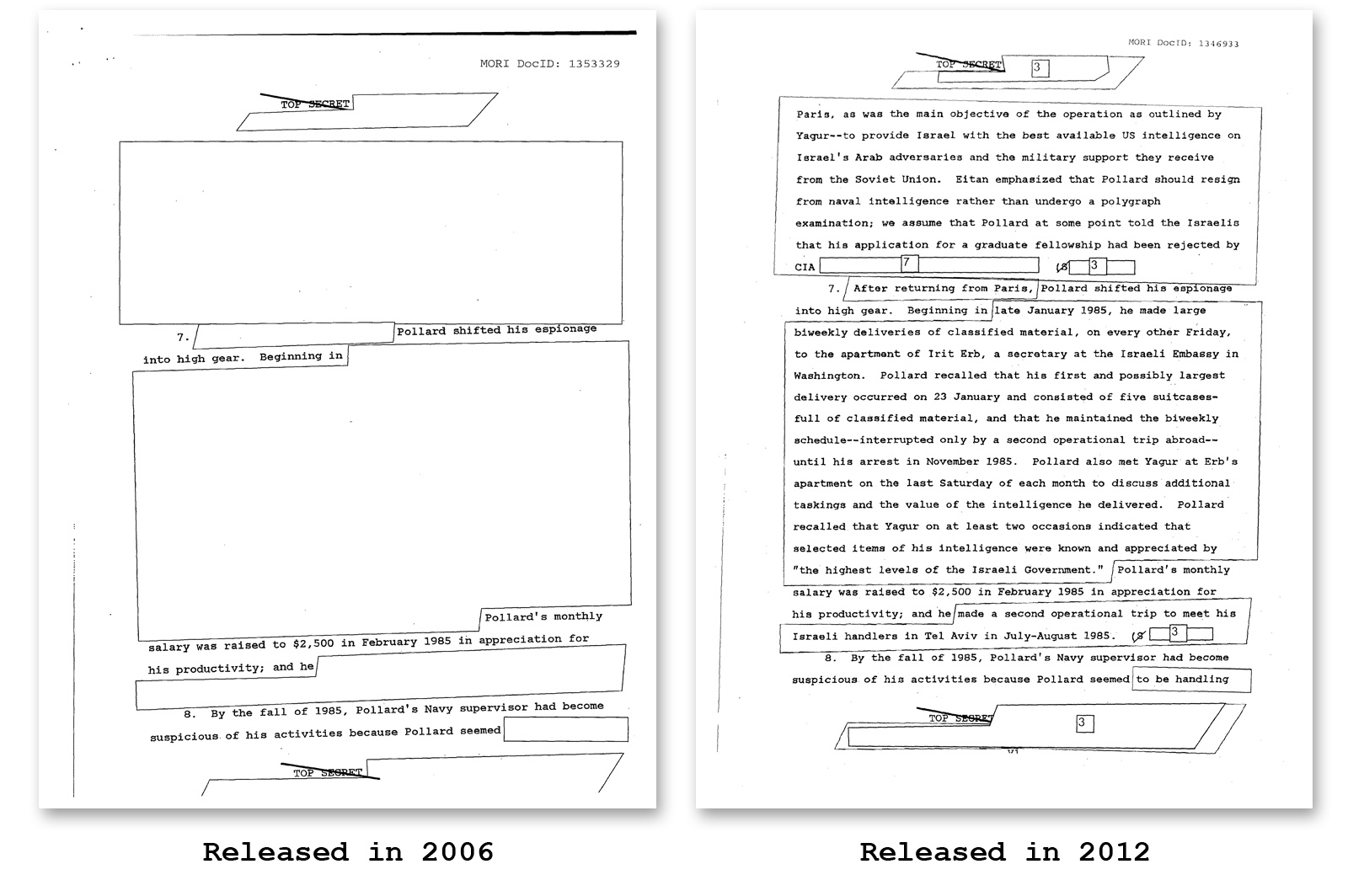
A: Released by CIA in 2006 in response to a Mandatory Declassification Review request.
B: Released in 2012 by the Interagency Security Classification Appeals Panel in response to the Archive’s appeal of CIA’s 2006 withholding.
This assessment was one of two prepared in the aftermath of Pollard’s arrest (the other was prepared for the Department of Defense by several naval intelligence and security organizations). Two versions of the CIA document are included here to show the amount of material the agency excised in 2006, compared with what ISCAP released in 2012.
The main body of the study examines Pollard’s personal history and espionage career, Israeli intelligence priorities and requests, material provided by Pollard, as well as losses and vulnerabilities. Supplemental tabs provide a detailed chronology and a summary of security and counterintelligence lessons learned. Portions that were redacted in 2006 are enclosed in rectangles.

Document 12: Bruce Riedel, “Book Review: The Territory of Lies,” Studies in Intelligence, 33, 3 (Fall 1989). Unclassified.
Source: CIA Historical Review Program.
This review by a senior CIA intelligence analyst focuses on what Riedel describes as “the first in-depth assessment of this case in the public arena by an Israeli.” It notes that the book adds new details on LAKAM and that its “most important contribution” was “to refute the Israeli Government’s official position that the Pollard operation was a rogue mission.” Riedel also addresses the question of whether LAKAM would be replaced by another covert intelligence organization.

Document 13: Israeli Ministry of Foreign Affairs, “Government Statement on Jonathan Pollard – 12 May 1998,” May 12, 1998, Unclassified.
Source: www.mfa.gov.il.
As part of an attempt to obtain Pollard’s release, this note on the Israeli Ministry of Foreign Affairs website acknowledges Pollard’s role as an agent for the LAKAM.

Document 14: National Counterintelligence Executive, CI Reader: An American Revolution into the New Millennium,Volume 3, n.d., accessed December 11, 2012, Unclassified (Extract)
This extract concerning Jonathan Pollard is drawn from a multi-volume study performed for the National Counterintelligence Executive, a component of the Office of the Director of National Intelligence. It summarizes Pollard’s activities, the reaction of the Israeli government, the legal consequences for Pollard, and Pollard’s quest for clemency.


NOTES

[1] Jeffrey T. Richelson, A Century of Spies: Intelligence in the Twentieth Century (New York: Oxford, 1995), pp. 388-403.
[2] Scott Armstrong, “Israelis Have Spied on U.S. Secret Papers Show,” Washington Post, February 1, 1982.
[3] The most significant media account on Pollard is Wolf Blitzer, Territory of Lies: The Exclusive Story of Jonathan Jay Pollard: The American Who Spied On His Country For Israel And How He Was Betrayed (New York: Harper & Row, 1989). With regard to the count of stolen documents, see Director of Central Intelligence Foreign Denial and Deception Analysis Committee, The Jonathan Jay Pollard Espionage Case: A Damage Assessment, October 30, 1987, p. 45.
[4] Richelson, A Century of Spies, pp. 401-402.
[5] Ibid., p. 403; George J. Tenet with Bill Harlow, At the Center of the Storm: My Years at the CIA (New York: Harper Collins, 2007), p. 67; M.E. “Spike” Bowman, “The Drumbeats for Clemency for Jonathan Jay Pollard Reverberate Again,” Intelligencer, Winter/Spring 2011, pp. 7-10; Jonathan S. Tobin, “The Pollard Spy Case, 25 Years Later,” Commentary, March 2011, pp. 37-43.

Tuesday, January 01, 2013

Israel Lobby Should Not Have Veto Over US


If you care about the direction of this country but think you don't have time to pay attention to what the Israel lobby is doing, you may want to think again. This is no conspiracy theory - it is all in broad daylight and the stakes are big, in fact they are matters of life and death right now. As we communicate, the Israel lobby is teaming up with the neocon right to prevent President Obama from choosing his Secretary of Defence.

... Chuck Hagel, a Republican Senator who would normally also be easy to confirm in the Senate, as Obama's choice for Secretary of Defence. But unlike in the case of Susan Rice, there are real, substantive objections to real substantive positions he has held: he was an early critic of the Iraq war; he wants to get out of Afghanistan, soon; he does not want a war with Iran; and he has supported cuts in military spending. This makes him neocon enemy number one, someone who must be crushed.

Loyal To A Foreign Government


So, Hagel once said he was a US senator and not a senator in the Israeli government. And for this he has been vilified. This really completes my argument. Is there any other country in the world where a legislator can be denounced for not being sufficiently loyal to a foreign government? This is worse than the McCarthy era; at least back then you had to swear loyalty to the US government.

And he once used the term "Jewish lobby" instead of "Israel lobby", thus denying credit where credit is due, to right-wing evangelical Christians and other fine citizens who also would like to see a war with Iran and fight for the foreign policy agenda of Israel's far right. 

Last week, Elliot Engel became the first important Democratic Congressman to attack Chuck Hagel and oppose his nomination as Secretary of Defence. Engel is part of the Israel lobby and unfortunately he is now the ranking Democrat on the House Foreign Affairs committee. One of his first acts after being elected to Congress was to sponsor a resolution declaring Jerusalem to be the undivided capital of Israel, an extremist position even by US State Department standards. 

Promoting The Israel Lobby

Engel is a good example of how the Israel lobby, in alliance with the much weaker neocons, influences much more of US foreign policy than just the Middle East. Until the Democrats lost the House in 2010, he was Chair of the Western Hemisphere Subcommittee of the House Foreign Affairs Committee. What was he doing there, since his main interest is Israel? He was there to use the Committee to try to advocate for Israeli foreign policy in this hemisphere. Of course, he had allies among neocon Republicans like Ileana Ros-Lehtinen, fanatical Cuban-born Florida right-winger who is the current (outgoing) Chair of the Foreign Affairs Committee.

Though the Republicans were more extreme, Engel shared their hostility toward left governments - now governing the majority of Latin America - that didn't fall into line.  This included of course avowedly socialist governments such as Ecuador, Bolivia and Venezuela; but in 2010, when Brazil, together with Turkey, tried to broker a nuclear fuel swap arrangement with Iran, in an attempt to defuse the escalating confrontation between the US and Iran, Engel was quick to publicly denounce and threaten Brazil for doing, actually, what Washington had asked them to do.

It is important to understand that Engel's commitment to the foreign policy of Israel is not the result of Jewish voters in New York's 17th Congressional district. Jews are less than 14 percent of his district, which is majority African-American and Latino. And most American Jews do not agree with the extremist policies of the Israeli government, which Engel represents. This is a problem of an ideological and political commitment of someone working with a powerful lobby to influence US foreign policy.

Engel was one of 81 House Democrats who went against the majority of their party in the House and voted to authorise George W Bush's invasion of Iraq. Most of these 81 Democrats had strong ties to the Israel lobby, distinguishing them from the Democrats who voted against the war. Would Congress have authorised that war without the influence of the Israel lobby?

It's difficult to say, just as it is difficult to say how much their influence will be decisive if we end up going to war with Iran - a cause that Israeli Prime Minister Bibi Netanyahu has lobbied for on national US TV and that the Israel lobby is eager to promote. But this country can no longer afford to have this kind of influence on such important decisions. 

The fight over the Hagel nomination, which would never have been a fight if not for the Israel lobby, is just the latest example. Hagel's presence in the Obama cabinet could easily, in some circumstances, make the difference between war and peace.