Showing posts with label ReDrawing Regions. Show all posts

Sunday, January 18, 2015

US Army Calls For ‘Military Support’ Of Israeli Energy Grab


Photo: An Egyptian man looks at flames rising from a pipeline that delivers gas to Israel and Jordan after it was hit by an explosion some 40 kilometres (25 miles) west of the town of Al-Arish in the north of the Sinai peninsula, early on 10 November, 2011 (AFP)

US Military Strategists Are Contemplating The Threat Of War To Redraw The Middle East’s Energy Architecture Around Israel

A new report by the US Army War College’s Strategic Studies Institute emphasises the need for “US security and military support” to its key allies in the Eastern Mediterranean, particularly Israel, over access to recent vast discoveries of regional oil and gas.
The Army study, released earlier in December 2014, concludes that extensive US military involvement “may prove essential in managing possible future conflict” in case of “an eruption of natural resource conflict in the East Mediterranean,” due to huge gas discoveries in recent years.
Visible US engagement is also necessary to ward off the regional encroachment of “emerging powers and potential new peace brokers such as Russia - which already entertains a strong interest in East Mediterranean gas developments - and notably China.”

Fossil Fuel Bonanza In The Levant

Since 2000, the Levant basin - an area encompassing the offshore territories of Israel, Palestine, Cyprus, Turkey, Egypt, Syria, and Lebanon - has been estimated to hold as much as 1.7 bn barrels of oil and up to 122 trillion cubic feet (tcf) of natural gas. As much of the region’s potential resources remain undiscovered, geologists believe this could be just a third of the total quantities of fossil fuels in the Levant.
The new US Army report argues that these hydrocarbon discoveries are of “tremendous economic and geostrategic significance,” not just for its allies, but for the United States itself. Israel especially stands to “gain considerably from their newly discovered gas wealth” in terms of cost-effective energy for domestic consumption and revenues from gas exports.
But while the discoveries offer the prospect for closer regional cooperation, they also raise “the potential for conflict over these valuable resources.” The potential for resource conflicts over oil and gas relates directly to intractable border conflicts between Israel, the Palestinians, Lebanon and Syria, as well as the unresolved Cypriot question between Greece and Turkey. US interests are to minimise the risk of conflict between its core allies, while maximising their capacity to exploit these resources.
“Israel, Cyprus, and Turkey are key strategic US allies,” the report says. “Neighbouring Egypt, Syria and Lebanon play important roles from the European and US perspective, both as direct neighbours to Israel and the Palestinian Territories as well as because of their strategically important location as the geographic interconnection between Europe, North Africa, and the Middle East.”
The new US Army report is authored by Mohammed al-Katiri and Laura al-Katiri. Mohammed al-Katiri was previously research director at the UK Ministry of Defence’s (MoD) Advanced Research and Assessment Group (ARAG), but now heads up two private intelligence consultancies, MENA Insight and the Conflict Studies Research Centre  (CSRC), both of which provide services to government and commercial sectors, including the oil and gas industry.
The Strategic Studies Institute (SSI) which published the report, calls itself an Army “think factory” for “commanders and civilian leaders.” SSI uses independent analysis to help “develop policy recommendations” for the US Army on national security and to “influence policy debate” across the military.

Advancing Israel’s Energy Empire

The SSI report on the risk of Middle East resource conflicts notes that Israel’s massive offshore gas discoveries “have yet to translate into proven gas reserves,” but that it’s total of 9.48 tcf of proven and 30 tcf estimated reserves, positions Israel “ahead of all East Mediterranean countries in terms of gas reserves and resource prospectivity.”
The Army report also reveals that Syria could hold significant offshore oil and gas potential. In 2007, before the outbreak of hostilities, President Bashar al-Assad launched a first bidding round to secure investment into new exploration efforts, and another in 2012 that was cancelled due to deteriorating security conditions.
“Once the Syria conflict is resolved, prospects for Syrian offshore production - provided commercial resources are found - are high,” observes the report.  Potential oil and gas resources can be developed “relatively smoothly once the political situation allows for any new exploration efforts in its offshore territories.”
The report also mentions significant gas finds in the offshore territories of Lebanon and Palestine, including the Gaza Marine, which holds over 1 tcf – production of which has been “obstruction by Israel over concerns regarding the flow of revenues to Palestinian stakeholders.” But in addition to the Gaza Marine, “Palestinian offshore territories near Gaza are believed to hold substantial hydrocarbon potential,” whose total quantities are still unknown because a lack of exploration there:
“Both Israel and Cyprus are key US allies and pillars of US foreign policy in the region: Israel, with its long history of close political ties with the United States, historically has stood at the heart of American efforts to secure regional peace; while Cyprus forms the most eastern part of Europe and is an important strategic location for both US and British military interests.”

Regional War

The region faces four main potential arcs of conflict. Firstly, in Israel-Palestine, the US Army study warns that “the presence of valuable natural resources in disputed territory may further feed the conflict.”
Secondly, rival claims between Israel and Lebanon over maritime boundaries could “complicate” the development of regional offshore hydrocarbon resources and result in military confrontation.
Thirdly, that risk has, in turn, delayed efforts to define Cypriot-Israeli and Cypriot-Lebanese exclusive economic maritime zones.
Fourthly, in 2013 Israel granted oil exploration licenses in the Syrian-claimed Golan Heights, spelling “potential for another armed conflict between the two parties should substantial hydrocarbon resources be discovered.” According to a report to the UN Security Council in early December, Israel has been in regular contact with Syrian rebels, including Islamic State fighters, raising the question of Israel’s role in supporting anti-Assad extremists to cement its control of Golan’s potential fossil fuel resources.
The US Army study highlights a real risk that tensions across these flashpoints could escalate into a wider regional conflict:
“In the case of an armed conflict between Israel and Lebanon, the security of the wider Levant region could once again be at stake, with a possible escalation of the conflict into neighbouring Syria and the Palestinian Territories, as well as (with historical precedents) Jordan and Egypt. In combination, the pre-existing political problems in all of these countries – Syria destabilizing into de facto civil war, Egypt in the midst of political instability, the Palestinians and Lebanese lacking stable political cores – the potential for a new, escalating regional war is a threatening scenario indeed.”

War For Peace (For Gas)

To stave off this disturbing prospect, the US report recommends that Israel and other Levant gas hubs like Lebanon and Cyprus play a key role in exporting Eastern Mediterranean gas to their Arab neighbours, such as Egypt, Turkey and Jordan, given that Middle East demand for gas is projected to rise dramatically in coming decades.
Further, the report highlights the possibility of Israel piping gas to Turkey, where it can be exported to European markets, making Turkey a regional gas transhipment hub. This would allow both Turkey and Europe to wean off their Russian gas dependence, and integrate instead into a “peaceful” US-Israeli dominated regional energy architecture.
As has been confirmed by Quartet Middle East envoy Tony Blair’s energy advisor, Ariel Ezrahi, Gaza’s offshore gas resources are seen as a potential bridge to overcome popular Arab public opposition to gas deals with Israel. “Israeli as well as Palestinian offshore hydrocarbon resources could play a significant role in facilitating mutual trust and the willingness to cooperate,” the US Army study suggests, “including between Israel and a few of its other Arab neighbours, Jordan and Egypt.”
But ultimately this architecture cannot be installed without extensive US intervention of some kind. “US diplomatic and military support has a pivotal role to play in the East Mediterranean’s complex geopolitical landscape, and its importance will only grow as the value of the natural resources at stake increases,” concludes the Army report:
“US security and military support for its main allies in the case of an eruption of natural resource conflict in the East Mediterranean may prove essential in managing possible future conflict.”
Diplomatically, the US could play a significant role in mediating between the various parties to facilitate successful oil and gas development projects across the East Mediterranean, not just for “Israel’s sake,” but also to shore-up allies like Jordan and Egypt with “low-cost Israeli gas,” contributing to regional economic and thus political stability:
“US support - diplomatic and, where necessary, military - can form a potentially powerful element in the safeguarding of these long-term economic benefits, at little cost in relative terms.”
If regional tensions escalate though, the report warns that “the United States also holds an important military position that could have an impact in securing the East Mediterranean,” including “military training and equipment support” to defend Cyprus and Israel from attacks on “their energy infrastructure and gas developments.”
This Orwellian document thus reveals that in the name of maintaining regional peace, a new Great Game is at play. To counter Russian and Chinese influence while cementing influence over its Arab allies, US military strategists are contemplating the threat of war to redraw the Middle East’s energy architecture around Israel.
 - Nafeez Ahmed PhD, is an investigative journalist, international security scholar and bestselling author who tracks what he calls the 'crisis of civilization.' He is a winner of the Project Censored Award for Outstanding Investigative Journalism for his Guardian reporting on the intersection of global ecological, energy and economic crises with regional geopolitics and conflicts. He has also written for The Independent, Sydney Morning Herald, The Age, The Scotsman, Foreign Policy, The Atlantic, Quartz, Prospect, New Statesman, Le Monde diplomatique, New Internationalist. His work on the root causes and covert operations linked to international terrorism officially contributed to the 9/11 Commission and the 7/7 Coroner’s Inquest.
The views expressed in this article belong to the author and do not necessarily reflect the editorial policy of Middle East Eye.


Saturday, April 26, 2014

EUROPE'S FRAGMENTED FUTURE

The specter of secession is haunting Europe. Since 2000 there have been three successful separations from existing states — by Montenegro, Kosovo and Crimea — and at the moment, several other regions are attempting to secede and create independent states. In March, Crimea first seceded from Ukraine and then voted, in a referendum, to rejoin the Russian Federation. At the same time, in an informal online referendum, voters of the Veneto region in northern Italy overwhelmingly favored independence and the restoration of the old Venetian republic. In September, the citizens of Scotland will vote in an independence referendum, and the government of the Spanish region of Catalonia plans to hold a referendum of the same kind two months later — despite a ruling by the Constitutional Court of Spain that such a referendum would be illegal (a similar referendum in the Basque region in 2008 was thwarted by the Spanish government). 

Why Now?

Why are these referendums all taking place in 2014? In fact, the Scottish and Catalan votes were planned several years ago, at a time when dissatisfaction with the “host states” among the citizens of these regions was the highest. Spain and Italy were experiencing a series of banking and fiscal crises and increasing unemployment; the Conservative government in the U.K., which had no electoral support at all in Scotland, was introducing unpopular austerity measures. It was only when repeated attempts to get the Veneto regional assembly to hold an independence referendum stalled that the Veneto secessionists proceeded on their own with the online referendum — and made it coincide with the Crimean one.  
The point of these referendums is to mobilize the dissatisfaction of those who strongly self-identify as Scots, Catalan or Venetian and who regard their current “host state” as foreign, burdensome, incompetent or corrupt. By leaving this state, literally, and creating another, better state, the secessionists hope to improve their lot in life. In contrast to these movements, the Crimean referendum was conceived and conducted within a few weeks: It was a response to the violent overthrow of the Ukrainian president, a popular figure in Crimea, and was used to channel the consequent fears among the majority Russian speakers into a vote to rejoin Russia as a safe haven from the new, (allegedly) hostile, anti-Russian Ukrainian government. The referendum was rushed, with the Russian military lurking in the background, before the new Ukrainian government was able to dispel voters’ fears or establish control over the autonomous republic. Within weeks after the region rejoined Russia, the pay of public employees and pensions in Crimea almost doubled; the reunification thus brought more benefits to some Crimeans than a mere secession from Ukraine would have. 

No Easy Way Out

Seceding from a country isn’t always as fast and (relatively) painless as Crimea made it seem. But there are other cases of secession that suggest these pains can be eased somewhat. First, the best strategy for any secessionists is to attempt to convince their host state that the secession of their territory won’t cause much harm. The potential secession of Scotland does not appear to be harmful to the U.K., so the U.K. government is prepared to recognize its independence. The secession of Montenegro in 2006, which the EU supported and supervised, did not appear to harm Serbia either; the Serbian government agreed to the secession of this federal unit.
If this tactic fails, a secessionist movement should try to find a powerful sponsor – a superpower, such as the U.S., or a neighbor more powerful than its host state (and not easily intimidated by a superpower), such as Russia. The Albanian secessionists in Kosovo gained U.S. sponsorship in 1998, when they led a large armed uprising against Serbia. And in 2008, when Kosovo, then a province of Serbia under U.N./NATO administration, formally seceded from Serbia in spite of Serbia’s vehement opposition, the U.S., Kosovo’s principal sponsor, along with most EU member states immediately recognized its independence. It is notable that Spain, Slovakia, Romania, Greece and Cyprus refused to recognize, on principle, a state, such as Kosovo, that unilaterally seceded against the opposition of its “host state”; not coincidentally, all these EU member states oppose separatist movements within their own borders.
This doesn’t lend much hope to the Catalan, Basque and Venetian secessionists — their host states oppose their aspirations, and they are not likely to gain powerful sponsors. Secessionists all over the globe face similar obstacles: Those in Tibet and Xinjiang (in China), the Caucasus (in Russia), Congo, Kurdistan (in Iraq) or Azawad (in Mali) — to mention, randomly, only a small selection of cases — have little chance of carving out an independent, internationally recognized state, however strong their movements may be. Quebec at least has the law on its side: If its secessionists ever succeed in winning over the majority of their province’s population, they may legally secede from Canada, thanks to a 1998 Canadian Supreme Court opinion. 
For secessionists, the state they currently live in is effectively foreign. 
The differences between secessionists in Europe and Quebec, on the one hand, and those elsewhere are quite obvious. Outside Europe and Quebec, the secessionists often face either a failing or a highly repressive state. Faced with the pervasive threat of violence, they aim to create a state structure that will protect the lives of its inhabitants. In some cases, such as that of Somaliland (in Somalia) or Kurdistan (in Iraq), they succeed in creating a separate, protective state that has, however, no international recognition as an independent state. In many others, they fail and are plunged into a cycle of violent civil conflict.
Secessionists in Europe and Quebec, by contrast, aren’t facing threats of violence; thus their aim is not protection but provision of perceived benefits. They claim that an independent state would advantage their constituents in all aspects of their lives much more than the current host state could; this includes a better standard of living. For them, independence serves to provide a variety of enhanced benefits to a group of people inhabiting a region within an existing state.
Many supporters of secession find it oppressive to live in a state whose rulers speak a language or dialect they consider foreign. State or cultural symbols (flags, anthems, coats of arms, popular songs) are to them also foreign: For them, the state they currently live in is effectively foreign. But these people are in the minority. As the opinion polls in Scotland, Quebec, Veneto and Catalonia suggest, identity secessionists do not form clear majorities in these regions, so would-be voters need to be convinced that independence would benefit them.
That’s not easy: In Quebec’s past two referendums, in 1981 and 1995, the veteran secessionist Parti Québécois failed to achieve even simple majorities to support independence. Pre-referendum opinion polls in Scotland, Catalonia andVeneto, while showing that the majority of voters in these regions are highly dissatisfied with the host state or central government, do not unequivocally show that the same majority would vote for independence.

Questionable Benefits

Who would benefit most from the secession of Scotland, Catalonia, Veneto or Quebec? The answer is simple: The beneficiaries would first and foremost be the leaders of secessionist parties whose aim is to take over the governments of the newly independent states. If they were rulers of independent and sovereign states, their policies and actions — including the use of coercion and force — as well as their remuneration would not be subject to any higher or “foreign” sovereign authority or oversight. In addition, as the new state takes over the functions of the old — including those of diplomacy — there would be lots of new job opportunities in the expanding state bureaucracy. Local small and medium businesses would profit, too, as their competitors from outside the region withdraw across new state borders.
It’s less clear how other citizens of the new states would fare. As many nonlocal or even local companies pull out of the region (as they did prior to the Quebec referendum in 1995), employment is likely to become a pressing issue. Perhaps an economic downturn may be avoided if the seceded state remains in a regional economic organization (such as the EU) of which its former host state is a member. But this, too, remains uncertain: The EU, for example, has no policies about, or obligation toward, states seceding from an EU member.
For most people in these regions of Europe — unlike those in Crimea — seceding now would bring uncertainty and anxiety about the future that secessionist leaders would not be able to allay. For this reason alone it is highly uncertain whether the planned referendums will produce majorities in favor of independence — and, even if they do, whether these regions will become independent states, or be recognized as such, anytime soon. 
Aleksandar Pavković is an associate professor of politics and international relations at Macquarie University in Sydney, Australia. He is the author of “Creating New States” (2007) and an editor of “The Ashgate Research Companion to Secession” (2011) and of “Separatism and Secessionism in Europe and Asia” (2013). 

Wednesday, April 16, 2014

Dismantling The British State: Strategy, Tactics and Ideology


On March 14, 2014, author Tariq Ali presented, as part of Edinburgh University Sociology Department's Independence Lectures series, "Dismantling the British State: Strategy, Tactics and Ideology". It was held in association with Pluto Press and WordPower Books.

Monday, March 31, 2014

The Balkanization Of Sudan: The Redrawing Of The Middle East and North Africa

By Mahdi Darius Nazemroaya

Sudan is a diverse nation and a country that represents the plurality of Africa through various tribes, clans, ethnicities, and religious groups. Yet the unity of Sudan is in question, while there is talk of unifying nations and of one day creating a United States of Africa through the African Union.
The limelight is on the January 2011 referendum in South Sudan. The Obama Administration has formally announced that it supports the separation of South Sudan from the rest of Sudan.
The balkanization of Sudan is what is really at stake. For years the leaders and officials of South Sudan have been supported by America and the European Union.
The Politically-Motivated Demonization of Sudan
A major demonization campaign has been underway against Sudan and its government. True, the Sudanese government in Khartoum has had a bad track record in regards to human rights and state corruption, and nothing could justify this.
In regards to Sudan, however, selective or targeted condemnation has been at work. One should, nonetheless, ask why the Sudanese leadership has been targeted by the U.S. and E.U., while the human rights records of several U.S. sponsored client states including Saudi Arabia, Egypt, the U.A.E., and Ethiopia are casually ignored.
Khartoum has been vilified as a autocratic oligarchy guilty of targeted genocide in both Darfour and South Sudan. This deliberate focus on the bloodshed and instability in Darfour and South Sudan is political and motivated by Khartoum’s ties to Chinese oil interests.
Sudan supplies China with a substantial amount of oil. The geo-political rivalry between China and the U.S. for control of African and global energy supplies is the real reason for the chastisement of Sudan and the strong support shown by the U.S., the E.U., and Israeli officials for the seccession of South Sudan.
It is in this context that Chinese interests have been attacked. This includes the October 2006 attack on the Greater Nile Petroleum Company in Defra, Kordofan by the Justice and Equality Movement (JEM) militia.
Distorting the Violence in Sudan

While there is a humanitarian crisis in Darfour and a surge in regional nationalism in South Sudan, the underlying causes of the conflict have been manipulated and distorted.
The underlying causes for the humanitarian crisis in Darfour and the regionalism in South Sudan are intimately related to economic and strategic interests. If anything, lawlessness and economic woes are the real issues, which have been fuelled by outside forces.
Either directly or through proxies in Africa, the U.S., the E.U., and Israel are the main architects behind the fighting and instability in both Darfour and South Sudan. These outside powers have assisted in the training, financing, and arming of the militias and forces opposed to the Sudanese government within Sudan. They lay the blame squarely on Khartoum’s shoulders for any violence while they themselves fuel conflict in order to move in and control the energy resources of Sudan. The division of Sudan into several states is part of this objective. Support of the JEM, the South Sudan Liberation Army (SSLA), and other militias opposed to the Sudanese government by the U.S., the E.U., and Israel has been geared towards achieving the objective of dividing Sudan.
It is also no coincidence that for years the U.S., Britain, France, and the entire E.U. under the pretext of humanitarianism have been pushing for the deployment of foreign troops in Sudan. They have actively pushed for the deployment of NATO troops in Sudan under the cover of a U.N. peacekeeping mandate.
This is a re-enactment of the same procedures used by the U.S. and E.U. in other regions where countries have either formally or informally been divided and their economies restructured by foreign-installed proxy governments under the presence of foreign troops. This is what happened in the former Yugoslavia (through the creation of several new republics) and in Anglo-American occupied Iraq (through soft balkanization via a calculated form of federalism aimed at establishing a weak and de-centralized state). Foreign troops and a foreign presence have provided the cloud for state dismantlement and the foreign takeover of state infrastructure, resources, and economies.
The Question of Identity in Sudan

While the Sudanese state has been portrayed as being oppressive towards the people in South Sudan, it should be noted that both the referendum and the power sharing structure of the Sudanese government portray something else. The power sharing agreement in Khartoum between Omar Al-Basher, the president of Sudan, includes the SPLM. The leader of the SPLM, Salva Kiir Mayardit, is the First Vice-President of Sudan and the President of South Sudan.
The issue of ethnicity has also been brought to the forefront of the regional or ethno-regional nationalism that has been cultivated in South Sudan. The cleavage in Sudan between so-called Arab Sudanese and so-called African Sudanese has been presented to the outside world as the major force for the regional nationalism motivating calls for statehood in South Sudan. Over the years this self-differentiation has been diffused and socialized into the collective psyche of the people of South Sudan.
Yet, the difference between so-called Arab Sudanese and so-called African Sudanese are not that great. The Arab identity of so-called Sudanese Arabs is based primarily on their use of the Arabic language. Let us even assume that both Sudanese ethnic identities are totally separate. It is still widely known in Sudan that both groups are very mixed. The other difference between South Sudan and the rest of Sudan is that Islam predominates in the rest of Sudan and not in South Sudan. Both groups are still deeply tied to one another, except for a sense of self-identification, which they are well in their rights to have. Yet, it is these different identities that have been played upon by local leaders and outside powers.
Neglect of the local population of different regions by the elites of Sudan is what the root cause of anxiety or animosity between people in South Sudan and the Khartoum government are really based on and not differences between so-called Arab and so-called African Sudanese.
Regional favouritism has been at work in South Sudan.
The issue is also compounded by social class. The people of South Sudan believe that their economic status and standards of living will improve if they form a new republic. The government in Khartoum and  non-Southerner Sudanese have been used as the scapegoats for the economic miseries of the people of South Sudan and their perceptions of relative poverty by the local leadership of South Sudan. In reality, the local officials of South Sudan will not improve the living standards of the people of South Sudan, but maintain a klepocratic status quo. [1]
The Long-Standing Project to Balkanize Sudan and its links to the Arab World

In reality, the balkanization project in Sudan has been going on since the end of British colonial rule in Anglo-Egyptian Sudan. Sudan and Egypt were one country during many different periods. Both Egypt and Sudan were also one country in practice until 1956.
Up until the independence of Sudan, there was a strong movement to keep Egypt and Sudan united as a single Arab state, which was struggling against British interests. London, however, fuelled Sudanese regionalism against Egypt in the same manner that regionalism has been at work in South Sudan against the rest of Sudan. The Egyptian government was depicted in the same way as present-day Khartoum. Egyptians were portrayed as exploiting the Sudanese just as how the non-Southern Sudanese have been portrayed as exploiting the South Sudanese.
After the British invasion of Egypt and Sudan, the British also managed to keep their troops stationed in Sudan. Even while working to divide Sudan from Egypt, the British worked to create internal differentations between South Sudan and the rest of Sudan. This was done through the Anglo-Egyptian Condominium, from 1899 to 1956, which forced Egypt to share Sudan with Britain after the Mahdist Revolts. Eventually the Egyptian government would come to refuse to recognize the Anglo-Egyptian Condominium as legal. Cairo would continously ask the British to end their illegal military occupation of Sudan and to stop preventing the re-integration of Egypt and Sudan, but the British would refuse.
It would be under the presence of British troops that Sudan would declare itself independent. This is what lead to the emergence of Sudan as a separate Arab and African state from Egypt. Thus, the balkanization process started with the division of Sudan from Egypt.
The Yinon Plan at work in Sudan and the Middle East
The balkanization of Sudan is also tied to the Yinon Plan, which is a continuation of British stratagem. The strategic objective of the Yinon Plan is to ensure Israeli superiority through the balkanization of the Middle Eastern and Arab states into smaller and weaker states. It is in this context that Israel has been deeply involved in Sudan.
Israeli strategists viewed Iraq as their biggest strategic challenge from an Arab state. This is why Iraq was outlined as the centre piece to the balkanization of the Middle East and the Arab World. The Atlantic in this context published an article in 2008 by Jeffrey Goldberg called “After Iraq: What Will the Middle East Look Like?” [2] In the Goldberg article a map of the Middle East was presented that closely followed the outline of the Yinon Plan and the map of a future Middle East presented by Lieutenant-Colonel (retired) Ralph Peters in the U.S military’s Armed Forces Journal in 2006.
It is also no coincidence that aside from a divided Iraq a divided Sudan was shown on the map. Lebanon, Iran, Turkey, Syria, Egypt, Somalia, Pakistan, and Afghanistan were also presented as divided nations too. Of importance to East Africa in the map, illustrated by Holly Lindem for Goldberg’s article, Eritrea is occupied by Ethiopia, which is a U.S. and Israeli ally, and Somalia is divided into Somaliland, Puntland, and a smaller Somalia.
In Iraq, on the basis of the concepts of the Yinon Plan, Israeli strategists have called for the division of Iraq into a Kurdish state and two Arab states, one for Shiite Muslims and the other for Sunni Muslims. This has been achieved through the soft balkanization of federalism in Iraq, which has allowed the Kurdistan Regional Government to negotiate with foreign oil corporations on its own. The first step towards establishing this was a war between Iraq and Iran, which is discussed in the Yinon Plan.
In Lebanon, Israel has been working to exasperate sectarian tensions between the various Christian and Muslim factions as well as the Druze. The division of Lebanon into several states is also seen as a means of balkanizing Syria into several smaller sectarian Arab states. The objectives of the Yinon Plan is to divide Lebanon and Syria into several states on the basis of religious and sectarian identities for Sunni Muslims, Shiite Muslims, Christians, and the Druze.
In this regard, the Hariri Assassination and the Special Tribunal for Lebanon (STL) have been playing out to the favour of Israel in creating internal divisions within Lebanon and fuelling politically-motivated sectarianism. This is why Tel Aviv has been very vocal about the STL and very supportive of it. In a clear sign of the politized nature of the STL and its ties to geo-politics, the U.S. and Britain have also given the STL millions of dollars.
The Links between the Attacks on the Egyptian Copts and the South Sudan Referendum
From Iraq to Egypt, Christians in the Middle East have been under attack, while tensions between Shiite Muslims and Sunni Muslims are being fuelled. The attack on a Coptic Church in Alexandria on January 1, 2011 or the subsequent Coptic protests and riots should not be looked at in isolation. [3] Nor should the subsequent fury of Coptic Christians expressed towards Muslims and the Egyptian government. These attacks on Christians are tied to the broader geo-political goals of the U.S., Britain, Israel, and NATO in the Middle East and Arab World.
The Yinon Plan stipulates that if Egypt were divided that Sudan and Libya would also be balkanized and weakened. In this context, there is a link between Sudan and Egypt. According to the Yinon Plan, the Copts or Christians of Egypt, which are a large minority in Egypt, are the key to the balkanization of the Arab states in North Africa. Thus, the Yinon Plan states that the creation of a Coptic state in Upper Egypt (South Egypt) and Christian-Muslim tensions within Egyptian are vital steps to balkanizing Sudan and North Africa.
The attacks on Christians in the Middle East are part of intelligence operations intended to divide the Middle East and North Africa. The timing of the mounting attacks on Coptic Christians in Egypt and the build-up to the referendum in South Sudan are no coincidence. The events in Sudan and Egypt are linked to one another and are part of the project to balkanize the Arab World and the Middle East. They must also be studied in conjunction with the Yinon Plan and with the events in Lebanon and Iraq, as well as in relation to the efforts to create a Shiite-Sunni divide.
The Outside Connections of the SPLM, SSLA, and Militias in Darfour
As in the case of Sudan, outside interference or intervention has been used to justify the oppression of domestic opposition. Despite its corruption, Khartoum has been under siege for refusing to merely be a proxy.
Sudan is justified in suspecting foreign troops and accusing the U.S., Britain, and Israel of eroding the national solidarity of Sudan. For example, Israel has sent arms to the opposition groups and separatist movements in Sudan. This was done through Ethiopia for years until Eritrea became independent from Ethiopia, which made Ethiopia lose its Red Sea coast, and bad relations developed between the Ethiopians and Eritreans. Afterwards Israeli weapons entered South Sudan from Kenya. From South Sudan, the Sudan People’s Liberation Movement (SPLM), which is the political arm of the SSLA, would transfer weapons to the militias in Darfur. The governments of Ethiopia and Kenya, as well as the the Uganda People’s Defence Force (UPDF), have also been working closely with the U.S., Britain, and Israel in East Africa.
The extent of Israeli influence with Sudanese opposition and separatist groups is significant. The SPLM has strong ties with Israel and its members and supporters regularly visit Israel. It is due to this that Khartoum capitulated and removed the Sudanese passport restriction on visiting Israel in late-2009 to satisfy the SPLM. [4] Salva Kiir Mayardit has also said that South Sudan will recognize Israel when it separates from Sudan.
The Sudan Tribune reported on March 5, 2008 that separatist groups in Darfur and Southern Sudan had offices in Israel:
[Sudan People's Liberation Movement] supporters in Israel announced establishment of the Sudan People’s Liberation Movement office in Israel, a press release said today.
“After consultation with the leadership of SPLM in Juba, the supporters of SPLM in Israel have decided to establish the office of SPLM in Israel.” Said [sic.] a statement received by email from Tel Aviv signed by the SLMP secretariat in Israel.
The statement said that SPLM office would promote the policies and the vision of the SPLM in the region. It further added that in accordance with the Comprehensive Peace Agreement the SPLM has the right to open in any country including Israel. It also indicated that there are around 400 SPLM supporters in Israel. Darfur rebel leader Abdel Wahid al-Nur said last week he opened an office in Tel Aviv. [5]
The Hijacking of the 2011 Referendum in South Sudan

What happened to the dreams of a united Africa or a united Arab World? Pan-Arabism, a movement to unit all Arabic-speaking peoples, has taken heavy losses as has African unity. The Arab World and Africa have consistenly been balkanized.
Secession and balkanization in East Africa and the Arab World are on the U.S., Israeli, and NATO drawing board.
The SSLA insurgency has been covertly supported by the  U.S., Britain, and Israel since the 1980s. The formation of a new state in the Sudan is not intended to serve the interests of the people of South Sudan. It has been part of a broader geo-strategic agenda aimed at controlling North Africa and the Middle East.
The resulting process of “democratization” leading up to the January 2011 referendum serves the interests of the Anglo-American oil companies and the rivalry against China. This comes at the cost of the detriment of true national sovereignty in South Sudan.
Mahdi Darius Nazemroaya is a Research Associate of the Centre for Research on Globalization (CRG).
NOTES
[1] A kleptocracy is a government or/and state that works to protect, extend, deepen, continue, and entrench the wealth of the ruling class.
[2] Jeffrey Goldberg, “After Iraq: What Will The Middle East Look Like?” The Atlantic, January/February 2008.
[3] William Maclean, “Copts on global Christmas alert after Egypt bombing”, Reuters, January 5, 2011.
[4] “Sudan removes Israel travel ban from new passport”, Sudan Tribune, October 3, 2009:
<http://www.sudantribune.com/spip.php?iframe&page=imprimable&id_article=32776>.
[5] “Sudan’s SPLM reportedly opens an office in Israel – statement”, Sudan Tribune, March 5, 2008:
<http://www.sudantribune.com/spip.php?page=imprimable&id_article=26251>.
ANNEX: THE ATLANTIC MAP OF THE “NEW MIDDLE EAST”

Note: The following map was drawn by Holly Lindem for an article by Jeffery Goldberg. It was published in The Atlantic in January/February 2008. (Map Copyright: The Atlantic, 2008).

Thursday, December 05, 2013

A Remapped Middle East


By ROBIN WRIGHT

THE map of the modern Middle East, a political and economic pivot in the international order, is in tatters. Syria’s ruinous war is the turning point. But the centrifugal forces of rival beliefs, tribes and ethnicities — empowered by unintended consequences of the Arab Spring — are also pulling apart a region defined by European colonial powers a century ago and defended by Arab autocrats ever since.


A different map would be a strategic game changer for just about everybody, potentially reconfiguring alliances, security challenges, trade and energy flows for much of the world, too.
Syria’s prime location and muscle make it the strategic center of the Middle East. But it is a complex country, rich in religious and ethnic variety, and therefore fragile. After independence, Syria reeled from more than a half-dozen coups between 1949 and 1970, when the Assad dynasty seized full control. Now, after 30 months of bloodletting, diversity has turned deadly, killing both people and country. Syria has crumbled into three identifiable regions, each with its own flag and security forces. A different future is taking shape: a narrow statelet along a corridor from the south through Damascus, Homs and Hama to the northern Mediterranean coast controlled by the Assads’ minority Alawite sect. In the north, a small Kurdistan, largely autonomous since mid-2012. The biggest chunk is the Sunni-dominated heartland.
Syria’s unraveling would set precedents for the region, beginning next door. Until now, Iraq resisted falling apart because of foreign pressure, regional fear of going it alone and oil wealth that bought loyalty, at least on paper. But Syria is now sucking Iraq into its maelstrom.
The battlefields are merging,” the United Nations envoy Martin Kobler told the Security Council in July. “Iraq is the fault line between the Shia and the Sunni world and everything which happens in Syria, of course, has repercussions on the political landscape in Iraq.”
Over time, Iraq’s Sunni minority — notably in western Anbar Province, site of anti-government protests — may feel more commonality with eastern Syria’s Sunni majority. Tribal ties and smuggling span the border. Together, they could form a de facto or formal Sunnistan. Iraq’s south would effectively become Shiitestan, although separation is not likely to be that neat.
The dominant political parties in the two Kurdish regions of Syria and Iraq have longstanding differences, but when the border opened in August, more than 50,000 Syrian Kurds fled to Iraqi Kurdistan, creating new cross-border communities. Massoud Barzani, president of Iraqi Kurdistan, has also announced plans for the first summit meeting of 600 Kurds from some 40 parties in Iraq, Syria, Turkey and Iran this fall.
“We feel that conditions are now appropriate,” said Kamal Kirkuki, the former speaker of Iraq’s Kurdish Parliament, about trying to mobilize disparate Kurds to discuss their future.
Outsiders have long gamed the Middle East: What if the Ottoman Empire hadn’t been divvied up by outsiders after World War I? Or the map reflected geographic realities or identities? Reconfigured maps infuriated Arabs who suspected foreign plots to divide and weaken them all over again.
I had never been a map gamer. I lived in Lebanon during the 15-year civil war and thought it could survive splits among 18 sects. I also didn’t think Iraq would splinter during its nastiest fighting in 2006-7. But twin triggers changed my thinking.
The Arab Spring was the kindling. Arabs not only wanted to oust dictators, they wanted power decentralized to reflect local identity or rights to resources. Syria then set the match to itself and conventional wisdom about geography.
New borders may be drawn in disparate, and potentially chaotic, ways. Countries could unravel through phases of federation, soft partition or autonomy, ending in geographic divorce.
Libya’s uprising was partly against the rule of Col. Muammar el-Qaddafi. But it also reflected Benghazi’s quest to separate from domineering Tripoli. Tribes differ. Tripolitanians look to the Maghreb, or western Islamic world, while Cyrenaicans look to the Mashriq, or eastern Islamic world. Plus, the capital hogs oil revenues, even though the east supplies 80 percent of it.
So Libya could devolve into two or even three pieces. The Cyrenaica National Council in eastern Libya declared autonomy in June. Southern Fezzan also has separate tribal and geographic identities. More Sahelian than North African in culture, tribes and identity, it could split off too.
Other states lacking a sense of common good or identity, the political glue, are vulnerable, particularly budding democracies straining to accommodate disparate constituencies with new expectations.
After ousting its longtime dictator, Yemen launched a fitful National Dialogue in March to hash out a new order. But in a country long rived by a northern rebellion and southern separatists, enduring success may depend on embracing the idea of federation — and promises to let the south vote on secession.
A new map might get even more intriguing. Arabs are abuzz about part of South Yemen’s eventually merging with Saudi Arabia. Most southerners are Sunni, as is most of Saudi Arabia; many have family in the kingdom. The poorest Arabs, Yemenis could benefit from Saudi riches. In turn, Saudis would gain access to the Arabian Sea for trade, diminishing dependence on the Persian Gulf and fear of Iran’s virtual control over the Strait of Hormuz.
The most fantastical ideas involve the Balkanization of Saudi Arabia, already in the third iteration of a country that merged rival tribes by force under rigid Wahhabi Islam. The kingdom seems physically secured in glass high-rises and eight-lane highways, but it still has disparate cultures, distinct tribal identities and tensions between a Sunni majority and a Shiite minority, notably in the oil-rich east.
Social strains are deepening from rampant corruption and about 30 percent youth unemployment in a self-indulgent country that may have to import oil in two decades. As the monarchy moves to a new generation, the House of Saud will almost have to create a new ruling family from thousands of princes, a contentious process.
Other changes may be de facto. City-states — oases of multiple identities like Baghdad, well-armed enclaves like Misurata, Libya’s third largest city, or homogeneous zones like Jabal al-Druze in southern Syria — might make a comeback, even if technically inside countries.
A century after the British adventurer-cum-diplomat Sir Mark Sykes and the French envoy François Georges-Picot carved up the region, nationalism is rooted in varying degrees in countries initially defined by imperial tastes and trade rather than logic. The question now is whether nationalism is stronger than older sources of identity during conflict or tough transitions.
Syrians like to claim that nationalism will prevail whenever the war ends. The problem is that Syria now has multiple nationalisms. “Cleansing” is a growing problem. And guns exacerbate differences. Sectarian strife generally is now territorializing the split between Sunnis and Shiites in ways not seen in the modern Middle East.  
But other factors could keep the Middle East from fraying — good governance, decent services and security, fair justice, jobs and equitably shared resources, or even a common enemy. Countries are effectively mini-alliances. But those factors seem far off in the Arab world. And the longer Syria’s war rages on, the greater the instability and dangers for the whole region.

Friday, August 09, 2013

World War III Began In May 2006

Building The New Map Of The Middle East In Real Time

By Chycho

I. Beginnings Of Conflicts


Usually there are disagreements as to the exact dates of beginnings of conflicts, especially when those conflicts are global. 

The beginnings of wars are often hard to identify. Which act lit the spark on the tinderbox? Which straw was the final one? Like peak oilitself, the beginnings of war are often visible only in retrospect.” 

For example, some would argue that World War II began in 1939 withthe German invasion of Poland. Others would pick the 1931Japanese invasion of Manchuria, or maybe even the 1933 Reichstag Fire. The only consensus regarding World War II is that it was devastating. 

As for World War III, some believe that it was the Cold War and that we are in the beginning stages of World War IV. They believe that it started with the invasion of Iraq, and will be completely realized when the United States and Israel begin their attack on Iran and Syria (12)

Some reference the confrontation between Israel and Palestine at the turn of the century as the start. Others state that the First Gulf War was the “opening guns of World War III”, while some declare that “the most significant feature of this New World Order/World War III is that the target of war is no longer so much a state institution as it is the citizenry of states. Since this majority is working class, World War III is really a war upon the working class, designed to increase the rate of its economic exploitation.” 

There is even a belief that the root cause is the Shanghai Cooperation Organisation (SCO) which is “creating worldwide tensions similar to the standoff before the Second World War.” 

Others, specifically, Miles Copeland, Jr. who was one of the founding members of the Office of Strategic Services, the predecessor of the Central Intelligence Agency (CIA), predicted in 1989 that World War III would begin when the United States and Israel get duped by Russia into starting a self-destructive war - referred to as a crusade by some - with the Muslim world:

But even with the help of the Israelis - especially with the help of the Israelis! - we couldn't defeat the Iranians, the 'Arabs', the world of Islam or the whole Third World if it should turn against us. We [the CIA] have reason to believe that Soviet strategists well understand this, and that the Third World War that they envision will be one of ourselves against shapeless forces of the Third World, with Soviet Russia ostensibly aloof from it...The U.S Government was sinking into exactly the dilemma that best suited the purposes of Moscow's Leninists as they've begun to blossom under Gorbachev. In materials easily available to the U.S government without recourse to espionage, they had made it clear enough that in their version of the Third World War the United States would be forced into a variety of situations in which it would feel compelled to play the role of a powerful nation but, for all the world to see on it television sets, it would in fact, be powerless." The Game Player: Confessions of the CIA's Original Political Operative, London: Aurum Press, 1989

II. Start of World War III


Whichever truth you choose to believe, since they are all relevant and valid in their own right, the fact is that according to the mainstream media, World War III (or IV) has already begun

Considering that the players involved in starting this war are so conveniently, on our behalf, declaring that World War III (or IV) has already started, I thought it would be a good idea to narrow the timeline and pick a date which will be marked as the commencement of the demise of our civilization. 

So when exactly did World War III start? 

In early May of 2006, the president of the United States, George W Bush, the commander in chief of the United States Military, stated that 2001 was the beginning of World War III. His remarks were confirmed by Dan Gillerman, at the time Israel's UN Ambassador, when he also acknowledged during a routine UN Security Council meeting on 30 May 2006 that World War III had already begun. Many consider these two statements from two of the main nuclear powers in the world to be the declaration of War, indicating that World War III has already started. 

So even though 11 September 2001 is the key to understanding why this conflict has begun, and considered by the United States to be the event that triggered World War III, I believe that May 2006 is really the beginning of this global conflict. This is when the two major parties, who each individually is capable of starting World War III, declared war

III. Map Of The New Middle East


As to what the objective of this war is for some of its conspirators? The most likely purpose is twofold: to create the New Map of the Middle East, and to maintain the status quo of Western economic dominance over global financial markets. A lot more on theeconomics of war later, for now, let’s focus on the new map of the Middle East. 

The boundaries of countries were redrawn after World War I and World War II (12), and that is exactly what the end resulted will be once the dust settles after this world war. 

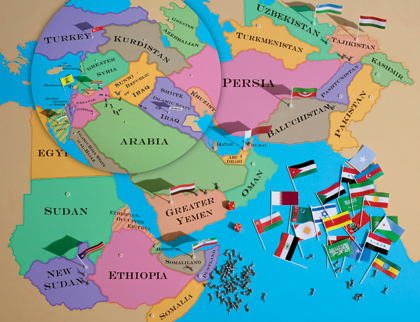
What is happening right now is very likely related to US plans to create aNew Middle East, the plans for which were revealed in 2006 by retired Lieutenant-Colonel Ralph Peters. The map, presented below, with the redrawn borders of the Middle East, indicates that Turkey would lose a large portion of its territory while Iraq would be split into three autonomous regions. This map also shows plans to partition Pakistan and reduce Iran’s territory, along with numerous other imperial agendas. 

Present Middle East


IV. The Human Toll


As to the human toll of this global war, a conservative estimate of how many people would die can be obtained by assuming that the same percentage of people that died in World War II would also die in World War III. 

In the 1940’s the world population was approximately 2.3 billion. World War II resulted in 60 to 80 million deaths (38 to 55 million of which were civilian casualties). This means that approximately 4% of the world’s population was killed. 

At present, the world population is approximately 7 billion. If we assume that the same percentage of people will die during this world war than the last, it would mean that over 280 million people will be dead in the next few years. This is a conservative estimate since nuclear weapons were introduced at the end of World War II, while they are being proposed at the beginning of World War III. The number of wounded will be approximately 1.5 billion if we assume a kill to wounded ratio of 1 to 5.