Showing posts with label Wars Of Aggression. Show all posts

Monday, April 14, 2014

British Armed Forces Could Be Given Immunity From Human Rights Laws


Philip Hammond, the Secretary of State for Defence Photo: Andrew Crowley for the Telegraph

Philip Hammond says he is prepared to introduce new powers to exempt armed forces from human rights laws which are hampering military operations 

The armed forces could be exempted from human rights laws because they are hampering British military operations in the field, Philip Hammond has said.


Mr Hammond said the government is prepared to introduce new legislation to protect the army from the "encroachment" of civil litigation on the battlefield.

His comments came amid concerns about the growing number of civil cases being brought against the Ministry of Defence.

Last year the Supreme Court ruled that damages claims could be launched by the families of soldiers killed in Iraq under human rights legislation.

A recent report by Policy Exchange found that the MoD has faced 5,827 claims since 2012, with litigation costing the ministry £36m a year. 

In the Commons yesterday, one MP warned that the "pernicious" human rights culture could lead to soldiers being barred from going out after dark.

Mr Hammond responded: "There are a number of cases currently before the courts or pending which could have a significant impact and we are watching them very closely.

"Once we commit our armed forces to combat they have to be able to carry out operations without fear of constant review in the civil courts.

"If we do find that the current cases develop in such a way that makes that difficult we will come back to the house with proposals to remedy the situation."

The report by Policy Exchange, published in October, found that recent judicial rulings showed a misunderstanding of how the armed forces work and were placing “impossible” bureaucratic burdens on troops.

The study warned a foreign power could in the future sponsor damage claims in order to paralyse the British armed forces through legal process.

Laura Croft, a military lawyer and retired US Army lieutenant colonel, who co-wrote the report, said: “[These rulings] are placing impossible burdens on the bureaucracy of military operations.

“By setting precedents which can barely be satisfied in today's limited conflicts the courts risk paralysing themselves and the military in a war of national survival.


“The paperwork alone would simply overwhelm the MoD even if the findings of the eventual inquiries ascribed no blame.” 

Tuesday, April 08, 2014

America's Planned War On Britain


War Plan Red

Joint Army and Navy Basic War Plan Red was a war plan created by the United States Army and Navy in the late 1920s and early 1930s to estimate the requirements for a hypothetical war with Great Britain (the "Red" forces).[1] War Plan Red discussed the potential for fighting a war with Britain and its Empire and outlined those steps necessary to defend the Atlantic coast against any attempted mainland invasion of the United States. It further discussed fighting a two-front war with both Japan and Britain simultaneously (as envisioned in War Plan Red-Orange). War Plan Red was not operationalized and did not have presidential or Congressional approval. In the U.S. only the Congress can declare war, and it made no war plans. President Herbert Hoover was known as a pacifist.[2]
War Plan Red was developed by the United States Army following the 1927 Geneva Naval Conference and approved in May 1930 by the Secretary of War and the Secretary of Navy and updated in 1934–35. In 1939 on the outbreak of World War II and Britain's war against Nazi Germany, a decision was taken that no further planning was required but that the plan be retained.[3] War Plan Red was not declassified until 1974.
The war plan outlined those actions that would be necessary to initiate war between Britain and the United States. The plan suggested that the British would initially have the upper hand by virtue of the strength of theRoyal Navy. The plan further assumed that Britain would probably use its Dominion in Canada as a springboard from which to initiate a retaliatory invasion of the United States. The assumption was taken that at first Britain would fight a defensive battle against invading American forces, but that the US would eventually defeat the British by blockading the United Kingdom and economically isolating it.[4]

Zones Of Operation

The main zones of operation discussed in the plan are:
  • Nova Scotia and New Brunswick:
    • Occupying Halifax, following a poison gas first strike, would deny the British a major naval base and cut links between Britain and Canada.
    • The plan considers several land and sea options for the attack and concludes that a landing at St. Margarets Bay, a then undeveloped bay near Halifax, would be superior to a direct assault via the longer overland route.
    • Failing to take Halifax, the U.S. could occupy New Brunswick by land to cut Nova Scotia off from the rest of Canada at the key railway junction at Moncton.
  • Quebec and the valley of the Saint Lawrence River:
    • Occupying Montreal and Quebec City would cut the remainder of Canada off from the Eastern seaboard, preventing the movement of soldiers and resources in both directions.
    • The routes from northern New York to Montreal and from Vermont to Quebec are both found satisfactory for an offensive, with Quebec being the more critical target.
  • Ontario and the Great Lakes area:
    • Occupying this region gains control of Toronto and most of Canada's industry, while also preventing Britain and Canada from using it for air or land attacks against the U.S. industrial heartland in the Midwest.
    • The plan proposes simultaneous offensives from Buffalo across the Niagara River, from Detroit into Windsor Ontario, and from Sault Ste. Marie into Sudbury. Controlling the Great Lakes for U.S. transport is considered logistically necessary for a continued invasion.
  • Winnipeg
    • Winnipeg is a central nexus of the Canadian rail system for connecting the country.
    • The plan sees no major obstacles to an offensive from Grand Forks, North Dakota, to Winnipeg.
  • Vancouver and Victoria:

Friday, December 13, 2013

The Victory That Wrecked Israel


By Taki Theodoracopulos 
William Buckley writes this week in his syndicated column about the ghosts of Vietnam watching us in Iraq. They sure are. Everyone in Europe seems to be writing about the 1967 Six-Day War, where Israel wiped out the Egyptian, Syrian and Jordanian armies in six quick days of mayhem.

Only a brave few, on the other hand, have mentioned the U.S.S. Liberty, the American spy ship that was rocketed and strafed by the Israelis while it was in neutral waters, with great loss of American lives. 

LBJ quashed all inquiries following the unprovoked attack, and the Israeli lobby took care of the rest. 

...Israel had been rumored to be about to attack the Arabs by early spring 1967.

A landmine had killed three Israeli soldiers and a retaliatory strike against Jordan saw a school, a hospital, a post office, a library and more than one hundred houses blown up.

Moshe Dayan headed the hawks who wanted a pre-emptive strike against Nasser. He had his way when, on June 5, Israeli fighter jets launched a strike which caught the Egyptian air force on the ground, effectively destroying it. Exploiting its dominance of the skies, Israel won its greatest victory.

One thing is for sure: The Arabs, there was never the slightest chance that they would have attacked Israel. 

Nasser had closed the Straits of Tiran in an act of folly and brinkmanship, but he was as likely to attack the Jewish state as Saddam Hussein was ready to launch his WMDs on New York city.

This was 40 long years ago. The Pyrrhic consequences of the occupation of Arab lands are obvious.

There are now thousands of illegal settlements, there is terrorism and intensification of Palestinian nationalism, and an ever-deepening hatred between Jews and Palestinians. Only distrust prevails.

A quarter of a million Israelis are squatting on Palestinian land, while terrible privations have been imposed on the local population.

Was any of this worth it? Personally, I do not think so.

The occupation has changed the Jewish character for the worse, and has made Israel and its principal backer, the United States, the two most hated countries in the world.

As the saying goes, no one has ever cried more bitter tears than the one who had their prayers answered.

Wednesday, October 16, 2013

Blow Them Away In The Name Of The Lord


Jesus and War

By John W. Whitehead


“Put your sword back in its place, for all who draw the sword will die by the sword.” ~ Jesus
With President Bush’s veto of the recent spending bill, fighting in the Middle East will continue indefinitely – wars not only waged by an avowed Christian president but also backed by the evangelical Christian Right. 
Rev. Jerry Falwell, in speaking of terrorists, epitomizes the Bush Administration’s stance: “I’m for the president to chase them all over the world. If it takes 10 years, blow them away in the name of the Lord.” In this way, Christianity is joined with the state and its war machine.
However, what would Jesus think about this in light of his teachings against the use of violence – war, of course, being organized, systematic violence?
One can only imagine that he would be horrified. After all, many who strive to follow Jesus’ teachings find it impossible to do so and still participate in war. Indeed, leaders in the early church adopted Jesus’ attitude of nonviolence. Tertullian (born about AD 160), one of the giants of the early church, stated very clearly that confessing “Jesus as Lord” means taking the teachings of Jesus seriously. Just as Caesar commanded men to kill their enemies, Jesus commanded them to love their enemies. Caesar made use of chains and torture, in much the same way as governments do today. Jesus, on the other hand, taught Christians to forgive and to sacrifice power for servanthood.
In fact, Tertullian had pithy advice for soldiers who converted to Christianity: quit the army or be martyred for refusing to fight. Tertullian was not alone in his thinking. “For three centuries,” writes biblical scholar Walter Wink in The Powers That Be (1998), “no Christian author to our knowledge approved of Christian participation in battle.” This, of course, changed in the third century when the church was institutionalized and became an integral part of the warring Roman Empire.
Jesus’ apostles never advocated violence. Rather, they urged their followers to suffer, forgive and trust God for the outcome rather than take matters into their own hands. And while they may have talked about warfare and fighting, it was not through the use of conventionalweapons. For example, the Apostle Paul wrote: “For though we live in the world, we do not wage war as the world does. The weapons we fight with are not the weapons of the world.”
Christ’s crucifixion was a radical repudiation of the use of violent force. And the cross, which was the Roman tool of execution, was reserved especially for leaders of rebellions. “Anyone proclaiming a rival kingdom to the kingdom of Caesar would be a prime candidate for crucifixion,” writes Brian McLaren in The Secret Message of Jesus (2006). “This is exactly what Jesus proclaimed, and this is exactly what he offered.” But Jesus’ kingdom was one of peace. Among other things, he proclaimed, “Love your enemies, do good to those who hate you, bless those who curse you, and pray for those who spitefully use you. To him who strikes you on the one cheek, offer the other also.” Consequently, Jesus ordered Peter not to use the sword, even to protect him.
The so-called Roman peace (Pax Romana) was made possible by the cross. That is, people so feared crucifixion that many opted not to challenge the emperor rather than face the possibility of death on the cross. Why then would early Christians choose the cross – an instrument of torture, domination, fear, intimidation and death – as their primary symbol? What could this possibly mean?
For early Christians, “it apparently meant that the kingdom of God would triumph not by inflicting violence but by enduring it,” notes McLaren, “not by making others suffer but by willingly enduring suffering for the sake of justice – not by coercing or humiliating others but by enduring their humiliation with gentle dignity.” Jesus, they believed, had taken the empire’s instrument of torture and transformed it into God’s symbol of the repudiation ofviolence. The message? Love, not violence, is the most powerful force in the universe.
Not surprisingly, the early Christians were not crusaders or warriors but martyrs – men and women with the faith and courage to face the lions. Like Jesus, they chose to suffer rather than inflict violence.
When Jesus said “Blessed are the peacemakers,” exhorting his followers to turn the other cheek and give freely, he was telling us that active peacemaking is the way to end war. Can you imagine what the world would be like if every church adopted that attitude and focusedits energies on active peacemaking?
The Rev. Martin Luther King, Jr., who vocally opposed the Vietnam War, took to heart Jesus’ teachings about peacemaking. In his acceptance speech for the Nobel Peace Prize, King proclaimed:
Peace is not merely a distant goal that we seek, but a means by which we arrive at that goal. We will not build a peaceful world by following a negative path. It is not enough to say “we must not wage war.” It is necessary to love peace and sacrifice for it. We must concentrate not merely on the negative expulsion of war but the positive affirmation of peace.
This is not to say that Jesus was a pacifist. The opposite is true. Hespoke truth to power and engaged in active resistance to injustice. In my opinion, Jesus would have intervened to defend someone beingviolently mistreated, and I believe we must do the same. But hewould never have engaged in violence as the means to an end.
One has to wonder what Jesus would say about war being waged in his name today. As Gary Wills writes in What Jesus Meant (2006), “If people want to do battle for God, they cannot claim Jesus has called them to this task, since he told Pilate that his ministers would not do that.” In fact, as Wills notes, Jesus “never accepted violence as justified.”

Thursday, September 26, 2013

Egypt Threatens Hamas Will Military Strike

"If we feel that there are parties in Hamas or other parties trying to violate Egyptian national security, our response will be severe," said Nabil Fahmy, foreign minister in the army-installed cabinet that came to office after Abdel Fattah Al-Sisi's military coup.
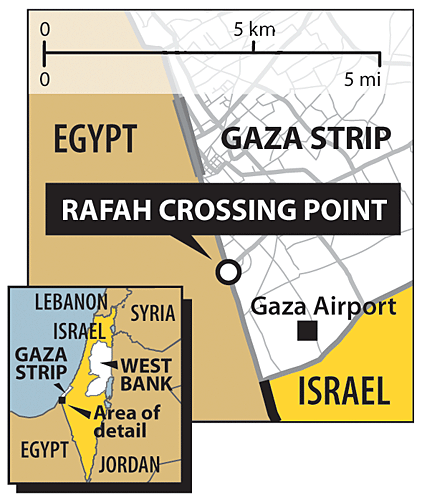
Asked whether any response would include a closure of the Rafah border crossing between Gaza and Egypt, Fahmy said: "Options are military-security."
Hamas denounced the threats and responded by stating:
"We were expecting an Egyptian position supporting the Aqsa Mosque and preventing its division, and not a threat by the foreign minister of Egypt to attack Gaza. We affirm that such remarks undermine Egypt's ethics and role in protecting our people."
"We will remain defenders of the Arab and Muslim nations' pride and dignity, and our main struggle is only against the Israeli occupation, the greatest threat to Egypt and Palestine."
It also said that this new Egyptian position only serve the Israeli occupation regime which has taken advantage of the military coupe and are trying to drive a wedge between Gaza and Egypt.

It highlighted that Gaza and its resistance would always remain the first line of defense for Egypt and the whole Muslim nation and a protector for Egypt's national security and borders.

Tuesday, August 20, 2013

Afghanistan: The Price Of Revenge


More Than A Decade Ago The US Launched A War Against Afghanistan, But Was It A Justified Battle?


Courtesy Of Al-Jazeera


After years of violence and bloodshed, the lives of more than 3,000 soldiers have been lost, and the US leaves behind a country on the brink of civil war.

They did not participate in 9/11. Not a single Afghan, not a single Taliban, was in that terrorist act.
Arturo Munoz, a former CIA officer
The official rhetoric has not stood up to the stark reality on the ground: Osama bin Laden was found and killed elsewhere - in neighbouring Pakistan; al-Qaeda and the Taliban may have been an ideological combination conveniently cooked up by the hawks in Washington; and the fate of Afghan women was just used as an excuse to sell the war to a Western public.

In this film, all parties to the conflict - members of the US secret service, commanders of the US armed forces, Taliban officials, Afghan warlords and tribal leaders, UN negotiators, Pakistani leaders and secret service, and NGO officials - give their view, unravelling the tangled web of a war that had no other motive than America’s thirst for revenge.

Western democracies promised Afghanistan a better future. But they will leave the country in a state of widespread corruption and disillusion, with thousands of lives lost, and the Taliban more powerful than ever.

Afghanistan, which was once the ideal target, has today become a volcano.

Tuesday, July 30, 2013

The War On Syria Planned 2 Years Before “The Arab Spring”


By Gearóid Ó Colmáin

In an interview with the French TV station LCP, former French minister for Foreign Affairs Roland Dumas said:
‘’ I’m going to tell you something. I was in England two years before the violence in Syria on other business. I met with top British officials, who confessed to me that they were preparing something in Syria.
This was in Britain not in America. Britain was organizing an invasion of rebels into Syria. They even asked me, although I was no longer minister for foreign affairs, if I would like to participate.
Naturally, I refused, I said I’m French, that doesn’t interest me.’’
Dumas went on give the audience a quick lesson on the real reason for the war that has now claimed the lives of tens of thousands of people.
‘’This operation goes way back. It was prepared, preconceived and planned… in the region it is important to know that this Syrian regime has a very anti-Israeli stance.
Consequently, everything that moves in the region- and I have this from the former Israeli prime minister who told me ‘we’ll try to get on with our neighbours but those who don’t agree with us will be destroyed.
It’s a type of politics, a view of history, why not after all. But one should know about it.’’
Dumas is a retired French foreign minister who is obliged to use discretion when revealing secrets which could affect French foreign policy. That is why he made the statement ‘I am French, that doesn’t interest me’.  He could not reveal France’s role in the British plan as he would be exposing himself to prosecution for revealing state secrets.
There have been many disinformation agents in the British and French press, many of them well known ‘leftist’ war correspondents and commentators, who have tried to pretend that Israel secretly supports Assad.  Those who make such arguments are either stupid, ignorant or deliberate disinformation agents of NATO and Israel.
Israel’s support for Al Qaeda militants in Syria has even been admitted by the mainstream press. For example, Germany’s Die Welt newspaper published a report on June 12th on Israel’s medical treatment of the Al Qaeda fighters.
Israel planned this war of annihilation years ago in accordance with the Yinon Plan, which advocates balkanization of all states that pose a threat to Israel. The Zionist entity is using Britain and France to goad the reluctant Obama administration into sending more American troops to their death in Syria on behalf of Tel Aviv.
Of all the aggressor states against Syria, Israel has been the quietest from the start. That is because Laurent Fabius, Francois Holland, William Hague and David Cameron are doing their bidding by attempting to drag Israel’s American Leviathan into another ruinous war so that Israel can get control of the Middle East’s energy reserves, eventually replacing the United States as the ruling state in the world. It has also been necessary for Tel Aviv to remain silent so as not to expose their role in the ‘revolutions’, given the fact that the Jihadist fanatics don’t realize they are fighting for Israel.
This is the ideology of Zionism which cares no more for Jews than it does for its perceived enemies.   The Jewish colony is determined to become a ruling state in the Middle East in the insane delusion that this will enable it to replace the United States as a global hegemon, once the US collapses fighting Israel’s wars.
Israeli Prime Minister once told American talk show host Bill Maher that the reason why Israel always wins short conflicts, while the United States gets bogged down in endless wars. ‘’ The secret is that we have America’’, he said.
But Israel is itself slowly collapsing. If one excludes the enslaved Palestinian population, the Jewish state still has the highest level of poverty in the developed world with more and more Jews choosing to leave the ‘promised’ land, a garrison state led by mad men, an anti-Semitic entity threatening to engulf the world in war and destruction. Israel cares no more about its own working class Jews than any other ethnic community.
In fact, if the Likudnik crooks running the Israeli colony get their way, working class Israelis will be among the first to pay as they are conscripted to fight terrorists created by their own government. With orthodox Jews protesting in the streets of New York against Israel and Haredi Jewish minority opposing Israel’s rampant militarism, Zionism is coming under increased attack from Jewish religious authorities and non-Zionist Jews both inside and outside of the occupied territories.
This is not the first time that Roland Dumas has spoken out against wars of aggression waged by successive French regimes. In 2011 he revealed that he had been asked by the United States when he was foreign minister in the Mitterrand administration to organize the bombing of Libya. On that occasion the French refused to cooperate.  Dumas, a lawyer by profession, offered to defend Colonel Gaddafi, at the International Criminal Court in the event of his arrest by Nato.
Dumas was also vocal in condemning France’s brutal neo-colonial bombing of the Ivory Coast earlier in 2011, were death squads and terrorists similar to those later deployed in Libya and Syria were unleashed upon the Ivoirian population in order to install a IMF puppet dictator Alassane Quattara in power. Gbagbo was described as one of the greatest African leaders of the past 20 years by Jean Ziegler, sociologist and former member of the Advisory Committee of the UN Human Rights Council.
Gbagbo had plans to nationalize banks and wrest control of the country’s currency from the colonial finance institutions in Paris. He also wanted to roll back many of the worst effects of IMF restructuring by nationalizing industries and creating a functioning, universal free health service. All of this threatened the interests of French corporations in the former French colony. So, the Parisian oligarchy went to work to find a suitable replacement as caretaker of their Ivoirian colony.
They sent in armed terrorist gangs, or ‘rebel’s in the doublespeak of imperialism, who murdered all before them while the French media blamed president Gbagbo for the violence that ensued. Gbagbo and Gaddafi had opposed Africom, the Pentagon’s plan to recolonize Africa. That was another reason for the  2011 bombing of their two African countries.
The formula is always the same. Imperialism backs ‘rebels’, whenever its interests are threatened by regimes that love their country more than foreign corporations.  One should not forgot that during the Spanish Civil War of 1936, General Franco and his cronies were also ‘rebels’ and they, like their counterparts in Libya in 2011, were bombed to power by foreign powers, replacing a progressive, republican administration with fascism.
There are pro-Israeli fanatics in France who have used the analogy of the Spanish Civil War as justification for intervention in Libya and Syria. The pseudo-philosopher Henry Bernard Levy is one of them.  Of course, the ignoramus Levy doesn’t realize that the reason France, England and the USA did not officially intervene in the Spanish Civil War is because they were covertly helping the ‘rebels’ from the start. They enabled arms shipments to the Francoist ‘rebels’ while preventing arms deliveries to the Spanish government, who, like Syria today, were helped by Moscow. Anyone who has studied the Spanish Civil War knows that all the imperialist countries wanted Franco as a bulwark against communism.
There is nothing imperialism loves more than a rebel without a cause. What imperialism hates, however, are revolutionaries. That is why the ‘rebels’ which imperialism sends into other countries to colonize them on behalf of foreign banks and corporations, have to be marketed as ‘revolutionaries’ in order to assure the support of the Monty Python brigade of petty-bourgeois, ‘ leftist’ dupes such as Democracy Now! and their ilk.
Dumas is not the only top French official to denounce the New World Order.  Former French ambassador to Syria Michel Raimbaud wrote a book in 2012  entitled ‘Le Soudan dans tous les états’, where he revealed how Israel planned and instigated a civil war in South Sudan in order to balkanize a country led by a pro-Palestinian government. He also exposed the pro-Israeli media groups and ‘human rights’ NGOS who created the ‘humanitarian’ narrative calling for military intervention by the United States in the conflict.
The subject was covered extensively by African investigative journalist Charles Onana in his 2009 book, Al-Bashir & Darfour LA CONTRE ENQUÊTE.
There are many more retired French officials who are speaking out about the ruinous policies of this French government, including the former head of French domestic intelligence Yves Bonnet. There have also been reports of dissent in the French armed forces and intelligence apparatus.
After the assassination of Colonel Gaddafi in October 2011, the former French ambassador to Libya Christian Graeff told French radio station France Culture that it was responsible for the diffusion of lies and war propaganda on behalf of Nato throughout the war.  Graeff also warned the broadcasters that such disinformation could only work on the minds of serfs but not in a country of free minds.
The power of the Israeli lobby in France is a subject rarely discussed in polite circles. In France there is a law against questioning or denial of the holocaust. However, denial of the Korean holocaust, Guatemalan holocaust, Palestinian holocaust, Indonesian holocaust and the dozens of other US/Israeli supported genocides is not only perfectly legal but is the respectable norm.
The same lobby which introduced the Loi Gayssot in 1990, effectively ending freedom of expression in France, would also like to ban any independent investigations of genocides whose narratives they have written, such as the Rwanda genocide, where Israel played a key role in supporting the ‘rebels’ led by Paul Kagame, who invaded Rwanda from Uganda from 1991 to 1994, leading to the genocide of both Tutus and Tutsis. Many serious scholars have written about the Rwandan genocide, which the Israel lobby repeatedly uses as a case study to justify ‘humanitarian’ intervention by Western powers.  The Zionist thought police would like to see such authors prosecuted for ‘negating’ imperialism’s disgusting lies on African conflicts.
Now, the Israeli Lobby is forcing the (their) French government to prosecute twitter messages which the lobby deems ‘anti-Semitic’. This is one further step towards the creation of a totalitarian state where any criticism of imperialism, foreign wars, racism, oppression, perhaps eventually capitalism itself could fall under the rubric of ‘anti-Semitism’.
These people are sick, and those who cow down to them are sicker. Perhaps the etymology of sickness, a word cognate with the German Sicherheit (security) according to dictionary.com, is not a coincidence. For what is particularly sick about our society is the cult of security,  endless surveillance, ubiquitous cameras, the cult of the all seeing eye, the prurient gaze as part of the incessant discourse on terrorism by those who specialize in the training of the very terrorists they claim to be protecting us from.  Whether or not the words security and sickness are linguistically related, they are certainly cognate in a philosophical sense.
Roland Dumas and others like him should be highly commended for having to guts to say what so many others are too morally corrupt, too weak and cowardly to admit.
As the French government and its media agencies drum up hysteria for war on Syria, Roland Dumas, now in the twilight of his years, is warning people of the consequences of not understanding where Israel is leading  the world. Will enough people heed the warning?

Friday, July 12, 2013

Bill Maher Shredded By Glenn Greenwald On US Intervention In Muslim Countries


Courtesy Of Real Time With Bill Maher and HBO,
Glenn Greenwald

Bill Maher is taken apart by Glenn Greenwald for trying to absolve the US from any responsibility for the mass slaughter and destruction in Muslim countries, blaming it on Islamic fundamentalism, as if the Afghanistan and Iraq wars never happened, as if the US wasn't pushing for more war in Iran, as if it isn't intervening in Somalia and Yemen.

Tuesday, July 09, 2013

The Eternal War


By Andrew Bacevich


Twelve and a half years after Congress didn’t declare war on an organization of hundreds or, at most, thousands of jihadis scattered mainly across the backlands of the planet, and instead let President George W. Bush and his cohort loose to do whatever they wanted; twelve and a half years after the president, his top officials, his neocon supporters, assembled pundits, and others swore we were nonetheless “at war” and the country in “wartime,” after our media beat the drums for “war” and assured us that “war” was our fate, after followers of the president insisted we were entering a monumental, multigenerational struggle, or even World War IV; twelve and a half years after the war that hadn’t been declared was launched and the bombing of Afghanistan began, after the CIA and Washington targeted up to 80 countries in a “worldwide attack matrix” -- later given the leave-no-location-out name the Global War on Terror -- and after top Washington officials swore we would soon “drain the [global] swamp,” another president has now assured us that someday, in a distant future, in a way that we might not even notice (“Our victory against terrorism won’t be measured in a surrender ceremony at a battleship...”), we might possibly find ourselves approaching the sort-of-end of what will have been a 20- or 30-year conflict.
At the National Defense University (NDU) last Thursday, President Obama, so media reports and editorials assured us, gave a speech in which he promised to dial back the war on terror as a “global” operation, curtail U.S. drone operations abroad, and launch another effort to whittle down, if not close, Guantanamo.  But a careful look at the text of his speech indicates that he still accepts the most basic premises of the previous administration: that we are “at war”; that the country, despite visible evidence to the contrary, is in “wartime”; and that, when a president decides it’s necessary, this planet will remain a global free-fire zone for drones, special operations forces, or whatever else he choses to throw at it.  He may even, reports Jonathan Landay of McClatchy News, have quietly expanded the categories of human beings that U.S. drones can attack. 
In those twelve and a half years between 9/11 and the recent speech, it’s been a bumpy ride through a minefield of unexpected IEDs.  Two invasions of the Eurasian mainland have led to two defeats that passed for better here and are bringing U.S. combat troops home with, as this president said, their “heads held high,” but also with massive numbers of PTSD casessuicides, and other debilitating issues.  In the meantime, America’s global warring has resulted in a significant destabilization of the Greater Middle East.  (The present Syrian disaster would have been unimaginable without the U.S. invasion of Iraq.)  It’s also resulted in the growth of an ever larger secret military cocooned inside the U.S. military, the special operations forces -- 10,000 of whom are now in Afghanistan alone -- and the launching of a series of drone wars and assassination campaigns across a significant swath of the planet.  These, from a White House that has taken on ever more power to do as it pleases in foreign and military policy, the president now claims to be curtailing and bringing under his version of the rule of law, largely because they haven't been working out so terribly well.  Finally, there’s the spread of the al-Qaeda franchise into areas Washington has helped unsettle, which, as the president indicated, ensures that our “war” cannot end any time soon.  Think of it as a Mobius strip of self-justifying conflict.
And yet, the ability of the U.S. to “project force” everywhere from the Mali-Niger border to the Philippines remains impressive.  Even its capacity to engage in a series of disasters over such an expanse of the planet for twelve and a half years and still be talking about “pivoting” militarily to Asia, while maintaining a massive build-up of U.S. forces around Iran, should give anyone pause.  It's a reminder that the now-seldom-heard term "sole superpower” continues to mean something.
But what? Somehow, like our empire of bases (and the private contractors that go with it), it’s been hard to absorb the continual use of such power projection and the vast web of military-to-military relationships and weapons sales that go with it, or the increasing ability of the White House alone to determine what makes sense and what doesn’t abroad, even as both the Greater Middle East and what’s left of American democracy and liberties are further destabilized.
Much of this has not yet been taken in here in a meaningful way, though you can feel it lurking, half-expressed, half-grasped, in the president’s NDU speech.  To begin to understand what’s actually been going on, it would help to define the “war” that we’ve been fighting all these years from North Africa to China's Central Asian border.  TomDispatch regular Andrew Bacevich, whose latest book Breach of Trust: How Americans Failed Their Soldiers and Their Country will be published in September, suggests that a good place to begin is by naming that now nameless “war.” (In fact, if, having checked out his piece, TomDispatch readers want to send in their own naming suggestions, along with their explanations for them, we might highlight a few of them above a future post.) Tom 
Naming Our Nameless War 

By Andrew J. Bacevich
For well over a decade now the United States has been “a nation at war.” Does that war have a name?
It did at the outset.  After 9/11, George W. Bush's administration wasted no time in announcing that the U.S. was engaged in a Global War on Terrorism, or GWOT.  With few dissenters, the media quickly embraced the term. The GWOT promised to be a gargantuan, transformative enterprise. The conflict begun on 9/11 would define the age. In neoconservative circles, it was known as World War IV.
Upon succeeding to the presidency in 2009, however, Barack Obama without fanfare junked Bush’s formulation (as he did again in a speech at the National Defense University last week).  Yet if the appellation went away, the conflict itself, shorn of identifying marks, continued.
Does it matter that ours has become and remains a nameless war? Very much so.

Names bestow meaning.  When it comes to war, a name attached to a date can shape our understanding of what the conflict was all about.  To specify when a war began and when it ended is to privilege certain explanations of its significance while discrediting others. Let me provide a few illustrations.
With rare exceptions, Americans today characterize the horrendous fraternal bloodletting of 1861-1865 as the Civil War.  Yet not many decades ago, diehard supporters of the Lost Cause insisted on referring to that conflict as the War Between the States or the War for Southern Independence (or even the War of Northern Aggression).  The South may have gone down in defeat, but the purposes for which Southerners had fought -- preserving a distinctive way of life and the principle of states’ rights -- had been worthy, even noble.  So at least they professed to believe, with their preferred names for the war reflecting that belief.
Schoolbooks tell us that the Spanish-American War began in April 1898 and ended in August of that same year.  The name and dates fit nicely with a widespread inclination from President William McKinley’s day to our own to frame U.S. intervention in Cuba as an altruistic effort to liberate that island from Spanish oppression.
Yet the Cubans were not exactly bystanders in that drama.  By 1898, they had been fighting for years to oust their colonial overlords.  And although hostilities in Cuba itself ended on August 12th, they dragged on in the Philippines, another Spanish colony that the United States had seized for reasons only remotely related to liberating Cubans.  Notably, U.S. troops occupying the Philippines waged a brutal war not against Spaniards but against Filipino nationalists no more inclined to accept colonial rule by Washington than by Madrid.  So widen the aperture to include this Cuban prelude and the Filipino postlude and you end up with something like this:  The Spanish-American-Cuban-Philippines War of 1895-1902.  Too clunky?  How about the War for the American Empire?  This much is for sure: rather than illuminating, the commonplace textbook descriptor serves chiefly to conceal.
Strange as it may seem, Europeans once referred to the calamitous events of 1914-1918 as the Great War.  When Woodrow Wilson decided in 1917 to send an army of doughboys to fight alongside the Allies, he went beyond Great.  According to the president, the Great War was going to be the War To End All Wars.  Alas, things did not pan out as he expected.  Perhaps anticipating the demise of his vision of permanent peace, War Department General Order 115, issued on October 7, 1919, formally declared that, at least as far as the United States was concerned, the recently concluded hostilities would be known simply as the World War.
In September 1939 -- presto chango! -- the World War suddenly became theFirst World War, the Nazi invasion of Poland having inaugurated a Second World War, also known as World War II or more cryptically WWII.  To be sure, Soviet dictator Josef Stalin preferred the Great Patriotic War.  Although this found instant -- almost unanimous -- favor among Soviet citizens, it did not catch on elsewhere.
Does World War II accurately capture the events it purports to encompass?  With the crusade against the Axis now ranking alongside the crusade against slavery as a myth-enshrouded chapter in U.S. history to which all must pay homage, Americans are no more inclined to consider that question than to consider why a playoff to determine the professional baseball championship of North America constitutes a “World Series.”
In fact, however convenient and familiar, World War II is misleading and not especially useful.  The period in question saw at least two wars, each only tenuously connected to the other, each having distinctive origins, each yielding a different outcome.  To separate them is to transform the historical landscape.
On the one hand, there was the Pacific War, pitting the United States against Japan.  Formally initiated by the December 7, 1941, attack on Pearl Harbor, it had in fact begun a decade earlier when Japan embarked upon a policy of armed conquest in Manchuria.  At stake was the question of who would dominate East Asia.  Japan’s crushing defeat at the hands of the United States, sealed by two atomic bombs in 1945, answered that question (at least for a time).
Then there was the European War, pitting Nazi Germany first against Great Britain and France, but ultimately against a grand alliance led by the United States, the Soviet Union, and a fast fading British Empire.  At stake was the question of who would dominate Europe.  Germany’s defeat resolved that issue (at least for a time): no one would.  To prevent any single power from controlling Europe, two outside powers divided it.
This division served as the basis for the ensuing Cold War, which wasn’t actually cold, but also (thankfully) wasn’t World War III, the retrospective insistence of bellicose neoconservatives notwithstanding.  But when did the Cold War begin?  Was it in early 1947, when President Harry Truman decided that Stalin’s Russia posed a looming threat and committed the United States to a strategy of containment?  Or was it in 1919, when Vladimir Lenin decided that Winston Churchill’s vow to “strangle Bolshevism in its cradle” posed a looming threat to the Russian Revolution, with an ongoing Anglo-American military intervention evincing a determination to make good on that vow?
Separating the war against Nazi Germany from the war against Imperial Japan opens up another interpretive possibility.  If you incorporate the European conflict of 1914-1918 and the European conflict of 1939-1945 into a single narrative, you get a Second Thirty Years War (the first having occurred from 1618-1648) -- not so much a contest of good against evil, as a mindless exercise in self-destruction that represented the ultimate expression of European folly.
So, yes, it matters what we choose to call the military enterprise we’ve been waging not only in Iraq and Afghanistan, but also in any number of other countries scattered hither and yon across the Islamic world.  Although the Obama administration appears no more interested than the Bush administration in saying when that enterprise will actually end, the date we choose as its starting point also matters.
Although Washington seems in no hurry to name its nameless war -- and will no doubt settle on something self-serving or anodyne if it ever finally addresses the issue -- perhaps we should jump-start the process.  Let’s consider some possible options, names that might actually explain what’s going on.
The Long War: Coined not long after 9/11 by senior officers in the Pentagon, this formulation never gained traction with either civilian officials or the general public.  Yet the Long War deserves consideration, even though -- or perhaps because -- it has lost its luster with the passage of time.
At the outset, it connoted grand ambitions buoyed by extreme confidence in the efficacy of American military might.  This was going to be one for the ages, a multi-generational conflict yielding sweeping results.
The Long War did begin on a hopeful note.  The initial entry into Afghanistan and then into Iraq seemed to herald “home by Christmas” triumphal parades.  Yet this soon proved an illusion as victory slipped from Washington’s grasp.  By 2005 at the latest, events in the field had dashed the neo-Wilsonian expectations nurtured back home.
With the conflicts in Iraq and Afghanistan dragging on, “long” lost its original connotation.  Instead of “really important," it became a synonym for “interminable.”  Today, the Long War does succinctly capture the experience of American soldiers who have endured multiple combat deployments to Iraq and Afghanistan.
For Long War combatants, the object of the exercise has become to persist.  As for winning, it’s not in the cards. The Long War just might conclude by the end of 2014 if President Obama keeps his pledge to end the U.S. combat role in Afghanistan and if he avoids getting sucked into Syria’s civil war.  So the troops may hope.
The War Against Al-Qaeda: It began in August 1996 when Osama bin Laden issued a "Declaration of War against the Americans Occupying the Land of the Two Holy Places,” i.e., Saudi Arabia.  In February 1998, a second bin Laden manifesto announced that killing Americans, military and civilian alike, had become “an individual duty for every Muslim who can do it in any country in which it is possible to do it.”
Although President Bill Clinton took notice, the U.S. response to bin Laden’s provocations was limited and ineffectual.  Only after 9/11 did Washington take this threat seriously.  Since then, apart from a pointless excursion into Iraq (where, in Saddam Hussein’s day, al-Qaeda did not exist), U.S. attention has been focused on Afghanistan, where U.S. troops have waged the longest war in American history, and on Pakistan’s tribal borderlands, where a CIA drone campaign is ongoing.  By the end of President Obama’s first term, U.S. intelligence agencies were reporting that a combined CIA/military campaign had largely destroyed bin Laden’s organization.  Bin Laden himself, of course, was dead. 
Could the United States have declared victory in its unnamed war at this point?  Perhaps, but it gave little thought to doing so.  Instead, the national security apparatus had already trained its sights on various al-Qaeda “franchises” and wannabes, militant groups claiming the bin Laden brand and waging their own version of jihad.  These offshoots emerged in the Maghreb, Yemen, Somalia, Nigeria, and -- wouldn’t you know it -- post-Saddam Iraq, among other places.  The question as to whether they actually posed a danger to the United States got, at best, passing attention -- the label “al-Qaeda” eliciting the same sort of Pavlovian response that the word “communist” once did.
Americans should not expect this war to end anytime soon.  Indeed, the Pentagon’s impresario of special operations recently speculated -- by no means unhappily -- that it would continue globally for “at least 10 to 20 years.”   Freely translated, his statement undoubtedly means: “No one really knows, but we’re planning to keep at it for one helluva long time.”
The War For/Against/About Israel: It began in 1948.  For many Jews, the founding of the state of Israel signified an ancient hope fulfilled.  For many Christians, conscious of the sin of anti-Semitism that had culminated in the Holocaust, it offered a way to ease guilty consciences, albeit mostly at others’ expense.  For many Muslims, especially Arabs, and most acutely Arabs who had been living in Palestine, the founding of the Jewish state represented a grave injustice.  It was yet another unwelcome intrusion engineered by the West -- colonialism by another name.
Recounting the ensuing struggle without appearing to take sides is almost impossible.  Yet one thing seems clear: in terms of military involvement, the United States attempted in the late 1940s and 1950s to keep its distance.  Over the course of the 1960s, this changed.  The U.S. became Israel’s principal patron, committed to maintaining (and indeed increasing) its military superiority over its neighbors.
In the decades that followed, the two countries forged a multifaceted “strategic relationship.”  A compliant Congress provided Israel with weapons and other assistance worth many billions of dollars, testifying to what has become an unambiguous and irrevocable U.S. commitment to the safety and well-being of the Jewish state.  The two countries share technology and intelligence.  Meanwhile, just as Israel had disregarded U.S. concerns when it came to developing nuclear weapons, it ignored persistent U.S. requests that it refrain from colonizing territory that it has conquered.
When it comes to identifying the minimal essential requirements of Israeli security and the terms that will define any Palestinian-Israeli peace deal, the United States defers to Israel.  That may qualify as an overstatement, but only slightly.  Given the Israeli perspective on those requirements and those terms -- permanent military supremacy and a permanently demilitarized Palestine allowed limited sovereignty -- the War For/Against/About Israel is unlikely to end anytime soon either.  Whether the United States benefits from the perpetuation of this war is difficult to say, but we are in it for the long haul.
The War for the Greater Middle East: I confess that this is the name I would choose for Washington’s unnamed war and is, in fact, the title of a course I teach.  (A tempting alternative is the Second Hundred Years War, the "first" having begun in 1337 and ended in 1453.)
This war is about to hit the century mark, its opening chapter coinciding with the onset of World War I.  Not long after the fighting on the Western Front in Europe had settled into a stalemate, the British government, looking for ways to gain the upper hand, set out to dismantle the Ottoman Empire whose rulers had foolishly thrown in their lot with the German Reich against the Allies.
By the time the war ended with Germany and the Turks on the losing side, Great Britain had already begun to draw up new boundaries, invent states, and install rulers to suit its predilections, while also issuing mutually contradictory promises to groups inhabiting these new precincts of its empire.  Toward what end?  Simply put, the British were intent on calling the shots from Egypt to India, whether by governing through intermediaries or ruling directly.  The result was a new Middle East and a total mess.
London presided over this mess, albeit with considerable difficulty, until the end of World War II.  At this point, by abandoning efforts to keep Arabs and Zionists from one another's throats in Palestine and by accepting the partition of India, they signaled their intention to throw in the towel. Alas, Washington proved more than willing to assume Britain’s role.  The lure of oil was strong.  So too were the fears, however overwrought, of the Soviets extending their influence into the region. 
Unfortunately, the Americans enjoyed no more success in promoting long-term, pro-Western stability than had the British.  In some respects, they only made things worse, with the joint CIA-MI6 overthrow of a democratically elected government in Iran in 1953 offering a prime example of a “success” that, to this day, has never stopped breeding disaster.
Only after 1980 did things get really interesting, however.  The Carter Doctrine promulgated that year designated the Persian Gulf a vital national security interest and opened the door to greatly increased U.S. military activity not just in the Gulf, but also throughout the Greater Middle East (GME).  Between 1945 and 1980, considerable numbers of American soldiers lost their lives fighting in Asia and elsewhere.  During that period, virtually none were killed fighting in the GME.  Since 1990, in contrast, virtually none have been killed fighting anywhere except in the GME.
What does the United States hope to achieve in its inherited and unending War for the Greater Middle East?  To pacify the region?  To remake it in our image?  To drain its stocks of petroleum?  Or just keeping the lid on?  However you define the war’s aims, things have not gone well, which once again suggests that, in some form, it will continue for some time to come.  If there’s any good news here, it’s the prospect of having ever more material for my seminar, which may soon expand into a two-semester course.
The War Against Islam: This war began nearly 1,000 years ago and continued for centuries, a storied collision between Christendom and the Muslim ummah.  For a couple of hundred years, periodic eruptions of large-scale violence occurred until the conflict finally petered out with the last crusade sometime in the fourteenth century.
In those days, many people had deemed religion something worth fighting for, a proposition to which the more sophisticated present-day inhabitants of Christendom no longer subscribe.  Yet could that religious war have resumed in our own day?  Professor Samuel Huntington thought so, although he styled the conflict a “clash of civilizations.”  Some militant radical Islamists agree with Professor Huntington, citing as evidence the unwelcome meddling of “infidels,” mostly wearing American uniforms, in various parts of the Muslim world.  Some militant evangelical Christians endorse this proposition, even if they take a more favorable view of U.S. troops occupying and drones targeting Muslim countries.
In explaining the position of the United States government, religious scholars like George W. Bush and Barack (Hussein!) Obama have consistently expressed a contrary view.  Islam is a religion of peace, they declare, part of the great Abrahamic triad.  That the other elements of that triad are likewise committed to peace is a proposition that Bush, Obama, and most Americans take for granted, evidence not required.  There should be no reason why Christians, Jews, and Muslims can’t live together in harmony.
Still, remember back in 2001 when, in an unscripted moment, President Bush described the war barely begun as a “crusade”?  That was just a slip of the tongue, right?  If not, we just might end up calling this one the Eternal War.