Showing posts with label Human Rights. Show all posts

Thursday, December 04, 2014

Cops Are An Occupying Army and We Are The Enemy


The war on terror has essentially turned police into occupying armies in some American communities of color.

“I remember it being drilled into me as a police officer, as a sergeant and then as a lieutenant: partnership, problem-solving, and prevention – the three Ps,” 
“In the early 2000s, particularly after 9/11, we saw a paradigm shift from community policing and problem-oriented principles to the war on terror, and we became Homeland Security police.
This shift toward “homeland security” had quickly destroyed the relationships police had worked nearly two decades to build.
“I think what has happened as a direct result of that, is that those relationships that we forged, and worked so hard to attain and to maintain in the late 1980s and early 1990s, began to erode because the police were seen, particularly in communities of color, as an army of occupation.”
“If you dress police officers up as soldiers and you put them in military vehicles and you give them military weapons, they adopt a warrior mentality.” 
“We fight wars against enemies, and the enemies are the people who live in our cities – particularly in communities of color.”
“We weren’t included in the discussion, we didn’t know anything about it, and I think Ferguson has brought that into the glare of the public spotlight.”
“I see the police conducting themselves in a highly militaristic fashion on routine patrol activities — and I know that’s what they’re doing because I come from that world.” 
“What I experience and what people on the street experience is a palpable, tangible sense of fear, and that is that we are unsafe if police need semiautomatic rifles to protect us and to keep us safe.”
“What we saw in that aftermath was the unilateral suspension of the United States Constitution, and particularly the Fourth Amendment.”
“We saw for the first time that I can recall in the United States of America house-to-house searches.”
“and what I said to some colleagues of mine, who work in the news media, that when we fail to object to what’s going on now, and we did, we forfeited our right to do so in the future — and we have.”

Tuesday, October 21, 2014

Free People Claim Their Rights


Your rights are yours by the very nature of your birth. You have them whether a document or a government says so or not. And while governments at every level will always work to limit or destroy your rights, it’s up to you – and others – to defend them.

How to do that? Thomas Jefferson had what I believe to be the most important advice on this front:

“A free people claim their rights, as derived from the laws of nature, and not as the gift of their chief magistrate.”

Monday, April 14, 2014

British Armed Forces Could Be Given Immunity From Human Rights Laws


Philip Hammond, the Secretary of State for Defence Photo: Andrew Crowley for the Telegraph

Philip Hammond says he is prepared to introduce new powers to exempt armed forces from human rights laws which are hampering military operations 

The armed forces could be exempted from human rights laws because they are hampering British military operations in the field, Philip Hammond has said.


Mr Hammond said the government is prepared to introduce new legislation to protect the army from the "encroachment" of civil litigation on the battlefield.

His comments came amid concerns about the growing number of civil cases being brought against the Ministry of Defence.

Last year the Supreme Court ruled that damages claims could be launched by the families of soldiers killed in Iraq under human rights legislation.

A recent report by Policy Exchange found that the MoD has faced 5,827 claims since 2012, with litigation costing the ministry £36m a year. 

In the Commons yesterday, one MP warned that the "pernicious" human rights culture could lead to soldiers being barred from going out after dark.

Mr Hammond responded: "There are a number of cases currently before the courts or pending which could have a significant impact and we are watching them very closely.

"Once we commit our armed forces to combat they have to be able to carry out operations without fear of constant review in the civil courts.

"If we do find that the current cases develop in such a way that makes that difficult we will come back to the house with proposals to remedy the situation."

The report by Policy Exchange, published in October, found that recent judicial rulings showed a misunderstanding of how the armed forces work and were placing “impossible” bureaucratic burdens on troops.

The study warned a foreign power could in the future sponsor damage claims in order to paralyse the British armed forces through legal process.

Laura Croft, a military lawyer and retired US Army lieutenant colonel, who co-wrote the report, said: “[These rulings] are placing impossible burdens on the bureaucracy of military operations.

“By setting precedents which can barely be satisfied in today's limited conflicts the courts risk paralysing themselves and the military in a war of national survival.


“The paperwork alone would simply overwhelm the MoD even if the findings of the eventual inquiries ascribed no blame.” 

Monday, September 30, 2013

French Interior Minister: Throw Out Roma People

French police stand guard as they evacuate a Roma encampment near Lille, on September 18, 2013 (AFP, Denis Charlet)

French Interior Minister Manuel Valls has defended his controversial call to deport tens of thousands of ethnic Roma people from the country, amid widespread criticism both from colleagues and the EU.

Valls said on Wednesday that he has "nothing to correct" and that the remarks "only shocked those who do not know the subject." 
"The majority (of Romas) should be delivered back to the borders," said Valls adding, "We are not here to welcome these people. I'd remind you of (former Socialist premier) Michel Rocard's statement: 'It's not France's job to deal with the misery of the whole world'."
The remarks came a day after Valls said any non-working Romas in France should be sent back to the borders, describing their way of life as "extremely different from ours," and claiming they will never integrate into French society. 


Saturday, September 21, 2013

Warfare and Torture In A Global Context


By Muhammad Khan
The Muslim News (UK)

Torture and the Twilight of Empire, from Algiers to Baghdad. By Marnia Lazreg. New Jersey: Princeton University Press, pp335, 2008, HB, £17.95.

Professor Emeritus of International Law at Princeton University, Richard Falk, once wrote, “Undoubtedly, part of the hidden cost of patriotic excesses is the tendency to become insensitive to infringements on liberties at home, and human rights generally. To the extent this pattern can be attributed to the impact of September 11, it represents an indirect victory for the al-Qaeda attacks, compromising the most legitimate elements of the American reality, including its own proudest traditions as first enunciated in the Declaration of Independence, heroically enacted in the Revolutionary War, and enshrined in the Constitution on the basis of the Federalist Papers and an exemplary constitutional convention. At the same time, it is important to avoid self-congratulatory assessments of America’s human rights record, which has throughout its period as a coherent country been beset by glaring contradictions between proclaimed values and actual practices at home and abroad.” (The Great Terror War, p147)

If Falk’s case against the American human rights record especially in relation to the so-called ‘War on Terror’ is a damning one, then Marnia Lazreg’s interdisciplinary analysis of the abuse of human rights and dignity in the form of state-sponsored torture and cruelty could not have been more powerful and pertinent. Indeed, according to the author of the book under review, “Informed by a utilitarian perspective that seeks to maximize gains and minimize losses, the formula ‘the ends justify the means’ considers torture an efficient means to achieve ends deemed morally worthy. Its variant, to which I will refer as the apologetic perspective, condones the use of torture as one of the options a politician might have to choose in a situation of crisis. This perspective has roots in the premise that politicians are not necessarily moral people; ‘they are often killers.’ Of course, some decent men do at times enter politics. And when they do, they sometimes face ‘moral dilemmas’ that they resolve by ordering actions that dirty their hands…But this method of reasoning reflects a major problem plaguing the apologetic perspective: it thrives on hypothetical situations, which, in this case at least, are simplifications of what actually occurs in real life. And because they are simplifications, these hypothetical situations rest on the selection of one or two features (a ‘rebel’ and ‘bombs’) from an intricate political reality requiring serious analysis in order to shed light on the decision to use torture.”(p 237-238)

As it happens, the author of this book was inspired to research and write about the psychological, cultural and political meanings of torture by the following incident: “In the course of a discussion about the Algerian war, a disenchanted man in his twenties who worked in the mailroom of a government institution where I had been employed in the early years of independence when I was still a student, said to me: ‘The French army broke my testicles! And here I am recording mail day in, day out.’ A shy young woman at the time, I had not quite grasped the enormity of the pain and suffering that this man had experienced, nor had I understood his trauma, although I glimpsed the depth of the anger that gleamed in his eyes.” (p1)

Based on her analysis of the French army’s coercive tactics during the Algerian war of 1954-1962 and the American invasion of Iraq and Afghanistan, and its subsequent recourse to torture in these countries, Lazreg’s book is nothing short of a thorough anatomy of torture and cruelty, their methods, justifications, functions and consequences both on the victims as well as the perpetrators. Drawing on the sociological, political, psychological and philosophical writings of Sigmund Freud, Friedrich Nietzche, Michel Foucault, Jean-Paul Sartre, Frantz Fanon, Albert Camus and also archives, interviews with former torturers and tortured, as well as war diaries, the author effectively argues that the occupying Western powers have not only justified their systematic use of torture and cruelty as a regrettable but necessary means of protecting and saving Western civilisation from those ‘who hate our way of life’ but they have also used this argument as a pretext for invading and colonising those nations that dare to challenge Western politico-economic hegemony.

Divided into four parts and eleven chapters, the author focuses on “torture as an analytical category and practice (that is, conscious and rule-bound activity) through which to understand how, between 1954 and 1962, the militarized colonial state normalized terror to forestall the collapse of the empire in an age of decolonization. In tracing the aetiology and methods of state terrorism, I explore the justifications that allowed for the routinization of torture in a “total” war of decolonization-recolonization…Torture was not, as was often claimed by military officers, an epiphenomenon of the war. It was central to the army’s defense of a colonial empire in its waning years.” (p3)

This, in turn, required the French in Algeria, for instance, and to a lesser extent the Americans in Iraq, Afghanistan and Guantánamo Bay to justify their actions as a regrettable but necessary action to ‘protect our way of life and promote higher values’. However, Lazreg argues that, “Justifications of torture play a crucial role in its routinization; they require for their efficacy a suspension of disbelief: They harness an array of reasons of unequal value and importance that must be accepted as a whole. The dictionary points to the root of justification as making ‘just,’ whereas explanation ‘makes flat.’ I take the position that intentional assault against the body physical or the body social is not justifiable, albeit explainable. In wars, ‘just’ or ‘unjust,’ belligerents are bound by rules of engagement, which are meant to avoid or minimize the occurrence of atrocities.” (pp 5-6).

Although the author’s approach to the analysis of torture is an integrated one, focusing as she does on the French army’s systematic use of torture in Algeria as well as the American troops wanton abuse of prisoners in Iraq, Afghanistan and Guantánamo Bay, it would have been equally useful to explore the phenomenon of outsourcing torture to Egypt, Jordan, Pakistan and Morocco by many Western governments, including the US. Perhaps this issue was beyond the remit of this study, yet it is an area which needs to be explored and highlighted using interdisciplinary tools of analysis, not least because all of these ‘centres of torture’ happen to be Muslim.

What do all of these countries have in common and why do the Western governments choose to outsource torture to these countries in the first place? How is this to be viewed in the context of political maturity and commitment to democracy and human rights on the part of the leading Western nations? Though this book does not answer these questions, it has paved the way for someone else to take up this issue and explore it further.

Yet, from a global perspective, Richard Falk is right to say that, “The most profound challenge confronting humanity is to devise alternatives to war as the foundation of global and human security. As matters now stand, even political foes generally sensitive to the restraints of international law and morality are locked within the confines of war system when confronted by fundamental security threats of the severity of those associated with mega-terrorism. This decentralized system of states tends to absolutize the survival and wellbeing of the part, while giving only shallow attention to the interests, wellbeing, and sustainability of the whole. Such a self-help dynamic underpinned by violence and evolving technologies of destruction tends to empower the militarily powerful and rich, and to punish the weak and poor. It is a system driven by power and wealth, whether the focus is on empire-building with weapons or by the control of markets…Such a mentality makes killing and dying fully justified, even an occasion of glory. In the end only a rejection of all fundamentalisms will enable humanity to grope toward a safer, fairer, and more sustainable and hopeful future than now seems in the offing.” (pp188, 190)

The author of this book deserves credit for focusing on the subject of global warfare and torture in such an integrated and systematic way. Her profound respect and regard for human life and dignity is both humbling and inspiring. Recommended reading especially for politicians, human rights lawyers, military figures, political activists and students of international law.

Muhammad Khan
M Khan is author of The Muslim 100
(Leicester: Kube Publishing, 2008)

Monday, August 12, 2013

Internet Surveillance and Free Speech: The UN Makes The Connection

Frank La Rue, the United Nations Special Rapporteur on Freedom of Expression and Opinion delivered this week landmark report [PDF] on state surveillance and freedom of expression. In preparation, the Special Rapporteur reviewed relevant studies, consulted with experts including EFF, and participated in the state surveillance and human rights workshop we organized last year.  Today, EFF's Katitza Rodriguez has been taking part in the first detailed conversation about State Surveillance and Human Rights at the U.N., held by the 47 member states of the Human Rights Council during the U.N.'s 23th session in Geneva.
At a time when efforts by states to conduct communications surveillance are rapidly proliferating across the globe, La Rue makes the case for a direct relationship between state surveillance, privacy and freedom of expression:
The right to privacy is often understood as an essential requirement for the realization of the right to freedom of expression. Undue interference with individuals’ privacy can both directly and indirectly limit the free development and exchange of ideas. … An infringement upon one right can be both the cause and consequence of an infringement upon the other.
La Rue’s landmark report could not come at a better time. The explosion of online expression we've seen in the past decade is now being followed by an explosion of communications surveillance.  For many, the Internet and mobile telephony are no longer platforms where private communication is shielded from governments knowing when, where, and with whom a communication has occurred.  
The report acknowledges the benefits of technological innovations that have enabled rapid, anonymous, cross-cultural dialogues around the world. Nevertheless, the report warns that these same technologies can open a Pandora's box of previously unimaginable state surveillance intrusions.
“The Internet has facilitated the development of large amounts of transactional data by and about individuals. This information, known as communications data or metadata, includes personal information on individuals, their location and online activities, and logs and related information about the e-mails and messages they send or receive.”
The report explains how metadata can reveal sensitive information that can be easily accessed, stored, mined and exploited.
Communications data are storable, accessible and searchable, and their disclosure to and use by State authorities are largely unregulated.  Analysis of this data can be both highly revelatory and invasive, particularly when data is combined and aggregated. As such, States are increasingly drawing on communications data to support law enforcement or national security investigations. States are also compelling the preservation and retention of communication data to enable them to conduct historical surveillance.”
As La Rue indicates, it is the capacity of new technologies to instantly aggregate and analyze data makes it a beacon of one’s online presence. EFF believes that “metadata”1information logging individuals’ communication activities—is as sensitive as the content of communication and therefore deserves strong human rights protections.
For example, with all the amount of information and evolving surveillance technologies, law enforcement agencies now can:
  • Directly observe people's relationships and interactions and make inferences about their intimate and protected relationships. 
  • Examine millions of people's communications and rapidly identify precise communications interactions on any given topic.
  • Track any person's physical movements almost all of the time and draw conclusions about one’s professional, sexual, political, and religious activities, and attitudes from individuals' associations and Internet traffic.
  • Routinely retain data for decades, so that statements and interactions can be searched, analyzed, and recalled long after they have been made. 
  • Do all of the above simultaneously.
La Rue reminds States that in order to meet their human rights obligations, they must ensure that the rights to free expression and privacy—and metadata protection in particular—are at the heart of their communications surveillance frameworks. To this end, the Special Rapporteur urges states to review national laws regulating surveillance and update and strengthen laws and legal standards:
Communications surveillance should be regarded as a highly intrusive act that potentially interferes with the rights to freedom of expression and privacy and threatens the foundations of a democratic society.
Legislation must stipulate that State surveillance of communications must only occur under the most exceptional circumstances and exclusively under the supervision of an independent judicial authority.
   
At present, access to communications data has been conducted by a variety of public bodies for a broad range of purposes, often without judicial authorization and independent oversight. Such overbroad access threatens basic democratic values.
La Rue recommends that legal frameworks to ensure that communication surveillance measures:
Are prescribed by law, meeting a standard of clarity and precision that is sufficient to ensure that individuals have advance notice of and can foresee their application,
Are strictly and demonstrably necessary to achieve a legitimate aim,
Adhere to the principle of proportionality, and are not employed when less invasive techniques are available which have not yet been exhausted.
EFF could not agree more that individuals have a legal right to be notified when they have been subjected to communications surveillance and have had their communications data accessed by the state. We celebrate La Rue’s invaluable recommendations and will begin immediately using his report in our own advocacy work throughout the world. EFF will continue to blog about additional findings in the La Rue's report in the following days.
You can access the report delivered by Frank La Rue to the Human Rights Council here:

Tuesday, November 06, 2012

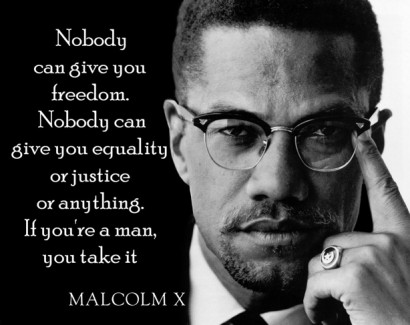
Malcolm X, The Elections and The Politics Of Empire


By Sohail Daulatzai,

With Guantanamo still open, drones still killing and anti-Muslim sentiment forming the rumbling bass line of empire, the upcoming US presidential elections have once again raised the spectre and threat of Islam and the Muslim third world to US national security and its interests.

to be black in America is enough to be deemed un-American, but to be black and Muslim is to be anti-American. While the "smearing" of Obama as a Muslim in the post-9/11 climate is informed by the threat posed by that thing called "al-Qaeda", Obama's blackness and his "proximity" to Islam is really a deeper seated anxiety around Malcolm X, who challenged American authority over not only the black past but also a black future, demanding that black people view themselves not as a national minority but as part of a global majority.

For Malcolm X, "Islam was the greatest unifying force of the Dark World", and the Muslim third world had a defining impact on Malcolm X's life and political vision, whether it was the spiritual centre Mecca or the anti-colonial struggles in Egypt, Algeria, Palestine, Iraq and elsewhere. But for Malcolm one didn't have to be a Muslim. What was important was the recognition of a racial reality to one's secular suffering that would view white supremacy as a global phenomenon and link black struggles with those in the third world.


In Cairo, Malcolm implored the heads of state not to be fooled by the "imperialist wolf" of the US or the State Department's attempts to use propaganda to convince African nations that the United States was making serious progress toward racial equality through Brown v Board and the passage of Civil Rights legislation. 

As Malcolm said, these measures were a "propaganda manoeuver" and "are nothing but tricks of the century's leading neo-colonialist power". Malcolm implored the gathering to heed his warning: "Don't escape from European colonialism only to become more enslaved by deceitful, 'friendly' American dollarism." 

In highlighting the use of propaganda and the managing of America's image abroad, Malcolm anticipated not only how after 9/11 the State Department would place Muslims in high profile positions in the arts and political realms to influence Muslim public opinion abroad, but also how the election of Obama and the rhetoric of "diversity" would be used to redefine America as inclusive, "post-racial" and progressive in order to mask the entrenchment of white power domestically and globally.  

And in tying domestic racial politics in the US to America's role as a "neo-colonial power" and the emergence of "American dollarism", Malcolm laid bare how race linked European colonialism and the emergence of the US as a global superpower. 

While Obama went to Egypt to co-opt this sacred city and put a benevolent face on American power, Malcolm had been there to strip away the veneer of benevolence and reveal the naked truth about US racial injustice and imperial ambition. This is why the legacy of Malcolm X is so important, as it sheds light on the racial dynamics that shape the global landscape today under US power.  

In the immediate aftermath of World War II, as the US replaced Europe as the dominant actor on the world's stage, President Truman declared "communism" public enemy number one, even viewing communism as a bigger threat than colonialism to the decolonising third world. As a result, the US and its allies in Europe believed that a liberated third world was the biggest threat to the post-War order that the US wanted to dominate, as it would create a vacuum of power that could be filled by Communism. 
 Inside Story US 2012 - 'Fear of a Black Republican'

The real fear, as Malcolm and others like Lumumba, Fanon and Nkrumah understood, was the liberation and independence of the majority of the world that would have the potential to radically redistribute global power and wealth away from the white world.  

Instead, the US expanded its imperial footprint into the third world and extended the logic of colonial racism by using "anti-communism" as a means to justify intervention, the supporting of dictators, the overthrow of democratically elected leaders, assassinations and destabilisation throughout the third world (witness Mossadegh, Arbenz, Lumumba and so many others). As a result, US foreign policy used "anti-communism" as a proxy for race by undermining the decolonisation of the third world.

Malcolm emerged out of this Cold War crucible where Civil Rights activists embraced an American identity and argued that Jim Crow violence was an Achilles' heel that would undermine America's global ambitions to a third world already hostile to white supremacy. Malcolm was deeply critical of the Civil Rights establishment for domesticating black struggle within American frameworks and supporting the logic of "anti-communism".  

For Malcolm and others, by not understanding the global nature of white supremacy, the Civil Rights establishment was not going to even make domestic gains on race. Instead of tying their fate to the decolonising third world to systemically undo white power, the Civil Rights mandate only masked white power through a reformist posture domestically, while facilitating its entrenchment throughout the world by assuming the flawed logic of "anti-communism". 

In 1964, Malcolm X made his infamous "The Ballot or the Bullet" speech and challenged the Civil Rights establishment by asserting the futility of black voting as a means toward gaining equality in the United States. Instead, he argued, black people needed to internationalise their struggles and link them to the struggles taking place throughout the third world of Africa, Asia and Latin America. 

As Malcolm said, "you don't take your case to the criminal, you take the criminal to court". For Malcolm X, the move from "civil rights" to "human rights" would place the plight of black peoples in America into a broader forum that would force the US to undergo scrutiny and challenge from the third world and that might tilt the balance of power to the dark nations, as it would reveal US hypocrisies, undermine the country's foreign policy objectives in the third world and expose the country's own brutal extension of European colonial racism. 

As part of his radical internationalism and in profound contrast to the Civil Rights establishment, Malcolm supported the Palestinians against Zionism, likened the ghettos of Harlem under racist segregation to the Casbah in Algiers under French colonial rule, praised Nasser's stand against England, France and Israel, celebrated the Bandung Conference and saw it as a model for unifying black political culture during the Cold War, supported the Mau Mau rebellion against British colonialism and the Vietnamese against French rule, met with Fidel Castro, lauded Lumumba as the "greatest Black man who ever walked the African continent", and like Fanon, gave ethical sanction to the possibility of armed struggle, fundamentally challenging the Cold War consensus. 


With the hyper-nationalism of the post-9/11 era fuelling America's war with the Muslim third world, Malcolm's legacy of resistance that combined black internationalism with the politics of the Muslim third world provides a blueprint to challenge the imperial consensus that has characterised the post-9/11 era. 
 American racism 'on the rise'

Just as "anti-communism" was a proxy for race during the Cold War, "anti-terrorism" has become the new proxy for race and the re-entrenching of white supremacy by justifying US intervention abroad while also containing dissent domestically, as the logic of "terrorism" is used to determine who is a citizen and who is an enemy, who is human and who is not, and who is to be killed and who is allowed to live. 

Forged out of the Cold War, Malcolm's legacy can challenge the embrace by minority communities (including Muslims) of the rhetoric of "terrorism" by recognising its racially coded roots and how "anti-terrorism" is used to not only police dissent, but also allows for the violent expansion of US empire. For not only does the logic of "anti-terrorism" play into the racist logic of "moderate" and "radical" Muslims, it also fails to give dignity to challenges to US state power around the world. 

While many activists, artists, scholars and organisations are infusing the ideas of Malcolm within their work, it's important that black and Muslim communities, as well as other communities of colour, continue to draw the deep internationalist connections that Malcolm did. 

The linking of these struggles isn't some romantic vision of solidarity. It's rooted in a deeper understanding of how profoundly connected these violent forces really are. And it is a recognition that the persistence of racism here in the United States is precisely because white supremacy is deeply woven into the very fabric of US statecraft and is perpetually given life through the everyday functioning of how the US conducts its affairs, whether here or abroad.  

It's the recognition that the logic of mass incarceration in the US that has destroyed black political possibility and contained dissent through local policing and counter-insurgency is also what drives the US military and its imperial imprisonment in Abu Ghraib, Guantanamo, Bagram and other places. It's the recognition that the plight of migrants across the heavily militarised US-Mexico border resembles the conditions that contain and destroy Palestinian lives and livelihood. And it's the recognition that the neoliberal economic policies that have destroyed the social wage and witnessed the emergence of the warfare state in the US is deeply rooted in the exploitation of the third world through global finance capital and war. 

To only talk about domestic anti-racism and not see white supremacy as a global problem, or to only make tepid critiques of US foreign policy around tactics and strategies and not its fundamentally racist posture rings hollow and misses the boat entirely. For it fails to recognise that white supremacy is rooted in the very structure of global relations that the US helped bring into being - a set of relationships where diplomacy, trade, political manoeuvering, war and questions of sovereignty are played out on a radically uneven playing field where the US and Europe exert overwhelming diplomatic leverage, political power and brutal military might.  

To ignore this falls into the worst forms of liberal internationalism that presume the US to be a force for good in the world, and it replicates the very problem that Malcolm X heroically struggled against, and was ultimately killed for.  

Though the bullets finally caught up with Malcolm, he left an indelible imprint on generations of artists and activists. But his legacy is under attack, and even erasure, as the Obama presidency and the triumphalist narrative of Civil Rights seeks to make black internationalist impulses irrelevant and outdated. 

While there are those who claim that voting for Obama is the practical thing to do and that to either vote for a third party or to not vote at all is "impractical" and "misguided", Malcolm might turn the tables and ask how "practical" is it to vote for either major party when the violent forces that define them are so intractable and resistant to change, let alone transformation? 

And when confronting such forces, and recognising the others in the past who have tried so valiantly, how practical is it to continue to invest and commit to this process and expect something different? Isn't that "impractical" and the path to irrelevance? 

Via: "Al-Jazeera"


Friday, August 17, 2012

Suppressing Protest


Human Rights Violations In The U.S. Response To Occupy Wall Street

A group of legal experts have published a report detailing "abusive and unlawful protest regulation and policing practices" by New York police in response to Occupy Wall Street protests.

The report, Suppressing Protest: Human Rights Violations in the U.S. Response to Occupy Wall Street, examines treatment of protestors and journalists by local, state, and federal authorities from September 2011 through July 2012.

The eight-month investigation – carried out by law clinics at NYU, Fordham, Harvard and Stanford – documents instances in which authorities acted in ways that "suppress and chill protest rights" and violate international obligations to respect free assembly and expression.

These include excessive or unnecessary use of force, massive and continuous over-policing, obstruction of press freedoms and legal monitoring, constant surveillance, accountability and transparency failures, unjustified restrictions on peaceful assembly and arbitrary rule enforcement.

The first appendix of the 132-page report lists 130 incidents of excessive or unnecessary physical force by police in New York City.

A few examples (with video links):

September 24, 2011: A protester was being surrounded and held by three officers... One of the officers then pushed him to the ground... officers then proceeded to handcuff and arrest the protester.

October 5: An officer took at least three two-handed overarm swings at protesters. Some of the protesters are holding cameras, and at least one protester had his hands in the air as if signaling the officer to stop.

November 17: An officer threw another protester to the ground who was standing between police and their target... The video then shows another officer appearing to strike the apprehended protester several times with downward jabbing motions of his baton.

January 1, 2012:  An officer lifted a metal barricade with both hands, causing it to move up in the direction of a protester’s face. The video appears to show that the protester was struck in the face by the top bar of the barricade.

March 17: An officer [at 4:11] grabbed a protester out of the arms of another officer... Approximately six other officers then surrounded the protester, grabbed at his head and arms, ripped the mask off his face and pushed him to the ground.

The authors call for the city to establish an inspector general to oversee the police department, a review of the city’s response to the protests and the creation of new guidelines for policing them, and the prosecution of officers found to have broken laws.

If the NYPD fails to respond to these suggestions, the group said, it will ask the Department of Justice to investigate their complaints.

Further detailed studies from the Protest and Assembly Rights Project will be published in the coming months about police response in Boston, Charlotte, Oakland, and San Francisco.

Via: "Business Insider"

The Report: "About The Protest and Assembly Rights Project"

Friday, August 10, 2012

Dalai Lama Stirs Controversy In Kashmir

The Dalai Lama: "Kashmiri people should live peacefully and if there is any problem, dialogue is the only way [to resolve issues]. Violence is in nobody's interest. A peaceful way is essential," he said in Jammu and Kashmir's summer capital, Srinagar.

Kashmiri separatist leaders have said that the spiritual leader allowed this visit to be hijacked by the Indian government, as he overlooked the grim reality of human-rights abuses in the region.

"We respect the Dalai Lama ... However, peace cannot prevail till justice is done," Mirwaiz Umar Farooq, the chairman of the Hurriyat Conference political front, told a local news agency. Faroog said that the spiritual leader's failure to meet local civil society members and mention Kashmiris killed by Indian security forces was a disappointment to many.

"He did not interact with people, neither did he meet civil society members, rights workers or different shades of political leadership. He did not talk about injustice, killings and human-rights violations," said Faroog.

Another Kashmiri leader, Syed Ali Gilani, said the Dalai Lama was being used as a tool by the Indian government. "He should have cleared the very basics about Kashmir and then talked to different sections of society. He is appeasing New Delhi. He should have cleared the very basics about Kashmir and then talked to different sections of society. He is appeasing New Delhi by his utterances."

Avoiding the separatist issue, the Dalai Lama spent much of his trip meeting high-ranking Indian officials, interacting with students at the Tibetan Public School and visiting Buddhist sites.

Some Kashmiris say that as a champion of Tibet's right to self-determination, the spiritual leader could have done more to highlight their plight.

"The Dalai Lama came to Kashmir and chose to remain silent; it was more like a tourist visit to the valley as he didn't speak of any politics. As he was kept away from the public eye in Kashmir, the people fighting the cause of Kashmiri freedom were not allowed to meet him just for the reason that they might persuade him to speak out the truth," said Basharat Ali, director of the Kashmir Centre for Peace and Reconciliation.

"The Dalai Lama did not make even a cursory mention of the abuses and oppression faced by the common Kashmiri. This caused a lot of heartbreak in the valley among those looking for a show of solidarity," said Dawar Dedmari, a young Kashmiri engineer.

Apparently, the Dalai Lama, a long-staying guest in India who once called himself a "son of India", did not want to irritate his host, which uses exiled Tibetans as a leverage against China. This is perhaps the fundamental reason for his caution on commenting on the Kashmir issue.

Via: "Asia Times Online"

Thursday, July 19, 2012

Freedom For All


“Education on the value of free speech and the other freedoms reserved by the Bill of Rights, about what happens when you don’t have them, and about how to exercise and protect them, should be an essential prerequisite for being an American citizen — or indeed a citizen of any nation, the more so to the degree that such rights remain unprotected.

If we can’t think for ourselves, if we’re unwilling to question authority, then we’re just putty in the hands of those in power. But if the citizens are educated and form their own opinions, then those in power work for us.

In every country, we should be teaching our children the scientific method and the reasons for a Bill of Rights. With it comes a certain decency, humility and community spirit.

In the demon-haunted world that we inhabit by virtue of being human, this may be all that stands between us and the enveloping darkness.”

— Carl Sagan — Ch.21 Real Patriots Ask Questions, The Demon-Haunted World : Science as a Candle in the Dark (1995)

Friday, June 22, 2012

Bad Judgment On Guantanamo

Supreme Court
The high court rejected the appeals of seven Guantanamo Bay inmates. (Jacquelyn Martin / Associated Press / March 25, 2012)


The Supreme Court, in refusing to review a lower court's rulings limiting the rights of detainees, abdicates its responsibility.

June 12, 2012
Courtesy Of "The LA Times"

Four years ago, the Supreme Court did its duty as a guardian of the Constitution by ruling that Congress couldn't prevent inmates at Guantanamo Bay from filing petitions for habeas corpus, a venerable feature of Anglo-American law that allows prisoners to challenge their confinement in court.This week, the justices walked away from that responsibility by refusing to review lower court rulings that have narrowed the protections of its 2008 decision to the vanishing point.
In granting inmates a right to habeas in Boumediene vs. Bush, the court sternly corrected an overreaching executive and a compliant Congress. But on Monday it refused to engage in similar scrutiny of the U.S. Circuit Court of Appeals for the District of Columbia, which has adopted a scandalously cramped interpretation of Boumediene. Because the Obamaadministration has determined that more than 40 detainees are too dangerous to be tried even before military commissions, meaning that habeas is their only means of legal redress, the effect of the appeals court's hard line is to undermine even that last resort.
Especially deserving of review was a petition by Adnan Latif, a Yemeni who was captured near the border between Afghanistan and Pakistan in December 2001. Latif said he had traveled to Pakistan to seek medical treatment; the U.S. government insisted that he was a fleeing Taliban fighter.
A federal district judge ruled in Latif's favor, concluding that, because of possible transcription and other errors, a government report of an interview with him was "not sufficiently reliable to support a finding by a preponderance of the evidence that Latif was recruited by an Al Qaeda member or trained and fought with the Taliban." Overturning that finding, the D.C. Circuit ruled that the government's evidence was entitled to "a presumption of regularity" and that lower court judges should require that a detainee's "self-serving account must be credible — not just plausible." In her opinion, Circuit Judge Janice Rogers Brown (a former California Supreme Court justice) approvingly cited dissents in the Boumediene case and referred snidely to its impracticality and "airy suppositions."
More than three years after President Obama promised to close Guantanamo, the facility remains in operation, with a population of 169 (down from nearly 800). Beginning in 2004, the Supreme Court has ordered Congress and the presidency to provide due process to inmates, Americans and foreigners alike, yet progress toward that objective has been sluggish and grudging. The result is justice deferred for inmates and a continued embarrassment for the United States.
Dissenting in the Latif case, Judge David Tatel described the decision as an "assault on Boumediene." At the very least, the ruling called for a full-fledged review by the Supreme Court. Instead, the justices have abdicated their authority and devalued their own achievement.


Sunday, May 20, 2012

The Price Of Sex Trafficking

Posted by "CavalierZee"

The Price Of Sex (Trailer):


Sex Trafficking: How It Works:


The Price of Sex is a feature-length documentary about young Eastern European women who've been drawn into a netherworld of sex trafficking and abuse. 

Intimate, harrowing and revealing, it is a story told by the young women who were supposed to be silenced by shame, fear and violence. 

Photojournalist Mimi Chakarova, who grew up in Bulgaria, takes us on a personal investigative journey, exposing the shadowy world of sex trafficking from Eastern Europe to the Middle East and Western Europe. 

Filming undercover and gaining extraordinary access, Chakarova illuminates how even though some women escape to tell their stories, sex trafficking thrives. Learn more at www.priceofsex.org .

http://priceofsex.org/content/multimedia.

Sunday, May 06, 2012

The Constitution and Internment Camps

Due Process and The Japanese-American Internment

Posted by "Sayf Maslul"


Video By "Matthew Shimura"


This is a moving documentary that won CSPAN's 2012 Student Documentary Competition in which 9th student Matthew Shimura from Punahou School in Honolulu, HI detailed the plight of his grandfather and other Japanese citizens during World War II when the US government decided to suspend the constitutional rights of US citizens and declared Japanese Americans as C4 "enemy aliens" without due process.

While many don't know it, it was not only Japanese citizens that were rounded up by the United States. Instead of hundreds of thousands of US citizens including Germans, Italians and political dissidents were also rounded up and hauled off to the concentration camps. Even worse is tens of thousands of American citizens who had their citizenship suspended, including women and children against which there was no evidence for the "enemy alien" designation, were held in the camps for years after the war had ended.

Matthew warns that Americans need to fully understand the gravity of these events which are still clouded in mystery so we can be better prepared and possible try to prevent the government from even again deciding to suspend the inalienable rights the constitution is SUPPOSED to guarantee to us.

Perhaps even more spine-tingling is recollections from Hawaii Senator Daniel Inouye's who recalls how he was serving in the US military during the war and did not even have any knowledge that Americans were being rounded up into concentration camps because the news was censored by the US government

Tuesday, January 10, 2012

State Of Human Rights In Israel


By Stephen Lendman 
January 3rd, 2012 
Courtesy Of "The Peoples Voice"


Annually, the State Department publishes human rights reports for over 190 countries. Its latest April 8, 2011 Israel assessment noted serious human rights abuses, including:

(1) numerous NGO complaints about torture and other abuses in Gaza and the West Bank.

(2) Israel's High Court of Justice (HCJ) ruling against painful shackling. At issue is tightening restraints to inflict pain.

In Public Committee Against Torture in Israel v. Prime Minister, former HCJ President Aaron Barak said:

"A reasonable interrogation is an interrogation without torture, without cruel or inhuman treatment of the interrogee, and without a humiliating attitude thereto."

"It is forbidden to use brutal and inhuman measures during the course of the interrogation."

"Painful cuffing is a prohibited action. Moreover: other means exist to prevent escape from lawful custody or to protect the interrogators which do not involve pain and suffering to the interrogee."

(3) the UN fact finding commission finding that Israeli security forces "arbitrarily" killed nine Mavi Marmara humanitarian activists.

(4) targeted assassinations.

(5) whitewashed investigations, unaccountability, and few prosecutions of Israelis involved in killings and other human rights abuses.

(6) "unnatural deaths" in prisons.

(7) prison "deficiencies," including sub-standard isolation cells.

(8) detentions without charge up to six months, "renewable indefinitely."

(9) arrests for "security reasons," "even when the accused posed no clear danger."

(10) "denial of fair public trial(s)."

(11) "arbitrary interference with privacy, family, home or correspondence."

(12) free expression and press restrictions, including prohibiting journalists from entering Gaza; requiring media organizations "submit to military censors any material relating to specific military issues" or strategic ones; impeding free assembly, association, and movement; as well as other civil liberty violations.

(13) discrimination against citizens and residents of Arab origin.

(14) human rights violations against refugees and asylum seekers with regard to status, social rights, safety, and "hot return" policy.

Association for Civil Rights in Israel Annual Human Rights Report

Annually, the Association for Civil Rights in Israel (ACRI) publishes its "State of Human Rights - Situation." For 2011, it documents "grave violations of rights in Israel's prisons and describes a rising trend of restrictions of liberty" overall, including:
    freedom of expression;


    freedom of political activity; and


    freedom of thought and opinion.

It also covers last summer's mass social rights protests, infringing protesters' freedom of expression, and few results so far achieved.

According to ACRI's Executive Director, Hagai El-Ad:

"With this report, ACRI displays the reality of human rights issues: when some of us are less equal than others - none of us are equal. When freedom of expression is under threat - we are all in danger."

"In the face of threats to democracy in Israel, we saw this past summer how more and more citizens demand to become active partners in designing reality, in order to realize human rights and social justice in Israel. We hope that the Situation Report will raise public debate and help in bringing the desired change(s)."

Part I discusses deplorable conditions in Israeli prisons. No one's addressing them or efforts to safeguard prisoner dignity and basic rights.

Palestinians, Israeli Arabs, refugees, asylum seekers, and migrant workers are especially affected. Months or years in prison usually follow arrests. It's the rule, not the exception, including for many uncharged.

Arresting minors is also commonplace, despite international law requiring prosecutions and imprisonment used only as a last resort.

In Occupied Palestine, Israel's permit system, militarized presence, checkpoints, Separation Wall, Jews only roads, and other barriers severely restrict free movement. Gaza remains besieged. Jordan Valley residents are disconnected from other West Bank communities, and East Jerusalemites face dispossessions to entirely Judaize the city.

Tactics employed against basic freedoms have a chilling effect overall. They undermine popular efforts and motivation to hold free discussions about fundamental human and civil rights.

Democracies can't exist without them. Nor when citizens can't participate actively and be able to influence policies.

Summer 2011 social justice protests united dissimilar groups, including Arabs and Jews, workers and unemployed, poor and middle class, young and old, men and women, and migrants and refugees among others.
Success remains elusive.

However, a new awareness permeated Israeli society. People know change demands social activism. Moreover, when marginalized groups are harmed, everyone's affected.

Part II covers imprisoning the spirit, including rights violations in the broadest sense. Violence, restrictions, and other crackdowns diminish democratic discourse. Unidentified masked police violate Israeli law.

Requiring released demonstrators pledge no further protests stifles free expression. So does harassing and threatening them in "warning talks."

In Occupied Palestine, demonstrations are prohibited. Violence confronts participants. Injuries, arrests and at times deaths follow.

Anti-democratic legislation's been passed. More's coming. Individual liberties are threatened, including those of minorities. Affected groups include those named above and anyone criticizing government policies, including Jews.

In Part III, social rights are discussed. Israelis demand. Netanyahu's government turns a deaf ear. Socioeconomic gaps follow years of degrading rights. Ethnic, national and cultural minorities are especially affected. So are all Israelis in areas of healthcare, education, housing, employment and welfare.

ACRI endorses a new Basic Law: Social Rights to enshrine fundamental rights and dignified living for all. Israel wants none of it, serving the same corporate interests as in America, Europe, and elsewhere.

A Final Comment

Religious extremism and violence threaten all Israelis. On December 27, thousands protested against gender segregation near Beit Shemesh's Orot girl's school. Ultra-orthodox Haredi extremists were involved.

Israel's Channel 2 broadcast the plight of eight-year old Na'ama Margolese. Daily to and from school, she faces Haredi abuse. She's young, cursed, spat on, and bewildered about what's happening.

On December 26, Haredim clashed with police and TV news crews. Arrests and detentions followed. Earlier on Christmas day, a Channel 10 TV news team was targeted. An hour later, Channel 2 personnel were assaulted with eggs, and a videographer attacked.

Haredim also pelted police with rocks. Rising tensions brought calls for Beit Shemesh's mayor to resign. He refused but opposes religious extremism. Saying he'll "act decisively against anyone who lifts a hand on children," he stopped short of adding more.

On December 28, a Haaretz editorial headlined, "Religious extremists threaten democracy in Israel," saying:
Incidents like in Beit Shemesh "should set off major alarm bells." Public outrage massed against them on Tuesday and "the enormous threat" they represent. Everyone's affected.

Haredim "rioters....are criminals in every sense of the word. They cannot hide behind their religious worldview, behind their rabbis' rulings on matters of halakha (Judaic law). Nor can they hide behind the argument (even though correct) that government authorities have preferred to ignore" their growing violence and let them "terrorize the city's residents and turn them into defenseless hostages."

Most Israelis want no part of enforcing halakha to the exclusion of secular rights. They want freedom to live as they choose within the law. Authorities must use it against Haredim and their rabbis "who encourage and incite them to run wild."

They endanger everyone. So do US Christian fascists. They want their extremist dogma forced on everyone. Like Haredim, it includes male gender dominance, disdain for non-believers, opposition to free thought, and everyone against their views.

Political, religious, and other extremists threaten freedom everywhere. They dominate Israel's Knesset and political Washington dangerously.

Their out-of-control agenda puts humanity at risk. Stopping them is job one.

-###-

Stephen Lendman lives in Chicago and can be reached at lendmanstephen@sbcglobal.net.
Also visit his blog site at sjlendman.blogspot.com and listen to cutting-edge discussions with distinguished guests on the Progressive Radio News Hour on the Progressive Radio Network Thursdays at 10AM US Central time and Saturdays and Sundays at noon. All programs are archived for easy listening.

http://www.progressiveradionetwork.com/the-progressive-news-hour/