Showing posts with label Freedom Of Expression. Show all posts

Monday, January 12, 2015

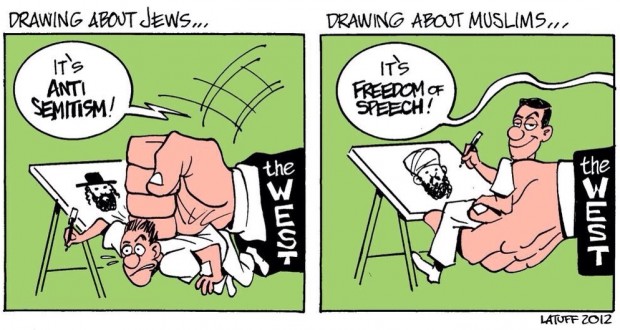
Freedom Of Speech In France

IMG-20150111-WA0000

Freedom of Speech in France: For the Powerful, By the Powerful, With the Powerful

Let us leave aside what occurs closer to home where allied British and American Troops are repeatedly bombing and killing Al-Jazeera journalists. Let us look past the locking up of Moazzam Begg for exposing British collaboration with the Syrian regime in torture, or even Edward Snowden and Julian Assange‘s ‘freedom of speech’. And yet, it remains very obvious for those informed that freedom of speech does not exist anywhere in the world if it does not suit the ruling paradigm or ideology.
France’s (and the West’s) claim that free expression is a ‘fundamental principle’ is a myth, an opiate of the masses, explicitly invoked for anti-Semitic purposes in the years leading up to the holocaust, and has recently being used to whip up hatred of immigrants, ethnic minorities and Muslims. As everywhere else in the ‘Free World’, in France, free expression is for some but not others:
1. A French court injunction banned a Jesus based clothing advert mimicking Da Vinci’s Last Supper. The display was ruled “a gratuitous and aggressive act of intrusion on people’s innermost beliefs”, by the French judge.[1]
2. In 2005 ‘Aides Haute-Garonne’ organized an informative evening about the prevention of the HIV-AIDS. The prospectus contained a head-and-shoulders image of a woman wearing a nun’s bonnet and two pink condoms. On the grounds that the prospectus insulted a group because of its religion, a court convicted Aides Haute-Garonne.
3. In 1994 Le quotidien de Paris published the article L’obscurité de l’erreur by journalist, sociologist, and historian Paul Giniewski. The article criticises the Pope, and states that Catholic doctrine abetted the conception and the realisation of Auschwitz. A court upheld proceedings on the ground that the article was an insult to a group because of its religion, and convicted the newspaper.
4. ‘Charlie Hebdo Magazine’ itself censored, apologised and then fired longtime cartoonist Sinéfor a caricature insulting the son of former president Nicholas Sarkozy and his wife Jessica Sebaoun-Darty, while staunchly standing on their ‘right’ to repeatedly troll Muslims, minorities and immigrants e.g. by showing Muḥammad (sall Allāhu ʿalayhi wa sallam) naked and bending over – which tells you something about the brand of satire they practice and that they would rather be aiming downward than upward.[2]
5. Dieudonné M’Bala a French comedian and satirist – was convicted and fined in France for describing Holocaust remembrance as “memorial pornography”.[3] 
6. The ‘Quennele’ hand sign has been described as anti-establishment and anti-zionist by French youth and famous football players (e.g. Anelka). It stoked serious controversy in France since first being used by anti-establishment comedian Dieudonné M’Bala M’Bala in 2005.  M’Bala has been barred from many theatres and convicted many times for his ‘freedom of speech.'[4]
7. As part of “internal security” enactments passed in 2003, it is an offense to insult the national flag or anthem, with a penalty of a maximum 9,000 euro or up to six months’ imprisonment. Restrictions on “offending the dignity of the republic”, on the other hand, include “insulting”anyone who serves the public.
8. French Rap Star Facing Prison for Insulting the French Stateinsulting Napoleon andCharles de Gaulle.[5] It is illegal to insult the French state and it seems historical characters like Napoleon and Charles De Gaulle are sacred. But Muḥammad (sall Allāhu ʿalayhi wa sallam), the leading light and ideal of divine justice for 1.5 billion people is open to criticism?
9. Nicolas Sarkozy, then-Interior Minister and former President of the Republic until 2012, ordered the firing of the director of Paris Match — because he had published photos of Cécilia Sarkozy (his wife)with another man in New York.
10. In 2006, rapper ‘Joestarr’ had his rap song against President Sarkozy censored.[6]
11. The following films have been censored in France for provoking violence:
12. Under France’s “Public Health Code” passed on the 31 December 1970, “positive presentation of drugs” and the “incitement to their consumption” stipulates five years in prison and fines of up to €76,000. Newspapers such as LibérationCharlie Hebdo and associations, political parties, and various publications criticising the current drug laws and advocating drug reform in France have been repeatedly hit with heavy fines based on this law.[7]
13. Muslim women are barred from education (No, not just by the Taliban) in France, if they practise their religion by wearing a headscarf, despite French schools having no policy on uniforms, neither are crosses on necklaces allowed.
14. “France’s law against “religious symbols in public spaces” is specifically enforced to target Muslim women who choose to wear hijab—ironic considering we are now touting Charlie Hebdo as a symbol of France’s staunch commitment to civil liberties.”[8]
15. It is illegal in France to take the opinion of the Turkish side on the then civil war involving Armenians. It is illegal to deny that the killing of Armenians by Turkish troops was a deliberate genocide.
16. In 2007, a tribunal in Lyon sentenced Bruno Gollnisch and fined him €5,000 for the offense of contesting some of the information about the Holocaust and ordered him to pay €55,000 euros in damages to the plaintiffs and to pay for the judgment to be published in the newspapers that originally printed his remarks.
British Freedom of Speech Evangelicals seem to be silent when it comes to the freedom of speech of Muslims: 
“So for example, when a Muslim decided to burn a poppy on the streets of London – an act which physically harmed nobody – they demanded the individual responsible be prosecuted (he was) and remained noticeably silent about the death threats directed towards him as a result of his exercising his right to free speech and expression. Similarly when a group of Muslims held a peaceful – if vocal – protest against British military returnees from Afghanistan it seems that suddenly the “right to offend” was no longer sacrosanct.”[9]
Just to be clear about what the Charlie Hebdo magazine was about, I would like to quote some left-wing, liberal, socialist, atheist folks, because I am sure if an Islamist said the below he would end up on a list somewhere under the British Stasi ‘PREVENT’ spying and thought police programme:
Charlie Hebdo has facilitated the growth of a form of politicized anti-Muslim sentiment that bears a disturbing resemblance to the politicized anti-Semitism that emerged as a mass movement in France in the 1890s.
In its use of crude and vulgar caricatures that purvey a sinister and stereotyped image of Muslims, Charlie Hebdo recalls the cheap racist publications that played a significant role in fostering the anti-Semitic agitation that swept France during the famous Dreyfus Affair, which erupted in 1894 after a Jewish officer was accused and falsely convicted of espionage on behalf of Germany. In whipping up popular hatred of Jews, La Libre Parole [“Free Speech”], published by the infamous Edoard Adolfe Drumont, made highly effective use of cartoons that employed the familiar anti-Semitic devices. The caricatures served to inflame public opinion, inciting mobs against Dreyfus and his defenders, such as Emile Zola, the great novelist and author of J’Accuse.”[10]
Lastly on the role of satire, it needs to be responsible:
“The whole reason the concept of responsible satire has been summed up as “punch up, don’t punch down” is to acknowledge that not all your targets of satire start out on an equal footing. Francois Hollande is not on the same level as girls who have been kidnapped into sexual slavery, and having the same “no-holds-barred” attitude toward them both is not the same as treating them fairly. {Charlie Hebdo had a front page cartoon about Nigerian Muslim schoolgirls kidnapped, raped and impregnated by terrorists depicted as ‘benefits scroungers pregnant with more benefits scroungers’ – feeding into that now popular stereotype about black immigrants sucking the ‘white’ state’s finances dry.
The situation of the Muslims in France right now is rather dismal. The scars of the riots nine years ago are still fresh for many peopleMuslims make up 60 to 70 percent of the prison population despite being less than 20 percent of the population overall, and France’s law against “religious symbols in public spaces” is specifically enforced to target Muslim women whochoose to wear hijab—ironic considering we are now touting Charlie Hebdo as a symbol of France’s staunch commitment to civil liberties.”[11]
5 Times France Really Cared About #FreedomOfSpeech


Notes:

[1] http://news.bbc.co.uk/2/hi/europe/4337031.stm
[2] http://www.thedailybeast.com/articles/2015/01/09/trolls-and-martyrdom-je-ne-suis-pas-charlie.html
[3] http://www.mirror.co.uk/sport/football/news/nicolas-anelka-anti-semitic-gesture-quenelle-2966787
[4] www.mirror.co.uk/sport/football/news/nicolas-anelka-anti-semitic-gesture-quenelle-2966787
[6] http://en.wikipedia.org/wiki/Censorship_in_France#List_of_censored_songs
[7] http://www.legifrance.gouv.fr/affichCodeArticle.do?idArticle=LEGIARTI000006688178&cidTexte=LEGITEXT000006072665
[8] http://www.thedailybeast.com/articles/2015/01/09/trolls-and-martyrdom-je-ne-suis-pas-charlie.html
[9] https://maskedavenger1.wordpress.com/2015/01/09/le-mort-de-charlie-hebdo-quel-dommage/
[10] http://www.wsws.org/en/articles/2015/01/09/pers-j09.html
[11] http://www.thedailybeast.com/articles/2015/01/09/trolls-and-martyrdom-je-ne-suis-pas-charlie.html

Source: Islam21c

Saturday, November 15, 2014

Stick Your New World Order Up Your Arse


DazNez (search Google to find out more) performing at Anon Demo at BBC Salford Quays 16th Nov 2013. 

Over a 100 Demonstrators under the banner of Anonymous Protested at the BBC to rebuke them over their lack of coverage of protests. They barely even mentioned 60,000 protesters at the recent Tory Party Conference in Manchester.

Saturday, October 11, 2014

Yale Chaplain Forced Out By Zionist Attacks


The three-sentence letter to the Times has now produced the resignation of the chaplain, Father Bruce Shipman, from the Episcopal Church at Yale.
It happened three days ago. The statement from the Episcopal Church at Yale refers to “dynamics” between Shipman and his board of governors:
The Rev. Bruce M. Shipman, on his own initiative, has resigned as Priest-in-Charge of the Episcopal Church at Yale, effective immediately.
The Rt. Rev. Ian T. Douglas, President of the Board of Governors, and the Rt. Rev. Laura J. Ahrens, bishop with oversight of university and college chaplains in the Episcopal Church in Connecticut, have accepted with sadness the resignation of the Rev. Bruce M. Shipman; and wish to thank him for his faithfulness, hard work, vision, and most especially his dedication to the students at Yale over the last fourteen months as Episcopal chaplain.
It is our belief that the dynamics between the Board of Governors and the Priest-in-Charge occasioned the resignation of the Rev. Shipman. Bishops Douglas and Ahrens are dedicated to working with the Board on matters of governance and process so that the Episcopal Church at Yale can continue faithfully to serve students and God’s mission at Yale University.
In addition, The Episcopal Church at Yale, its Board of Governors, the Bishops of the Episcopal Church in Connecticut, and the Rev. Bruce Shipman are all committed to a civil dialogue on difficult issues that divide peoples of this world and pledge ourselves to the prayerful and humble work of reconciliation and peace in our hurting and divided world.
Here is Shipman’s letter to The New York Times on August 25 on Gaza, precipitating the controversy:
Deborah E. Lipstadt makes far too little of the relationship between Israel’s policies in the West Bank and Gaza and growing anti-Semitism in Europe and beyond.
The trend to which she alludes parallels the carnage in Gaza over the last five years, not to mention the perpetually stalled peace talks and the continuing occupation of the West Bank.
As hope for a two-state solution fades and Palestinian casualties continue to mount, the best antidote to anti-Semitism would be for Israel’s patrons abroad to press the government of Prime Minister Benjamin Netanyahu for final-status resolution to the Palestinian question.
(Rev.) BRUCE M. SHIPMAN
Groton, Conn., Aug. 21, 2014
The writer is the Episcopal chaplain at Yale.
Here is Shipman’s letter to the Yale Daily News following up his letter to the Times, walking the letter back.
To all who have been offended by my August 26 letter published in the New York Times, I would like to say the following:
I believe that there is a correlation between the uptick in anti-Semitic violence in the world and the events taking place in Israel/Palestine and Gaza. That said, there is never any excuse for such violence and the crimes described by Professor Deborah Lipstadt are disgusting and repellant. There can be little doubt that many who engage in such behavior use the Israel/Palestine dispute as an excuse to mask a much deeper disorder known as anti-Semitism.
I ought to have said this in my letter.
I have been accused of anti-Americanism for my opposition to the Vietnam War in the ’60s and the Iraq War in the ’00s. In fact, my patriotism runs deep, as does my love for Israel and Palestine and for the two peoples locked in a tragic fight over the land. If I seemed to suggest in my letter that only Jews who actively oppose present Israeli policies have a right to feel safe, that was not my intention nor is it my belief. Personal safety and protection by the rule of law is a fundamental right. Nothing done in Israel or Palestine justifies the disturbing rise in anti-Semitism in Europe or elsewhere. Persons of good will must be concerned as well by the rise of Islamophobia that is now being justified in terms of national security.
This has been a painful time for many of us, but I am a hopeful person and I believe that good will come of it. I have received many letters that offer opportunities for dialogue and understanding, and I trust that I am humble enough to still be taught.
Bruce M. Shipman
Aug. 28
This seems another instance of the intense pressure to support Israel inside elite institutions, because that’s all the Israel lobby has now in the wake of Gaza. This Yale student called on the church to dismiss Shipman for “incendiary comments” demonstrating “profoundly poor judgment and insensitivity,” and the church’s board of governors evidently sided with that student. Rabbi Brant Rosen resigned from his synagogue in the Chicago area because “I gradually became a Palestine solidarity activist rather than liberal Zionist,” as he told Haaretz. His synagogue was riven by the controversy, as Yale must be, too. Rosen will surely have more freedom now, and Father Shipman will too. I think good things will come of this. The resignation demonstrates the pattern of blacklisting/corruption in prestige institutions that is bound to crack at some point, and it opens up more space at the grassroots for free discussion of these important questions. 
Many have pointed out that William Sloane Coffin Jr, a Yale chaplain, practiced civil disobedience in protest of the U.S. war in Vietnam. There are probably plaques for him in New Haven.
Thanks to Marc Ellis.

Monday, August 12, 2013

Internet Surveillance and Free Speech: The UN Makes The Connection

Frank La Rue, the United Nations Special Rapporteur on Freedom of Expression and Opinion delivered this week landmark report [PDF] on state surveillance and freedom of expression. In preparation, the Special Rapporteur reviewed relevant studies, consulted with experts including EFF, and participated in the state surveillance and human rights workshop we organized last year.  Today, EFF's Katitza Rodriguez has been taking part in the first detailed conversation about State Surveillance and Human Rights at the U.N., held by the 47 member states of the Human Rights Council during the U.N.'s 23th session in Geneva.
At a time when efforts by states to conduct communications surveillance are rapidly proliferating across the globe, La Rue makes the case for a direct relationship between state surveillance, privacy and freedom of expression:
The right to privacy is often understood as an essential requirement for the realization of the right to freedom of expression. Undue interference with individuals’ privacy can both directly and indirectly limit the free development and exchange of ideas. … An infringement upon one right can be both the cause and consequence of an infringement upon the other.
La Rue’s landmark report could not come at a better time. The explosion of online expression we've seen in the past decade is now being followed by an explosion of communications surveillance.  For many, the Internet and mobile telephony are no longer platforms where private communication is shielded from governments knowing when, where, and with whom a communication has occurred.  
The report acknowledges the benefits of technological innovations that have enabled rapid, anonymous, cross-cultural dialogues around the world. Nevertheless, the report warns that these same technologies can open a Pandora's box of previously unimaginable state surveillance intrusions.
“The Internet has facilitated the development of large amounts of transactional data by and about individuals. This information, known as communications data or metadata, includes personal information on individuals, their location and online activities, and logs and related information about the e-mails and messages they send or receive.”
The report explains how metadata can reveal sensitive information that can be easily accessed, stored, mined and exploited.
Communications data are storable, accessible and searchable, and their disclosure to and use by State authorities are largely unregulated.  Analysis of this data can be both highly revelatory and invasive, particularly when data is combined and aggregated. As such, States are increasingly drawing on communications data to support law enforcement or national security investigations. States are also compelling the preservation and retention of communication data to enable them to conduct historical surveillance.”
As La Rue indicates, it is the capacity of new technologies to instantly aggregate and analyze data makes it a beacon of one’s online presence. EFF believes that “metadata”1information logging individuals’ communication activities—is as sensitive as the content of communication and therefore deserves strong human rights protections.
For example, with all the amount of information and evolving surveillance technologies, law enforcement agencies now can:
  • Directly observe people's relationships and interactions and make inferences about their intimate and protected relationships. 
  • Examine millions of people's communications and rapidly identify precise communications interactions on any given topic.
  • Track any person's physical movements almost all of the time and draw conclusions about one’s professional, sexual, political, and religious activities, and attitudes from individuals' associations and Internet traffic.
  • Routinely retain data for decades, so that statements and interactions can be searched, analyzed, and recalled long after they have been made. 
  • Do all of the above simultaneously.
La Rue reminds States that in order to meet their human rights obligations, they must ensure that the rights to free expression and privacy—and metadata protection in particular—are at the heart of their communications surveillance frameworks. To this end, the Special Rapporteur urges states to review national laws regulating surveillance and update and strengthen laws and legal standards:
Communications surveillance should be regarded as a highly intrusive act that potentially interferes with the rights to freedom of expression and privacy and threatens the foundations of a democratic society.
Legislation must stipulate that State surveillance of communications must only occur under the most exceptional circumstances and exclusively under the supervision of an independent judicial authority.
   
At present, access to communications data has been conducted by a variety of public bodies for a broad range of purposes, often without judicial authorization and independent oversight. Such overbroad access threatens basic democratic values.
La Rue recommends that legal frameworks to ensure that communication surveillance measures:
Are prescribed by law, meeting a standard of clarity and precision that is sufficient to ensure that individuals have advance notice of and can foresee their application,
Are strictly and demonstrably necessary to achieve a legitimate aim,
Adhere to the principle of proportionality, and are not employed when less invasive techniques are available which have not yet been exhausted.
EFF could not agree more that individuals have a legal right to be notified when they have been subjected to communications surveillance and have had their communications data accessed by the state. We celebrate La Rue’s invaluable recommendations and will begin immediately using his report in our own advocacy work throughout the world. EFF will continue to blog about additional findings in the La Rue's report in the following days.
You can access the report delivered by Frank La Rue to the Human Rights Council here:

Tuesday, January 29, 2013

State Surveillance Around The World


States around the world are demanding private data in ever-greater volumes—and getting it. They are recognizing the treasure troves of personal information created by modern communications technologies of all sorts, and pursuing ever easier, quicker, and more comprehensive access to our data. They are obtaining detailed logs of our entire lives online, and they are doing so under weaker legal standards than ever before. Several laws and proposals now afford many states warrantless snooping powers and nearly limitless data collection capabilities. These practices remain shrouded in secrecy, despite some private companies’ attempts to shine a light on the alarming measures states are taking around the world to obtain information about users.
To challenge the sweeping invasions into individuals’ personal lives, we’re calling on governments to ensure their surveillance policies and practices are consistent with international human rights standards. We’re also demanding that governments and companies become more transparent about their use of the Internet in state surveillance. 
Signs of Growing International Surveillance in 2012
  • new law in Brazil allows police and public prosecutors to demand user registration data from ISPs directly, via a simple request, with no court order, in criminal investigations involving money laundering. And, a new bill seeks to allow the Federal Police to demand registration data of Internet users in cases of crimes without the need of a court order nor judicial oversight.
  • Colombia adopted a new decree that compels ISPs to create backdoors that would make it easier for law enforcement to spy on Colombians. The law also forces ISPs and telecom providers to continuously collect and store for five years the location and subscriber information of millions of ordinary Colombian users.
  • Leaked documents revealed that the Mexican government shelled out $355 million to expand Mexican domestic surveillance equipment over the past year.
  • The Canadian government put proposed online surveillance legislation temporarily "on pause" following sustained public outrage generated by the bill. The bill introduces new police powers that would allow authorities easy access to Canadians’ online activities, including the power to force ISPs to hand over private customer data without a warrant.
  • The EU’s overarching data retention directive has become a dangerous model for other countries, despite the fact that several European Courts have declared several national data retention laws unconstitutional.
  • Romania went ahead with adopting a new data retention mandate law without any real evidence or debate over the right to privacy, despite the 2009 Constitutional Court ruling declaring the previous data retention law unconstitutional.
  • The German government is proposing a new law that would allow law enforcement and intelligence agencies to extensively identify Internet users, without any court order or reasonable suspicion of a crime. This year, more details were found on German State Trojan Program to spy on and monitor Skype, Gmail, Hotmail, Facebook and other online communications.
  • The UK government is considering a bill that would extend the police’s access to individuals' email and social media traffic data. The UK ISPs will be compelled to gather the data and allow the UK police and security services to scrutinize it.
  • A Dutch proposal seeks to allow the police to break into foreign computers and search and delete data. If the location of a particular computer cannot be determined, the Dutch police would be able to break into it without ever contacting foreign authorities. AnotherDutch proposal seeks to allow the police to force a suspect to decrypt information that is under investigation in a case of terrorism or sexual abuse of children.
  • In Russia, several new legal frameworks or proposed bills enable increased state surveillance of the Internet.
  • Australian law enforcement and intelligence agencies have continued to advance the false idea of the need for data retention mandates, mandatory backdoors for cloud computing services and the creation of a new crime for refusing to aid law enforcement in the decryption of communications.
  • A controversy arose in Lebanon over revelations that the country's Internal Security Forces (ISF) demanded the content of all SMS text messages sent between September 13 and November 10 of this year, as well as usernames and passwords for services like Blackberry Messenger and Facebook.
  • The Rwandan Parliament is discussing a bill that will grant sanctions the police, army and intelligence services the power to listen to and read private communications in order to protect "public security", the keyword often invoked to justify unnecessary human rights violations.
  • Pakistan adopted a Fair Trial Bill authorizing the state to intercept private communications to thwart acts of terrorism. No legal safeguards have been built in to prevent abuse of power and the word "terrorism" has been poorly defined (a word that's often invoked to justify unnecessary human rights violations).
  • RIM announced that they had provided the Indian Government with a solution to intercept messages and emails exchanged via BlackBerry handsets. The encrypted communications will now be available to Indian intelligence agencies.
  • The Indian government approved the purchase of technological equipment to kickstart the National Intelligence Grid (NATGRID)—a project that seeks to link databases for ready access by intelligence agencies. The project is expected to facilitate "robust information sharing" by security and law enforcement agencies to combat terror threats.
    Moving Forward
    EFF's international team and a coalition of civil society organizations around the world have drafted a set of principles that can be used by civil society, governments and industry to evaluate whether state surveillance laws and practices are consistent with human rights. In 2013, we will continue demanding that states adopt stronger legal protections if they want to track our cell phones, or see what web sites we’ve visited, or rummage through our Hotmail, or read our private messages on Facebook, or otherwise invade our electronic privacy. EFF will keep working collaboratively with advocates, lawyers, journalists, bloggers and security experts on the ground to fight overbroad surveillance laws. Our work will involve existing legislative initiatives, international fora, and other regional venues where we can have a meaningful impact on establishing stronger legal protections against government access to people’s electronic communications and data.

    Tuesday, January 15, 2013

    Western Europe vs. Religious Freedom


    By Mary Ann Glendon, Azizah al-Hibri
    Courtesy Of "The National Interest"


    When most people picture Western Europe, they envision well-established democracies where fundamental freedoms are vigorously protected. For the most part, this portrait is accurate. However, when it comes to religious freedom, the past year and decade have witnessed trends that challenge this image.
    As 2012 draws to a close, a number of countries continue restricting religious practice and expression, from religious dress to fundamental life rituals such as circumcision. Such restrictions not only compromise internationally protected rights, they fuel an environment in which religious people and members of religious minorities in particular are sometimes made to feel like outsiders in their home countries.
    These infringements are surprisingly widespread.
    For example, France and Belgium bar students in state schools and government workers from wearing “conspicuous religious symbols,” forbidding the Islamic headscarf, the Sikh turban, large Christian crosses, and the Jewish yarmulke.
    France and Belgium now ban people from publicly wearing full-face veils while Switzerland, the Netherlands, and other European states have debated similar prohibitions. Islamic dress restrictions for teachers exist in some Swiss and German states.
    France also forbids people from wearing any headgear in official identity document photos. In 2011, the UN Human Rights Committee concluded that this rule violated the religious freedom rights of a Sikh man who refused to remove his turban for a residency-card photo. France has yet to take corrective action.
    Sweden, Switzerland, Norway, and Iceland have long banned kosher and halal slaughter. In 2011, the Dutch parliament’s lower house also passed such a ban, but an outcry from Muslim and Jewish groups forced the government to forge a compromise allowing religious animal slaughter to continue.
    After a similar outcry in Germany this year against a lower-court ruling criminalizing religious circumcisions of male children, the German parliament is considering a law permitting this practice.
    Efforts against religious circumcision persist in other parts of Europe. Norway’s Center Party, a small party in parliament, has sought to criminalize it, and the ombudsman for children—an independent governmental body—has suggested that Muslims and Jews replace circumcision with “a symbolic, non-surgical ritual.”
    In Germany and Sweden, government authorities have told Christian and Jewish parents that they cannot homeschool their children for religious reasons.
    Government officials in the United Kingdom are forcing Catholic adoption agencies to shut down because they follow religious criteria in placing children with families.
    What is driving this rise in restrictions? At least two factors are at play—one historical, the other demographic.
    The first factor is Western Europe’s unfortunate history of monolithic state religion. The rise of secular states did little to change the idea of a religious monoculture—it just included secularism as one of the monocultures. Indeed, “lay” states such as France and Turkey have long enforced secularism as the only acceptable form of behavior in public affairs, while countries like Norway treat their official churches as vestigial organs.
    The second factor is the region’s growing religious diversity, including a rising population of Muslims. The distinctive dress of conservative Muslims has fueled a fear of “the other” as well as a doubling down in already-existing opposition to public religious expression. While governments cite the need for national security, restrictions on religious expression risk creating exactly the opposite outcome. They drive a wedge between governments and their Muslim citizens, dashing hopes for much-needed cooperation to prevent radicalization and promote the assimilation of democratic values and identity in Muslim communities.
    Couched as attempts to protect established values, government laws and policies prohibiting religious expression and practice specifically violate human rights. Such actions defy internationally recognized religious-freedom standards established in United Nations treaties and also protected by European human rights documents from the European Union, Council of Europe and Helsinki process.
    These standards guarantee the right not just to believe but to manifest one’s beliefs, individually or in community with others, in public or in private, through worship, observance, practice and teaching. This includes the right to wear distinctive symbols, clothing or head coverings, follow dietary rules and practice rituals connected with certain life stages. Any limitations on these freedoms must be narrowly construed and based on grounds specified by Article 18 of the International Covenant on Civil and Political Rights. They must not discriminate in application, destroy guaranteed rights or derive from a single tradition alone.
    The increasing restrictions on religious practice and expression in Western Europe both arise from and encourage a climate of intolerance against religious groups, especially those with strong truth claims and vigorous demands on their members. Muslims, in some instances, clearly are being targeted. This increasingly hostile atmosphere in turn triggers private discrimination, and sometimes even violence, against members of these groups.
    Indeed, according to the U.S. State Department’s International Religious Freedom Report on France, the number of anti-Muslim assaults, harassment, and vandalism increased 34 percent in 2011.
    If the lamp of liberty is to remain lit, Western Europeans must accept that the age of conformity to an official monoculture—secular or religious—is at an end. In the coming year, their countries should embrace their religiously diverse future and accord religious freedom to all.
    Mary Ann Glendon serves as vice chair of the U.S. Commission on International Religious Freedom (USCIRF). Azizah al-Hibri serves as a USCIRF Commissioner.