Showing posts with label Freedom Of Speech. Show all posts

Monday, January 12, 2015

Freedom Of Speech In France

IMG-20150111-WA0000

Freedom of Speech in France: For the Powerful, By the Powerful, With the Powerful

Let us leave aside what occurs closer to home where allied British and American Troops are repeatedly bombing and killing Al-Jazeera journalists. Let us look past the locking up of Moazzam Begg for exposing British collaboration with the Syrian regime in torture, or even Edward Snowden and Julian Assange‘s ‘freedom of speech’. And yet, it remains very obvious for those informed that freedom of speech does not exist anywhere in the world if it does not suit the ruling paradigm or ideology.
France’s (and the West’s) claim that free expression is a ‘fundamental principle’ is a myth, an opiate of the masses, explicitly invoked for anti-Semitic purposes in the years leading up to the holocaust, and has recently being used to whip up hatred of immigrants, ethnic minorities and Muslims. As everywhere else in the ‘Free World’, in France, free expression is for some but not others:
1. A French court injunction banned a Jesus based clothing advert mimicking Da Vinci’s Last Supper. The display was ruled “a gratuitous and aggressive act of intrusion on people’s innermost beliefs”, by the French judge.[1]
2. In 2005 ‘Aides Haute-Garonne’ organized an informative evening about the prevention of the HIV-AIDS. The prospectus contained a head-and-shoulders image of a woman wearing a nun’s bonnet and two pink condoms. On the grounds that the prospectus insulted a group because of its religion, a court convicted Aides Haute-Garonne.
3. In 1994 Le quotidien de Paris published the article L’obscurité de l’erreur by journalist, sociologist, and historian Paul Giniewski. The article criticises the Pope, and states that Catholic doctrine abetted the conception and the realisation of Auschwitz. A court upheld proceedings on the ground that the article was an insult to a group because of its religion, and convicted the newspaper.
4. ‘Charlie Hebdo Magazine’ itself censored, apologised and then fired longtime cartoonist Sinéfor a caricature insulting the son of former president Nicholas Sarkozy and his wife Jessica Sebaoun-Darty, while staunchly standing on their ‘right’ to repeatedly troll Muslims, minorities and immigrants e.g. by showing Muḥammad (sall Allāhu ʿalayhi wa sallam) naked and bending over – which tells you something about the brand of satire they practice and that they would rather be aiming downward than upward.[2]
5. Dieudonné M’Bala a French comedian and satirist – was convicted and fined in France for describing Holocaust remembrance as “memorial pornography”.[3] 
6. The ‘Quennele’ hand sign has been described as anti-establishment and anti-zionist by French youth and famous football players (e.g. Anelka). It stoked serious controversy in France since first being used by anti-establishment comedian Dieudonné M’Bala M’Bala in 2005.  M’Bala has been barred from many theatres and convicted many times for his ‘freedom of speech.'[4]
7. As part of “internal security” enactments passed in 2003, it is an offense to insult the national flag or anthem, with a penalty of a maximum 9,000 euro or up to six months’ imprisonment. Restrictions on “offending the dignity of the republic”, on the other hand, include “insulting”anyone who serves the public.
8. French Rap Star Facing Prison for Insulting the French Stateinsulting Napoleon andCharles de Gaulle.[5] It is illegal to insult the French state and it seems historical characters like Napoleon and Charles De Gaulle are sacred. But Muḥammad (sall Allāhu ʿalayhi wa sallam), the leading light and ideal of divine justice for 1.5 billion people is open to criticism?
9. Nicolas Sarkozy, then-Interior Minister and former President of the Republic until 2012, ordered the firing of the director of Paris Match — because he had published photos of Cécilia Sarkozy (his wife)with another man in New York.
10. In 2006, rapper ‘Joestarr’ had his rap song against President Sarkozy censored.[6]
11. The following films have been censored in France for provoking violence:
12. Under France’s “Public Health Code” passed on the 31 December 1970, “positive presentation of drugs” and the “incitement to their consumption” stipulates five years in prison and fines of up to €76,000. Newspapers such as LibérationCharlie Hebdo and associations, political parties, and various publications criticising the current drug laws and advocating drug reform in France have been repeatedly hit with heavy fines based on this law.[7]
13. Muslim women are barred from education (No, not just by the Taliban) in France, if they practise their religion by wearing a headscarf, despite French schools having no policy on uniforms, neither are crosses on necklaces allowed.
14. “France’s law against “religious symbols in public spaces” is specifically enforced to target Muslim women who choose to wear hijab—ironic considering we are now touting Charlie Hebdo as a symbol of France’s staunch commitment to civil liberties.”[8]
15. It is illegal in France to take the opinion of the Turkish side on the then civil war involving Armenians. It is illegal to deny that the killing of Armenians by Turkish troops was a deliberate genocide.
16. In 2007, a tribunal in Lyon sentenced Bruno Gollnisch and fined him €5,000 for the offense of contesting some of the information about the Holocaust and ordered him to pay €55,000 euros in damages to the plaintiffs and to pay for the judgment to be published in the newspapers that originally printed his remarks.
British Freedom of Speech Evangelicals seem to be silent when it comes to the freedom of speech of Muslims: 
“So for example, when a Muslim decided to burn a poppy on the streets of London – an act which physically harmed nobody – they demanded the individual responsible be prosecuted (he was) and remained noticeably silent about the death threats directed towards him as a result of his exercising his right to free speech and expression. Similarly when a group of Muslims held a peaceful – if vocal – protest against British military returnees from Afghanistan it seems that suddenly the “right to offend” was no longer sacrosanct.”[9]
Just to be clear about what the Charlie Hebdo magazine was about, I would like to quote some left-wing, liberal, socialist, atheist folks, because I am sure if an Islamist said the below he would end up on a list somewhere under the British Stasi ‘PREVENT’ spying and thought police programme:
Charlie Hebdo has facilitated the growth of a form of politicized anti-Muslim sentiment that bears a disturbing resemblance to the politicized anti-Semitism that emerged as a mass movement in France in the 1890s.
In its use of crude and vulgar caricatures that purvey a sinister and stereotyped image of Muslims, Charlie Hebdo recalls the cheap racist publications that played a significant role in fostering the anti-Semitic agitation that swept France during the famous Dreyfus Affair, which erupted in 1894 after a Jewish officer was accused and falsely convicted of espionage on behalf of Germany. In whipping up popular hatred of Jews, La Libre Parole [“Free Speech”], published by the infamous Edoard Adolfe Drumont, made highly effective use of cartoons that employed the familiar anti-Semitic devices. The caricatures served to inflame public opinion, inciting mobs against Dreyfus and his defenders, such as Emile Zola, the great novelist and author of J’Accuse.”[10]
Lastly on the role of satire, it needs to be responsible:
“The whole reason the concept of responsible satire has been summed up as “punch up, don’t punch down” is to acknowledge that not all your targets of satire start out on an equal footing. Francois Hollande is not on the same level as girls who have been kidnapped into sexual slavery, and having the same “no-holds-barred” attitude toward them both is not the same as treating them fairly. {Charlie Hebdo had a front page cartoon about Nigerian Muslim schoolgirls kidnapped, raped and impregnated by terrorists depicted as ‘benefits scroungers pregnant with more benefits scroungers’ – feeding into that now popular stereotype about black immigrants sucking the ‘white’ state’s finances dry.
The situation of the Muslims in France right now is rather dismal. The scars of the riots nine years ago are still fresh for many peopleMuslims make up 60 to 70 percent of the prison population despite being less than 20 percent of the population overall, and France’s law against “religious symbols in public spaces” is specifically enforced to target Muslim women whochoose to wear hijab—ironic considering we are now touting Charlie Hebdo as a symbol of France’s staunch commitment to civil liberties.”[11]
5 Times France Really Cared About #FreedomOfSpeech


Notes:

[1] http://news.bbc.co.uk/2/hi/europe/4337031.stm
[2] http://www.thedailybeast.com/articles/2015/01/09/trolls-and-martyrdom-je-ne-suis-pas-charlie.html
[3] http://www.mirror.co.uk/sport/football/news/nicolas-anelka-anti-semitic-gesture-quenelle-2966787
[4] www.mirror.co.uk/sport/football/news/nicolas-anelka-anti-semitic-gesture-quenelle-2966787
[6] http://en.wikipedia.org/wiki/Censorship_in_France#List_of_censored_songs
[7] http://www.legifrance.gouv.fr/affichCodeArticle.do?idArticle=LEGIARTI000006688178&cidTexte=LEGITEXT000006072665
[8] http://www.thedailybeast.com/articles/2015/01/09/trolls-and-martyrdom-je-ne-suis-pas-charlie.html
[9] https://maskedavenger1.wordpress.com/2015/01/09/le-mort-de-charlie-hebdo-quel-dommage/
[10] http://www.wsws.org/en/articles/2015/01/09/pers-j09.html
[11] http://www.thedailybeast.com/articles/2015/01/09/trolls-and-martyrdom-je-ne-suis-pas-charlie.html

Source: Islam21c

Saturday, November 15, 2014

Stick Your New World Order Up Your Arse


DazNez (search Google to find out more) performing at Anon Demo at BBC Salford Quays 16th Nov 2013. 

Over a 100 Demonstrators under the banner of Anonymous Protested at the BBC to rebuke them over their lack of coverage of protests. They barely even mentioned 60,000 protesters at the recent Tory Party Conference in Manchester.

Friday, October 10, 2014

The Rising Tide Of Anti-Semitism


To the Editor:
Deborah E. Lipstadt makes far too little of the relationship between Israel’s policies in the West Bank and Gaza and growing anti-Semitism in Europe and beyond.
The trend to which she alludes parallels the carnage in Gaza over the last five years, not to mention the perpetually stalled peace talks and the continuing occupation of the West Bank.
As hope for a two-state solution fades and Palestinian casualties continue to mount, the best antidote to anti-Semitism would be for Israel’s patrons abroad to press the government of Prime Minister Benjamin Netanyahu for final-status resolution to the Palestinian question.
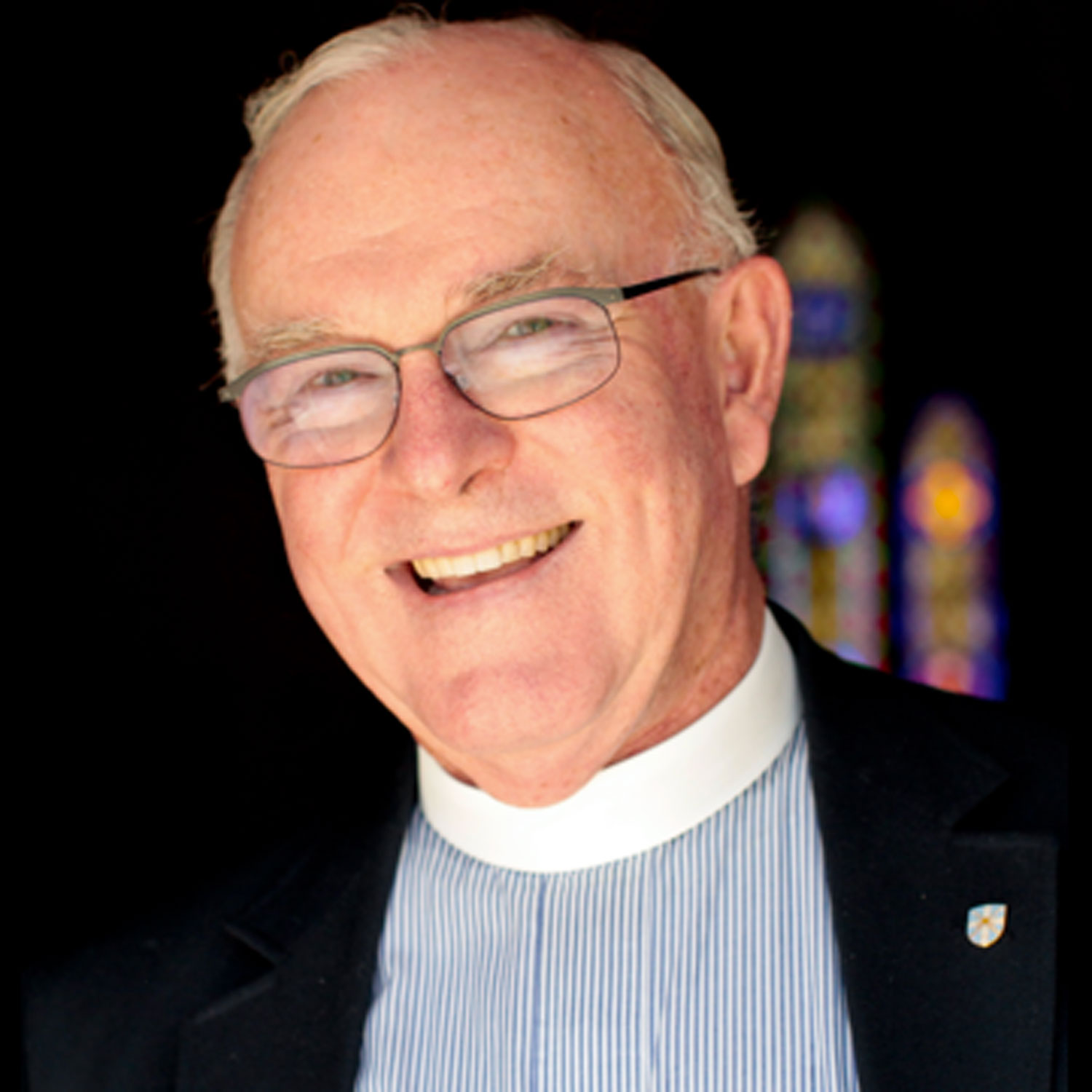
(Rev.) BRUCE M. SHIPMAN
Groton, Conn., Aug. 21, 2014
The writer is the Episcopal chaplain at Yale.

Tuesday, September 24, 2013

The Suppressed Speech Of Wamsutta


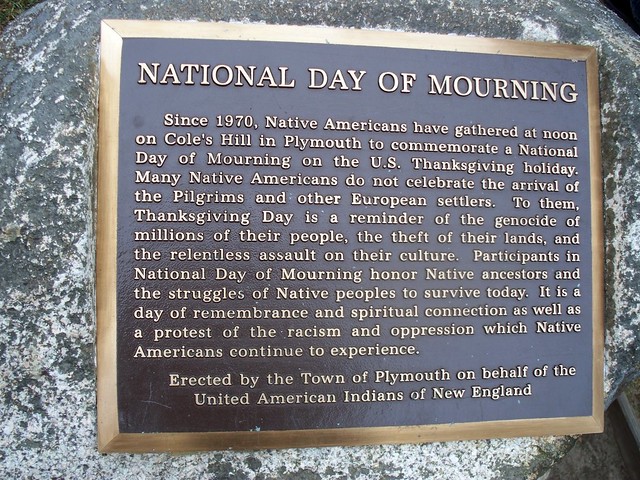
This is the Suppressed speech of Wamsutta (Frank B.) James, Wampanoag. that was to be delivered at Plymouth, Massachusetts, 1970.

The Massachusetts Department of Commerce asked the Wampanoag Indians to select a speaker to mark the 350th anniversary of the Pilgrims' arrival, and the first Thanksgiving.

Three hundred fifty years after the Pilgrims began their invasion of the land of the Wampanoag, their "American" descendants planned an anniversary celebration. Still clinging to the white schoolbook myth of friendly relations between their forefathers and the Wampanoag, the anniversary planners thought it would be nice to have an Indian make an appreciative and complimentary speech at their state dinner. Frank James was asked to speak at the celebration. He accepted. The planners, however , asked to see his speech in advance of the occasion, and it turned out that Frank James' views — based on history rather than mythology — were not what the Pilgrims' descendants wanted to hear. Frank James refused to deliver a speech written by a public relations person. Frank James did not speak at the anniversary celebration. If he had spoken, this is what he would have said:

I speak to you as a man -- a Wampanoag Man. I am a proud man, proud of my ancestry, my accomplishments won by a strict parental direction ("You must succeed - your face is a different color in this small Cape Cod community!"). I am a product of poverty and discrimination from these two social and economic diseases. I, and my brothers and sisters, have painfully overcome, and to some extent we have earned the respect of our community. We are Indians first - but we are termed "good citizens." Sometimes we are arrogant but only because society has pressured us to be so.
It is with mixed emotion that I stand here to share my thoughts. This is a time of celebration for you - celebrating an anniversary of a beginning for the white man in America. A time of looking back, of reflection. It is with a heavy heart that I look back upon what happened to my People.
Even before the Pilgrims landed it was common practice for explorers to capture Indians, take them to Europe and sell them as slaves for 220 shillings apiece. The Pilgrims had hardly explored the shores of Cape Cod for four days before they had robbed the graves of my ancestors and stolen their corn and beans. Mourt's Relation describes a searching party of sixteen men. Mourt goes on to say that this party took as much of the Indians' winter provisions as they were able to carry.
Massasoit, the great Sachem of the Wampanoag, knew these facts, yet he and his People welcomed and befriended the settlers of the Plymouth Plantation. Perhaps he did this because his Tribe had been depleted by an epidemic. Or his knowledge of the harsh oncoming winter was the reason for his peaceful acceptance of these acts. This action by Massasoit was perhaps our biggest mistake. We, the Wampanoag, welcomed you, the white man, with open arms, little knowing that it was the beginning of the end; that before 50 years were to pass, the Wampanoag would no longer be a free people.
What happened in those short 50 years? What has happened in the last 300 years? History gives us facts and there were atrocities; there were broken promises - and most of these centered around land ownership. Among ourselves we understood that there were boundaries, but never before had we had to deal with fences and stone walls. But the white man had a need to prove his worth by the amount of land that he owned. Only ten years later, when the Puritans came, they treated the Wampanoag with even less kindness in converting the souls of the so-called "savages." Although the Puritans were harsh to members of their own society, the Indian was pressed between stone slabs and hanged as quickly as any other "witch."
And so down through the years there is record after record of Indian lands taken and, in token, reservations set up for him upon which to live. The Indian, having been stripped of his power, could only stand by and watch while the white man took his land and used it for his personal gain. This the Indian could not understand; for to him, land was survival, to farm, to hunt, to be enjoyed.
It was not to be abused. We see incident after incident, where the white man sought to tame the "savage" and convert him to the Christian ways of life. The early Pilgrim settlers led the Indian to believe that if he did not behave, they would dig up the ground and unleash the great epidemic again.
The white man used the Indian's nautical skills and abilities. They let him be only a seaman -- but never a captain. Time and time again, in the white man's society, we Indians have been termed "low man on the totem pole."
Has the Wampanoag really disappeared? There is still an aura of mystery. We know there was an epidemic that took many Indian lives - some Wampanoags moved west and joined the Cherokee and Cheyenne. They were forced to move. Some even went north to Canada! Many Wampanoag put aside their Indian heritage and accepted the white man's way for their own survival. There are some Wampanoag who do not wish it known they are Indian for social or economic reasons.
What happened to those Wampanoags who chose to remain and live among the early settlers? What kind of existence did they live as "civilized" people? True, living was not as complex as life today, but they dealt with the confusion and the change. Honesty, trust, concern, pride, and politics wove themselves in and out of their [the Wampanoags'] daily living. Hence, he was termed crafty, cunning, rapacious, and dirty.
History wants us to believe that the Indian was a savage, illiterate, uncivilized animal. A history that was written by an organized, disciplined people, to expose us as an unorganized and undisciplined entity. Two distinctly different cultures met. One thought they must control life; the other believed life was to be enjoyed, because nature decreed it. Let us remember, the Indian is and was just as human as the white man. The Indian feels pain, gets hurt, and becomes defensive, has dreams, bears tragedy and failure, suffers from loneliness, needs to cry as well as laugh. He, too, is often misunderstood.
The white man in the presence of the Indian is still mystified by his uncanny ability to make him feel uncomfortable. This may be the image the white man has created of the Indian; his "savageness" has boomeranged and isn't a mystery; it is fear; fear of the Indian's temperament!
High on a hill, overlooking the famed Plymouth Rock, stands the statue of our great Sachem, Massasoit. Massasoit has stood there many years in silence. We the descendants of this great Sachem have been a silent people. The necessity of making a living in this materialistic society of the white man caused us to be silent. Today, I and many of my people are choosing to face the truth. We ARE Indians!
Although time has drained our culture, and our language is almost extinct, we the Wampanoags still walk the lands of Massachusetts. We may be fragmented, we may be confused. Many years have passed since we have been a people together. Our lands were invaded. We fought as hard to keep our land as you the whites did to take our land away from us. We were conquered, we became the American prisoners of war in many cases, and wards of the United States Government, until only recently.
Our spirit refuses to die. Yesterday we walked the woodland paths and sandy trails. Today we must walk the macadam highways and roads. We are uniting We're standing not in our wigwams but in your concrete tent. We stand tall and proud, and before too many moons pass we'll right the wrongs we have allowed to happen to us.
We forfeited our country. Our lands have fallen into the hands of the aggressor. We have allowed the white man to keep us on our knees. What has happened cannot be changed, but today we must work towards a more humane America, a more Indian America, where men and nature once again are important; where the Indian values of honor, truth, and brotherhood prevail.
You the white man are celebrating an anniversary. We the Wampanoags will help you celebrate in the concept of a beginning. It was the beginning of a new life for the Pilgrims. Now, 350 years later it is a beginning of a new determination for the original American: the American Indian.
There are some factors concerning the Wampanoags and other Indians across this vast nation. We now have 350 years of experience living amongst the white man. We can now speak his language. We can now think as a white man thinks. We can now compete with him for the top jobs. We're being heard; we are now being listened to. The important point is that along with these necessities of everyday living, we still have the spirit, we still have the unique culture, we still have the will and, most important of all, the determination to remain as Indians. We are determined, and our presence here this evening is living testimony that this is only the beginning of the American Indian, particularly the Wampanoag, to regain the position in this country that is rightfully ours.
Wamsutta September 10, 1970

Monday, August 12, 2013

Internet Surveillance and Free Speech: The UN Makes The Connection

Frank La Rue, the United Nations Special Rapporteur on Freedom of Expression and Opinion delivered this week landmark report [PDF] on state surveillance and freedom of expression. In preparation, the Special Rapporteur reviewed relevant studies, consulted with experts including EFF, and participated in the state surveillance and human rights workshop we organized last year.  Today, EFF's Katitza Rodriguez has been taking part in the first detailed conversation about State Surveillance and Human Rights at the U.N., held by the 47 member states of the Human Rights Council during the U.N.'s 23th session in Geneva.
At a time when efforts by states to conduct communications surveillance are rapidly proliferating across the globe, La Rue makes the case for a direct relationship between state surveillance, privacy and freedom of expression:
The right to privacy is often understood as an essential requirement for the realization of the right to freedom of expression. Undue interference with individuals’ privacy can both directly and indirectly limit the free development and exchange of ideas. … An infringement upon one right can be both the cause and consequence of an infringement upon the other.
La Rue’s landmark report could not come at a better time. The explosion of online expression we've seen in the past decade is now being followed by an explosion of communications surveillance.  For many, the Internet and mobile telephony are no longer platforms where private communication is shielded from governments knowing when, where, and with whom a communication has occurred.  
The report acknowledges the benefits of technological innovations that have enabled rapid, anonymous, cross-cultural dialogues around the world. Nevertheless, the report warns that these same technologies can open a Pandora's box of previously unimaginable state surveillance intrusions.
“The Internet has facilitated the development of large amounts of transactional data by and about individuals. This information, known as communications data or metadata, includes personal information on individuals, their location and online activities, and logs and related information about the e-mails and messages they send or receive.”
The report explains how metadata can reveal sensitive information that can be easily accessed, stored, mined and exploited.
Communications data are storable, accessible and searchable, and their disclosure to and use by State authorities are largely unregulated.  Analysis of this data can be both highly revelatory and invasive, particularly when data is combined and aggregated. As such, States are increasingly drawing on communications data to support law enforcement or national security investigations. States are also compelling the preservation and retention of communication data to enable them to conduct historical surveillance.”
As La Rue indicates, it is the capacity of new technologies to instantly aggregate and analyze data makes it a beacon of one’s online presence. EFF believes that “metadata”1information logging individuals’ communication activities—is as sensitive as the content of communication and therefore deserves strong human rights protections.
For example, with all the amount of information and evolving surveillance technologies, law enforcement agencies now can:
  • Directly observe people's relationships and interactions and make inferences about their intimate and protected relationships. 
  • Examine millions of people's communications and rapidly identify precise communications interactions on any given topic.
  • Track any person's physical movements almost all of the time and draw conclusions about one’s professional, sexual, political, and religious activities, and attitudes from individuals' associations and Internet traffic.
  • Routinely retain data for decades, so that statements and interactions can be searched, analyzed, and recalled long after they have been made. 
  • Do all of the above simultaneously.
La Rue reminds States that in order to meet their human rights obligations, they must ensure that the rights to free expression and privacy—and metadata protection in particular—are at the heart of their communications surveillance frameworks. To this end, the Special Rapporteur urges states to review national laws regulating surveillance and update and strengthen laws and legal standards:
Communications surveillance should be regarded as a highly intrusive act that potentially interferes with the rights to freedom of expression and privacy and threatens the foundations of a democratic society.
Legislation must stipulate that State surveillance of communications must only occur under the most exceptional circumstances and exclusively under the supervision of an independent judicial authority.
   
At present, access to communications data has been conducted by a variety of public bodies for a broad range of purposes, often without judicial authorization and independent oversight. Such overbroad access threatens basic democratic values.
La Rue recommends that legal frameworks to ensure that communication surveillance measures:
Are prescribed by law, meeting a standard of clarity and precision that is sufficient to ensure that individuals have advance notice of and can foresee their application,
Are strictly and demonstrably necessary to achieve a legitimate aim,
Adhere to the principle of proportionality, and are not employed when less invasive techniques are available which have not yet been exhausted.
EFF could not agree more that individuals have a legal right to be notified when they have been subjected to communications surveillance and have had their communications data accessed by the state. We celebrate La Rue’s invaluable recommendations and will begin immediately using his report in our own advocacy work throughout the world. EFF will continue to blog about additional findings in the La Rue's report in the following days.
You can access the report delivered by Frank La Rue to the Human Rights Council here:

Monday, July 22, 2013

Repudiating Zionist Abuse Of The Anti-Semitism Charge


By MIKE MARQUSEE


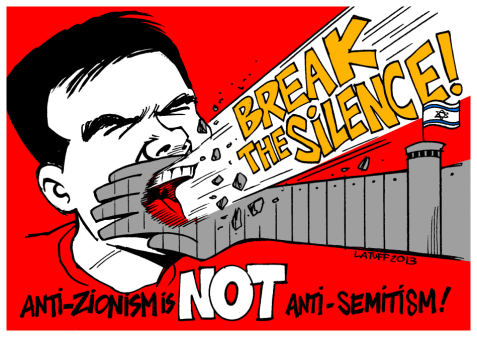
Taunting and tainting opponents with the charge of anti-semitism is a long-standing Zionist ploy, familiar to everyone involved in the Israel-Palestine issue. As their support weakens in the face of evidence-based argument, Israel’s advocates have stepped up their use of the accusation as a means to close down debate, particularly on proposals for boycott, divestment and sanctions.
A key component in their armoury is what’s been called “lawfare”: attempts to use the courts to stifle opponents. This strategy, which has been employed in the US, France and Britain, suffered a significant reverse at the end of March, when an Employment Tribunal in London comprehensively rejected a claim made by Ronnie Fraser, of Academics for Israel, against his union, the University and College Union.
Fraser and his celebrity lawyer, Anthony Julius, argued that debates and decisions on Israel-Palestine issues within UCU amounted to “harassment” against Fraser as a Jew. They made ten specific allegations to support this charge; every one of them was dismissed by the Tribunal as false or irrelevant.
Jonathan Freedland once lauded Julius’s musings on anti-semitism as “forensic”. But when subjected to a genuinely forensic examination at the hands of the Tribunal, they were shown to be anything but. In fact, the Tribunal’s point by point demolition of Julius’s arguments shows just why Zionists are so fearful of open, fact-based, rational discussion. (For a thorough examination of the Tribunal’s findings and the aftermath, see Mark Elf’s excellent blog, http://jewssansfrontieres.blogspot.co.uk.)
The judges had harsh words for a number of Fraser’s witnesses, particularly the chief executive of the Jewish Leadership Council, Jeremy Newmark, whose testimony as to his alleged treatment at a UCU meeting was labelled “false”. Two Labour MPs, John Mann and Denis Macshane (still in Parliament when the hearings were held last autumn), appeared for Fraser but did him no favours. They were criticised by the Tribunal for giving “glib evidence…Neither seemed at ease with the idea of being required to answer a question not to his liking.”
The Tribunal also found no evidence of the “atmosphere of intimidation” alleged by Fraser. UCU’s adherence to democratic procedures was fully exonerated. Unions in general should be relieved that the judges have found that they are not liable for psychological “damage” arising from debates among members.
Most significantly, on the core question of whether opposition to Israel or Zionism amounted to anti-semitism, the Tribunal reached a clear-cut, unimpeachable conclusion. “A belief in the Zionist project or an attachment to Israel or any similar sentiment cannot amount to a protected characteristic,” they declare, adding “It is not intrinsically a part of Jewishness.” 
It’s welcome to have this simple truth, so fiercely denied by Israel’s advocates, upheld as logical and lawful.
Julius had argued that although not all Jews were Zionists the great majority felt an affinity for Israel. 
The Tribunal found this argument unpersuasive; a political view cannot claim “protected” status simply because many members of a particular religion or “race” hold it. If that were to be the case, political debate would be shut down. 
The Tribunal was clearly aware of that danger, as their final words on the case indicate: “We greatly regret that the case was ever brought. At heart, it represents an impermissible attempt to achieve a political end by litigious means… The Employment Tribunals are a hard-pressed public service and it is not right that their limited resources should be squandered as they have been.”
In the pro-Israel camp, the humiliating ruling has caused consternation. Some are now calling for what is known as “the European Union Monitoring Center on Racism and Xenophobia’s ‘working definition’ of anti-Semitism” to be adopted in British law. According to this definition, opposition to Zionism, descriptions of Israel as an “apartheid” or “racist “ state, and calls for boycotts are all in themselves anti-semitic. It has never had any official status within the EU and has been quietly dropped by the EUMC’s successor body, the Fundamental Rights Agency. 
Clearly, it would endow Israel and supporters of Israel with a protected status enjoyed by no other state or political opinion. This from people who accuse their opponents of “singling out Israel”. Worryingly, a similar definition was adopted last year by the California state legislature, without a single vote against.
It apparently does not trouble the self-appointed protectors of the Jewish community that inscribing the “working definition” into law would make the British state the adjudicator on what does and does not constitute Jewishness. Historically, Jewish freedom and equality has been advanced as and when the state’s role in relation to religion opinion has been diminished. Here we see again how the Zionists’ abuse of the anti-semitism charge actually undermines the real struggle against anti-semitism.
There’s been no mention of the Tribunal ruling anywhere in the mainstream media. Of course, had the judges found the UCU guilty of “harassing” its Jewish members, the story would have been on every front page.

Wednesday, December 12, 2012

Freedom Of Speech: An Islamic Perspective


Umm Ibtihal conveys the following:

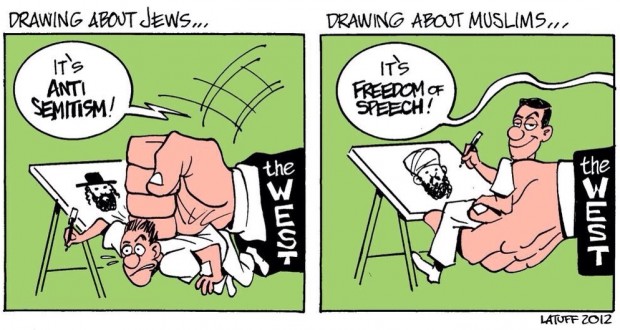
It is therefore hardly surprising that the recent film attacking the honor of the Prophet (saw) has drawn escalating outrage from Muslims all over the world. To add fuel to the fire, a French magazine has now published some extremely derogatory caricatures of the Prophet (saw). Those defending such actions claim they are upholding freedom of speech; and freedom of speech can never be curbed regardless of the consequences.

The grossly hypocritical nature of this elusive concept is however quite apparent for all to see. Europe, for instance, imposes legal and social limits on freedom of expression; publication of anti-Semitic cartoons would almost everywhere be liable to legal prosecution. In some of the European countries it is against the law to say that Hitler did not murder millions of Jews. But, it appears that it is quite acceptable to ridicule Islam and the Messenger of Allah (saw). 

The reality is that there can never be complete freedom of speech. Laws will always be required that would limit freedom of speech in order to preserve society at large. A clear example of this is the preservation of national security. The Official Secrets Act exists in the United Kingdom for the protection of official information, mainly related to national security. People working with secret information are commonly required to sign a statement to the effect that they agree to abide by the restrictions of the Official Secrets Act. In the US, the clash between the conflicting aims of national security and freedom of expression came to a head in 1971 in the 'Pentagon Papers' case. 'The New York Times' had ignored the government's demand to halt publication of a document dealing with the US military involvement in Vietnam. As a result, it was enjoined from continuing to publish portions of the document. Although the Court's decision went in the favor of freedom of speech and the press, it did implicitly acknowledge a national security exception to the First Amendment's ban on prior restraint. In subsequent years, the Court has upheld the government's national security claims in several cases that involved former CIA agents who had written memoirs.

Even the philosophers of liberalism had to admit that there exist inherent discrepancies within the concept of freedom and its application at state level. One strand of liberal thought argues that freedom of speech should not be limited because once this happens, the society would inevitably move towards tyranny and censorship. The other line of argument states with equal force that a government's involvement with the action of individuals should never be removed because this would eventually lead to anarchy and a life that Hobbes described in Leviathan as "solitary, poor, nasty, brutish, and short". Moreover, some feel that the only purpose for which power can be rightfully exercised over any member of a civilized community, against his will, is to prevent 'harm' to others. But there has always been a problem in defining 'harm'. Does prostitution, for instance, fall under this domain? Most liberals would also include 'offense' as a major factor that should legitimize the exercise of power over the actions of the individuals living in a society. Again the issue arises as to which actions are to be considered 'offensive'. Should pornography, for example, come under this category? Some have argued that pornography is not only offensive but is also harmful. Such contradictions lead to a never ending debate as to what does/ does not constitute 'harm' or 'offense'. Thus what we find is that the slogan of freedom of speech is one of the most used slogans in the world, and yet no one is quite sure what it entails or where the boundaries (should) lie.

But for the Muslims, the issue should be quite clear: Islam does not allow the adoption and propagation of 'Freedom of Speech' as propagated by the west since this would include the promotion of such ideas that clearly contradict Islam, such as usury, obscenity under the guise of entertainment and separation of Islam from life's affairs.

This is not to say that Islam does not allow the Muslims to express their opinions freely. It is allowed for a Muslim to express his opinion about anything or any issue, but this opinion must be derived from Quran and Sunnah of Prophet Muhammad (saw). Numerous examples can be cited from the Islamic history where freedom to express one's opinion not only existed but was also encouraged. The companions of the Prophets (saw) openly disagreed with each other on various aspects of Islamic rules. The Khaleefah Harun al-Rashid provided financial incentives for anyone who would teach, learn, propagate or debate issues of the deen. Islam has given the Muslims the right to express their opinions, even if they contradict the opinions of the ruler or that of the majority of the Muslims. It has made it obligatory upon the Muslims to express their opinions and criticize the ruler if he abuses his authority by ordering something that displeases Allah (swt). The Messenger of Allah said, "The master of martyrs is Hamzah bin Abdul Muttalib and a man who stood up to an oppressive ruler, ordered him (to do good) and forbade him (from doing evil) and was killed by him." 

Looking at the glorious history of Islam, we find that the Muslims excelled in every sphere of life: science flourished under the Islamic rule. The Muslims were the most advanced in the world in various fields such as mathematics, geometry, medicine, natural sciences, etc. In terms of economics, they were the most prosperous ; Khaleefah Umar bin Abdul Aziz at one stage of his rule could not find a single poor person to give zakat to during his rule in 7th Century C.E. The Muslims also excelled in agriculture; in the 8th and 9th century, Iraq under Islam had a population of 30 million, 80% of whom were farmers with modern irrigation systems from the rivers Tigris and Euphrates. The ration of yield of seed for wheat in the Muslim world was 10:1 compared to 2.5:1 in Europe. With regard to showing tolerance towards the Non-Muslims, Prophet Muhammad (saw) had said "Whoever hurts a Non-Muslim citizen of an Islamic state hurts me, and he who hurts me annoys Allah (swt)." (Bukh‰ri). With this kind of mentality towards Non-Muslims, it is hardly surprising that the Christians of Ash-sham fought alongside the Muslims against the Christian Crusaders who had attacked the Islamic State.

The question that needs to be asked is, 'What was it in the Muslim world that had fostered such tolerance, authenticity, creativity, and human flourishing?' It certainly was not the current notion of freedom that is prevailing in today's world but rather it was the result of the implementation of Islam on society. Unlike man-made systems, Islam is in total harmony with the reality of human nature since it is revealed by the One (swt) who created human beings. Therefore, the aims of Islam conform to the reality of human society. Islam has designated certain aims for society which include protection of mind, belief, private property, security and state. Only when such aims exist in a society can human beings progress in every sphere of life. To safeguard these aims, an Islamic society will restrict freedom of expression as espoused by the west since it acknowledges the fact that society is not just made up of individuals and what an individual does will have an impact on society at large. Islam makes no apology for doing this. In actual fact, liberal societies, despite their claims of being free and tolerant, are also forced to take certain steps to safeguard society. Hence they have laws restricting the 'amount of freedom' that can exist in society. In addition to this, their laws continually twist and change to suit their interests and are often interpreted in a manner that clearly reflects their prejudice and enmity towards Islam as shown in this recent example. The concept of freedom of speech is therefore laden with ambiguity.

A society, by its very nature, demands the existence of certain rules and regulations as to what is and what is not acceptable in speech as well as in other spheres of life. But the fundamental question is where these limitations should be set. We either base our society on philosophical principles that tend to rotate in a vicious circle, or alternatively, as those who believe in Allah (swt)'s supremacy, we turn to the Guidance sent by Him (swt). For us the choice has already been made: We have set you on a plain way of commandment so follow it, and not the desires of those who have no knowledge (Quran 45:18). 

Basing our opinions on this premise, we Muslims throughout the world, need to discuss and debate on the issue of what is the way forward for us.

Via: "IslamiCity"

Thursday, December 06, 2012

Online Freedom: Who Should Control What?


Delegates from 193 countries are meeting in Dubai to discuss the future of the internet. They will be negotiating a new International Telecommunications Treaty - which has not been updated since 1988.

The main debate at the conference is over internet freedom. The US and Europe want less internet regulation, while countries like Russia and China are accused of wanting more.

But the possibly bigger question of who controls the internet is also in play. The US in particular is criticised for dominating the way the internet is run.

Since 1947 a UN body called the International Telecommunication Union (ITU) has been in charge of international technical standards.

Delegates from 193 countries have regulated everything from radio frequencies to satellite orbits. Their mission is to make sure networks and technologies easily interconnect. But according to internet giant Google, the ITU could be about to take steps to reduce the free flow of information on the web.

"There is a mood to change the governance structure of the internet from one that is multi-stakeholder system to one that is inter-governmental. And I think the fear is that the internet repression and censorship that is already going and the throttling of the speed of communication and widespread surveillance in certain countries will be legitimised if they change the system."
- Richard Rogers, University of Amsterdam
It says if proposals being heard at the ITU conference in Dubai are accepted, there will be an increase in censorship and national regulation.

But other countries censor content on the internet as well.

Known as the 'Great Firewall of China', the People's Republic has perhaps the world's most impressive example of online control. In addition to banning social networking sites, China also has tens of thousands of monitors who snoop and often hack into people's emails.

Following protests in 2009, the Iranian government intensified its efforts to censor the web. It has rounded up and jailed bloggers and internet dissidents. The country also often shuts down access to the internet when it expects anti-government protests.

In Belarus, the government has also noticed the opposition's use of the internet. Websites are sometimes blacked out, opposition voices are monitored and the government even uses websites like Twitter to intimidate journalists and activists.

And last month, the United Arab Emirates showed where it stands on internet censorship. It issued a decree making it a crime to insult or criticise the country's leaders online.

We ask should limits be placed on the web? And if so, how and by whom? What does it all mean for freedom of speech online and is it being threatened with over-regulation?