


Showing posts with label Population Control. Show all posts
Showing posts with label Population Control. Show all posts
Wednesday, January 21, 2015
How Do They Manipulate Us?
By Lucien Cerise
• Summary:
1. What is Social Engineering ?
2. Human brain’s manipulation & computers’ system: formatting human brain.
3. From Management to Social Engineering: optimizing the control of the society.
4. Structuralism, French Theory, The Gender Theory & the Deconstruction of the Human dehumanization: Formatting the Human.
5. Dehumanization part two: future of the Human.
6. Frauds on the vote for the Taubira’s law in France ? Gay mariage law in France.


Wednesday, December 31, 2014
How The Elite Stay In Power
In this video we break down in simple terms the only way "those in power" can stay in power. It's not as complex at it may seem. They need us more than we need them.
“The race issue based on skin colour is a deeply emotional one among many, that has caused unimaginable separation and was used very craftily to position large groups of people against each other. This is a wake-up call to all those who believe they are free because of race or class or wealth. We have all been denied freedom and dignity, trapped in a life of servitude to the banking families and their economic stranglehold on our planet - no matter what colour our skin may be.”― Michael Tellinger, UBUNTU Contributionism - A Blueprint For Human Prosperity
Music: Xtrngr - Dreams
Speech, Voice and Video Editing: Elina St-Onge
Free eBook: http://bit.ly/howtochangetheworldbook
Courtesy Of: We Are Change
Monday, December 22, 2014
Asking Muslims To Condemn Terrorism Must Stop
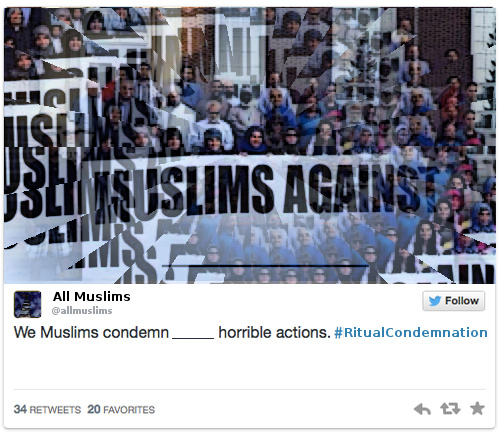
There's a certain ritual that each and every one of the world's billion-plus Muslims, especially those living in Western countries, is expected to go through immediately following any incident of violence involving a Muslim perpetrator. It's a ritual that is continuing now with the Sydney hostage crisis, in which a deranged self-styled sheikh named Man Haron Monis took several people hostage in a downtown café.
Here is what Muslims and Muslim organizations are expected to say: "As a Muslim, I condemn this attack and terrorism in any form."
This expectation we place on Muslims, to be absolutely clear, is Islamophobic and bigoted. The denunciation is a form of apology: an apology for Islam and for Muslims.
The implication is that every Muslim is under suspicion of being sympathetic to terrorism unless he or she explicitly says otherwise. The implication is also that any crime committed by a Muslim is the responsibility of all Muslims simply by virtue of their shared religion.
This sort of thinking — blaming an entire group for the actions of a few individuals, assuming the worst about a person just because of their identity — is the very definition of bigotry.
It is time for that ritual to end: non-Muslims in all countries, and today especially those in Australia, should finally take on the correct assumption that Muslims hate terrorism just as much as they do, and cease expecting Muslims to prove their innocence just because of their faith.
Bigoted assumptions are the only plausible reason for this ritual to exist, which means that maintaining the ritual is maintaining bigotry. Otherwise, we wouldn't expect Muslims to condemn Haron Monis — who is clearly a crazy person who has no affiliations with formal religious groups — any more than we would expect Christians to condemn Timothy McVeigh. Similarly, if someone blames all Jews for the act of, say, extremist Israeli settlers in the West Bank, we immediately and correctly reject that position as prejudiced. We understand that such an accusation is hateful and wrong — but not when it is applied to Muslims.
This is, quite literally, a different set of standards that we apply only to Muslims. Hend Amry, who is Libyan-American, brilliantly satirized this expectation with this tweet, highlighting the arbitrary expectations about what Muslims are and are not expected to condemn:
Hend @LibyaLibertyAs a Muslim, I condemn acts of sexual assault following time spent as a self-proclaimed spiritual healer specializing in black magic.10:50 AM - 15 Dec 2014
This ritual began shortly after September 2001. American Muslims, as well as Muslims in other Western countries, feared that they could be victims to a public backlash against people of their religion. While the short-term need to guard against a backlash was real, that moment has passed, and the ritual's persistence is perpetuating Islamophobia rather than reducing it, by constantly reminding us of our assumption that Muslims are guilty until proven innocent.
The media has played a significant role in maintaining this ritual and thus the prejudiced ideas behind it. Yes, that includes openly Islamophobic cable news hosts like those in the US. But it also includes even well-intentioned media outlets and reporters who broadcast Muslims' and Muslim organizations' condemnation of acts of extremist violence, like the hostage crisis in Sydney.
There is no question that this coverage is explicitly and earnestly designed to combat Islamophobia and promote equal treatment of Muslims. No question. All the same, this coverage ends up cementing the ritual condemnation as a necessary act, and thus cementing as well the racist implications of that ritual.
By treating it as news every time, the media is reminding its readers and viewers that Muslims are held to a different standard; it is implicitly if unintentionally reiterating the idea that they are guilty until proven innocent, that maybe there is something to the idea of collective Muslim responsibility for lone criminals who happen to share their religion.
Instead, we should treat the assumptions that compel this ritual — that Muslims bear collective responsibility, that they are presumed terrorist-sympathizers until proven otherwise — as flatly bigoted ideas with no place in our society. There is no legitimate reason for Muslim groups to need to condemn Haron Monis, nor is there any legitimate reason to treat those condemnations as news. So we should stop.
We should treat people like Haron Monis as what he is: a deranged lunatic. And we should treat Muslims as what they are: normal people who of course reject terrorism, rather than as a lesser form of humanity that is expected to reject violence every time it happens.
By Max Fisher
Thursday, December 18, 2014
Obedience: Obeying Authority Figures
If a man in a uniform came up to you, gave you a taser, and told you to guard and detain another man who he claims is a criminal, would you? If that man tried to leave would you stop him or taser him?
In the video below, most of the people tested actually go to the extent of hurting another human being, who they’ve never met, simply because a man in a uniform told them to do so.
This unquestioning obedience to the state, regardless of morality, is a telltale sign of a police state. It is also the end result of decades of societal conditioning.
The costumed individual is obeyed, because this costume and shiny medal, is backed with the promise of violence. We’ve all been taught this from childhood.
What the uniform says is, “I belong to a very powerful group and if you do not do what I say, I can have my other friends come back here to kidnap you, lock you in a cage, or worse and no one will question me for it.”
Sunday, July 27, 2014
The Bernaysian Manipulation Of The Human Psyche

Photo: Shutterstock (c) Johan Swanepoel, Featured Image: Shutterstock (c) Sciencepics
Edward Bernays was the master of influencing and shaping public opinion who developed upon the ideas of earlier social psychologists and the work of his uncle, Sigmund Freud, in order to create techniques to manipulate the subconscious desires of the masses. Throughout his 103 year life-span, the “father of public relations” was at the pinnacle of his field advising US Presidents Coolidge, Eisenhower, Hoover and Wilson, as well as inventor Thomas Edison, US industrialist Henry Ford and First Lady Eleanor Roosevelt. He also reportedly refused invitations by Hitler and Franco to work on fascist propaganda campaigns in Europe. At the end of World War 1 Bernays served as a propagandist for America before going on to work with various government departments and corporations throughout his lifetime, including: the US Department of State, CBS, Procter and Gamble, and the American Tobacco Company, as well as designing the propaganda campaign for the United Fruit Company which led to the CIA coup against the Guatemalan President Jacobo Árbenz in 1954.
Bernays combined the work of people such as the French social psychologist Gustave Le Bon to create techniques which appeal to the subconscious emotions of the public, as opposed to engaging the public in rational and intellectual debate. Le Bon studied the mental characteristics and the behaviour of the crowd, believing that when part of a mass, individuals are subordinate to the crowd mind and that a human behaves in a more emotive, irrational manner. Bernays observed that if a propagandist could understand the “motives of the group mind”, they would possess the ability to “control and regiment the masses”:
“The systematic study of mass psychology revealed to students the potentialities of invisible government of society by the manipulation of the motives which actuate man in the group. Trotter and Le Bon, who approached the subject in a scientific manner, and Graham Wallas, Walter Lippmann, and others who continued with searching studies of the group mind, established that the group has mental characteristics distinct from those of the individual, and is motivated by impulses and emotions which cannot be explained on the basis of what we know of individual psychology. So the question naturally arose: If we understand the mechanism and the motives of the group mind, is it not possible to control and regiment the masses according to our will without their knowing of it?” (Bernays, 1928, p.71)
Bernays continues to reveal the growing ability of the propagandist to understand and successfully alter “public opinion” way back in the 1920’s, long before television sets were in every household and the sophisticated modern media techniques of today:
“The recent practice of propaganda has proved that it is possible, at least up to a certain point and within certain limits. Mass psychology is as yet far from being an exact science and the mysteries of human motivation are by no means all revealed. But at least theory and practice have combined with sufficient success to permit us to know that in certain cases we can effect some change in public opinion with a fair degree of accuracy by operating a certain mechanism, just as the motorist can regulate the speed of a car by manipulating the flow of gasoline.” (Bernays, 1928, p.71 & p.72)
The basic premise of Bernays thesis is that humans are “rarely aware” of the true motivations ad desires powering their actions, and if certain individuals could uncover the real desires of the mass mind, the public could be influenced and manipulated without their knowledge of it:
“Men are rarely aware of the real reasons which motivate their actions…….It is chiefly the psychologists of the school of Freud who have pointed out that many of man’s thoughts and actions are compensatory substitutes for desires which has been obliged to suppress. A thing may be desired not for its intrinsic worth or usefulness, but because he has unconsciously come to see it as a symbol of something else, the desire for which he is ashamed to admit to himself…. This general principle, that men are very largely actuated by motives which they conceal from themselves, is as true of mass as of individual psychology. It is evident that the successful propagandist must understand the true motives and not be content to accept the reasons which men give for what they do…..Human desires are the steam which makes the social machine work. Only by understanding them can the propagandist control that loose-jointed mechanism which is modern society” (Bernays, 1928, p. 74, p.75 & p.76)
The study of mass psychology and herd behaviour were important areas which had to be understood to intelligently manipulate the public:
“The whole basis of successful propaganda is to have an objective and then to endeavour to arrive at it through an exact knowledge of the public and modifying circumstances to manipulate and sway that public (Bernays, 1928, p.126). But clearly it is the intelligent minorities which need to make use propaganda continuously and systematically……Small groups of persons can, and do, make the rest of us think what they please about a given subject. (Bernays, 1928, p.57)”
In ancient times, leaders of a tribe, group or society processed tremendous power over the rest of the people especially if they are skilled in the art of persuasion. Political leaders in modern times have the ability to shape and mould the psychology of their followers in a truly profound manner, especially if they have the ability to use propaganda effectively:
“The voice of the people expresses the mind of the people, and that mind is made up for it by the group leaders in whom it believes and by those persons who understand the manipulation of public opinion. Fortunately, the sincere and gifted politician is able, by the instrument of propaganda, to mould and form the will of the people” (Bernays, 1928, p. 109)
Bernays reveals the power propagandists have to manipulate and control the “public mind” through understanding the techniques of managing the public:
“The conscious and intelligent manipulation of the organised habits and opinions of the masses is an important element in democratic society. Those who manipulate this unseen mechanism of society constitute an invisible government which is the true ruling power of our country. We are governed, our minds moulded, our tastes formed, our ideas suggested, largely by men we have never heard of…………..Whatever attitude one chooses toward this condition, it remains a fact that in almost every act of our daily lives, whether in the sphere of politics or business, in our social conduct or our ethical thinking, we are dominated by a relatively small number of persons – a trifling fraction of our hundred and twenty million – who understand the mental processes and social patterns of the masses. It is they who pull the wires which control the public mind, who harness old social forces and contrive new ways to bind and guide the world.” (Bernays, 1928, p.37 & p.38)
Sources:
Edward Bernays – ‘Propaganda’ 1928
Via: The Analyst Report
Thursday, April 17, 2014
The “Conspiracy Theory” Label
Powerful Tool of Media Disinformation and Political Discourse

 Image: CNN’s Anderson Cooper (Wiki Commons)
On March 18, 2014 Cass Sunstein released his latest collection of essays,Conspiracy Theories and Other Dangerous Ideas.[1] Like his other works geared toward a mainstream readership, the prominent Harvard law professor, former Obama administration regulatory czar, and NSA advisor [2] points to numerous alleged dangers posed by even “rational people” who are susceptible to adopting “crippled epistemologies.” What Sunstein fails to explain throughout his most recent medley of gentle authoritarianism is how the “conspiracy theory” term has received vigorous promotion from the editorial practices of certain major corporate news media.
“Conspiracy theory” is not merely a flippant or off-handed water cooler term, but rather a powerful tool of political discourse. “Deployed as a pejorative putdown,” political scientist Lance deHaven-Smith observes,
the label is a verbal defense mechanism used by political elites to suppress mass suspicions that inevitably arise when shocking political crimes benefit top leaders or play into their agendas, especially when those same officials are in control of agencies responsible for preventing events in question or for investigating them after they have occurred.[3]
Along these lines, “conspiracy theory” and its common variants, “assassination buff,” “crackpot,” “wacko,” and so on, were essentially interpolated into news reports and commentary in the late 1960s by CIA media assets as the agency maneuvered to bolster the Warren Commission’s “lone assassin” explanation of John F. Kennedy’s assassination.
When confronted in 2012, Sunstein does not “remember very well” co-authoring a 2008 paper, “Conspiracy Theories,” the namesake of his most recent book.
Only in the past forty years or so has the label become an especially salient discursive technique for channeling political dialogue and inquiry. From the late 1800s through the first half of the 1900s the phrase can seldom be found in news discourse. A search of the Historical New York Timesdatabase finds that “conspiracy theory” is used 30 times between 1870 and 1960, often in accounts of criminal court proceedings. Yet from 1960 to 1969 alone there are 46 instances of the term’s usage in Times articles. Since 1970, it is invoked in over 1,700 pieces, with a peak between 2000 and 2009 (728).[4]
Today the pejorative not only acts as a disciplinary measure–journalists and scholars alike fear such a trenchant smear–but also as a technique to shape information and analysis. It serves as a more-than-subtle way of saying, “Look here, not there,” thereby guiding readers and viewers to place their reasoning faculties in abeyance and adopt what are often uncritical and even misleading modes of substantiation and conclusion. While this phenomenon is clearly demonstrable in print news media, it is also widespread in US-based cable and broadcast news.
A LexisNexis search of news program transcripts for the dates March 1, 2011 to March 1, 2014 reveals 2,469 usages of the “conspiracy theory/theories” term. Probing the surveyed time span reveals CNN (586 transcripts) and MSNBC (382) as the foremost purveyors of the phrase, with Fox News (182) a distant third. The US government’s transcript service, US Federal News, comes in at fourth, suggesting persistent strategic usage of the label at federal government press conferences and similar functions to drive home official positions and dispel challenges to them. Programming on National Public Radio ranks fifth, with 115 instances.
The following is a breakdown of the cable or broadcast outlet/program referencing “conspiracy theory” or “conspiracy theories” in transcript text within the aforementioned three-year span.
CNN Transcripts - 586
Global Broadcast Database (local broadcast transcripts) - 416
MSNBC - 382
Fox News - 182
US Federal News - 144
National Public Radio - 116
Australian Broadcasting Corporation - 71
NBC News - 67
Congressional Quarterly Transcripts - 57
ABC News - 55
CTV TV (Canada) - 55
CBS News – 54
CNN International - 48
Imus Simulcast - 39
Financial Market Regulatory Wire - 31
PBS News Hour - 21
Bloomberg: Surveillance Show - 17
Congressional Quarterly Testimony - 16
The Charlie Rose Show - 15
Follow the Money - 14
Euro News - 13
Lou Dobbs Tonight – 12
Cavuto – 8
Global Broadcast Database (local broadcast transcripts) - 416
MSNBC - 382
Fox News - 182
US Federal News - 144
National Public Radio - 116
Australian Broadcasting Corporation - 71
NBC News - 67
Congressional Quarterly Transcripts - 57
ABC News - 55
CTV TV (Canada) - 55
CBS News – 54
CNN International - 48
Imus Simulcast - 39
Financial Market Regulatory Wire - 31
PBS News Hour - 21
Bloomberg: Surveillance Show - 17
Congressional Quarterly Testimony - 16
The Charlie Rose Show - 15
Follow the Money - 14
Euro News - 13
Lou Dobbs Tonight – 12
Cavuto – 8
To be more conclusive, the specific contexts in which the term is mobilized might be more fully examined and delineated. An argument may also be waged that this metric is not exactly proper given the dissimilar breadth of content produced by each outlet. After all, a 24-hour cable news channel such as CNN simply has far more “news hole” to fill than a daily one-hour broadcast likePBS News Hour or Charlie Rose.
Image: MSNBC’s Rachel Maddow (Wiki Commons)
Yet even here the variances are telling. For example, when comparing domestic CNN transcripts to those of the channel’s counterpart, CNN International, the former uses the term over twelve times as frequently. Such findings suggest the execution of a clear-cut editorial policy to fulfill certain propaganda-related ends–indeed, not unlike the Central Intelligence Agency’s usage of the term to combat alternative interpretations of President Kennedy’s assassination.
Along these lines, further examination of the data sample distinguishes how even news personalities’ bylines are correlated with frequent employment of the “conspiracy theory” label. Searching within the same data set, transcripts with CNN Anderson Cooper’s byline possess the highest incidence of the expression (81), with MSNBC’s Rachel Maddow and Al Sharpton tied for second place (77), and Piers Morgan (38) ranking third. CNN’s Erin Burnett and MSNBC’s Chris Hayes tie for fourth. Ostensibly conservative Fox News personalities Bill O’Reilly and Sean Hannity use the expression less frequently.
Anderson Cooper (CNN) - 81
Rachel Maddow (MSNBC) - 77
Al Sharpton (MSNBC) - 77
Piers Morgan (CNN) - 38
Erin Burnett (CNN) - 31
Chris Hayes (MSNBC) - 31
Sean Hannity (Fox News) - 29
Bill O’Reilly (Fox News) – 19
Rachel Maddow (MSNBC) - 77
Al Sharpton (MSNBC) - 77
Piers Morgan (CNN) - 38
Erin Burnett (CNN) - 31
Chris Hayes (MSNBC) - 31
Sean Hannity (Fox News) - 29
Bill O’Reilly (Fox News) – 19
Image: CNN’s Anderson Cooper (Wiki Commons)
With the exception of ABC (Australia) and CTV (Canada), all of the outlets are US-based, suggesting how the American population, well known for its limited historical comprehension and political sophistication, is expressly targeted with repeated usage of the “conspiracy theory” phrase. A population relying on sensation, caricature, and hearsay to understand national and world affairs has already forsaken its freedom. It is perhaps ironic that CNN and MSNBC in particular cater to audiences that see themselves as open-minded and “liberal”–indeed, the opposite of cunning technocrats such as Sunstein. At the same time, if these two networks’ continually depressed ratings are any indication, the public is becoming more and more skeptical of how it is being patronized.[5]
A most profound political act any individual can undertake may involve adopting a basic regimen of intellectual self-defense that would include an increased awareness of the “conspiracy theory” label itself and a resolve to assess the term’s utilization vis-á-vis the context in which it is employed, in an effort to better determine what it seeks to obscure, legitimate, and redirect attention to.
Notes
[1] Cass Sunstein, Conspiracy Theories and Other Dangerous Ideas, New York: Simon and Schuster, 2014.
[2] “America’s Joseph Goebbels to Serve on NSA Oversight Panel,” Liberty Blitzkrieg, August 25, 2013.
[3] Lance deHaven-Smith, Conspiracy Theory in America, Austin: University of Texas Press, 2013, 9.
[4] See also deHaven-Smith, 126-131.
[5] “Key Indicators in Media & News,” Pew Research Journalism Project, March 26, 2014.
(James F. Tracy)
Monday, August 19, 2013
The New Thought Police

The Israel Lobby and Traumatic Memory
By LAWRENCE SWAIM
Edward Snowden speaks of an electronic “architecture of oppression,” based on the mania of our national security state to control the communications of humankind at large. But there are other systems of control—emotional and cultural rather than digital—whose mechanisms of control are no less capable of being abused. The most effective of these are the overlapping systems of influence and control set up by the Israel Lobby. This is a generic term referring to disparate people and institutions that believe that Americans should not be allowed to publicly criticize the government of Israel, even when it does bad things; and it is with that intent in mind that they conduct extensive policing of public discussion of anything having to do with Israel.
The Lobby consists mainly of the leadership of three important organizations—the Anti-Defamation League, the American Jewish Committee and the Simon Wiesenthal Center; the Lobby’s most well-known public figures are Abraham Foxman, Director of the ADL, and Alan Dershowitz, an American attorney, professor lawyer and political commentator. They are backed up by an even larger contingent of rightwing Christian evangelicals, the largest and most active constituency in the Republican Party, many of whom believe that a religious war would bring about the Second Coming of Christ. All of the above-mentioned people have one thing in common: they attack American critics of the Israeli state, usually by calling them anti-Semites or self-hating Jews, often trying to ruin their reputations or drive them from their jobs.
In Congress the American-Israeli Public Affairs Committee (AIPAC) does pretty much the same thing, with one major difference: they have at their disposal immense amounts of money. Currently an actual majority of elected officials receive money from AIPAC to vote as the current government of Israel wants them to, at least on issues having to do with the Middle East. There’s nothing illegal about it—it’s called ‘bundling,’ and is basically a form of legal bribery. But one must say that it’s rather odd, not to mention unprecedented, that the Prime Minister of a foreign country would participate in the distribution of money through his proxies to the US Congress, so that its members vote as he wants them to. From the point of view of American sovereignty, not to mention political morality, it’s an astonishing situation.
But why do people and organizations in the Israel Lobby behave in this manner, and why do so many supposedly free Americans follow their dictates? Why do they cooperate in suppressing criticism of the Israeli state, when everybody knows that self-criticism and robust debate are necessary to the health of the state, any state? Why do so many people who say they love Israel embrace doctrines that ensure Israel’s eventual destruction? And why do so many people feel constrained to think, speak and act according to the dictates of a Lobby that is often irrational? They do so because attitudes toward Israel are deeply intertwined with ongoing efforts to suppress traumatic memory of the Nazi Holocaust, and likewise to suppress the gnawing awareness of the systemic evil that drove it. That is both troubling and dangerous, because you cannot suppress that kind of trauma (by which I mean the traumatic memory associated with the Holocaust), you can only manage it. And you can only manage it by deconstructing the aggression internalized along with the trauma. And that means accepting the ghastly but universal capacity of all human beings for evil.
Some institutions, especially the Simon Wiesenthal Center in Los Angeles, actually encourage and seek to enhance traumatic memory associated with the Holocaust, insisting that identification with Holocaust victims should be the basis of Jewish identity, rather than identifying with those who tried to stop the Holocaust. In my book The Death of Judeo-Christianity: Religious Aggression and Systemic Evil in the Modern World, I call attention to the extreme danger of this approach: “To live in the same world in which the Holocaust occurred, the Wiesenthal Center is saying, you must accept it both as history’s biggest crime and the most important determinant of Jewish identity. But that is a mistaken strategy, because it gives too much power to the Holocaust. You cannot base identity on the Holocaust without internalizing itsaggression, because you cannot take in one without the other.”[i] This creates a trauma bond, which bonds the victim not to the aggressor, but to his aggression. This is why so many victims appear to imitate and act out the kind of aggression with which they were once victimized; the abused child grows up to be an abuser.
It is this internalization of Holocaust aggression that one meets at every point in the Israel Lobby, and in the people who follow its cultural and political dictates, even when those dictates are disastrous for Israel. Managing traumatic memory of the Holocaust also means managing the internalized aggression that inevitably accompanies it. That is not to say that all people who uncritically support the Israeli state are affected by multigenerational trauma, nor are all the Christians and Jews who obediently do its bidding. The trauma associated with the Nazi Holocaust often affects people who have no connection whatsoever to Europe, or the historical period when the Holocaust occurred; and that is, for the most part, because the Holocaust confronts people with the problem of systemic evil in a way they cannot ignore or avoid. Modern people are so unused to confronting the omnipresence of evil that even trying to do so can be traumatizing, because modernity has no philosophy, no theology, and no detailed explanation whatsoever, that can explain why aggression and evil are so powerful in human affairs. And while institutional religion tries to identify evil, it can’t stop it, and often makes it worse.
Acknowledging the existence of evil often leads people to realize—including a great many that are horrified by it—that evil can be more powerful than good, and usually is. This realization is by itself quite disorienting, because it goes against what enlightened people have believed for the last three centuries. It is not based on mere philosophical speculations, but arises as the result of excruciating psychological upheavals in which people discover that the world they knew before, no longer exists. This process creates an anxiety so profound that the only way some people can suppress it is to create an imaginary system in which delusions replace unpredictable realities, and the reactions of other people must be endlessly manipulated through a kind of emotional totalitarianism. (That is, the manipulation of negative emotions—especially fear, guilt, aggression and shame—can be used to make people avoid taboo subjects, and in so doing encourage them to suppress thoughts about them.)
This is a big part of the cultural system that the Israel Lobby has set up, but there is another component to it, one that is hidden. At a very deep level uncritical supporters of the Israeli state suffer from a gnawing fear that Israel is not the perfect place that the Lobby says it is; and to control their suppressed fears, they must strive to control what everybody else thinks and feels about it, often by ritually punishing unrepentant American critics of Israel in conspicuous, public and sometimes surreal ways.
That brings up the phenomenon of ex post facto scapegoating, an expedient widely practiced by visionaries when their shimmering dreams turn into nightmares; consider, for example, the pathologies associated with Stalinism. Why were there show trials, assassinations, people sent by the thousands to the gulag? Because Communism could not deliver on its promises: therefore scapegoats had to be blamed and punished. In the case of Israel, the ideals of generations of liberals, social democrats and socialists toward a Jewish state have been mainly abandoned; so someone, or some group of people, must be blamed and punished for this failure. Thus the suppressed fury at Israel’s moral collapse is seamlessly displaced onto the critics who document that same collapse. This may partially explain the over-the-top, buffoonish nature of the accusations hurled by the Israel Lobby at those who criticize the current government of Israel: that such critics are secret crypto-fascists; that they long for the destruction of Israel; that they are planning another Holocaust; and so forth.
If you’re still wondering why people in the Israel Lobby behave as they do, consider also the following dynamics from the point of view of a Holocaust survivor, or someone who lost family members in the Holocaust. Where was God at the moment of greatest peril to his people, when 10,000 Jews were being murdered every day in the gas chambers at Auschwitz-Birkenau? God was not there for his people when they needed him—no, God was nowhere to be found. Likewise the secular faith in liberal, social democratic and progressive ideas embraced by secular Jews since the Enlightenment: all of them made not the slightest difference once the Endloesung, the Final Solution, was in place. The result was a largely unconscious loss of faith in God, in liberal democracy, and in any solution to political problems except military force. Many survivors ended up believing—unconsciously more than consciously—that those who survive in this world do so only by hurting others.
This led to a process in which worship of the Israeli state slowly replaced a Torah-based God, not to mention a secular belief in progressive political solutions. People who increasingly saw God as little more than a ancient metaphor could now worship something far more concrete: the Israeli state’s victorious army, its active diplomatic corps, its vast propaganda initiatives, not to mention its Shin Bet interrogation centers and 200-400 nuclear weapons—all the furnishings of a successful theocratic state! And instead of feeling close to a mainly absent and intangible God, they could now experience tumultuous feelings of religious nationalism, the strongest and most dangerous force on the planet. Indeed, this constitutes the real secular religion of Israel, and many of its uncritical supporters in the US: the worship of religious nationalism in the service of state power, in the form of the Israeli state.
Yet religious nationalism feels like God, because it is so powerful—and considering what Jews have gone through in the past, certainly Jews need power to protect themselves. But what the Israeli Jews have done to the Palestinians, and what they continue to do to them, is the wrongkind of power. They have embraced a form of systemic evil, the addictive nature of which they are only now beginning to comprehend. The Israeli political class has internalized the aggression of the European anti-Semites, aided by the almost daily references to the Holocaust by Israeli media and rightwing politicians, the social outcome being that they now hate the Palestinians in much the same way as the Christians in Europe once hated them.
But if Jews struggle with aggression that they cannot acknowledge, so do Christians wrestle with a shame that dare not speak its name. After all, it was Christians who carried out the Holocaust, which was but the final act in a thousand years of Christian anti-Semitism. If Christians thought too much about this last fact, it might occur to some of them that Christianity has been, and is, by its own standards, a failed religion. Thus the built-in incentive to declare the Israeli project a smashing success: along with enough unacknowledged guilt to cause the Christians to give the Israelis whatever they want—for along with the guilt is a generalized fear of being publicly vilified as anti-Semites, which Zionists quickly learned to do to get what they wanted. Thus anything having to do with Israel/Palestine is hedged about with elaborate taboos, for Christians as well as Jews, to the extent that people dare not talk publicly, or even think privately, about the moral and political implications of impunity for Israel’s crimes and misdemeanors.
All of which should help us understand why Israel must be represented as perfect by the Israel Lobby, and why, according to the Lobby, it must never be criticized. The Nazi Holocaust must be morally repudiated, and its traumatic memory suppressed—but not in a way that would require anybody to make any changes or do anything; so only a Holy State, a perfect state, an exalted and utopian state thousands of miles away (that is to say, an imaginary state) can in that quick and efficient manner redeem the shame of Christians, and help to suppress the anger and internalized aggression of Jews. If the Nazi madness was pure evil, the Israeli state must now be perceived as wholly and perfectly good; only the most transcendent and eternally perfect State could help people repress the traumatic memory of the six million dead in Europe, and in so doing suppress all thought of the human evil in the present moment. (Because if the Holy State is perfect, Christians and Jews that support it are likewise perfect, and need not make any changes or do anything.) The result of this malignant, self-exculpatory fantasy is a wholly dysfunctional system in which legislators are paid to sign off on proclamations they don’t really believe, Christians and Jews are obligated to do obeisance to flagrantly mediocre leaders, and intellectuals are browbeat into pretending that they love Israel when most of them secretly wish that the state of Israel and its power-hungry supporters would go away.
Of course, it isn’t as though Western civilization has not seen fanatical, power-obsessed lobbies before. As George Orwell documented in the 1940s, the intellectual classes of Britain and Europe were obsessed for a time by the Soviet Union, which Orwell understood to be a covert form of power worship. But the Communists in the US were never strong institutionally, being confined mainly to a small following among creative intellectuals and a handful of trade unionists. The Israel Lobby, on the other hand, possesses enormous wealth from its billionaire donors, and its influence is very strong at every level of institutional life in America—furthermore, its evangelical followers constitute the most dynamic constituency in the Republican Party. The conviction that Israel cannot be criticized isn’t just the fancy of a few highly-paid fanatics in the Israel Lobby, although they define fanaticism in our time; they are also supported by what seems to be a majority of the American people.
But the fact that irrational and immoral beliefs and behavior have a great following doesn’t make those beliefs and behaviors right. The traumas of the 20th century have driven millions of intelligent, capable people into active psychological pathologies, which they experience as ideological realities. The Israeli/Palestinian conflict is not about politics, nor religion, nor even geo-politics. It is about pathology; and ultimately it is about systemic evil. The evil of the Holocaust, like the traumatic memory it generates, is by definition a wound that will never heal; it cannot be suppressed, but only acknowledged and managed. And the only way to really manage it is to deconstruct the trauma bond—the emotional bondage to aggression as the supreme arbiter of history—at its heart.
In the meantime, the real state of Israel (not the fantasy that people are supposed to believe in) keeps moving to the right, the politicians of American and Israel continue to lie about what is really happening, and the use of targeted assassinations, mass internment, torture and collective punishment of Palestinians continues. What the state of Israel really needs is what every state needs, which is educated critics denouncing what is wrong about it and supporting what is right, and working to confront injustices and correct them. But the message of the Israel Lobby, like so much American cultural and political expression, is not about reality, but about an apocalyptic idea of perfection that itsapparatchiki must ram down everybody’s throat in order to suppress their own trauma—in this case, the traumatic memory of humanity’s worst crime, and their own creeping doubts about the real nature of the Holy State begotten by it.
Lawrence Swaim is the Executive Director of the Interfaith Freedom Foundation, a civil rights organization that opposes Islamophobia and advocates religious liberty for all. His latest book, Trauma Bond: An Inquiry into the Nature of Evil, was published in March by Psyche Books, an imprint of John Hunt Publishers, Ltd.
Notes.
[i] Lawrence Swaim, The Death of Judeo-Christianity: Religious Aggression and Systemic Evil in the Modern World (Winchester UK and Washington DC: Circle Books, John Hunt Publishing, Ltd., 2013), 169.
Sunday, August 18, 2013
The Making Of A Global Security State

The Five Uncontrollable Urges Of A Secrecy-Surveillance World
By Tom Engelhardt
As happens with so much news these days, the Edward Snowden revelations about National Security Agency (NSA) spying and just how far we’ve come in the building of a surveillance state have swept over us 24/7 -- waves of leaks, videos, charges, claims, counterclaims, skullduggery, and government threats. When a flood sweeps you away, it’s always hard to find a little dry land to survey the extent and nature of the damage. Here’s my attempt to look beyond the daily drumbeat of this developing story (which, it is promised, will go on for weeks, if not months) and identify five urges essential to understanding the world Edward Snowden has helped us glimpse.
1. The Urge To Be Global
Corporately speaking, globalization has been ballyhooed since at least the 1990s, but in governmental terms only in the twenty-first century has that globalizing urge fully infected the workings of the American state itself. It’s become common since 9/11 to speak of a “national security state.” But if a week of ongoing revelations about NSA surveillance practices has revealed anything, it’s that the term is already grossly outdated. Based on what we now know, we should be talking about an American global security state.
Much attention has, understandably enough, been lavished on the phone and other metadata about American citizens that the NSA is now sweeping up and about the ways in which such activities may be abrogating the First and Fourth Amendments of the U.S. Constitution. Far less attention has been paid to the ways in which the NSA (and other U.S. intelligence outfits) are sweeping up global data in part via the just-revealed Prism and other surveillance programs.
Sometimes, naming practices are revealing in themselves, and the National Security Agency’s key data mining tool, capable in March 2013 of gathering “97 billion pieces of intelligence from computer networks worldwide,” has been named “boundless informant.” If you want a sense of where the U.S. Intelligence Community imagines itself going, you couldn’t ask for a better hint than that word “boundless.” It seems that for our spooks, there are, conceptually speaking, no limits left on this planet.
Today, that "community" seeks to put not just the U.S., but the world fully under its penetrating gaze. By now, the first “heat map” has been published showing where such information is being sucked up from monthly: Iran tops the list (14 billion pieces of intelligence); then come Pakistan (13.5 billion), Jordan (12.7 billion), Egypt (7.6 billion), and India (6.3 billion). Whether you realize this or not, even for a superpower that has unprecedented numbers of military bases scatteredacross the planet and has divided the world into six military commands, this represents something new under the sun. The only question is what?
The twentieth century was the century of “totalitarianisms.” We don’t yet have a name, a term, for the surveillance structures Washington is building in this century, but there can be no question that, whatever the present constraints on the system, “total” has something to do with it and that we are being ushered into a new world. Despite the recent leaks, we still undoubtedly have a very limited picture of just what the present American surveillance world really looks like and what it plans for our future. One thing is clear, however: the ambitions behind it are staggering and global.
In the classic totalitarian regimes of the previous century, a secret police/surveillance force attempted, via every imaginable method, including informers, wire tappers, torture techniques, imprisonment, and so on to take total control of a national environment, to turn every citizen’s life into the equivalent of an open book, or more accurately a closed, secret file lodged somewhere in that police system. The most impressive of these efforts, the most global, was the Soviet one simply because the USSR was an imperial power with a set of disparate almost-states -- those SSRs of the Caucasus and Central Asia -- within its borders, and a series of Eastern European satellite states under its control as well. None of the twentieth-century totalitarian regimes, however, ever imagined doing the same thing on a genuinely global basis. There was no way to do so.
Washington’s urge to take control of the global communications environment, lock, stock, and chat room, to gather its “data” -- billions and billions of pieces of it -- and via inconceivably powerful computer systems, mine and arrange it, find patterns in it, and so turn the world into a secret set of connections, represents a remarkable development. For the first time, a great power wants to know, up close and personal, not just what its own citizens are doing, but those of distant lands as well: who they are communicating with, and how, and why, and what they are buying, and where they are travelling, and who they are bumping into (online and over the phone).
Until recently, once you left the environs of science fiction, that was simply beyond imagining. You could certainly find precursors for such a development in, for instance, the Cold War intelligence community’s urge to create a global satellite system that would bring every inch of the planet under a new kind of surveillance regime, that would map it thoroughly and identify what was being mappeddown to the square inch, but nothing so globally up close and personal.
The next two urges are intertwined in such a way that they might be thought as a single category: your codes and theirs.
2. The Urge To Make You Transparent
The urge to possess you, or everything that can be known about you, has clearly taken possession of our global security state. With this, it’s become increasingly apparent, go other disturbing trends. Take something seemingly unrelated: the recent Supreme Court decision that allows the police to take a DNA swab from an arrestee (if the crime he or she is charged with is “serious”). Theoretically, this is being done for “identification” purposes, but in fact it's already being put to other uses entirely, especially in the solving of separate crimes.
If you stop to think about it, this development, in turn, represents a remarkable new level of state intrusion on private life, on your self. It means that, for the first time, in a sure-to-widen set of circumstances, the state increasingly has access not just -- as with NSA surveillance -- to your Internet codes and modes of communication, but to your most basic code of all, your DNA. As Justice Antonin Scalia put it in his dissent in the case, “Make no mistake about it: As an entirely predictable consequence of today’s decision, your DNA can be taken and entered into a national DNA database if you are ever arrested, rightly or wrongly, and for whatever reason.” Can global DNA databases be far behind?
If your DNA becomes the possession of the state, then you are a transparent human being at the most basic level imaginable. At every level, however, the pattern, the trend, the direction is the same (and it’s the same whether you’re talking about the government or giant corporations). Increasingly, access to you, your codes, your communications, your purchases, your credit card transactions, your location, your travels, your exchanges with friends, your tastes, your likes and dislikes is what’s wanted -- for what’s called your “safety” in the case of government and your business in the case of corporations.
Both want access to everything that can be known about you, because who knows until later what may prove the crucial piece of information to uncover a terrorist network or lure in a new network of customers. They want everything, at least, that can be run through a system of massive computers and sorted into patterns of various potentially useful kinds. You are to be, in this sense, the transparent man or transparent woman. Your acts, your life patterns, your rights, your codes are to be an open book to them -- and increasingly a closed book to you. You are to be their secret and that “you” is an ever more global one.
3. The Urge To Make Themselves Opaque
With this goes another reality. They are to become ever less accessible, ever more impenetrable, ever less knowable to you (except in the forms in which they would prefer you to know them). None of their codes or secrets are to be accessed by you on pain of imprisonment. Everything in the government -- which once was thought to be “your” government -- is increasingly disappearing into a professional universe of secrecy. In 2011, the last year for which figures are available, the government classified 92 million documents. And they did so on the same principle that they use in collecting seemingly meaningless or harmless information from you: that only in retrospect can anyone know whether a benign-looking document might prove anything but. Better to deny access to everything.
In the process, they are finding new ways of imposing silence on you, even when it comes to yourself. Since 2001, for instance, it has become possible for the FBI to present you with aNational Security Letter which forces you to turn over information to them, but far more strikingly gags you from ever mentioning publicly that you got such a letter. Those who have received such letters (and 15,000 of them were issued in 2012) are legally enjoined from discussing or even acknowledging what’s happening to them; their lives, that is, are no longer theirs to discuss. If that isn’t Orwellian, what is?
President Obama offered this reassurance in the wake of the Snowden leaks: the National Security Agency, he insisted, is operating under the supervision of all three branches of the government. In fact, the opposite could be said to be true. All three branches, especially in their oversight roles, have been brought within the penumbra of secrecy of the global security state and so effectively coopted or muzzled. This is obviously true with our ex-professor of Constitutional law and the executive branch he presides over, which has in recent years been ramping up its own secret operations.
When it comes to Congress, the people’s representatives who are to perform oversight on the secret world have been presented with the equivalent of National Security Letters; that is, when let in on some of the secrets of that world, they find they can’t discuss them, can’t tell the American people about them, can’t openly debate them in Congress. In public sessions with Congress, we now know that those who run our most secret outfits, if pushed to the wall by difficult questions, will as a concession respond in the “least untruthful manner” possible, as Director of National Intelligence James Clapper put it last week.
Given the secret world’s control over Congress, representatives who are horrified by what they’ve learned about our government’s secrecy and surveillance practices, like Democratic Senators Ron Wyden and Mark Udall, can only hint at their worries and fears. They can, in essence, wink at you, signal to you in obscure ways that something is out of whack, but they can’t tell you directly. Secrecy, after all.
Similarly, the judiciary, that third branch of government and other body of oversight, has, in the twenty-first century, been fully welcomed into the global security state’s atmosphere of total secrecy. So when the surveillance crews go to the judiciary for permission to listen in on the world, they go to a secret court, a Foreign Intelligence Surveillance (FISA) court, locked within that secret world. It, in turn, notoriously rubberstamps whatever it is they want to do, evidently offering no resistance whatsoever to their desires. (Of the 6,556 electronic surveillance requests submitted to the court in Obama’s first term in office, for instance, only one was denied.) In addition, unlike any other court in America, we, the American people, the transparent and ignorant public, can know next to nothing about it. And you know perfectly well why: the overriding needs of secrecy.
What, though, is the point of “oversight” if you can’t do anything other than what that secret world wants you to do?
We are, in other words, increasingly open to them and they are increasingly closed to us.
4. The Urge To Expand
As we’ve known at least since Dana Priest and William Arkin published their stunning series, “Top Secret America,” in the Washington Post in 2010, the U.S. Intelligence Community has expanded post-9/11 to levels unimaginable even in the Cold War era. Then, of course, it faced another superpower, not a small set of jihadis largely located in the backlands of the planet. It now exists on, as Arkin says, an “industrial scale.” And its urge to continue growing, to build yet more structures for surveillance, including a vast $2 billion NSA repository in Bluffdale, Utah, that will be capable of holding an almost unimaginable yottabyte of data, is increasingly written into its DNA.
For this vast, restless, endless expansion of surveillance of every sort and at every level, for thenearly half-million or possibly far more private contractors, aka “digital Blackwater,” now in the government surveillance business -- about 70% of the national intelligence budget reportedly goes to the private sector these days -- and the nearly five million Americans with security clearances (1.4 million with top security clearances, more than a third of them private contractors), the official explanation is "terrorism." It matters little that terrorism as a phenomenon is one of the lesser dangers Americans face in their daily lives and that, for some of the larger ones, ranging from food-borne illnesses to cars, guns, and what’s now called “extreme weather,” no one would think about building vast bureaucratic structures shrouded in secrecy, funded to the hilt, and offering Americans promises of ultimate safety.
Terrorism certainly rears its ugly head from time to time and there’s no question that the fear of some operation getting through the vast U.S. security net drives the employees of our global security state. As an explanation for the phenomenal growth of that state, however, it simply doesn’t hold water. In truth, compared to the previous century, U.S. enemies are remarkably scarce on this planet. So forget the official explanation and imagine our global-security-state-in-the-making in the grips of a kind of compulsive disorder in which the urge to go global, make the most private information of the citizen everywhere the property of the American state, and expand surveillance endlessly simply trumps any other way of doing things.
In other words, they can’t help themselves. The process, the phenomenon, has them by the throat, so much so that they can imagine no other way of being. In this mood, they are paving the way for a new global security -- or rather insecurity -- world. They are, for instance, hiking spending on “cybersecurity,” have already secretly launched the planet’s first cyberwar, are planning for more of them, intend to dominate the future cyber-landscape in a staggering fashion, continue to gather global data of every sort on a massive scale, and more generally are acting in ways that they would consider criminal if other countries engaged in them.
5. The Urge To Leak
The massive leaks of documents by Bradley Manning and Edward Snowden have few precedents in American history. Daniel Ellsberg’s Pentagon Papers leak is their only obvious predecessor. They are not, however, happenstances of our moment. They are signs of what’s to come. If, in surveillance terms, the urge to go global and impose ultimate secrecy on both the state’s secrets and yours, to prosecute whistleblowers to the maximum (at this point usually via the Espionage Act or, in the case of Manning, via the charge of “aiding the enemy,” and with calls of “treason” already in the air when it comes to Snowden), it’s natural that the urge to leak will rise as well.
If the surveillance state has reached an industrial level of operations, and ever more secrets are being brought into computer systems, then vast troves of secrets exist to be revealed, already cached, organized, and ready for the plucking. If the security state itself goes global, then the urge to leak will go global, too.
In fact, it already has. It’s easy to forget that WikiLeaks was originally created not just for American secrets but any secrets. Similarly, Manning uploaded his vast trove of secrets from Iraq, and Snowden, who had already traveled the world in the service of secrecy, leaked to an American columnist living in Brazil and writing for a British newspaper. His flight to Hong Kong and dream ofIcelandic citizenship could be considered another version of the globalizing impulse.
Rest assured, they will not be the last. An all-enveloping atmosphere of secrecy is not a natural state of being. Just look at us individually. We love to tell stories about each other. Gossiping is one of the most basic of human activities. Revealing what others don’t know is an essential urge. The urge, that is, to open it all up is at least as powerful as the urge to shut it all down.
So in our age, considering the gigantism of the U.S. surveillance and intelligence apparatus and the secrets it holds, it’s a given that the leak, too, will become more gigantic, that leaked documents will multiply in droves, and that resistance to regimes of secrecy and the invasion of private life that goes with them will also become more global. It’s hard from within the U.S. to imagine the shock in Pakistan, or Germany, or India, on discovering that your private life may now be the property of the U.S. government. (Imagine for a second the reaction here if Snowden had revealed that the Pakistani or Iranian or Chinese government was gathering and storing vast quantities of private emails, texts, phone calls, and credit card transactions from American citizens. The uproar would have been staggering.)
As a result of all this, we face a strangely contradictory future in which ever more draconian regimes of secrecy will confront the urge for ever greater transparency. President Obama came into officepromising a “sunshine” administration that would open the workings of the government to the American people. He didn’t deliver, but Bradley Manning, Edward Snowden, and other leakers have, and no matter how difficult the government makes it to leak or how hard it cracks down on leakers, the urge is almost as unstoppable as the urge not to be your government’s property.
You may have secrets, but you are not a secret -- and you know it.
Tom Engelhardt, co-founder of the American Empire Project and author of The United States of Fear as well as a history of the Cold War, The End of Victory Culture (just published in aKindle edition), runs the Nation Institute's TomDispatch.com. His latest book, co-authored with Nick Turse, is Terminator Planet: The First History of Drone Warfare, 2001-2050.
Follow TomDispatch on Twitter and join us on Facebook or Tumblr. Check out the newest Dispatch book, Nick Turse’s The Changing Face of Empire: Special Ops, Drones, Proxy Fighters, Secret Bases, and Cyberwarfare.
Copyright 2013 Tom Engelhardt
Subscribe to:
Posts (Atom)
