Showing posts with label Stealing Election Votes. Show all posts

Wednesday, June 26, 2013

The Political 1% OF THE 1%


By The SunLight Foundation

The Sunlight Foundation took a look at the 2012 election and found that not a single candidate for federal office won without taking a donation from the 31,385 people who make up the top 1 percent of the top 1 percent of American politics. The median contribution from this group was $26,584 —  which is more than the median income of an average American family.

These top one percent of the one percenters are not representative of America, of course. They predominantly live in big cities and work for Fortune 500 companies. The minimum contribution to be in this group is $13,054 an election — and that number keeps growing.
3-one-percent-of-the-one-percent-minimum-donations-over-time

Sunlight argues that the Citizens United decision, which paved the way for unlimited donations to PACs, is behind the rise — though 87.5 percent did not donate to any PACs at all. Winning congressional candidates on average received more money from these 31,385 top donors (17.1 percent) than all of their small donors combined (13 percent).

Both major parties benefit from these uber-donors, though they do tend to favor Republicans.
7-the-one-percent-of-the-one-percent-and-partisanship
So why does this matter?

Lawrence Lessig says it makes for a “corruption” of our democracy, where only .5 percent of Americans truly have a say in how it works.


And there’s no better example of this than how we regulate Wall Street. Lessig writes:
The most important architectural feature of Dodd-Frank is that the most important regulations of Dodd-Frank were not actually in the bill. Instead, Dodd-Frank punted the guts of its potential reform to a multi-year regulatory process. Almost 400 rules were to be written by regulators (with the generous aid of lobbyists): a process, which five years after the crisis, has not yet come to an end.
It doesn’t take a PhD in game theory to understand what that design was about. By shifting the core of the regulations to a procedure stretched over years and dominated by bank lobbyists, the bankers could minimize the chance that this “change” would actually change anything real—and ensure that public and press attention would drift elsewhere as the new rules were worked out.
And that’s precisely what has happened.
Democrats eager to close the gap with those 31,385 top donors are eagerly listening to Wall Street’s advice when it comes to writing these regulations. And that’s music to the 1 percent of the 1 percent’s ears.

Tuesday, November 06, 2012

United States Has Worst Election Process On Planet

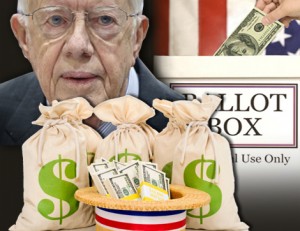
Jimmy Carter Says Elections Corrupted

JIMMY CARTER SAYS ELECTIONS CORRUPTED

By Pete Papaherakles,


Injecting billions of dollars into U.S. politics is a recipe for corruption, says former President Jimmy Carter. Placing the blame squarely on the Supreme Court for endorsing a corporate spending free-for-all in American politics, he said the justices gave unlimited freedom to special interest groups representing corporations and lobbyists to provide campaign funding through third parties that don’t have to disclose their donors.
“We have one of the worst election processes in the world right here in the United States of America,” he said, “and it’s almost entirely because of the excessive influx of money.
“You know how much I raised to run against Gerald Ford?” asked Carter in his latestConversation at the Carter Center. “Zero. You know how much I raised to run against Ronald Reagan? Zero. You know how much will be raised this year by all presidential, Senate and House campaigns? Six billion dollars. That’s 6,000 million.”


Carter did get public funding from the Democratic National Committee but received no money from private donors—corporate or individuals.
In contrast, Romney and Obama are both on their way to possibly raising an astonishing billion dollars each in campaign funds this year. By August 31 Romney had raised $669M while Obama had raised $766M. In the month of August Romney raised $112M and Obama brought in $114M, and the stakes keep getting higher until Election Day. These funds are a combination of public and private funds, with public funds comprising only about a quarter of the total money raised.
The Supreme Court justified its 5-4 Citizens United ruling on the basis that the First Amendment prohibits government from restricting independent political donations by corporations and unions. As a result, special interest groups have taken control of the election process making it “shot through with financial corruption that threatens [America],” according to Carter. He expressed his hope that “the Supreme Court will reverse that stupid ruling.”
The American Israel Public Affairs Committee (AIPAC) is, of course, the most powerful lobby in Washington. Along with other pro-Zionist lobbies, individuals and corporations, they dominate campaign funding, thus influencing the political platform, including foreign policy, for both candidates.
Carter prefers publicly financed elections, currently used by other countries.


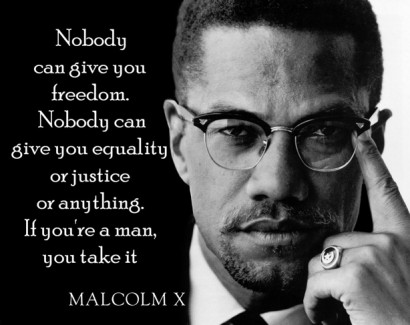
Malcolm X, The Elections and The Politics Of Empire


By Sohail Daulatzai,

With Guantanamo still open, drones still killing and anti-Muslim sentiment forming the rumbling bass line of empire, the upcoming US presidential elections have once again raised the spectre and threat of Islam and the Muslim third world to US national security and its interests.

to be black in America is enough to be deemed un-American, but to be black and Muslim is to be anti-American. While the "smearing" of Obama as a Muslim in the post-9/11 climate is informed by the threat posed by that thing called "al-Qaeda", Obama's blackness and his "proximity" to Islam is really a deeper seated anxiety around Malcolm X, who challenged American authority over not only the black past but also a black future, demanding that black people view themselves not as a national minority but as part of a global majority.

For Malcolm X, "Islam was the greatest unifying force of the Dark World", and the Muslim third world had a defining impact on Malcolm X's life and political vision, whether it was the spiritual centre Mecca or the anti-colonial struggles in Egypt, Algeria, Palestine, Iraq and elsewhere. But for Malcolm one didn't have to be a Muslim. What was important was the recognition of a racial reality to one's secular suffering that would view white supremacy as a global phenomenon and link black struggles with those in the third world.


In Cairo, Malcolm implored the heads of state not to be fooled by the "imperialist wolf" of the US or the State Department's attempts to use propaganda to convince African nations that the United States was making serious progress toward racial equality through Brown v Board and the passage of Civil Rights legislation. 

As Malcolm said, these measures were a "propaganda manoeuver" and "are nothing but tricks of the century's leading neo-colonialist power". Malcolm implored the gathering to heed his warning: "Don't escape from European colonialism only to become more enslaved by deceitful, 'friendly' American dollarism." 

In highlighting the use of propaganda and the managing of America's image abroad, Malcolm anticipated not only how after 9/11 the State Department would place Muslims in high profile positions in the arts and political realms to influence Muslim public opinion abroad, but also how the election of Obama and the rhetoric of "diversity" would be used to redefine America as inclusive, "post-racial" and progressive in order to mask the entrenchment of white power domestically and globally.  

And in tying domestic racial politics in the US to America's role as a "neo-colonial power" and the emergence of "American dollarism", Malcolm laid bare how race linked European colonialism and the emergence of the US as a global superpower. 

While Obama went to Egypt to co-opt this sacred city and put a benevolent face on American power, Malcolm had been there to strip away the veneer of benevolence and reveal the naked truth about US racial injustice and imperial ambition. This is why the legacy of Malcolm X is so important, as it sheds light on the racial dynamics that shape the global landscape today under US power.  

In the immediate aftermath of World War II, as the US replaced Europe as the dominant actor on the world's stage, President Truman declared "communism" public enemy number one, even viewing communism as a bigger threat than colonialism to the decolonising third world. As a result, the US and its allies in Europe believed that a liberated third world was the biggest threat to the post-War order that the US wanted to dominate, as it would create a vacuum of power that could be filled by Communism. 
 Inside Story US 2012 - 'Fear of a Black Republican'

The real fear, as Malcolm and others like Lumumba, Fanon and Nkrumah understood, was the liberation and independence of the majority of the world that would have the potential to radically redistribute global power and wealth away from the white world.  

Instead, the US expanded its imperial footprint into the third world and extended the logic of colonial racism by using "anti-communism" as a means to justify intervention, the supporting of dictators, the overthrow of democratically elected leaders, assassinations and destabilisation throughout the third world (witness Mossadegh, Arbenz, Lumumba and so many others). As a result, US foreign policy used "anti-communism" as a proxy for race by undermining the decolonisation of the third world.

Malcolm emerged out of this Cold War crucible where Civil Rights activists embraced an American identity and argued that Jim Crow violence was an Achilles' heel that would undermine America's global ambitions to a third world already hostile to white supremacy. Malcolm was deeply critical of the Civil Rights establishment for domesticating black struggle within American frameworks and supporting the logic of "anti-communism".  

For Malcolm and others, by not understanding the global nature of white supremacy, the Civil Rights establishment was not going to even make domestic gains on race. Instead of tying their fate to the decolonising third world to systemically undo white power, the Civil Rights mandate only masked white power through a reformist posture domestically, while facilitating its entrenchment throughout the world by assuming the flawed logic of "anti-communism". 

In 1964, Malcolm X made his infamous "The Ballot or the Bullet" speech and challenged the Civil Rights establishment by asserting the futility of black voting as a means toward gaining equality in the United States. Instead, he argued, black people needed to internationalise their struggles and link them to the struggles taking place throughout the third world of Africa, Asia and Latin America. 

As Malcolm said, "you don't take your case to the criminal, you take the criminal to court". For Malcolm X, the move from "civil rights" to "human rights" would place the plight of black peoples in America into a broader forum that would force the US to undergo scrutiny and challenge from the third world and that might tilt the balance of power to the dark nations, as it would reveal US hypocrisies, undermine the country's foreign policy objectives in the third world and expose the country's own brutal extension of European colonial racism. 

As part of his radical internationalism and in profound contrast to the Civil Rights establishment, Malcolm supported the Palestinians against Zionism, likened the ghettos of Harlem under racist segregation to the Casbah in Algiers under French colonial rule, praised Nasser's stand against England, France and Israel, celebrated the Bandung Conference and saw it as a model for unifying black political culture during the Cold War, supported the Mau Mau rebellion against British colonialism and the Vietnamese against French rule, met with Fidel Castro, lauded Lumumba as the "greatest Black man who ever walked the African continent", and like Fanon, gave ethical sanction to the possibility of armed struggle, fundamentally challenging the Cold War consensus. 


With the hyper-nationalism of the post-9/11 era fuelling America's war with the Muslim third world, Malcolm's legacy of resistance that combined black internationalism with the politics of the Muslim third world provides a blueprint to challenge the imperial consensus that has characterised the post-9/11 era. 
 American racism 'on the rise'

Just as "anti-communism" was a proxy for race during the Cold War, "anti-terrorism" has become the new proxy for race and the re-entrenching of white supremacy by justifying US intervention abroad while also containing dissent domestically, as the logic of "terrorism" is used to determine who is a citizen and who is an enemy, who is human and who is not, and who is to be killed and who is allowed to live. 

Forged out of the Cold War, Malcolm's legacy can challenge the embrace by minority communities (including Muslims) of the rhetoric of "terrorism" by recognising its racially coded roots and how "anti-terrorism" is used to not only police dissent, but also allows for the violent expansion of US empire. For not only does the logic of "anti-terrorism" play into the racist logic of "moderate" and "radical" Muslims, it also fails to give dignity to challenges to US state power around the world. 

While many activists, artists, scholars and organisations are infusing the ideas of Malcolm within their work, it's important that black and Muslim communities, as well as other communities of colour, continue to draw the deep internationalist connections that Malcolm did. 

The linking of these struggles isn't some romantic vision of solidarity. It's rooted in a deeper understanding of how profoundly connected these violent forces really are. And it is a recognition that the persistence of racism here in the United States is precisely because white supremacy is deeply woven into the very fabric of US statecraft and is perpetually given life through the everyday functioning of how the US conducts its affairs, whether here or abroad.  

It's the recognition that the logic of mass incarceration in the US that has destroyed black political possibility and contained dissent through local policing and counter-insurgency is also what drives the US military and its imperial imprisonment in Abu Ghraib, Guantanamo, Bagram and other places. It's the recognition that the plight of migrants across the heavily militarised US-Mexico border resembles the conditions that contain and destroy Palestinian lives and livelihood. And it's the recognition that the neoliberal economic policies that have destroyed the social wage and witnessed the emergence of the warfare state in the US is deeply rooted in the exploitation of the third world through global finance capital and war. 

To only talk about domestic anti-racism and not see white supremacy as a global problem, or to only make tepid critiques of US foreign policy around tactics and strategies and not its fundamentally racist posture rings hollow and misses the boat entirely. For it fails to recognise that white supremacy is rooted in the very structure of global relations that the US helped bring into being - a set of relationships where diplomacy, trade, political manoeuvering, war and questions of sovereignty are played out on a radically uneven playing field where the US and Europe exert overwhelming diplomatic leverage, political power and brutal military might.  

To ignore this falls into the worst forms of liberal internationalism that presume the US to be a force for good in the world, and it replicates the very problem that Malcolm X heroically struggled against, and was ultimately killed for.  

Though the bullets finally caught up with Malcolm, he left an indelible imprint on generations of artists and activists. But his legacy is under attack, and even erasure, as the Obama presidency and the triumphalist narrative of Civil Rights seeks to make black internationalist impulses irrelevant and outdated. 

While there are those who claim that voting for Obama is the practical thing to do and that to either vote for a third party or to not vote at all is "impractical" and "misguided", Malcolm might turn the tables and ask how "practical" is it to vote for either major party when the violent forces that define them are so intractable and resistant to change, let alone transformation? 

And when confronting such forces, and recognising the others in the past who have tried so valiantly, how practical is it to continue to invest and commit to this process and expect something different? Isn't that "impractical" and the path to irrelevance? 

Via: "Al-Jazeera"


Monday, November 05, 2012

Plotting For A Permanent Republican Presidency


By STEVEN JONAS MD,
Courtesy Of "Truth-Out"


Karl Rove was dreaming of what he called “The Permanent Republican Majority.”   That is he thought that he could achieve a majority vote among the 50% or so of US eligible voters who actually vote, for the Republican candidates for the Presidency, on a permanent basis.  In the 2000 election (1) he had achieved less than a majority of the popular vote (47.9% to Gore’s 48.4%, the rest going to minor candidates [mainly the spoiler Ralph Nader]), and had managed a majority of the electoral vote only by getting, as is very known, a one vote majority on the Supreme Court.  But Karl had a big dream.  For 2004 he would construct a true majority, among those actually voting that is, by pulling “his people” to the polls in numbers out of proportion to their proportion among the eligible.
He did that that year by getting anti-gay marriage initiatives of one sort of another onto the ballots in 12 states where pulling homophobes to the polls in numbers out-of-proportion to their numbers in the general population would boost the vote total for George Bush.  The strategy did work in one sense.  Bush did get 50.7% of the popular vote (2).  
But John Kerry actually won the electoral vote, except that Ohio had been rigged by the Republican Secretary of State, who just happened to also be the Ohio chair for Bush-Cheney(!) (3).
(In fact, Kerry had anticipated such a possible outcome and had prepared a $15,000,000 war chest for legal action.  For unknown reasons he chose not to use it [leaving John Edwards, to whom he had promised he would, in a rage.  Of course, Edwards was not a paragon of ethical behavior either, as it turned out, but that’s another story.]  But Rove knew which end was up.  
And the full Ohio vote-count rigging story would have come out a couple of years later if the man at the technical center of it had not somehow been killed in a light plane crash on his way to testify at a hearing on the matter, for which he had indicated that he was going to tell the truth (3).  [It is interesting to note that Senators Paul Wellstone and Mel Carnahan had some years earlier died the same way.])
Given the closeness of both the popular and electoral vote totals, following the 2004 election it became very apparent that he was no longer focusing on a Permanent Republican Majority.  It was too risky if one wanted to keep GOP control of the Federal government.  For the one thing, the proportion of eligible voters actually voting could go up, and they might go to the other side.  That was the lesson of 2008.  For another, how many times could one put homophobe-philic initiatives or similar ones on state ballots?  No, another strategy had to be developed.  And so instead of the Permanent Republican Majority, Rove and his cohorts came up with the concept of the Permanent Republican Presidency.
The strategy has six major components, built up over time.  And if one has been watching GOP actions since the middle of the last decade one can discern them fairly easily. 
First is the cementing of the vote of the Religious Rightists without going to the lengths of coming up with ballot initiatives and similar.  You simply convert the GOP into what Howard Fineman of MSNBC and The Huffington Post has called “The American Faith Party” (4).  

Second, you fake stories of sex and corruption which manage to take down the principal organization whose principal focus is on registering low-income voters, Association of Community Organizations for Reform Now (ACORN) (5).  

Third, following the 2008 election (which you hardly minded losing, given the economic pit into which the country was falling due to the policies enacted by your party --- let the other guy take the blame for the outcomes, which blame the GOP is shoveling on him by the truckload this year) you focus on organizing the right-wing vote at the state level through the very well-funded so-called “Tea Party” movement

Fourth, once having taken over both Executive and Legislative branches of a number of state governments, with the very active help of the Fox”News”Channel you make the  practice of “voter fraud” the tool through which you enact a series of state laws designed to achieve wide-spread voter suppression.  Since there have been a series of successful court challenges to those laws, it remains to be seen just how successful they will be this time around.  But Rove and his people are on for the long haul.  

Then (fifth) of course there is “Citizens United” and the “Super-PACs.” Thom Hartmann to the contrary notwithstanding, they have not made a qualitative difference in the owning-class control of the state apparatus in the United States which goes back to the days of the Slave Power.  But they surely have made a quantitative difference in the amount of money the Right-wing has to spend on assuring electoral outcomes to their liking.  

Finally (sixth) there is the widespread cheating which began in earnest in 2004 with the substitution of electronic voting, run by GOP corporate allies, for paper or manual machine voting (3). 
Third, following the 2008 election (which you hardly minded losing, given the economic pit into which the country was falling due to the policies enacted by your party --- let the other guy take the blame for the outcomes, which blame the GOP is shoveling on him by the truckload this year) you focus on organizing the right-wing vote at the state level through the very well-funded so-called “Tea Party” movement
It remains to be seen how this will play out in this year’s election.  Until the first Presidential debate, Romney had been far enough behind so that cheating in such states under GOP control as Ohio and Florida would have become fairly obvious.  Following the President’s miserable performance in the first debate, Romney started to catch up and gave himself a chance to win even without cheating and with limited voter suppression.  
With Obama’s strong performance in the second debate, the GOP may have to fall back on cheating to secure victory.  But one can be sure, if they are within striking distance of victory for Romney, and cheating will seal the deal they will surely do what it takes, for them (3).
-
1. 2000 General Election Results, http://uselectionatlas.org/RESULTS/national.php?year=2000
2. 2004 General Election Results, http://uselectionatlas.org/RESULTS/national.php?year=2004
3. Bob Fitrakis and Harvey WassermanThe Free Press | News Analysis, Tuesday, 16 October 2012, “Will Bain-Linked E-Voting Machines Give Romney the White House?” Republished on Truthout, Oct. 16, 2012, http://truth-out.org/news/item/12130-will-hig-owned-e-voting-machines-give-romney-the-white-house.
4. Fineman, H., "Rise of Faith within the GOP has created America's First Religious
Party," The Huffington Post, http://www.huffingtonpost.com/2012/03/05/republican-
party-religion-first-religious-party_n_1322132.html.
5. Association of Community Organizations for Reform Now (ACORN), http://en.wikipedia.org/wiki/Association_of_Community_Organizations_for_Reform_Now.

Sunday, November 04, 2012

Voting Against The Machine


Polls show the US presidential election is a close contest. Yet a number of voters argue Obama and Romney are so similar that there’s no point in casting a ballot. Others say they will back a third party with no real chance of winning. By refusing to endorse Obama or Romney, could these citizens decide the next president and what would that mean? 

In this episode of The Stream, we speak to: 

Michael Moschella @MikeMoschella
Founder, New Leaders Council
newleaderscouncil.org 

Jason Brennan
Professor at Georgetown University, author of "The Ethics of Voting"
jasonfbrennan.com 

Kevin Gosztola @kgosztola
Blogger, Firedoglake.com 


  1. In the highly contested US presidential campaign between President Barack Obama and Republican candidate Mitt Romney, many voters are disappointed with the positions of the two candidates. A key number of these, around five per cent of likely voters, plan to back third-party candidates, while others may not vote at all.

    Analysts say the election could end in a tie due to the electoral college voting system, with both candidates winning 269 out of 538 electoral college votes.
  2. Currently there are 32 combinations for a potential electoral tie. The map below shows one possible outcome.
    What do you think? Are Americans who are voting for third-party candidates wasting their vote or changing the system?

Thursday, October 25, 2012

Money Is Speech


A Musical History Of Campaign Finance

Act I: Brown Paper Bags

“I made my mistakes, but in all my years of public life, I have never profited [from public service]. I’ve earned every cent.” (Richard Nixon)

“Money is speech.” (Jeff Greenfield)
“The more speech the better.” (Antonin Scalia)
“Money is speech.” (Jeff Greenfield)
“I’ve earned every cent.” (Richard Nixon)
“Money is speech.” (Jeff Greenfield)
“The more speech the better.” (Antonin Scalia)
“I don’t like all the influence of money in politics.” (Mitt Romney)

When people think of Watergate they think of a break-in
But they don’t mention the money that Nixon was taking
From wealthy donors to help him get reelected
Nixon paid them back in favors just like they expected

To battle corruption Congress passed a new law
Capping contributions to a candidate’s haul
The source of the donations had to be disclosed too
And the FEC was formed to enforce the new rules

Some who felt the law went against the Constitution sued
Saying limits on money limited free speech too
So the courts kept the cap on how much you can donate
But said spending was unlimited by an outside group or candidate

That meant no more spending limits to promote a cause
Or to point out a rival campaign’s flaws
So while candidates once snuck around with brown paper bags 
From then on they raised money publicly or left it to PACs

“Money is speech.” (Jeff Greenfield)
“The more speech the better.” (Antonin Scalia)
“Money is speech.” (Jeff Greenfield)
“I’ve earned every cent.” (Richard Nixon)
“Money is speech.” (Jeff Greenfield)
“The more speech the better.” (Antonin Scalia)
“I don’t like all the influence of money in politics.” (Mitt Romney)

Act II: Soft Money

“We should also curb the role of big money in elections by capping the cost of campaigns…” (Bill Clinton)

In the 80s and 90s, there was a new gimmick:
“Soft money” that’s disclosed but had no limits
It’s supposed to cover each party’s expenses
But guys like Clinton used it to help their election chances

There was just one problem, Clinton’s party was broke
So he asked for more money every time he spoke
And in return for the 100 million dollar cash-in
He let donors use the Lincoln Bedroom to crash in

Then the “scandal and reform” cycle happened again
And legislation was proposed by Feingold and McCain
It capped donations to parties, ending soft funds
And banned corporate/union issue ads right before elections

But with each new reform comes new loopholes
Tax exempt “527s” arose
Because they weren’t explicit about whom they supported
Many still raised money without limits to thwart them

“Money is speech.” (Jeff Greenfield)
“The more speech the better.” (Antonin Scalia)
“Money is speech.” (Jeff Greenfield)
“I’ve earned every cent.” (Richard Nixon)
“Money is speech.” (Jeff Greenfield)
“The more speech the better.” (Antonin Scalia)
“The rules are what they are…” (Jay Carney)

Act III: Super PACs and Non-Profits

“I don’t think American elections should be bankrolled by America’s most powerful interests.” (Barack Obama)

But the most outside money was yet to be spent
Some argued spending limits broke the first amendment
“Corporations and unions are entitled to free speech”
They took it to court, the Supreme Court agreed.

Super PACs can raise as much money as they want
They can also use union and corporate funds
The only rule is they cannot coordinate
With a specific party or a specific candidate

But reform opponents weren’t quite done yet
They found new uses for 501(c)(4) non-profits
Which are a lot like Super PACs with more mystery
They haven’t had to disclose donors ever in history

Whether Republican or Democrat you might believe
That spending limits jeopardize our freedom of speech
But with each new cycle of deregulation
More money is being injected into our elections

Lyrics via: ProPublica

Thursday, October 18, 2012

The Rigged Presidential "Debates"


Secret Collusion Between The Two Parties, Funded By Corporations, Run By Lobbyists

By Glenn Greenwald,


The way the two major parties control the presidential debates is a perfect microcosm of how political debates are restricted in general. Though typically shrouded in secrecy, several facts about this process have recently come to light and they are quite instructive.
I was on Democracy Now this morning along with George Farah discussing the ways these debates, designed to cast the appearance of fostering vibrant exchanges, are actually intended to constrict the range of debated views as much as possible. My segment (and the transcript to it) can be seen here, but it was the commentary of Farah - who is a genuine expert in the history of presidential debates - that I found revealing.
He described how the two political parties in the 1990s joined forces to wrest control over the presidential debates away from the independent League of Women Voters, which had long resisted the parties' efforts to shield their presidential candidates from genuine surprise or challenge. Now run by the party-controlled Commission on Presidential Debates, these rituals are designed to do little more than " eliminate spontaneity" and "exclude all viable third-party voices". Citing a just-leaked 21-page "memorandum of understanding" secretly negotiated by the two campaigns to govern the rules of the debates, Farah recounted:
"We have a private corporation that was created by the Republican and Democratic parties called the Commission on Presidential Debates. It seized control of the presidential debates precisely because the League was independent, precisely because this women's organization had the guts to stand up to the candidates that the major-party candidates had nominated. And instead of making public these contracts and resisting the major-party candidates' manipulations, the commission allows the candidates to negotiate these 21-page contracts that dictate all the fundamental terms of the debates."
Gawker's John Cook has an excellent breakdown of the 21-page memo. In his piece, entitled "Leaked Debate Agreement Shows Both Obama and Romney are Sniveling Cowards", Cook details how the rules imposed on these debates demonstrate that, above all else, "both campaigns are terrified at anything even remotely spontaneous happening."
Under this elaborate regime, the candidates "aren't permitted to ask each other questions, propose pledges to each other, or walk outside a 'predesignated area.'" Worse, "the audience members posing questions aren't allowed to ask follow-ups (their mics will be cut off as soon as they get their questions out). Nor will moderator Candy Crowley." The rules even "forbid television coverage from showing reaction shots of the candidates".
All of this means, as Farah put it:

"The town hall debate we're going to see tonight is the most constrained and regulated town hall debate in presidential debate history. The first town hall debate was introduced in 1992, and no one knew what anyone was going to ask, none of the audience members were going to ask. The moderator could ask any follow-up questions. It was exciting, and it was real.
"Well, President George H.W. Bush stumbled in response to an oddly worded question about the federal deficit, and the candidates - the campaigns have panicked and have attempted to avoid that kind of situation from happening again. In 1996, they abolished follow-up questions from the audience.
"In 2004, they began requiring that every single question asked by the audience be submitted in advance on an index card to the moderator, who can then throw out the ones he or she does not like. And that's why the audience has essentially been reduced, in some ways, to props, because the moderator is still ultimately asking the questions.
"And this election cycle is the first time that the moderator herself is prohibited from asking follow-up questions, questions seeking clarification. She's essentially reduced to keeping time and being a lady with a microphone."
Making matters worse still, the Commission is run by lobbyists and funded by large corporations. As Zaid Jilani writes today, the two Commission co-chairmen are former GOP Chairman Frank J. Fahrenkopf, Jr. and former Clinton spokesman Michael D. McCurry. Fahrenkopf is one of the nation's leading lobbyists for the gaming industry, while McCurry advises a long list of corporate clients including the telecom industry.
The debates are paid for by large corporate sponsors, including Anheuser-Busch Companies. As Jilani writes, "in the past, the tobacco industry, AT&T, and others have all been sponsors." And as Farah describes, with all that sponsorship comes the standard benefits:
"FARAH: 'First, the just nice advertising, of course. They get to - you know, Philip Morris sponsored one of the presidential debates, paid $250,000 and got to hang its banner in the post-debate spin room that was seen throughout the country. But more importantly, they get access, and they get to show support for both major parties.'
"AMY GOODMAN: 'The major parties on their podiums have Bud Light on the podium?'
"FARAH: 'Not yet. We're getting there. We're getting there, Amy. But they get to show support for both major parties. How often can corporations find a way to make a single donation that strengthens both the Republican and Democratic parties and get a tax deduction for that kind of donation? So it's a rare contribution. And it also gives them access. They get to go to the actual debate themselves and rub shoulders at private receptions with the campaigns and their staff.'"
Meanwhile, the moderators were selected to ensure that nothing unexpected is asked and that only the most staid and establishment views are heard. As journalism professor Jay Rosen put it when the names of the moderators were unveiled, using terms to describe those views that are acceptable in Washington media circles and those which are "fringe":
"In order to be considered as a candidate for moderator you have to be soaked in the sphere of consensus, likely to stay within the predictable inner rings of the sphere of legitimate controversy, and unlikely in the extreme to select any questions from the sphere of deviance."

Here then, within this one process of structuring the presidential debates, we have every active ingredient that typically defines, and degrades, US democracy. The two parties collude in secret. The have the same interests and goals. Everything is done to ensure that the political process is completely scripted and devoid of any spontaneity or reality.
All views that reside outside the narrow confines of the two parties are rigidly excluded. Anyone who might challenge or subvert the two-party duopoly is rendered invisible.
Lobbyists who enrich themselves by peddling their influence run everything behind the scenes. Corporations pay for the process, which they exploit and is then run to bolster rather than threaten their interests. The media's role is to keep the discourse as restrictive and unthreatening as possible while peddling the delusion that it's all vibrant and free and independent and unrestrained. And it all ends up distorting political realities far more than illuminating them while wildly exaggerating the choices available to citizens and concealing the similarities between the two parties.
To understand the US political process, one can just look to how these sham debates are organized and how they function. This is the same process that repeats itself endlessly in virtually every other political realm.

Wednesday, October 17, 2012

No Matter Who “Wins”, Humanity Loses


By Larry Chin,

On one side, the Obama administration, and the traditional brand of neoliberal imperialism and international consensus, and false domestic populism. On the other side with Mitt Romney and Paul Ryan, militant right-wing extremism, an apocalyptic war agenda and the politics of sadism at home.


The final choice will not be made by voters (who will be disenfranchised again, via electronic vote fraud and other manipulations), but by the criminal elements who seize final control of the apparatus over the final month of the “contest”.

The “children” are being allowed to fight it out amongst themselves. The side with ultimate command of the corporate media propaganda, the most effective back door deals, and the most effective dirty tricks and election night shenanigans, will prevail, the pre-determined result promptly encrypted into the software of controlled Diebold voting machines.

The Debate Charade
 
It is tempting but futile to dissect the theatrics of the debates, which are based on entirely on false premises to begin with. Not one exhaustively argued “talking point” addresses realities.

The carefully pre-selected issues assume a host of falsehoods, from the legitimacy of the wars in Iraq and Afghanistan, and the destabilizations of Iran and Syria, to the need for fiscal austerity.

These are rhetorical dog-and-pony shows without real differences, beyond timing, style, and method, by which they will execute similar agendas.

Both sides largely agree on foreign policy. Both sides proudly trumpet how best to inflict crippling economic warfare on “nuclear Iran”, and topple Syria. The only argument is whether the sequential multinational stranglehold (“diplomacy”) led by the Obama administration continues apace, or, if Romney/Ryan and the right will get what they really want: an all-out war with Iran.

Both sides agree on the same falsehoods regarding the national debt (without mentioning that the world war that they enthusiastically wage is the main expenditure) and the US financial crisis (ignoring the fact that the financial “crisis” and “bailout” was a manipulation that centralized the power for Wall Street constituents, the big banks, who support both sides equally, at the expense of US taxpayers). In terms of social programs (that will be cut in any case in order to pay for more war), the Romney/Ryan contingent calls for an immediate destruction of the entire social structure of the US—a swift draconian end to social programs such as Medicare and Social Security—while the Obama administration takes a more gradual approach.

Essentially, the candidates have already admitted that they do not serve the interests of most of humanity.

The media “analysis” of the election has been stomach-turning— nothing more than insanity heaped atop insanity. The chattering of talking heads over infantile nonsense, such as “who looks presidential”, who got more “gotchas” and “zingers”. A dumbed-down spectacle for a dumbed-down, manipulated populace.

Which Way To The Abyss?

There have never been real elections in contemporary America, and there will be no “election” this time either. There will, as always, be no real choice: war-mongering, mass-murdering imperialist “A” or war-mongering mass-murdering imperialist “B”.

America and the world must pay attention to which brand of fascism will ultimately be chosen, if only to properly prepare for what is to come. The marginal differences in method and style have ramifications, domestically and globally.

The quelling of increasingly large swaths of humanity is more important to the elite than ever before. The next White House occupant will spearhead the likely UN and NATO regime changes for Syria and Iran, both of which have been systematically destabilized by the CIA and its affiliates, and the “reconstruction” of the American social net.

Will it be more of the fist inside the velvet glove, or the hammer directly to the skull?

No matter who “wins”, humanity loses.