


Showing posts with label Money Talks. Show all posts
Showing posts with label Money Talks. Show all posts
Thursday, October 25, 2012
Money Is Speech
A Musical History Of Campaign Finance
Act I: Brown Paper Bags
“I made my mistakes, but in all my years of public life, I have never profited [from public service]. I’ve earned every cent.” (Richard Nixon)
“Money is speech.” (Jeff Greenfield)
“The more speech the better.” (Antonin Scalia)
“Money is speech.” (Jeff Greenfield)
“I’ve earned every cent.” (Richard Nixon)
“Money is speech.” (Jeff Greenfield)
“The more speech the better.” (Antonin Scalia)
“I don’t like all the influence of money in politics.” (Mitt Romney)
When people think of Watergate they think of a break-in
But they don’t mention the money that Nixon was taking
From wealthy donors to help him get reelected
Nixon paid them back in favors just like they expected
To battle corruption Congress passed a new law
Capping contributions to a candidate’s haul
The source of the donations had to be disclosed too
And the FEC was formed to enforce the new rules
Some who felt the law went against the Constitution sued
Saying limits on money limited free speech too
So the courts kept the cap on how much you can donate
But said spending was unlimited by an outside group or candidate
That meant no more spending limits to promote a cause
Or to point out a rival campaign’s flaws
So while candidates once snuck around with brown paper bags
From then on they raised money publicly or left it to PACs
“Money is speech.” (Jeff Greenfield)
“The more speech the better.” (Antonin Scalia)
“Money is speech.” (Jeff Greenfield)
“I’ve earned every cent.” (Richard Nixon)
“Money is speech.” (Jeff Greenfield)
“The more speech the better.” (Antonin Scalia)
“I don’t like all the influence of money in politics.” (Mitt Romney)
Act II: Soft Money
“We should also curb the role of big money in elections by capping the cost of campaigns…” (Bill Clinton)
In the 80s and 90s, there was a new gimmick:
“Soft money” that’s disclosed but had no limits
It’s supposed to cover each party’s expenses
But guys like Clinton used it to help their election chances
There was just one problem, Clinton’s party was broke
So he asked for more money every time he spoke
And in return for the 100 million dollar cash-in
He let donors use the Lincoln Bedroom to crash in
Then the “scandal and reform” cycle happened again
And legislation was proposed by Feingold and McCain
It capped donations to parties, ending soft funds
And banned corporate/union issue ads right before elections
But with each new reform comes new loopholes
Tax exempt “527s” arose
Because they weren’t explicit about whom they supported
Many still raised money without limits to thwart them
“Money is speech.” (Jeff Greenfield)
“The more speech the better.” (Antonin Scalia)
“Money is speech.” (Jeff Greenfield)
“I’ve earned every cent.” (Richard Nixon)
“Money is speech.” (Jeff Greenfield)
“The more speech the better.” (Antonin Scalia)
“The rules are what they are…” (Jay Carney)
Act III: Super PACs and Non-Profits
“I don’t think American elections should be bankrolled by America’s most powerful interests.” (Barack Obama)
But the most outside money was yet to be spent
Some argued spending limits broke the first amendment
“Corporations and unions are entitled to free speech”
They took it to court, the Supreme Court agreed.
Super PACs can raise as much money as they want
They can also use union and corporate funds
The only rule is they cannot coordinate
With a specific party or a specific candidate
But reform opponents weren’t quite done yet
They found new uses for 501(c)(4) non-profits
Which are a lot like Super PACs with more mystery
They haven’t had to disclose donors ever in history
Whether Republican or Democrat you might believe
That spending limits jeopardize our freedom of speech
But with each new cycle of deregulation
More money is being injected into our elections
Lyrics via: ProPublica


Sunday, February 26, 2012
No Matter Who You Vote For, Money Always Wins
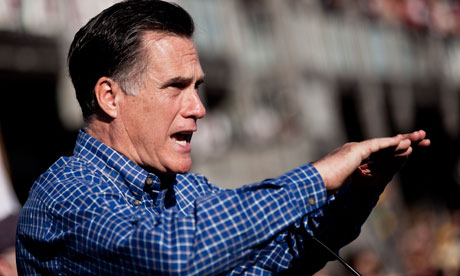
Mitt Romney's personal wealth is double that of the last eight US presidents combined. Photograph: TJ Kirkpatrick/Corbis
Dollars Play A Decisive Role In US Politics. And More So Since The Supreme Court Allowed Unlimited Campaign Contributions
By Gary Younge
Sunday 29 January 2012 15.30 EST
Courtesy Of "The Guardian"
Republican presidential debates are not for the faint-hearted. Last week in Jacksonville, Florida, Rick Santorum warned of the "threat of radical Islam growing" in Central and South America. Newt Gingrich advocated sending up to seven flights a day to the moon, where private industry might set up a colony, and reaffirmed his claim that Palestinians were invented in the late 70s. Mitt Romney argued that if you make things tough enough for undocumented people, they will "self-deport".
Given the general state of the Republican party, such comments now attract precious little attention. Truth and facts are but two options among many. The party's base, overrun by birthers, climate change deniers and creationists, floats its warped theories and every now and then one makes it to the top and bobs out into the airwaves.
So the oft-touted notion that these debates have been responsible for shifting the trajectory of this primary race would be worrying if it were true. It is difficult to think of anywhere else in the western world where these debates would have any credibility outside of a fringe party (even if the fringes in Europe are now spreading). Far from indicating America's exceptionalism, it looks more like an awful parody of the stereotypes most outsiders already believed about American politics at its most bizarre. "Those who follow this race daily may have long since lost perspective on how absurd it is," said the German magazine Der Spiegel last week. "Each candidate loves Israel. They all love Ronald Reagan. Each loves his wife, a born first lady, for a number of reasons."
The good news is, with the exception of Perry's demise, the debates have not been pivotal. The bad news is that the truly decisive element has been something even more insidious: money. Lots of it.
This is not new. But since a 2010 supreme court ruling allowing unlimited campaign contributions by corporations and unions, it has become particularly acute. Moreover, the contributors can remain anonymous. The organisations that are taking advantage of this new law are known as Super Pacs. Even at this early stage of the presidential cycle, their potential for framing the race is clear. In the whole of 2008 individuals, parties and other groups spent $168.8m independently on the presidential election. This year on Republican candidates alone, where voting started less than a month ago, the Super Pacs have reportedindependent expenditures of almost $40m. In 2008 election spending doubled compared with 2004. This year industry analysts believe the money spent just on television ads is set to leap by almost 80%compared with four years ago.
Money in American politics was already an elephant in the room. Now the supreme court has given it a laxative, taken away the shovel, and asked us to ignore both the sight and the stench.
The only real restriction is that there should be no co-ordination between the candidate and the Super Pac. In practice, this is little more than a fig leaf. A few weeks ago one of the ads, funded by the Super Pac supporting Gingrich, was slated for its many brazen inaccuracies. At a campaign stop in Orlando, Gingrich told supporters: "I am calling on this Super Pac – I cannot co-ordinate with them and I cannot communicate directly, but I can speak out as a citizen as I'm talking to you – I call on them to either edit out every single mistake or to pull the entire film."
Romney is no less compromised. His former chief campaign fundraiser and political director work for the main Super Pac supporting him, which was set up with the help of a $1m cheque from an ex-business partner. "This legalism of 'no co-ordination' is a filament-thin G-string," wrote Timothy Egan in the New York Times recently. "Everyone co-ordinates."
Money alone can't guarantee success. Santorum spent around 74 cents a voter in Iowa and narrowly won; Perry spent around $358 per vote and came a distant fourth. Debate performances, policy positions, personal histories and retail politics play a role. But the fact that money is not the sole determinant doesn't mean it's not the key one. Two months ago Gingrich's surge in Iowa was halted after Romney's Super Pac ploughed millions of dollars into campaign ads attacking him. Romney's commanding lead in South Carolina was similarly thwarted when Gingrich's Super Pac injected several million dollars.
This is not a partisan point. Almost two-thirds of Americans believe the government should limit individual contributions – with a majority among Republicans, Democrats and independents. The influence of money at this level corrupts an entire political culture and in no small part explains the depth of cynicism, alienation and mistrust Americans now have for their politicians.
The trend towards oligarchy in the polity is already clear. There are 250 millionaires in Congress. As a whole, the polity's median net worth is $891,506, nine times the typical US household. Around 11% are in the nation's top 1%, including 34 Republicans and 23 Democrats. And that's before you get to Romney, whose personal wealth is double that of the last eight presidents combined. All of this would be problematic at the best of times, but in a period of rising inequality it is obscene.
The issue here is not class envy, hating rich people because they are rich, but class interests – cementing the advantages of the privileged over the rest. The problem is not personal, it's systemic. In the current climate, it means a group of wealthy people in business will decide which wealthy people in Congress they would like to tell poor people what they can't have because times are hard. And unless the ruling is overturned there is precious little that can be done about it.
Last week in a Massachusetts Senate race, both the Republican incumbent and his likely Democratic challenger signed a pact agreeing not to use third-party money. The trouble is that the agreement is completely unenforceable. Already at least one pro-Republican group has refused to commit to it.
Downplaying money's central role at this point merely buys into the illusion of participatory democracy, where ideas, character and strategy are paramount, while others are actually buying the candidates and access to power. The result is a charade. Fig leaf, G-string – name the scanty underwear of your choice. The emperor is butt naked. Whoever you vote for, the money gets in.
• This article was amended on 1 February 2012 to make clear that it is Congress as a whole that has a median net worth of $891,506.
Subscribe to:
Posts (Atom)
