Showing posts with label Class Warfare. Show all posts

Monday, May 19, 2014

The Truth Is Out: Money Is Just An IOU

British banknotes – money
The central bank can print as much money as it wishes.' Photograph: Alamy

The Bank of England's Dose Of Honesty Throws The Theoretical Basis For Austerity Out The Window

Back in the 1930s, Henry Ford is supposed to have remarked that it was a good thing that most Americans didn't know how banking really works, because if they did, "there'd be a revolution before tomorrow morning".


Last week, something remarkable happened. The Bank of England let the cat out of the bag. In a paper called "Money Creation in the Modern Economy", co-authored by three economists from the Bank's Monetary Analysis Directorate, they stated outright that most common assumptions of how banking works are simply wrong, and that the kind of populist, heterodox positions more ordinarily associated with groups such asOccupy Wall Street are correct. In doing so, they have effectively thrown the entire theoretical basis for austerity out of the window.
To get a sense of how radical the Bank's new position is, consider the conventional view, which continues to be the basis of all respectable debate on public policy. People put their money in banks. Banks then lend that money out at interest – either to consumers, or to entrepreneurs willing to invest it in some profitable enterprise. True, the fractional reserve system does allow banks to lend out considerably more than they hold in reserve, and true, if savings don't suffice, private banks can seek to borrow more from the central bank.
The central bank can print as much money as it wishes. But it is also careful not to print too much. In fact, we are often told this is why independent central banks exist in the first place. If governments could print money themselves, they would surely put out too much of it, and the resulting inflation would throw the economy into chaos. Institutions such as the Bank of England or US Federal Reserve were created to carefully regulate the money supply to prevent inflation. This is why they are forbidden to directly fund the government, say, by buying treasury bonds, but instead fund private economic activity that the government merely taxes.
It's this understanding that allows us to continue to talk about money as if it were a limited resource like bauxite or petroleum, to say "there's just not enough money" to fund social programmes, to speak of the immorality of government debt or of public spending "crowding out" the private sector. What the Bank of England admitted this week is that none of this is really true. To quote from its own initial summary: "Rather than banks receiving deposits when households save and then lending them out, bank lending creates deposits" … "In normal times, the central bank does not fix the amount of money in circulation, nor is central bank money 'multiplied up' into more loans and deposits."
In other words, everything we know is not just wrong – it's backwards. When banks make loans, they create money. This is because money is really just an IOU. The role of the central bank is to preside over a legal order that effectively grants banks the exclusive right to create IOUs of a certain kind, ones that the government will recognise as legal tender by its willingness to accept them in payment of taxes. There's really no limit on how much banks could create, provided they can find someone willing to borrow it. They will never get caught short, for the simple reason that borrowers do not, generally speaking, take the cash and put it under their mattresses; ultimately, any money a bank loans out will just end up back in some bank again. So for the banking system as a whole, every loan just becomes another deposit. What's more, insofar as banks do need to acquire funds from the central bank, they can borrow as much as they like; all the latter really does is set the rate of interest, the cost of money, not its quantity. Since the beginning of the recession, the US and British central banks have reduced that cost to almost nothing. In fact, with "quantitative easing" they've been effectively pumping as much money as they can into the banks, without producing any inflationary effects.
What this means is that the real limit on the amount of money in circulation is not how much the central bank is willing to lend, but how much government, firms, and ordinary citizens, are willing to borrow. Government spending is the main driver in all this (and the paper does admit, if you read it carefully, that the central bank does fund the government after all). So there's no question of public spending "crowding out" private investment. It's exactly the opposite.
Why did the Bank of England suddenly admit all this? Well, one reason is because it's obviously true. The Bank's job is to actually run the system, and of late, the system has not been running especially well. It's possible that it decided that maintaining the fantasy-land version of economics that has proved so convenient to the rich is simply a luxury it can no longer afford.
But politically, this is taking an enormous risk. Just consider what might happen if mortgage holders realised the money the bank lent them is not, really, the life savings of some thrifty pensioner, but something the bank just whisked into existence through its possession of a magic wand which we, the public, handed over to it.
Historically, the Bank of England has tended to be a bellwether, staking out seeming radical positions that ultimately become new orthodoxies. If that's what's happening here, we might soon be in a position to learn if Henry Ford was right.

Thursday, April 24, 2014

The Crisis of Civilization


"This civilization in its current form can not survive the 21st Century"

The Crisis of Civilization is a documentary feature film investigating how global crises like ecological disaster, financial meltdown, dwindling oil reserves, terrorism and food shortages are converging symptoms of a single, failed global system.

Directed by Dean Puckett
Animations by Lucca Benney
Based on the Book by Nafeez Mosaddeq Ahmed :http://crisisofcivilization.com/book/

Wednesday, April 02, 2014

U.S. "Stock Market Is Rigged"


Courtesy of: CBS and 60 Minutes

Steve Kroft reports on a new book from Michael Lewis, "Flash Boys," that reveals how a group of unlikely characters discovered how some high speed traders work the stock market to their advantage.

 U.S. stock ownership is at a record low and less than half of Americans trust banks and financial services. And in the last two weeks, the New York attorney general and the Commodities Futures Trading Commission in Washington have both launched investigations into high-frequency computerized stock trading that now controls more than half the market.

Tuesday, April 01, 2014

"Spending Money Is Not Speech"


Noam Chomsky: 'Let's Forget Any Pretense of Being a Democratic Society'

Famed linguist, philosopher Noam Chomsky sits down with Abel Collins to talk about money, free speech, McCutcheon vs FEC, and Citizens United in this poignant interview at MIT 10-8-13. 

Blog on Huffington Post - http://www.huffingtonpost.com/abel-co...

This video is about 10-8-13 #2 Abel & Noam Interview Part 2 Money as Free Speech Produced by Robert Malin c.2014

Wednesday, January 08, 2014

Peter Joseph vs The Senate


By Peter Joseph
Culture In Decline

"Culture in Decline" is a satirical yet serious expression that challenges various cultural phenomena existing today which most of society seems to take for granted. Nothing is considered sacred in this Series except for a detached benchmark of fundamental logic and reason - forcing the viewer to step out of the box of "Normality" and to consider our societal practices without traditional baggage and biases. Common themes include Politics, Economics, Education, Security, Religion, Vanity, Governance, Media, Labor, Technology and other issues centric to our daily lives.

Friday, December 20, 2013

Sunday, October 13, 2013

Racism: A History


A documentary which is exploring the impact of racism on a global scale, as part of the season of programmes marking the 200th anniversary of the abolition of slave trade (but not slavery itself) in the British Empire. Beginning by assessing the implications of the relationship between Europe, Africa and the Americas in the 15th century, it considers how racist ideas and practices developed in key religious and secular institutions, and how they showed up in writings by European philosophers Aristotle and Immanuel Kant.


Looking at Scientific Racism, invented during the 19th century, an ideology that drew on now discredited practices such as phrenology and provided an ideological justification for racism and slavery. These theories ultimately led to eugenics and Nazi racial policies of the master race. Some upsetting scenes.


The third and final episode examines the impact of racism in the 20th Century. By 1900, European colonial expansion had reached deep into the heart of Africa. Under the rule of King Leopold II, The Belgian Congo was turned into a vast rubber plantation. Men, women and children who failed to gather their latex quotas would have their limbs dismembered. The country became the scene of one of the century's greatest racial genocides, as an estimated 10 million Africans perished under colonial rule. Contains scenes which some viewers may find disturbing.

Wednesday, October 09, 2013

Imperial Washington


By John Stossel

There are 2 different America's, one for the elite, and another for the rest of us.

Tuesday, October 08, 2013

How The Economic Machine Works


Ray Dalio manages the world's largest hedge fund, Bridgewater Associates.
It has a tremendous track record, so when the man talks about markets, people usually listen.
Beyond that, Dalio is known for having one of the most refined understandings of the economy in the financial industry.
Lots of investors pontificate, but Dalio's views are legitimately well-respected.
As part of his mission to explain how the economy works, Dalio has put together a neat, new 30-minute animated video called "How the Economic Machine Works," where Dalio narrates his big-picture view of the economy.
"I feel a deep sense of responsibility to share my simple but practical economic template," Dalio says. "Though it's unconventional, it's helped me to anticipate and sidestep the financial crisis, and it has worked well for me for over 30 years."
Dalio is worth almost $13 billion, so it's safe to say his economic template has served him well.

Sunday, September 01, 2013

How Grossly Unfair The U.S. Tax System Has Become

By Mark Gongloff


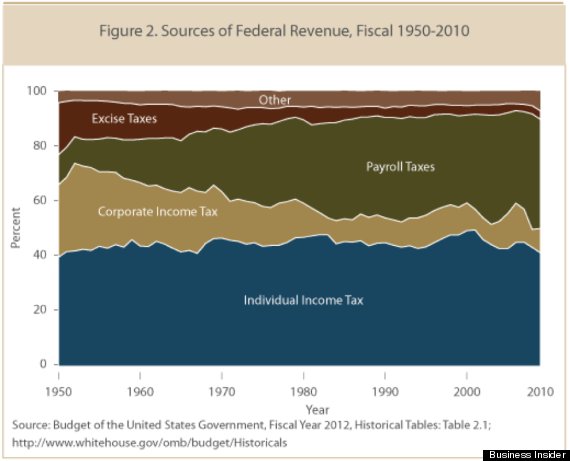
Apple CEO Tim Cook waved a magic wand in front of America on Tuesday, vanishing our outrage over how shamelessly companies avoid paying taxes, leaving the rest of us to foot the bill. As a public service to you, here is a chart that should enrage you about corporate tax rates all over again! (Story continues below chart of RAGE.)
federal revenue
Notice the beige stripe that is shrinking steadily? That stripe is the percentage corporate taxes contribute to total federal revenue. And notice the olive-green stripe that has swollen to be larger than the beige stripe used to be? That is the contribution of payroll taxes to federal revenue.
What this shows is how dramatically corporate tax contributions have shrunk in the past several decades, and how our personal taxes have risen to fill the gap. Payroll taxes now make up 35 percent of all federal government tax receipts, up from 11 percent in 1950. Corporate income taxes, meanwhile, now make up less than 10 percent of federal revenue, down from about 26 percent in 1950.
To 'splain those numbers a little more clearly: We who are on the payrolls of companies now bear way more of a tax burden than those companies bore decades ago. Those companies, meanwhile, bear less of a burden than we ever did.
And this doesn't include individual income tax, which accounts for about 46 percent of total federal tax receipts, roughly the same as 60 years ago.
Update: This chart of course does not reflect the fact that employers typically cover half of the payroll taxes collected by the government. Assuming companies pay half of the payroll taxes in this chart, the total tax burden for individual Americans is reduced to about 63 percent of total federal revenue, instead of 81 percent, as I estimated in an earlier version of this story. But that is up from about 45 percent in 1950.
And the total corporate contribution to federal revenue, including employers' share of payroll taxes, has dwindled from 32 percent in 1950 to about 17 percent today. Employer contributions to payroll taxes make the unfairness of the tax code slightly less unfair, but the trend is still clear and dramatic: Corporations are paying a lot less than they used to.
This chart was produced for aSeptember 2012 report (download-y PDF file) about corporate tax avoidance by the Senate Permanent Subcommittee on Investigations. Walter Hickey of Business Insider helpfully republished the chart on Tuesday, in honor of Cook's testimony before the same subcommittee. Update: The Senate lifted the chart directly from an earlier Tax Policy Center report about the sources of government revenue.
Cook was there to techsplain how Apple holding $102 billion of cash offshore isn't really tax avoidance so much as good old fashioned ingenuity. Also, have you forgotten the shiny objects Apple makes (including the dreamy MacBook Air on which this here story was typed)? By the end of the hearing, Sen. Rand Paul (R-Ky.) had demanded that Congress apologize to Apple for the inconvenience, and Sen. John McCain (R-My Lawn) was reduced to gently jibing Cook about how often he has to update his apps.
And Rand Paul is kind of right, you guys, as is Tim Cook: We should not be so mad at Apple for doing what the law allows. We should be mad that the law allows Apple and other companies to keep billions of dollars of cash offshore and out of the government coffers, where it could be helping the unemployed and our crumbling infrastructure and such. Another thing we can get mad about is how the "corporate tax reform" that Cook and other corporate leaders are always banging on about will actually serve tomake it so companies pay even less in taxes than they do now.

Sunday, August 25, 2013

The Dissolution Of The West


Courtesy Of Global Research TV
Host: James Corbett
Guest: Paul Craig Roberts

From economic turmoil to social dissolution and cultural chaos, it can no longer be denied that the once-opulent West is on the brink of collapse. In his new book, respected economist and father of Reaganomics, Paul Craig Roberts, explores the roots of this crisis and where we are going from here. 

Wednesday, August 07, 2013

How Money Drives The ‘Cycle Of Tyranny’


In Order For The “Cycle Of Tyranny” To Exist, There Are 4 Key Institutions That Must Be Totally Co-Opted

By Jason Charles

This process can be termed the “Cycle of Tyranny” and is basically the method large institutions such as government, corporations, and banks participate in as a on going feed back loop that is totally driven by money and power.
This cycle is designed to centralize power, rob people of their liberties, wealth and ultimately dignity due to the very dehumanizing and egregious actions of the men who sell themselves to this system. In fact, this whole system thrives on the dehumanizing process and erosion of individual rights enshrined in the Constitution.
To achieve this effect in a society large amounts of money are infused at every layer of the targeted and co-opted institution to assure that typically good moral people are bribed and in continual defense of the corrupted institution. With out the money factor the internationalist system simply would not work because the incentive component with in the cycle would be removed. The ablity for banks to create money out of thin air is the driving force behind the “Cycle of Tyranny”. 

The Banks

“I believe that banking institutions are more dangerous to our liberties than standing armies.  Already they have raised up a moneyed aristocracy that has set the government at defiance. The issuing power should be taken from the banks and restored to the people, to whom it properly belongs.”  - Thomas Jefferson

The banking families of Europe have utilized a debt based system to centralize a vast empire of wealth and power over the course of hundreds of years. By lending governments and institutions money, it creates a state of perpetual dependence, the fear of losing the money source is how banks control and socially engineer these institutions to pliable agencies of the internationalists worldview. Money truly corrupts the hearts of man, as long as the money is flowing men will turn a blind eye to atrocities of all types. It is through the corrupting influence money has had on mankind we begin to see how money and it’s love is truly the engine in the “Cycle of Tyranny”.
Today’s America serves as a perfect model as to how the old banking families have been able to leverage their large financial capabilities into a free country in order to corrupt and take over all of the major institutions with in a society. America was founded on the Principles of Liberty which detested banking institutions to the point of war with England and the British monarchy.
The process begins with the establishment of a central bank, in America’s case the Federal Reserve in the year 1913. It is no coincidence that the American Industrial Revolution coincided with the founding of the Federal Reserve. What we termed the “Robber Barons” during the early 20th century like Rockefeller, Carnegie, Ford, J.P. Morgan were really no more than agents of the Federal Reserve and the European financial elite. These agents were lent massive sums of money through the banking apparatuses backed by the newly formed Federal Reserve. They then took over their respective sectors of society. For example, Rockefeller took the Pharmacological/Medical/Education and also Oil sector, while Carnegie took over the Steel and Railroads, J.P. Morgan served as a financial agent etc. etc.
All of these men became exceedingly wealthy because they were financed agents who built the mega corporations of today. It is these corporations that had an unfair advantage because they were specially trained, and groomed by the international elite for the sole purpose of building up all of America, with the long term plan of turning it back over to the globalists at a later date.
The bankers utilize the “Boom and Bust Cycle” of the economy to first “Boom”, or build up large corporations through influxes of capital that then creates large, businesses, property, inventions, and institutions. The bankers can then “Bust” the economy by drying up the lending credit suddenly to these reliant businesses and institutions. This sudden collapse in capital is called a “Depression” it is an orchestrated event planned by the central bank to purposely collapse companies into bankruptcy. Once bankrupt the bank can then buy up the company assets pennies on the dollar funneling these new assets to the share holders of the banks.
This “Boom and Bust” cycle is the verbatim tactic that our founding fathers warned us time and time again having seen this happen in European nations. They hated the bankers and fought tooth and nail to keep a central bank out of our country knowing their money is the moral ruin to everything America stood for.
One hundred years later we have forgot history and the bankers have utilized this system to create, crash then buy up resources and the wealth of nation in every country on the planet. This financial boom and bust is the mechanism of control they have used to enslave countries world wide in debt and are now bringing about their international global system called the New World Order. A banking order controlled by organizations such as the IMF, UN, and World Bank.

The Corporations

“I hope that we shall crush in its birth the aristocracy of our monied corporations, which dare already to challenge our government to a trial of strength, and bid defiance to the laws of our country.” -Thomas Jefferson
 
The companies that have been built up by the lending power of the central banks are controlled and sustained through bank capital and the drive of the share holders whose only motive is profit. This creates an amoral environment where everybody from the CEO down to the mail-room clerk are chasing dollar signs at every turn. Their only concern is how they can make more profit.
They do this by a variety of ways, they will cheapen the quality of their product, they will identify populations with low standards of living and human rights to exploit for little to no wages, they will also lobby government to create laws and regulations that favor them and harm their competition.
Through this process, of receiving unfair financial lending advantage, reducing ethics with in the institution, and creating fascist partnerships with government, corporations that place money first almost always inevitable become so corrupt that they begin to create even more and more devious ways to assure the take over and monopolization of their host countries competition. They soon grow so large they begin to covet the resources and wealth of neighboring nations, which put’s them in a new strata of power called the multinational corporation.
It is much harder to employee these tactics on an international scale because without the protection of the target countries government, the unethical and dirty dealings almost always lead to war.
The people will never go to war for a corporation. The vast majority of people wish to live in peace and harmony with their neighbors, but corporations have insatiable need for control, power and money and have to find more and more dubious ways to push their corporation into other countries to keep the feeding cycle going.
This is where companies can then hire think tanks to devise devious, far reaching plans that allow them eventual access to the resources of other countries as well as their own when they come up against obstacles towards their agenda.

Think Tanks

“If ye love wealth better than liberty, the tranquility of servitude better than the animating contest of freedom, go home from us in peace. We ask not your counsels or arms. Crouch down and lick the hands which feed you. May your chains set lightly upon you, and may posterity forget that ye were our countrymen.” – Samuel Adams
 
Think tanks are made up of individuals who have been long time agents of the system. They are usually made up of very smart people who have bounced back and forth between corporate and government structures gaining reputation, influence and command over the intricacies of corporate, banking and government institutions.
Whether it be military, intelligence, financial, social, political or international needs a corporation can hire a wide variety of think tanks to create plans that utilize the various sectors of societal institutions to further the agenda of their client. Both governments and corporations hire these companies for large sums of money for the sole purpose of creating facilitating plans to push their agenda forward.
Now that America is a fascist state, it is very, very difficult to determine where the corporate objectives end and the governmental objectives begin, often times they are one in the same. The think tanks are able to utilize assets of both institutions by pulling together military, intelligence and corporate teams to formulate plans to access resources and strategic objects that are beneficial for the corporation, the government and also the banks.
This partnership is very dangerous for the general public and society at large and is often wrought with corruption and shadowy dealings that must be hidden through the cloud of top secrecy and clandestine operations. Tactics of extortion, racketeering, money laundering, assassination and other criminal activity are almost always considered in the think tank atmosphere. There are expensive ways and moral ways to gain access to resources or their are covert ways often touted as much cheaper but are ethically bankrupt and criminal to gain the desired access.
The more covert means always need cooperation and cover by the government through national security and official channels. The think tank will then utilize their influence and lobby and produce policy that impacts political parties towards their “prescribed” resolutions.
Often times it is the government or corporation that comes to the think tank saying we want to invade here or secure our corporation here, the think tank provides both the plan to create a facilitating event which is carried out covertly through sabotage campaigns, or false flag attacks, or stage bombings and then when the crisis reaches a climax it will lend it’s credibility and solution towards dealing with the crisis they created. This is called “Problem, Reaction, Solution”. They simply create the problem, the reaction is the politicians and public demand action and then they turn around and offer the solution of sending in their corporations or military towards resolution. A resolution that just so happens to give them full access strategically, militarily, and politically to a targeted nation.
A successful mission will given them the desired result every-time, enriching multinational corporations, banks and governments alike as they split up the loot and resources of taking over countries and conquering. A program as old as time itself.
Government comes into play to provide PR and official cover for these programs. Obviously war and invading nations is nasty business and the government has to be on board, that is why you always see politicians defaulting to the think tanks who write the policies as specialists and advisers on such things.

Government

“Government is not reason; it is not eloquent; it is force. Like fire, it is a dangerous servant and a fearful master.” – George Washington
The government is an institution charged with securing the liberties and security of their population. That is the sole reason for them to exist and is always formed through a unified agreement of the people towards this end.
The Declaration of the United States is a beautiful word picture of why governments are formed, who forms and empowers them which is the people, and when it is appropriate to disband them in favor of a new government body. The only proper way and time to disband a government is when it becomes so corrupt that it encroaches on the liberties, wealth and prosperity of the people. At that point the people have every right to nullify and succeed from corrupt government. Seeing it was them who formed the state they too can end the state.
Self-defense is a natural right of man, government is instituted to aid this natural right, but sometimes governments become so out of touch with the original charter they begin to infringe on the rights of the people to point of distress and ruin with in society. When this happens it no longer serves the interest of the people and must be opposed and resisted by force if necessary, why, because again self-defense of life and  the liberties of the people is a universal law that trumps all institutional agendas including government.
The people, if they through apathy allow government to get out of control, have a natural right to defend themselves against their own government that seeks their ruin. Nothing is more destructive than wicked government. Government, once taken over by politicians, corporate agents and banking controllers, history shows will act in the most dehumanizing, repulsive and tyrannical way possible. Instead of fulfilling their oath to the Constitution, they side with agents of the fascist system as it is taken over lock stock and barrel by the banking elite.
Why the government is such a powerful vehicle towards tyranny and oppression is because it has the power to tax the people to pay it’s debt to the banks i.e. IRS, it also is in control of standing armies which can be easily directed through manufactured crisis events either in the homeland or abroad wreaking havoc on society, and it also provides political and official cover for corporate and globalist agendas, agendas that are a determent to the people.
Tyrannical government has murdered, enslaved, imprisoned and bankrupted countless millions over the eons of human history. To allow it to get out of control is to invite destruction and destitution on a society.

Solutions

“Our Constitution was made only for a moral and religious people. It is wholly inadequate to the government of any other.” – John Adams
The solution to these things is morality. Our founders were quite clear that without an ethical, knowledgeable moral, and well informed population these institutions would most certainly gain control.
If you as a philosophical libertarian equate freedom and liberty with living excessive lifestyles you are totally off base. These things have nothing to do with liberty, the moral resolve of our founders who many of them lost it all in the revolution is about understanding. They understood that defending life is paramount to anything we can do on this planet. Those who refuse to defend life, seeing that it is scared and worthy of protection have no concept of what it means to walk in the principles our forefathers bequeathed us. It is they who have sold themselves to these systems and jeopardize everything our country is founded on.
We have identified the “Cycle of Tyranny” it is driven by money, but equally so it is driven by those who have lost sight of the sacred principles enshrined in our Constitution, these men and women who put money and power over the moral, foundational Principles of Liberty are our enemies and must be treated and prosecuted as such.

Wednesday, June 26, 2013

The Political 1% OF THE 1%


By The SunLight Foundation

The Sunlight Foundation took a look at the 2012 election and found that not a single candidate for federal office won without taking a donation from the 31,385 people who make up the top 1 percent of the top 1 percent of American politics. The median contribution from this group was $26,584 —  which is more than the median income of an average American family.

These top one percent of the one percenters are not representative of America, of course. They predominantly live in big cities and work for Fortune 500 companies. The minimum contribution to be in this group is $13,054 an election — and that number keeps growing.
3-one-percent-of-the-one-percent-minimum-donations-over-time

Sunlight argues that the Citizens United decision, which paved the way for unlimited donations to PACs, is behind the rise — though 87.5 percent did not donate to any PACs at all. Winning congressional candidates on average received more money from these 31,385 top donors (17.1 percent) than all of their small donors combined (13 percent).

Both major parties benefit from these uber-donors, though they do tend to favor Republicans.
7-the-one-percent-of-the-one-percent-and-partisanship
So why does this matter?

Lawrence Lessig says it makes for a “corruption” of our democracy, where only .5 percent of Americans truly have a say in how it works.


And there’s no better example of this than how we regulate Wall Street. Lessig writes:
The most important architectural feature of Dodd-Frank is that the most important regulations of Dodd-Frank were not actually in the bill. Instead, Dodd-Frank punted the guts of its potential reform to a multi-year regulatory process. Almost 400 rules were to be written by regulators (with the generous aid of lobbyists): a process, which five years after the crisis, has not yet come to an end.
It doesn’t take a PhD in game theory to understand what that design was about. By shifting the core of the regulations to a procedure stretched over years and dominated by bank lobbyists, the bankers could minimize the chance that this “change” would actually change anything real—and ensure that public and press attention would drift elsewhere as the new rules were worked out.
And that’s precisely what has happened.
Democrats eager to close the gap with those 31,385 top donors are eagerly listening to Wall Street’s advice when it comes to writing these regulations. And that’s music to the 1 percent of the 1 percent’s ears.

Saturday, June 22, 2013

Park Avenue: Money, Power and The American Dream


Courtesy Of Why Poverty?

How much inequality is too much? To find out more and get teaching resources linked to the film, go to www.whypoverty.net

740 Park Ave, New York City, is home to some of the wealthiest Americans. Across the Harlem River, 10 minutes to the north, is the other Park Avenue in South Bronx, where more than half the population needs food stamps and children are 20 times more likely to be killed. In the last 30 years, inequality has rocketed in the US -- the American Dream only applies to those with money to lobby politicians for friendly bills on Capitol Hill.

Director Alex Gibney
Producer Blair Foster
Produced by Jigsaw Productions 

Why Poverty? http://www.whypoverty.net/en/video/29/

Sunday, June 16, 2013

The One Percent


This 80-minute documentary focuses on the growing "wealth gap" in America, as seen through the eyes of filmmaker Jamie Johnson, a 27-year-old heir to the Johnson & Johnson pharmaceutical fortune. 

Johnson, who cut his film teeth at NYU and made the Emmy®-nominated 2003 HBO documentary Born Rich, here sets his sights on exploring the political, moral and emotional rationale that enables a tiny percentage of Americans - the one percent - to control nearly half the wealth of the entire United States. 

The film Includes interviews with Nicole Buffett, Bill Gates Sr., Adnan Khashoggi, Milton Friedman, Robert Reich, Ralph Nader and other luminaries.

http://www.theonepercentdocumentary.com/

Saturday, May 18, 2013

Canada Could See Indigenous Uprising


... According to a new report penned by a former Canadian military officer for the MacDonald Laurier Institute, a think-tank supported by corporate executives.

"For many Aboriginal people in Canada, but especially for First Nations women and children, life on-reserve is dreary, dark and dangerous," wrote Douglas Bland in the report, Canada and the first Nations: Cooperation or Conflict? "Social fractionalisation significantly increases the risk of social conflict. The phenomenon provides motives for an insurgency," read the report, issued in May.

"The Canadian right-wing establishment is seizing on this to justify its own agenda of stricter controls and the continued criminalisation of native people who defend their rights," Taiaiake Alfred, chair of the centre for indigenous governance at the University of Victoria, and one of Canada's most influential aboriginal intellectuals, told Al Jazeera. "The positive elements of Canadian society - progressive values and social justice - are founded on the ongoing injustice of land theft and murder of indigenous people."

In November, Paul Martin, Canada's former prime minister and a business tycoon, echoed Alfred's comments, albeit in a softer tone. "We have never admitted to ourselves that we were, and still are, a colonial power," he said.


One of the world's most developed countries, Canada is home to about 1.2 million indigenous people out of a population of 34.5 million. The indigenous population is rising faster than other demographic groups, despite drastically higher rates of poverty, incarceration and substance abuse.
If indigenous Canadians were ranked as a country according to the United Nations Human Development Index, which measures living standards and life expectancy, they would have social outcomes comparable to residents of Kazakhstan and Albania.
Across Canada's prairies, the heartland of the country's agricultural industry and a centre for mining, about 42 percent of the indigenous population will be under the age of 30 by 2016, more than twice the youth rate in the non-indigenous community.
"The fact that Canada's natural wealth flows unfairly from Aboriginal lands and peoples to non-Aboriginal Canadians is a long-standing and justifiable grievance," the report said.
A large number of poorly educated, unemployed young men - a "warrior cohort", as Bland put it - provide fertile recruits for militant groups, the report says.
Using a formula first developed by researchers at Oxford University, Bland argued that the "feasibility" of unrest, rather than just root causes, could determine outcomes. 
Most of Canada's resource industries, including mines, dams and oil facilities, are located on land claimed by indigenous people - and attacking such facilities is easily feasible, the report said.
Comprising about four percent of the population, indigenous people make up 23 percent of Canada's prisoners, a 43 percent increase during the five years prior to 2013, according to a government report released in March.


Saturday, May 11, 2013

Baby Go Boom


By Culture In Decline

 Episode #5 "Baby Go Boom!" by Peter Joseph - May 1st 2013

Subtitle Project: http://dotsub.com/view/0837813d-5220-...

In this installment of Peter Joseph's public access parody,the subject of Security and True Safety will be investigated. The evil terrorists are revealed to be at it again with a new airline scare; our Guy In A Tie reminds us of who is in control and a special award show finds a very special recipient in the Gun Control Debate..

Special guest appearances by Chad Fisher (Alex Jones) & Rick Overton.

www.chadfishercomedy.com

www.rickoverton.net

Please Subscribe to this Channel for future Episodes:
http://www.youtube.com/user/CultureIn...

About:
"Culture in Decline" is a satirical yet serious expression that challenges various cultural phenomena existing today which most of society seems to take for granted. Nothing is considered sacred in this Series except for a detached benchmark of fundamental logic and reason - forcing the viewer to step out of the box of "Normality" and to consider our societal practices without traditional baggage and biases. Common themes include Politics, Economics, Education, Security, Religion, Vanity, Governance, Media, Labor, Technology and other issues centric to our daily lives.

Website: http://www.cultureindecline.com/
Twitter: https://twitter.com/cultureindeclin
Facebook: http://www.facebook.com/CultureinDecline
YouTube Subscribe: http://www.youtube.com/user/CultureIn...
Mailing List: http://mailinglist.thezeitgeistmoveme...

Free DVD Torrents Download, Hi-Res QuickTime Torrent & Fully Sourced Text Transcript PDF are/will be found here:http://www.cultureindecline.com

*Sharing Terms:
Any re-upload of these fully copyright episodes must adhere to these terms:
1) Please do not re-upload within 3 days of the original publishing date.
2) Please do not allows advertisements.
3) Please source the channel [http://www.youtube.com/user/CultureIn...]
and the website at the very top of the description. [http://www.cultureindecline.com/]
Thank you.

Thursday, May 02, 2013

American Democracy Is A Corruption


How .05 Percent Of Our Population Have Bent Our Republic Into An Oligarchy

A vast majority of America wants spend money to create jobs while preserving our safety net and ending tax breaks on the rich and corporations to pay for it. Yet most of Congress wants to do the exact opposite.


How did our democracy get so broken? Of course, gerrymandering plays a role. But the truth is there are two elections taking place all the time: the general election and the money election. The money election is the one that really matters, and only .05 percent of country truly has a vote.

A tiny percentage of Americans have hijacked our country for their own purposes, according to Lawrence Lessig. This TED talk, “We the People, and the Republic we must reclaim” may make you feel a bit hopeless. But in the end, if we cannot see what we’ve become, there’s no hope of fixing it.

Saturday, March 09, 2013

How To Sell “Hard Choices”


The Origin of Bipartisanship and The Decline Of Democracy

By ALAN NASSER
Courtesy Of "CounterPunch"


In his State of the Union address president Obama told us that “We must make the hard choices to reduce the cost of health care and the size of our deficit.” We have learned to beware when elites talk of “hard” and “tough” choices. These terms are synonymous with ‘unpopular’, and those for whom life will be made hard and tough are never the ones selling the choices. Historically, in times of crisis the working population has been made into shock absorbers for the oligarchs, and the austere policies required -by the plutocrats-  to undo the effects of the crisis on elites have been put forward as bipartisan. The policies are alleged to be the product of no particular interest but represent a consensus shared by all participants in the political process. What is pressed upon the people is thus held to be beyond politics, determined by experts to be pragmatically necessary.
This general strategy was born in the period 1899 – 1907. There had been a series of failed attempts to address the problem of serial recessions and depressions that had plagued the formative years of nineteenth-century industrializing capitalism. Between 1867 and 1900 the economy experienced eight business cycles over 396 months. During this period the economy expanded during 199 months and contracted during 197. This stretch included three severe depressions, from 1873-1879 (the longest contraction in US history), 1883-1885 and 1893-1897. The captains of business understood that this period of serial bankruptcies and chronic instability was the inevitable result of cutthroat competition, which drove prices into a downward spiral to the level at which capitalists were unable to cover their huge fixed costs. Many of the most prominent businessmen of the time, including JP Morgan and Andrew Carnegie, came to understand that combination, consolidation and merger were essential to protecting their interests by muting competition and administering markets and prices. Coordination trumped competition when the interests of the ruling class were at stake. It was common to hear and read corporate heads and attorneys trashing the going ideology of unmitigated competition as a fool’s fairy tale. A way was sought  -in vain, as we shall see-  for private business to get its house in order on its own.
The business barons attempted a series of combinations, from “gentlemen’s agreements” to the pool and the trust. None of these efforts bore fruit: the individualism endogenous to capitalism led parties to these consolidations repeatedly to break their agreements. Finally, from 1898 to 1902, businessmen resorted to an unprecedent wave of corporate mergers, in which the absorbed companies lost their independent legal and business identities. The opportunity for parties to intercorporate agreements to break their agreement was eliminated. But now competition took new forms, the most effective of which was the entry into key industries of smaller newcomers with smaller fixed-cost debt obligations and the ability to compete… by price cutting! Fratricidal competition was once again, in spite of all the efforts available to business to eliminate it, threatening to undo the ascendancy of the biggest giants.
The situation was grave. The market share of the leading behemoths  -US Steel, Standard Oil, International Harvester, Anaconda Copper and the American Can Company- actually fell during the first two decades of the twentieth century. Only about half of the large enterprises formed by combination between the late 1880s and 1906 survived. Iron Age, the steel industry magazine, wrote in 1909 that “So large a part of the current business has been going to those who were either willing or compelled to make lower prices that the situation finally became unendurable.”
All the private methods of eliminating competition had failed to effect the stable market environment sought by the consolidators. A hitherto untried strategy needed to be found that would successfully address the problem of destructive competition that private capital by itself was powerless to fix.
The forty to fifty year persistence, in spite of every strategy available tothe private sector, of recessions, depressions, bankruptcies and cutthroat competition constituted the first major crisis threatening US capitalism as a system. When attainable strategies failed to produce stability, businessmen concluded that not only did capitalism preclude automaticmarket self-regulation, it also resisted any private efforts to render the system sufficiently dependable to enable investors to expect profits with the desired confidence. Big capital came to recognize that the only effective alternative was political intervention in the form of government regulation.
The rhetoric of the business community since the New Deal has been replete with ritual denunciations of government regulation of the private economy. These tirades are always aimed at government intervention intended to protect working people from the vicissitudes of the market. When the interests of capital are jeopardized, business does not hesitate to seek government succor. In the period of industrialization, prominent businessmen evidenced no reservations in their desire for government intervention to regulate and stabilize an economy otherwise insufficiently responsive to the needs of capital. In effect, these captains of industry recognized chronic recessions and depressions, with their retarding effects on the growth of output, productivity and profits, as at bottom apolitical problem demanding a political solution. Thus was born what the historian Gabriel Kolko has called “political capitalism”, namely business elite support for the “utilization of political outlets to attain conditions of stability, predictability, and security  -to attain rationalizatiuon-  in the economy.”
Referring of the destructive effects of persistent cutthroat competition Andrew Carnegie wrote: “it always comes back to me that Government control, and that alone, will properly solve the problem.” Business leaders were clear that it was federal government regulation they were after. State and local laws were disparate; production for a national market required the uniformity that only federal authority could produce. Between 1899 and 1907 a consensus was formed among large-corporate capitalists, trade unionists and small producers advocating legislation establishing federal regulation of reasonable restraints of trade.
In 1899 the Chicago Civic Federation sponsored the Chicago Conference on Trusts, which promoted the acceptance of corporate bigness as a fait accompli, with the proviso that the power of these companies be curbed by government regulation. How exactly this was to be accomplished was a matter of intense dispute, as the conferees represented perspectives as heterogenous as laissez-fair capitalism, Marxian socialism and single-tax populism.Concord was in effect ruled out from the start.Dissatisfied with the results, a group of delegates called a splinter conference four months later, the National Anti-Trust Conference, but the diversity of the delegates generated the same kind of schism that had doomed the earlier assemblage.
Unanimity was essential to the agenda of elites, who understood that the appearance of bipartisanship was most likely to encourage the mobilization of popular support for congressional action. Marshalling public opinion was especially challenging, since elites aimed to persuade a public largely hostile to the corpoprate giants to acquiesce in the incorporated firm as the dominant form of business enterprise and large-corporate administration of markets. The elite hope was that the advocacy of a strong government regulatory role would dampen widespread suspicion of the giants.
With this in mind, the National Civic Federation organized the National Conference on Combinations and Trusts in October 1907. This time, agenda setting and delegate selection were deliberately controlled. The 492 delegates included representatives of commercial, manufacturing, labor, agricultural and civic associations, presidents of prestigous universities, corporate officers and presidents of state bar associations, among others perceived as private elites. Deliberately excluded from the proceedings were the political elements though to have contributed disproportionately to the discord that had foiled the earlier meetings. Nationally prominent political leaders and U.S. senators and representatives were not invited.
The idea was to de-politicize the trust question. Oligarchic power would be taken out of politics, thereby rendering democracy irrelevant to corporate priorities and national policy making. The recommendations of the Conference would be presented to the public and to Congress as nonpartisan, nonpolitical, representing the best thinking of the most expert and disinterested parties in the country.

The Conference was ultimately successful. Shortly after the Conference concluded, Andrew Carnegie averred that “it always comes back to me that Government control, and that alone, will properly solve the problem [of economic instability wrought by destructive competition].” As a leading authority on the origins of railroad regulation wrote:
“When these efforts [of private business to cooperate in rate setting] failed, as they inevitably did, the railroad men turned to political solutions to [stabilize] their increasingly chaotic industry. They advocated measures designed to bring under control those railroads within their own ranks that refused to conform to voluntary compacts. … [F]rom the beginning of the 20th century until at least the initiation of World War I, the railroad industry resorted primarily to political alternatives and gave up the abortive efforts to put its own house in order by relying on voluntary cooperation. … Insofar as the railroad men did think about the larger theoretical implications of centralized federal regulation, they rejected … the entire notion of laissez-faire [and] most railroad leaders increasingly relied on a Hamiltonian conception of the national government.” (Gabriel Kolko, Railroads and Regulation, Princeton, 1965, pp. 3-5)

The history and the basic rationale of the business movement for federal regulation assured that government would remain subordinate to business domination. The fact of “regulatory capture”, the domination of the regulatory agencies by executives of the firms supposed to be regulated, was built into the regulatory regime from the start. Regulation in the first decade of the twentieth century was openly welcomed by the regulated interests in nearly every case.Upton Sinclair, perhaps the leading public intellectual of the time,  wrote of the meat industry, “the federal inspection of meat was historically established at the packers’ request. … It is maintained and paid for by the people of the United States for the benefit of the packers.” Representing the large Chicago packers, Thomas E. Wilson  publicly announced: “We are now and have always been in favor of the extension of the inspection.”

The silliness of the conceit that these rescue efforts were beyond politics is underscored by their depending entirely on government regulation to enforce agreements that capital left to its own devices was unable to implement. This was an epochal consciousness raising for big capital. Government involvement in the accumulation process was inescapable, and was to be secured only by deliberate class-concerted mobilization aimed at securing the state for the interests of big business. Capital learned this lesson well. When the New Deal was perceived by the most influential businessmen to place workers’ interests at the center of the state’s agenda, they attempted to organize a coup to replace FDR with a business-military coalition. When the New Deal-Great Society period 1949 – 1973 evidenced an influential labor movement, several large-scale labor actions and the first and only 40-year downward distribution of income from the top 1 percent to the rest in the nation’s history, elites perceived this as a major crisis and mobilized in the mid-1970s to sieze control of the state in order to undo the social programs and business regulations of the Golden Age, paving the way for the neoliberal macroeconomic reconfiguration superintended by Reagan, Clinton, Bushpere, Bush fils and Obama.
Both the 2008 bailout of finance capital and the ongoing project of doing away with government functions designed to promote the interests of workers and regulate business were put forward as above partisan politics and as requiring for their implementation governmental action. In both cases elite command of the state was demanded lest the economy collapse and government be shut down. Since the establishment early in the twentieth century of corporate oligopoly capitalism as the nation’s settled economic formation, corporate elites have identified two key elements of class power: mobilization and control of the State. Individual efforts are never sufficient to secure interests that are essentially class-bound. Private collective efforts are indeed necessary, but never sufficient to safeguard class interests. That goal is a political one, and as such requires underwriting by the State, and that won’t happen absent control of the State.
John Kenneth Galbraith argued, in American Capitalism (1956), that as the economy grows, its crises become increasingly severe and government remedial action greater in scope. We may draw the appropriate conclusion: increasingly harsh crises will prompt the owning class to demand increasing control of the State. Let’s not mince words. We are talking about the creeping  -now galloping-  privatization of the State. In fact, domestic policy is now entirely shaped by Timothy Geithner and Ben Bernanke.
The masters of capital have taught the working class a priceless lesson. You will not get what you want unless you mobilize in order to capture State power, i.e. power to turn the State into one whose dominant objective is to further the interests of the working population. It’s not impossible; it only looks that way.
CODA
That the two major constituent classes of a capitalist economy must establish an alliance with the State in order to secure their interests goes farther back than is indicated in this article and is as inherent a feature of capitalism as the compulsion to increase profits and the wage labor relationship. In a footnote in Capital (volume III, p. 270, International Publishers) Marx comments on the 1863 testimony of Josiah Wedgewood, of uptown pottery fame, urging Parliament’s Children’s Employment Commission to effect “some legislative enactment” to limit the working hours of children. In an uncommon philanthropic gesture, Wedgewood sought to gain consensus among competing potters to treat child labor less severely. He implored the Commission: “Much as we deplore the evils before mentioned, it would not be possible to prevent them by any scheme of agreement between the manufacturers… Taking all these points into consideration, we have come to the conviction that some legislative enactment is wanted.”