Showing posts with label The Vatican. Show all posts

Friday, October 31, 2014

The Islamic Army Of Frederick II

Archeologists and historians are shedding new light on how medieval Holy Roman emperor Frederick II created an Islamic army to attack the pope. The German Historical Institute in Rome – together with universities of Foggia (Italy), Trier and Kiel (both in Germany) are investigating the southern Italian city of Lucera which, in the 13th century, was a major centre of Islamic culture and learning – and the cause of considerable papal anger.

The story started in 1222 when emperor Frederick II, faced with a Muslim rebellion in Sicily, started deporting Sicilian Muslims to the Lucera area of south-east Italy. By 1244, he had transferred up to 20,000 people – virtually entire Muslim population of Sicily. However, in order to keep the deportees loyal, he treated them well in their new homes and allowed mosques and an Islamic university to be built, and gave them land.
Holy Emperor Frederick II
The pope – just 130 miles to the north-west – was furious and declared Frederick a heretic.  Soon war was raging between emperor and pope – and Frederick used his muslim Sicilian deportees as a purpose – made army to secure initial victory. Indeed it is probable that creating a Muslim army against the pope had been the ulterior motive behind the deportation in the first place.
Frederick II ‘s court in Palermo, Sicily
The investigations so far suggest that Frederick settled his Sicilian Muslims in and around the city of Lucera – not inside town’s vast castle as had been thought until now. Settling them around the city would almost certainly have necessitated the forced removal of some of the pre-existing Christian communities, including the local bishop – a process which angered the pope still further.
Source: History Notes

Sunday, June 08, 2014

Islamic Prayers To Be Held At Vatican

For the first time in history, Islamic prayers and readings from the Quran will be heard at the Vatican on Sunday, in a move by Pope Francis to usher in peace between Israelis and Palestinians.
Francis issued the invitation to Israeli President Shimon Peres and Palestinian Authority President Mahmoud Abbas during his visit last week to Jordan, Israel, and the Palestinian Authority.
Abbas, Peres, and Francis will be joined by Jewish, Christian and Islamic religious leaders, a statement released by Peres’s spokesperson said, according to the Times of Israel.
Holy See officials on Friday said the evening prayers would be a “pause in politics” and had no political aim other than to rekindle the desire for Israeli-Palestinian peace at the political and popular level, according to the Associated Press.
And from the Times of Israel…
President Shimon Peres will head to the Vatican on Sunday to participate in an interfaith peace prayer event at the invitation of Pope Francis.
Francis issued the invitation to Peres and Palestinian Authority President Mahmoud Abbas during his visit last week to Jordan, Israel, and the Palestinian Authority.
According to a statement released by Peres’s spokesperson, Abbas, Peres, and Francis will be joined by Jewish, Christian and Islamic religious leaders.
The event will feature readings about peace by the clergy from the Tanach, the New Testament and the Quran. Francis will then read religious verses with Peres and Abbas, which the three will have selected for the ceremony.
Israel’s delegation, which the Chief Rabbinate helped to select, will include members of the local Jewish, Druze and Muslim communities.
Vatican Radio) At a press conference in the Vatican on Friday, the head of the Holy See’s press office, Fr Federico Lombardi, and the Franciscan Custos of the Holy Land, Fr Pierbattista Pizzaballa, announced details of a prayer encounter to be held on Sunday with the presidents of Israel and Palestine. Also attending the event will be the spiritual leader of the Orthodox world, Ecumenical Patriarch Bartholomew of Constantinople.
Pope Francis invited Israeli President Shimon Peres and Palestinian President Mahmoud Abbas to the encounter on May 25th during his brief but intense visit to the Holy Land.
“Building peace is difficult, but living without peace is a constant torment.” Those were Pope Francis’ words to the Israeli and Palestinian presidents when he invited them to come to the Vatican to join him in “heartfelt prayer to God for the gift of peace.” Both leaders immediately accepted that invitation and will be arriving in the Vatican around 6.30pm on Sunday evening, accompanied by delegations of about 20 people representing the different faith communities present in both states. Also taking part in the Vatican delegation will be the Orthodox Patriarch who played such a central role in the Pope’s recent pilgrimage to Jerusalem to recall a similar encounter between their predecessors exactly half a century ago.
Following a brief welcome in the Casa Santa Marta where he lives, Pope Francis will accompany the two presidents and the patriarch through the Vatican gardens to a specially prepared venue surrounded by two tall hedges between the Pontifical Academy of Sciences building and a wing of the Vatican museums.
Fr Lombardi explained that each faith community will present a piece of music, then thank God for the gift of creation, ask forgiveness for sins committed and pray for the gift of peace. 

Pope Francis and the two presidents will add their own calls for peace in the region, before exchanging greetings, planting an olive tree as a visible symbol of their desire for an end to the conflict and sharing a moment of private conversation together.

Answering journalists’ questions about the aim of the encounter, Fr Pizzaballa said it is a purely religious event designed to provide space for people to stand back from the conflict and “recreate a desire for change”. While the meeting will not lead to any overnight solutions to the complex problems of the Middle East, Fr Pizzaballa said he hoped it might just reopen a path of dialogue and allow people to dream of a world where peace really is possible.

(From archive of Vatican Radio)

Friday, December 20, 2013

Sunday, June 30, 2013

The Vatican: A Holy Roman Empire?


Empire travels to Rome, the spiritual home of the world’s oldest Christian denomination to reveal, on deeper examination, a more complex picture of a faith in flux and a church at a crossroads.

Whilst its following may be growing in new territories, the traditional Catholic heartlands of Europe and the Americas have seen significant reductions in numbers of church-goers.

The rise of secularism, the resurgence of Protestant and Evangelical churches and the self-inflicted scourge of sex-abuse scandals and charges of mismanagement, have damaged Catholicism’s credibility and diminished its membership.

As the Catholic Church faces new and old challenges - both internal and external - Empire asks: What can Pope Francis, the first from the global South, do to stem the bleed of devotees in the West? And will he seek to reform and modernise or will he maintain ‘business as usual’?

In the coming and going between the faithful and the faithless, we examine how the battle for hearts, minds and souls, is more than just a numbers game.

Joining us in Vatican City to discuss the present issues and future direction for the Roman Catholic Church are: Marco Tosatti, writer for La Stampa, and author of several books on religion, including John Paul II: Portrait of a Pontiff; Father Norman Tanner, a Jesuit Priest, and author of New Short History of the Catholic Church; and Marco Politi, a journalist and author of Joseph Ratzinger - Crisis of a Papacy.

Thursday, April 12, 2012

The Doctrine Of Intervention


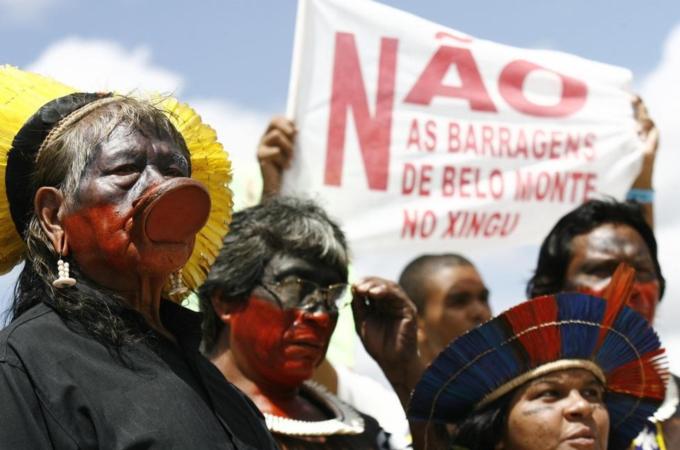
Indigenous populations in Brazil were completely bypassed by the construction of the Belo Monte dam [REUTERS]


Today's Political Ethics Are Surprisingly Similar To The Doctrine Of Discovery Set By The Vatican Back In 1452.

By Manuela Picq
Last Modified: 04 Apr 2012 12:45
Courtesy Of "Al-Jazeera"


New York, NY - One does not think of archaic papal bulls when witnessing democratic states like Brazil or the United States building dams on Amazon rivers or drilling for oil in the Arctic Ocean. Yet today's political ethics are surprisingly similar to the doctrine of discovery set by the Vatican back in 1452.

Fifteenth-century papal bulls that declared war against all non-Christian peoples also encouraged the conquest and exploitation of enemy territories throughout the world. European explorers like Columbus took possession of newly "discovered" non-Christian lands with the express authorisation of the Catholic Church.

This internationally recognised doctrine allowed claims to be made on "empty" invaded lands outlasted European absolute monarchies and has become enshrined in secular nation-states. In the US, for instance, Chief Justice John Marshall used the right of discovery in 1823 to invalidate native claims over their land and to assert the authority of the US government over land titles.

The World Council of Churches (WCC) recently disowned the doctrine of discovery, perhaps in light of its centrality at the 11th session of the UN Permanent Forum on Indigenous Issues this coming May in New York. Better late than never.


Inside Story Americas - The real cost of Brazil's dam
Yet from the Amazon to Iraq, policies still attempt to save the barbarians from themselves, export the truth of democracy or teach natives how to best preserve their own habitat. The problem is that the doctrine justifying the conquest and exploitation of certain states survived colonial times to evolve into a broader - and more resilient - self-arrogated right of intervention.

Rejecting The Doctrine Of Discovery

In February, the WCC issued a statement denouncing the doctrine used to colonise the Americas and enslave native populations as a violation of human rights. 

Affirming the rights of indigenous peoples to live in and retain their traditional lands as well as enrich their ancestral cultures, the WCC now urges governments to dismantle the legal structures and policies based on the doctrine of discovery and dominance so as to enable indigenous peoples to identify their own aspirations and pursue their own concerns.

The WCC specifically identifies the role of the Catholic Church in establishing a doctrine that justified the conquest and acquisition of indigenous territories, repelling documents such as Dum Diversas (1452) that called for the enslavement of non-Christian peoples, the seizure of their possessions and the occupation of their lands.

At last, churches have formally spurned any moral or legal right to seize indigenous land or dominate indigenous peoples. Identifying its historical significance, they framed the doctrine of discovery as the legal precedent that permitted continuous appropriation and resulted in the current extent of indigenous exploitation. 

The WCC statement is relevant because it explicitly recognises that the concepts that emerged five centuries ago forged a paradigm of domination that is still deployed against indigenous peoples today.

Whose Right To Intervene?

The doctrine of discovery remains a contemporary political challenge because it paved the way for the principle of intervention. Peoples and territories that were not Christian were treated as empty, un-modern spaces, up for grabs and improvement.

Since the Americas were conceptualised as terra nullis to justify colonisation, conquest became embedded in a discourse of civilising universalism, in which those claiming to hold the truth self-righteously bestow upon themselves the right to intervene against the barbarians.

Immanuel Wallerstein traces this rhetoric of power all the way back to the 16th century Valladolid Debate between Bartolome de Las Casas and Juan Gines de Sepulveda on the status of natives. Sepulveda derived the right of European monarchies to dominion from the inherent barbarity of the Amerindians. He defended intervention to protect natives from themselves, from their own harmful practices.

De Las Casas, in contrast, maintained that evil occurred everywhere and was not unique to Amerindians, denying justification for their subjugation, which could cause far more harm than good. The debate, which was left unresolved, continues in modified form today, for instance in controversies about Iraq, where the violence of war was trivialised by supporters of a military intervention destined to bring democracy.

The doctrine of intervention has a long, enduring history, one in which universalism is prone to colonialising tactics and modernisation all too frequently overlaps with westernisation. The "barbarians" may be Amerindians in 1551 or Muslims in 2001.

From Valladolid to Iraq, the same discourse seeks to justify appropriation in the name of universal truths. The doctrine of discovery faded only to give way to a doctrine of intervention, determining who intervenes, for what cause and with what legitimacy. The justificatory rationale changes - from Christianity to development and human rights - leaving the right to intervene unaltered.


Australians push for Aborigine recognition
The discourse that rationalised the colonisation of the Americas in the sake of Christianity is the same that justifies protecting human rights in Iraq or privatising water supplies for the sake of development.

Indigenous Tutelage

Intervention remains particularly strong when it comes to indigenous peoples and territories. Large-scale mining continues to engender human abuse and resource appropriation by multinational corporations across the Andes and Central America, perpetuating the pillage Spanish colonisers started centuries ago in Potosi. In the Amazon, governments and corporations alike take possession of "empty" lands to drill for oil in the name of development and national interest.

Latin American governments rhetorically insist on a foreign policy of non-intervention, yet are quick to intervene on indigenous territories to modernise the state. From the TIPNIS highway in Bolivia to the Belo Monte dam in Brazil, governments continue to bypass indigenous consultation and autonomies for the sake of national development.

The priorities of indigenous peoples are silenced in Chile, while their agency is dismissed in Ecuador, where massive indigenous mobilisations are dismissed as being manipulated by international interests. In Brazil, the government's self-congratulatory tone for bringing a woman to direct the National Foundation of the Indian (FUNAI) seems to ignore its failure to appoint an indigenous person.

The idea that natives are un-modern, almost part of nature, and therefore unable to manage their own land continues to lead to "well-intentioned" intervention as well. When indigenous territories in the Arctic or the Amazon are not conceptualised as empty spaces to be exploited for national development, it is the turn of conservationists to intervene in the name of nature.

When parks such as Yellowstone were founded, conservationists like John Muir promoted the idea that the land had not been previously trodden upon, pushing out people who actively lived and fed on those lands to "protect" nature. Today, it is the turn of powerful conservationists groups in the global north to intervene by buying big chunks of land and pushing populations out.

The UN system itself may perpetuate forms of tutelage. On February 21, the Indigenous Forum at the World Intellectual Property Organisation unanimously decided to withdraw from discussions on the draft treaty relating to genetic resources in response to consistent efforts to undermine indigenous inclusion within the process. 

How equitable can a treaty be that ostensibly holds indigenous interests as central but actually operates without significant indigenous decision-making? This unprecedented move calls into question the entire UN practice of incorporating indigenous voices in its deliberating process.

Dominant cultures continue to intervene in the autonomy of indigenous peoples. This continuum is proof that the doctrine of intervention did not die with formal processes of decolonisation, adapting to new zeitgeists like a chameleon.

The practice of conquest, more diverse than often assumed, needs to be reconceived as a global political challenge that concerns us all rather than as a mere cultural concern discussed in indigenous forums. It is the international system that is at stake. Universalism cannot be exported, much less imposed. It is a collective practice.

Manuela Picq has just completed a position as a visiting professor and research fellow at Amherst College. She is currently writing a book on indigenous peoples' rights in the Amazon.

Wednesday, December 07, 2011

Does The Church Have Any Weapons Left?

By Dallas Darling 
Courtesy Of "The World News Network"


When the Vatican proclaimed that it supported worldwide protests against economic inequalities, it was mindful of another scene that had unfolded around the first millennium in Europe. But first, the Catholic Church's Justice and Peace Department announced that businesses and state economies should always lead to the welfare and good of the people. While decreeing that people should demand a more equitable economic and social order, one that protests unemployment, homelessness and food shortages, the Catholic Church also issued a statement saying the economic and financial crisis which the world is going through calls everyone, individuals and peoples, to examine in depth the principles and the cultural and moral values at the bases of social coexistence. But how powerful and effective are such Church decrees, and do people really care about sacred judgments?

By the time Pope Gregory VII attempted to excommunicate (banishment from the Church) King Henry IV over appointing bishops and unmitigated acts of violence, the papacy and Church had become greatly weakened. Not only had militant and corrupt ideologies overtaken the Church from within, but from without surrounding feudalistic kingdoms were continually at war and causing enormous civil strife. 

Superstitious beliefs had replaced the more virtuous qualities of love, service, forgiveness, and mercy. 

Economic sharing and simplicity, including acts of charity, had been substituted with pagan rituals and traditions of avarice and revenge. Even Church weapons like the Peace and Truce of God did not prevent kings and nobles and knights from shedding blood during holy seasons nor plundering and killing innocent men, women and children.

Therefore, Pope Gregory excommunicated King Henry. He also placed German lands under interdiction (sacraments or signs of God's grace and salvation were no longer effective). Concerned that German kingdoms would rebel against his authority, King Henry traveled to Canossa. According to Pope Gregory, "having laid aside all the belongings of royalty, wretchedly, with bare feet and clad in wool," he (King Henry) stood before the castle gates of Canossa for three days with many tears imploring mercy." Even though Pope Gregory grudgingly forgave King Henry, King Henry never forgave the Pope. Seven years later, King Henry marched into Canossa and disposed of Pope Gregory. This conflict between the sacred and mundane, Canon and Secular Law, and Church and State, would continually reoccur over the centuries.

After Pope Gregory's attempt for a new kind of "libertas ecclesiae," Pope Urban II, out of desperation, used the weapon of a "just" and holy war. He declared a unholy crusade against Muslims and pagans to try and conquer Jerusalem. He was fearful of a burgeoning population, ongoing wars between rival kingdoms, and a declining Church. He wanted to also assist Byzantium's emperor who had requested military assistance. But the crusades did not liberate the Church, neither did it unite Europe. While future crusades turned inwards leading to horrific inquisitions, they would also justify forced conversions and the death of millions throughout Africa, Asia an the Americas. Meanwhile, some merchants grew rich from the ongoing wars against Muslims. The looting of Constantinople and innovations from the House of Wisdom merely fueled the "idolatry of European markets."

Like modern neo-liberal and secularized economies, backed by trans-national corporations, the Church itself experienced "selfishness, collective greed and hoarding of goods on a great scale." The accumulation of Church relics (sacred objects and material remains thought to have belonged to Jesus and his disciples) were advertised as a way to gain supernatural powers and bring about prosperity. Not only did the imperial Church try to monopolize Jesus' True Cross and Holy Sepulcher, but street preachers and vendors peddled bodily parts belonging to saints or anything connected to their early ministries. Even disposable items like teeth, hair, nail clippings, Jesus' sandals and traces of his blood, and milk from the Virgin's breast, could be bought and sold. Since the "idolatry of the market" promised holy and untapped powers, crusaders could never have enough relics.

As the Church wonders if it has any powerful weapons left in its holy arsenal of faith, and as it grapples with monopolizing God's grace and salvation through excommunication, interdiction, just wars, and holy relics, it might want to remember there are other, probably more effective, weapons. The greatest of these, of course, are love, forgiveness, justice, and acts of mercy and charity. Proclaiming the Historical Jesus, the one who overturned the money changers' tables in the temple and then chased them out, not to mention Jesus' civil disobedience and nonviolent direct action campaigns against Imperial Rome, are also powerful weapons to speak about and too live. The Historical Cross, the one that evoked fear and terror because it symbolized what would happen if one challenged the Peace of Rome and its economic exploitation, is really the True Cross and should be embraced.

Jesus did not announce or live the Holy Sepulcher, but instead he announced and lived the Kingdom of God. It was not a Kingdom based on feudalism and usury and war, but a Kingdom that would topple the rich and mighty rulers. One that would be where the greatest would be the servant of all. And it would be Kingdom signaling the beginning of God's action against evil in history, including militarism and retaliatory violence and foreign occupiers. Instead of seeking the Holy Sepulcher, pilgrims should pursue sharing food with the hungry, providing drink for the thirsty, welcoming the stranger, caring for the sick, visiting those in prison for their faiths and due to economic injustices, and clothing the naked. These are the real and more powerful weapons of the Church. Such weapons bring about the great reversal that Jesus spoke about and lived.

This is how Jesus is vindicated, especially in the midst of neo-liberal economies that create "various forms of injustice, the negative effects that will follow on the social, political and economic level," and that "...create a climate of growing hostility and even violence, and ultimately undermine the very foundations of democratic institutions." Along with urging Wall Street powerbrokers to examine the impact of their decisions on humanity, those in the Church should reevaluate their own actions and how they influence others regarding "unequal and pre-existing balances of power that prevail over the weakest and poorest of the world." A "supranational authority" and worldwide "universal jurisdiction," one that guides economic and political policies, should first serve and help liberate the poor, actually the very same ones that Jesus came to serve and liberate.

The Church should also recognize the enormous void and severe divisions that now exist in the world due to secularized states and their unholy market economies. A delegation of Muslim, Christian, Jewish, and Druse religious leaders, that recently met in Israel, should serve as a paradigm. The Council of Religious Leaders, an interfaith group, promotes toleration and compassion in the midst of misguided democratically-imposed wars in the Middle East. The council also believes economic and political inequalities and conflicts are mainly caused by selfishness and personal motives and interests. Pope Benedict XVI reiterated the importance of interfaith dialogue and peace in "troubled times." To be truly authentic, the Church must remember to fashion ploughshares and not swords. To be truly effective, it must always reject and condemn the militancy and weapons of the state.

Dallas Darling (darling@wn.com)

(Note: All quotations are from a recent statement issued by the Catholic Church's Justice and Peace Department regarding the global economy.)

(Dallas Darling is the author of Politics 501: An A-Z Reading on Conscientious Political Thought and Action, Some Nations Above God: 52 Weekly Reflections On Modern-Day Imperialism, Militarism, And Consumerism in the Context of John's Apocalyptic Vision, and The Other Side Of Christianity: Reflections on Faith, Politics, Spirituality, History, and Peace. He is a correspondent for

Friday, October 28, 2011

“Ninos Rabados”: Spain’s Stolen Children


Manoli Pagador recalls her first-born child being taken away

Spanish society has been shaken by allegations of the theft and trafficking of thousands of babies by nuns, priests and doctors, which started under Franco and continued up to the 1990s.

By Katya Adler 
18 October 2011 
Last updated at 05:31 ET 
Courtesy Of "The BBC News"


Spain's Stolen Babies

  • How many? More than 900 cases are being investigated, but new cases are still coming to light - lawyers say the total could reach 300,000
  • How long? Over a period of 40-50 years, beginning under Franco, up to the 1990s
  • Who benefited? Initially the Fascists by bringing up the children of their enemies - later children were taken from parents judged to be morally or economically deficient and placed with approved Catholic, often childless, families
  • Why did it take so long to expose? The Church and medical profession are highly respected, and Spanish law does not require the biological mother's name on the birth certificate


I first met Manoli Pagador in Getafe, in a working-class suburb of Madrid. She was attending a meeting for people affected by the scandal Spaniards call "ninos robados" - stolen children.
She has three daughters and lots of grandchildren, but she has never got over the loss of her first-born - a son - nearly 40 years ago.
She had come to think she was crazy for believing he was alive, instead of dead and buried as hospital doctors had told her.
"Now," she said, gripping my hand tightly. "Look around the room at the other women here. All like me. The same background. The same experience. I'm not mad and my family finally believes me."
In 1971 Manoli, who was 23 at the time and not long married, gave birth to what she was told was a healthy baby boy, but he was immediately taken away for what were called routine tests.
Nine interminable hours passed. "Then, a nun, who was also a nurse, coldly informed me that my baby had died," she says.
They would not let her have her son's body, nor would they tell her when the funeral would be.
Did she not think to question the hospital staff?
"Doctors, nuns?" she says, almost in horror. "I couldn't accuse them of lying. This was Franco's Spain. A dictatorship. Even now we Spaniards tend not to question authority."
The scale of the baby trafficking was unknown until this year, when two men - Antonio Barroso and Juan Luis Moreno, childhood friends from a seaside town near Barcelona - discovered that they had been bought from a nun. Their parents weren't their real parents, and their life had been built on a lie.
Juan Luis Moreno discovered the truth when the man he had been brought to call "father" was on his deathbed.
"He said, 'I bought you from a priest in Zaragoza'. He said that Antonio had been bought as well."
The pair were hurt and angry. They say they felt like two dogs that had been bought at a pet shop. An adoption lawyer they turned to for advice said he came across cases like theirs all the time.
The pair went to the press and suddenly the story was everywhere. Mothers began to come forward across Spain with disturbingly similar stories.
'Approved Families'
After months of requests from the BBC, the Spanish government finally put forward Angel Nunez from the justice ministry to talk to me about Spain's stolen children.
Asked if babies were stolen, Mr Nunez replied: "Without a doubt".
"How many?" I asked.
"I don't dare to come up with figures," he answered carefully. "But from the volume of official investigations I dare to say there were many."
Lawyers believe that up to 300,000 babies were taken.
The practice of removing children from parents deemed "undesirable" and placing them with "approved" families, began in the 1930s under the dictator General Francisco Franco.
At that time, the motivation may have been ideological. But years later, it seemed to change - babies began to be taken from parents considered morally - or economically - deficient. It became a money-spinner, too.
The scandal is closely linked to the Catholic Church, which under Franco assumed a prominent role in Spain's social services including hospitals, schools and children's homes.
Nuns and priests compiled waiting lists of would-be adoptive parents, while doctors were said to have lied to mothers about the fate of their children.
The name of one doctor, Dr Eduardo Vela, has come up in a number of victim investigations.
In 1981, Civil Registry sources indicate that 70% of births at Dr Vela's San Ramon clinic in Madrid were registered as "mother unknown".
This was legal under Spanish law, and was meant to protect the anonymity of unmarried mothers. It is alleged that this was also widely used to cover up baby theft and trafficking.
Dr Vela stands accused of telling women their babies had died when they had not and handing over those newborn children to other couples for cash.
A Spanish magazine published photographs of a dead baby kept in a freezer at the San Ramon clinic, supposedly to show mothers that their child had died.
He refused to give the BBC an interview. But, by coincidence, I had recently given birth at a clinic he founded, so I was able to book an appointment with him.
We met at his private practice in his home in Madrid. The man painted as a monster in the Spanish media was old and smiley, but his smile soon disappeared when I confessed to being a journalist.
Dr Vela grabbed a metal crucifix which had been standing on his desk. He moved towards me brandishing it in my face. "Do you know what this is, Katya?" he said. "I have always acted in his name. Always for the good of the children and to protect the mothers. Enough."
Dr Vela insists he always acted within the law.
Empty Graves
After Franco's death in 1975, the major political parties agreed an amnesty to help smooth the transition to democracy.
But this amnesty law has never been repealed, so attempts to investigate Spain's baby trafficking as a national crime against humanity have been rejected by the country's judiciary and resisted by its politicians.
"Thirty-five years have passed since the death of the dictator… Evidently, we still have problems from the past. Social problems and personal or even cultural problems and the policy of this government has been trying to solve them," says the justice ministry's Angel Nunez.
The Spanish government's refusal to set up a national inquiry into the scandal has frustrated affected families, who in many cases are carrying out their own investigations, as best they can.
Babies' graves have been dug up across the country for DNA-testing. Some have revealed nothing but a pile of stones, while others have contained adult remains.
Spaniards have flocked to clinics to take DNA tests in the hope of reuniting their families.
The first few matches have now been made between so-called stolen children and their biological mothers. But there could potentially have already been so many more. Data protection laws prohibit DNA banks from sharing or cross-referencing data and the Spanish government has yet to fulfil its promise to set up a national DNA database.
Manoli Pagador is still tortured by the events of 40 years ago. She told me she has been taking medication ever since.
"You can't just say to yourself, I have to forget it and that's it.
"It's not something you forget, it's with you for the rest of your life."
Katya Adler investigates in This World: Spain's Stolen Babies on BBC Two at 2100BST on Tuesday 18 October and on Assignment on BBC World Service Radio on 3rd November. Watch (UK only) or listen online afterwards at the above links.


Monday, May 02, 2011

Vatican Inc.

People & Power Examines The Secretive World Of The Vatican's Bank.

Last Modified: 27 Apr 2011 09:48
Courtesy Of "Al-Jazeera"


Earlier this month, the Vatican, the sovereign papal state at the heart of Rome, introduced new rules to clean up its financial system.

At the heart of that system is the Vatican's own bank, the Institute of Religious Works (IOR).

Until now the IOR has operated with few of the regulations that govern the activities of banks in the wider world, with sometimes disturbing results.

In the 1980s it became involved in an infamous fraud scandal the Banco Ambrosiano affair which made global headlines when its chief, Roberrto Calvi, was found hanging from a bridge in London, a murder that has never been solved.

More recently Italian state prosecutors have been investigating allegations of money laundering at the IOR, freezing some accounts, seizing funds and putting its president under formal scrutiny.

Filmmakers Alessandro Righi and Emanuele Piano have been examining this latest chapter in the history of a notoriously secretive organisation.

Saturday, October 30, 2010

Vatican Calls For End Of Israeli Occupation Of Arab Lands

Thousands of families of all faiths lived in the Holy land prior to the establishment of Israel in the late 1940's.

By Tim King
Oct-23-2010 19:07
Courtesy Of "The Salem-News"


Cardinal John Patrick Foley
(SALEM, Ore.) - Awareness of Israel's ongoing aggressions against the native population of Palestine has led to a demand from the Vatican in Rome, that Israel accept U.N. resolutions and end its unlawful occupation of Arab lands.

The bishops are telling the Jewish state that it shouldn't use the Bible to justify "injustices"- viewed as genocide by a widening population, against the Palestinian people.

As we have explained many times in the past, Israel uses the religious philosophy called "Zionism" to justify their continual expansion of land over the past 63 years. The movement is based on the Biblical statement that "Jews inherit to the promised land".

The obvious problem is that thousands of families of all faiths lived in the Holy land prior to the establishment of Israel in the late 1940's.

To this day, mostly Arab families are literally tossed into the street and held back while their homes are bulldozed and the land prepared for new Israeli "settlements" which are colonies on Arab land.

Cardinal John Patrick Foley, Grand Master of the Equestrian Order of the Holy Sepulchre of Jerusalem, stated Friday:

As messengers of Christ's peace, I am convinced that all of us must pray and work for peace in the Middle East - especially for a just and lasting peace between Palestine and Israel and among their neighbors.
I am convinced that the continued tension between the Israelis and the Palestinians has contributed greatly to the turmoil in all of the Middle East and also to the growth of Islamic fundamentalism.
While many, including the Holy See, have suggested a two-state solution to the Israeli-Palestinian crisis, the more time passes, the more difficult such a solution becomes, as the building of Israeli settlements and Israeli-controlled infrastructure in East Jerusalem and in other parts of the West Bank make increasingly difficult the development of a viable and integral Palestinian state.
The Cardinal says Catholic schools play a large role in this part of the world, and they are not limited to Catholic membership. The efforts in this area and others are considerably well funded too.
Many have made pilgrimages to the Holy Land where they have visited not only the places made sacred by the life, death and resurrection of Jesus Christ but also the parishes, schools and hospitals which serve those we call the "living stones" - the Christian descendants of the original followers of Jesus Christ in that land we call ''holy''.
Since the Great Jubilee of the Year 2000, the Order of the Holy Sepulchre has sent more than $50 million to assist especia1ly the Latin Patriarchate of Jerusalem but also other Christian communities and institutions to survive and indeed excel in service to the entire community in the Holy Land.
According to Cardinal Foley, this level of generosity is important, but secondary to the development of an ever deeper spiritual life.
Years ago, I noted that the so-called five pillars of Islam really had their origins in Judaeo-Christian sources.
Jews, Christians and Moslems all believe in one God; we all practice frequent and, I hope, fervent prayer; we all, in different ways, practice fasting; we believe in and practice almsgiving; and we all seek to take part in pilgrimage - also to Jerusalem, a city sacred to Jews, Christians and Moslems.
May these common beliefs and practices be acknowledged and followed in the hope of greater mutual understanding and of reconciliation, peace and indeed love in that land which all of us, Jew, Christian and Moslem, are moved to call "holy".
Monsignor Pierre Burcher, Bishop of Reykjavïk - Iceland, recognizes the fragile political systems of the Middle east. His comments lead back to the never changing answer to the crisis; Israel must end its occupation of Palestine and therefore draw to a close the sixty plus years of deadly conflict.
The Bishops of the Northern Episcopal Conference (NEC), together with their Middle Eastern brothers and sisters, are aware that in addition to the difficult political situation and the confrontation with extremist Muslims, a difficult problem is also the emigration of Christians. This problem can only be resolved with the definitive solution of the Israeli-Palestinian conflict. The urgent moment of reconciliation and peace has arrived! The Christians of the Middle East, rather than flee the region, are especially necessary in this vital process of justice and peace. In fact, they have inherited the Christian mandate of forgiveness. Therefore it is not a question of their welcome in foreign lands but more their presence in the Middle East to safeguard a historical culture that is vital for the entire world. Peace is the urgent vocation of the Holy Land! Justice for the three monotheistic religions is that Jerusalem is open to all!
Bishop Burcher says Catholic Churches have been used by Catholic Christians as well as non-Catholics for their Divine Liturgy. He believes this too is a sign of practiced ecumenism that allows all faiths to coexist.

The notion of halting the occupation of Palestine should not be a political issue. People in the world are granted certain rights under the General Assembly of the United Nations Universal Declaration of Human Rights. These rules which are published online for all to see, do not allow the aggressive deadly policies Israel has exhibited increasingly in recent years.

Israel maintains separate laws for Jews and non-Jews, and even within the ranks of Judaism itself there is a great divide. Perhaps Israel will accept this suggestion, it remains to be seen. A quick perusal of Internet articles from Israel, groups like YNet and Jerusalem Post, have carried an article from the AP which was sent to Salem-News.com this morning, alerting us of this significant development.

The Vatican is serious about maintaining a Christian presence and outreach in the Middle east. Embracing the ecumenical movement to recognize and give credit to all monotheistic faiths, three days ago, for the first time ever, Vatican Radio began producing a webpage in Hebrew that features up-to-date information about the ongoing Special Synod of Bishops for the Middle East.

The work of Hana Bendcowsky - who is behind the Web page - "is to make quite sure 'that the Israeli public' be correctly and well-informed about Synod proceedings and the message of the Bishops with no margin for misunderstandings and controversy," World Jewish Congress reports.

On Friday the UN stated:

"The people of Gaza continue to suffer from the humanitarian consequences of the Israeli blockade of the area, despite the recent partial easing of the restrictions, a United Nations independent human rights expert said today.

"Israel imposed the blockade on Gaza, where some 1.5 million Palestinians live, over three years ago for what it called security reasons after Hamas ousted the Fatah movement in the Strip in 2007.

"'The situation in Gaza remains very serious from a humanitarian perspective. The blockade has been eased in some respects, but it has been maintained in other respects, and it continues to put the population there under great psychological and physical stress,' Richard Falk, the UN Special Rapporteur on the situation of human rights in the occupied Palestinian territories, told reporters at the UN Headquarters in New York."

It seems like the forces are working for the freedom of Palestine. Peace could exist in the world if the conflict can be resolved by ending the Israeli occupation of Arab lands.

Sources:

Vatican News Service
Universal Declaration of Human Rights - General Assembly of the United Nations
'The synod in Hebrew' Radio Vatican - World Jewish Congress

Tim King: Salem-News.com Editor and Writer

Tim King is a former U.S. Marine with twenty years of experience on the west coast as a television news producer, photojournalist, reporter and assignment editor. In addition to his role as a war correspondent, this Los Angeles native serves as Salem-News.com's Executive News Editor. Tim spent the winter of 2006/07 covering the war in Afghanistan, and he was in Iraq over the summer of 2008, reporting from the war while embedded with both the U.S. Army and the Marines.

Tim holds numerous awards for reporting, photography, writing and editing, including the Oregon AP Award for Spot News Photographer of the Year (2004), first place Electronic Media Award in Spot News, Las Vegas, (1998), Oregon AP Cooperation Award (1991); and several others including the 2005 Red Cross Good Neighborhood Award for reporting. Tim has several years of experience in network affiliate news TV stations, having worked as a reporter and photographer at NBC, ABC and FOX stations in Arizona, Nevada and Oregon. Serving the community in very real terms, Salem-News.com is the nation's only truly independent high traffic news Website. As News Editor, Tim among other things, is responsible for publishing the original content of 65 Salem-News.com writers. He reminds viewers that emails are easily missed and urges those trying to reach him, to please send a second email if the first goes unanswered. 

You can send Tim an email at this address: newsroom@salem-news.com